




Abstract
The Food and Agriculture Organization considers imports crucial to food security (FS) based on their inclusion in the FS definition. Given the broadening of the definition of FS to more than just food availability, the real impact of imports on FS is questionable. This article analyzes the effect of imports on FS in 56 lower-middle income countries from 2011 to 2016. Adopting the generalized method of moments technique, the estimation results point to the negative effects of imports on FS. The breakdown analysis for each dimension indicates that the level of food availability tends to be higher with imports. This could be why imports are considered part of FS measurement. However, the remaining three dimensions, level of food accessibility, utilization, and stability, do against imports. This could explain why the negative impacts of imports outweigh the positive ones in the net. This study indicates that the inclusion of imports in FS can help to secure stable food supplies and meet shortfalls in local production through a better import regulation system.
Introduction
Trade is an integral part of an effective international economic system and a major economic development catalyst. One of the essential components of trade is imports. Some fundamental reasons support the attractiveness of imports, such as adopting new and advanced production technologies. These enable domestic firms to diversify and specialize and provide an incentive for organizing production more efficiently (Gossel & Biekpe, 2014; Parteka & Tamberi, 2013). Hence, it potentially stimulates productivity and economic growth in the host country. 1 Besides, imports present opportunities for the host countries to meet their rising needs, such as better quality, greater diversity of products, and employment opportunities, thereby improving their welfare (Mazumdar, 2001; Mishra, 2012; Samuelson & Nordhaus, 2002). Nevertheless, imports may also bring some undesirable effects, such as imported inflation and crowding out the local producers (Junttila & Korhonen, 2012). Therefore, lower-middle income countries should concentrate on reducing import demand and focus more on the real need for desirable embedded technology (Mishra, 2012; Wall, 1968).
Imports often allow the countries to acquire goods and services that are not available domestically; a similar claim may be made for importing food. First, imports help secure stable food supplies, meet shortfalls in domestic production, and promote a more balanced diet through a larger variety of foods (Brooks & Matthews, 2015; Hanjra & Qureshi, 2010). Second, imports are also expected to bring greater availability of nutrient-rich, healthy, and safe foods. For instance, the United States is the leading supplier of commodities such as soybean, meat, dairy, sugar, fruits, vegetable, and nuts to China (Lam et al., 2013). These importations are causing changes in consumption patterns (high nutritional, protein, and calorie-dense food), reducing hunger, and improving food security (FS) in China. Therefore, imports are likely to solve food shortages in lower-middle income countries.
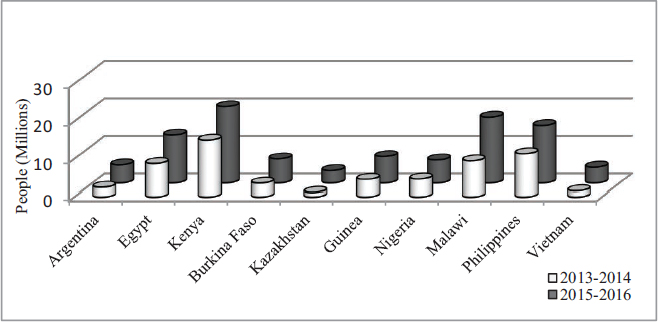
Figure 1 shows the number of severely food-insecure people in selected lower-middle income countries. They fall under low, moderate, and severe categories of hunger levels which have increased markedly over 2013–2016. In Kenya, a total of 17.3 million people in 2017 were suffering from hunger and did not have consistent access to nutritious and sufficient food to meet their dietary needs for an active and healthy life. Although Kenya’s major food imports include maize, wheat, rice, and sugar from South Africa, Italy, and the USA, the number of people suffering from hunger is still on the rise, and the target of achieving zero hunger is still a long way. The main reason being that an increase in imports has led to higher food prices ranging from 50% to 80%, thereby constraining the household’s purchasing power (FAO et al., 2018; International Food Policy Research Institute, 2018). This is likely to aggravate food insecurity in Kenya. Several other countries have also experienced the same such as Malawi, Egypt, Argentina, Burkina Faso, Kazakhstan, Guinea, Nigeria, the Philippines, and Vietnam, resulting in widespread food insecurity, food deficits, and calorie deficiency for the population (FAO et al., 2018). The enigma here is why imports cannot guarantee FS when a simple calculation can identify the volume of food needed to ensure everyone’s needs are met. We believe that the issue of FS is beyond mere importation issues. Imports certainly improve food supply or availability but may adversely affect food accessibility, utilization of healthy foods, and stability of supply in the long run. There are several explanations to justify the case. First, dependency on food imports may lead to food insecurity in many countries, particularly in lower-middle income countries, if imports crowd out the local producers and cause food inflation. According to Macdonald et al. (2015), implications may adversely affect the food supply if major exporters reduce or stop their food exports due to the imposition of export restrictions and export taxes on food items. This may aggravate the problem of food insecurity in importing countries. In Mauritania and Nigeria, around 136 million people are facing food deprivation since Thailand stopped its rice exports to these countries (Sagener, 2016). Consequently, this decrease in rice exports drives up rice prices and affects the consumers’ willingness to pay and affordability to obtain rice. Moreover, there have been growing concerns about the safety of imported foods. For example, international concerns over the safety of several products have damaged China’s export reputation, resulting in numerous security alerts and even bans on certain imports (Lam et al., 2013). The European Union blocked all imports of animal origin in 2002 due to veterinary drug residues on imports from China. In 2003, Japan also banned Chinese frozen spinach due to high levels of pesticide residues (Jia & Jukes, 2013).
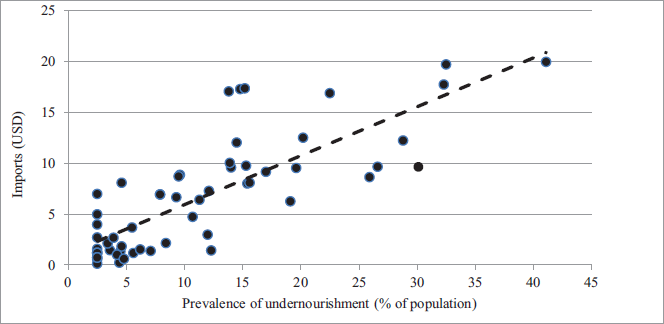
In short, imports will not necessarily guarantee FS as suggested by past studies. 2 Nigeria is one of the African countries that rely heavily on imports of grains, fish, and livestock products from Thailand but remains a food-insecure nation. Possibly a higher dependence on imported staples increases food prices and puts pressure on households’ purchasing power, thereby limiting the ability of poor people to access foods in general, including nutritious foods. To find further support, Figure 2 offers firsthand insight into the food-security-worsening import issue. It shows that increasing imports tend to increase food insecurity in lower-middle income countries. This simple correlation may hint that imports may not always ensure sufficient, healthy foods for all. Therefore, this study aims to investigate the dynamic impact of imports on FS in developing counties.
The rest of this article is organized as follows: the next section outlines the literature review, followed by a discussion on the panel data regression model. The subsequent section presents the empirical results and discussion. Finally, the conclusions are presented.
Literature Review
From a theoretical perspective, FS can be explained by the Malthusian theory, Food Availability Decline (FAD), and Food Entitlement Decline (FED). The first theory of research focuses on the Malthusian and Neo-Malthusian theories. They mainly focus on population growth and arable land, which can be a potential determining factor of FS (Malthus, 1798). According to the Malthusian, food insecurity exists due to the presence of too many people compared to the food supply. This research is supported by several researchers such as Brown (1981), Lutz et al. (2002), Faisal and Parveen (2004), Schneider et al. (2011), Godber and Wall (2014), Szabo (2016), and Tian et al. (2016). Their findings show that a rapid increase in population demands relative to the supply may push food prices up, leading to lower accessibility and a threat to FS. Besides, an increase in the population often adds pressure on limited resources such as land and water, which affects the capacity of agricultural productivity (Faisal & Parveen, 2004; Szabo, 2016; Tian et al., 2016).
The neo-Malthusian theory suggests that increasing food production may result in an insufficient food supply per person due to limited and finite land resources (Godfray et al., 2010; Negash & Swinnen, 2013; Tian et al., 2016). Hence, a reduction in the land resource may lead to shortages of food production. In this context, arable land will impact the supply capability of crops and food production. According to Godfray et al. (2010), increasing land access to the poor can contribute to poverty alleviation and improve FS by increasing household accessibility.
4
The second theory mainly focuses on FAD. The FAD claims that food scarcities or shortages occur due to a decline in the food supply relative to population growth. This leads to people suffering from chronic hunger around the world as they lack sufficient food for a healthy and active life. Based on FAD, the level of food supply or production is determined by environmental degradation. A number of studies have found a negative relationship between food supply and environmental degradation, as indicated by Hanjra and Qureshi (2010), Codjoe and Owusu (2011), Sarr (2012), Godber and Wall (2014), Rasul and Sharma (2016), and Szabo (2016). Environmental degradation poses a significant threat to food production due to changes in rainfall distribution, water availability, biodiversity, and terrestrial resources. This will exacerbate the food chain, crop yield, and the ability to feed people.
The third theory is the FED, which concerns more about access to food or the demand side of FS. A significant concern is that food availability alone does not ensure access to all. Inequality in access to resources will lead to unequal food distribution and opportunities. In this context, remittances have been one of the important sources of income for poor people across lower-middle income countries and a promising source of economic development (Chami et al., 2005). The increased remittances enable households to buy a variety of food items (Atuoye et al., 2017; Mabrouk & Mekni, 2018; Mango et al., 2014; Regmi & Paudel, 2017). These studies provide a general understanding that remittance provides a source of FS. Improving the household income increases their purchasing power leading to higher food accessibility.
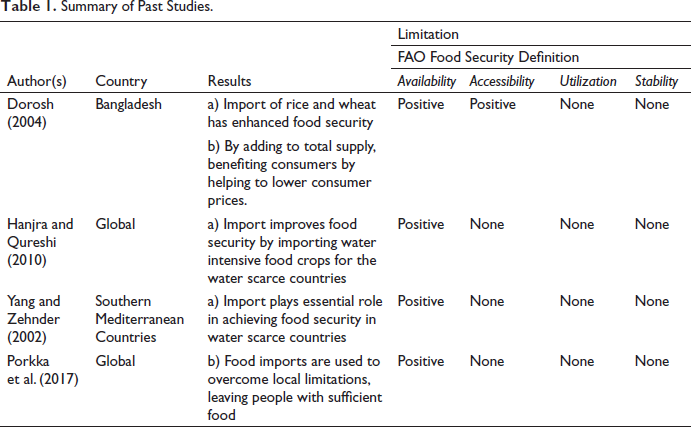
Summary of Past Studies.
Methodology
The FS model can be based on three theories mentioned in the literature review. In other words, FS can be formulated as a function of the three theories as follows:

Initially, Malthusian and neo-Malthusian theories emphasize that food insecurity exists due to too many people and limited and finite land resources (Malthus, 1798). Then, FAD theory is applied to incorporate the major causes of food supply shortage (Devereux, 1993). The FAD claims that the level of food supply or production is affected by environmental degradation and imports. Subsequently, the model is completed by incorporating FED theory, which indicates that remittances determine food demand or consumption. Therefore, the FS function can then be specified as follows:

where POP is population, AL is arable land, ED is environmental degradation, IMP is imports, and REM is remittances. Equation (2) can be simplified as follows:

where yit is the dependent variable food security (FS), xit is the explanatory variable imports (IMP), zit is a vector of controlling variables, namely, population growth (POP), arable land (AL), environmental degradation (ED), and remittances (REM). vi is the country-specific effect, ψt is fixed time effect, and ε_(i,t) is a stochastic error term.
Equation (3) is a linear dynamic panel model with statistical problems that render the standard panel estimation approach inappropriate and biased (Ibrahim & Law, 2014). There is potential endogeneity of variables in the model and a correlation between the unobserved panel-level effect and the lagged dependent variable (Arellano & Bond, 1991). In addressing these problems, Arellano and Bond (1991) develop generalized methods of moments (GMM) estimator. Following Arellano and Bond (1991), the first step is to take the first difference GMM in order to wipe out the country-specific effect under the conditions that the disturbance term is not serially correlated and the level of the explanatory variables is weakly exogenous (uncorrelated with future error terms). Unfortunately, the first difference GMM performs poorly and leads to large sample bias when the independent variables are persistent over time (Blundell & Bond, 1998). To overcome this condition, the first difference GMM regression was further combined with an estimator in levels to produce a system, which is known as a system-GMM estimator (Arellano & Bover, 1995; Blundell & Bond, 1998). Moreover, Blundell and Bond (1998) indicate that there are two different statistics, namely, serial correlation and the Hansen test, to examine the validity of the GMM estimator. The serial correlation test examines the null hypothesis of no first-order serial correlation and no second-order serial correlation in the residuals. The second test is the Hansen test of over-identifying restrictions, which is used to examine the overall validity of the instruments by comparing the moment’s conditions with their sample analog. Thus, in this article, we use the system GMM approach to estimate our models.
Data
Our analysis is based on a 6-year period covering 2011–2016 for 56 lower-middle income countries. On the measurement of the dependent variable of FS, this study constructs the index based on the average of four components or dimensions of FS by FAO, namely, the index of food availability (FSAVA), food accessibility (FSACC), food utilization (FSUTI), and food stability (FSSTA). To construct the index of FS, there are three steps. First, we need to transform each element within each of the four mentioned major dimensions of FS by FAO to have a similar range, which is set between 0 and 100. To normalize the scores, we refer to the methodology employed by the UN in the construction of the human development index as follows:

The world’s maximum value will be proxied by the USA on the assumption that it is the world’s most secure country in terms of food. The world minimum will be represented by Sudan, assuming that it is the world’s hungriest country (World Bank, 2018). Second, we create four separate indices for each of the four dimensions. This is done by taking the average of all indices of elements that belong to each dimension. For instance, food availability index (FSAVA) comprises five elements, and therefore, the index is represented by the average of five elements’ indices as the equation below.
5
The last step is to calculate the composite FS index by taking the average of four dimensions as follows:

where FSACC is food accessibility index, FSUTI stands for food utilization index, and FSSTA denotes food stability index. In this case, we add all these four dimensions together and then divide them by 4 (total dimension). Therefore, the FS index is expressed as a value between 1 and 100, where the higher the value of FS, the better the level is.
Moreover, population (POP) is measured as the annual population growth rate in percentage. According to the World Bank (2017), the annual population growth rate for year t is the exponential growth rate of the midyear population from year t−1, which counts all residents regardless of citizenship or legal status. Environmental degradation (ED) refers to total carbon dioxide emissions that come from the consumption of solid, liquid, and gas fuels and gas flaring in metric tons per capita. FAO defined arable land (AL) as land capable of being plowed and used to grow crops, thereby arable land is measured in land area, expressed in percentage. Besides that, imports (IMP) are generally measured as the total quantity of food and agricultural imports, which are expressed in thousand US dollars, while the remittances (REM) are measured in the percentage of the GDP.
Results and Discussion
As we can observe from Table 2, the nature of FS score of lower-middle income countries can fall below half with a percentage lower than 50 and above half with a percentage greater than 50. Among other countries, only Ecuador, Egypt, Pakistan, Paraguay, Israel, and Thailand possess a level of FS above an average of 50%. Meanwhile, most lower-middle income countries are in the bottom half. This provides a rough indication that they are suffering from lower levels of FS, reflecting widespread food insecurity, crop production deficits, and calorie deficiency for the population.
Countries with Levels of Food Security in 2016.
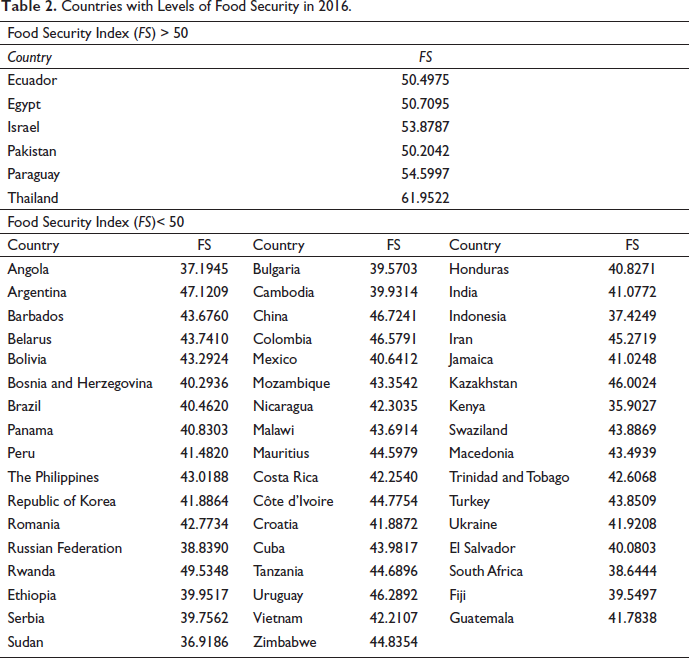
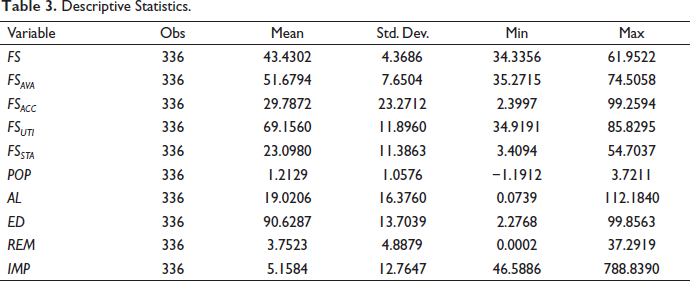
Table 3 presents the descriptive statistics for the independent and dependent variables. The results indicate that the mean of food security (FS) of a group of developing countries for the period 2011–2016 is 43.43%. The maximum FS is 61.95% and could be represented by the case of Thailand in 2016, whereas the lowest FS is observed at 34.33% and potentially refers to Sudan in 2011. It is also reported that the mean value of the POP for the developing countries during the same period is 1.21%, while the maximum POP is 3.72% in the year 2016 (Sudan). For arable land, the maximum value of 112.18% and the minimum value of 0.074% are recorded in 2016 (Ukraine) and 2015 (Belarus), respectively. The mean and maximum value of remittance is recorded as 3.75% and 37.29%. In addition, China is the largest importer of foods, as described by the maximum score of imports relative to the lowest size of imports in Sudan in 2016.
Descriptive Statistics.
Panel estimates for the estimated GMM FS equation are reported in Table 4. Model 1 is the baseline model, with the average of four dimensions (FS) while Models 2–5 are represented by food availability (FSAVA), accessibility (FSACC), utilization (FSUTI), and stability (FSSTA). The estimated coefficient on the lagged FS is statistically significant, indicating that FS in one year is heavily influenced by FS in the previous year. Moving to the appropriateness of the GMM estimator, the Hansen test fails to reject the null hypothesis of no over-identifying restrictions and recommended that the model has a valid model of specification. Second, the serial correlation test fails to reject the null hypothesis of no second-order autocorrelation AR (2) while it rejects the null of no first-order autocorrelation AR (1).
Regression Analysis of Model 1 (DV: LFS).
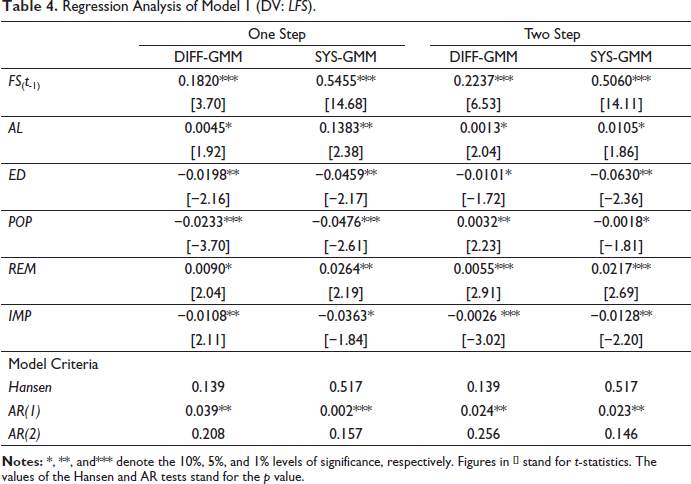
Based on Table 4, arable land (AL) has a significant positive impact on FS. The arable land coefficient 0.0284 suggests that a 1% increase in arable land is associated with an average increase in FS by 0.0284%. This result confirms the findings of Liu et al. (2010), Schneider et al. (2011), and Tan et al. (2018) that an expansion of arable land in a sustainable way can help improve agricultural productivity and thereby increasing food production and improvement in the level of FS in developing countries. As mentioned earlier, arable land expansion is essential for the production of food in countries of sub-Saharan Africa, Latin America, and East Asia. These countries are under immense pressure of food insecurity, where the number of undernourished people increased to 557.2 million people in 2017 (FAO, 2018). Therefore, as arable land increases, food production is projected to increase, and the number of people suffering from chronic food deprivation will decrease. The expected sign of arable land on the FS explains that arable land is a resource that plays a role in improving the level of food supply in developing countries. 6
Environmental degradation (ED) has a negative and statistically significant effect on FS. The findings are as expected and supported by the results of Faisal and Parveen (2004) for Bangladesh, Gregory et al. (2005) for southern Africa, and Connolly-Boutin and Smit (2016) for sub-Saharan Africa. Deterioration in environmental quality, such as deteriorating soil and water quality and rising greenhouse gas emissions, leads to lower crop yields, nutrient levels, soil moisture, and water availability, eventually undermining food supply. In other words, environmental degradation will diminish the capability of countries to continue producing enough food to meet the need for sufficient and safe food for an active life.
The results provide evidence supporting the Malthusian theory for the association between population growth (POP) and food supply because the coefficient for population growth is negative and significant. It shows that this variable has a negative effect on FS, indicating that a 1% increase in population growth reduces food supply by 0.0236%. The increasing population growth has not been able to keep up with the level of food production, which typically results in chronic food insecurity (Godber & Wall, 2014; Tian et al., 2016). Consequently, this raises the challenge of adequate food production and distribution systems in meeting human nutritional needs. The researcher estimates that the earth’s population is expected to increase from 7 billion to 9.1 billion by 2050, most of it in developing countries. These demographic shifts imply evolving lifestyles and consumption patterns, which will have significant consequences on FS. Thus, this explosive growth in the number of people seems to bring in acute food shortages in developing countries.
Moving on to the remittances, this study finds support for the hypothesis that remittances have a positive influence on FS. It means that remittances can increase household income, which would improve the level of FS. The result is similar to the findings from Mango et al. (2014) for Zimbabwe, Regmi, and Paudel (2017) for Bangladesh, and Atuoye et al. (2017) for Ghana. Atuoye et al. (2017) point out that households receiving remittance have a more positive impact on food consumption than non-receiving households. Thus, an increase in remittances can lead to a reduction in food insecurity as the increase in people’s income raises purchasing power and improves the consumption of safe and nutritious foods.
Imports of agricultural products have a significant negative impact on FS for all developing countries. The findings are confirmed in Figure 2, which shows that imports decrease the level of the FS in food-importing countries. Increased imports of agricultural products such as rice, sugarcane, corn, groundnut, maize, and soybean can potentially crowd out the domestic producers. 7 At the same time, fluctuations in global production and price volatility can increase the risk of food supply and disrupt access in importing counties (Valdes & Foster, 2012).
Moving on to the results for each dimension of FS, we start with the first dimension of food availability (FSAVA) as shown in Table 5. The results soundly support the earlier assumptions of this study that FS tends to worsen in a country with higher population growth and environmental degradation. Remittances and arable land have a significant positive impact on FS.
Regression Analysis of Model 2 (DV: LFS = LFSAVA).
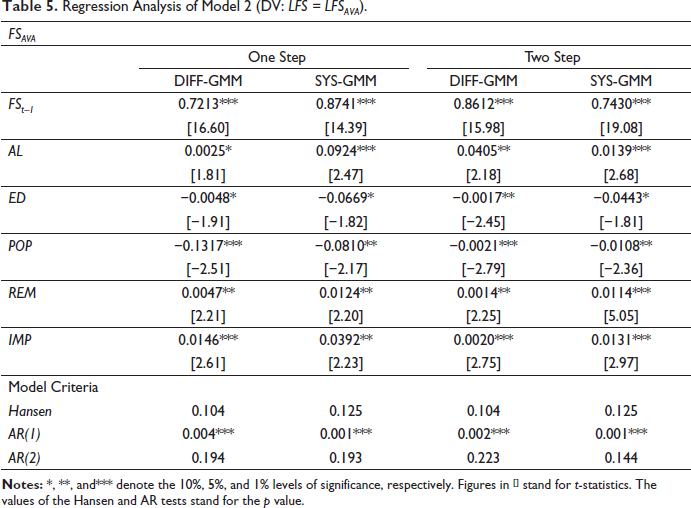
Regarding imports, the result supports the hypothesis that imports increase food availability in developing countries, where we find the positive contribution of imports to the food supply. From the regression analysis, a one-unit increase in imports is related to the rise in FS by roughly 0.0131%. It implies that high dependence on food imports improves the level of FS in developing countries. In terms of food availability, increased imports of food crops such as rice, sugar, and soybean oil can potentially increase the availability of crops in importing countries (Ramirez-Vallejo & Rogers, 2004). Following this dimension, imports have the potential to enhance countries’ FS by reducing the food gap (Hanjra & Qureshi, 2010).
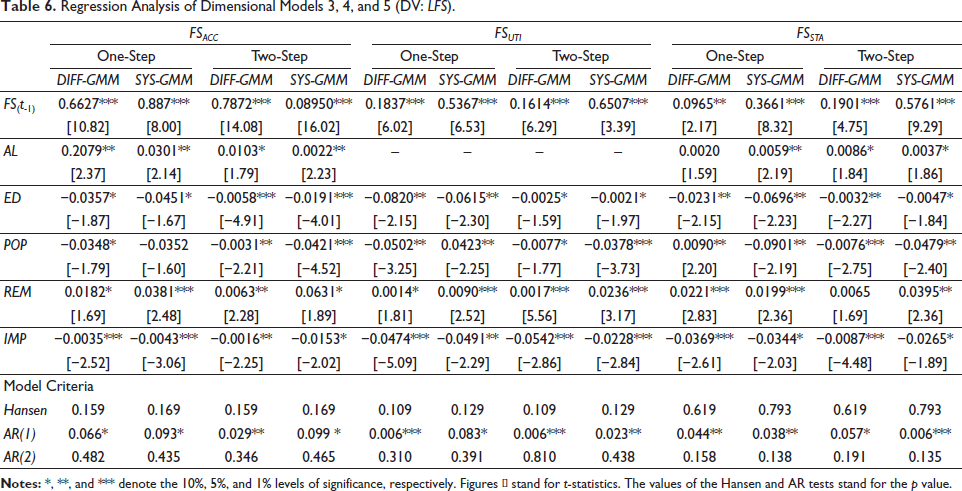
However, the remaining three dimensions of FS models, as presented in Table 6, indicate that imports contribute negatively to food accessibility, utilization, and stability. This is mainly because most net importers are middle- and low-income developing countries that are unable to pay for their food import bills (Valdes & Foster, 2012). The higher food import bills are driven by higher freight rates and in response to increased international demand for food items. There is a general concern that high food import bills are likely to increase the pressure on countries’ budgets by the need for increased foreign exchange to purchase imported foods. Hence, countries relying on food imports are expected to be hurt by the rising cost, thereby decreasing the food supply. Beyond that, higher food import bills are likely to increase food prices and adversely affect the purchasing power of the poor in developing countries (Campbell et al., 2016; Valdes & Foster, 2012; Zhou et al., 2017). Between 2007 and 2008, Eastern and Southern African countries experienced a serious food insecurity issue due to the dramatic swing in food prices. This was mainly due to the high increase in the cost of food imports. As a result, an increase in the prices of food will result in a reduction in the ability of consumers to purchase nutritious and healthy foods, thereby increasing the incidence of food insecurity.
Regression Analysis of Dimensional Models 3, 4, and 5 (DV: LFS).
Second, there will likely be an increase in the threats to food supply due to food imports crowding out the domestic agricultural producers (FAO et al., 2013). The reason is the inability of the domestic agricultural sector to compete against the imports. A 2013 report by FAO indicated the vulnerability of agricultural producers in the Caribbean region to the threat from food imports that could collapse domestic production (FAO et al., 2013). Crowding-out of a domestic agricultural product by imported food also threatens sustainable development, resulting in unemployment, the welfare of rural communities, and increases in rural-to-urban migration. According to Loopstra and Tarasuk (2013), unemployment leads to critical socioeconomic problems, especially when a sizeable number of people do not have enough income to purchase foods for their well-being. An increase in unemployment will threaten the food supply chain and limit human capacity for food production and consumption (Loopstra & Tarasuk, 2013).
Conclusion
This article presents empirical evidence on the impact of imports on FS for the 56 developing countries over the period 2011–2016 using GMM estimation. First, our empirical results suggest that imports are essential to uplifting food availability in developing countries. The imports improve FS through the virtual flow of crops from producing or exporting countries to importing countries. Hence, including food imports may substantially increase food availability in developing countries. Second, this article highlights that imports do negatively affect food accessibility, utilization, and stability. It implies that rising imports may not be able to improve FS, if domestic agriculture producers are exposed to foreign competition and high food import bills. Overall, the negative impact of imports on FS outweighs the positive impact. Therefore, this allows us to conclude from the analysis that an increase in food imports contributes to a decrease in FS.
As a policy implication, developing countries should reduce their tariff (duties, surcharges) and non-tariff (licensing rule, quota) on food crops to increase food supply and lower food prices. Although it may coincide with the reduction of government support to the domestic agricultural sectors, this can be offset by supporting local market development and farmer simultaneously. Food imports should be a secondary or short-term solution to solve the FS problem. Governments should ensure that most food supply comes from domestic production in the long run. Even if domestic food production is insufficient to meet the population’s needs, imported food should be minimal. Therefore, governments should design effective policies and incentives to support the agriculture sector so that it can significantly contribute to FS.
It is also important to reconsider the inclusion of imports in the calculation of FS. This study justifies that imports are not necessarily FS enhancing, although likely to be supported if only food availability is the focus. The inclusion of imports may under- or over-estimate the seriousness of FS issue.
Footnotes
Author Contribution
All authors have participated in (a) conception and design, or analysis and interpretation of the data; (b) drafting the article or revising it critically for important intellectual content; and (c) approval of the final version.
Declaration of Conflicting Interests
The authors declared no potential conflicts of interest regarding the research, authorship, and/or publication of this article.
Funding
The authors disclosed the following financial support for the research, authorship and/or publication of this article: The study was funded by the Universiti Teknologi Malaysia under the project “UTM Fundamental Research (UTMFR) Grant No: Q.J130000.3855.21H98.”
