




Abstract
This study offers an analytical evaluation of the effects of Free Trade Area (FTA) agreements on trade, revenue, and welfare in Nigeria. The study applied World-Integrated Trade Solution/Software for Market Analysis and Restrictions on Trade (WITS-SMART), anchored on a partial equilibrium model (PEM) for its simulations. The study simulated 100% tariff elimination on selected products under Harmonized System (HS)-2 classification code sourced from Trade Analysis Information Systems (TRAINS) and Common Format for Transient Data Exchange (COMTRADE). The study’s findings show that the African Continental Free Trade Area (AfCFTA) agreement will benefit Nigeria’s economy from trade creation estimated at US$8,860.419 million, including a favorable welfare gain to the value of US$740.571 million. Nevertheless, Nigeria will sustain losses in trade revenue, valued at US$6,142.061 million. The study recommends proficient revenue management and well-diversified revenue collection sources, such as improvement in Value Added Tax and Ad-Valorem duty, to cushion the effects of the revenue loss resulting from tariff elimination in the FTA.
Introduction
Since the middle of the last century, African countries have become growingly interconnected and integrated into the global economy. Zahonogo (2016) ascribes the intensified global engagement to a decrease in transaction costs through wide-ranging trade liberalizations. Hence, most transition and developed countries are inter-linked due to merchandise and services trade, making economic integration an essential part of every region in the world (Pasara & Dunga, 2019). However, African states are perceived to be the weak players in the global market, as evidenced by the decreasing stake in both shares of global output and trade (African Economic Outlook [AEO], 2016). For the period 2015–2017, the total trade share of Africa to the rest of the world averaged US$760 billion, while Europe, America, and Asia’s contributions were US$4,109 billion, US$5,140 billion, and US$6,801 billion, respectively (United Nations Conference on Trade and Development [UNCTAD], 2019). Also, the intra-trade situation in Africa is even worse compared to other regions. During 2015–2017, intra-African trade was around 2%, while comparative statistics for America, Asia, and Europe were 47%, 61%, and 67%, respectively (Afreximbank, 2018). Factors responsible for this relatively low intra-trade performance have been identified as tariff and non-tariff barriers (NTBs) and as product similarity due to over-dependence on primary commodities (Kituyi, 2018).
To improve intra-African trade, international trade analysts have advocated for regional economic integration over a couple of decades to assist Africa in exploiting the gain of intra-trade in the region (African Development Bank [AfDB], 2014; Pasara & Dunga, 2019). The formation of regional economic integration in Africa was set in motion as early as 1963 under the Organisation of African Unity (OAU). Later, in 2002, it came to be known as the African Union (AU). Africa has experienced several forms of economic integration, starting with a free trade area (FTA), and it developed into a customs union and common market before it culminated in an economic union (Gurova, 2014). As of August 2018, the AU officially recognizes eight regional economic communities (RECs). These RECs are the Arab Maghreb Union (UMA), Common Market for East and Southern Africa (COMESA), Community of Sahel-Saharan States (CEN-SAD); East African Community (EAC); Economic Community of Central African States (ECCAS); Intergovernmental Authority on Development (IGAD); Economic Community of West African States (ECOWAS); and Southern African Development Community (SADC). As part of an effort towards achieving 2030 sustainable development goals (SDGs) and AU Agenda 2063, 44 countries in Africa endorsed an agreement on March 21, 2018, establishing the African Continental Free Trade Area (AfCFTA). The Agreement aims to boost intra-trade in Africa by eliminating tariffs and NTBs to trade and services (Woolfrey et al., 2019).
Although theory and empirical evidence have suggested that an improvement in intra-regional trade is generally welfare-enhancing, free trade agreements typically lead to trade creation and diversion effects (AfDB, 2014; Gurova, 2014; Mold & Mukwaya, 2015). This implies that some countries and economic sectors within the AfCFTA can gain more, to the detriment of others, splitting nations and industrial sectors into gainers and losers (Duede & Zhorin, 2016). More diversified and manufacturing-oriented economies are likely to be the winners. In contrast, agriculture-oriented and natural-resource-based economies will likely be the losers in FTA agreements (Afreximbank, 2019). In addition, an FTA agreement can balance diverse benefits among industrial sectors, thereby contracting incomes and quality of life of economic actors in different sectors of an economy, and invariably leading to a decrease in welfare (Mold & Mukwaya, 2015).
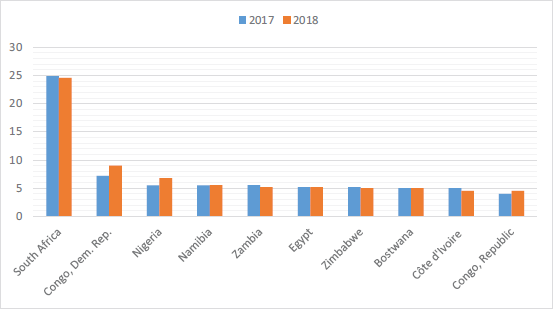
Among members of AfCFTA, Nigeria dominates in terms of a population size of about 190 million and its economic share with a nominal GDP of approximately US$444.9 billion as of 2019 in purchasing power parity (PPP) terms (National Bureau of Statistics [NBS], 2019). The size of the Nigerian market means it can account for a large proportion of intra-trade in Africa. From Figure 1, Nigeria is the third most significant contributor to intra-African trade (after South Africa [SA] and Congo), accounting for 6.8%, up from 5.51% in 2017, while SA largely dominates with a share of 24.9% (Afreximbank, 2019). According to the Africa trade report, SA, Togo, and Côte d’Ivoire are the top three destinations for Nigerian exports. At the same time, the rest of the continent relies on Nigeria for fuel imports (Afreximbank, 2019). More so, the aggregate value of Nigeria’s imports from Africa is lower than its exports, and the country’s merchandise exports are mainly dominated by oil.
Nigeria is faced with a complicated situation that might undermine the benefit of a free trade arrangement, given its weak domestic manufacturing sector, which accounted for 1.1% of the GDP in the third quarter of 2019 (PricewaterhouseCoopers [PwC], 2019). Nigeria is ranked fourth in Africa for manufacturing value-added, with a value of US$35.45 billion, behind Algeria (US$72.2 billion), SA (US$42.7 billion), and Egypt (US$42.2 billion) (Afreximbank, 2018). There is a legitimate concern that manufacturing firms struggling to survive due to insufficient technological prowess and high production costs will likely be left grappling with competing cheap imported products. Hence, Nigeria may end up being a dumping ground for manufacturing-oriented nations such as SA, Algeria, and Egypt (Azikiwe, 2018; Ikokwu, 2018; Ogunyemi, 2017). The FTA agreement might further present a serious challenge to Nigeria as the country currently has a tax-to-GDP ratio of 6%, considered the lowest in the continent (Onwuka & Ozegbe, 2020). As soon as the trade agreement comes into effect, Nigeria will need to drop 90% of its tariffs for imports from other member states, thereby depriving the country of the opportunity to generate revenue through tariffs and duties. This implies that in the event of AfCFTA, only 10% of member countries’ commodities would be subject to import duty. The FTA agreement would not only lead to the closure of domestic industries, loss of investment, and unemployment but also threaten import revenue and consumer welfare.
Against this backdrop, this study aims to analyze the impact of the FTA on trade, revenue, and welfare in Nigeria. The study departs from existing Nigerian studies in three core aspects: First, it used World-Integrated Trade Solution/Software for Market Analysis and Restrictions on Trade (WITS-SMART) partial equilibrium model (PEM). Second, the model can indicate the effects of the AfCFTA on Nigeria’s economy regarding trade creation, trade diversion, revenue, and welfare effects. Third, this study focuses on trade in primary and industrial products only since they are considered to be the most significant part of intra-trade in the African region. The core research questions include the following: (a) Has the FTA agreement led to welfare gain in Nigeria? (b) Has the FTA agreement led to an increase in trade creation and trade diversion in Nigeria? (c) Has the FTA agreement led to a loss of trade revenue for Nigeria?
The article is structured as follows: the next section presents conceptual literature including the stylized facts on trade in Nigeria and a short review of the theoretical framework and empirical literature; subsequently, the data and methodology are discussed followed by the results and discussions; and finally, we present the conclusions and policy recommendations.
Theoretical Framework and Literature Review
FTA is a form of economic integration that constitutes an economic entity in which all trade restrictions are eliminated among member nations; however, each partner independently retains its external trade barriers beyond the trade bloc. Unlike customs unions that specify the external tariffs of their member countries, FTA arrangement allows all signatories to determine external trade policies (McLaren, 2004). The aim of forming a FTA is to promote trade by reducing or eliminating trade costs for producers and consumers, thereby improving member countries’ trade and welfare of citizens (Burges, 2013). This would encourage member countries to increase specialization in their respective comparative advantages. AfCFTA is an example of an FTA. In this study, FTA is within the scope of AfCFTA member countries.
Welfare gain from trade occurs when the trade creation effect exceeds the trade diversion effect, as noted by Viner (1950). A market with trade creation would incur state welfare gains, while a market with trade diversion would incur state welfare losses; thus, a nation would only enter into FTA arrangement if it improves its state welfare (Suranovic, 1997). This suggests that an FTA agreement could improve consumers’ quality of life or possibly worsen it if the state fails to compete favorably with other member countries involved in the trade agreement. Therefore, the welfare effect of FTA can be defined as the satisfaction consumers in the importing country (Nigeria) derive from the lower product prices after removing or reducing trade restrictions among member nations.
Stylized Facts on Trade in Nigeria
The predominant share of Nigeria’s trade has been channeled toward the American and European regions. Only recently, some of its trades are slowly shifting to Asian and Middle Eastern regions, particularly to countries such as China, India, and Japan, among others. Consequently, Nigeria has a poor record in terms of global trade contributions. For instance, between 2005 and 2018, Nigeria’s total trade volume fluctuated around 12%–20%. This accounts for less than 1% of the global trade (UNCTAD, 2018). The country’s export trade has hovered around 1%–2% for the entire period 2005–2018. In other words, in terms of contribution to global trade, the country’s contribution to global export was approximately 0.6% in 2011, and by 2018, it decreased to about 0.20% (UNCTAD, 2018). In terms of global imports, the country’s global import share has oscillated from approximately 0.15% to 0.20% during 2005–2018 (UNCTAD, 2018).
Nigeria’s Selected Trade Statistics.
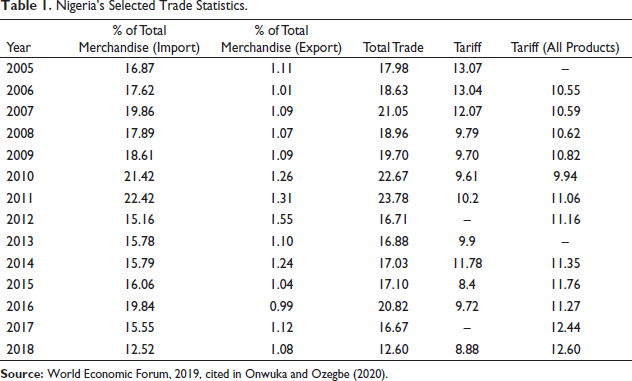
Nigeria’s average tariff has reduced considerably over the years due to several bilateral and multilateral trade agreements. The most significant of these tariff-reduction measures is the Common External Tariff (CET) in ECOWAS, to which Nigeria is a signatory. However, Nigeria’s average tariff regime is still high compared to rates in other neighboring countries and Nigeria’s other external trade partners (Onwuka & Ozegbe, 2020). As shown in Table 1 Nigeria’s simple average tariff rate has hovered between 8% and 13% from 2005–2018. Despite the significant reduction in Nigeria’s tariff regimes over the years, the country’s average tariff rate remains high compared to its peers in the African region and other European countries (World Economic Forum, 2019).
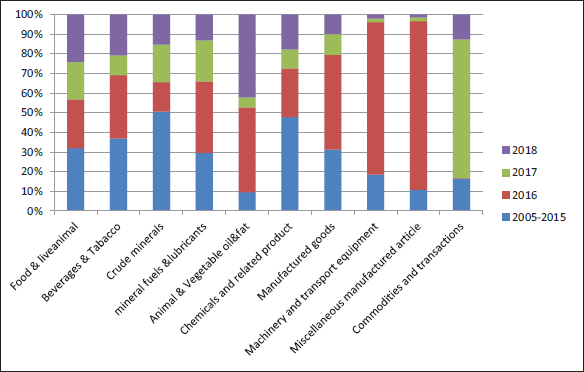
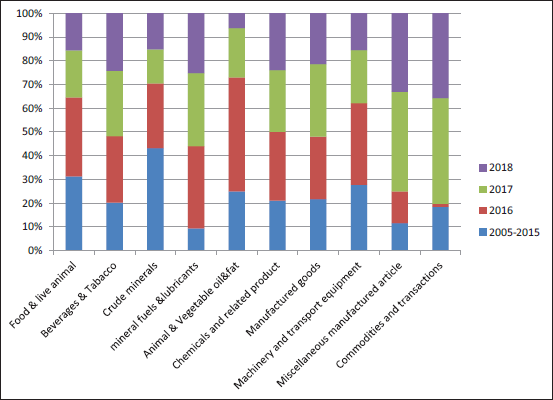
Nigeria can potentially boast of several exportable commodities. Figures 2 and 3 demonstrate Nigeria’s topmost export and import commodity structure. Nigeria can be described as a mono-product economy as indicated in Figure 2. For instance, in the period 2005–2018, the country’s export of crude oil and lubricants accounted for approximately 93% of the total value of all merchandise exports, with a net export flow of over US$60 billion for the period. None of the other export commodities recorded anything near that value in terms of the total contribution and dollar net flows.
In terms of Nigeria’s import commodities, machinery and transport equipment dominated the scene. For instance, for the period 2005–2018, imports of machinery and transport equipment accounted for approximately 34% of the total imports. This means that Nigeria has only crude oil and lubricants to offer as an export commodity, while imports are mostly manufacturing inputs with little or no local content.
Theoretical Framework
Trade theories attempt to explain the need and gains obtained from international trade and regional integration. The theory of absolute advantage by Smith (1776) established that uneven resources among nations bring about uneven development and unequal distribution of wealth, which necessitates international trade between and among nations (Pasara, 2019). Smith argued that countries should specialize and improve the production of goods they have an absolute advantage over other countries.
David Richardo, in 1817, developed the comparative advantage and specialization concept because of the differences in relative prices, division of labor, and specializations. Contrary to Adam Smith’s absolute advantage theory, Richardo argued that nations and the world, in general, can mutually gain from international trade by specializing in producing commodities they have comparative advantages over others. The theory encourages countries to participate in foreign trade even when factor inputs, such as labor, is more efficient at processing all goods than other nations. The logic derived from both theories is that international trade can be mutually beneficial, mainly if economies specialize in their economic strength. The theories also assert that the leading economies should seek closer integration through trade with those lagging behind (Parasa, 2019).
On the other hand, the factor endowment theory, also called Hecksher-Ohlin (H-O) theory of 1919, is another theoretical build-up on the need for international trade and liberalization. It was developed from two variant theories of absolute advantage and the principle of comparative advantage. The factor endowment theory emphasized the importance of factor proportions and stressed that countries trade due to comparative advantages in factor input proportions. The relative factor endowment differences and the pattern of factor intensities will make trade mutually beneficial. The theory asserts that gains from trade are mutually possible and beneficial if nations export goods for which they have abundant factor intensity and import the products they have scarce factor inputs.
While most international trade theories emphasize the gains from trade and economic integration, Viner (1950) postulated a ground-breaking model contrary to the generally believed hypothesis that trade liberalization always enhances welfare. Viner’s static analysis disintegrated the possible effects of free trade arrangement into trade creation and trade diversion. The former enhances welfare, while the latter restricts welfare. Trade creation occurs when trade shifts from high-cost- to low-cost suppliers due to a trade agreement. On the other hand, trade diversion denotes when member countries shift imports from a low-cost producer who is not a partner of the agreement to a high-cost supplier who, by the trade agreement, is a member country (Parasa & Dunga, 2019). The non-member country’s products will become costly simply because of the additional tariffs imposed on their products (Cheong & Wong, 2007; Gurova, 2014).
Therefore, the theoretical framework of this study is anchored on Viner’s theory of international trade. FTA agreements allow members to reduce costs and increase trade among member countries. A concern raised by Viner’s theory is that this mechanism could also generate trade diversion, which has negative welfare implications. The trade creation effect is the reduction in domestic production that is now met by more-efficient imports. More so, as the FTA lowers the domestic price, there is a rise in consumption, which is also satisfied by increased imports. Hence, the total trade creation is the sum of FTA’s production and consumption effect due to changes in imports. On the contrary, FTA could also cause trade diversion because imports from the member countries replace the imports formerly sourced from the non-member countries. The domestic country loses tariff revenue equivalent to the volume of goods imported from the trade partners in the FTA, which would have been imported from non-member countries. The switching of import sources from non-member to the FTA partners occurs because the tariff liberalization makes imports from member countries cheaper than those from non-member countries. The FTA’s welfare effect on the home country is the sum of changes in producer surplus, consumer surplus, and tariff revenue.
Review of Empirical Literature
It is clear from the literature that improving trade, revenue, and welfare through trade reforms, such as FTA arrangements, have undergone empirical scrutiny in the extant literature. Walter (2018) investigated the possible impact of a bilateral trade agreement between the United States and Japan on consumers’ welfare and trade. The study utilized the computable general equilibrium (CGE) model to weigh the possible benefits between Washington and Tokyo and to understudy the US government’s policy option to join the Trans-Pacific Partnership (TPP). The study simulation output revealed that Japan had the highest welfare gain of 0.085% in the bilateral trade agreement, while the United States only had a welfare gain of 0.05%.
Another study in the United States by the United States International Trade Commission (2017) investigated the effect of the TPP agreement on the US economy. The study used a dynamic CGE model to evaluate the trade policy. The findings revealed that the TPP has a positive but small percentage effect on the total size of the US economy. The US import will increase by a percentage point, valued at US$27.2 billion, and export will increase by 1.1%, valued at US$48.9 billion in a baseline projection. The US exports to new FTA partners would grow by 18.7% to $34.6 billion, while US imports from TPP member nations would increase by 10.4%, valued at $23.4 billion. The study revealed that the TPP agreement would decrease economic actors’ trade costs and harmonize trade regulations in the regions.
A similar study conducted in the United States by Abdelmalki et al. (2007) simulated the effect of the free trade agreement between the United States and Morocco with the WITS-SMART model. The output revealed that the bilateral trade agreement between the two nations significantly impacted their trading relationships. The result indicated that Moroccan revenue reduced more as compared to the United States, with a value of US$147 million. About 60% of the loss accrued from the US cereals import duty elimination. The study further indicated that imports from the United States to the Moroccan economy climbed to US$53.68 million, and consumer welfare increased significantly, mainly because of the fall in prices of industrial commodities.
In the American continent, Villa et al. (2012) used WITS-SMART Model with trade data for 2010 in an ex-ante approach. The model was used to analyze the effect of the bilateral trade agreement between Colombia and Canada. The findings revealed that trade creation exceeded trade diversion by more than 1.5%. Total trade between the two nations in the agreement’s first year grew by about 10%. The study further revealed that Canada incurred a revenue loss valued at US$78.1 million, but with a consumer welfare improvement of US$11.5 million.
In the European Union (EU), Elebehri and Hertel (2004) investigated the possible impact of a Morocco–EU FTA on the welfare state, trade, and production in Morocco. The study applied the general equilibrium model (GEM) to the Global Trade Analysis Project (GTAP) 5.3 database. The results revealed that the trade agreement could affect consumer welfare in Morocco because the manufacturing sector’s output is expected to decline under the FTA, and only the clothing industries were anticipated to witness an increase in production. Hence, the study revealed that the trade agreement would negatively impact the manufacturing sector performance and welfare in Morocco.
In an inter-regional study, Guei et al. (2017) used the WITS-SMART model with 2012 trade data in the WITS database to evaluate the bilateral trade agreement between the EU and SA. The study investigated the effect of the FTA (0% tariff rate) on revenue, welfare, and trade effects in SA. The simulation output of the study revealed that SA is likely to witness a surge in total trade by US$1.036 billion, with a favorable welfare gain estimated at US$134 million. The output further revealed that trade creation would exceed trade diversion with an estimated value of US$782 million and US$254 million, respectively. The country is expected to incur a revenue loss of US$562 million. The study, therefore, recommended that the SA government needs to diversify tax revenue sources to mitigate revenue losses from the bilateral trade agreement.
Turning to Asia, Choudhry et al. (2013) analyzed the effect of bilateral trade agreements between Sri Lanka and India using the textile and clothing sectors in a sector-specific analysis. Sri Lanka reduced tariffs to 35% in 2003, then 70% in 2006, and the total tariffs elimination of 100% in 2008. The SMART result revealed that during the period 1999–2009, Indian export earnings climbed from US$121 million to US$395 million from textiles exported to Sri Lanka. Hence, This Is an indication that trade creation outweighed trade diversion effects. When the study simulated articles of apparel and clothing accessories, trade diversion accounted for US$248, 000 and trade creation was around US$555,000.
Imamuddin et al. (2010) investigated the welfare effect of the South Asia Free Trade Agreement (SAFTA) on Pakistan’s economy. The study used the GTAP model to analyze the trade agreement’s potential impact in a general equilibrium framework. The simulation output revealed that most consumables such as rice, leather, and garments would significantly increase in volume after the FTA and it would create a positive welfare effect. The decrease in domestic prices of rice and other consumer items will increase the production of numerous export-oriented industries, which would have favorable multiplier effects on Pakistan’s economy. Therefore, the study recommended that the government take proactive measures before fully implementing FTA.
More recently, studies have been carried out to estimate the ex-ante benefits of AfCFTA on the economies of West African region in particular, and African States in general. Notable among such studies is Pasara and Diko (2020), who employed the WITS-SMART model to interrogate the potential impacts of AfCFTA on trade in cereals among 15 SADC countries. The simulation outputs revealed that free trade agreements would yield favorable outcomes in Madagascar, Angola, the Democratic Republic of Congo, and Namibia. At the same time, the rest of the SADC members would experience unchanged outcomes. Therefore, the study recommended that African countries deepen their integration levels for ease of factor input mobility.
Abrego et al. (2019) adopted Costinot and Rodriguez-Clare’s (2014) approach to the GEM to estimate the potential welfare effects of AfCFTA in Africa. The simulations of full and partial elimination of import tariffs revealed significant potential welfare gains from the trade policy. The study further showed that considerable welfare gain comes from lowering NTBs in the simulation since intra-regional tariffs in Africa are already low. The study recommended that members of AfCFTA focus on improving the region’s NTBs.
In another study, UNCTAD (2018) investigated the potential challenges and opportunities of the AfCFTA. The study used the CGE model to assess the possible long-run costs and benefits of the agreement on African countries. The international trade data were sourced from the GTAP database. The study result revealed significant long-run benefits regarding welfare gains, intra-African trade growth, employment, and output growth. On the other hand, the study showed that AfCFTA members are likely to incur adjustment costs and losses on tariff revenue in the short run. To achieve the ambitious targets set by AfCFTA, the study recommended that member countries go beyond tariff reduction and improve on non-tariff factors.
Chauvin et al. (2017) analyzed the possible impacts of a Continental Free Trade Agreement (CFTA) in six African countries. The study used the CGE model with GTAP version 8.1 database. The study considered four incremental liberalization scenarios. The first and second scenarios eliminated tariffs for agricultural and manufacturing goods. The third scenario considered 50% reduction in non-tariff measures (NTMs). Finally, the fourth scenario considered a 30% reduction in transaction costs associated with time. The study revealed that trade liberalization’s modality determines growth, trade effects, and welfare benefits for each of the African country. The study also found that the CFTA influences African countries trade patterns asymmetrically and within states across sectors. Finally, the study found that the effect of CFTA is generally less in the short run while the long-run effects are positive instead. The study concluded that there is a peculiar difference in the welfare effects in a given country and across countries.
Mureverwi (2016) used the Dynamic GTAP model to simulate a 100% tariff reduction on consumer welfare in all African countries. The simulation output showed a heterogeneous effect in the labor demand growth, terms of trade, capital accumulation, and allocative efficiencies among all African countries. However, most countries witnessed significant revenue losses from tariff elimination, which tends to diminish gains from other variables. In absolute terms, SA, Kenya, and Nigeria are the major benefactors of the CFTA 100% tariff liberalization. The study also acknowledged that the gains could be higher if the 100% tariff liberalization was accompanied by NTBs. The study recommended that countries in Africa should focus on trade similarity, insecurity, and border issue management.
Mevel and Karingi (2013) used the MIRAGE model with GTAP 7 SAM (based on 2004) data. The study was analyzed under two scenarios: 100% tariff liberalization, and 50% trade cost liberalization. The study found that tariff reduction only increases welfare by 0.2%, while intra-African trade will surge by +50%. The effect of trade cost reduction is + 1% for welfare, while intra-African trade would double. The study also found that all countries modelled welfare gain. The study recommended that governments tackle non-tariff barriers, reform the agriculture sector, and implement good education policies to produce higher skilled workforce for the African labor market.
A recent study by Onwuka and Ozegbe (2020) examined the potential benefits of AfCFTA agreement for Nigeria using standard trade costs between Nigeria and peer African countries. The study applied a content analytical framework on data from the World Bank (i.e., World Development Indicators) and WITS. Results from the study revealed that Nigeria’s average tariff rate was quite high compared to its other African peers, such as SA, Egypt, and Ghana. Nigeria’s ease of doing business and trade-related physical infrastructure was also found to be very poor compared to other major trading rivals. Furthermore, it revealed that Nigeria’s major export commodity (crude oil and lubricants) had an insignificant market share in the African region. Therefore, the study recommended that Nigeria should embark on massive infrastructural development, improve institutional quality, and diversify the economy.
Similarly, a study by Jibrilla (2019) used annual data from CBN to carry out a descriptive analysis of the benefits of AfCFTA to the Nigerian economy. The study found significant obstacles in Nigeria’s ease of doing business: inadequate electricity supply, high cost of financial access, corruption, tax rates, and weak transport system. The study concluded that AfCFTA would benefit Nigeria more than any other country in the continent if the Nigerian government could improve on the obstacles mentioned earlier for business growth, hence improving the private sector productivity and consumer welfare.
Data and Methodology
Data Sources and Software
The secondary data used in this study were sourced from Trade Analysis Information Systems (TRAINS) and Common Format for Transient Data Exchange (COMTRADE) database, under Harmonized System (HS)-2, taking 2016 as the base year. The HS classification enables commodities traded to be coded for customs and related purposes on a common basis by participating countries. The study used the nine standard product classifications under HS classification code of 27, 10, 11, 17, 25, 52, 22, 69, and 70. The WITS-SMART software was used in simulating 0% tariff on product lines listed earlier. The 100% tariff elimination was simulated against the actual tariff (applied tariffs) by the Nigeria revenue and customs authority for AfCFTA member countries as deposited in TRAINS.
Model Specification
This article employed PEM and the WITS-SMART to analyze the impact of FTA on trade, revenue, and welfare in Nigeria. The PEM was adopted due to its efficacy in analyzing the effect of single market tariff on disintegrated product lines and has strength in examining the impact of trade policy reforms on sectors that are directly affected by the reform in the presence of imperfect substitutes (Othieno & Shinyekwa, 2011; Simiyu & Mugano, 2017). The partial equilibrium WITS-SMART model paradigm developed by UNCTAD and the World Bank runs on information in the COMTRADE and TRAINS tariff (applied tariff) data for simulation purposes and express results in terms of trade creation effect, trade diversion effect, revenue effect, and ultimately welfare effects. The model presents the following equations:

where TCijk is the trade creation on good i imported from country j to country k;Mijk is the imports of good i to country j from exporting country k; tijk represent tariffs; φ is the import elasticity of demand in the importing country; and β is the export supply elasticity. The trade diversion equation is estimated in Equation 2. This is the relative change in duty price paid for commodities originating from FTA member countries relative to other prices from the rest of the world. Diversion depends on the elasticity of substitution and the equation is estimated as follows:
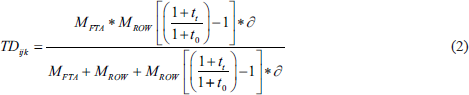
where TDijk is the trade diversion on commodity i imported from country k into country j; MFTA is the import from FTA countries; MROW represents imports from the rest of the world; tt is tariffs (t0 and tt refer to pre and post integration tariffs); and ∂ is the substitution elasticity. The equation of the net trade effect and net revenue are also estimated as follows:

where ∆Rijk is the revenue effect of tariff change, φ is the import elasticity of demand for country j; tijk is the tariff, and β is the export supply elasticity. Equation 4 captures the welfare implications of FTA on the trade partner (Nigeria). Welfare effect is the summation of the consumers’ and producer surplus.

Results and Discussions
This section presents the empirical results obtained from the WITS-SMART simulation of the ex-ante impact of FTA on welfare, revenue, and trade effects in Nigeria. The section is divided into three parts. The first describes the simulation results on trade creation and diversion effects of the FTA agreement. The second analyzes the simulation results on revenue effects. Finally, the third examines the welfare implication of the FTA agreement.
Trade Creation and Trade Diversion Effects
The WITS-SMART simulation outputs shown in Table 2 are the trade creation and diversion effects as a result of FTA.
Trade Effects After the Free Trade Area Agreement (US$000).
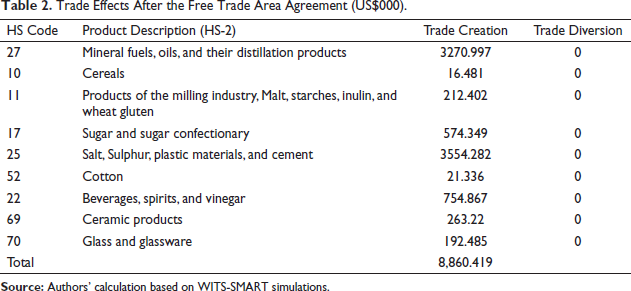
Table 2 illustrates the potential trade effects on Nigeria if the AfCFTA protocol is adopted. This implies that the FTA is expected to generate a total trade creation effect amounting to US$8,860.419 million in Nigeria, solely from the AfCFTA partners. It suggests that the FTA would have favorable trade implications for Nigeria. Furthermore, a decrease in import prices and the affordability of high-quality goods from superior producers in the trade agreement have beneficial trade implications. It is fundamental to emphasize that there is no possible trade diversion effect resulting from forming an FTA in the region and within the product classifications simulated in this study. The zero-trade diversion might result from the similarity in exported products and the composition of mostly primary products in the FTA. This is consistent with Villa et al. (2012) and Guei et al.’s (2017) findings.
Revenue Effects
The revenue implications of the FTA are a major concern for AfCFTA partners. This is the basis for which most partners developed cold feet in being part of the trade agreement and seek answers that would address their concerns on how they would be compensated for lost revenues through tariff removal. Table 3 shows the potential FTA effect on revenue in Nigeria.
Revenue Effects After the Free Trade Area Agreement (US$000).
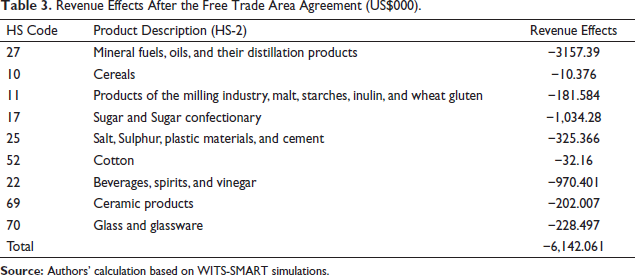
It is important to note that Nigeria has a high average tariff rate compared to its peers in the African region and other European countries (Onwuka & Ozegbe, 2020; World Economic Forum, 2019). Table 3 indicates the possible implications of revenue loss for Nigeria due to the FTA agreement, which amounts to US$6,142.061 million. The tariff removal from the trade liberalization reveals the unfavorable effect on Nigeria’s economy due to revenue losses. The products most affected by losses are mineral fuels, oils, and other distillation products worth US$3157.39 million. The second products with heavy revenue losses are sugar and sugar confectionaries worth US$1034.28million, 16.83% of the total losses. Beverages, spirits, and vinegar follow with 15.80% of the total losses among other goods and products mentioned in Table 3. These findings align with Pasara and Diko’s (2020) study, which reveals that most SADC would experience revenue losses due to the AfCFTA agreement.
Welfare Effects
The simulation output in Table 4 shows the potential welfare implication of AfCFTA on consumer welfare in Nigeria. Through the free trade agreement, Nigeria is expected to enjoy welfare benefits from the simulated products at US$740.571 million.
Welfare Effects After the Free Trade Area Agreement (US$000).
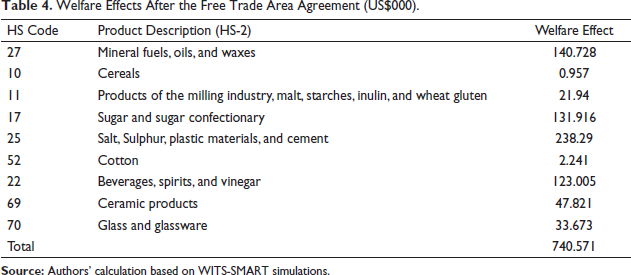
The sum of welfare gains realized from the selected product classifications is insignificant as they represent only 0.16% of Nigeria’s GDP as of 2019, which stood at US$446.54 billion (World Bank, 2019). Mineral fuels, oils, and waxes produced the most consumer welfare effects, valued at US$140.728 million, followed by sugars and sugar confectionery, valued at US$131.916 million. It is imperative to attest that the highest trade creation products were akin to the products that yielded the most welfare effect. This justified the existence of a more efficient producer within an FTA that benefits from the opportunity to produce cheaper and more efficient goods, leading to increased welfare. The third set of products with the highest welfare effects were beverages, spirits, and vinegar, valued at US$123.005 million, among other products stated in Table 4. The findings of this study regarding the welfare implication of AfCFTA are in-line with the results of Guei et al. (2017) for SA.
Conclusion and Recommendations
The study analyzed the potential impact of FTA on trade, revenue, and welfare in Nigeria. The WITS-SMART simulation anchored on a PEM with disaggregated trade data was employed to confirm Viner’s theoretical postulations. The result revealed that Nigeria is anticipated to have a trade creation effect valued at US$4,834.886 million in totality on the HS-2 products classification simulated. The trade creation is spread across a large variety of commodities. However, mineral fuels, oil, and products of their distillation, as well as salt, sulfur, plastic materials, and cement generated greater trade effects. The model further shows that Nigeria would witness consumer welfare gains valued at US$470.929 million after implementing the FTA agreement. Apparently, the consumer surplus would improve significantly by reducing items’ prices on HS codes 27 and 25. The model simulation output indicates that Nigeria is expected to incur revenue losses of about US$5,458.242 million due to tariff withdrawal from the FTA partners on the sampled products. It is worth noting that the possible revenue losses are 11 times greater than the welfare gains. This implies that policymakers must work on decreasing the revenue losses and improving the welfare benefits from liberalization. Thus, this study generally recommends that Nigeria needs to diversify its revenue base, as well as work on improving the revenue collection mechanism. This could be achieved by modifying internal revenue sources, like general sales tax such as value-added tax (VAT) and excise on some commodities, to cushion the deficit arising from the expected tariff withdrawal due to AfCFTA. The rationale behind this domestic consumption tax principle required aligning each percentage point reduction in the tariff rate on consumption goods with a one-point increase in domestic tax in consumption on that same commodity. This is because the welfare gains of joining AfCFTA would outweigh the effect of a sales tax increase as recommended.
Footnotes
Declaration of Conflicting Interest
The authors declared no potential conflicts of interest with respect to research, authorship, and/or publication of this article.
Funding
The authors received no financial support for the research, authorship, and/or publication of this article.
