




Abstract
This article estimates the import demand function for Botswana, which is rated among the fastest-growing countries in Sub-Saharan Africa. Using the autoregressive distributed lag (ARDL) approach to cointegration, the study finds that Botswana’s import demand is inelastic to the changes in import prices, both in the short run and in the long run, which resembles the import demand behavior in other fast-growing economies. The inelastic response of the import demand to import price is not surprising for a country that mainly imports diamonds, fuel, and machinery, all essential items for export production and economic development. The study further confirms that structural instabilities have a significant negative impact on Botswana’s import demand, which is an element that the policymakers must pay attention to. Considering the recent developments in the African continent, which include the recent ratification of the African Continental Free Trade Area (AfCFTA), this study suggests that policymakers in Botswana should revisit the country’s import policy and determine how Botswana’s imports can be positioned in a way that could benefit the sought-after intra-African trade.
Introduction
The economy of Botswana has, over the years, been experiencing buoyant economic growth, ranking the country among the fastest-growing economies in the world. Botswana’s economy has largely been boosted by the impetus from the mining sector, mainly involving diamonds, which have historically remained the country’s leading trade commodity. On the imports side, diamonds continue to be among Botswana’s top three imported commodities, particularly in the past decade. In terms of contribution to GDP, diamond mining accounts for more than one-third of Botswana’s GDP (Besada & O’Bright, 2018). Moreover, the increase in output in the diamond mining sub-sector has recently boosted the overall performance of the mining industry, which expanded by 4% in 2018 (Bank of Botswana, 2018).
Botswana’s Country Strategy Paper (2015–2019) focuses on two pillars that support the objective of economic diversification and inclusive growth. These pillars are infrastructure and private sector development (African Development Bank, 2021). Botswana has been importing significant amounts of fuel and electricity to supply energy for construction and other projects to achieve broader economic goals. Against this backdrop, the current study investigates the behavior of Botswana’s traditional import demand function. This allows estimating the associated elasticities that could be used to establish the responsiveness of Botswana’s import demand to changes in import price, income, changes in the prices of domestic substitutes, and structural changes.
Based on the previous empirical studies on import demand function, the following facts emerge: first, at the theoretical level, the demand for imports signifies the demand for products having close substitutes (Orcutt, 1950). Second, while the behavior of the import demand function varies across economies, import demand is primarily driven by income, as confirmed by studies conducted in emerging and developing countries (Arize & Nippani, 2010; Ngoma, 2020; Sinha, 1997a). Third, some previous studies emphasize the importance of including dummy variable import demand estimation to capture the effects of structural changes or import liberalization policies (Dutta & Ahmed, 1999; Zhou & Dube, 2011).
By including structural changes in estimating the import demand function, reforms in trade policy and external factors that affect trade patterns can be incorporated. An example is the 2008 global financial crisis that affected the advanced economies and their trading partners in emerging markets. Following the global financial crisis, Botswana, like other emerging economies, experienced weaker global demand for exports, culminating in a temporary suspension of production in the diamond industry in 2009 (Bank of Botswana, 2010, p. 65).
In the context of recent developments in the African continent, first, this study makes a significant contribution as none of the previous studies have investigated the import demand function in the manner done in the current study. Such empirical investigation would have widespread implications for informing policymakers and other researchers. Most importantly, this study comes at an opportune time when Botswana and other African economies have recently ratified the African Continental Free Trade Agreement (AfCFTA).
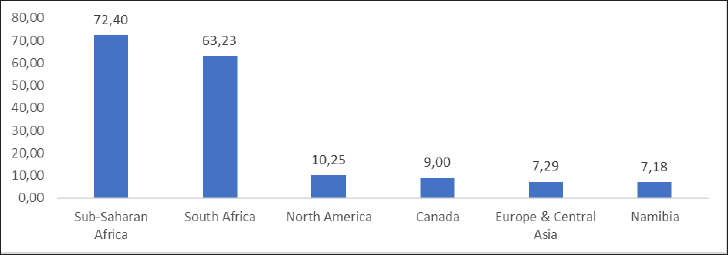
The AfCFTA mainly seeks to achieve trade and economic integration in Africa by facilitating the free movement of goods and services among African countries (Leshoele, 2020; Obeng-Odoom, 2020). However, as the data indicate, South Africa and Namibia are the only countries from Sub-Saharan Africa that feature among the top sources of Botswana’s imports. Furthermore, even though a substantial share of Botswana’s imports comes from Sub-Saharan Africa, they are mainly from South Africa, with little to no contribution from other African countries (Figure 2).
The findings from this study indicate the size and magnitude of the import elasticities, thereby demonstrating the responsiveness of Botswana’s imports to the country’s real income and domestic prices, structural instability, and the price of imports. Such information would help determine how best Botswana could position itself in the AfCFTA arrangement to gradually move towards sourcing some of the country’s imports from the African continent, especially given that Botswana is one of the fastest-growing African economies.
The second contribution of this study is the incorporation of structural changes into the import demand function. The current study argues that structural changes have much relevance to Botswana since the country’s imports, relative prices, and real income are subject to external shocks and other internal factors like the economic development process and trade policy reforms. Hence, this study hypothesizes that internal factors like changes in trade policy focus from import substitution to export promotion are likely to affect Botswana’s trade patterns. Moreover, the 2008 global financial crisis has disrupted Botswana’s trade patterns, among other external factors.
This article is organized as follows: the next section discusses the literature review, followed by an overview of Botswana’s economic and trade environment. The following section describes the methodology and subsequently discusses the results. The final section provides the conclusion and policy recommendations.
Literature Review
The existing literature on import demand reveals that different approaches to examining the behavior of the import demand function depend on the variables included in the analysis. According to Zhou and Dube (2011), variations in the modeling of the import demand depend on how income is measured. Unlike other variations, the traditional import demand demonstrates the relationship between real income and relative prices. Though the traditional import demand function involves only relative prices and income, Khan (1975) argues that it is sufficient to provide the basis for drawing valuable conclusions on the behavior of imports.
In estimating the import demand, imports are typically treated as imperfect substitutes as opposed to perfect substitutes for domestically produced goods. Under the imperfect substitution assumption, it is impossible for consumers to entirely choose imports over domestic goods or domestic goods over imports as there is some form of finite substitution between the two goods (Narayan & Narayan, 2005). If imports are imperfect substitutes for domestically produced goods, the a priori expectation is that the coefficient of domestic price is positively related to the demand for imports, ceteris paribus. Thus, as prices of domestically produced goods increase, consumers tend to switch to cheaper substitute goods, which are imports in this case. Such behavior is consistent with the demand theory. For example, Urbain (1993) estimated an import demand function for Belgium from 1953 to 1985 and confirmed a positive relationship between the domestic price and import demand.
However, it should be noted that the substitution between imports and domestically produced goods is not always significant in magnitude, as there are cases where empirical evidence points to an insignificant relationship between import demand and the domestic price. Some examples are the studies by Rehman (2007) and Sinha (1997b), who found evidence of an insignificant cross-price coefficient for Pakistan and Thailand, respectively, indicating the non-responsiveness of import demand to changes in domestic prices. In other cases, if imports comprise equipment and intermediate products, then changes in domestic prices tend to have an insignificant effect on import demand (Urbain, 1993).
The other factor that could lead to import demand being non-responsive to domestic price is trade policy. If a country engages rigorously in measures to promote exports, there could be an insignificant response in import demand even if domestic prices were to change in favor of imports. This was observed in the case of Thailand between 1955 and 1981, as indicated by Sinha (1997b), who found that an increase in domestic price did not significantly substitute domestically produced goods for imported goods.
Further evidence shows that imports can also be driven by the price paid by importers, which arises from the responsiveness of import demand to changes in import price. Import price, therefore, is one of the crucial determinants of import demand, especially in developing countries (Arize & Afifi, 1987). Theoretically, there is an inverse relationship between import demand and import price, consistent with the classical theory of demand (Murray & Ginman, 1976). Nevertheless, the responsiveness of the import demand to changes in import price could be positive or negative, depending on the composition of imports and their use in the destination economy.
Evidence shows that while some studies find a negative price elasticity in the import demand function (Agbola & Damoense, 2005; Arize & Afifi, 1987; Kreinin, 1973), other studies have witnessed an insignificant price elasticity (Gumede, 2000) or a positive price elasticity (Durmaz & Lee, 2015; Hossain et al., 2019; Zhou & Dube, 2011). The latter category of studies is usually based in countries whereby imports are dominated by intermediate and capital goods required for economic development. Uganda is an example from Africa in which aggregate imports primarily consist of capital and intermediate goods that mainly serve in production for export purposes (Samuel, 2015).
In one of the earliest studies on import demand function, Kreinin (1973) estimates an import demand from five European countries and another five OECD countries. The results from the study show that income demand is negatively related to price, although the magnitude of price elasticity was found to be relatively low. In another study focusing on 30 developing countries, of which 27 were from Africa, Arize and Afifi (1987) confirm a negative price elasticity for 23 of the total sample countries. Likewise, Agbola and Damoense’s (2005) study focusing on developing economies found a negative price elasticity in India’s import demand function in the market for pulses (chickpeas and lentils).
Although the price of imports is conventionally expected to have a negative relationship with import demand, there are some cases in which evidence points to a positive relationship between the two variables. In one of the recent studies conducted in various economies, Hossain et al. (2019) found a positive relationship between the relative price and import demand in the case of developing countries in both the short run and the long run. Similarly, Durmaz and Lee (2015) confirmed a positive relationship between the relative price and import demand in Turkey, implying that the trade balance might deteriorate if the import growth continues to surpass the export growth. In another study, Zhou and Dube (2011) estimated the import demand for China, India, Brazil, and South Africa between 1970 and 2007. The results confirm a positive and significant price elasticity, indicating that import demand in the studied countries continued to grow even in the presence of increasing import prices.
Other studies, including those focusing on African economies, confirm that real income is a significant determinant of imports. For example, Arize and Nippani (2010) found that in three African countries, namely Kenya, South Africa, and Nigeria, import demand is positively related to income but is highly elastic in Nigeria and South Africa compared to Kenya. In another study focusing on Zimbabwe, Ngoma (2020) found a positive and elastic coefficient of income in the estimated import demand function.
The above-reviewed literature indicates that import demand is traditionally dependent on the income of the importing country and relative prices. However, the direction and size of the effect of the determining variables on import demand tend to vary across countries, leading to inconclusiveness in the precise effect of the determinants of the traditional import demand for a given economy. Again, reviewing the existing studies, it can be deduced that Botswana has received little if any coverage, although some African countries were studied. Hence, the current research bridges the gap in the literature by estimating the traditional import demand function for Botswana to study the behavior in response to the selected variables. Intuitively, the findings of this study could assist future studies or policymakers in Botswana.
An Overview of Botswana’s Economic and Trade Environment
Botswana’s national development agenda has arguably set the direction and stance for the country’s trade activities. The key target areas in the country’s development agenda include economic growth, social justice, economic independence and sustained development (The Republic of Botswana, 2017a). Thus, over the years, Botswana has implemented a series of National Development Plans (NDPs), leading to the current NDP 11. The NDP 11 was adopted in December 2016 for operation from March 2017 to April 2023. Like the previous development plans in trade, the NDP 11 emphasizes on the need to diversify the economy away from its heavy reliance on the diamond sector (The Republic of Botswana, 2017a, p. xv).
Nevertheless, while the economic diversification drive (launched in April 2010) and other strategies have been put in place for economic diversification, Botswana’s trade sector continues to be dominated by the diamond trade. The importance of the diamond sub-sector in Botswana originates from its significant role in rescuing the economy from its poor economic status in the years following the country’s independence in 1966 (The Republic of Botswana, 2017b).
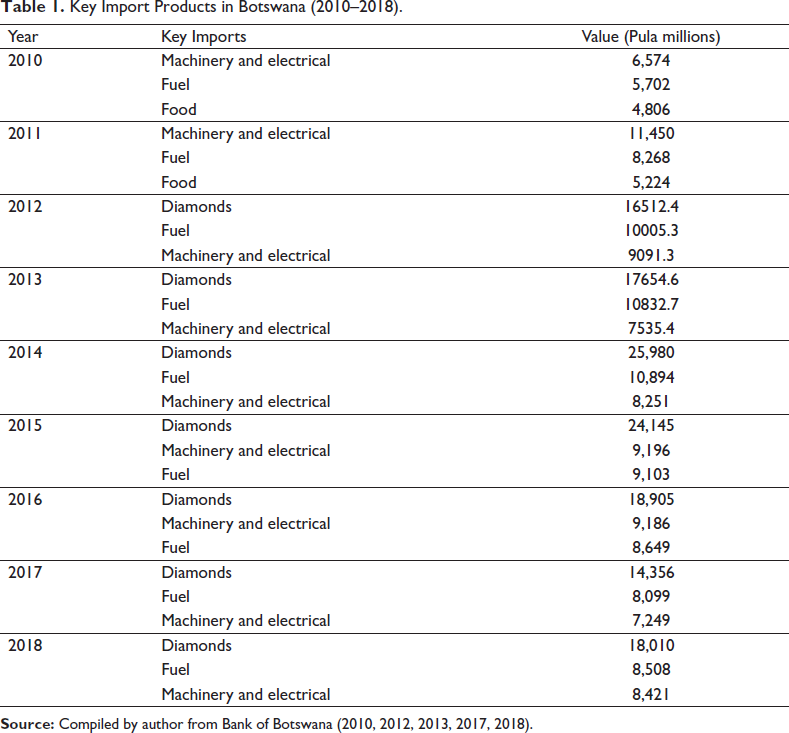
Considering the composition of Botswana’s major imports, as shown in Table 1, diamond imports have been predominant in recent years, particularly since 2012. One plausible reason could be their subsequent use as intermediary products for re-export to other global markets. According to the Bank of Botswana (2018) report, the surge in diamond imports has been mainly driven by domestic processing and re-export.
Key Import Products in Botswana (2010–2018).
Despite the significance of diamonds in Botswana’s economy, this trade is susceptible to external shocks. Following the global financial crisis (2008/2009), the negative effect on the price of Botswana diamonds affected the country’s GDP adversely, spilling over to other sectors that depended on the diamond industry (UNDP, 2014). For Botswana, the adverse effects on the mining sector, including the deterioration in global demand for diamonds, could constrain the economy since the diamond industry is closely linked to the country’s economic growth.
Besides diamonds, Botswana’s other major imports are fuel, machinery, and electrical equipment. These categories of imported goods are critical for several production processes, including power plants, hospitals, transport networks, mines, and infrastructure development. Consequently, the energy imports, including petroleum and electricity, have been of utmost significance in providing power to Botswana’s construction sector (Bank of Botswana, 2012).
Against this backdrop of Botswana’s economic success relative to many other sub-Saharan African economies, it can be argued that the efficacy of Botswana’s trade sector necessitates the coordination of the national strategies with the broader goals of the African Union’s 2063 Agenda, taking into consideration the AfCFTA.
Considering the AfCFTA, Botswanan’s involvement and commitment to the African Union is crucial since Botswana is one of the fastest-growing African economies. Botswana’s consumption of imported goods could benefit the African continent as these imports are sourced from the regional markets. This argument, however, does not imply that Botswana, or any African country for that matter, should completely shift away from engaging with its former trading partners outside the AfCFTA. Instead, like other African Union members, Botswana is encouraged to work towards promoting self-reliance within the framework of the African Union (Magliveras & Naldi, 2002).
The trends depicted in Figure 1 show that Botswana’s real income has been steadily increasing over the past four decades. Although the country’s imports have generally followed an upward growth path, the import growth has instead been unstable when compared to the real income growth. Some of the fluctuations in Botswana’s imports can be attributed to the changes in the domestic economy, coupled with the global economic crises.
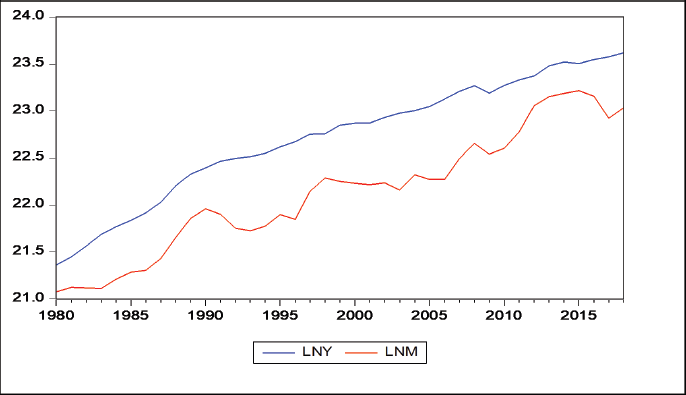
Starting with changes in the domestic economy, typical examples include the completion of some infrastructure projects coupled with the closure of some copper mines, which negatively affected the imports of machinery and equipment and fuel during the reviewed period (Bank of Botswana, 2013, p. 79, 2017, p. 92). Furthermore, the fluctuating trend in Botswana’s imports could have been due to the global economic slowdown around 2008, resulting in a slump in trade. There has also been a recovery in some major economies that serve as sources of import to Botswana. In 2018, apart from Sub-Saharan Africa aggregate imports, the top five sources of Botswana’s imports were South Africa, North America, Canada, Europe, Central Asia, and Namibia. The respective percentage shares of these economies in Botswana’s imports are indicated in Figure 2.
Methodology
The import demand function adopted in this study encompasses the traditional determinants of import demand: real income, domestic price, and import price. However, according to Urbain (1993), omitting the structural changes in estimating the import demand function could render the estimated elasticities doubtful and their usefulness in policy recommendation futile. In this context, the current study develops a dummy variable to account for structural changes. First, the Bai and Perron (1998) multiple break test is used to determine the significant break points in the data; following that, the study assigns break points to specific periods during which structural changes occurred, including those related to trade policy and economic development.
The resulting dummy variable (DUM) was assigned value 1 for the following years: 1984–1997, 2008, and 2016. The period from 1984 to 1997 marks when import substitution was in place, whereas 2008 corresponds with the global financial crisis. The year 2016 represents the time when some of the mining activities ceased their operations. The closed mining activities include the BCL and Tati copper mines (Bank of Botswana, 2017, p. 92).
The empirical analysis in this study employs the autoregressive distributed lag (ARDL) model based on Pesaran et al. (2001), leading to the following specification:

where the variables are defined as follows: M is the real imports, PM is the import price, PD is the domestic price, and Y is the real income. The underlying test to determine the existence of the long-run relationship uses the bounds test for cointegration. This test is based on the null hypothesis of no cointegration given by
Results and Discussion
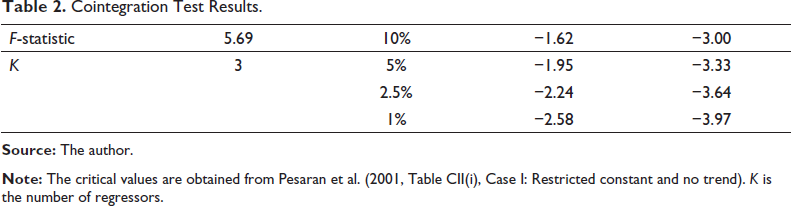
Comparing the results reported in Table 2 with the critical values in Pesaran et al. (2001) indicates cointegration since the value of the computed F-statistic (5.69) is above the upper bound critical value at a 1% significance level (−3.69).
Cointegration Test Results.
Following the cointegration test and having confirmed the existence of a cointegrating relationship, the error correction model is estimated, and the results are reported in Table 3. From the long-run results, it can be deduced that the coefficient of import price is positive and statistically significant, which suggests that an increase in the import price of imported goods will increase import demand. These results are not surprising considering that Botswana’s imports mainly constitute diamonds, fuel, machinery, and electrical equipment required to fuel the economy. The findings of this study are consistent with Zhou and Dube (2011). They argue that for fast-growing open economies, certain imports meant for development or export production continue to be imported even if their prices keep rising.
Results of the Long-run and Short-run Estimations.
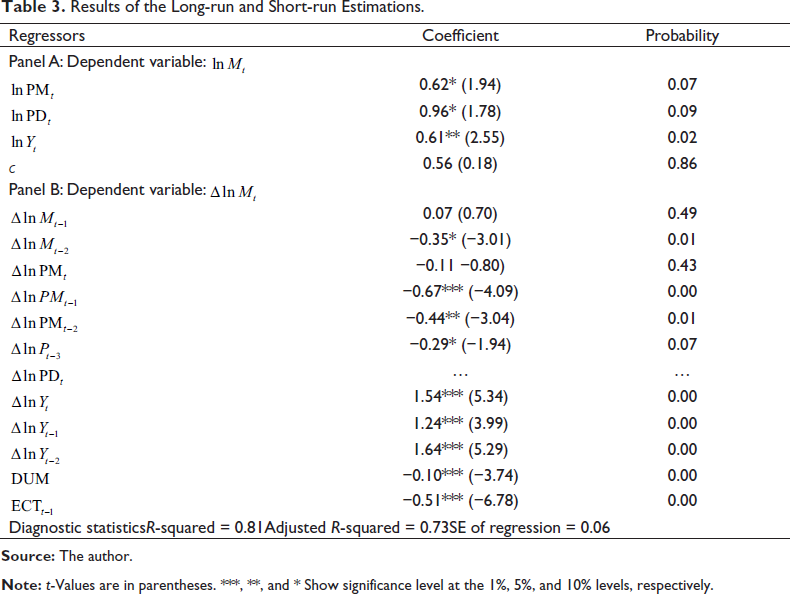
Regarding the domestic price, the findings of this study show that import demand responds differently to price changes, which concurs with some of the earlier studies on import demand, including Wilson and Takacs (1979). In particular, the long-run results reported in Table 3 indicate that the coefficient of import price is positive and statistically significant coefficient, which suggests some form of substitution between the imported goods and their substitute goods in the domestic market. This observation is consistent with the standard demand theory. The demand for imported goods tends to increase in response to an increase in prices of substitute domestic goods since imports will be relatively cheaper (Narayan & Narayan, 2005). Nevertheless, the sizes of the coefficients of domestic price and the import price indicate that Botswana’s import demand is more responsive to prices of domestic substitute goods than it is to changes in prices of imported goods.
The third observation from the long-run results indicates that the coefficient of real income is positive and statistically significant in the long run, although it is inelastic. These findings suggest that Botswana’s real GDP growth induces the demand for imported products, which is not surprising as the country has been importing in substantial quantities to advance the economy. Again, the results for Botswana are consistent with the findings from previous studies focusing on Africa, which confirm a positive relationship between income and import demand (Arize & Nippani, 2010; Gumede, 2000; Ngoma, 2020).
Regarding the short-run results reported in Panel B of Table 3, the following findings emerge: the coefficient of lagged import demand is negative and statistically significant, confirming the dynamic adjustment in import demand where the current import demand adjusts negatively to its past levels. These findings are consistent with Razafimahefa and Hamori (2005), who report similar results for Malaysia. The study further finds that though inelastic, the coefficient of past import prices is negative and statistically significant. Thus, it can be inferred that increases in import prices could have an undesirable lingering effect on imports in the short run.
Further, findings from the short-run results relate to income elasticity. The sign and magnitude of the coefficient of real income suggest that import demand is highly elastic and adjusts positively to both the contemporaneous and the past changes in income. These findings are consistent with previous studies, proving that real income is a significant determinant of imports. Nevertheless, the flip side of the positive effect of real income on imports is that the situation could have dire implications on the balance of payments unless the increase in imports is offset by a surge in export demand (Samuel, 2015).
In line with the expectations of the study, the coefficient of the structural instability dummy variable (DUM) is negative and statistically significant. This suggests that structural instability, including the 2008 financial crisis and the closure of some mining activities, could have negatively affected Botswana’s import demand. Again, the implementation of the import substitution strategy from 1984 to 1997 could have also contributed to the country’s structural instability.
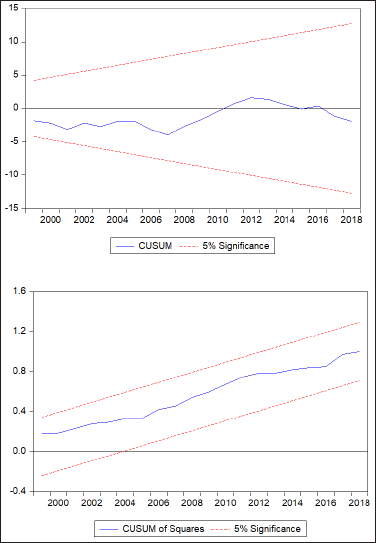
From the coefficient of the error correction term, which is negative and statistically significant as expected, it can be concluded that about 51% of the deviation from long-run equilibrium is corrected within a 1-year period. Furthermore, model stability tests conducted using the cumulative sum CUSUM and the quadratic cumulative sum (CUSUMQ) plots indicate model stability. Figure 3 presents the two graphs showing the results of the model stability test.
CUSUM and CUSUMQ Plots.
Conclusion and Recommendations
Botswana is one of the fastest-growing economies among other developing countries and is renowned for its prudent macroeconomic policy. However, like other developing economies, the country’s trade activities have been affected by structural instability ranging from external shocks to internal uncertainties. This study estimates the traditional import demand function using real income, domestic price, and import price as the key variables of the empirical investigation.
The selected study period, 1980–2018, covers two different major trade regimes, namely the import substitution and export promotion eras. The study further extends the analysis to incorporate the structural instability dummy variable. By incorporating the structural changes, the study addresses the effects of the previous import substitution regime and those encountered during the export promotion era. These include the 2008 financial crisis and the closure of some of the mining activities in Botswana.
The significant finding from the empirical results indicates that, like with other fast-growing economies, Botswana’s import demand is inelastic to the changes in import prices. This behavior of the import demand to its price is not surprising for a country that mainly imports diamonds, fuel, and machinery, which are essential for export production and economic development. Over the past decades, part of Botswana’s development agenda has been attaining sustainable economic growth and development, and increasing mining activities and infrastructure projects. Hence, the demand for imported products, especially those targeted at the production process, has been inevitable irrespective of the global price increase.
It also emanates from the empirical results that there is some form of substitution between imports and domestically produced goods in the short run, but not so in the long run. Thus, an increase in prices of domestically produced goods is likely to increase import demand, which could affect the trade balance adversely in the long run. Therefore, policymakers would have to ensure that the deterioration in the trade balance does not go beyond the short run. Over and above these findings, the current study confirms that structural instabilities, representing both the changes in trade policy and external shocks, have a significant negative impact on Botswana’s import demand. While the policymakers may not have much control over the external shocks, they could implement measures to deepen the intra-regional trade by closing deals with alternative sources of those imports aimed at major production sectors.
In line with the newly ratified AfCFTA agreement, this article suggests that policymakers in Botswana could bring the need to revisit the country’s imports to the fore and identify those that can be sourced from the African continent in a phased-in manner. Furthermore, for a country that is so heavily dependent on the mining sector, this article recommends that Botswana’s ongoing export diversification drive be aligned to some of the broader objectives of the African Union to assist the continent in attaining the deeper economic and trade integration that the AfCFTA seeks to achieve.
This article has some limitations, in that it only examines the traditional determinants of the import demand function. Future studies can include the following factors: the impact of domestic policies to stimulate the re-export trade, the impact of global value chains, the impact of trade costs, or the structure of different countries and groups.
Footnotes
Declaration of Conflicting Interests
The author declared no potential conflicts of interest with respect to the research, authorship, and/or publication of this article.
Funding
The author received no financial support for the research, authorship, and/or publication of this article.
