




Abstract
This article traces contemporary debates on labour regulation related to state-led labour laws and voluntary compliance in a macro context of de-regulation, dilution of workers’ rights and deterioration of labour relations, which have resulted in a decline in migrant workers’ access to trade unions. It argues that non-compliance of state-led labour regulations and compliance of voluntary governance exacerbated the precarity and well-being of migrant workers. It then explores the role of two civil society organisations (CSOs) in southern India—Gram Vaani and Radio Active 90.4—that use technology in redressing migrant workers’ grievances. In the empirical context of the pandemic, when both state and state-led labour laws and voluntary compliance failed in protecting workers’ rights, the article finds that CSOs have emerged as significant actors in bridging the gap between trade unions and migrant workers. The paper critically examines the strengths and limitations of such collaboration and advocates union revitalisation and coalition strategies to strengthen the voice of migrant labour in a post-pandemic world of work and employment.
Keywords
Introduction
Garment factories in Tiruppur and Bengaluru deal with two types of regulations: state-led labour laws and voluntary compliance. India had 44 labour laws, which are consolidated into four labour codes—the Industrial Relations Code (2020), the Code on Social Security (2020), the Occupational Safety Health and Working Conditions Code (2020) and the Code on Wages (2019). Voluntary compliance consists of buyers’ code of conduct, ethical trading initiatives, auditing, ranking, certification, complementary regulation, multi-stakeholder initiative and transnational governance. The evolution of voluntary compliance is linked with the Rana Plaza incident in Bangladesh. In response, the workers demanded an alternative governance mechanism which led to the formation of the National Tripartite Plan of Action (NTPA). It is an independent governance body—a legally binding multi-stakeholder initiative to avoid tragic accidents and regulate workplace safety (Wichterich & Khan, 2015). The initial turnaround of NTPA instigated rampant application of voluntary governance structures in the global South factories (Wichterich & Khan, 2015).
Piore and Schrank (2018) argue that state regulations are imprudent because violations result in the emergence of new independent labour laws leading to inconsistent and redundant regulations and are termed specialist regulatory agencies. We see that voluntary compliance applies similar practices resulting in poor and repetitive governance. Amengual (2010) and Alexander (2019) discuss voluntary compliance which guarantees global North buyers that production units in the global South follow core labour standards through certification. Typically, global South units use voluntary compliance as a means to push trade union activities to the periphery and promote workers’ committees (a detailed discussion is provided in the section ‘The Need for Coalition’). Applying voluntary compliance increases future order volume but failing to obtain certification will result in the cancellation of future orders (Anner, 2018).
Both these regulatory frameworks are fraught with problems such as corrupt practices, increased frequency in voluntary compliance, involving corporations (global North buyers and global South producers) and short duration of a coalition (De Neve, 2008). They adversely impact production by increasing their costs, thus fuelling violation and appropriation of migrant and women workforce in the garment factories (Mezzadri, 2017). Therefore, Soundararajan et al. (2019) have argued that voluntary compliance is a mere standardisation, having limited capacity of setting governance that could work for a global marketplace. The arguments suggest that as the state failed to avoid overarching labour laws, voluntary compliance is becoming an overbearing agency that is also failing to improve core labour standards. It results in growing power imbalances and gives global North buyers the recourse to bid for predatory purchasing practices under the pretence of voluntary governance.
Thus, drawing from these studies, the puzzle that emerges is—factories neglect state-led regulations, yet the same factories approve the implementation of voluntary compliance. Thus, it is evident that state-led labour laws and voluntary compliance are becoming detrimental to expanding the presence and outreach of trade unions and put them in a constant state of crisis (Munck, 2018). Furthermore, Sundar (2007) and Heery et al. (2012) argue that trade unions could forge coalitions with civil society organisations (CSOs) and prevent them from becoming obsolete. Trif et al. (2023) developed a multi-dimensional conceptualisation of unions through the lens of structure and institution 1 to prevent them from fading. In the 1970s, labour internationalism was foregrounded on the principle of amalgamating workers across the globe. Clawson (2005) provides a compelling argument that new forms of internationalisms made trade unions inclusive. Munck (2008) applied a transformationalist approach, arguing that global unionism is a combination of local/regional/global, and with this, there is a possibility of renewed interest in trade unionism. In an increasingly deregulated context, the available discourse suggests that revitalisation and coalition frameworks could not bridge the gap, as the coalition between a trade union and CSO is filled with conflict, hence are not long-standing.
Despite the in-roads, trade unions are also plagued by informality and political affiliations that prevent them from preserving workers’ rights (Ota, 2014). Against this background, this article—using the case of the community radio services of Gram Vaani and Radio Active 90.4—shows that CSO may bridge the gap between trade unions and strengthen workers’ governance. The alliance helps in building a relatively conflict-free coalition. The article argues CSOs may aid in the revitalisation of unions and apply coalition strategies in a deregulated global market. Therefore, we intend to show how revitalisation invokes workers to approach trade unions, can result in coalition and provide a platform to engage with workers. The rest of the article is as follows. The second section discusses the macro problems experienced by the state in regulating labour laws and simultaneously highlights the revival of trade union literature that puts a case for CSOs to reinvigorate trade union activities among the wider context of workers in contemporary capitalism. The third section introduces the methodology and data sources of the study and discusses the historical context of trade unions in the field sites of Tiruppur and Bengaluru in southern India. The fourth section, in the context of the pandemic, presents empirical data on wage theft of migrant workers before, during and after the pandemic to showcase the failure of state and voluntary compliances in a post-pandemic context. It also elaborates on the ways in which workers used Gram Vaani and Radio Active 90.4 to air their grievances and resolve some of their issues related to core labour standards. Finally, the fifth section underscores the strengths and limitations of coalition in a post-pandemic world of work and employment.
Undermining State-led Labour Laws: Macro Problem
The state aligned with capital and deregulated labour laws to organise production in the hyper-production and hyper-competition model (Anner, 2018). In this process, the state’s focus is on generating quantity employment rather than quality—thus enabling precariat employment on a massive scale (Papola, 2012; Thornley et al., 2010). In contemporary globalisation, there has been a reconfiguration of labour and capital relations, mediated by the state. Hence, trade unions could not handle structural changes (de-regulation and re-regulation). This furthered capitalist interest to create flexible labour market and pushed labour institutions, including trade unions, to the periphery (Sood et al., 2014). These debates highlight the changing dynamics between the state, capital and labour. Moreover, there is a plethora of contributions examining the impact of the neoliberal state and the extent to which trade unions could not partake in bridging the inequalities gap and dissuade to regulate work and employment (Ford, 2019). This debate points out that state and state-led labour regulations failed to regulate capitalist behaviour.
In addition to the above-mentioned factors, the decline of trade unions, globally, has been attributed to factors such as the plurality of trade unions, male domination, low female representation, not addressing the concerns of the migrant workforce and failure to broaden the horizon such as develop linkages, alliances, coalition and reforms (Turner, 2005). There are sufficient examples to highlight the contributions made by trade unions in combatting precarity (Hyman & Gumbrell-McCormick, 2017; Munck, 2018). In the industrialised phase, the trade unions were successful in achieving solidarity as the workforce was homogeneous, consisting of local workers and a majority of them were males. With changing times, that is, with heterogeneous labour force (migrant and women) and deregulated markets, trade unions struggled to counter precarity and failed to listen to the voices of a diversified workforce (Keune & Pedaci, 2020). This impacted solidarity and augmented exclusionary practices; trade unions withered and increased the welfare gap. The constant re-shaping of contemporary world markets has put a strain on trade unions, thus pressuring them for resurgence and reform (Turner, 2005). In this article, we focus on the strategies adopted, such as trade unions forming a coalition with Gram Vaani and Radio Active 90.4 by listening to the grievances and providing a solution.
The Need for Coalition
In order to understand the need for coalition, we examine the drawbacks in state-led labour laws and voluntary compliance. Piore and Schrank (2018) argue that state-led regulations are designed as a series of precise rules to address specific violations. This resulted in the emergence of multiple enforcement agencies with a relatively narrow jurisdiction (Piore & Schrank, 2018). In state-led regulations, factories trade off between the monetary cost of compliance and non-compliance; for example, if the monetary cost of non-compliance is high, owners will indulge in bribery, leading to corrupt practices. Thus, instead of deterring transgressions, it enhances the gap between the implementation of labour law and workplace practice Piore and Schrank (2018). Voluntary compliance is imposed by global North buyers than corporates in the global South. The main purpose of this compliance is to boost order volume (Kim & Davis, 2016; Lund-Thomsen & Lindgreen, 2014) and has very little to do with improving core labour standards in the global South factories (De Neve, 2008; Locke, 2013). Bartely (2011) argues that this mode of compliance has turned into a trillion-dollar industry, and there is no alternative mechanism in place to check the inefficiency or ineffectiveness that plagued the voluntary compliance system.
Workers’ committee is a significant aspect of voluntary compliance—it is imposed by buyers from the global North. Depending on the factory size, a number of workers’ committees emerge; for instance, in a large unit, we can find up to eight workers committees. 2 According to the buyer’s code of conduct, members of the workers’ committee must be democratically elected. However, at the factory level, we see that the selection of the members is at the discretion of the management. In small and micro-factories, we find that workers’ committees are outsourced to non-governmental organisations (NGOs), which are managed by relatives or friends of factory owners. The key committee positions are held by the management, thus questioning the relevance of workers’ committees. Moreover, workers’ committees are not legally binding; therefore, factory owners agree to implement them as they can systematically dismantle trade unions, which are legally binding regulatory entities.
This article shows how coalition strategies between trade unions and CSOs are important and how it could improve their presence, accessibility and functioning appeal to a wide range of workers. Trade unions could use technology provided by Gram Vaani and Radio Active 90.4 such as interactive voice response (IVR) consisting of voice-enabled data collection, voice-enabled conversational message delivery, automated voice-enabled question and answer service and podcast shows—these approaches could bridge a gap that exists between trade unions and migrant workers.
Coalition Strategy with Civil Society Organisation: Embedding Technology
Globally, progressive coalition debates have emerged in the context of the decline of trade unions, when the state maintains a neoliberal stance. This literature highlights coalition as one form of trade union revitalisation strategies; others include organising, labour–movement partnership, political action and international solidarity (Behrens et al., 2004). Although these multifaceted strategies broaden worker solidarity, it crucially depends on the conceptualisation of labour union revitalisation, which is based on four dimensions: membership, economic, political and institutional (Behrens et al., 2004). Membership strategy is one of the straightforward dimensions for analysing trade union revitalisation across the global, national and local levels—the aim is to increase the presence of workers density. However, in the context of globalisation, membership has had implications on representativeness, thereby making it unpopular among workers, thus declining their presence in trade unions.
The second mode is the economic dimension; its relevance is based on membership density; as this increases, the trade union will be able to leverage membership to gain workers’ economic well-being (Behrens & Hamann, 2019), for example, obtaining decent wages, working hours or improving their working conditions. Ironically, trade unions lost its ability to change attitudes and, hence, failed to meet the expectation of marginalised workers. Therefore, the impact of the economic dimension among workers has not resulted in union revitalisation. Political union revitalisation implies critical interaction of trade unions with stakeholders, such as government and supra-national bodies. In this method, unions could leverage their membership density to create an impact on the electoral process and influence policy-making, bargaining process and/or protecting workers’ rights. Nevertheless, this political dimension is temporary as it failed to garner workers’ interest in the long run.
Institutional dimension 3 is one of the key strategies that trade unions apply to revitalise their structure (Behrens et al., 2014). Within the institutional dimension framework, coalition and international solidarity are the next preferred options available for revitalising unions. In this relationship, Frege and Kelly (2003) argue trade unions forego absolute power and must operate with stakeholders (workers, employers, state and industry associations) with a degree of power. Frege et al. (2004) pointed out that coalition strategies are not new among developed societies. For example, in the United States, the United Kingdom, Germany, Italy and Spain, trade unions allied with the following organisations: living wage, anti-sweatshop, No sweat campaigns, anti-fascists and green organisations (see Foster & Scott, 1998; Hurd et al., 2003; Nissen & Rosen, 1999) in securing varying levels of positive outcomes in revitalising trade unions. In the global South, the Bangladesh Accord (textile and garment factories) is a classic example and is considered a major breakthrough for supporting worker’s rights legally. The governance of the accord is through a steering committee with equal representation from trade union signatories and company signatories (Wichterich & Khan, 2015). Drawing from these experiences, Sundar (2007) identifies that the intervention of CSO promotes better coalition and is suited to improving labour standards.
Mohan (2002) sees the ideas of the state and CSO as indistinguishable as both of them are committed to protecting people from exclusion. Accords are a result of a coalition among state, CSO and trade union; the aim is to provide interim relief, but Smith (2009) argued that in the context of neoliberalism, this system is not effective. The reasons for failure are coalitions are for a short term, with no financial assistance to remediate the safety issues, leaving many subcontracting units outside the scope of the accord (Wichterich & Khan, 2015). However, Edwards (2004) criticises both state and CSO further the interest of capitalist by keeping certain sections of people to remain poor. Therefore, coalition strategy is an outcome of moral pressure or business ethics and is not an attempt to improve shared responsibility and form a new form of governance to mend labour relations. Although it has brought some degree of success; the coalition is contested as it raises the question of the extent to which how power relations are negotiable between the state, civil society and trade unions.
We argue that embedding technology could provide an inclusionary framework to enhance coalition structure. Moreover, it could be efficient in governing migrant workers across the garment factories. Within the discourse of revitalisation, we see that the authority and power of trade unions are fragmented by capitalist strategies. 4 Capitalism is making trade unions obsolete (Thornley et al., 2010); they are not able to meet the interest of marginalised workers and, hence, are forced to adopt coalition strategy even though they do not enjoy absolute power. The purpose is to allow trade unions work together with CSOs to encourage grassroots involvement and perhaps improve the possibility of scaling membership density and eventually leverage. Technology being the fifth dimension could be a useful tool in revitalising trade union efforts for the people that belong to the bottom of the pyramid.
CSOs adapting technology using mobile phones are equipped in producing meaningful coalition, for instance, Wang et al. (2020) show how CSO use television and radio drama as a means to create awareness of health and education effectively. Seth (2018) points out how mobile usage could deliver welfare schemes to migrant workers during the pandemic. While pointing out the positive impact, it is also crucial to highlight challenging aspects, for example, biometric fingerprint failure, illegible fingerprints and corruption while using an Aadhaar-enabled point of service (Seth, 2020). Due to this, migrant workers were unable to access provident fund and failed to receive relief measures given by the government. Hence, technology could also disempower and escalate inequality in a short time (Seth, 2020).
Seth (2018) argues that the use of digital tools such as blogs, photos, video sharing revolutionised governance and awareness. For instance, the Municipal Corporation of Delhi (MCD) initially set up a Facebook page for people to submit photograph and video to register complaints about poor sanitation facilities. Many people could not register their grievances as the number was limited to 5 per day and access was restricted to Facebook users. Alternatively, MCD in collaboration with NGOs launched a voice-based IVR system to raise complaints. They are not only low-cost but effectively improved community interaction.
Methodology and Data Sources
Gram Vaani and Radio Active 90.4 are community radio stations. Gram Vaani is active in Tiruppur, whereas Radio Active 90.4 engages workers in Bengaluru. These CSOs produce popular podcast shows to discuss labour issues among migrant workers. Radio Active 90.4 produced 8,623 podcast tracks, whereas Gram Vaani has 36,000 unique caller bases, 50,000 workers air their grievances and impacted 48,000 workers. This is a faceless mode of expression; anonymity is particularly useful when women workers share their verbal and sexual abuse experiences. Technology enables a hybrid mode where workers do not have the fear of losing jobs or being recognised as members of a trade union. We argue this is a source of revitalisation provided by Gram Vaani and Radio Active 90.4 CSOs. These CSOs act as a platform to connect workers with trade unions to legally fight their violations or take advice from them to question their employer, thereby, forming a coalition. To study this aspect, we collected data on migrant workers from the cities of Tiruppur and Bengaluru using 30 podcast shows.
Table 1 provides a detail account of data sources and the data is collected using the purposive sampling strategy. In addition, data were collected from 120 migrant workers in Tiruppur (49 males and 11 females) and Bengaluru (24 males and 36 females) to understand the dynamics of earnings and wage theft during the pandemic. I also obtained data from seven workers-cum- Radio Jockeys (RJs) from the two CSOs. The data were collected using telephone calls, and each interview lasted for approximately 30 minutes. I could interview one employee from Gram Vaani. I also interviewed local workers (7), merchandisers (2), owner (1) and unemployed local workers (4).
Data Sources.

Tiruppur Background
Tiruppur is an industrial hub with deep value chains, while Bengaluru is a hub for readymade garment production. Tiruppur got its first knitwear factory in 1920 because of the labour struggles in neighbouring districts of Coimbatore, Salem and Madurai (Ota, 2014). Textile production is dominated by Naidu, while garment production is dominated by the Gounder community. The Naidu’s established large knitting and spinning mills while Gounders were involved in micro-scale businesses such as bleaching and dyeing, and mostly in home-based production (Ramamurthy, 2022). Tiruppur’s rich industrial struggle makes it an interesting/ legitimate case for the foregrounding trade union movements that occurred between 1920 and 2020. From 1940 and 1960, production was organised in a single unit and there were no traces of outsourcing or subcontracting. Outsourcing started in the 1970s after the visit of an Italian garment producer named Verona (Chari, 2000). Prior to this, Tiruppur was predominantly an agrarian economy. In the initial stages of industrialisation, the workers had permanent employment (Ramamurthy, 2021). However, in the view of Ota (2014), workers agitated for wage increases and this led to the close-down of many large factories. The study of Neetha (2002) gestured that institutional actors such as South Indian Hosiery Manufacturing Association and Tiruppur Export Association exerted undue influence on the outcome of trade unions and were successful in marginalising them. This organisation was successful in implementing piece rate wages, introducing shift time (12 hours) duration and revised wages every three years and accepting dearness allowance amount to put an end to the strike.
From 1969 to 1984, Tiruppur witnessed many strikes and lockouts, trade unions vehemently led the protest against working hours, working conditions, low wages, provident fund, insurance and dearness allowance. In 1984, Tiruppur witnessed its longest strike for 127 days to implement a dearness allowance, also known as general strike. During this time, the entire production ecosystem was shut. For example, when an employer tried to transport the goods using 30 bullock carts, it was burned down. It goes to show the intensity of the general strike. After the conclusion of the general strike, Gounders opened subcontracting units to escape the purview of trade unions that gripped the factories (Krishnaswami, 1989). Subcontracting practices successfully diluted the outreach of trade unions. Beyond 1984, Tiruppur did not witness any significant strike or lockout.
With the advent of subcontracting, migrant workers started to replace local workers and there was an increase in the female workforce. It helped units to avoid the formation of trade unions. In these circumstances, workers’ gatherings reduced substantially. Therefore, the associational power that trade unions harnessed from mutual solidarity lost its relevance. Every year, we see gatherings of local workers affiliated with the Communist Party of India participating in the May Day procession but giving no meaningful insight into solidarity as the numbers reduced from 20,000 to a few hundred.
Bengaluru Background
Ray and Peepercamp (2013) estimate that Bengaluru produced 20% of the national garment production and 8% of all Indian garment exports. Bengaluru has more than 1,200 factories and employs about 5,00,000 women workers coming from Northern and Eastern states such as Odisha, Assam, Jharkhand and Madhya Pradesh. Mani (2011) shows that in the 1980s, Bengaluru witnessed a strong struggle for establishing labour union. The emergence of an exclusive trade union for garment workers in Bengaluru emerged in the late 1990s. There are two trade unions for garment workers: Garment Labour Union (GLU) and Karnataka Garment Workers Unions. It is interesting to note that trade unions are popular among women workers because of the Self-Help Group (SHG) movement. They engaged with workers outside the factory gate. Over time, these SHGs turned into a Garment Mahila Mazdoor Kendra (GMMK) in 2004. Some of these trade unions have proactively protested against the management. For instance, GMMK organised demonstrations against the use of bare hands for mixing chemicals, and it was brought to the notice of the ILO and discussed in the European Parliament. In 2006, the Garment and Textile Workers Union (GTWU) demanded a raise of ₹200 as their minimum wage and were successful. In 2012, GTWU again protested as workers were laid off without settlement. However, GTWU intervened and got workers compensation. In both the cases, it is evident that mobilising workers is complicated, resulting in sporadic strikes and workers face challenges in attaining solidarity.
The difference between these two sites is Tiruppur has a history that spans over 100 years in production and trade union, whereas Bengaluru is a recent phenomenon. This section highlights the distinct approaches used in the two-research sites to establish contact, improve operational efficacy and break social barriers. For instance, in Bengaluru, RJs are women garment workers who led the initiative of participating in radio shows to describe exploitation, violation and appropriation experienced by them. The podcast shows are hosted in two languages: Kannada and Hindi. The drawback is that a worker can air their grievances only if they are members of the GLU or if they are enrolled in an associated trade union. The workers initially listen to the podcast shows, and it allows them to decide whether they want to take membership in the trade unions. Since language is not a barrier, it is able to garner the attention of workers, make them enrol into trade unions and obtain the benefits of the coalition.
In Tiruppur, Gram Vaani applied multiple strategies. First, it uses SHG to create awareness of labour laws through the Gram Sabha. In this manner, they are able to engage with local women workers. Second, Gram Vaani recruits migrant garment workers to spread information on IVR calling using pamphlets. The Gram Vaani phone platform provides actionable information and awareness to listeners. Every month, more than 150 queries are responded to, thus encouraging other workers to call and register their violation. Gram Vaani assists workers in providing offline guidance and mentoring while registering tricky complaints. In addition to this, they use programmes such as Vandu Murugan, Tirupur Kural and Nama Kural. Shramik Vaani and Sahaj Maanch especially engage with migrant workers. At the time of the pandemic, workers-cum-RJs played a crucial role in connecting migrant workers with Gram Vaani.
Findings and Discussion
From the discussions, it is evident that existing coalitions are not adequately reliable; therefore, migrants require platforms that are flexible, convenient and accessible to express their grievances. We highlight the role played by Gram Vaani and Radio Active 90.4—community radio stations that are designed to air grievances through the ease of using mobile phones. Table 2 highlights major grievances through podcast shows such as Shramik Vaani, Tirupur Kural, Namma Kural, Gram Sabha and Behind the Label. Gram Vaani, in their workforce and labour rights section, underlines 36,000 unique users and recordings of 50,000 worker voices, creating an impact on 48,000 workers. Gram Vaani reports that about 20% of the time workers who resort to SOS calls receive immediate attention. Workers use IVR to register their grievances. Based on the IVR content, Gram Vanni is able to create podcast shows that translate awareness among migrant workers. Gram Vaani created a platform for airing grievance, registering and tracking workers’ plight. They have been successful in collecting grievance data, building evidence and aggregating complaints. Moreover, Gram Vaani also leverages SHG platforms to educate local workers on labour laws. The SHG leaders briefly talk about what they understood and how they have used it to obtain benefits from their employers. This is relayed on the radio to instigate other women to use the resources of SHGs effectively. They talk about four things trade union membership, solidarity, minimum wages, provident fund and insurance.
Podcast Shows and Major Grievances.

Part of the revitalisation strategy is to make trade unions universal; the case of Nitika is to showcase how technology can break cultural and language barriers by using the IVR platform. This helps Gram Vaani to increase their outreach, credibility and achieve operational efficacy. Typically, 90.4 Radio Active breaks language and cultural barriers by appointing local and migrant workers as RJs. This unconventional strategy is also able to break the traditional norms that afflict the trade unions. Both Gram Vaani and 90.4 Radio Active apply unique strategies to revitalise unions and are able to build a relatively conflict-free coalition with trade unions.
Nikita is from Odisha working as a tailor in Tiruppur for five years. During lockdown, Nikita was not paid wages and was asked to come when the factory re-opened after six months. Nikita was informed that her employment will be treated as new and the company will not pay the six-month wages. Nikita did not agree to this condition and started working in another company. Nikita expressed her discontent with using IVR. Gram Vaani asked her to approach Penn Thozilalargal Sangam (PTS) for legal assistance. After assistance from PTS, Nikita received her unpaid wages after two years. Here we see a potential coalition building between the trade union and Gram Vaani a CSO.
The Case of Tiruppur
This is the story of Kannan working in a garment factory in Tiruppur; the management denied Kannan the PF amount. Once the grievance was registered with Gram Vaani, the grievance was transferred to advocate Geroge Marks from Tamil Nadu Labour Rights Freedom (TLRF), who admitted the case in district legal aid. The judge condemned this act and passed an order to settle the amount before 28 October 2020. In another case, a group of 10 women working in the garment factory registered a complaint as the company refused to give their PF amount after working for five years. The women also said that management has been deducting ₹1,000 every month from their salary towards PF contribution and when they asked for it the women were pushed out of the company gate. Ponnuswamy from TLRF asked them to submit valid documents such as company ID card, payslip, PF/Universal Account Number, Permanent Account Number and Aadhaar card to the district office. In this case, the workers only had company ID cards as the company did not provide any other document. Based on the legal advice, these women approached PTS and filed a case against the company and these women are hopeful for justice.
Shramik Vaani is an exclusive podcast show for migrant workers. The show gained popularity during and after the onset of the pandemic. Migrant workers could register their pandemic-related grievances such as livelihood and unemployment, relief distribution and wage theft issues. Rita Devi and her husband are from Bihar, they came to Tiruppur to work. Rita Devi stopped working after pregnancy and needed money to travel back home along with her husband and son. Rita Devi narrated that the company refused to give her give food, money and shelter. Since Rita Devi was not getting enough support from the government, she approached the Gram Vaani helpline to arrange for travel and safety. Santosh Sahu is a migrant worker from Odisha working in Tiruppur. He shares a single room with 10 people; all of them work for the same company. Santosh along with others is going daily to the company to see if there is employment. He and his roommates have been unemployed for 45 days and the company refused to give money for food, stay and water. From July 2021 to March 2021, Shramik Vaani captured 5,160 distress calls made by migrant workers after the government initiated the lockdown. With this information, Gram Vaani could distribute dry ration to about 100 families that were impacted by the lockdown.
The Shramik Vaani programme collects information from migrant workers in Tiruppur on work availability. Workers express their opinion, for instance, Amit Tiwari, said that after a long wait Amit has got a job and the employment is steady, slowly, factories are returning to full production. At the time of data collection in March 2020, Amit was expecting that by Pongal (January 2022), labour demand in Tiruppur garment factories would be saturated. Such information is relayed across India, and workers listen to this information and decide whether to come or look for job in Tiruppur or choose another destination.
The Case of Bengaluru
Radio Active 90.4 covers everyday experiences of violation and appropriation using the Behind the Label podcast show. Rukmini is an RJ at Radio Active 90.4 and also a garment worker. There are several women like Rukmini who perform RJ duty voluntarily on the Behind the Label podcast show and then go to work in garment factories. We will now analyse the podcast show hosted by RJ Asha, who is the primary speaker and the secondary speaker is Geeta Bhonsle. This podcast is 8 months old and the length of this podcast is 21 minutes. Geeta Bhonsle is from a Bhadravathi taluk in the Shivamogga district of Karnataka and has 13 years of experience as a tailor in various garment factories. Bhonsle arrived in Bengaluru in search of employment and better wages so that she could provide English medium education to her children. She started as a helper and has graduated to the position of a tailor. However, she does not receive her wages on time as there is no one to raise the voice against the management. Bhonsle said that when workers asked for 5 minutes break, the supervisor said ‘Do you think is this Dharmashala?’ Bhonsle said, ‘when we raised our voice, the supervisor targets us, making our life miserable leading to many workers quitting their job.’ Geeta Bhonsle passionately talks about the health issues faced by women working in the garment industry. Dust is a common source of pollution in the garment industry which causes asthma; when 100 sewing machines operate at the same time, then, it causes chronic headache. The sewing machines generate heat causing nose bleed; despite this, the women continue to work. Bhonsle ends the show by pointing out that supervisors are like butchers because they do not recognise the efforts that go into producing one T-shirt!
The second podcast show duration is about 22 minutes; the primary speaker is RJ Asha and the secondary speaker is Vasantha, a garment worker employed in Bengaluru. This podcast show was uploaded two years ago. Vasantha is from Chitradurga district in Karnataka and has 17 years of experience as a garment worker. She started as a helper and now she is a tailor. Vasantha explains that working in a garment factory is not easy and has a lot of difficulties; she discussed thyroid, asthma, menstruation and reproductive problems because of which young girls are admitted to the hospital. Vasantha discussed the tyrannical (dourjanya) working conditions experienced by women workers in the garment units. The supervisor speaks to us in ‘double meaning’ (disrespecting women’s body). The abuse does not stop at the workplace. When we stand at bus stops, drunk men pass comments on us, and the management does not do anything to protect us in such a situation; they make us work till midnight when they cannot provide safety!
In the third show under analysis, Savitriamma discussed two main issues—PF and workplace violation. The duration of this show is 32 minutes and was uploaded two years ago. Savitriamma started working as a helper in the garment factory. Initially, she found the work to be difficult, but after some time, she adjusted. Savitriamma talked about the power of supervisor:
Since he has direct access to production and the general manager, everyone is afraid of the supervisor. At the factory floor, the supervisor’s decision is final. If the supervisor thinks that a worker is unfit, then they are removed from the job, and if we do not listen to him, he spreads lie about us to the production manager. Some of the allegations levied against us are we do not arrive duty on time, we are not able to complete the hourly target set by the management, we are frequently taking short breaks, and always gossiping. The supervisor gives unrealistic deadline to complete the work and, if we fail, then he will throw the fabric on our face and hurls abuses at us.
In Bengaluru, there is a water crisis, the tank comes in the night (3 am). Because of this, Savitriamma gets tired. Once, when she asked for 5 minutes rest, the supervisor shouted at her. Savitriamma skips lunch to get rest. Savitriamma discussed the problems they encountered while visiting the doctor at the Employee State Insurance (ESI) hospital. 5 She said that ESI doctors do not come on time, because of which they lose one day’s wage. Since there are lots of patients, the doctor does not have time to check properly. Hence, the workers have to visit private doctors for treatment which is expensive.
The overall outcome for workers is that they can take the name of the factory freely and point at the management that causes violation. Workers speak fearlessly as their identity is masked. The workers in the garment industry can listen to this podcast shows while travelling to work or while returning from work. The 90.4 Radio Active provides a toll-free number for the workers to register their grievances or share their experiences. In Tiruppur and Bengaluru, it is evident that workers are dismissed from the company for asking their rights. Meanwhile, these workers join another company and at the same time fight for their rights.
Relevance of Coalition and Revitalisation in a Pandemic Context
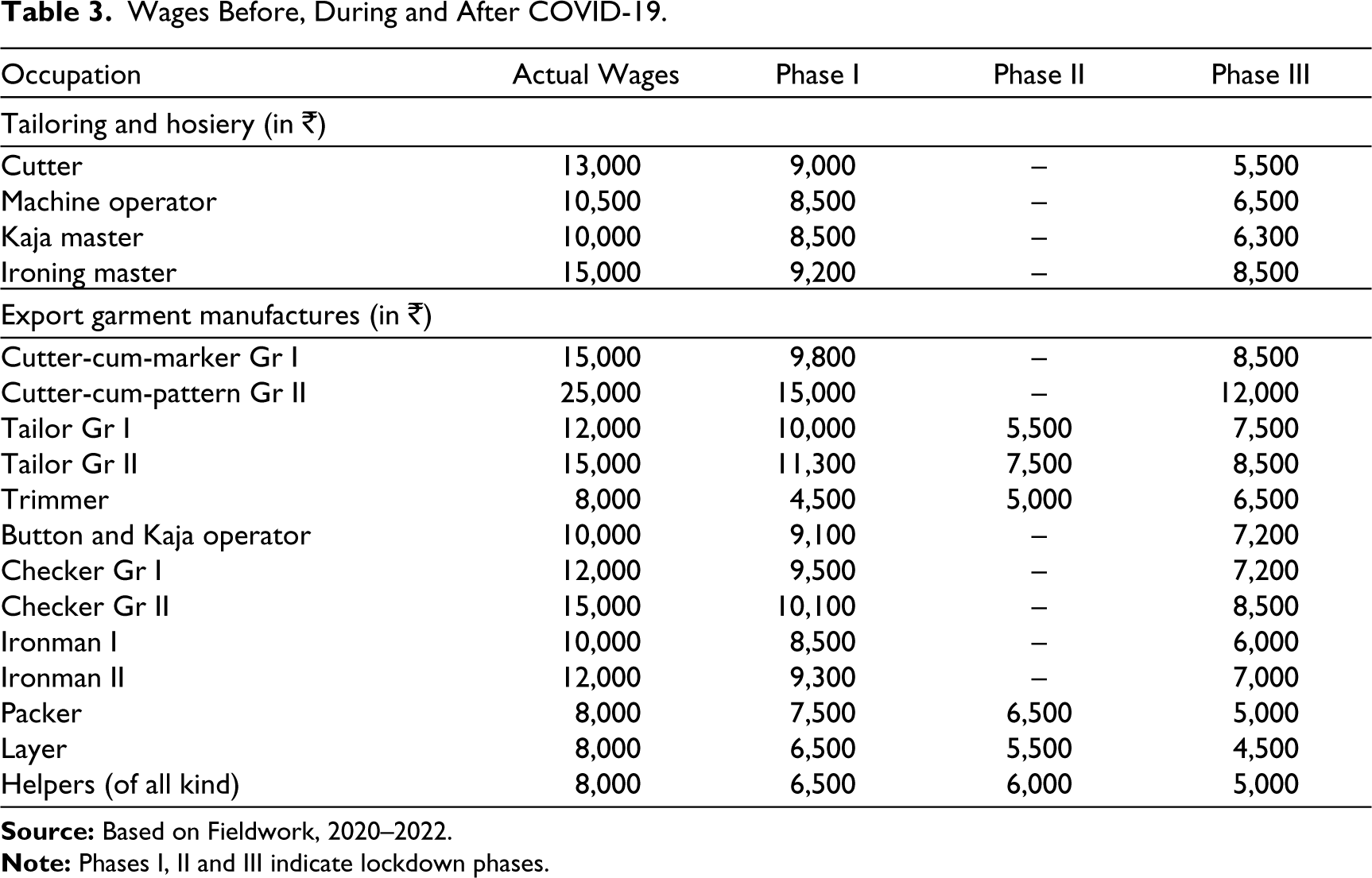
During the pandemic, the government failed to mitigate critical challenges faced by migrant workers, such as increases in rent, food shortage, transport facility to workplace and inflation of essential goods. This section shows the extent of wage theft experienced by migrant workers thus iterating at the drawbacks of state-led regulation and voluntary governance. On the one hand, we have companies that did not apply state-led regulation, on the other hand, we have the same companies willing to pay for voluntary compliances such as auditing, certification and ranking to keep the inflow of orders. Table 3 highlights wage theft that happened during three different phases of the pandemic. The literature points out the ways in which wage theft was examined before the start of the pandemic, for example, Anner (2020) blamed the free-on-board (FoB) pricing structure. Since the beginning of the pandemic garment producers were unable to hoard cotton so they accepted orders on the current cotton price and this adversely impacted the revenue of the garment producer. In addition to this, global North buyers insisted on lowering the FoB prices. All these factors directly impacted workers’ wage (Anner, 2020). Hence, factories started to lower wages and were unable to pay wages for completed jobs. None of these incidences were reported when applying voluntary compliance. State-led regulators could not help migrant workers as they were not registered in the muster roll.
In my sample of 120 workers from Tiruppur and Bengaluru, not a single worker received wages from March. Therefore, migrant workers forfeited their earnings in search of new jobs. The analysis suggests that wages mirror a V-shaped recovery (Table 3). From this analysis, it is evident that state-led labour laws and voluntary compliances did not take enough measures to address wage theft. However, the article particularly points to the initiatives of Gram Vaani and Radio Active 90.4 used by migrant workers in resolving their issues by airing their grievances (see Table 2). This goes to show a disconnect between state regulations and voluntary compliance as this is amplified during the pandemic. This points to the migrant workers’ state of affairs and the findings emphasise having a space to air migrant workers’ grievances. The findings of this section culminate that CSOs such as Gram Vaani and Radio Active 90.4 by using digital tools could become a preferred agency for coalition framework; in turn, revitalisation is possible as CSOs provide a platform for workers to connect with trade unions, which is relatively conflict-free.
Wages Before, During and After COVID-19.
Concluding Remarks
The article shows that state-led labour laws and voluntary compliance are unable to build solidarity; it puts unions in a constant state of crisis. Although the literature argues that revitalisation and coalition could bring stability to trade unions, such coalitions are not conflict free. Hence, it poses a serious challenge in advancing workers’ rights, and in its current form is inept in forming long-term and effective coalition frameworks. This brings us to the main debate offered in this article—offering insight into the ways in which CSOs managed to have significant outreach and provide a relatively conflict-free coalition by embedding technology.
However, the article particularly points to the initiatives of Gram Vaani and Radio Active 90.4 used by migrant workers in resolving their issues by airing their grievances. This article shows how a coalition between trade unions and CSOs could improve the presence, accessibility and functioning of trade unions and appeal to a wide range of workers. Trade unions could use technology provided by Gram Vaani and Radio Active 90.4 such as IVR consisting of voice-enabled data collection, voice-enabled conversational message delivery, automated voice-enabled question and answer service and podcast shows—these approaches could bridge a gap that exists between trade unions and migrant workers. Therefore, the article shows how revitalisation invokes workers to approach trade unions while providing an opportunity for a relatively conflict-free coalition.
We have seen that CSOs ensure anonymity, but when workers seek help, they might have to give up their identity or obtain membership. In the case of Tiruppur and Bengaluru, we see that worker reveal their identity while seeking compensation; hence, a worker is forced to choose another factory. In the new workplace, the worker’s identity is again masked unless and until she/he comes across a violation for which he/she has to reveal their identity as a member of the trade union. However, we have not deliberated this in the article, and it requires further exploration. Investigating further into strategies to protect workers’ identity could be beneficial for advancing workers’ rights. Nevertheless, technology, here, is aiming to bridge the gap of bringing the worker and trade union on the same platform while trade union can use a degree of power to renew the membership and attain solidarity by expanding their network to women and migrant workers in Tiruppur and Bengaluru.
Footnotes
Acknowledgements
I would like to thank Dr Valeria Guarneros Meza for the helpful comments on an earlier draft of this article. I would also like to thank Dr Amrita Datta for pointing out useful references in the trade union revitalisation literature and for providing overall support in writing this article.
Declaration of Conflicting Interests
The author declared no potential conflicts of interest with respect to the research, authorship and/or publication of this article.
Funding
The author received no financial support for the research, authorship and/or publication of this article.