



Abstract
Internal migration, nearly four times more than the migration across national boundaries, accounts for the largest human movements in the world. In context of agrarian distress, circular migration between the rural and the urban is a common livelihood trajectory of at least 100 million Indians. It is known that circular migrants face numerous economic and social challenges of survival in the city. This article focuses on gendered experiences and strategies adopted by migrants for inclusion in informal settlements in Bengaluru. Drawing on the concepts of social exclusion, inclusion and agency, we use household surveys (n = 1,109) in 30 informal settlements in Bengaluru in 2016, semi-structured interviews (n = 20) in one informal settlement, key informant interviews (n = 5) and participant observation in events and meetings in the city to illustrate individual and collective strategies used by diverse groups and the ways in which these are gendered. We find that the length of stay in the settlement is a crucial determinant of social inclusion in the city.
Introduction
Internal migration accounts for the largest human movements across the globe. Internal migration has contributed to urbanisation: 55% of the world’s population resides in urban areas in 2018 as compared to 30% in 1950 (United Nations, 2019). In rural India, growing agrarian distress makes it impossible to have a livelihood solely based on agriculture (Mishra, 2020; Vasavi, 2012). Precarious work in the urban informal sector and higher costs of living have, however, resulted in fewer rural inhabitants fully relocating to cities in India. Instead, seasonal and temporary migration as well as commuting persist (Breman, 1996, 2011; Deshingkar & Farrington, 2009; Srivastava, 2012). Circular migration is the temporary, often seasonal movement of workers from their place of residence for employment and is central to the provisioning and reproduction of their families. Circular migrants are estimated to be over 200 million people in 2011–12, based on the India Human Development Survey (Nayyar & Kim, 2018, p. 18). The Census of India as well as the National Sample Survey Organisation are limited in capturing short- and long-term circular migration (Deshingkar & Akter, 2009; Srivastava, 2011). Scheduled Castes (SC) 1 and Scheduled Tribes, located at the bottom of the social hierarchy, often have no choice but to migrate in order to make a living and repay their debts. As a result, they often end up in conditions of neo-bondage as migrants, with little freedom to choose alternate employment trajectories (Acharya, 2020; Breman, 2010; Centre for Equity Studies, 2013; Lerche, 2011).
In the urban, precarity manifests itself as temporariness of work, uncertainty and risk, informality of contract, wage squeezes and lack of mobilisation (Schierup & Jorgensen, 2017, p. 6). Several studies in Indian cities have demonstrated manifestations of precarity across a diverse occupational spectrum (Breman & Van Der Linden, 2014; Jha & Kumar, 2016; Samaddar, 2016; Zaidi et al., 2017, p. 34). Precarious livelihoods both reproduce poverty based on caste, class and gender, and produce new and overlapping vulnerabilities emerging from rapid urban growth and the lack of adequate public services, ecological degradation, dispossession from land and indebtedness (Rigg et al., 2016).
Given the context of economic and social exclusion in the city, we ask how migrants exercise agency and what are their experiences and strategies for inclusion in the city. In the following sections, we illustrate both individual and collective strategies used by diverse groups and the ways in which these are gendered. The article is organised as follows: in the following section, we lay out the empirical and conceptual literature relevant to understanding gendered strategies for inclusion in cities. The section on context and methods elaborates on the stages of economic growth in Bengaluru since the 1990s, the growth of informal settlements in Bengaluru and explains the methods used in the study. The results section focuses on the relationships (individual and collective), resources (material and social) and rights (state social protection) that are critical for inclusion over a period of time. As a result, we find that recent migrants to the city are particularly disadvantaged due to mobile and precarious lives in the city.
Social Exclusion, Inclusion and Agency
Scholars are unanimous on the experiences of social exclusion in Indian cities, expressed in residential segregation, poverty and inequality. Residential segregation on the basis of religion, or caste, has been studied in several Indian cities, with its consequences for access to basic services and labour markets (Bharathi et al., 2018, 2022; Chandrasekhar & Mitra, 2018; Gayer & Jaffrelot, 2012; Mhaskar, 2018; Sattar, 2018; Singh et al., 2019; Susewind, 2017). Others have shown the lack of inter-generational occupational mobility within households in informal settlements (Krishna, 2013; Mitra, 2006; Rains et al., 2018). In Bengaluru, apart from the status of the settlement as notified or not, and the stratifications created by caste, education or occupation, Krishna (2013) points to the downward spirals resulting also from adverse life events like illnesses, accidents, deaths and marriages. In this article, we find that inclusion and exclusion also appear to be mediated by the migrants’ length of stay in the city.
Social exclusion is a framework that is relational and goes beyond material dimensions, allowing for an analysis of social relations between individuals across age, caste, class and gender. Social exclusion is most commonly defined as ‘the process through which individuals or groups are wholly or partially excluded from full participation in society in which they live’ (European Foundation for the Improvement of Living and Working Conditions, 1995, p. 4). In developed countries, it is seen to reflect exclusion from welfare benefits resulting from both the rupture of the social bond and concentration in the informal workforce, often considered the norm in the context of developing countries. Nevertheless, given its relational approach, the idea of social exclusion rejects the individualisation and exteriorisation of poverty, seeing it as embedded in diverse sets of social relations (Mosse, 2007).
This is acknowledged in de Haan and Maxwell’s (1998) heuristic of rights, resources and relationships that focuses on the relations and processes that cause deprivation. Rights here are understood as human rights, legal and civic rights, as well as democratic rights; resources include human and social capital, access to labour and product markets, and common property resources, and relationships that go beyond family networks to wider support networks. Democratic and civic rights, as well as access to legal support, are fraught for migrants in the city. Lefebvre argued that the right to participation and appropriation (seen as distinct from the right to property) is implicit in the right to the city (Lefebvre, 1996), while studies in the Indian context repeatedly affirm the denial of these rights to migrants. The ability to appropriate space and ‘inhabit’ the habitat requires the possibility to use space for daily routines. This involves the access to housing and basic amenities such as food and water.
In developing countries like India, access to resources such as land, labour and credit, and, therefore, exclusion from these key resources determine livelihood and social mobility. In the urban context, residence in urban settlements is the most important resource measured by the acquisition of title deeds, as linked to this is the state provision of necessities such as piped water and sewerage, also a measure of resources. The very process of migration to and resettlement in a city may lead to a loss of resources, such as land or the right to food (Wood, 2003), thus making migrants more vulnerable to social exclusion. The plight of migrants, stranded in cities during the COVID-19 lockdown in March–April 2020, led the government to rethink place-based rights, especially to food and housing (Rao et al., 2020). In addition, resources go beyond material endowments as understood conventionally, to the material and social resources, including education, social networks or collective organisation, that provide a potential for agency, by enhancing options and therefore the ability to exercise choices (Kabeer, 1999).
The gender-analytic approach, which considers relationality as not just the relationship between individuals, community and the state but the ‘social relations which define the terms and conditions’ (Jackson, 1999, p. 134) of inclusion or exclusion, helps us analyse de Haan and Maxwell’s third dimension, namely, relationships. With its emphasis on agency, which is typically missing from structuralist approaches that focus on entitlements alone or relegate agency solely to excluders, gender analysis allows for an understanding of how the excluded ‘engage their marginality by protesting, reinterpreting, and embellishing their exclusion’ (Tsing, 1993 cited in Jackson, 1999). Such an approach enables us to investigate the gendered strategies for confronting this exclusion and claiming inclusion.
Inclusion and exclusion are then two sides of the same coin. In the context of women domestic workers migrating from Jharkhand to Delhi, Rao (2011) demonstrates that while migrant workers may be excluded at their workplace, they may gain status and respect in their rural homes, both due to their remittances and the spatial separation which can hide the actual work they do (Datta, 2018; Rao, 2014). The spatial separation of the place of work and home also results in a phenomenon of translocal householding, wherein migrants to the city share the labour and costs of social reproduction across geographies (Gidwani & Ramamurthy, 2018; Ramamurthy, 2020). Of course, these experiences are not uniform, but vary by the social identity, gender and class position of the migrant workers, with less educated, rural poor, ethnic and religious minorities and the lower castes doing poorly, and women among them, even worse (Collins, 1998; Crenshaw, 1991). Taking an intersectional approach, disaggregating the data by caste and gender, and the length of stay in the city, is therefore critical to our analysis.
While entrenched gender and caste norms reinforce low-paid opportunities for women and the lower castes, we find a range of state interventions targeting these groups, self-help groups (SHGs) of women being one example. Another is the political mobilisation of the SC or Dalits through the Dalit Sangharsh Samiti (DSS), fighting for rights and political inclusion, even though discrimination may prevail in the labour markets. Inclusion and exclusion seem to work simultaneously here, with collective agency used to challenge exclusion and bolster inclusion, at least politically and discursively. Wider social networks beyond the family are then needed to support living in the city and labouring in the informal economy. This wider network includes labour contractors or labour brokers, who could be kin, or caste members, often older migrants supporting the migration of their friends and relatives from distant villages, dominant castes holding ambivalent positions between castes and classes (Picherit, 2009, 2018), or state and civil society interventions.
The mutual dependency of agency and structure are key to the discussions of social exclusion and inclusion (Wright, 1995). Agency is understood as the ability to make meaningful choices and strategic decisions (Rao et al., 2019), which may involve not only the ability to act, but also negotiations, deceptions and manipulations (Kabeer, 1999). Agency in labour geography became synonymous with the unionisation of workers, while structure reflected the capitalist system (Coe & Jordhus-Lier, 2011). However, in the neoliberal context in the Global South where the majority of workers are in the informal sector, more fragmented expressions of agency are observed. Thus, we see both individual and collective agency at play, with structures including social institutions of kinship, gender and religion, having an important role in workers’ acts of resistance (Ong, 1991). This theorisation of agency enables us to look at dispersed individual expressions of agency, such as decisions of migration and the role of marriage and social networks in this process, and collective expressions of agency, in this case through the SHGs or DSS.
Context and Methods
Bengaluru’s formal sector growth underwent three phases after Indian independence. The public sector phase in the 1940s and 1950s saw the migration of people to work in government sector jobs alongside the growth of townships in Bengaluru (Heitzman, 2004; Nair, 2005). With the outsourcing of the manufacture of several components to small-scale industries in the 1970s, an unorganised labour force with lower salaries and poorer working conditions than in the public sector came into being (Pani, 2009). This spurred the garment sector phase in the mid-1970s which saw the migration of several informal workers from around Bengaluru to work in the garment factories in the city (Pani, 2009; Pani & Singh, 2012).
The most recent phase has been the growth of the IT sector in the late 1980s which has attracted young workers from all over the country (Sudhira et al., 2007). The employment in the IT sector in India in 2006–07 was about 1.6 million of a 110 million urban workforce, covering those in IT services, engineering services and software products, ITES-BPO sector as well as domestic IT professionals (Chandrasekhar et al., 2006; Upadhya, 2011). While the sector contributes greatly to the generation of income and foreign exchange, the IT industry employed 3.97 million (NASSCOM, 2018) of the 156 million strong urban workforce in 2018. 2
Apart from formal sector growth, there has been an increase in the informal sector as well, particularly in the construction industry (Pattenden, 2012; Picherit, 2012). The construction sector saw a high growth rate from 2002–03 to 2007–08 nationally, after which growth was lower due to the 2008 global financial crisis (Srivastava & Jha, 2016, p. 3). The number of people working in the sector in Bengaluru city has increased by nearly 50% from 143,343 in 1999–2000 to 215,403 in 2011–12 as per NSSO estimates. Most of them are labour migrants (Srivastava & Sutradhar, 2016) from poorer districts of northern Karnataka and Andhra Pradesh, mainly SC (Bowers, 2019; Pattenden, 2012; Shivanand, 2020). Recent migrants maintain a link with their rural homes where agriculture is practised which offers some security in situations of crisis. They circulate between the city and the village, maintaining a foot in both places. Prior research has focused on various aspects of circular migration in Karnataka, from its role in the urbanisation of the village (Iyer, 2017) to possibilities for upward mobility for labouring migrants (Pattenden, 2012) or the impermanence of life in the city for circular migrants (Shivanand, 2020). The ways in which gender norms converge with employment to inhibit women workers’ mobility (Bowers, 2019), or their gendered strategies of inclusion remain under-explored.
Low-income migrants typically live in informal settlements. One of the key events in the life of an informal settlement is the process of notification, a legal designation given by the Karnataka Slum Development Board in Bengaluru. This process takes several years to complete (Krishna et al., 2014) and is crucial to the life of the settlement. The total number of notified settlements in Bengaluru as per the Karnataka Slum Areas (Improvement and Clearance) Act (1973) is 246, while non-notified settlements are 290. 3 However, it has been found that in several cities, the number of notified settlements is the tip of the iceberg (Bhan & Jana, 2013), and activist groups working on informal settlements suggest there are at least four times the official number of informal settlements in Bengaluru (Benjamin, 2000, p. 38). Notified settlements in Bengaluru have also been found to consist of older migrants to the city. It is well understood that service provision by the government of potable water and sanitation improves after notification (Nolan et al., 2017). While studies on Indian informal settlements have highlighted differentiation across notification status, how strategies used by residents of varied migration statuses gendered are less understood.
The greatest social exclusion takes place in non-notified settlements, as these are often much newer habitations, with relatively more temporary housing structures and a larger proportion of recent migrants to the city. Yet, notified settlements, especially along growth corridors, provide the grounds for comparison of households and individuals of diverse migrant trajectories over a long period of time. Our primary qualitative data collection is therefore located in a notified settlement.
In this article, we used mixed methods to study patterns of inclusion and exclusion, focusing in particular on the duration of migration, caste and gender. The data comprise surveys of 1,109 households in 30 informal settlements (of which 11 were notified settlements) in Bengaluru in 2016, 20 semi-structured interviews in a notified settlement with migrants and non-migrants, as well as five key-informant interviews with organisations working with migrants in Bengaluru. Apart from these interviews, participant observation was carried out in public events/meetings of relevance to this study through 2017–18, such as the First All Karnataka Bengali Migrant Workers Conference—where activists, politicians from West Bengal, leaders and residents of a large informal settlement in East Bengaluru, members of social justice movements participated; a meeting organised by a union to enable domestic workers (inter-state migrants) to organise, attended by 19 domestic workers in an informal settlement in East Bengaluru; and public events and classroom lectures by activists working in informal settlements.
The survey, conducted as part of the ASSAR (Adaptation at Scale in Semi-arid Regions) project, 4 covered aspects of physical infrastructure, household characteristics, social protection entitlements and social networks. The survey data were analysed using SPSS. The informal settlements in the survey were chosen based on three criteria: (a) the settlements are located in low-lying areas; (b) proximity to infrastructural corridors, hence rapid land-use change as well as migration; and (c) demographic factors such as population density, social and economic marginalisation (see Michael et al., 2018). In each informal settlement, the households were selected using standard door-to-door sampling using the right-hand rule with a sample proportional to the total population. The infrastructural corridors where the informal settlements were chosen are illustrated in Figure 1.
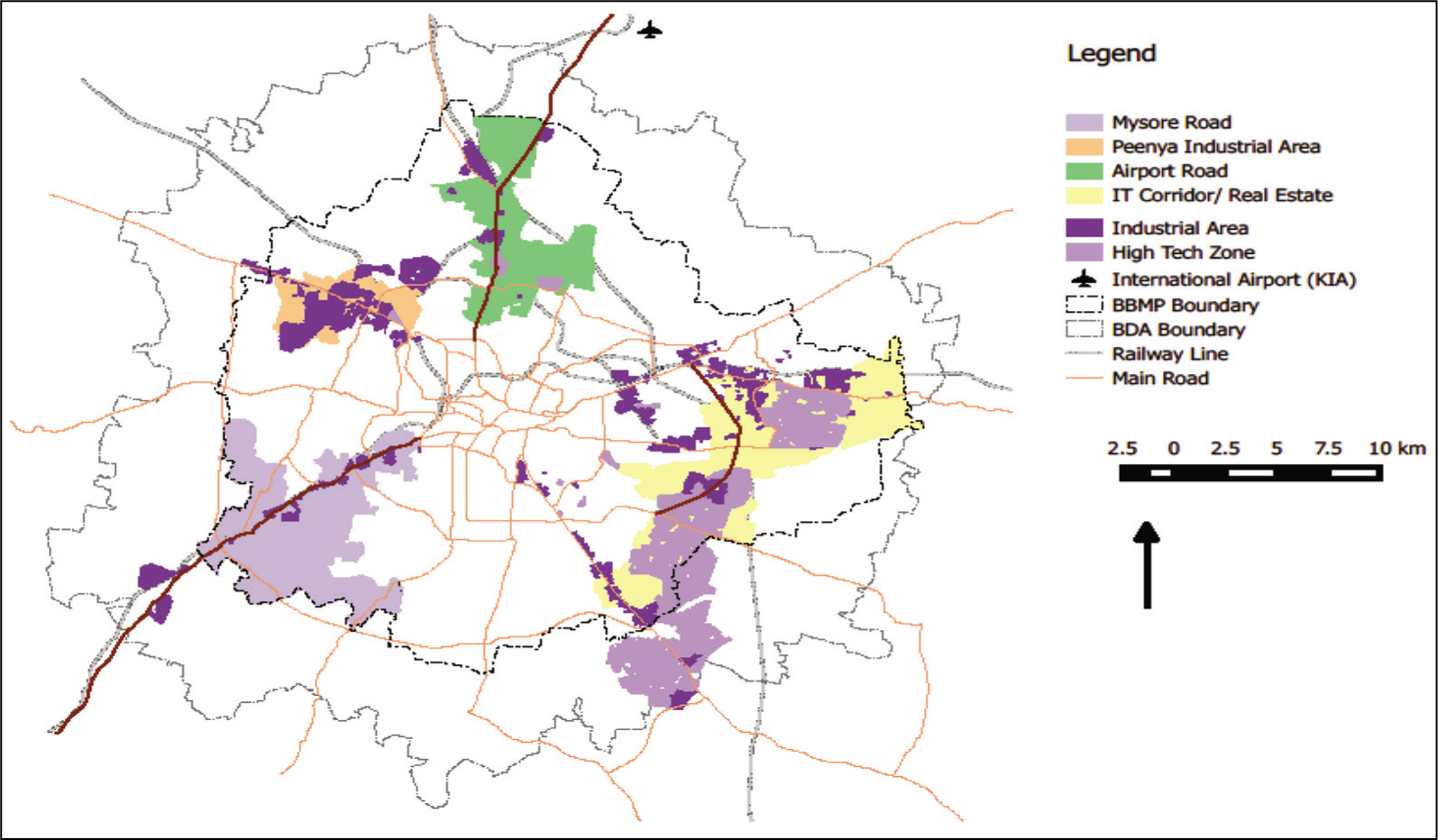
For our in-depth study, we chose settlement 8 on the Northern corridor. This settlement had a distribution of migrants by time of residence, allowing for a study of differences between categories of migrants. Recent migrants in settlement 8, while small in number in a notified settlement, were primarily Dalits, while older migrants were predominantly Dalits and OBCs. 72.8% of the non-migrant households in settlement 8 were Dalits, and nearly a fifth were OBCs. Purposive sampling was carried out to conduct semi-structured interviews with men and women of differing migration statuses to understand a range of perspectives on the nature of rights, resources and relationships. Interviews were conducted with non-residents (those who worked in the settlement but did not live in the settlement, for e.g., the government pre-school (Anganwadi) teacher, non-migrants, older migrants and recent migrants (see Table 1).
Sample Characteristics of Interview Respondents in Settlement 8.

Based on fieldwork, it was gleaned that achievement of basic entitlements in informal settlements takes anywhere from two to five years. Given an extra year, recent migrants were defined as those who migrated to Bengaluru six years ago, 5 older migrants as those who migrated anywhere from seven years and above and non-migrants were those who answered in negative to the question on migration, often also described as residents (Krishna, 2013). The qualitative interviews were transcribed and translated into English and then coded using RQDA.
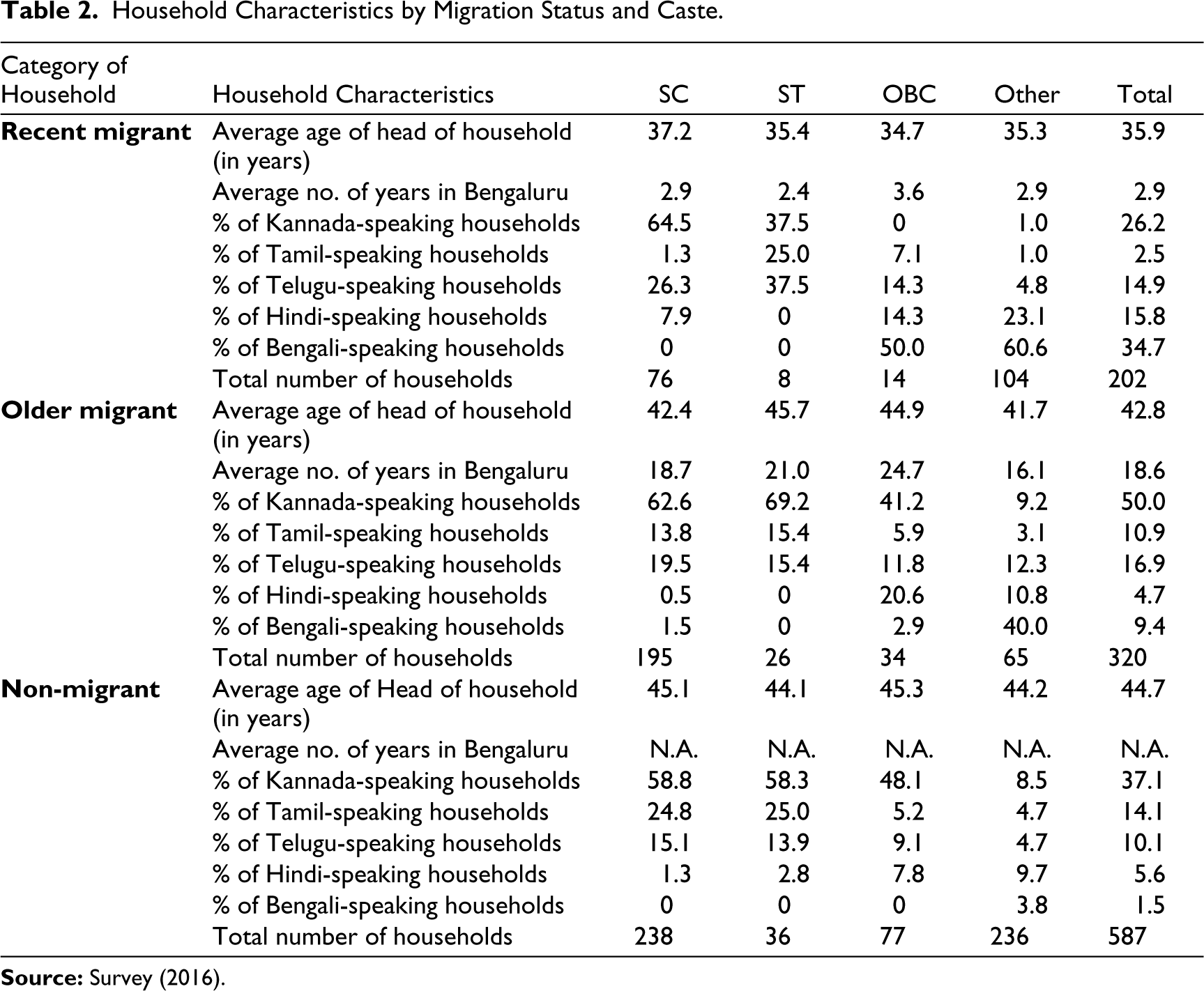
A large number of Kannada-speaking recent migrants in the settlements were landless, Dalit households from the Gulbarga and Yadgir districts of Northern Karnataka, which are rain-fed and fare poorly on human development indicators (Bakshi et al., 2015). Interestingly, a third of recent migrants are Bengali-speaking Muslims, followed by Hindi-speaking Muslims from Bihar and Uttar Pradesh, and Dalits (SC) and Adivasis (ST) from the Telugu-speaking states of Andhra Pradesh and Telangana (Table 2). While we do provide some insights about these groups, mainly from our surveys, the qualitative interviews were restricted to the experiences and strategies of Dalit and Other Backward Caste migrant households from within Karnataka present in settlement 8.
Household Characteristics by Migration Status and Caste.
Gendered Experiences of Inclusion and Exclusion
Life in the city is deeply unequal; however, it is also a place brimming with hope and possibilities for growth. We focus on the gendered experiences of inclusion and exclusion to understand how migrants exercise agency in the city. These are not straightforward and reveal tensions between inclusion and exclusion, empowerment and subordination. As noted earlier, while certain groups may be deprived of resources, they may at the same time have advantages in terms of their social relationships and rights claims through specific mobilisation efforts based on their marginality as women or Dalits. This section analyses individual experiences and collective strategies across institutional scales, from the community to the state, for inclusion and empowerment in the city, as acceptance by the local community as well as access to state social protection are both central to urban living. Inclusion is differentiated not just by gender, but equally by intersecting identities of class, caste, language and migration status.
Resources
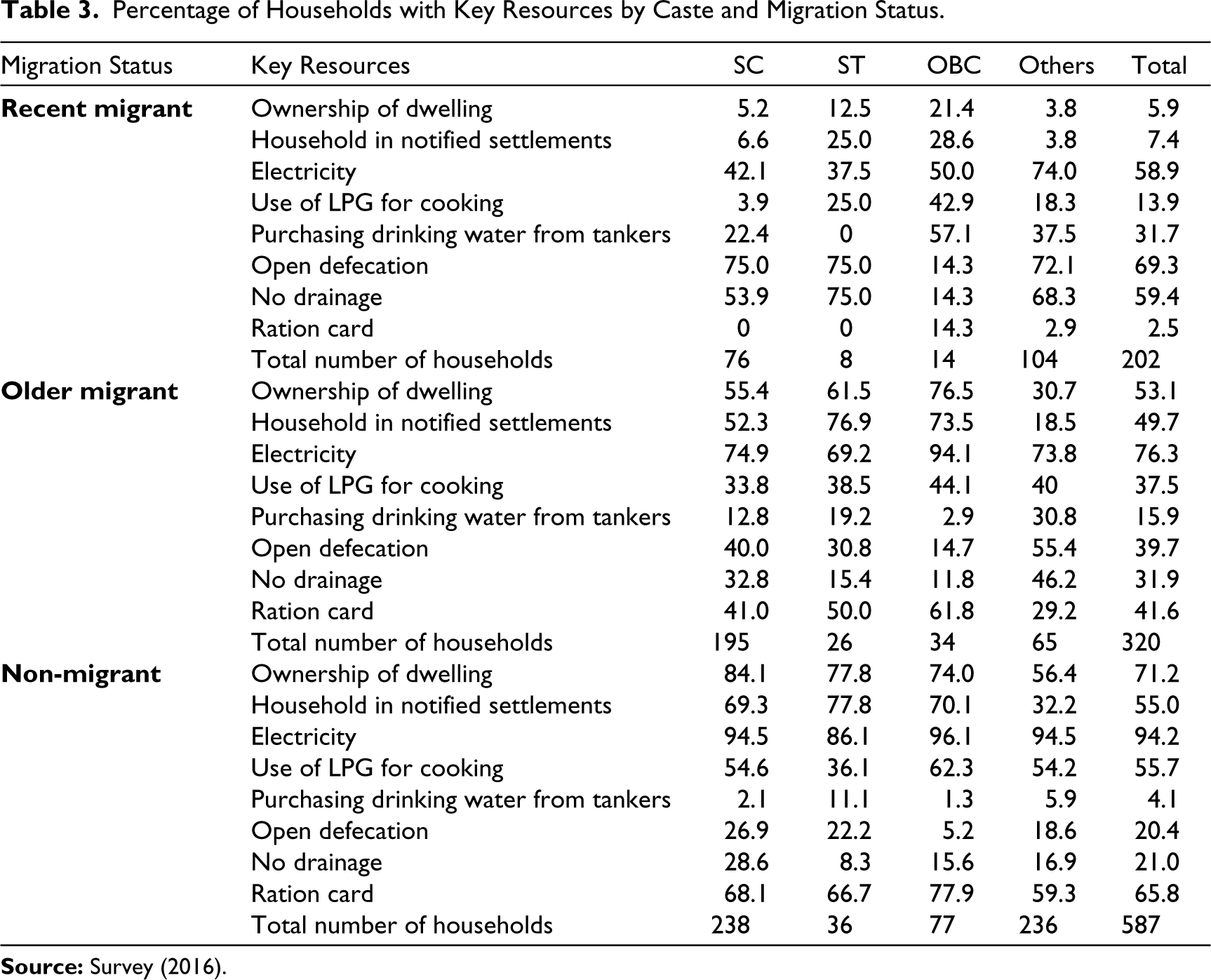
One of the key resources for inclusion in the city is access to housing, and property rights, which in turn impacts access to amenities such as electricity, water and cooking gas. We see from Table 3 that recent migrants are worse off than older migrants, who in turn are worse off than non-migrants across all variables for which data is available. Further, Dalits, Adivasis and Bengali- and Hindi-speaking Muslims (classified as Others) generally fare worse than OBCs in each migrant category. Among the recent migrants, for instance, none of the Dalits have ration cards, and a majority depend on open defecation. While ownership of dwelling and access to related services improve with their length of stay in the city, it always remains worse than the OBCs.
Percentage of Households with Key Resources by Caste and Migration Status.
Given this divide in resource distribution across migration status, we explore next the individual strategies in terms of linguistic inclusion and collective strategies of financial inclusion by gender and caste status.
Linguistic Inclusion
Speaking the local language is one of the most critical resources that builds the social capital that is necessary for survival in the city. The First All Karnataka Bengali Migrant Workers Conference, convened in December 2018 in East Bengaluru, following the murder of a ragpicker from West Bengal by locals, was a reminder of the contestations around linguistic inclusion. About 200 Bengali men and women, working in the scrap industry and domestic work attended the meeting and discussed everyday challenges with social workers and politicians. For inter-state migrants, blending into the city by learning the language was a viable strategy of inclusion. A social worker remarked to the assembly of workers,
How many here speak and understand Kannada? There are very few hands up, maybe ten people. We should try to learn Kannada; most problems will disappear.
In settlement 8, we heard resonances of the same sentiment among Telugu Dalit migrant women and men. Men typically learnt Kannada on the job, while young mothers in caregiving roles such as Bhavya (22 years) did not find the opportunity to do so. These gendered responses were further differentiated by migration status, recent migrants were less likely to have learnt Kannada as compared to older migrants. Goutaman, a 36-year-old OBC man, who had worked for 11 years as a helper in Bengaluru’s construction sector said,
I speak Kannada and Telugu. I speak Telugu at home. I learnt Kannada after coming to Bengaluru. I studied up to 4th class.
Case studies of informal settlements have shown that migrants face exclusion in dynamic urban settings, especially along linguistic differences in the case of inter-state migrants (Michael et al., 2018). Table 3 shows the differences in local language speakers across migration status by caste. Recent migrants have a greater number of inter-state migrants than older migrants or non-migrants, making linguistic inclusion a critically important issue. While the qualitative interviews show that men are more likely to learn the local language, given the imperatives of their jobs, the quantitative data is not disaggregated by gender.
Financial Inclusion
We examine two modes of financial inclusion in Bengaluru’s informal settlements, self-help group-bank linkage, and the informal chit fund. Despite critiques of SHGs that specifically target vulnerable groups such as women by framing them as risk-averse (Taylor, 2012), SHGs are an important mechanism for financial inclusion in informal settlements. While women’s control over this money and empowerment outcomes may be questionable, SHG membership nevertheless gives women visibility as recipients of money within the household (Kalpana, 2017). Loans from SHGs are used by women to meet household expenditure needs rather than for entrepreneurship and job creation (Guérin, 2014).
Hema, an OBC older migrant in settlement 8 who manages an SHG, said that members of her group take loans for paying the school fees for their children. Education is an important strategy for future occupational mobility and women through their SHG membership, seek to fulfil their roles and aspirations for their children. While this could be seen as part of women’s social reproduction roles, in terms of raising the next generation, it nevertheless involves significant agency to secure appropriate resources and access, and negotiation within the household in terms of agreements on the taking of loans and their repayment in particular (Shah & Lerche, 2020).
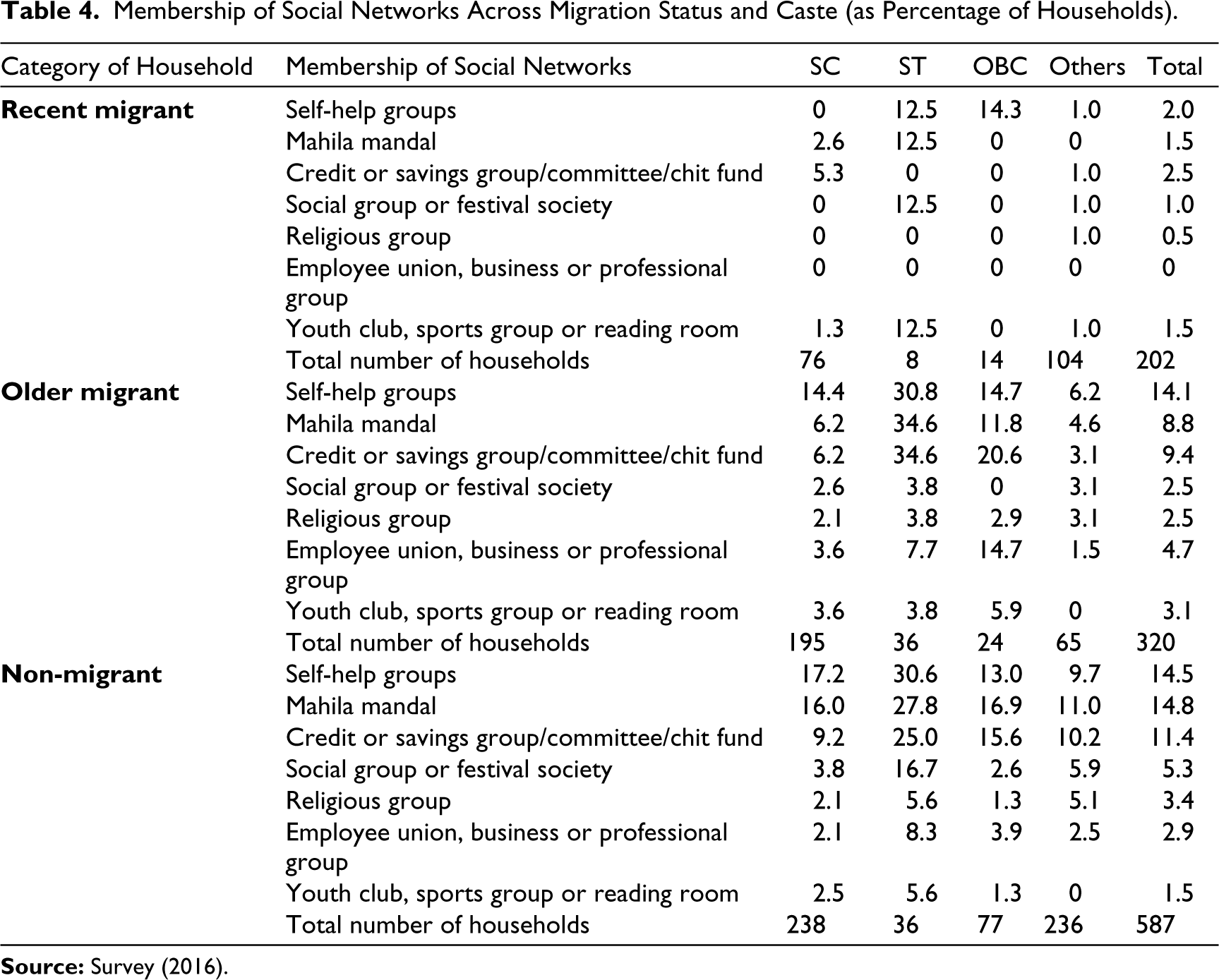
We find across settlements in the city, that recent migrant women have much lower access to collective strategies, whether SHGs, mahila mandals, credit groups or other social or religious groups. But here too there is variation by caste. While 14% of OBC women have access to SHGs, this is virtually nil among Dalit and Muslim women (see Table 4). Membership improves across castes as they stay longer in the city, more so for Dalit women than the Muslim women who constitute the ‘others’ category. This may be because of state affirmative action towards the Dalits, but equally Dalit mobilisation for inclusion through the DSS, discussed in the next section. The mobile lives of recent migrants were essentially incompatible with the model of SHGs which require members to be rooted in place. Such patterns of mobility have meant that most SHGs which are 5–10 years old comprise older migrant and non-migrant women. This is not to say that attrition of members from SHGs does not occur; in one case, a woman member of an SHG left Bengaluru to return to her maternal home during her pregnancy and ceded membership. She was replaced by a new member.
Membership of Social Networks Across Migration Status and Caste (as Percentage of Households).
Further, these groups are almost exclusively women’s groups. Residents of settlement 8 believed that women were better at saving, and that men did not form SHGs because they were engaged in paid work, or that men’s groups were seen in the villages, but not in the city. Saving and earning were often seen as gender-segregated responsibilities within the household. So while men are seen as providers, responsible for earning incomes, women are seen as household managers, responsible for the everyday survival and social reproduction of the household. In fact, Papanek has argued that women’s savings, investments in children’s education, gift-giving and home maintenance all constitute ‘work’, linked to ‘status production’ (Papanek, 1979). As one respondent said,
Ladies save, they put away money here and there. They feel that if they take about ₹10,000 they can use it for some purpose. Men do not feel the need to do this because they work.
Yet, it was interesting to note the presence of chitis or informal chit funds in the settlement with men and women participating in equal measure and bidding larger amounts of money. Chitis are Rotating Savings and Credit Associations which involve regular cash contributions in a common pool, followed by bidding by members during emergencies. The same women managing SHGs also convene chitis in the settlement, though these are much more prevalent among the older migrants belonging to the Other Backward Castes (Table 4). These two modes of credit were available more easily to older migrants who had invested their time and money in savings groups. Poorer recent migrants often ended up with higher interest loans from private moneylenders.
Relationships
As noted earlier, we explore de Haan and Maxwell’s heuristic of relationships from an intersectionality perspective, focusing specifically on how gender, caste and duration of stay in the city interact to shape relationships. We explore how these relationships work across scales: from household and marriage relations to the role of labour contractors in the markets and political parties and social workers in the wider socio-political domain of the community.
Marriage and Kinship: Defining Relationships at the Household Level
Marrying into households with long-term residence in Bengaluru is a potential pathway to inclusion. As the process of acquiring title deeds is long drawn out, only long-term residents and old migrants were able to access it. We see here that access to resources and relationships are intertwined with each other.
Hema, an OBC, moved from Lakshmipura in Kolar district to Bengaluru after marrying her husband from settlement 8 five years ago. Her husband worked as an office boy in an upmarket commercial area and had lived for about 15 years in the settlement. They lived in an EWS (economically weaker sections) apartment that was built by the Karnataka slum board. She is an active member of a SHG that she started two years ago with her neighbours in the apartment. Similarly, Revathi, also an OBC, an articulate anti-caste activist (DSS) moved into settlement 8 after an inter-caste marriage with her Dalit husband and was able to apply for title deeds based on her mother-in-law’s prolonged residence of 40 years in settlement 8. Despite facing personal difficulties in getting accepted by her in-laws in an inter-caste marriage, she emphasised that the long-term residence of her husband’s family was critical for mobilisation around title deeds. She said,
Since my mother-in-law has been staying since a long time in this place, we have been able to get our rights. If someone has come recently, they cannot stake claim to a place here.
While marriage opens up a pathway for the inclusion of women into the city, kinship networks play a key role in job acquisition for men. Stanley, a 36-year-old recent migrant, Christian from Yadgir district in north Karnataka, works as a helper to a maistry (a master workman). He came to Bengaluru four years ago. He said,
My older brother was here; he was doing construction work. Now he is settled in the village, and he works there. He helped me come here. My sister’s husband was here for seven years in the same area, that’s how we came to this settlement and rented this house. Now my sister-in-law and everyone has gone back there.
Across the migration (recent and old migrants) and job (formal and informal) spectra, kinship networks come in handy for both finding a place to stay and a job.
The Labour Contractor
But kinship is not enough. Contractors were particularly important for recent migrants to access the labour market in the city. While friends and relatives were the first point of support when it came to help with migration from the village to the city, contractors supported the migration of 20% of the recent migrant households in our survey. Ganapathy, an older migrant came to Bengaluru eight years ago from Gulbarga. He belongs to the Besthar caste (OBC) and works in construction. He said,
My relatives were here in Bengaluru before I came. Using their reference, I came here. There was a maistry we had contact with, using that we came here. Then there were other workers, other contractors we got in touch with.
Contractors are not just instrumental in the migration of workers, but also in everyday access to information about work. Consider for instance the migration trajectory of Devi and her husband, recent migrants from a village in Yadgir district. She moved to Bengaluru with her husband in 2015 to earn money to repay a loan in the village, leaving her children with her mother-in-law in the village. As Madiga caste members (Dalits), they were landless and performed agricultural labour on pigeon pea and groundnut farms in the village. Construction labour in Bengaluru supplemented their income. For the first one and half years, they were based at another location in Bengaluru, completing repairs of a police quarters. They lived in makeshift huts and moved out when the work was completed. Around this time, Devi’s mother-in-law died, and she had to move her children to Bengaluru. Through this period, they got jobs through a contractor. Over time, their house in the village remained locked for longer periods with visits for occasions. When they did manage to save money, they took it back to the village to repay their loan.
Devi’s case echoes several other recent migrants in the role played by the contractor in everyday work and life in the city. Devi’s life in the city is intertwined with that in the village through relations of debt.
Party Workers and Social Workers
Individuals such as party workers and social workers play a role in enabling migrants’ inclusion. Yashoda, belonging to the Gowda (OBC) caste, a long-term resident of settlement 8, had lived nearly three generations in the same place and built a livelihood and a community through support from the corporator. The corporator himself a long-term resident, had risen the ranks from a social worker to a party worker. This trajectory has been seen among slum leaders in other contexts, where enabling service provision within a slum is a pathway to being absorbed into political parties (Auerbach, 2019). The corporator constructed a temple and two shops adjacent to the temple, a milk booth managed by his son and a bakery managed by Yashoda. Her case illustrates the important role played by the party workers in the settlement. She considered the corporator’s family as kin and said,
When we stay together, we have to be like that (referring to family) is not it? We should be together and be well.
She paid the corporator a rent for the bakery. She was a middle-aged single woman, and lived with her brother, sister-in-law and their daughter, but was financially independent due to her work at the bakery. She also managed several functions at the temple as a priest and managed several SHGs in the settlement.
In July 2018, an interview with a party worker, Latha, a Dalit, and the president of the women’s wing of the Indian National Congress, ended with an insightful event. A Muslim woman paid a visit to the party worker’s house with her daughter with her high school certificates carefully wrapped in a plastic cover. She requested Latha to help her daughter secure admission in the college nearby. Latha discussed the issue with them and promised to accompany them to the college to navigate the bureaucracy. She was influential in helping them gain admission and fulfil their gendered responsibility towards their children’s education. She and other political workers also helped access other rights as discussed in the next section.
Other actors such as social workers were also present in the settlement. Marital disputes, property disputes and career counselling were a part of the stated activities taken up by the NGO, but the social worker was also an intermediary between the state and the recent migrants. Several recent migrants approached the NGO for family counselling, particularly in cases of domestic violence. Rather than approach the police, women preferred to report complaints against their husbands to the NGO, as approaching the police would result in severe punishments. Non-state actors play an important role in ‘boundary work’ between the state and the family, and in resolving interpersonal conflict (Ellison, 2018).
Rights
Rights are constructed as universal, as opposed to the access and meaning of resources and quality of relationships that are both mediated by caste and gender, in turn shaping inclusion and exclusion in the city. Here, we find that while Dalits and women as categories are disadvantaged in the economy and by cultural norms that devalue their contributions, yet, it is this disadvantage that has made them the target of affirmative state interventions such as SHGs, and political mobilisation, as in the case of the DSS. Both these challenge their traditional marginalisation.
Gaining Political Leadership
Although in the neighbourhood of settlement 8, there was an active Dalit Sangharsh Samiti
6
(Samatavada) presence, recent migrants were not involved. DSS enabled older Dalit migrants and non-migrants to secure land titles and access basic services, apart from intervening in family disputes and land conflicts. Revathi, a DSS activist and a non-migrant said,
We have submitted an application for the houses under 94cc.
7
This is a Government directive; we have to take a title deed through this. In this manner, we got things done one by one—be it the water bill, the light bill, everything we have got done through the organisation (DSS)….
Mobilisation for title deeds required long-term residence in place, which was not compatible with more recent migrants. In fact, recent migrants in construction work lived in makeshift tarpaulin and aluminium sheet huts on rent (see Figure 2), and accessed private water, thus bearing a higher cost than older migrants and non-migrants.
Recent Migrant Households in Settlement 8.
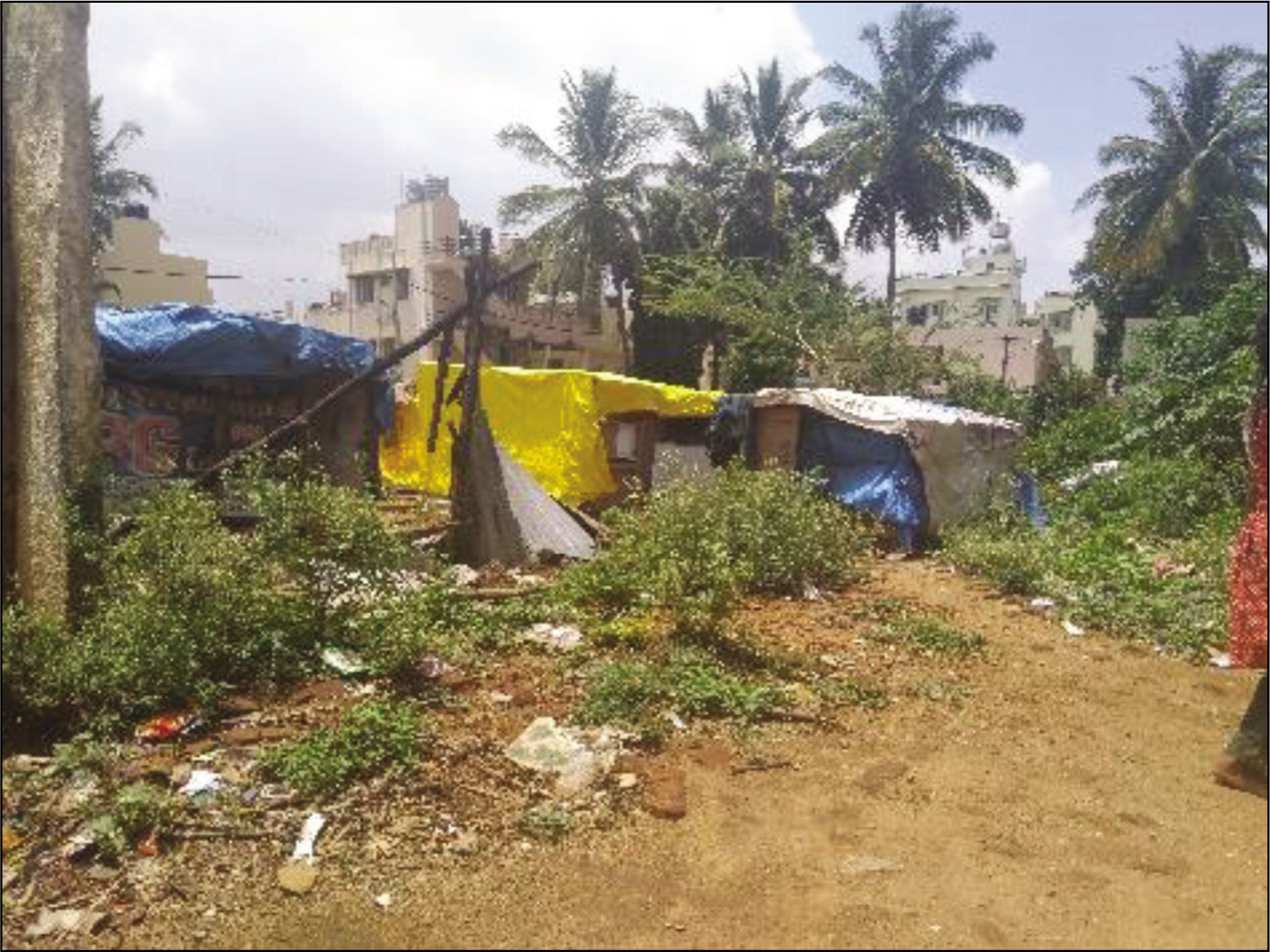
Other than enabling material benefits, the labour of members of the DSS was used by political parties for election campaigns. Attending meetings and talking to people and government officials, provided leadership opportunities for women. For instance, Revathi joined the DSS primarily to apply for title deeds, but over time became a member and then the treasurer.
After observing me at the meetings, the way I talked, how boldly I asked questions, and the just manner in which I conducted myself, the organisation members asked me to become a member too…. I am a leader now, I was told that I speak in a just, right manner, and that I participate well in all protests and campaigns, and stand up bravely for causes, and so I should be a leader.
It is interesting to note that poor migrant women, often discriminated due to their caste, struggling to access resources to meet their basic needs, often end up in visible, leadership positions, as in the case of Revathi, pointing to the interconnections between inclusion and exclusion, deprivation and empowerment.
State Social Protection
A key realm of inclusion is social protection by the state. Table 5 shows that social protection schemes are differentially available to migrants across informal settlements in Bengaluru based on duration of stay. Interestingly, these schemes are predominantly perceived as relating to women’s roles in the domestic domain, be it food security, childcare and education of the girl child.
We focus on two examples, the Anganwadi (government pre-school) which runs the Integrated Child Development Services and Mathrupoorna (Karnataka government scheme for maternity benefits), and the Public Distribution System (PDS).
The Anganwadi allows young women to leave their children under the care of the teacher and helpers during the day and participate in paid work. For recent migrants into settlement 8, enrolling children in the Anganwadi or the government pre-school was an important mode of social inclusion. Selvamma, the Anganwadi teacher, said,
a lot of kids whose parents have migrated from Raichur, Gulbarga come here … they mostly come to work as construction labour … we call for children aged below three years and keep them with us.
Anganwadi staff are key resources for migrants in informal settlements in the city, and we see that it is through them that recent migrants receive information and welfare benefits. Anganwadi teachers and helpers typically maintain an updated list of pregnant women in their wards. Using help from local women’s SHGs, they make physical visits and conduct surveys. They use this information to enrol children of recent migrants and to ensure that pregnant women are given nutritious food under the Mathrupoorna
8
scheme of the state government. The Mathrupoorna scheme was launched to tackle the high maternal mortality rates in Karnataka in 2017. Selvamma, the Anganwadi teacher, said,
(those) who stayed earlier are not there now—people who are staying now will not be there after two months—we won’t come to know where they are going.
The Anganwadi could only reach out to those in the ward, but the PDS supported migrants across rural and urban geographies, despite being linked to residence. This was possible only due to the mobility of recent migrants and not portability in the PDS at the time. This meant that migrants returned once or twice a year to their villages, while some travelled back and forth every two months, enabling regular access to their entitlements under the PDS in the village. Those who had secured ration cards in the city could access PDS entitlements in the city, but this was only observed for 1.5% of recent migrant households (no Dalits among them) and 41.3% of older migrants (see Table 5).
State Social Protection by Migration Status and Caste (as Percentage of Households).
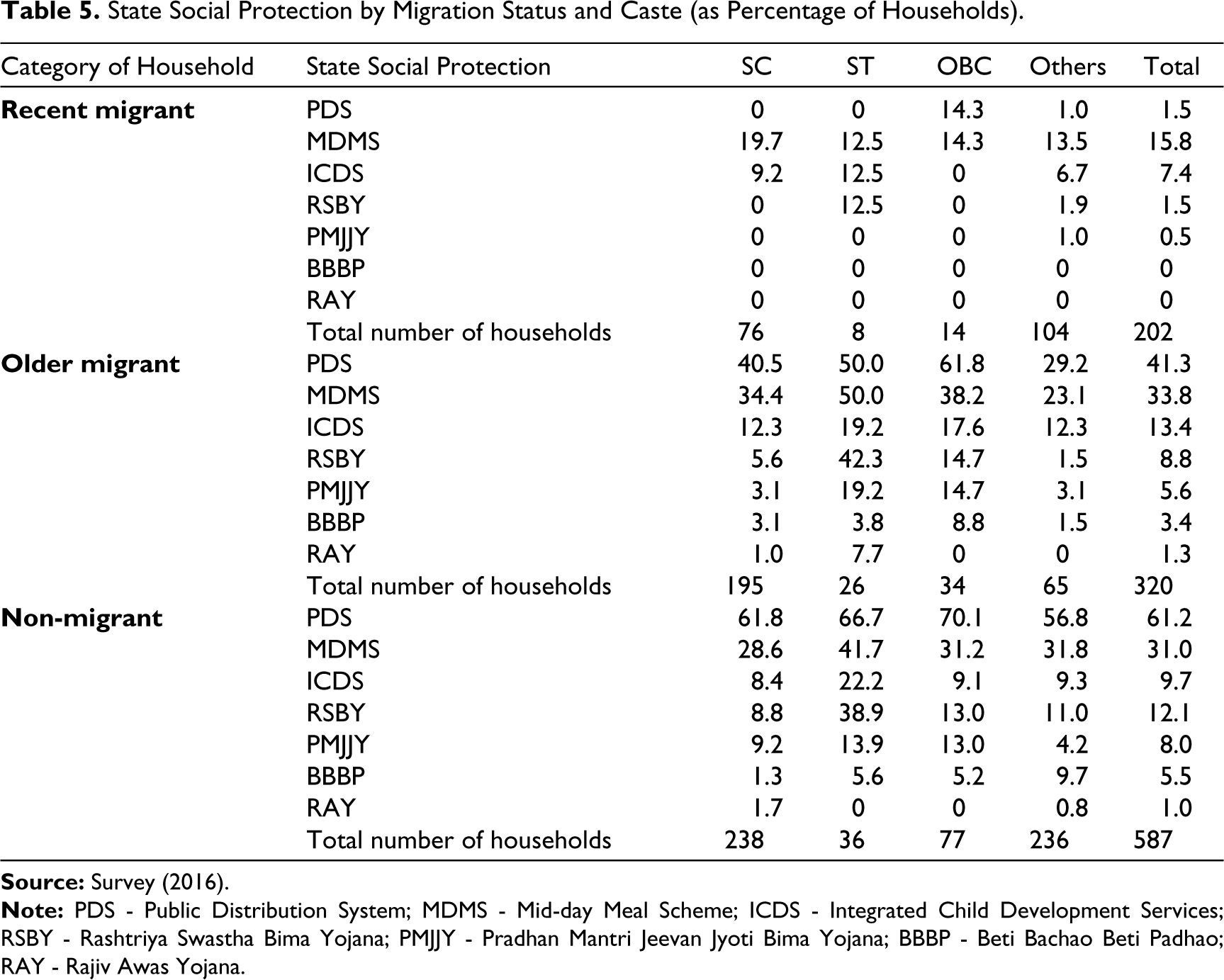
Social protection is intimately enmeshed with women’s financial inclusion through SHGs. Government frontline workers such as the Anganwadi (day-care) workers, almost all women, played an important role in recruiting and book-keeping for SHGs. They also used the space of the SHG to discuss ways in which the members could live a ‘good life’. For instance, those who fell outside the ambit of the SHGs, migrant construction workers who only spent a short time in the settlement were seen as unwilling to save,
They do not have any vision about saving for the future, or how they envisage their life should be—their attitude is that they have come here, they have to work, earn and eat, that’s it.
The discussions on living well were, however, of a gendered nature, focusing on women’s unpaid household and care work.
Personal hygiene, environmental cleanliness and health, how to cook food, that vegetables should be washed before cutting—all these topics will be informed, and again news also—if good information is published somewhere we also tell the group.
Further rights gained by state social protection and resources acquired via financial inclusion are accompanied by responsibilities. These responsibilities are gendered. The labour of women from SHGs is used for government activities such as weight surveys of children below the age of five years and Census operations. SHGs, thus, go beyond the stated aims of financial inclusion, and generation of productive employment, to using the credit for smoothening household consumption and gendered work by its members for the state (Kalpana, 2017). Women’s SHGs also earmark a certain amount each year towards social work, such as cleanliness drives, construction of toilets and disaster relief funds. Various mechanisms were used to obtain the labour of women for volunteer work such as subsidies for SC SHGs from the government and funds from the corporator for annual celebrations of Women’s Day, Mother’s Day and anniversary celebrations for SHGs. Using the language of empowerment, women are self-responsibilised to contribute beyond the home to their familial and community life (Surendran, 2020). While this could be seen as reinforcing gender stereotypes in terms of women’s reproductive roles and unpaid community contributions, they at the same time do provide women opportunities for achieving their aspirations, whether through their children’s careers or by themselves taking on leadership roles in political parties and NGOs at the community level.
Conclusion
Our study on migrant worker strategies in a notified settlement in Bengaluru reveals two key features. First, recent migrants are the most disadvantaged when it comes to inclusion in the city. We find that inclusion is a function of access to resources, rights and relationships, and on each of these counts, recent migrants are at a disadvantage. And within this category, the Dalits and other marginal groups (mainly Muslims from Northern and Eastern India), remain the most disadvantaged. The state, however, plays a vital role through its disbursement of resources in informal settlements. This leads us to our second key finding, that strategies of inclusion are largely place-based, and thus favour older migrants and long-term residents over recent migrants. In the present neoliberal context, where labour unionisation as a mode of inclusion using the rights approach is sparse in the informal sector, we find migrants using political movements as well as state social protection to access basic services in the city. The DSS active in the area focuses on mobilisation for title deeds. This however requires rootedness to place, thus disadvantaging recent migrants into the city, who have either moved from the village to the city or from one location in Bengaluru to another for work.
We disaggregate the experiences and strategies of inclusion by gender using qualitative and quantitative data and find that women’s SHGs are an important mode of financial inclusion as well as visibility to women that help manage household expenditures. SHGs as a form of collective agency enable women to carry out tasks of social reproduction and are thus key resources for social inclusion within the framework of the heteronormative family. Women’s SHGs have also been made responsible by the state to improve community life, thus drawing on women’s ‘voluntary’ and unpaid labour for community benefit. Yet, women do exercise their agency individually and collectively to draw on this critical resource to build wider social relationships with state and NGO workers, important in the process of securing their rights.
In the context of low female labour force participation rates in Indian cities, labour market inclusion has been facilitated by knowledge of the local language and also links with labour contractors. Linguistic inclusion is largely accessed by male migrants on their jobs. Men use real kin or idioms of kinship to seek inclusion, particularly in labour markets in the city. For women, marriage plays a crucial role in social inclusion and upward mobility, alongside participation in a range of group-based, community-level activities.
Through our research, we bring to light the multiple dimensions and expressions of agency in negotiating rights, resources and relationships, some individual and some collective, mediated by caste and gender. While not all may be successful, ultimately, the inclusion of migrants in the city is important for sustainable urban growth in India in the coming decades.
Footnotes
Declaration of Conflicting Interests
The authors declared no potential conflicts of interest with respect to the research, authorship and/or publication of this article.
Funding
This study was carried out under the Adaptation at Scale in Semi-Arid Regions project, one of the four research programmes under the Collaborative Adaptation Research Initiative in Africa and Asia, funded by the UK Government’s Foreign, Commonwealth & Development Office and the International Development Research Centre, Canada. Iyer carried out additional work under the ASSAR-Small Opportunities Grant awarded to her by START International Inc. in 2018 to work with Nitya Rao, when she was a post-doctoral fellow at the Indian Institute for Human Settlements, Bengaluru.
Acknowledgements
The authors would like to thank Amir Bazaz, Andaleeb Rahman, Shoibal Chakravarty, Tripta Chandola, Natasha Koshy, Anamika Ajay, special issue editors Irudaya Rajan and Amrita Datta, and the anonymous reviewers for their suggestions. We are grateful to the respondents and the survey team. The views expressed in this paper are those of the authors alone.