




Abstract
The latest National Family Health Survey (NFHS 5) indicates that child stunting in India was severe and has been deteriorating since 2015. This trend could have worsened since the pandemic and the stringent lockdowns meant to contain it. There has been an acute increase in impoverishment as governmental food policies have further exacerbated rather than mitigated inequalities. Families eligible under the National Food Security Act (NFSA), 2013, have been provided with double food grain rations during two waves of the pandemic. However, nearly 42% of India’s population without these ration cards have been largely excluded from additional food relief from the central government. Simultaneously, India’s food grain stocks in government granaries have accumulated to their all-time peak with 2 years of bumper harvests. Therefore, in light of the acute distress faced by marginalised communities due to the pandemic, this article analyses the availability of adequate food grain stocks and contends that the time is opportune for the universal expansion of the public distribution system.
Keywords
Introduction
India has the world’s largest undernourished population (FAOSTAT, 2019). Further, children belonging to marginalised castes and tribes are more likely to be underweight (Deshpande & Ramachandran, 2020; Narayan, 2016; NFHS, 2017). In this scenario, the imposition of one of the most stringent COVID-19 lockdowns in the world (Hale et al., 2020) has acutely exacerbated structural inequalities of caste, class, ethnicity and gender. The second wave of the pandemic has been particularly catastrophic for both lives and livelihoods and intensified hunger among vulnerable communities.
The National Food Security Act (NFSA), 2013, guarantees subsidised food grains to two of every three Indians each month. Nevertheless, in the last few years, despite burgeoning food grain stocks in government granaries, there have been a series of purported starvation deaths (Bhattacharya, 2020; Johari, 2018), especially among marginalised castes and tribes (Bhatia, 2018). Further, since the abrupt lockdown in March, more than 200 people have reportedly died of starvation, financial distress and exhaustion (Aman et al., 2020). Most of these families did not have functional ration cards to purchase subsidised food grains. The latest National Family Health Survey (NFHS), also indicates that in 13 of 17 Indian states, for which data have been released, the proportion of stunted children has worsened or stagnated from 2015 to 2019 (IIPS & MoHFW, 2020).
Hence, in this scenario, this research study will concentrate on two modes of enquiry. On the supply side, this research will estimate projected stocks in government warehouses. Then on the demand side, this analysis will examine the implementation of food security measures, especially in terms of the capability of vulnerable communities to mitigate the impacts of repeated lockdowns. In the context of the pandemic and unprecedented global economic recession, this analysis contends that the time is opportune for the universal expansion of food security protections.
Intersectional Vulnerabilities and Universal Entitlements
Theoretically, the capabilities approach analyses this paradoxical phenomenon of “hunger amidst plenty”, due to acute inequalities in food distribution (Drèze & Sen, 1989a; Sen, 2003). More than two decades ago, economists Drèze and Sen had highlighted the “scandalous phenomenon of mounting food stocks against a backdrop of widespread hunger” (Drèze & Sen, 2002, p. 336). Despite enactment of a series of legislative entitlements, unfortunately this phenomenon has been exacerbated in the midst of the pandemic.
The strident national and state lockdowns have particularly aggravated multidimensional inequalities. Davies defines intersectional vulnerabilities as “the interaction between gender, race, and other categories of social difference in individual lives, social practices, institutional arrangements, and cultural ideologies and the outcomes of these interactions in terms of power” (Davis, 2008). Especially, given the depth of undernutrition in India, the pandemic has amplified food insecurity among vulnerable communities.
However, as periods of accelerated change, social crises often function as policy levers to open unprecedented political windows of opportunity to bolster welfare systems (Beresford, 2016) for their role as “automatic stabilizers” (Ocampo & Stiglitz, 2018). The pandemic, in particular, has necessitated a fundamental rethink of citizen–state relations and the need for “radically transformative, egalitarian and inclusive” policies (Leach et al., 2021).
In India, the impact of the contagion has been so severe that irrespective of the scenario of recessionary contraction of the economy, the pandemic is expected to contribute to half the estimated additional poor globally (Sumner et al., 2020). Estimates indicate that 230 million Indians may have already fallen into poverty (APU, 2021). Therefore, given the severity of the pandemic, coupled with the existing depth of poverty and malnutrition in India, there is an urgent need for a shift in the welfare regime towards universal food entitlements.
Before 1997, India’s subsidised public distribution system (PDS) was universally accessible to the entire population through a well-established network of more than 1 million fair price shops. Thereafter, the targeted regime introduced differential prices and entitlements (Khera, 2009). For nearly a decade, the selection criteria to identify eligible “Below the Poverty Line” families officially remained unaltered, despite significant inclusion and exclusion errors (Hirway, 2003; Khera, 2009; NCAER, 2015; Sundaram, 2003; Swaminathan & Misra, 2001). With the legal enactment of NFSA in 2013, the targeted approach continued, albeit with a change in nomenclature and substantial expansion of eligible “priority” families to include two-thirds of the population. Nevertheless, though exclusion errors have declined overall, they remain substantial in backward states such as Bihar and Jharkhand (Drèze et al., 2015). The series of starvation deaths, especially in the poorest states, even after the enactment of the law, also, indicate the inherent flaws of restricted narrow targeting (Banik, 2016; Bedamatta, 2016; NCAER, 2015). Despite their legal eligibility, marginalised communities with intersectional vulnerabilities and weaker sociopolitical clout are invariably at greater risk of exclusion. With the pandemic, oddly, as a relief measure, the central government has provided an additional 5kg of free food grains under the Pradhan Mantri Garib Kalyan Anna Yojana (PMGKAY) only for families with NFSA “priority” ration cards for a limited period. However, families without these ration cards have been largely excluded from central government food security protections. Therefore, the persistence of targeted food policy has exacerbated inequalities.
Especially, in scenarios of mass impoverishment, universal programmes are more effective (Ocampo & Stiglitz, 2018). First, universally justiciable rights-based legislative protections are expected to be more inclusive (Drèze & Sen, 1989b). Second, the greater political clout of wealthier households in universal programmes is expected to improve accountability (Hirschman, 1970; Sen, 1992) of the PDS. On the other hand, programmes with limited beneficiaries often have weaker political bases and are more susceptible to rationalisation (Skocpol, 1991). Third, elite capture (Bardhan & Mookherjee, 2005) and exclusion of poor households (Swaminathan & Misra, 2001) are greater concerns in targeted systems. Fourth, information asymmetries invariably plague targeted programmes (Swaminathan, 2002). Empirical research also indicates that “take-up rates by poor households increase with benefits provided to nonpoor households” (Kochar, 2005, p. 233). The experience of several states in expansion and universalisation of the PDS, such as Tamil Nadu (Chaudhuri et al., 2015), Odisha (Chatterjee, 2014) and Andhra Pradesh (Dutta & Ramaswamy, 2001), have also ensured greater inclusion of poor households. Further, in states with relatively well-functioning PDS, lower caste households tend to benefit more (Das & Basu, 2014). Alternatively, geographical targeting to ensure universal coverage, at least in hunger-prone districts, is also an effective strategy which in the Kalahandi Balangir Koraput (KBK) region of Odisha has ensured improvement in both household food intake and diet quality (Rahman, 2016).
Supply Side: Food Grain Mountains in Government Granaries
Since the Green Revolution in the 1960s, India has attained self-sufficiency with surplus food grain production. India’s cereal production has increased 500% in seven decades, from 48 million tonnes in 1951 to 292 million tonnes in 2019–2020. However, some states such as Kerala remain deficit states due to their limited sowing area and focus on cash crops. Therefore, since its inception in 1965, the Food Corporation of India (FCI) has been procuring cereals from farmers at minimum support prices (MSPs) in order to redistribute them at subsidised prices to deficit states and impoverished consumers.
After the harvest, in June 2021, food grain stocks with the FCI were at an all-time peak of 110 million tonnes and exceeded its storage capacity of 81 million tonnes (see Figure 1). Therefore, the prime minister’s announcement of free food grains for all Indians with NFSA ration cards was also a calculated measure to offset rotting of food grains in granaries in the monsoon months (Drèze, 2020). The stocks were so excessive that the government had even permitted diversion of rice for the production of ethanol for use in alcohol-based hand sanitisers (Hussain and Ranade 2020). Even in May 2021, food grain stocks were 3.5 times more the buffer norm (Hussain & Mohapatra, 2021).
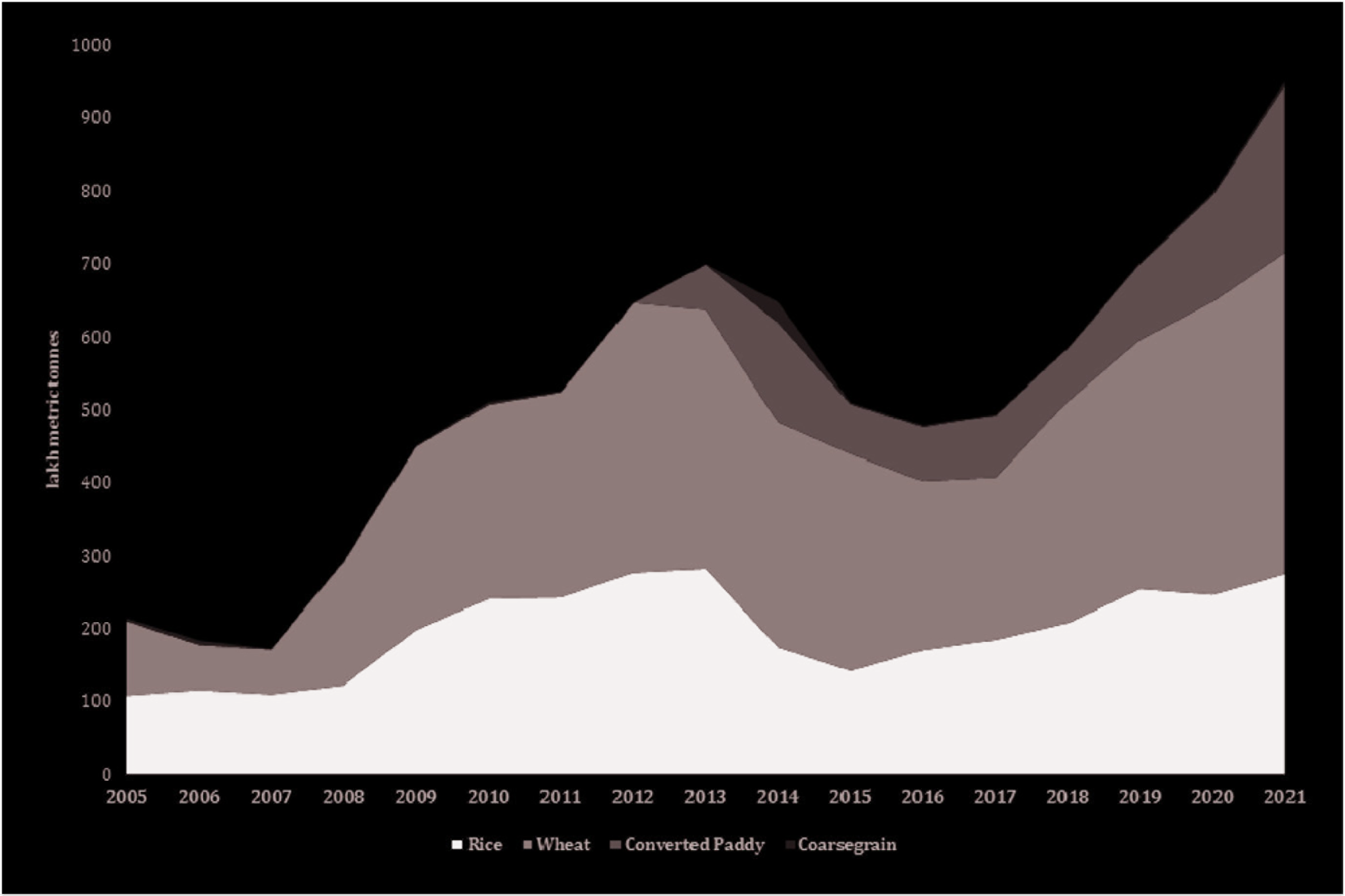
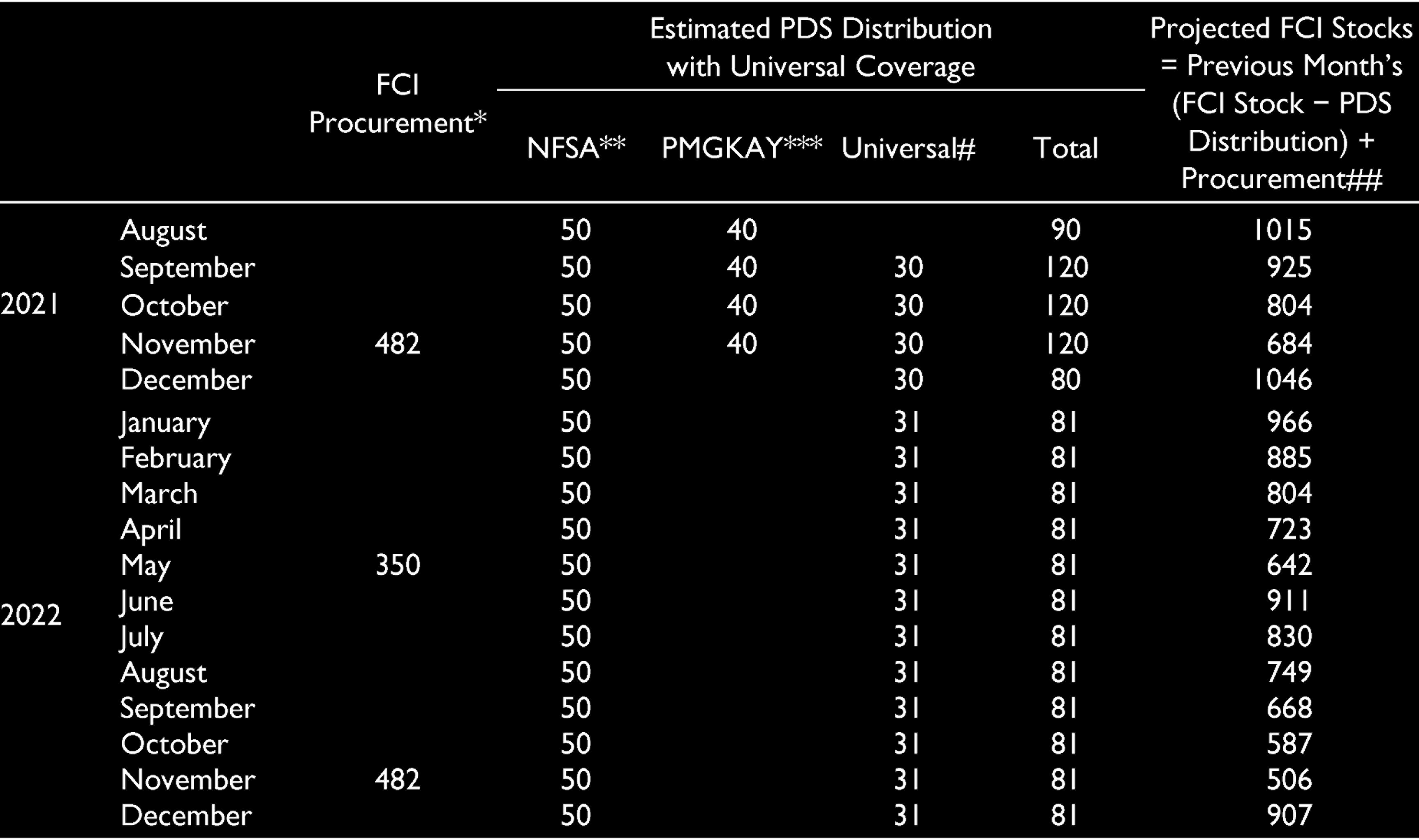
The additional food grain requirement for universal expansion of the PDS at 5 kg per person per month, assuming even an exceptionally high 99% offtake (except for 1% of income taxpayers in the country), can be estimated at approximately 30–31 million tonnes annually in 2021 and 2022 (see Table 1). With the existing stock of 101.5 million tonnes in government warehouses in August 2021, this expansion can be easily implemented. Further, the average annual government procurement in 2019–2020 was 86 million tonnes in a year of normal harvests, and 95 million tonnes in 2020–2021 with bumper harvests.
Estimated Projections of FCI Stocks and PDS Distribution for Universal Coverage (lakh metric tonnes)
**Estimated NFSA distribution includes allocation for the PDS along with food grains for the Integrated Child Development Scheme (ICDS), Mid-day Meal (MDM) and other legal commitments under the law (Monthly Food Grain Bulletin).
***The government announced that 5kg of free food grain would be provided to all NFSA beneficiaries till November 2021 under the PMGKAY.
#Population projections for 2021 and 2022 based on (Census of India, 2019).
##Only for August 2021, the current FCI stock is calculated as the existing stock of rice, wheat and paddy in the FCI godown at the beginning of the month as per the FCI website. For unmilled paddy, CMR is calculated based on an out-turn ratio of 67%.
Even though the government has extended PMGKAY which provides 5 kg of additional free food grains to current NFSA ration cardholders till November 2021, this research indicates that there is still more than sufficient food grain stock to simultaneously universalise PDS to provide 5 kg of food grains to those without ration cards. In fact, with exceptionally good rains and despite the lockdown, in June 2021, there was mega harvest of rabi wheat. The procurement of wheat was 43 million tonnes, the highest ever recorded (PIB, 2021). Nevertheless, for this research, the food grain availability projections for 2021 and 2022 have been maintained at extremely conservative levels to avoid unrealistic future expectations. The procurements for rabi and kharif seasons are assumed to be the average of the previous 2 years with full estimates, that is, 2018–2019 and 2019–2020 of 35 and 48 million metric tonnes, respectively. Further, the government always has the possibility, in future, of increasing MSP provided to farmers to increase procurement. From 2017 to 2020, FCI procurement averaged at only around 32%–37% of the annual harvests, with ample scope for expansion.
Population projections for 2021 and 2022 also indicate that around 600 million Indians would be without NFSA rations cards unless there is an upward revision of population estimates. The assumption for this research on universal coverage is that each of these excluded persons, except income taxpayers, will be provided with 5kg of food grain each month from September 2021 onwards. Thus, projections of food grain procurement and stocks indicate that the universal expansion of PDS is undoubtedly viable in terms of availability of food grains.
Demand Side: Chronic Hunger and Vulnerable Communities
In 2013, the food law guaranteed subsidised food grains to only 800 million Indians or two-thirds of India’s population. However, due to rapid growth, India’s population is projected to have reached 1.36 billion by 2021. Despite economic growth, ration cards lists had not been updated in the last decade, and at least 100 million eligible persons are estimated to be out of its ambit (Scroll, 2020). Of these, the majority may be children under the age of 10 years born after the 2011 Census. Further, the process of selection of beneficiaries has always been plagued with targeting errors (Drèze et al., 2017; Khera, 2015). The insistence on linkage with the national unique identity number, Aadhaar, has also deprived scores of genuine beneficiaries (Muralidharan et al., 2020).
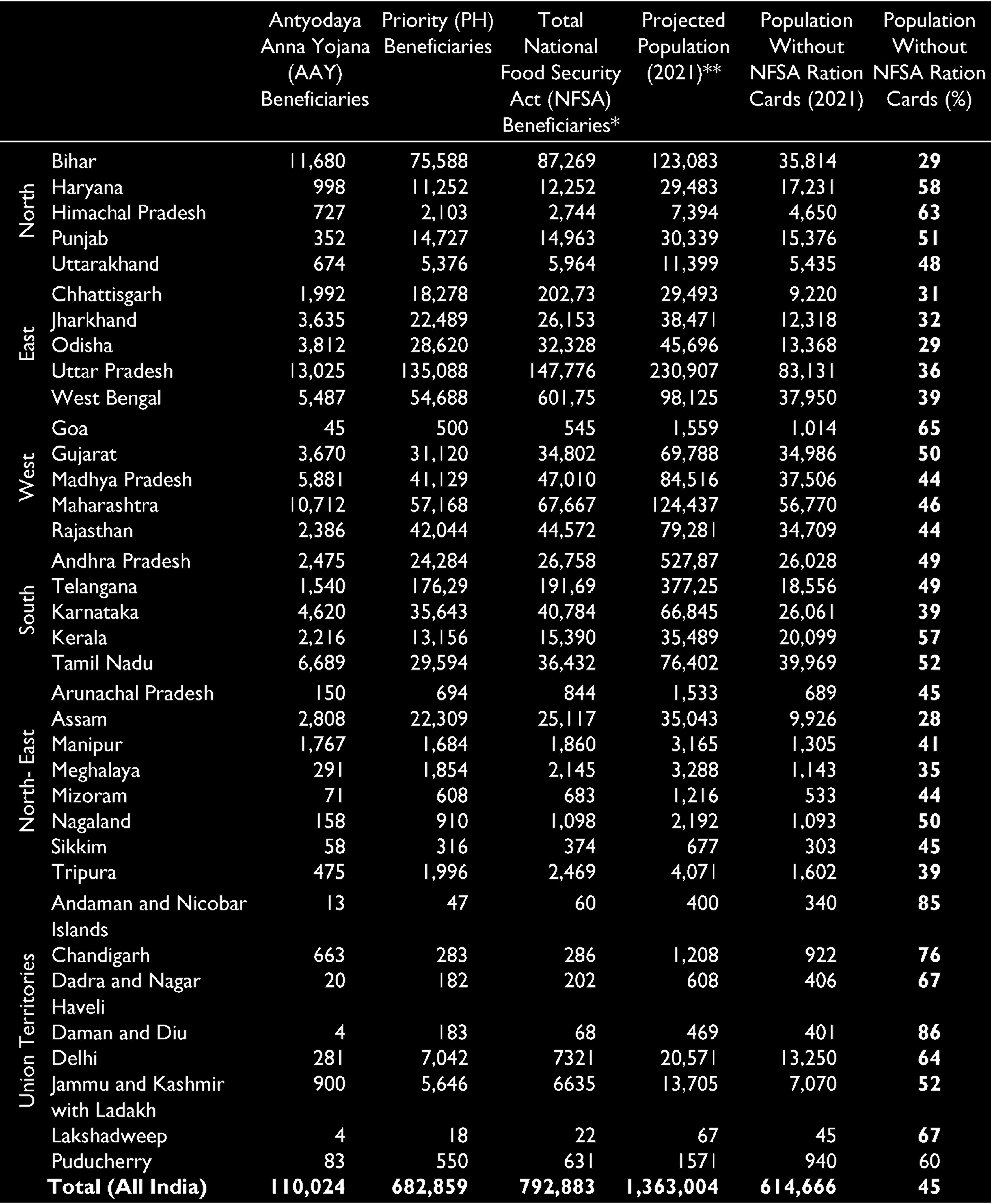
Further, as NFSA ration cards have not increased, despite rapid population expansion, based on projections for 2021, this research estimates that 42% of India’s population is effectively excluded from NFSA ration cards (see Table 2). Urbanised and wealthier states such as Goa and those in Northeast India have the largest proportions of left-out populations. However, poorer states such as Bihar and Jharkhand have greater exclusions in terms of the absolute number of people outside the NFSA ambit.
Estimated Population Excluded from NFSA Ration Cards 2021 (in thousands)
**Census of India (2011).
Further, only some states such as Odisha, Chhattisgarh, Rajasthan, West Bengal, Tamil Nadu and Himachal Pradesh have invested their own state finances to expand or universalise coverage. However, populous states with high levels of poverty such as Bihar, Jharkhand, Uttar Pradesh and Madhya Pradesh have not been able to effectively expand their food distribution systems. During different phases of lockdowns, their populations without any ration cards have been the most affected.
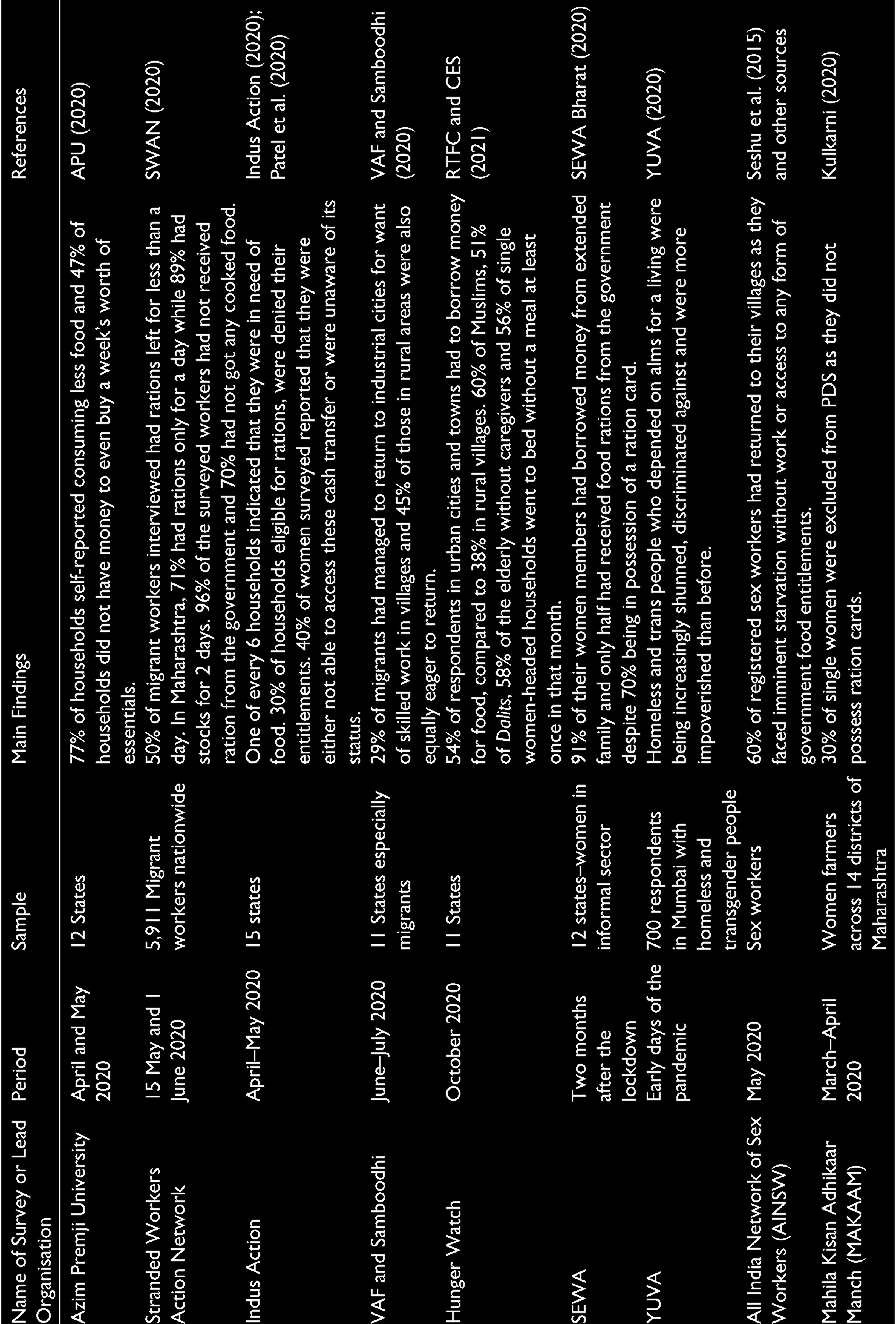
In this context, among the many excluded populations, two communities most impacted by the lockdown were internal migrants and vulnerable women (see Table 3). In most cases, within these broader categorisations, marginalised castes, tribes, ethnicities and religions have been the most affected.
Selected Surveys Conducted Especially on the Food Security of Internal Migrants and Vulnerable Women in Cities and Villages
Internal Migrants
In the first wave of the pandemic, the prime minister announced the abrupt nationwide lockdown from 25 March 2020 with only four hours’ notice. This triggered unprecedented distress-induced reverse migration from cities to villages, the largest in the India’s history since the 1947 Partition. Consequently, more than 20 million internal migrants (Singh & Magazine, 2020) are estimated to have defied lockdown orders to traverse hundreds of kilometres from industrial cities to distant villages.
Thirty-six hours after this shutdown, the government introduced PMGKAY with a few food security initiatives. However, the package increased entitlements only for existing NFSA beneficiaries. Most migrant labourers either do not possess ration cards or leave them behind in their villages for their families. After 3 months, the government finally announced the Atma Nirbhar package aimed to provide a one-off grant of 10kg of food grains to 80 million migrant labourers without ration cards. However, due to excessively centralised quotas and insistence on identity proof, despite an extension, only 33% of the allocated food grains for migrants was distributed (Sharma, 2020).
The most publicised initiative the “One Nation One Ration” (ONOR) scheme to enable migrants to purchase subsidised food grains in any destination, is also only restricted to eligible NFSA ration cards holders. As per the government’s Integrated Management of Public Distribution System (IM-PDS) database, in September 2021, less than 14,000 (0.005%) ration cards employed ONOR nationwide. In the second wave, the situation was so dire that the Supreme Court on 13 May 2021 and various high courts had to order state governments to set up community kitchens for migrants.
Vulnerable Women
More than half of Indian women are anaemic (NFHS, 2017). Typically, the intra-household distribution of food acutely discriminates against women who eat last at family meals (Coffey et al., 2015). Especially, during times of food scarcity, nutritional consumption of women deteriorates with age within Indian households (Shivkumar & Kerbart, 2004). However, the lockdown policies initiated by the government were restricted to a modest cash transfer (US$6.7 per month only) in 200 million women’s Jan Dhan bank accounts for only 3 months. Numerous surveys indicate that women were either not able to access this cash transfer or were unaware of its status (Indus Action, 2020; Patel et al., 2020). Despite being in possession of ration cards, many women also struggled to gain access to their food entitlements (SEWA Bharat, 2020).
Further, trans people, sex workers and homeless people who depended on alms for a living were being increasingly shunned, with limited access to any food security or livelihoods (YUVA, 2020). Eventually, in September 2020, based on a writ, the Supreme Court ordered that all states should provide rations, without identity proof, to all recognised sex workers. Single women, especially those from particularly vulnerable tribal groups (PVTGs) and denotified and nomadic tribes (DNTs) were also more likely to be excluded from ration cards (Kulkarni, 2020). The 2020 Hunger Watch survey also found that single women-headed households were more likely to be hungry (RTFC & CES, 2021).
Summary and Conclusion: Time for Universal Food Entitlements
One of every four of the world’s undernourished people live in India (FAO, 2020). In no other country in the world has mismanaged COVID-19 lockdown triggered a humanitarian crisis with an exodus of migrants. Besides, even before the pandemic, India already had unprecedented levels of unemployment and recession.
The pandemic has further exposed and exacerbated the inequalities in India’s food entitlements infrastructure, as only those with existing ration cards have benefitted. India also is expected to have the largest population impoverished due to the pandemic (World Bank, 2020). However, the central government has spent less than 3% of GDP as a fiscal stimulus for food subsidy. This minimalistic support has proven to be sorely inadequate to protect vulnerable communities from food insecurity.
Therefore, a perceptible need exists to universalise food entitlements to ensure that especially those with “intersectional vulnerabilities” including internal migrants and vulnerable women from marginalised communities are effectively protected from impoverishment. Even before the pandemic, studies had recommended universal allocation of nutritious food grains each month (Jha & Acharya, 2016).
Therefore, with a historic record of food grains stocks currently in government granaries, the time is ripe for the universal expansion of the PDS.
Footnotes
Acknowledgements
The author is grateful to Jean Drèze for helpful comments on an earlier version.
Declaration of Conflicting Interests
The author declared no potential conflicts of interest with respect to the research, authorship and/or publication of this article.
Funding
The author received no financial support for the research, authorship and/or publication of this article.