




Abstract
This study investigates the scholarship of sustainability teaching and learning (SoSTL) in higher education (HE), focusing on the disciplinary integration of Education for Sustainable Development (EfSD) at the module level. Employing a narrative review of 33 case studies published between 2017 and 2023, the research explores disciplinary patterns using Biglan’s classification of academic fields. Results reveal a dominant presence of SoSTL in applied disciplines (n = 32), particularly in business, education and engineering, with minimal representation in pure disciplines (n = 1). The case studies exhibit an even distribution between sustainability-focused (n = 17) and sustainability-inclusive (n = 16) modules, highlighting diverse pedagogical approaches. General education interventions were fewer (n = 6) than discipline-specific ones (n = 27), underscoring the structural challenges of interdisciplinarity in HE. These findings illuminate gaps in disciplinary SoSTL engagement and emphasize the need for expanded scholarship across pure disciplines to foster comprehensive EfSD integration and equip students to address global sustainability challenges effectively.
Keywords
Introduction
Education for Sustainable Development (EfSD) has been recognized globally as a fundamental and required response to the challenges of sustainable development and climate change (UNESCO, 2014). The goal of EfSD is to allow ‘every human being to acquire the knowledge, skills, values and attitudes that empower them to contribute to sustainable development and take informed decisions and responsible actions for environmental integrity, economic viability and a just society for present and future generations’ (UNESCO, 2014). The universality of this vision requires EfSD to be present across all sectors of education from primary to informal settings, and including higher education (HE), the focus of this study.
Defining EfSD is challenging in part due to the broad and contested nature of sustainable development itself, although there is some agreement that it refers to the use of education to achieve sustainable development rather than just learning about it (Landorf et al., 2008). The definition utilized in the UNESCO Decade of Education for Sustainable Development (2005–2014) sees EfSD as including environmental education along with added sociocultural and sociopolitical issues affecting many of the world’s peoples (Venkataraman, 2009).
Integrating EfSD into the existing curriculum of higher education institutions (HEIs) is challenging due its lack of a clear definition of sustainability, the competency-driven approach, the inter- and multidisciplinary nature of sustainability, the variation in models of curricular integration and the attraction of more clearcut and easily measurable sustainability activities such as campus operational changes (Christie et al., 2013; Cotton et al., 2007; Filho, 2000; Karatzoglou, 2013; Konrad et al., 2021; Shephard, 2015; Wals & Blewitt, 2010; Wiek et al., 2011).
Within the HE academic community, there is a large and growing, yet disparate, body of published research reflecting the increased interest and activity in the area (Hallinger & Chatpinyakoop, 2019). There are studies on pedagogy (Castro & Zermeño, 2020; Cotton et al., 2007; Jones, 2019; Sprain & Timpson, 2012), competences (Konrad et al., 2021; Lozano et al., 2017; Sommier et al., 2022; Wilhelm et al., 2019) and curricular integration. Reviews have been conducted across disciplines such as engineering and architecture (Boarin & Martinez-Molina, 2022; Gutierrez-Bucheli et al., 2022), characteristics such as leadership (Sanchez-Carrillo et al., 2021), scientific publishing on sustainability (Filho et al., 2021), HEI’s sustainability reporting (Ceulemans et al., 2015), along with more general reviews looking at critical attributes and the SDGs in HE (Serafini et al., 2022; Viegas et al., 2016).
Many of these reviews are based on the substantial body of case study literature where academics who have integrated EfSD into their teaching share their experience and learnings. This represents the scholarship of teaching and learning for EfSD, a scholarship of sustainability teaching and learning (SoSTL) as it were, an established method for the development and sharing of educational best practice and vital in the light of the challenges of integrating EfSD into HE (Boyer, 1990; Corradini, 2022; Shulman, 1998; Trigwell, 2013; Trigwell & Shale, 2004).
Academic disciplines are the main criteria around which HE is organized (Biglan, 1973a, 1973b). There are reviews of the case study literature on EfSD within specific disciplines; however, despite extensive searches, there is little published research in English into the coverage of published EfSD case studies between disciplines. As a result, there is also little research into the types of disciplines that are more active in publishing EfSD intervention case studies than others. Similarly, there is little research into whether the case studies represent integration into a disciplinary programme or represent a general educational intervention open to students from a range of disciplines.
High-quality, published SoSTL is a valuable resource in meeting the challenges of EfSD curricular integration. Understanding which disciplines are sharing their educational experiences (and which are not) provides us with a valuable insight into this developing and useful scholarly activity.
This article seeks to uncover patterns and trends in how sustainability education scholarship is approached across different disciplines. It analyses sustainability education case studies (n = 33) to identify and classify the academic disciplines they focus on. Recording the disciplines within the Biglan classification of subject matter characteristics reveals a clear pattern of engagement with the SoSTL among subjects characterized as applied (n = 32) and little among subjects characterized as pure (n = 1). EfSD interventions within life characterized subjects were more prevalent than those within nonlife characterized subjects (n = 24 vs. n = 9).
Literature Background
EfSD in HE
EfSD has long been promoted alongside the United Nations (UN) declarations and commitments for sustainable development, including the UN International Environmental Education Programme (1975–1990) and the implementation framework for the UN Decade of Education for Sustainable Development (2005–2014). This framework establishes the need for EfSD to be delivered across all stages of life, within all education levels and sectors, and across all educational approaches and techniques, including curriculum, content and pedagogy (UNESCO, 2014). Declarations and commitments to EfSD across the HE sector have abounded (Thomas & Nicita, 2002), including the Talloires Declaration’s 10-point action plan and the Higher Education Sustainability Initiative (HESI, 2023). Despite the significant policy directives and declarations that have been signed, the implementation of EfSD within HE has been patchy and inconsistent (Cotton et al., 2007; Cotton & Alcock, 2013).
Within HEIs, sustainability initiatives have focused primarily on the areas of campus operations, education, research, and outreach and collaboration supported by institutional frameworks, assessment and reporting activities (Adams et al., 2018; Hooge & Dam, 2019; Lozano et al., 2015). More recently, the focus of many initiatives reflects not only the operationalization of the declarations but also the roles of managers of the enterprise and the campus, providers of learning and accreditation, researchers and knowledge workers, and community engagers (Sulkowski et al., 2020).
Despite this seemingly broad adoption and plenty of scholarly literature on the integration of sustainable development within HE, results and consistent patterns of adoption and integration are inconsistent and vaguely defined, with much of the published literature in case study form and often largely descriptive (Barth & Rieckmann, 2016; Karatzoglou, 2013; Weiss & Barth, 2019).
Sustainability and sustainable development are challenging subjects for faculty to teach. The competence-driven approach to integrating EfSD into HE has been an increasing phenomenon during the last decade and reflects the broader adoption of competence-driven approaches in HE (Wilhelm et al., 2019). EfSD requires a set of competences that reflect the nature of sustainability and its associated challenges. These include systems thinking, futures thinking, values thinking, strategic thinking and interpersonal competencies (Birdman et al., 2022; Konrad et al., 2021; Wiek et al., 2011). The adaptation of competence orientation in teaching is challenging for many HEI faculty due to a lack of knowledge on how to adapt or even how to identify which competences to operationalize in their teaching (Wilhelm et al., 2019) and has resulted in studies focusing on the beliefs and attitudes of lecturers towards EfSD (Cotton et al., 2007). Curricular integration across and within disciplines has therefore lagged behind the other dimensions of institutional initiatives to integrate sustainability into their activities (Christie et al., 2013).
Indeed, the focus on competences, and the specific EfSD competence of values thinking, further place EfSD within the problem space of teaching for values rather than for knowledge (Shephard, 2015). Accordingly, this places EfSD education within the affective domain more than the cognitive domain of Bloom’s taxonomy. Shephard notes that this in itself is challenging for most HE teaching faculty whose practice develops more along the guidance for the teaching of knowledge, namely the cognitive domain (Shephard, 2015).
Given its inherent interdisciplinary, sometimes controversial, subject matter and subjective interpretation that requires value judgements, sustainability as a concept is epistemologically, ideologically and methodologically unique. (Christie et al., 2013)
When EfSD curricula interventions do occur, there is a considerable range of formats. The interventions can be as simple as a single sustainability-focused lecture or seminar rising to a more substantial intervention in the form of a new module or class. Most programmes of study in HEIs are delivered through a series of modules (or classes depending on the culture) that are standalone, coherent series of educational activities that are assessed and normally last a single semester or quarter depending on the context.
Distinctions Within EfSD Interventions
In addition to the format of the intervention, there are further distinctions regarding the nature of the course offering, namely whether the EfSD intervention is specific to a single discipline or is a general sustainability educational experience, and whether the intervention focuses on sustainability itself or sustainability is a theme integrated within the module. It is as a result of these distinctions that there is such an extensive and varied literature outlining the experiences of EfSD integration.
The disciplinary EfS intervention can be incorporated into an existing disciplinary programme in the form of either a new class or by adapting an existing class. This approach does allow faculty to explore and develop an understanding of how their specific discipline can contribute to the challenges of sustainability that their graduates will face in their lifetime (Thomas & Nicita, 2002). This approach represents action at the disciplinary or departmental level.
The general sustainability education intervention is more closely aligned with both the principles and organizational structures of liberal HE (Hill & Wang, 2018) and is both broad and comprehensive in terms of student participation. It ensures all students within an HEI attain some understanding and competencies to support their efforts in addressing the challenges of sustainability. The intervention is focused entirely on sustainability issues and will normally contain the term in the module title or description. This approach is representative of action at the institutional level.
Both of these approaches reflect a tension with the interdisciplinary and holistic nature of environmentalism and sustainability when being integrated into the HE curriculum. The disciplinary approach allows the learner to make connections with and focus on their studies. This may result in a loss of interdisciplinarity compared to a general educational approach, which may in turn be more generic and less directly applicable to the learner.
The second distinction is whether the module focuses primarily on sustainability or whether sustainability is included as an aspect of the class (i.e., sustainability-focused or sustainability-inclusive). The Association for the Advancement of Sustainability in Higher Education created the Sustainability Tracking, Assessment & Rating System (STARS) as a framework for the measurement of progress in sustainability among HE institutions (Aashe, 2019). This framework distinguishes between types of sustainability course offerings. Sustainability-focused courses have a primary focus on sustainability itself, or sustainability in relation to a specific discipline or field. Sustainability-inclusive courses are those that include activities, content, concepts or challenges into a course whose focus is not explicitly on sustainability. This framework is similar to that of Thomas and Nicita, who distinguish between a modular model (new modules or subjects being added to the programme), an incorporation model (where EfSD themes are integrated into existing modules and subjects), and an engagement model (where EfSD themes are integrated across most subjects within a programme and focus on how a discipline can contribute most; Thomas & Nicita, 2002).
There is a clear need for high-quality and effective EfSD curricular interventions; however, the challenging nature of the subject matter, range of potential methods and type of course offering make it a complex area.
Disciplinary Structure in HE
The interdisciplinary and multidisciplinary nature of EfSD runs counter to the predominant structure and organization of HEIS into disciplinary-focused departments and faculties (Christie et al., 2013; Lawn & Keiner, 2006). This challenge is more than organizational obstacles and extends into the cognitive and methodological differences between domains (MacLeod, 2018). Each of these disciplines have their own paradigms and characteristics (Kuhn, 1962).
Academic disciplines evade a common definition but can be recognized by their attributes. Krishnan’s exhaustive analysis reviews disciplines from the philosophical, anthropological, sociological, historical and management perspectives (Krishnan, 2009). His general list of attributes includes an object or research, accumulated specialist knowledge organized by theories and concepts, with a specific language and terminology, specific research methods, and an institutional presence. This expands on the work of earlier researchers who sought to conceptualize disciplines (Lawn & Keiner, 2006; Squires, 1992). Disciplines can be classified and organized for analytical purposes across a range of characteristics or attributes. For example, Thomas S. Kuhn’s influential work on paradigms provides a single-axis classification for disciplines in that they can be seen as mature (a well-developed and ordered paradigm) or preparadigmatic (disagreement as to the nature of disciplinary knowledge and inquiry methods; Kuhn, 1962).
The Biglan model (1973) is one of the most widely applied (Doberneck & Schweitzer, 2017) and validated (Stoecker, 1993) classification of academic disciplines and emerged from an analysis of academics’ perceptions of what dimensions were applicable in characterizing disciplines.
The model contains three axes. The first axis reflects the extent to which a discipline has paradigmatic consensus, whereby those that have a generally accepted set of techniques and approaches are considered hard as opposed to the soft disciplines, where a more varied range of methods and approaches are present. The pure/applied dimension reflects the level of concern for the practical application of the discipline. The final dimension, life/nonlife, reflects whether the object of study is a living organism or not (Biglan, 1973a, 1973b; Doberneck & Schweitzer, 2017).
The Scholarship of Sustainability Teaching and Learning
The scholarship of teaching represents Boyer’s approach to elevate the importance and quality of teaching to match those of discovery, integration, and application as the hallmarks of the professoriate (Boyer, 1990). This process encourages faculty, regardless of their discipline, to engage in rigorous critical research into their own teaching and learning practice and initiatives in order to share the results for the benefit of other faculty facing similar challenges through publication in peer-reviewed locations as part of their academic practice (Boyer, 1990; Trigwell, 2013).
Such scholarship should follow Shulman’s three key characteristics of being public, open to review and useable by the community (Shulman, 1998). It aims to enhance university teaching and drive innovation (Corradini, 2022; Trigwell, 2013). While the scholarship of teaching itself has its critics, particularly in its approach to educational scholarship, its role in the sharing of innovative practice is well established and forms part of many HEIs’ professional development activities (Canning & Masika, 2022).
The requirement for scholarship of teaching and learning (SoTL) outputs to be public and evaluated leads to the outputs primarily appearing in peer-reviewed conference proceedings and journal articles, often in the form of case studies with their focus on rich description of an activity or event (Creswell & Guetterman, 2021).
The SoTL has potentially much to offer those faculty seeking to integrate and deliver EfSD into the HE curriculum. Published and reviewed articles outlining the experience and learning from faculty facing the same or similar challenges would provide examples of teaching innovation, how to overcome obstacles and motivation. This potential relies on the existence of such scholarship, and currently, little is known of the existing SoTL in EfSD.
The SoSTL refers, therefore, to scholarship reporting on the experiences and learnings of the integration of EfSD into the curriculum in HE.
This research seeks to provide insights and patterns into the SoSTL by reviewing a set of case studies that fit the criteria for scholarship (public, reviewed and useable) on EfSD curricular integrations at the module level in HE. These patterns will identify which disciplines are most active, the characteristics of those disciplines, and the extent to which they are discipline-specific or general education. The viability and usefulness of the SoSTL can thereby be evaluated.
Research Methodology
A sample of EfSD case studies that represent SoTL were identified. These case studies were analysed against the Biglan classification of disciplinary characteristics to identify patterns and trends.
The narrative review was selected as the most appropriate for the study as a means of identifying what is already present in the literature concerning the scholarship of modular and disciplinary integration of EfSD into academic disciplines in HE. The definitional issues surrounding EfSD (Christie et al., 2013; Cotton & Alcock, 2013; Filho, 2000) and the abundance of fast-emerging EfSD literature would make a comprehensive systematic review impractical (Karatzoglou, 2013). The review does not represent a synthesis of the cases (Barth & Thomas, 2012), rather it seeks to identify within which disciplines significant EfS interventions are taking place and being published as SoSTL, and whether those interventions are sustainability-focused or sustainability-inclusive.
Exploring EfSD interventions within and across disciplines alone could have been achieved by a detailed documentary analysis of module learning outcomes (where available) or curricula across disciplines. Such approaches suffer from the issues of access and the analysis of grey literature and as such were not deemed achievable. Such a process would also exclude the valuable lessons and experiences traditionally embedded within SoTL accounts.
While the narrative review form and method is less comprehensive than a systematic review, the inclusion of clear procedures is increasingly common and offers transparency (Bryman, 2016).
Search Criteria and Process
All SoTL should be public and open to scrutiny and critique (Creswell & Guetterman, 2021; Trigwell, 2013). Educational interventions, particularly in an area that has significant currency and a high profile, such as EfSD, are often presented in grey literature; however, the level of scrutiny and critique in this area is significantly less than publications within peer-reviewed journals. Accordingly, a key criterion for SoSTL interventions was publication within a peer-reviewed journal.
An additional criterion for inclusion is that the study be in the form of a case study. Case studies represent much of the published literature, thereby ensuring broad coverage within the search while not clouding any subsequent analysis with the competing objectives of alternative methodological approaches (Christie et al., 2013). A case study in this research is defined as a study that focuses on a specific (and bounded) activity (Merriam, 1988; Stake, 1995, Yin, 2014) whether the case is the object of study or a method of inquiry (Creswell & Guetterman, 2021). As an established yet flexible methodology, the use of case study as a criterion allowed for not only the rich information and context present in the methodology, but also demonstrated a certain rigour in their reporting.
Keywords were identified and implemented in three main searches. The initial searches were run using specific search terms (e.g., ‘sustainability education’ AND ‘case study’ AND ‘higher education’), with the later searches broadening out the keywords in order to ensure as wide a capture as possible (‘sustainab*’ AND ‘case stud*’ AND ‘education’). This resulted in a substantial number of duplicates from the initial searches, which were identified and removed. The inclusion of variations of ‘case study’ within the keywords may have excluded case studies that did not specifically self-define as such. The searches were run within the Scopus database and were restricted to English-language articles.
The criteria for inclusion in the review were that the article must refer to:
Curricular intervention related to EfS in some manner. A formal curricular intervention at the module level integrated into a course of study in HE and for credit. Be reported on as a case study as described in the text of the article itself.
The search period was limited to 6 years (2017–2023 inclusive), aligning with Davis and Cochran’s 6.5 years metric of appropriate scholarly literature for a review (Davis & Cochran, 2015).
The process followed the typical narrative review path of identifying literature, screening the literature, assessing the eligibility of articles and establishing the included set of articles for the case study analysis.
The initial searches identified 2,716 articles, which were reduced to 1,881 after the removal of duplicates. The screening process required the reading of the abstracts of the 1,881 articles in order to identify a set of potentially eligible full-text articles. 1,751 articles were removed at this stage, resulting in a pool of 130 full-text articles which were retrieved for more detailed review. These articles were read in full, and the criteria applied, resulting in a final set of 30 articles describing 33 case studies of curricular integration of EfS that met the criteria (see Figure 1).
PRISMA Flow Diagram.
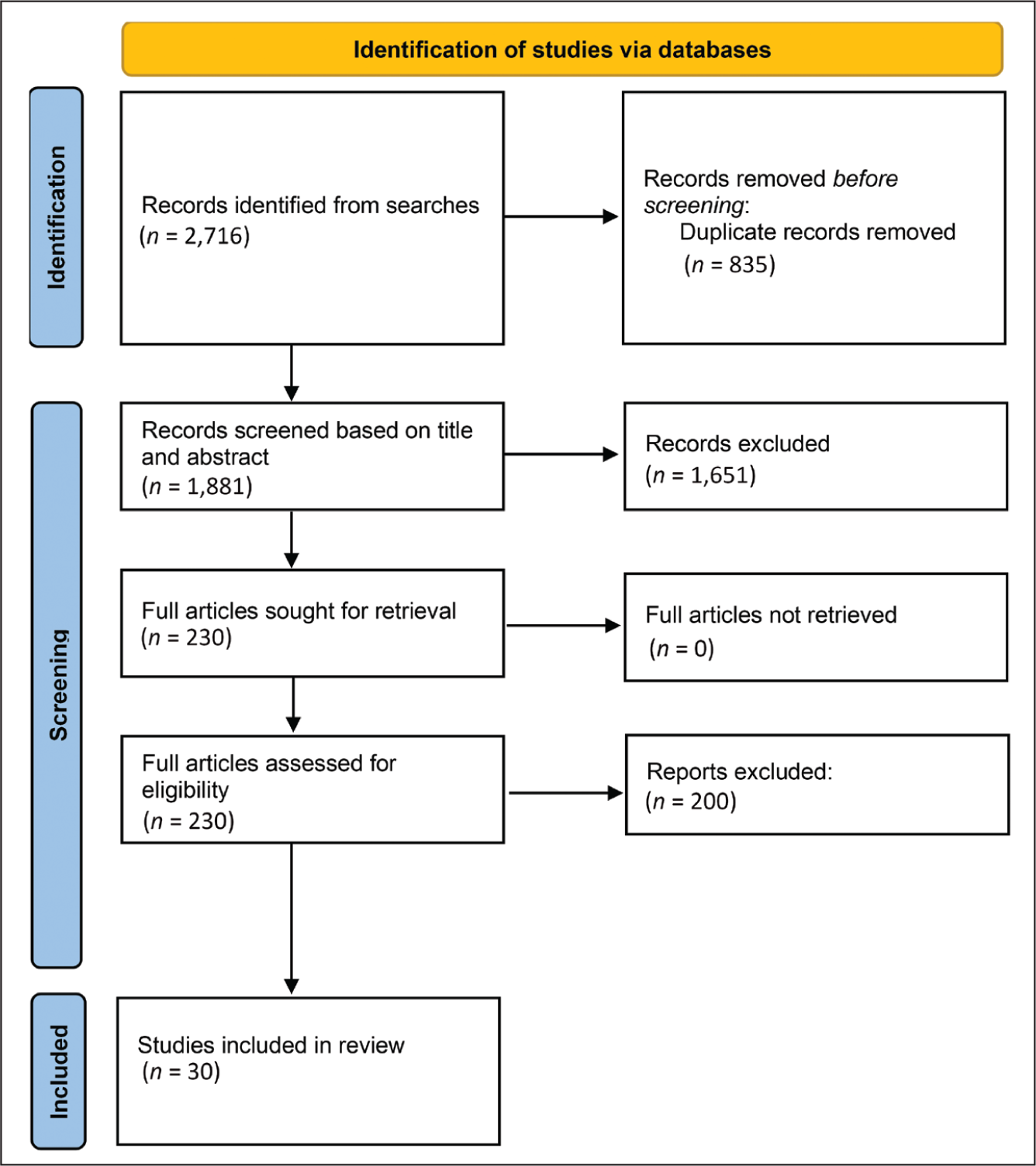
The reasons for exclusion during this process included the duration of the intervention (short workshops or limited duration interventions), not being credit-bearing or being extracurricular, not being part of a formal programme, or being the form of publication (conference proceedings, not a final article).
Disciplinary or General Identification of Case Studies (Using Biglan’s Classification)
Thirty studies (representing 33 cases) were analysed to identify whether they were reports of disciplinary-focused sustainability education modules or general sustainability education modules. To achieve this, the paper was read in full, and the description of the context within the study was reviewed. If the case study described interventions within disciplinary programmes and the students were from a single discipline, the study was identified as disciplinary. Interventions that were open to students from a range of disciplines were identified as general.
The disciplinary-focused modules were coded within the Biglan classification and allocated a location within the classification based on their characteristics vis-à-vis the pure/applied, hard/soft and life/nonlife distinctions.
For disciplines that were not captured in the original Biglan classification (e.g., business, marketing or advertising), these were allocated to the soft/applied/life classification as indicated by Stoecker (1993) and Doberneck and Schweitzer (2017).
The general sustainability education modules were located within the classification as hard/applied/life due to their primary focus on sustainability.
Differentiating Sustainability-focused Module and Sustainability-inclusive Modules
The studies were further analysed to identify whether they were accounts of primarily sustainability-focused modules or sustainability-inclusive modules using the guidelines from the Association for the Advancement of Sustainability in Higher Education (Aashe, 2019). Under this schema, sustainability-focused modules should have sustainability as the main topic of the module and be reflected in the title. Sustainability-inclusive modules are those that do not have sustainability as their primary focus; however, they do integrate sustainability-focused activities, issues, challenges, etc.
Results and Discussion
Descriptive Analysis of Results
A total of 30 SoSTL publications were identified as fitting the criteria and analysed for this review. Three publications reported two case studies apiece; therefore, the total number of case studies for analysis is 33.
Number of Publications per Year and per Journal
Figure 2 shows the spread of the 30 publications by the year of publication.
Publications per Year.

Figure 3 presents the number of publications studied per journal. These results demonstrate a clear emphasis on two journals as the publication location of choice for much of the published research. Sustainability and the International Journal of Sustainability in Higher Education together represent more than 50% of all case studies studied in this review (n = 16 out of a total of 30 publications).
Number of Publications Studied Per Journal.

Number of Publications Describing EfSD Case Studies by Discipline
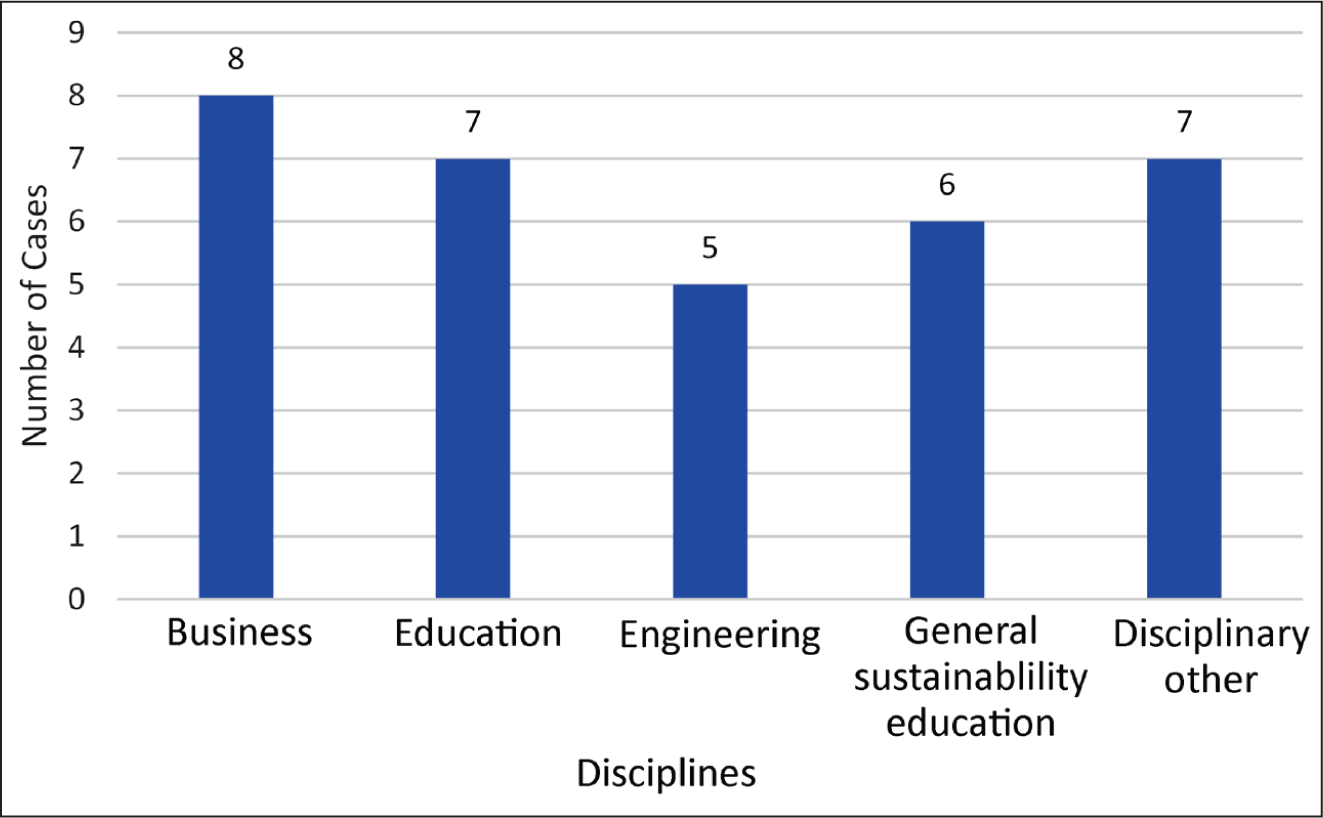
The allocation of 33 cases to the disciplines of their students is shown in Figure 4. Eight cases were identified as being from business, seven from education and five from engineering. Six cases were coded as general sustainability education in that the students came from a range of disciplines and the course was not specific to any single one. Seven cases were from disciplines that occurred only a single time in the data set. These were case studies from built environment, chemistry, design, fashion design, hospitality and retail management, maritime studies and urban studies.
Number of Publications Studied per Discipline.
Identifying Sustainability-focused and Sustainability-inclusive Interventions
The 33 case studies were analysed to determine if they were sustainability-focused or sustainability-inclusive courses by using the classification outlined in the STARS technical manual (see Table 1; Aashe, 2019).
Sustainability-Focused and Sustainability-Inclusive Breakdown.
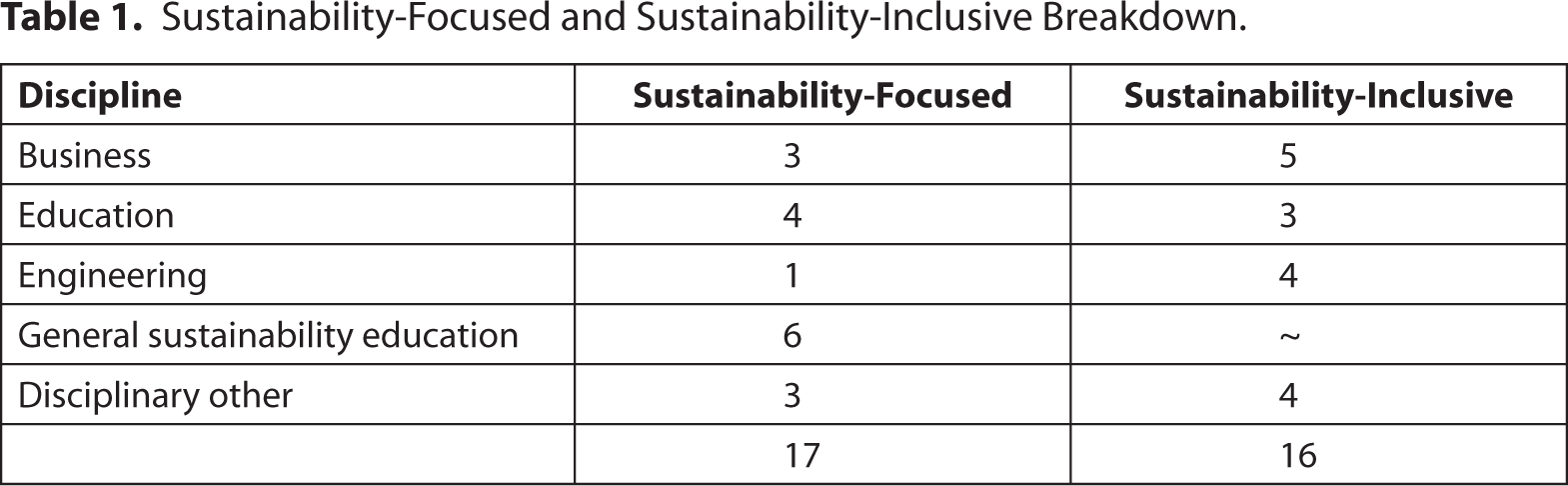
There was a broadly even distribution of cases in each category (17 sustainability-focused and 16 sustainability-inclusive). All general sustainability education cases were sustainability-focused as they were foundational modules with sustainability as their primary focus.
Populating the Biglan Classification
The case studies were allocated cells in the Biglan classification according to the discipline identified in the results above (see Table 2).
Populated Biglan Classification.

Of the case studies analysed, the split between hard and soft disciplines was almost even, with 15 cases within the hard discipline category and 18 case studies related to soft disciplines (all of which were within the soft/applied/life category). Within the axis of life or nonlife disciplines, the division was 24 case studies in life disciplines and 9 in nonlife disciplines.
The results also demonstrate that the SoSTL case studies fell almost entirely within the applied disciplines category (n = 32) as opposed to only a single case within the pure disciplines category (n = 1).
The soft/applied/life combination was the single most significant, with 18 of the 33 case studies falling within that category. The remainder were split between hard/applied/nonlife (n = 7) and hard/applied/life (n = 5). There were no case studies within the segments pure/life/hard, pure/non-life/soft, pure/life/soft and applied/non-life/soft.
Summary Description of Case Studies
The 33 case studies are described in Table 3. A total of 17 case studies were sustainability-focused, and 16 were sustainability-inclusive.
Case Study Details.


Disciplinary-Focused and General Education Interventions
The division between disciplinary-focused and general education intervention (n = 27 and n = 6, respectively) reflects the two approaches to integrating EfSD within HE: EfS interventions into existing disciplinary programmes and general educational interventions (Hill & Wang, 2018; Thomas & Nicita, 2002).
This may suggest that HE structures are maintaining the boundaries of EfSD within specific disciplines. Disciplinary-focused EfS interventions allow the faculty and students to explore specifically how their discipline (and in many cases subsequent careers) can contribute to the challenges of EfSD. Although it is welcoming to see integration at a disciplinary level, it calls into question whether these interventions are fostering EfS competencies such as trans- and inter-disciplinarity.
General educational interventions do serve to ensure that most, if not all, HE students receive education on sustainability, thereby achieving the UNESCO goal of EfS across all sectors. However, as this analysis has demonstrated, there are fewer examples of published scholarship literature relating to general educational interventions. This could suggest that there are fewer of these programmes in place, that the research landscape of these programmes is at a nascent state, or that there are fewer avenues for publishing general case studies on sustainability education.
Proponents and critics of both approaches exist. General EfS can be perceived as generic, and disciplinary-focused courses can be perceived as narrow (Cotton & Alcock, 2013). These should not be seen as mutually exclusive, as it can be argued that there is a need for both types of intervention. The general education intervention ensures breadth of fundamental knowledge of the challenge of sustainability, while the disciplinary-focused course ensures a deep understanding of how a student’s discipline can contribute to the challenges they will face in their future.
Sustainability-Focused and Sustainability-Inclusive Interventions
The even division between focused and inclusive interventions demonstrates a spectrum of scholarship on EfSD. Faculty are reviewing modules that focus on sustainability first, and those modules where sustainability is embedded while focusing on other components of the programme.
This represents a valuable resource to faculty looking to integrate EfSD into their own programmes by not focusing on a one-size-fits-all approach, and the body of scholarship represents a range of alternative models of integration.
Applied and Pure Disciplines
Reported SoSTL module interventions occur predominantly within applied disciplines (n = 32/33), and rarely in the pure disciplines (n = 1/33). For Biglan, Applied disciplines are academic areas concerned with ‘application to practical problems’, while pure disciplines are those that have little or no requirements for practical applications (Biglan, 1973a). The dominant disciplines of business, engineering and education fall into this category. It is important to stress that the absence of SoSTL case studies from a cohort of disciplines does not mean that EfSD curricular integrations are not happening, only that they are not being reported on using the criteria of the SoTL discussed earlier.
The impact of this trend on the integration of EfSD into HE is considerable. While faculty members from the applied disciplines who are seeking to integrate EfSD into their curriculum have a number of case studies to learn from and engage with, those from the pure disciplines are less fortunate. They will, from the perspective of SoSTL, be starting from scratch and potentially reinventing the wheel each time.
While the impact is clear, understanding why there are fewer SoSTL case studies from pure disciplines than applied is more challenging. The most obvious reason is that there is less EfSD activity within pure disciplines; however, this study does not address this, and no claims can be made. Similarly, the faculty within the applied disciplines may be more amenable to conducting scholarship on EfSD; however, there is no evidence of this arising from this study.
Conclusions and Limitations
This narrative review set out to identify trends and patterns of SoSTL educational interventions at a module level and identify whether these interventions were sustainability-focused or sustainability-inclusive. While this review does not claim to be comprehensive, it does highlight a distinct pattern in the disciplinary spread of SoSTL interventions along the pure/applied axis of Biglan’s classification, whereby almost all case studies reviewed related to applied disciplines.
The review also identified a concentration of interventions among the disciplines of business, education and engineering in addition to interventions considered to be General education. The findings in relation to the sustainability-focused/sustainability-inclusive divide demonstrated an even mix of the two forms.
The key trends identified from case studies identified and analysed within this study are as follows:
The majority of module-level EfSD interventions are discipline specific (n = 27) and the minority are general education interventions (n = 6). The interventions are almost evenly split between sustainability-focused (n = 17) and sustainability-inclusive (n = 16). Almost all the interventions were from disciplines characterized as Applied from the Biglan classification (n = 32) as opposed to pure disciplines (n = 1).
Limitations
The first limitation arises due to the nature of narrative reviews. This type of review lacks the formal structure of a more systematic review and therefore has less of a claim of being an exhaustive or comprehensive review of the case study literature concerning SoSTL EfS interventions. The novelty of the area and the difficulty in identifying the case study literature informed the decision to conduct a narrative review.
The second limitation of the study arises due to the selection criteria requiring studies to be declared as being in a case study format. Case studies themselves are an interpretivist and primarily qualitative research methodology. As such, they would be more challenging to construct by faculty whose discipline would be more focused on quantitative approaches. It is therefore a possibility that EfS interventions are occurring in greater numbers in the pure discipline; however, they are not being published due to a lack of familiarity with case study and qualitative research.
Conclusion
The SoTL is an established mechanism whereby academic practitioners can investigate their own teaching practice and share and disseminate the findings to the benefit of others in their community. The challenges of teaching EfSD, coupled with the imperative for higher education to deliver such an education, require a body of scholarship concerning the experience and learnings from the academic community’s efforts across the whole curriculum and disciplinary structure.
This review has identified a significant imbalance within the SoSTL literature by discipline characteristics. Scholarship of sustainability teaching and learning is becoming established in the applied disciplines, particularly in business, engineering, and education, but is receiving scant attention, if any at all, in most of the pure disciplines. The impact of this is the loss of a vital and established method of sharing peer-reviewed teaching innovation, practice, and experiences. This may, in turn, hinder attempts to integrate EfSD into many areas of the institution.
The existential threat of climate change and the sustainability challenges require all students to understand the challenges and acquire the skills required to address them, and yet, EfS integration into disciplines is a challenging activity. Scholars from all disciplines must be encouraged to investigate and share their own experiences as one way to help the transition to an integrated sustainability education for the benefit of our students and, in turn, to address the challenges of sustainability.
Footnotes
Data Availability Statement
The data set generated and/or analysed during the current study is available from the corresponding author on reasonable request.
Declaration of Conflicting Interests
The authors declared no potential conflicts of interest with respect to the research, authorship and/or publication of this article.
Funding
The authors received no financial support for the research, authorship and/or publication of this article.