




Abstract
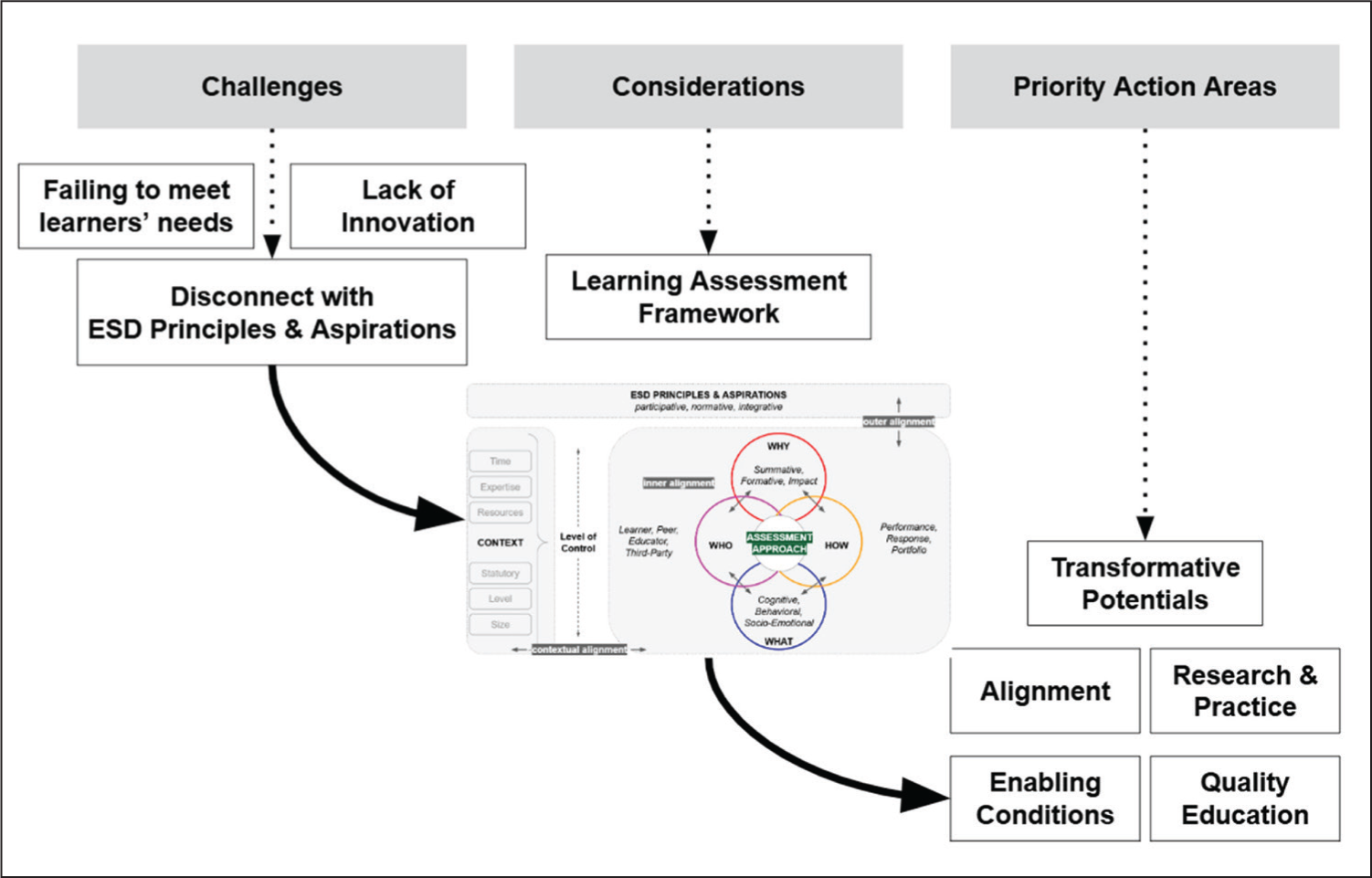
The role of assessment in education for sustainable development (ESD) is in need of re-assessment. Despite its importance, assessment in ESD has been criticized for its detrimental effects on learner well-being, lack of innovation and failure to adequately consider fundamental sustainability principles, limiting its integral link to learning. A framework for ESD-sensitive assessments is proposed, considering the ‘WHAT’, ‘HOW’, ‘WHO’ and ‘WHY’ of assessment. This commentary argues that constructive alignment is needed not only between objectives, pedagogies and assessment, but also between these considerations of assessment and their alignment with general principles and aspirations of ESD. By rethinking assessment along these lines, and by grounding them in local contexts, ESD can contribute to its original task of reorienting quality education towards sustainable development. In light of this endeavour, the authors call for a more nuanced understanding of the purposes, methods, roles and objectives of ESD learning assessment, and how they can be aligned to better support ESD principles and aspirations.
Introduction
The role of assessment in education for sustainable development (ESD) is a critical yet often overlooked aspect of the teaching and learning process. Assessment is not just a technical addendum to teaching and learning, but serves as a culmination point that reveals ‘what truly matters’ (Nieminen & Yang, 2024) in education. Assessment functions as an ‘act of communication about what we value’ (Boud, 2000), and what gets assessed and graded forms the ‘real curriculum’ that shapes learners’ strategic rationales for allocating time and focus (Serrano et al., 2018). In the field of ESD, significant progress has been made in determining the principles and objectives that guide learning processes (Redman & Wiek, 2021), as well as experimenting with pedagogical approaches to meet these targets (Lozano et al., 2017; Rieckmann et al., 2017). However, less attention has been paid to how learning in ESD is, can and should be assessed to fully reflect and contribute to the aspirations and principles of ESD.
So, despite its widely acknowledged importance, assessment in ESD is substantially underdeveloped both in theory and practice (Redman et al., 2021). Current approaches to assessment in ESD have been criticized for their lack of innovation and for largely reproducing existing assessment practices that have been shown to have detrimental effects on learners’ wellbeing and learning needs (Farioli et al., 2022). This commentary builds on a previously conducted systematic literature review (Redman et al., 2021), supplemented with key scholarly additions of the last few years. The focus herein is to review the most substantive critiques of assessment in ESD. In doing so we found that a root cause of the lack of innovation in this space is that the current, mostly superficial approaches to assessment fail to consider the principles and aspirations of ESD and apply those to assessment. The results of this lacuna are insufficient connections between assessment in ESD and learning, and a limited capacity to evaluate or promote sustainability impact through that learning.
The need to innovate assessment in ESD is pressing, and UNESCO’s recently adopted Recommendation for Peace, Human Rights and Sustainable Development (United Nations Educational, Scientific and Cultural Organization (UNESCO), 2023) provides a strong impetus for this effort. The document, endorsed by all UNESCO member states and acting as the only intergovernmental instrument that articulates a vision for the design of education systems in the twenty-first century, calls for a shift and reorientation of assessment to support adaptive, context-specific learning experiences for all learners, with approaches that are free from cultural bias, prioritize collaboration over competition and focus on the whole-person and wellbeing of the (lifelong) learner. If assessment in ESD is to achieve this goal, we argue that it must be better developed in relation to both best practices in the broader field of assessment and its engagement with the principles and practices of ESD and sustainability more generally. This commentary is an intervention to put assessment more into the focus of ESD practitioners, policymakers and researchers. It proceeds in three steps: reviewing the shortfalls of current approaches to assessment in ESD, sketching considerations for more innovative approaches to learning assessment that better align with the principles and aspirations of ESD and proposing priority action areas to guide the further development of approaches to what we have labelled as ESD learning assessment for research, policy and practice.
Challenges in Learning Assessment in ESD
This section explores the limitations and challenges of mainstream assessment practices in ESD, highlighting the need for more ESD-aligned assessment approaches.
Failing to Meet Learners’ Needs
Mainstream assessment practices have been criticized for their detrimental impacts on both learners’ well-being and ability to meet their learning needs. For example, a systematic review of 60 studies found that one in six students experience excessive distress during the final two years of secondary school, with female students being more affected (Wuthrich et al., 2020). This is not an isolated issue, as the Organisation for Economic Co-operation and Development’s Programme for International Student Assessment (PISA) 2015 study found that two out of three students reported feeling stressed about poor grades, and more than half of students felt ‘very anxious about school testing, even when they are well prepared’ (Pascoe et al., 2020).
In addition to well-being impacts, mainstream assessment approaches have also been criticized for failing to meet the learning needs of learners. Critics argue that current assessment practices prioritize individualized qualification over other dimensions of education, such as socialization and subjectification (Biesta, 2010; Biesta, 2020). This can lead to a neglect of learners’ agency and self-formation, with assessment being designed and implemented by others for the purposes of others (Nieminen & Yang, 2024). Furthermore, assessment practices can actually endanger learners’ learning needs, such as the case of standards-based assessments in the United Kingdom, which led to a focus on ‘teaching to the test’ and a decline in depth in learners’ engagement with the subject matter (McIntosh et al., 2015). These findings highlight the need for a more nuanced understanding of the impacts of assessment on learners’ well-being and learning needs, as well as the need for more innovative and effective assessment approaches that meet the needs of learners.
Lack of Innovation
Researchers have emphasized the need to innovate assessment systems in education, particularly in light of increasing demands for students to engage with authentic real-world problems, provide more interaction and feedback within limited resource constraints, and leverage advancements in technological and digital support systems (Knight & Drysdale, 2020). However, most research and practice on ESD learning assessment have been status quo or reform-oriented, operating within current assessment systems and focusing on what is assessed and how, rather than being based on transformative considerations regarding the roles of assessment in ESD and the agency of learners. This is particularly problematic for the field because traditional forms of assessment can struggle to be responsive to the multi-faceted and applied forms of learning outcomes that are prevalent in ESD (King et al., 2024).
Efforts in the field have focused on linking ESD with mainstream assessment practices, incorporating ESD learning outcomes into mainstream assessments or deploying mainstream assessment practices in ESD contexts. While this may seem like a necessary step in mainstreaming ESD, it risks perpetuating the detrimental effects of mainstream assessment systems as discussed above, potentially aggravating the problems that ESD aims to address. From an innovation theory perspective (Chandra et al., 2021; Fischer & Nemnich, 2013), another shortcoming of current assessment work is that approaches to learning assessment in ESD have remained in the ideation or invention stages, but not yet reached the phase of broader use and marketization, except for some tools like SULITEST (Stough et al., 2023) or approaches implemented by larger networks like the ESD Significant Learning Assessment Model (Shumba et al., 2021). To inform and enhance the assessment practices in ESD, it might be beneficial to engage with a broader range of innovations in assessment outside of the field, critically evaluating which approaches may be adapted and applied to support the unique principles and aspirations of ESD.
Recent reviews of the academic literature on assessment in ESD revealed several limitations, one of the most critical from an innovation perspective being a lack of utility for practitioners (Cebrián et al., 2019; Redman et al., 2021). While most scholarly studies on ESD interventions utilize assessment (and sometimes very innovative tools) to evaluate the impact of the ESD intervention, these assessments are not being used in the classroom for either summative or formative purposes. This disconnect between the purpose of the assessments described in the ESD literature (diagnostic) and what is needed in the real world (pedagogical) limits the direct applicability of much of the published academic work to K-12 classroom assessment and large-scale learning assessments.
Disconnect with ESD Principles and Aspirations
As described, current approaches to learning assessment in ESD have been criticized for failing to adequately embody and contribute to the main principles and aspirations of ESD and its distinct type of learning. One of the key features of ESD learning is that it deals with real-world challenges that do not lend themselves to easy solutions and cannot be atomized in conventional problem-solving approaches (Ludwig et al., 2022). Confronting such wicked sustainability problems requires a distinct type of learning that involves creative, change-oriented, experiential and experimental pedagogies, transdisciplinary collaboration and diverse types of knowledge, such as systems thinking, strategic thinking, values thinking and futures thinking (Laurie et al., 2016; Wiek et al., 2011). It also often requires stronger ownership and increased agency of learners of their learning process, and higher-order reflections about the feasibility and appropriateness of the learning approaches chosen (double and triple loop learning, Barth et al., 2023). However, current approaches to learning assessment in ESD often fail to capture the essence of this type of learning, as they are commonly designed to evaluate learners’ ability to recall and apply established and testable knowledge. Such mismatch between learning goals and assessment methods might lead to a narrow focus on right or wrong answers, rather than encouraging learners to think critically, reflexively and strategically about complex, real-world problems.
To better align learning assessment approaches and ESD philosophy, King et al. (2024) proposed that sustainability-oriented assessment should incorporate three key sustainability principles: participative, normative and integrative. The participative features of sustainability-oriented assessment are operationalized in increased learner agency, which emphasizes the collaborative and reflective dimensions of learning. This approach positions assessment as a critical and generative dialogue in which students can advance authentic insights. The normative features of sustainability-oriented assessment are operationalized in increased deliberation of values and goals, allowing learners to critically engage with what high versus low performance in a problem-solving process might mean and how different learning styles can be considered in the assessment process. The integrative features of sustainability-oriented assessment are operationalized through students’ agency in negotiating consensus across diverse perspectives regarding learning objectives and assessment standards. Leveraging these features of assessment design may enhance the efficacy of assessments in ESD to capture and contribute to the ways that ESD learning processes translate into sustainable action in the real world.
Considerations in ESD Learning Assessment
In order to advance assessment practice and theory in the field, we propose the concept of ESD learning assessment, which can be defined as the aligned approach of integratively evaluating and enhancing learning and its application in the context of sustainability through assessment. What are some of the key considerations that need to be addressed to design ESD learning assessments that better reflect the principles and aspirations of ESD in assessing learning? This section applies four lenses to learning assessment that can help to further specify how the characteristics of ESD learning outlined above can inform innovative and more sustainability-based approaches to learning assessment: the why, what, how and who of assessment (Richmond et al., 2019). These four considerations provide the foundational choices for how an approach or tool is designed and implemented. We suggest that alignment across the four considerations is important for ensuring that assessments are internally consistent and robust in meeting the needs of learners while also being aligned with the aspirations and principles of learning in ESD.
The Why: Purposes of Assessment
In ESD, assessment can serve multiple purposes that go beyond traditional notions of evaluation and grading. These purposes can be defined as (King et al., 2023):
Assessment of learning: How learning in ESD leads to intra-individual changes, typically measured by means of pre-determined operationalized learning outcome constructs. Assessment for learning: How learning in ESD can be advanced through the use of assessment, for example, by allowing learners to engage with the information assessed or even having them design their own assessment to improve their learning and performance. Assessment for impact: How learning in ESD leads to real-world change, without prescribing or predetermining what exactly the change to be affected through ESD learning is.
A major purpose of ESD learning that assessment should contribute to is to stimulate further learning. This occurs best through methods that enable learning’s application, reflection on that learning and the development of additional learning. These purposes can be supported by different assessment approaches (King, 2024). Authentic assessment approaches reflect the demands of professional settings, testing learners’ performance in real-world contexts. Reflective assessment approaches involve critical introspection and contemplation of learning goals, progress and potential strategy adaptations. Generative assessment approaches indicate, motivate and enable learning application during and after assessment tasks, creating impact beyond the assessment activity.
By recognizing these different purposes and approaches, ESD assessment can move beyond a one-sided use of summative evaluation and grading, towards a more sophisticated use of assessment to facilitate open learning and meta-learning. By involving learners in defining what is meaningful and relevant to be learned, providing feedback along the way and allowing learners to engage with and use the feedback for improvements, double- and triple loop learning can be stimulated (Barth et al., 2023). This type of transformational learning, which prioritizes learner agency that is responsive to their needs, may also better foster well-being increases and diminish the anxiety associated with high-stakes exams (Kiptiony, 2024).
The What: Learning Outcomes to Assess
A key consideration for the design of ESD learning assessments is the choice of which learning processes or learning outcomes to focus on. Commonly, ESD learning outcomes are described on three domains (Rieckmann et al., 2017):
Cognitive: Knowledge and thinking skills Socioemotional: Self-reflection and social skills Behavioural: Actions and practical skills
ESD learning objectives go beyond knowledge and the preoccupation with cognitive intellectual academic outcomes that are typically represented as the foci of assessment tools. They involve the ability to successfully solve problems in specific situations and contexts, including behavioural and socioemotional dimensions (Rieckmann et al., 2017), which also involves interpersonal and intrapersonal levels of learning (Frank, 2021). In recent years, the focus of educational objectives has shifted to targeting competencies (such as in ESD) and twenty-first century skills. Assessment though has not caught up with the change in learning objectives and ‘the theoretical and methodological difficulties entailed in the measurement of competencies are frequently underestimated in both educational practice and educational policy’ (Leutner et al., 2008). Other authors have continued to find a lack of sufficient research on the measurement of these types of skills and competencies, and what exists too often relies on student self-reports (Zlatkin-Troitschanskaia et al., 2015).
Assessing these new skills/competencies is fundamentally different from more conventional domains such as numeracy because these are complex, non-routine, dynamic, interrelated with each other and based on their application to real-life (Vista et al., 2018). A core challenge for assessment in this space will be establishing construct validity given the complexity of the constructs and the challenge of drawing inferences when the intention is that they should translate across content and contexts (but any real-world assessment cannot feasibly include sufficient permutations to measure this generalizability). While assessment of ESD can and should draw from the extensive practice and research in assessment in education more broadly, it will need to forge much new ground as the assessment of constructs similar to that which ESD seeks to develop in learners is still relatively underdeveloped across all education.
The How: Assessment Approaches and Designs
ESD learning assessment should not only focus on what is being assessed but also on the assessment process itself, with the aim of reflecting core principles of sustainability such as creating a more inclusive and equitable assessment process and empowering students to take an active role in their learning. Work towards such assessment approaches in ESD can draw on a range of evidence-based assessment types and methods that can be tailored to meet the characteristics of ESD learning and its principles and aspirations (King et al., 2023; Redman et al., 2021; Reynolds et al., 2009).
Portfolio-based assessment, for example, allows students to explore and showcase their learning over time, highlighting their growth and progress in relevant domains of ESD learning. This approach can provide nuanced insights into student learning.
Performance assessment evaluates students’ ability to apply their knowledge and skills in real-world contexts, such as through project-based learning or simulations. This type of assessment can help to prepare students for the challenges they will face in their future professional or civic roles.
Other established assessment approaches include test-based assessments, which can take the shape of response assessments or large-scale learning assessments, which can provide insights into learning achievements of larger groups of learners and offer insights on the effectiveness of ESD teaching and learning settings.
By embracing and combining more diverse evidence-based assessment approaches and utilizing them in line with principles of ESD learning assessment, assessment designs can overcome the field’s heavy reliance on tests and self-reports and provide more nuanced and comprehensive understandings of, and offer more active support, to student learning in ESD.
The Who: Roles in the Assessment Process
In ESD, assessment should not only be about compliance with current systems but also about creating capacities to transform institutions and regimes that have created lock-in effects and structures of unsustainability (Lotz-Sisitka et al., 2015). This requires a shift from instructor-centred, summative, linear and cognitive-oriented assessment to student-centred, formative and more interactive, iterative and skill-oriented approaches (King et al., 2024). To achieve this, ESD positions learners as active agents with agency, rather than just objects of assessment. This involves a more participatory and inclusive assessment process, where learners are heard and involved throughout the design and implementation of the assessment approach. Assessment should be a transformative learning experience in itself, exemplifying to learners what it means to challenge taken-for-granted practices and standards by redesigning them on sustainability premises. In this vein, engagement with third-party stakeholders, such as community members or project partners, can provide real-world perspectives in assessing the efficacy of learning for applied problem-solving.
In this context, learners can take on various roles in the assessment process, including
self-assessment, peer-assessment, and educator-assessment (Redman et al., 2021).
One exemplary approach to achieve this is peer assessment, which has been demonstrated to have positive effects on student learning (Alqassab et al., 2023; Double et al., 2020). Research has shown that peer assessment can be effective when properly implemented, with rater training being essential (Liu & Carless, 2006). Regular use of peer assessment, combined with written or oral feedback, can lead to more effective learning outcomes (Li et al., 2020). While evidence supports the involvement of learners in assessment processes, such involvement should not be limited to the mere execution of the assessment method alone, but also extend to the design process, including who is involved in determining what to assess, how to assess and why to assess.
ESD Learning Assessment Framework
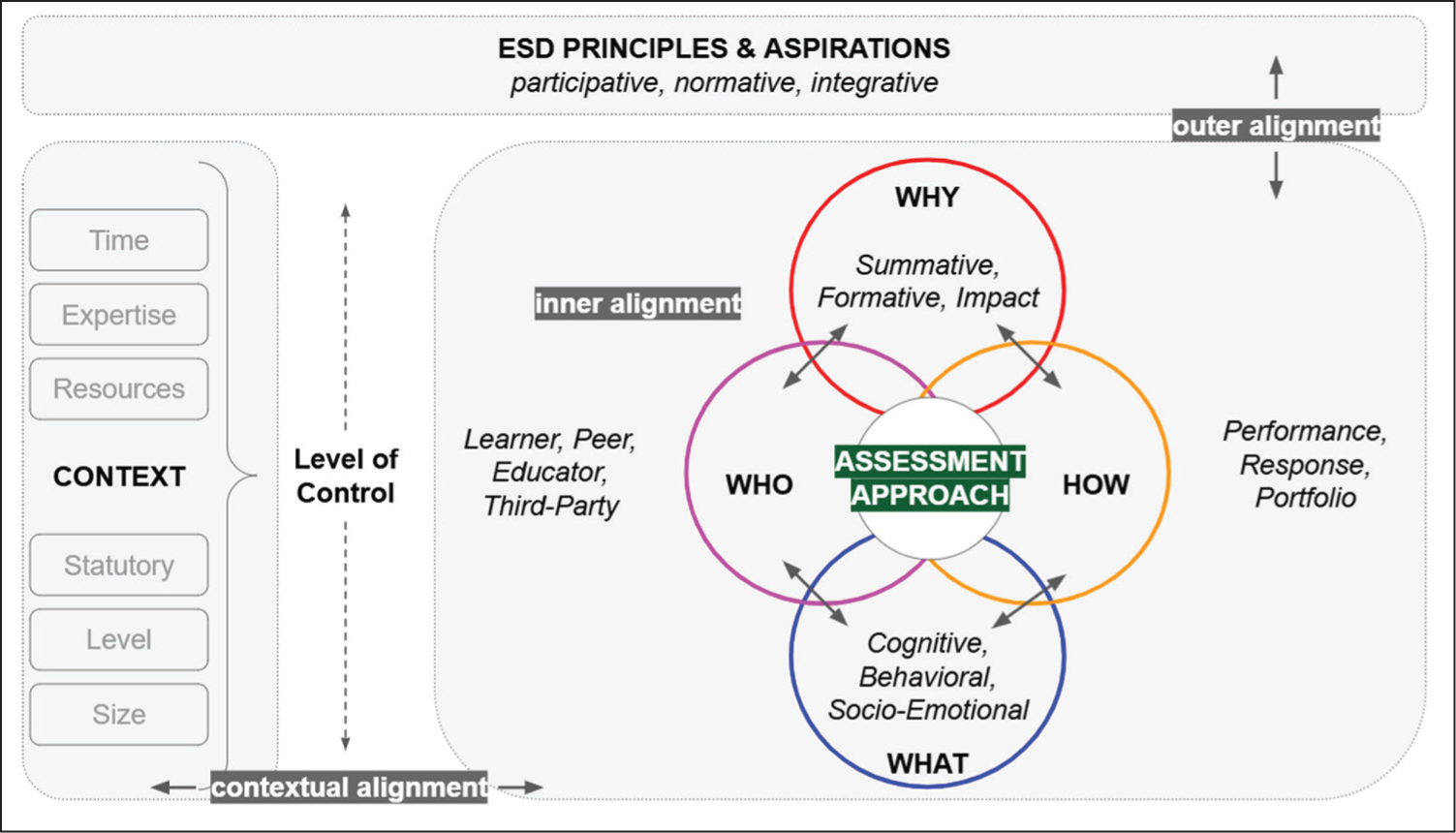
In response to current challenges in ESD learning assessment, and building on the four design considerations outlined before, we present a framework, the ESD Learning Assessment Framework (ESD-LAF), as a lens to re-assess and innovate assessment practices in ESD. Key to this is improved alignment on different levels that the framework works towards (see Figure 1). We will discuss these levels and then illustrate the use of the framework using two case examples.
ESD Learning Assessment Framework (ESD-LAF).
Alignment Levels
At the heart of the ESD-LAF is the inner alignment of different design considerations. Here, the focus is on ensuring that the WHY, WHAT, HOW and WHO of an assessment approach are internally consistent, free from contradictions and mutually supporting each other.
On a second alignment level (outer alignment), the assessment approach as a whole should support and reflect the general principles and aspirations of ESD (as outlined above), and not run counter to them. It is this alignment level especially that determines what makes a learning assessment approach an ESD learning assessment approach.
A third alignment level considers the feasibility of the approach within the specific conditions of environment where the approach is used (contextual alignment), for example, by critically appraising in how far time, expertise, resources (financial, temporal), legal frameworks or specifics of the learner group (level, size) pose specific constraints (or opportunities) to the assessment approach that should be considered in its design.
Case Examples
To illustrate how the ESD LAF can be used to inform the design of more suitable and aligned ESD learning assessment approaches, we will use two examples of widely used assessment practices: test-based learning assessment and reflective journaling. We apply the framework in three steps: describing the approach (using the four considerations), critically appraising it (using alignment checks) and (re)designing it (using modification and enrichment).
In a first step, both approaches can be described using the four considerations (WHY, WHAT, HOW, WHO):
The test-based approach is commonly a summative assessment that aims to evaluate students’ knowledge and problem-solving skills. Its main purpose is to determine if students have achieved learning outcomes, typically focusing on cognitive and behavioural learning outcomes. Common methods are the use of closed and open-ended questions that students need to respond to in writing. Typically, the responses will then be graded by the educator, or by an external provider/assessor in case of centralized/standardized assessments. Reflective journaling is often a formative assessment that aims to facilitate meta-cognitive and self-guided learning processes. Its main purpose is to promote reflection and self-awareness, typically focusing both on cognitive and socioemotional learning processes and outcomes. A widely used method is to have students compose relevant insights, observations, notes and other reference materials into a portfolio that then serves as a documentation of their learning process. Typically, educators provide feedback on the portfolio or use it as a basis for grading.
The second step is to critically appraise the examples by using alignment checks. This can be done by asking critical-constructive questions, such as:
Why is the test-based approach focused on (summative) assessment of learning only, and how can it be modified to include more formative elements to use the test also for facilitating learning? How can the test-based approach be made more authentic and relevant to real-world problems? Should a portfolio approach really be used to assess and grade learning, if its main purpose is to facilitate critical and open-ended self-reflection? How can the reflective journaling approach be made more participative and integrative, for example, by including peer feedback and combining it with other assessments?
The third step is to explore actions that can be taken to improve inner and outer alignment and strengthen the ESD learning assessment approach while maintaining contextual alignment. This can be done by modifying and enriching the examples in such ways as:
Including additional elements into test-based assessments, such as presenting complex real-world problems with no right-or-wrong answers and challenging students to develop creative approaches to define a problem and develop potential solutions. Combining the summative purpose with a more formative one, such as using test results as data points in portfolio work to stimulate reflections on the learning process. Having students self-assess or peer-assess their tests on rubrics they have co-created with the educator, analyse their results and derive implications to improve their individual and collective learning and mastery of the domains assessed. Incorporate reflection on specific behavioural outcomes of the learning process into the writing process in order to move beyond assessment of or for learning toward an assessment (and learning) for ESD impact approach, while spurring increases in learner well-being.
In conclusion, the use of the considerations for inner and outer alignment in ESD learning assessment can provide critical and constructive insight at the same time. It allows the disentanglement of often convoluted and implicit facets in choices for assessment approaches and enables a more thoughtful approach not just to their initial design but also to their incremental improvement.
Priority Action Areas for ESD Learning Assessment
Based on the three challenges and four considerations of the ESD LAF discussed thus far, we lay out five areas that we consider crucial for rethinking assessment in ESD. To emphasize the significance of addressing assessment as a neglected practice in ESD, we have drawn on the ESDfor2030 Roadmap (UNESCO, 2020) and identified these areas as Priority Action Areas for ESD learning assessment.
Harness the Transformative Potentials of Assessment
Currently, assessment is often used as a one-sided, summative tool to evaluate student learning, rather than a dynamic, formative process that facilitates open learning and meta-learning (Schellekens et al., 2021). To advance ESD learning assessment, it is essential to strengthen the role of assessment for learning. This requires a shift in focus from evaluation of learning to transformation through learning, in order to create assessment systems that empower learners to take an active role in their learning, foster collaborative relationships between learners, teachers and other stakeholders and promote a culture that is more conducive to risk-taking and experimentation. To accomplish this necessitates a deployment of a greater diversity of assessment approaches and a stronger emphasis on dialogue, co-investigation and process-oriented evaluation over traditional, banking-model assessment (Serrano et al., 2018). Assessment systems that are activating, collaborative, adaptive and providing safe spaces are potentially powerful for promoting authentic, inclusive learning (Inoue, 2004) while nurturing learners’ intrinsic motivation as essential qualities of the transformative aspirations of ESD.
Foster Alignment Within Assessment
A key priority action area highlighted in the ESD-LAF is the advancement of better aligned ESD learning assessment approaches and designs. Beyond the assessment approach itself, this involves ensuring that assessment is constructively aligned with learning objectives and pedagogies in the first place, as proposed by Bigg’s notion of ‘Constructive Alignment’ (Biggs, 1996). A disconnect between assessment and learning objectives can lead to a lack of understanding of how assessment can be used to support learning and achieve ESD learning outcomes. To address this, it is necessary to establish constructive inner alignment within the WHAT, HOW, WHO and WHY of assessment. This means specifying what desired outcomes are to be achieved (the WHAT), how these outcomes can be captured (the HOW), who is involved in the assessment process in which roles (the WHO) and why assessment is being used to support learning (the WHY). For example, if the goal of ESD learning assessment is to promote the impact of student learning on a real-world sustainability issue (the WHY), the approach should clearly articulate the desired outcomes (the WHAT)—such as the ability to influence a city council decision by applying forecasting and backcasting techniques—and specify how these outcomes can be measured and captured (the HOW), for example, through performance-based methods and including external stakeholders (the WHO) such as city council members (see, e.g., Foucrier, 2020). Outer alignment needs to ensure that ESD learning assessment is aligned with the principles and aspirations of not only ESD but sustainability more broadly in order to fulfil the ambitions for ESD to contribute to sustainability outcomes across local and global levels. By fostering alignment within assessment, educators can increase the coherence of the assessment design’s considerations and make sure that it delivers to the transformative aspirations of ESD not just in what it assesses, but also in how the assessment approach is set up and how it supports learning that contributes to sustainability outcomes.
Reconcile Disconnects Between Research and Practice
A key challenge to the advancement of ESD learning assessment innovations is the disconnect between research and practice (Farioli et al., 2022; Redman et al., 2021). A first disconnect is that the existing research on ESD learning assessment has primarily focused on higher education and relied heavily on university students as subjects, limiting the direct applicability of the research to K-12 classrooms. A second disconnect is that the research on ESD learning assessment has limited utility for practitioners, as the assessments are often used to evaluate the impact of educational interventions rather than being used in the classroom for summative or formative purposes. To address this, there is a need for more ground-level action research approaches that involve practitioners in the design and development of assessment approaches, as well as more follow-up efforts to valorize past research for educational practice. This should also consider systemic constraints (e.g., policy) and how opportunities can be created to enable more ESD-sensitive assessment approaches, particularly through longitudinal studies that examine both learning and (educational) systems change over time.
Create Enabling Conditions for Critical Engagement with ESD Learning Assessment Practice
To advance ESD learning assessment approaches and designs, it is essential to create enabling conditions for a more active, critical and sophisticated engagement with assessment practices in ESD. This requires addressing systemic barriers that hinder the development of assessments aligned with ESD principles and aspirations. One such barrier concerns research practices. A review of 131 studies found that while all agreed that students should have an active role, only few studies actually studied it, pointing to a need to bridge the ‘gap’ between verbal advocacy for student agency in assessment, and continued practices of traditional assessment (Schellekens et al., 2021). Among researchers studying assessment practices, there seems to be a need to focus more thoroughly in their research on how assessment promotes student agency, rather than just advocating for it. Educational institutions, policymakers and practitioners are called on to address the challenges of implementing new models of assessment that prioritize student agency and transformative learning. This requires navigating institutional obstacles, such as limited resources (time, financial resources, expertise) and outdated infrastructure, as well as addressing student resistance to change and the comfort they derive from traditional assessment methods (Serrano et al., 2018). The needs of educators in becoming more comfortable with ESD-aligned assessment approaches—through initiatives such as training, resources or scaffolded and localized support—is also a key endeavour for the field (Fischer et al., 2022). Being able to advocate for the role of forms of assessment compatible with learning in ESD is also crucial to promoting systems change that allows for more supportive policy and oversight across educational levels and contexts.
Leverage ESD Learning Assessment as a Mechanism to Promote Quality Education
In sustainability policy and practice, ESD has been tasked to reorient what we develop as quality education towards sustainability, promoting learning that is relevant to the challenges of our times (Hopkins et al., 2020; Laurie et al., 2016). For other fields like teacher education, it has been argued how sustainability innovations in the field of ESD can cross-pollinate into the educational mainstream of the field (Fischer et al., 2022), a process that Barth and Michelsen (2013) have labelled outside-in innovations. Similar processes are yet to be seen for the field of ESD learning assessment, despite the field’s potential to stimulate such outside-in innovations. After all, while happening slowly, the field of ESD learning assessment is also witnessing an early phase of consolidation, with attempts at systematization and typologization emerging in the literature. Review articles (Cebrián et al., 2019; Günther et al., 2022; O’Flaherty & Liddy, 2018; Redman et al., 2021; Vare, 2022) have begun to synthesize the various approaches and frameworks, providing a clearer understanding of the field’s progress and challenges. This consolidation is likely to catalyse further educational innovation, as new approaches to ESD learning assessment can push the boundaries of how education researchers, planners and practitioners approach assessment of student learning more generally, potentially providing a pathway toward mainstreaming ESD as well.
Conclusion
ESD is an ambitious and potentially radically transformative concept. Its ambition is not just to contribute to quality education, but to shape what quality education in the twenty-first century should be about. Innovations in ESD learning assessment can contribute to this aspiration by broadening our collective imagination of the role that assessment can play in building the collective capacity to learn our way out of unsustainability (Wals, 2010).
To achieve this, several key priority areas need to be addressed. Assessment designs must be better aligned with ESD principles, and research on learning assessment must become more relevant and practice-apt. It will be crucial to build assessment capacity in the field and create the systemic conditions needed for practitioners to be able to engage with new forms of assessment. By addressing these challenges, ESD can be put into a position to make better use of the assessment space to create the innovations it wishes to spread into the broader education field. The current lack thereof is a missed opportunity, as ESD-sensitive assessment approaches do have the transformative potential to challenge existing assessment systems and reorient them towards what learners and what societies need to tackle the complex, real-world problems of our times in sustainable ways.
The potential of ESD learning assessment to disrupt educational assessment regimes and leverage the impact of ESD is vast. It is time to re-assess the role of assessment in ESD and act to strengthen collective efforts to unleash its transformative potential for learners and our social future.
Footnotes
Authors’ Notes
The opinions expressed are those of the author and are not necessarily those of UNESCO.
Declaration of Conflicting Interests
The authors declared no potential conflicts of interest with respect to the research, authorship and/or publication of this article.
Funding
The authors disclosed receipt of the following financial support for the research, authorship and/or publication of this article: This commentary is funded by the Government of Japan as part of UNESCO’s ESD for 2030 programme.