




Abstract
STEAM education provides an interdisciplinary approach that fosters an understanding of sustainability and enhances real-world problem-solving, collaborative and inquiry skills. Given the absence of a comprehensive overview of STEAM with sustainability (G-STEAM) practices in primary school contexts, this scoping review conducts a thematic analysis to examine how sustainability is integrated into learning projects, covering learning topics, intended outcomes, pedagogical approaches and assessment tools. The findings emphasize a lack of STEAM projects promoting sustainability understanding. Projects are designed to enhance students’ twenty-first-century skills, subject knowledge, engaging learning experiences and sustainability knowledge and mindsets. Using diverse, constructive pedagogical approaches, these learning processes involve real-world problem-solving methods and integrated techniques to facilitate student reflection and abstraction. Assessment diversity is crucial for understanding student learning and promoting critical thinking, which are key for effective teaching. More research is needed to evaluate G-STEAM project alignment and effectiveness for evidence-based guidelines.
Introduction
Education for Sustainable Development (ESD) is UNESCO’s initiative to address the myriad local and global challenges our planet is facing (UNESCO, 2017). ESD’s core objective is to instil in students a comprehensive understanding and readiness for a sustainable environment, utilizing interdisciplinary teaching strategies and promoting collaboration (Hsiao & Su, 2021; Krug & Shaw, 2016). Research has highlighted the vital role of STEAM (science, technology, engineering, arts and mathematics) education in developing students’ scientific grasp of critical social issues, like ethical dilemmas, and fostering the essential cross-disciplinary skills required to address these issues (Rahmawati et al., 2022). In the twenty-first century, equipping students with such skills is crucial for nurturing socially responsible individuals who incorporate sustainability into their everyday lives, workplaces and communities (Rahmawati et al., 2022).
The integration of STEAM elements is increasingly recognized, although many curriculums did not explicitly label it as ‘STEAM’, for example, in Finnish basic education curriculum (Finnish National Board of Education, 2016). STEAM projects offer students the chance to engage in negotiation, innovation and collaboration, addressing open-ended challenges. Distinguishing STEAM projects from other school-based projects is their use of open-ended problems as a starting point and the integration of all STEAM disciplines within a single project (Vuopala et al., 2023). Nevertheless, there is a clear need to enhance teachers’ understanding of this approach and provide the necessary tools for its effective implementation in classroom settings. Research findings point towards the urgent need to improve teacher education both in ongoing development and in acquiring theoretical and practical expertise in STEAM subjects, including fostering skills in designing interdisciplinary curricula and aligning assessments with this pedagogical approach (Silva-Hormazábal & Alsina, 2023).
G-STEAM Education
Green-STEAM (G-STEAM) represents an innovative educational approach that merges the principles of STEAM education with education for sustainable development. This method integrates problem-solving within authentic real-world scenarios, employing a variety of inquiry, exploration and design strategies. This approach not only offers diverse perspectives on issues but also facilitates solution-oriented learning (Quigley et al., 2020). Research has shown that STEAM methodologies effectively foster students’ understanding of the interconnectedness between knowledge and skills across different disciplines. Furthermore, these approaches cultivate critical transversal competencies in students, including creativity, problem-solving, collaboration and the ability to manage uncertainty (Graham & Brouillette, 2017; Lu et al., 2022). These competencies are pivotal in addressing challenges in sustainable development. While the current integration might contribute to the European Union’s green transition plan for 2030, G-STEAM education in primary schools might also contribute to achieve the European Union’s climate-neutral goal by 2050 (Directorate-General for Climate Action (European Commission), 2019).
In the context of the Finnish basic education curriculum, sustainable development is seamlessly integrated across a variety of subjects and grade levels, using diverse methods (Finnish National Board of Education, 2016). The curriculum’s objective is to provide students with comprehensive knowledge about sustainable development and lifestyles, as well as responsible citizenship. Within this evidence-based learning framework, themes of sustainable development are explored through interdisciplinary learning modules. These modules encompass areas such as environmental education, consumer education, global education and sustainable development itself. Subjects such as biology, geography, social studies, home economics and crafts approach sustainable development from multiple angles (Finnish National Board of Education, 2016). The overarching goal is to integrate sustainability into various learning contexts, rather than treating it as an isolated topic. This approach ensures that global issues relating to sustainable development are thoroughly addressed, thus fostering a deeper understanding of these challenges among students and encouraging them to become proactive global citizens (Finnish National Board of Education, 2016).
The Benefits and Challenges of STEAM Education for Sustainability
Sustainability involves balancing and interconnecting social, economic, ecological and cultural developments with a long-term vision. Sustainable development extends these concepts, emphasizing the need for communities, regions and countries to develop in ways that do not deprive future generations of necessary resources (Amsler, 2019). Addressing sustainable development challenges and learning about sustainability require multiple intelligences and interdisciplinary collaboration. These approaches foster the creation of innovative solutions that did not exist before (Krug & Shaw, 2016). Therefore, ESD aims not only to equip students with knowledge related to sustainability and raise their awareness but also to develop their critical thinking skills, foster curiosity and creativity, and empower them to positively impact their environment for a better future. STEAM education, which integrates arts into STEM education, creates an inclusive and integrated interdisciplinary model (Hsiao & Su, 2021). It has been implemented at various educational levels, from early childhood to higher education, encouraging students to understand the world through the lens of STEAM subjects and their interconnections. This approach is conducive to cultivating students’ innovation capabilities, where they learn collaboratively through ‘learning by doing’ to solve practical problems (Hsiao & Su, 2021).
The common goals of ESD and STEAM education and their complementary merits have led to research and practices aimed at combining these educational approaches. Research indicates that STEAM education facilitates education for sustainable development, encouraging students to use interdisciplinary knowledge and skills to address current sustainable development problems (Hsiao & Su, 2021). Moreover, diverse teaching strategies in STEAM, such as the use of virtual reality (VR) in the classroom, have positively impacted students’ learning motivation, satisfaction and effectiveness (Hsiao & Su, 2021). Achieving sustainable development necessitates the co-creation of sustainability knowledge, a foundational element of STEAM education (Krug & Shaw, 2016; Rahmawati et al., 2022; Reinholz et al., 2019).
Theoretically, integrating STEAM education and ESD provides students with a holistic understanding of complex global issues, such as climate change, biodiversity loss and sustainable resource management. In addition, creativity, a key focus in STEAM education, is vital for developing innovative solutions to sustainability challenges and for imagining future solutions through artistic expression (Harris & de Bruin, 2017). Combining STEAM education with sustainable development prepares students for the complex challenges of a rapidly changing world and fosters global awareness and cultural sensitivity by helping them understand the global impacts of local actions and diverse cultural perspectives on sustainability (Hsiao & Su, 2021).
Research Gap in Integrating STEAM and Sustainability
Several gaps exist in aligning G-STEAM education theory, practices and empirical research. Teachers often find it challenging to implement STEAM education and ESD due to a lack of knowledge and skills (Perignat & Katz-Buonincontro, 2019). While STEAM education is being implemented in various parts of the world, there is a noticeable lack of guidelines to assist teachers in designing and implementing pedagogically sound STEAM education (Herro & Quigley, 2017; Vuopala et al., 2023), especially pedagogical planning. There is, fortunately, a growing body of STEAM research that reinforces and supports teachers in their work (Li et al., 2020). This support encompasses a wide range of knowledge, including expertise in education, subject matter knowledge, pedagogical skills and understanding of curriculum coherence. Teachers need to possess skills in generating new ideas, selecting appropriate materials, systematic curriculum design and effective implementation management. Lacking these skills, teachers may encounter challenges in both the planning phase and the practical implementation of the STEAM project (Huizinga et al., 2014).
Based on research findings, it is advisable to develop STEAM learning materials that provide more detailed explanations of methodologies and the use of technology. Such materials would support deeper learning and promote active learning. Bridging the gap between research findings and practical application is crucial to provide students with greater opportunities to practice and develop future skills (Vuopala et al., 2023). While there are reviews exploring STEAM in early childhood education (Ng et al., 2022), STEAM teacher training and the use of digital tools in STEAM education (Leavy et al., 2023), comprehensive overviews of STEAM practices with evidence of improvement in students’ learning and competence development remain limited.
Our research aims to summarize the practical practices of STEAM learning project and the integration of the sustainability in STEAM education in primary school settings. To understand the practical characteristics of the G-STEAM project implemented in primary schools, this scoping review was conducted to answer the following research questions:
How is sustainability covered in STEAM education? How are the lesson plans (intended learning outcomes (ILOs), pedagogical approaches and assessments) designed in G-STEAM learning projects?
Materials and Methods
This scoping review aims to identify key aspects of G-STEAM learning projects by mapping the existing literature, thereby clarifying the current research scope before implementing focused practices in classrooms (Munn et al., 2018). The scoping review assists in identifying various types of evidence, clarifying concepts, understanding research methodologies, and highlighting potential gaps or limitations in current research (Munn et al., 2018; Tricco et al., 2018). The authors adhere to a five-step scoping review methodology, which includes identifying the research questions, identifying relevant studies, selecting studies, charting the data and collating, summarizing and reporting the results (Arksey & O’Malley, 2005).
Search Strategy
The search strategy was devised to locate publications that discuss the implementation of G-STEAM projects in the context of primary schools. To ensure the quality of the sources, the literature search was restricted to peer-reviewed articles. Initially, the search focused on finding articles through specific search terms that were closely related to the topic of our study. This search encompassed a variety of databases within the EBSCOhost library, including Art Full Text, Art Index Retrospective, ERIC, APA PsycArticles, APA PsycInfo, Education Source, Teacher Reference Centre and Education Source Ultimate (see Table 1).
Search Strategy of the Scoping Review.
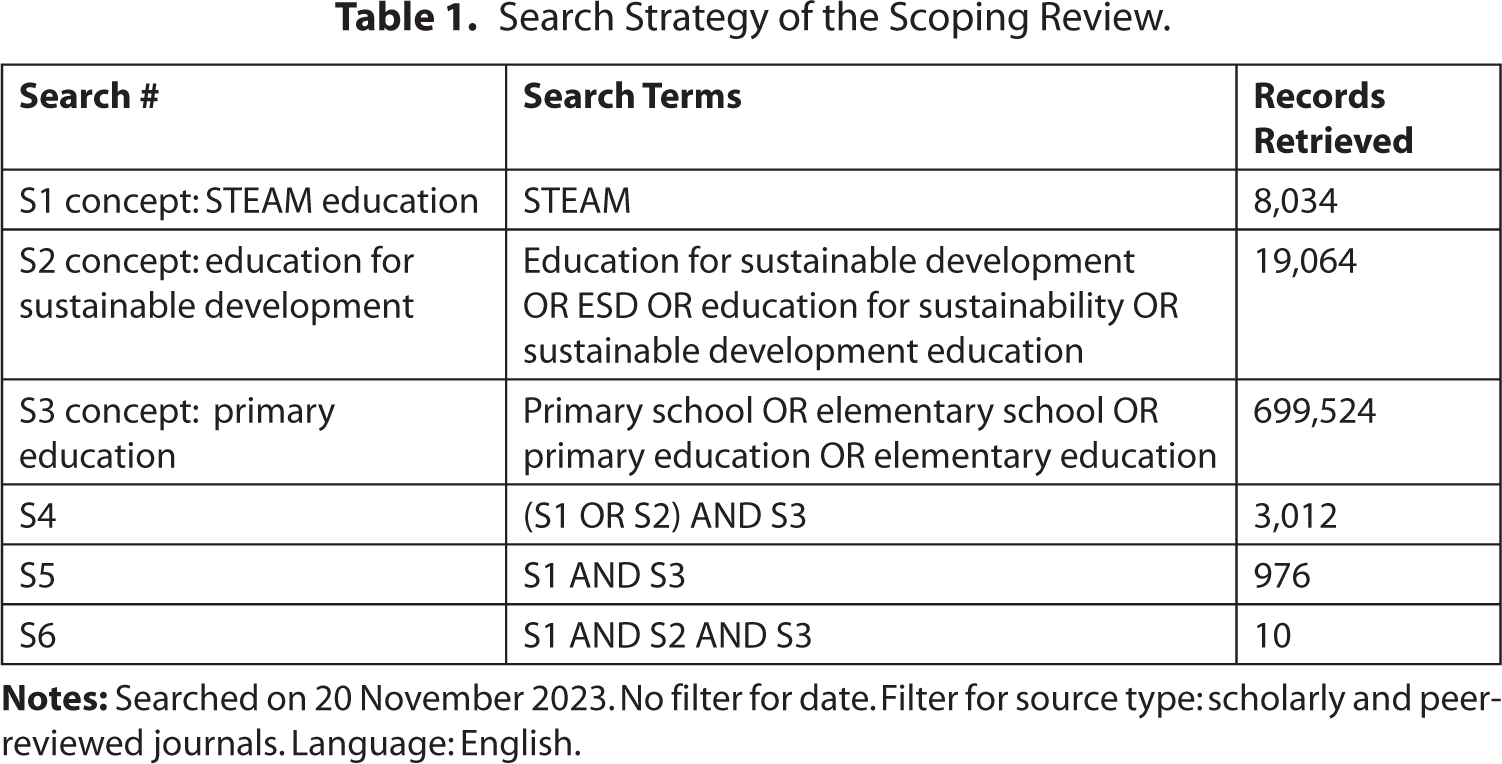
In our search strategy, we employed various combinations of search terms (see Table 1). Initially, we used a combination (denoted as S1 AND S2 AND S3), but this resulted in an overly limited selection of articles. Alternatively, the combination (S1 OR S2) AND S3 produced too broad a range of articles, resulting in a loss of specific focus on STEAM education. Consequently, to maintain focus on STEAM education while capturing a comprehensive range of relevant articles, we selected the S1 AND S3 combination. From the 976 results obtained, we identified 642 unique articles. These articles were then further scrutinized to ensure their relevance to our research objectives, focusing specifically on G-STEAM implementation in primary education.
Inclusion and Exclusion Criteria
To address the research questions, this review focuses on empirical studies that explore the implementation of G-STEAM education and its effects on student learning outcomes, as well as changes in teachers’ instructional approaches. The inclusion criteria are as follows: (a) the study must be empirical, (b) the study must implement a G-STEAM project to examine its impact on students’ learning outcomes and (c) the research project must be conducted in primary schools. Conversely, articles will be excluded from this study if they meet any of the following exclusion criteria: (a) the study is a review or theoretical article, (b) the study implements G-STEAM education outside the primary school context and (c) the study focuses on teacher education or professional development.
Screening and Data Extraction
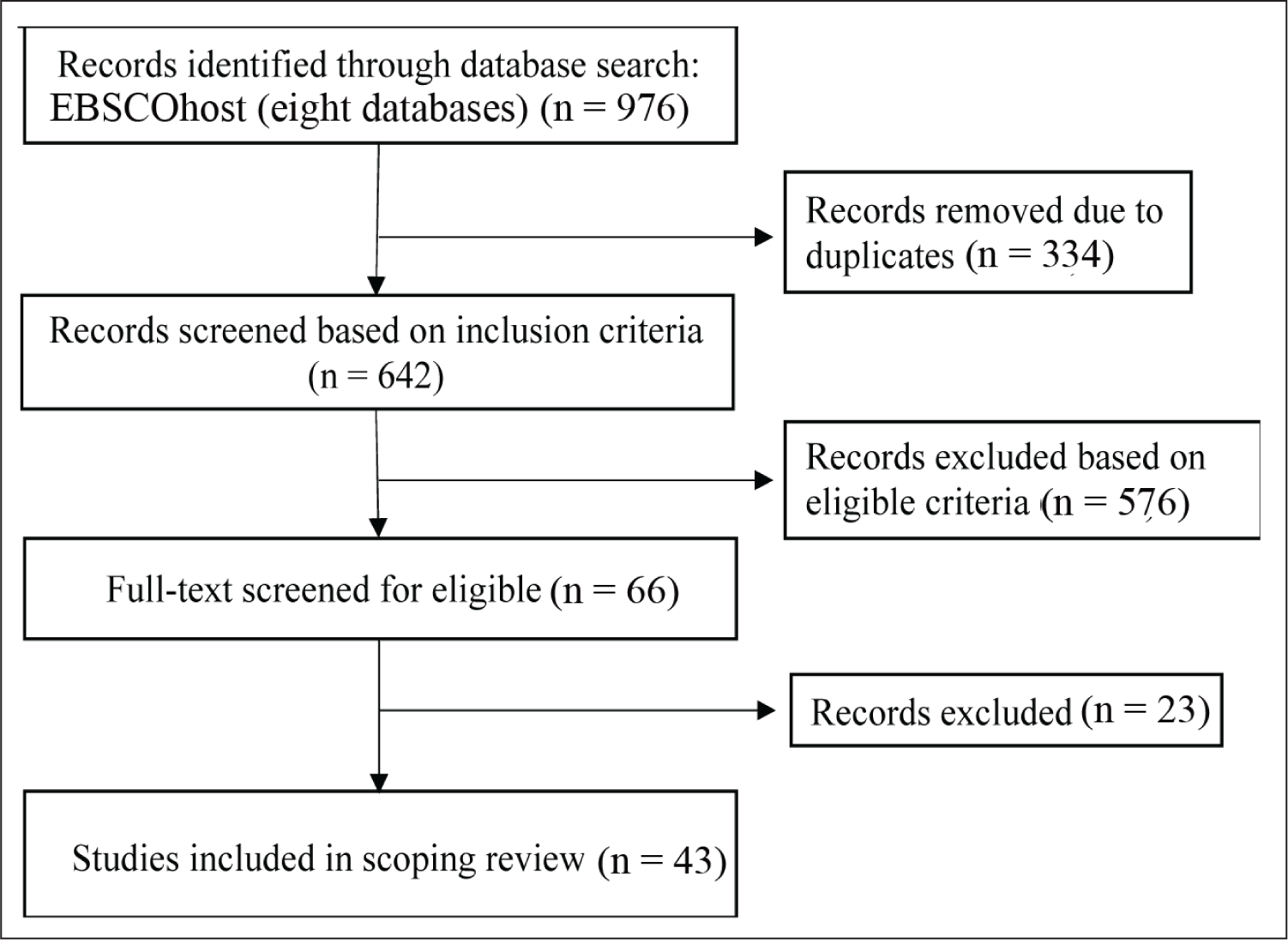
The search process results in the identification of 642 unique sources. Initial screening based on titles and abstracts based on included and excluded criteria, led to the inclusion of 66 articles, which further narrowed down to 43 after full-text review (see Figure 1). The reasons for exclusion during the screening stages includes 18 articles that discussed G-STEAM education but lacked detailed information, 2 articles that were inaccessible in full-text, 2 non-English articles and 1 undetected duplicate. This process ensured that the final selection of articles was highly relevant and provided substantial information for the study.
Flowchart of the Article Search and Selection Process.
Data Analysis
To answer the research questions, we have identified two main first-level themes to understand how STEAM education for sustainability is implemented in primary schools. In line with the constructive alignment principle, we analyse the lesson plan of included articles based on ILOs, pedagogical approaches and assessments (Biggs, 1996). Additionally, in terms of the common digital learning environment for G-STEAM education, the current research also identifies the media tools used in G-STEAM learning projects and to explore their pedagogical purposes.
Topics: This category focuses on the specific topics and subjects discussed within the context of STEAM education in the articles.
STEAM education: Articles in this category discuss STEAM education. They examine the range of topics addressed in the STEAM projects featured in the articles, including specific STEAM subjects and their interconnections.
STEAM education for sustainability: Articles in this category discuss STEAM education in the context of sustainability. They describe how the articles incorporate sustainability into STEAM education.
Lesson plan: This category focuses on the implementation strategies of G-STEAM projects as presented in the articles.
ILOs: This category records the specific learning outcomes outlined in the lesson plans, highlighting the goals and expected achievements of the STEAM projects.
Pedagogical approaches: This category analyses the pedagogical approaches used in the lesson plans. It pays specific attention to whether the articles use constructive approaches to facilitate learning, including art-based pedagogy, design thinking, inquiry-based learning, problem-based learning and project-based learning.
Assessment: This category reviews the methods used to evaluate student progress and achievement.
Media tools: This category explores the media tools used in the STEAM projects, analysing their functions and relevance in facilitating learning.
All the basic information of included articles is recorded in Appendix A, and all the coding is included in Appendix B.
Results
The Integration of Sustainability in the STEAM Project
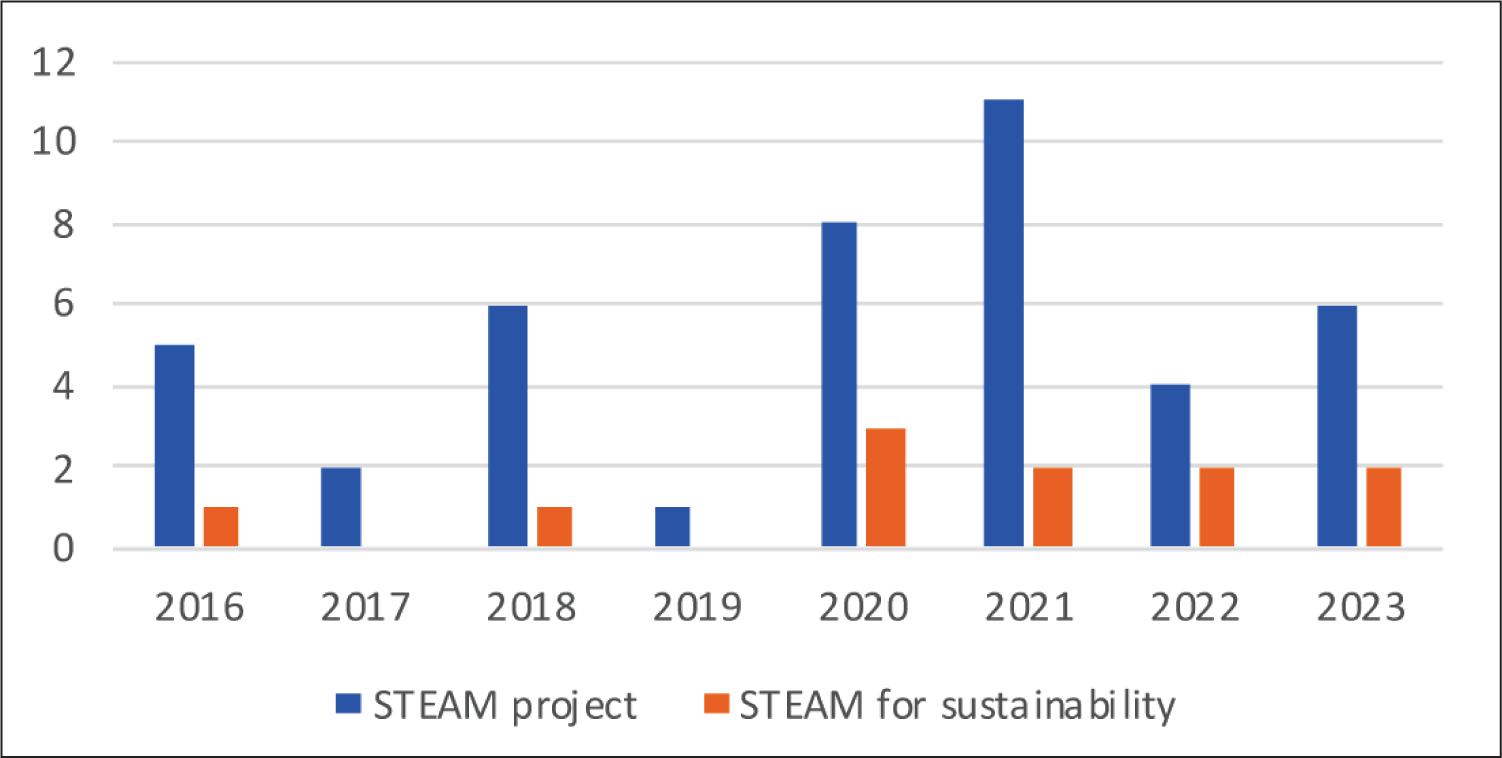
The analysis shows a fluctuating but generally increasing trend in publications on STEAM project implementation, with a notable peak in 2021 (see Figure 2). In contrast, the number of publications on STEAM projects that explicitly discuss sustainability is considerably lower throughout the years, with slight increases and decreases, indicating a more steady but less pronounced interest in this area. The disparity between the two categories may reflect a broader focus on STEAM education in general compared to the more specific application of STEAM to introduce sustainability issues. The overall number of publications in both categories is relatively low.
Number of Papers Published Reporting STEAM Project and STEAM for Sustainability Project.
The exploration of STEAM education topics in recent academic literature has revealed a diverse range of thematic integrations (see Table 2). This engagement with multiple disciplines—ranging from the scientific understanding of ecosystems and microorganisms to the intricacies of robotics and aerospace engineering—demonstrates the breadth of knowledge that G-STEAM projects aim to impart. Mathematics and physics are equally integral. In the realm of art and design, G-STEAM projects encourage students to engage creatively, whether through traditional visual arts or through modern mediums such as animation and game design.
The Topics Covered in STEAM Projects.
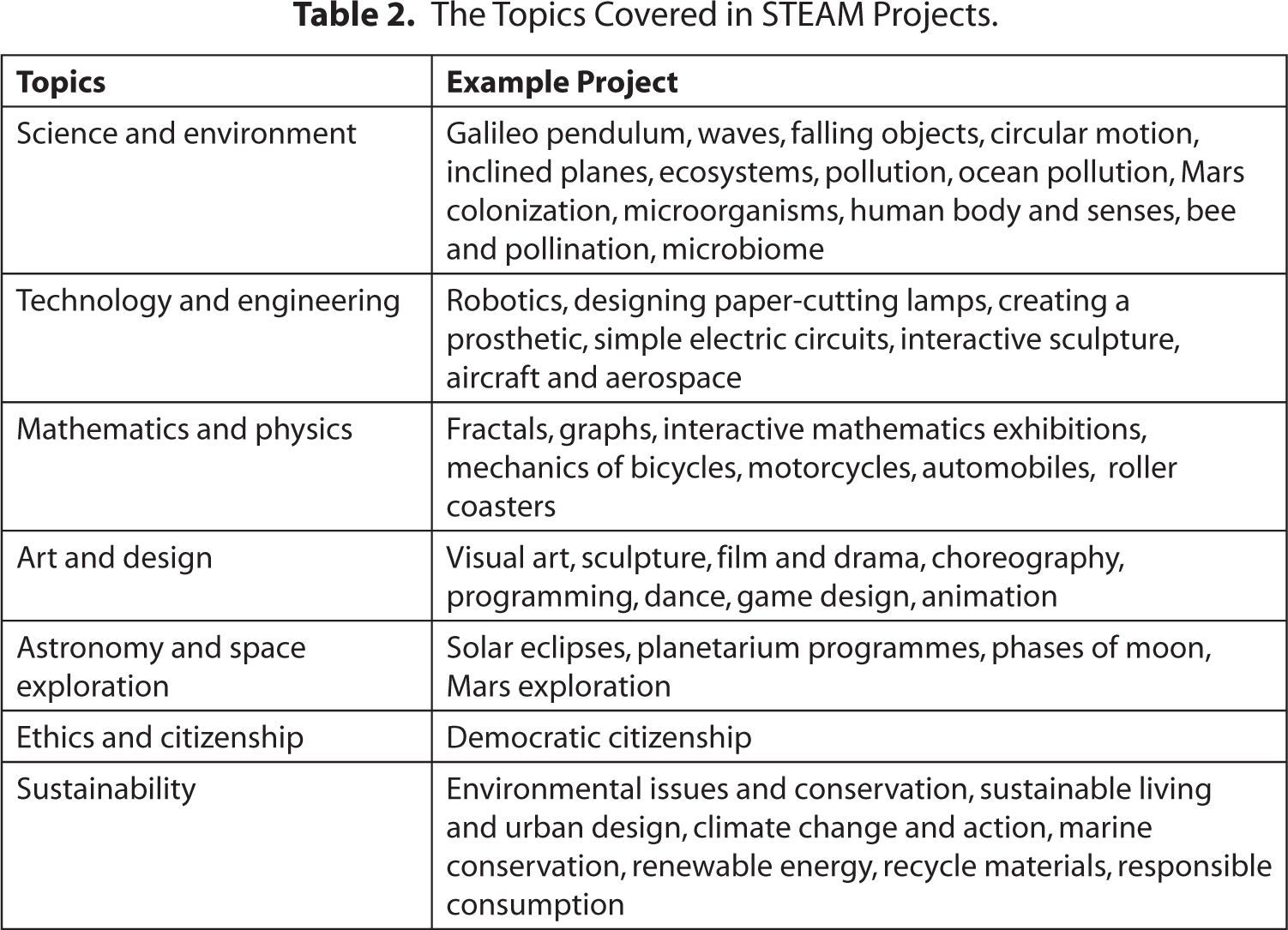
On the sustainability front, Table 3 reflects a more targeted exploration of G-STEAM education, where the environmental imperative is brought to the fore. The explicit focus on natural disasters, sustainable city planning and climate change within STEAM curricula underscores the focuses of equipping learners with the knowledge and skills to navigate and mitigate the ecological challenges. While sustainability discussions predominantly centre on ecological aspects, there is an acknowledgement of the social dimension of sustainability as well. One study emphasizes democratic citizenship, underscoring the goal of fostering individuals who possess academic excellence and exhibit social and environmental responsibility. Although the social dimensions of sustainability are recognized, they are less represented, with only a single project exploring this angle. Notably, cultural and economic aspects of sustainability remain unexplored within the scope of the articles reviewed.
The Four Main Categories of Intended Learning Outcomes of Included Articles.
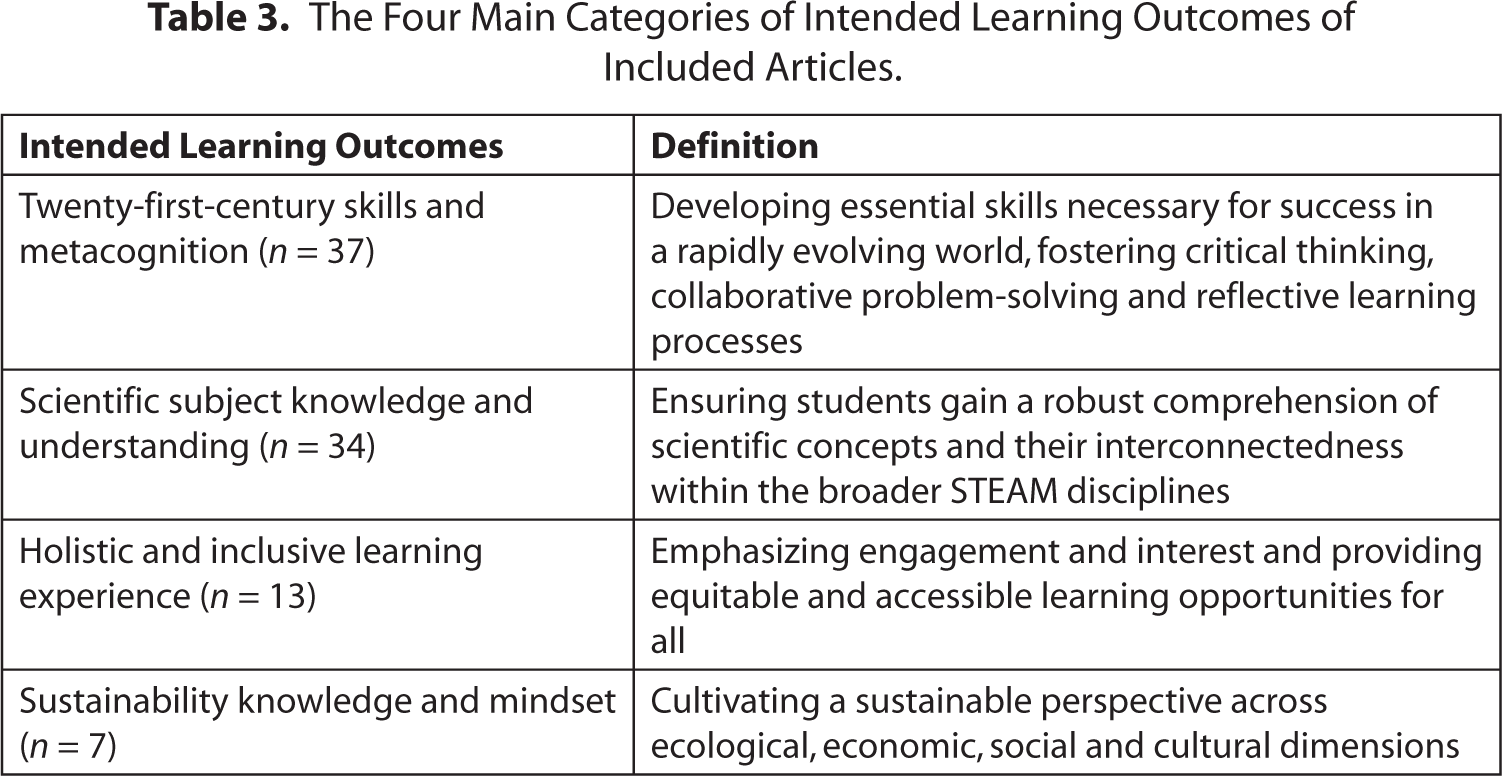
Intended Learning Outcomes
The analysis of ILOs indicates that STEAM learning projects have diverse focuses and emphases, supporting a variety of learning experiences. Four main categories are identified from the included articles (see Table 3 and Figure 3).
Intended Learning Outcomes of STEAM Learning Projects.
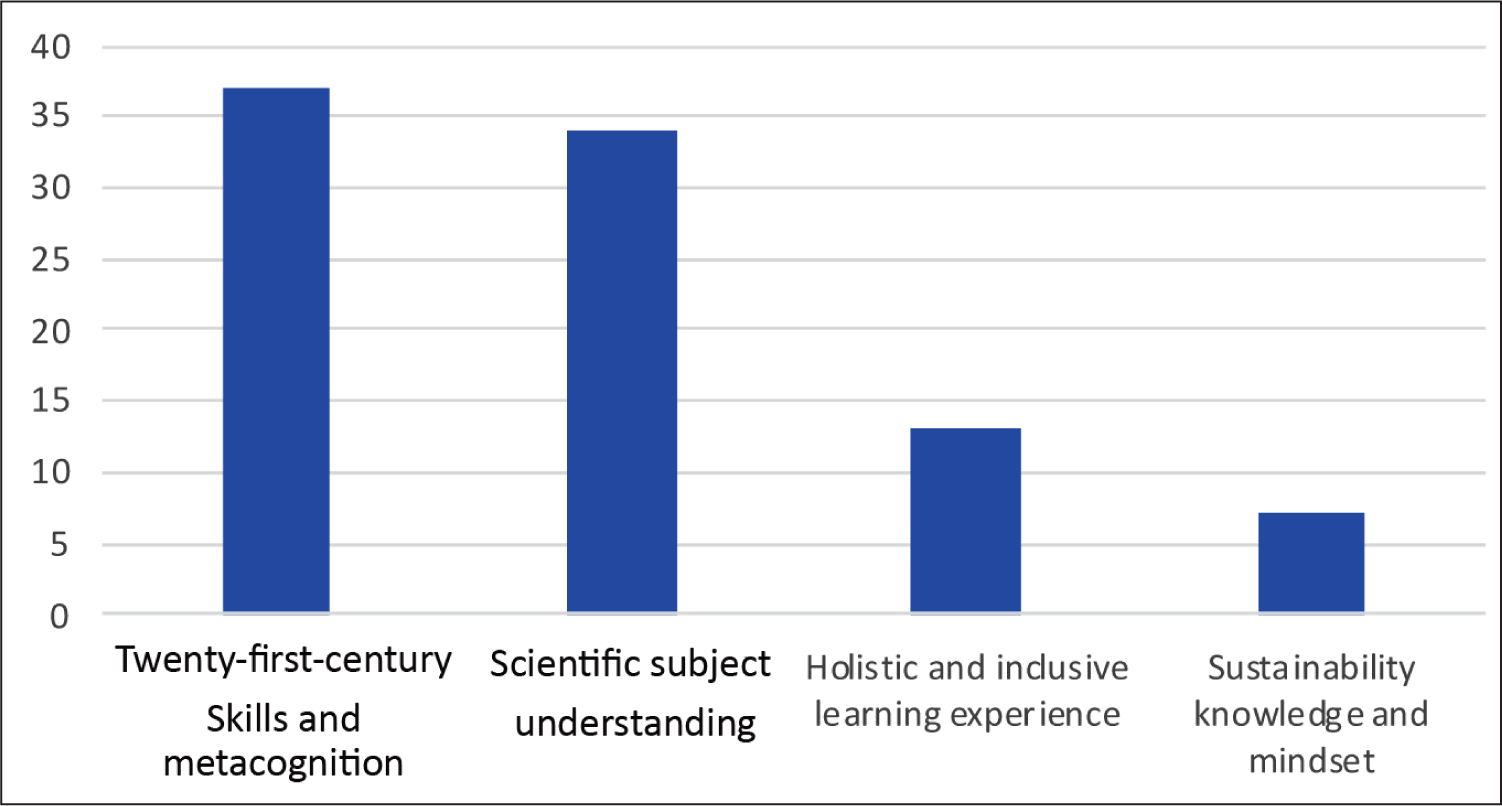
One core component of a STEAM project is to develop twenty-first-century skills and often incorporate metacognitive strategies to help students reflect on their own learning process. For instance, the integration of design thinking principles, as seen in Cook et al. (Cook & Bush, 2018), emphasizes empathy and collaborative problem-solving to effectively tackle real-world challenges. Sustainability knowledge and mindset emerges as a distinct theme, reflecting an educational response to global environmental challenges. Projects such as those by Schrodt et al. (2021) and Baek et al. (2022) aim to instil a sense of responsibility towards ecological conservation and to equip students with the mindset to engage in sustainable practices. A significant number of reviewed articles, like Yoon and Baek (2018), focus on enhancing subject-specific knowledge, aiming to deepen students’ understanding of scientific principles and their applications in technology and engineering.
Ideally, all the reviewed articles should describe STEAM projects that aim to improve scientific knowledge and understanding. However, the results indicate that not all articles have explicitly used the STEAM project for curriculum implementation. The fourth focus emphasizes that STEAM education is accessible to all students and supports the development of the wholeness. This is exemplified in the work of Coleman and Lind (2020) and Lage-Gómez and Ros (2021), where the learning environment is designed to be inclusive, engaging and responsive to diverse learning needs.
Pedagogical Approach
Based on the analysis, 12 pedagogical approaches are highlighted as key to G-STEAM projects (see Table 4). The predominant methods are derived from constructivist learning theories and include project-based learning, problem-based learning, inquiry-based learning, design thinking and art-based pedagogy. Among these, project-based learning stands out as a broad method that allows students to engage in projects without being restricted by specific theoretical pedagogical procedures. In contrast, problem-based learning, inquiry-based learning and design thinking are presented as more structured approaches that provide step-by-step guidance for learning activities, emphasizing real-world problem-solving methods. Art-based pedagogy is prominently featured in G-STEAM projects to accentuate the importance of art, typically enabling students to articulate STEM learning through artistic creation or to apply artistic methods when engaging with STEAM concepts.
Pedagogical Approaches Used in the G-STEAM Project.
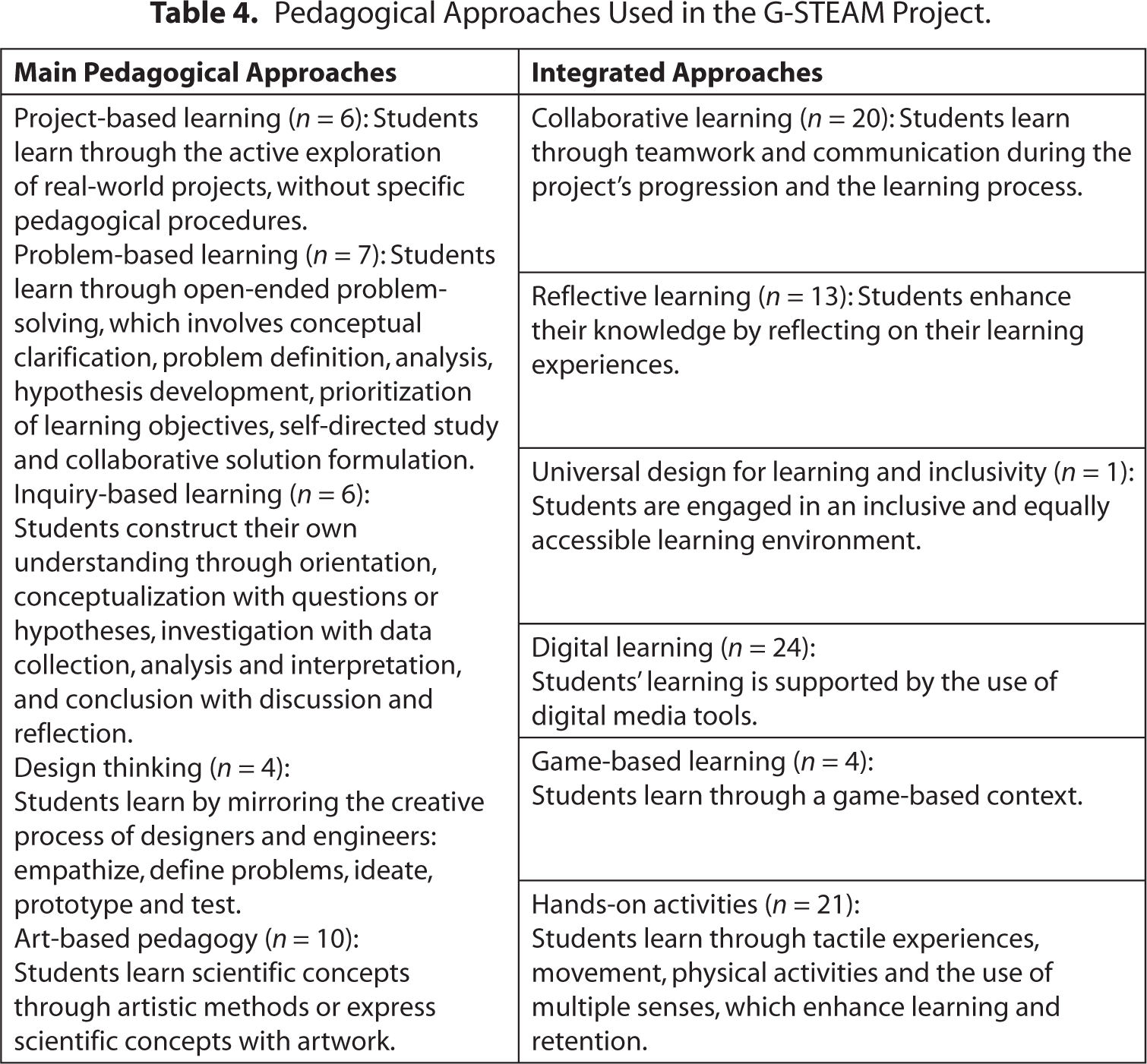
Furthermore, integrated approaches, utilized in conjunction with main pedagogical methods, enrich the learning experience. Notably prevalent are collaborative learning, digital learning and hands-on activities. Collaborative learning is integral to the structured pedagogical methods mentioned earlier. The extensive use of digital tools underscores the importance of digital learning, using technology in enhancing G-STEAM learning experiences. Articles reviewed also highlight the importance of adaptable, hands-on activities within G-STEAM projects. However, the lack of comprehensive documentation on how these activities are organized in some studies suggests a gap and indicates the need for more detailed research and clearer reporting on STEAM educational practices.
Overall, these strategies aim to champion a student-centred learning approach, where students are proactive in their education. These pedagogical methods are not isolated; they frequently intersect, yielding a holistic and dynamic educational experience.
Assessment Tools
The assessment of STEAM projects, as derived from various studies, involves a thorough assessment encompassing knowledge acquisition, skill development, attitudes and behaviours (see Table 5). These studies employ a range of tools to gauge students’ understanding of STEAM disciplines; for instance, Mereli et al. (2023) utilized questionnaires. Skill development, particularly in areas such as critical thinking and creativity, is assessed with instruments like the Creativity Assessment Packet featured in Lu et al. (2022). Changes in attitudes and perceptions towards science and teamwork are evaluated using surveys and reflective assessments, as demonstrated in Cabello et al. (2021). Behavioural outcomes, like task or project completion, are monitored through performance-based assessments, with student demonstrations highlighted in Buono and Burnidge (2022).
Assessment Forms and Tools Used in the STEAM Project.
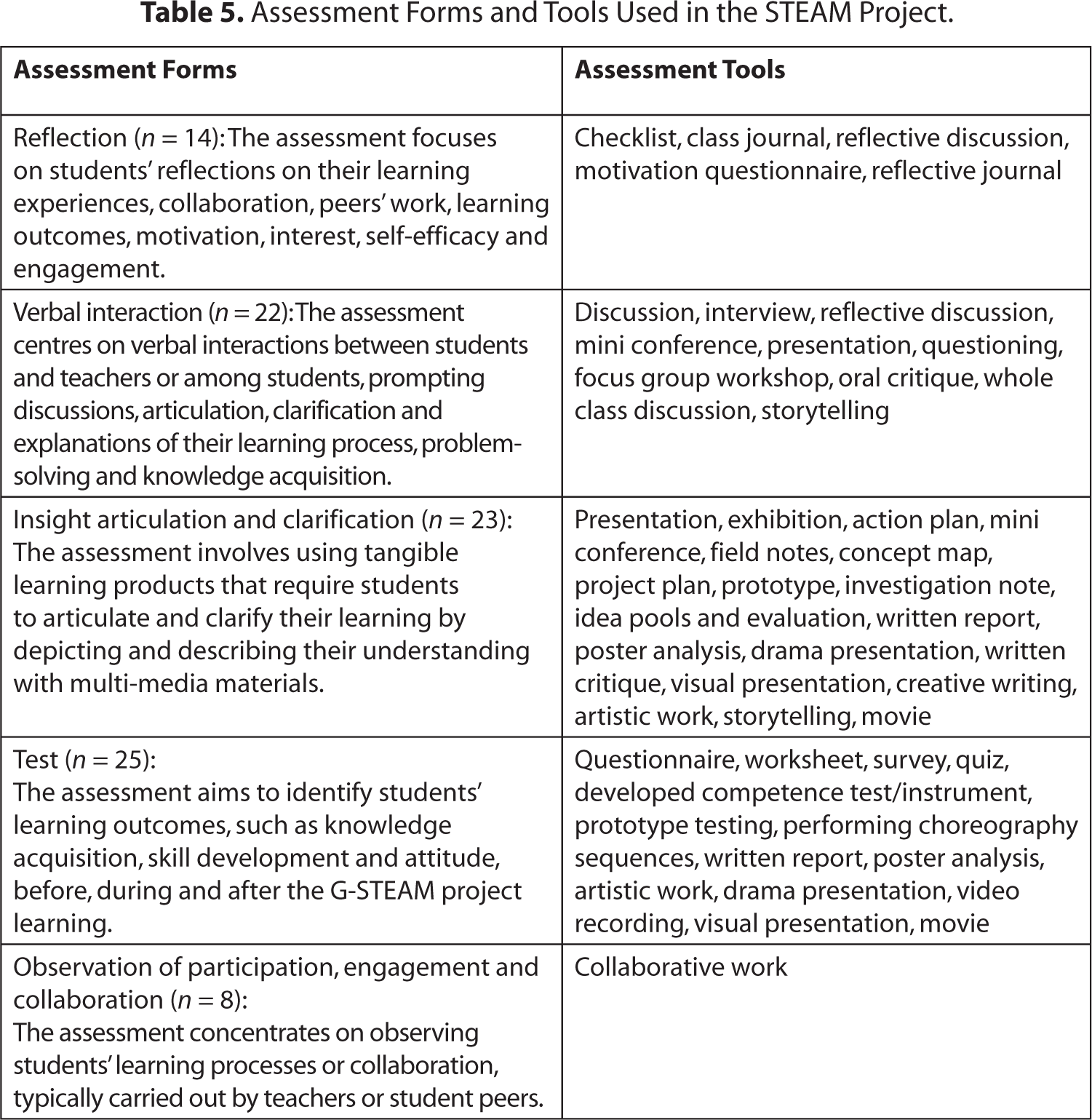
Despite the varied focuses of these assessments, the review analysis shows that there are five forms of assessment commonly integrated into STEAM projects, enriching learning experiences and evaluating outcomes. For example, the final design of a sustainable city can serve as both a summative and a formative assessment, accompanying students throughout their learning journey.
Reflective assessments emphasize students’ personal insights, encouraging critical thinking and self-evaluation, using tools such as checklists, class journals and reflective discussions to measure engagement and self-efficacy. Verbal interaction assessments focus on the communicative aspects of learning, enabling students to articulate and explain their learning processes, which is key to assessing their collaboration and problem-solving skills. Moreover, assessments that involve insight articulation and clarification use concrete learning products, such as multimedia presentations and written reports, to assess students’ understanding and creativity. Observational assessments, which are often qualitative, contribute by tracking the dynamic aspects of student participation and teamwork. The forms of insight articulation and clarification typically involve an observational component where teachers assess students’ presentations, articulation and collaboration. Testing through quizzes and competence instruments quantifies learning outcomes within the G-STEAM curriculum.
These diverse assessment forms are adaptable, aligning with the versatile nature of STEAM education. Formative assessments, in particular, play a critical role by providing continuous feedback throughout the STEAM learning process.
Discussion
Findings from publications that explore how sustainability is integrated into STEAM initiatives reveal interesting trends. The lack of publications focusing on sustainability within STEAM projects signals a need for increased research attention in this particular area. This shortage also suggests varying levels of academic recognition between broader STEAM education and its integration with sustainability. It is important to highlight that there is a relatively low total number of publications in both categories, especially those that specifically address sustainability within STEAM projects. This observation may prompt further investigation into potential barriers that may limit substantial academic discussions or hinder research advancement in this area.
The curriculum might have significantly impacted the increase in STEAM publications. For example, the renewed Finnish basic education curriculum, which emphasizes project-based and interdisciplinary learning alongside sustainable development, might have significantly contributed to the growth in publications during that time. However, it is important to note that establishing a direct cause-and-effect relationship between the curriculum and publication growth can be complex, as various factors influence research output. Nonetheless, the curriculum serves as crucial guidance for education and could be one factor inspiring STEAM education research and development in Finland (Finnish National Board of Education, 2016).
Integration of STEAM and Education for Sustainability
Different topics can be approached from STEAM and sustainability perspectives to provide diverse learning activities for students (Belbase et al., 2022). Sustainability issues such as climate change, renewable energy and sustainable urban planning are dominant elements in cross-curricular STEAM education. These topics offer rich opportunities for problem-based learning, inspiring students to apply a wide range of STEAM skills to solve real-world problems. Students can also engage with a variety of stakeholders, such as environmental organizations and technology professionals, gaining valuable expertise and resources to enrich their learning experiences. This kind of learning encourages students to perceive multiple ways of approaching and solving problems (Zarei et al., 2022).
However, the included articles have primarily focused on ecological sustainability, addressing social and economic aspects more implicitly, such as in the context of sustainable urban design or civic engagement. There is scope for further investigation into more integrally incorporating social, cultural and economic sustainability into STEAM projects, both in developing new initiatives and in adapting existing ones, to enhance their educational value in sustainability (Brocchi, 2008). Additionally, despite the somewhat limited discussion on sustainability topics, it is noteworthy that many projects can inherently address at least one of the four key dimensions of sustainability—social, cultural, economic and ecological (Daneshpour & Kwegyir-Afful, 2022). This is often observed in the way sustainability concepts are embedded in student activities, such as problem-solving or product design, considering material choices and the broader impact of their solutions. These articles illustrate a growing recognition of the need for research to embed sustainability within STEAM frameworks, preparing students to tackle pressing global issues with a holistic and interdisciplinary approach.
G-STEAM Lesson Plan
The G-STEAM learning project, characterized by its diverse ILOs and diverse pedagogical methods, demonstrates a clear alignment between learning objectives and student-centred teaching approaches. Despite this, art-based pedagogy is not fully leveraged in STEAM education. At present, its main function is to facilitate the introduction and expression of scientific concepts. Nevertheless, the role of art in education should not be confined to representing other disciplines. It is integral in embedding social and cultural aspects into learning, promoting a culture of critique, exhibition and adaptability to change (Smith & Henriksen, 2016). To fully harness art’s unique educational contributions, further research must investigate its inherent qualities and collaborative strategies with artists to understand how art can introduce perspectives and functionalities distinct from other subjects, thus enhancing students’ ability to confront failure and reap the full benefits of arts education (Smith & Henriksen, 2016).
Furthermore, not all studies within the scope of this review adhere to specific systematic pedagogical frameworks such as problem-based learning, design thinking, or inquiry-based learning. Often, hands-on activities are designed with a degree of flexibility to achieve the desired learning outcomes. This observation suggests that the implementation of G-STEAM learning projects is highly adaptable. An intriguing question arises regarding the extent to which and the context in which projects should adhere to a more systematic or flexible structure of learning activities to effectively engage students in real-world problem-solving.
In this context of flexibility, it is important for educators to ensure student engagement in various activities, including idea articulation, feedback, reflection and hands-on product creation. Given these diverse learning experiences, teachers must employ a range of assessments aligned with comprehensive learning objectives to accurately monitor student progress. The frequency of assessments might vary based on the project’s duration, potentially involving regular student–teacher interactions to stay aligned with intended outcomes. Effective assessments by teachers are essential for accurately tracking students’ interdisciplinary learning progress. The integration of diverse subject standards into the curriculum is vital to maintain its relevance. Flexibility in assessment types and frequencies is key to the thorough development and evaluation of learning outcomes (Herro et al., 2019). In G-STEAM education, many assessments not only facilitate learning but also serve as tools for teachers to capture students’ understanding.
Designing the G-STEAM Learning Project and Its Challenges
In efforts to enhance STEAM education, especially with a focus on sustainability, the role of teachers in creating and executing effective lesson plans is crucial. Li et al. (2022) proposed a framework that involves teachers in collaborative teaching and the design of STEAM projects. This framework underscores the importance of:
Cooperative teaching to address the shortage of qualified STEAM educators Providing comprehensive scaffolding to aid learners’ collaborative learning Choosing practical, relatable problems as project themes, and adjusting task difficulty and complexity to boost motivation and participation Integrating STEAM education into the standard curriculum and scheduling it alongside traditional subjects Extending the duration of individual instructional sessions to accommodate teacher guidance, student exploration and evaluative communication
Combining this framework with the findings of our review reveals that while the design and implementation of STEAM education are flexible, they also provide a structured approach for teachers to use as a reference in their project design. However, research identified challenges in implementing STEAM learning projects, including fostering leadership, defining topics, formulating questions and promoting teamwork among students (Mohd Hawari & Mohd Noor, 2020). Further research and teacher training are necessary to explore diverse learning content, global issues and the concept of a shared future in G-STEAM. Teachers need to be prepared to face uncertainties and embrace mutual learning in G-STEAM ‘teaching’.
The primary limitation of this review analysis is its inability to comprehensively examine the constructive alignment between the design of STEAM projects and their effects on learning outcomes. While this article emphasizes the versatility of STEAM projects in accommodating a diverse range of learning outcomes, it also acknowledges the inherent complexity of these learning environments. Such complexity requires adaptable pedagogical approaches and assessment tools to effectively support the learning journey. The scoping review introduces a range of pedagogical strategies and assessment instruments, thereby laying the foundation to understand the multifaceted and adaptable nature of STEAM projects. Nonetheless, further research is needed to develop a systematic framework and overarching principles for effectively navigating and implementing STEAM projects. Additionally, the data analysis, based on how publications record projects, may omit crucial details such as assessment tools and media used in the projects. Consequently, this review may not fully capture the reality of the projects based on the available publications.
Conclusions
The scoping review of G-STEAM education in primary schools highlights a trend in integrating sustainable development with STEAM education, though it notes a relative scarcity in literature specifically focusing on sustainability within STEAM. This gap underscores the need for more research and academic discourse on incorporating comprehensive sustainability aspects—social, cultural and economic—alongside the ecological focus in STEAM projects. Additionally, the findings reveal diverse ILOs and varied pedagogical approaches in G-STEAM education, indicating its adaptability and student-centred nature. However, the role of art in these educational projects is not fully realized, suggesting an opportunity for deeper exploration into how art can contribute more significantly to interdisciplinary learning. Additionally, there is a clear need for structured yet flexible frameworks to guide teachers in designing and assessing STEAM projects, which is crucial for effectively navigating the complexities of interdisciplinary STEAM projects. Overall, the review calls for an enhanced focus on integrating sustainability in all its dimensions within STEAM education and for strengthening the role of art to enrich interdisciplinary learning.
Footnotes
Authors’ Contributions
Conceptualization, S.R. and X.H.; methodology, S.R. and X.H.; validation, S.R. and X.H. and M.V.; formal analysis, S.R. and X.H.; investigation, S.R. and X.H.; writing—original draft preparation, S.R. and X.H.; writing—review and editing, S.R. and X.H. and M.V.; supervision, S.R. and X.H. and M.V. All authors have read and agreed to the published version of the article.
Declaration of Conflicting Interests
The authors declared no potential conflicts of interest with respect to the research, authorship and/or publication of this article.
Funding
The authors received no financial support for the research, authorship and/or publication of this article.
Appendix
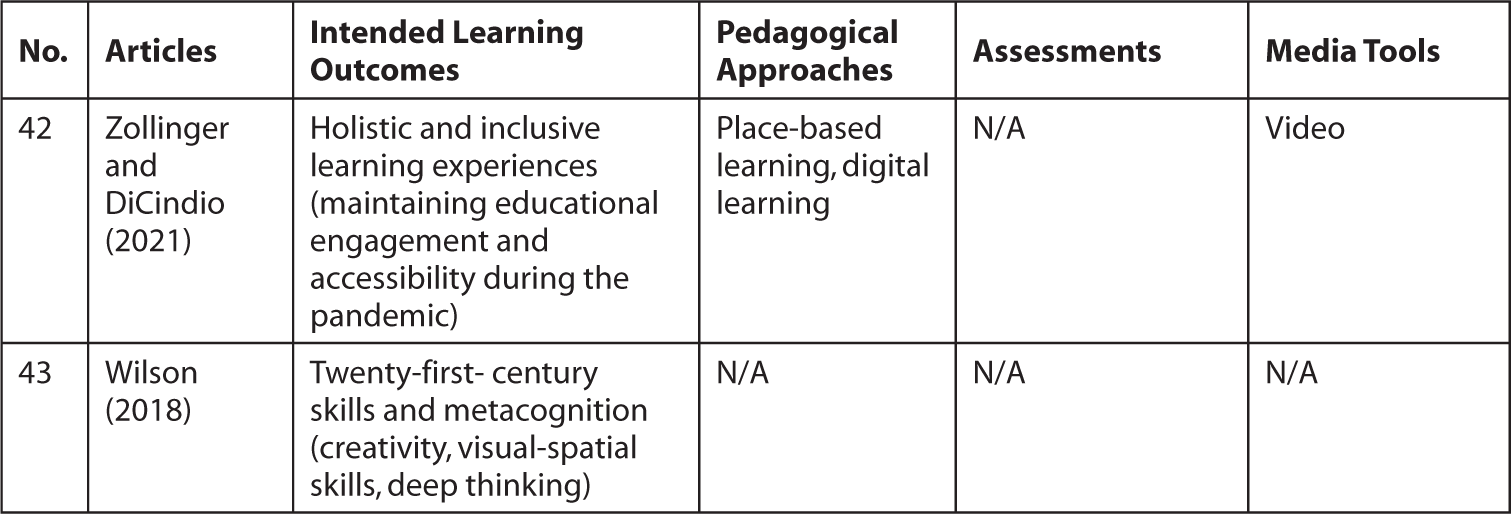
G-STEAM Project Lesson Plan Coding.
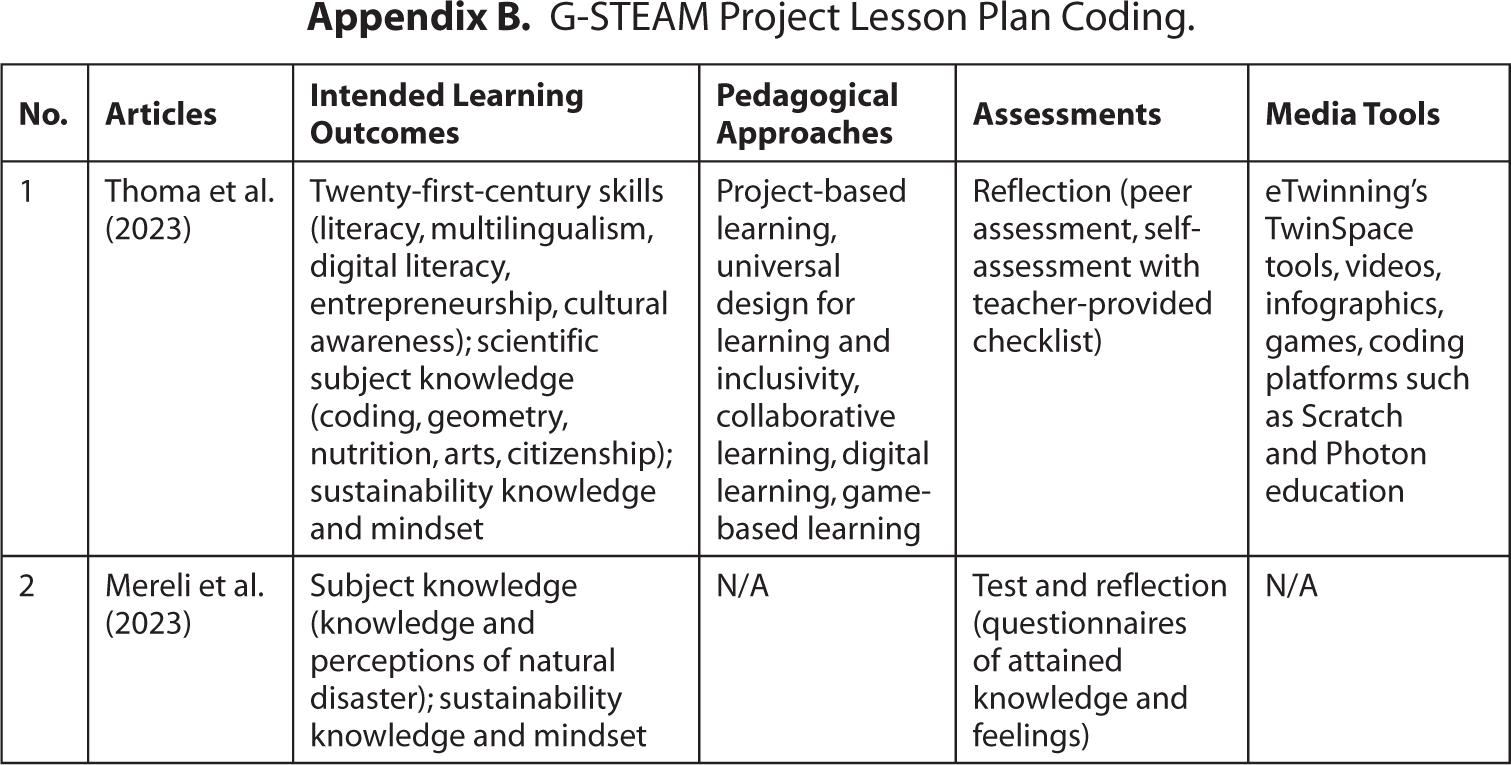
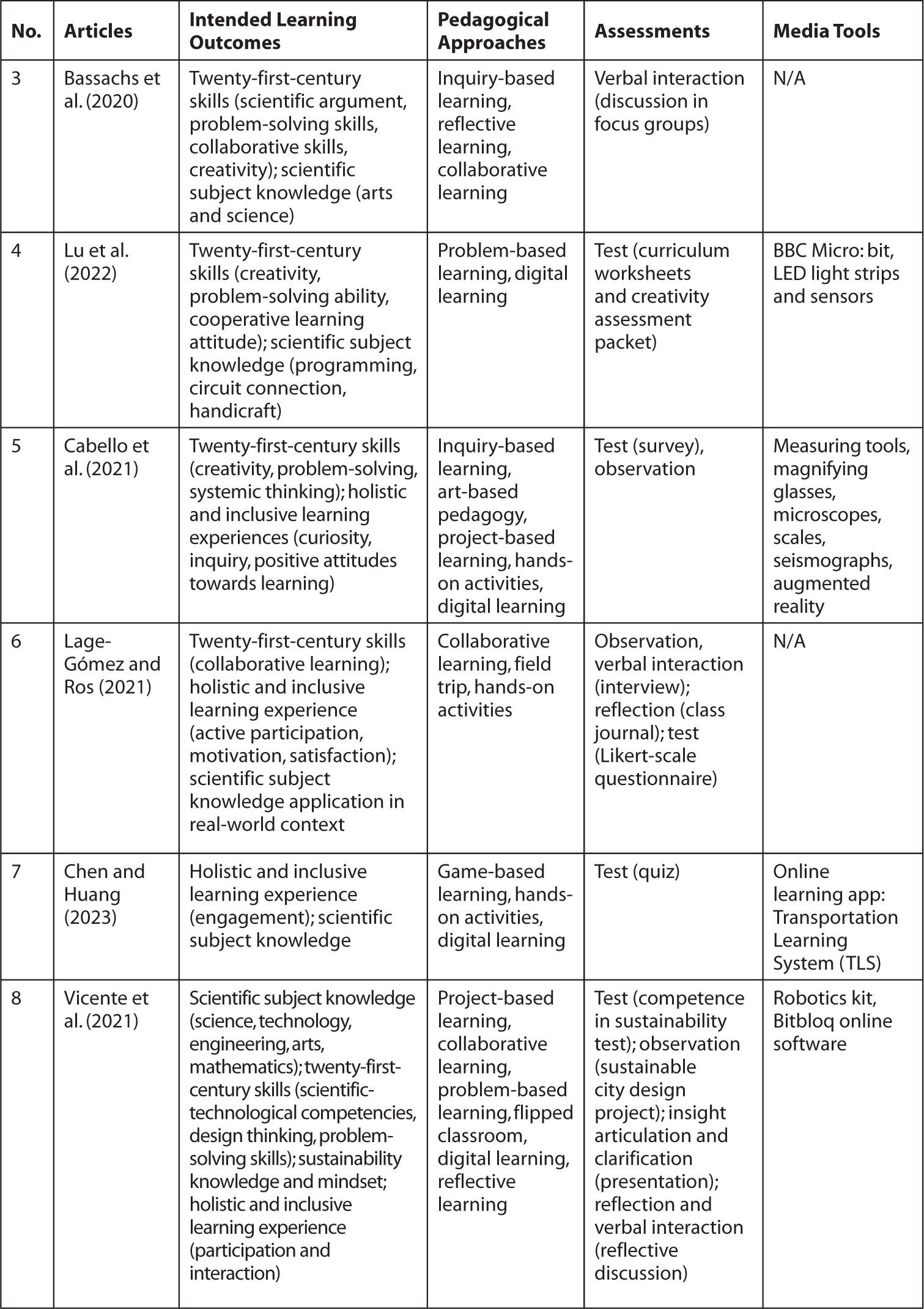
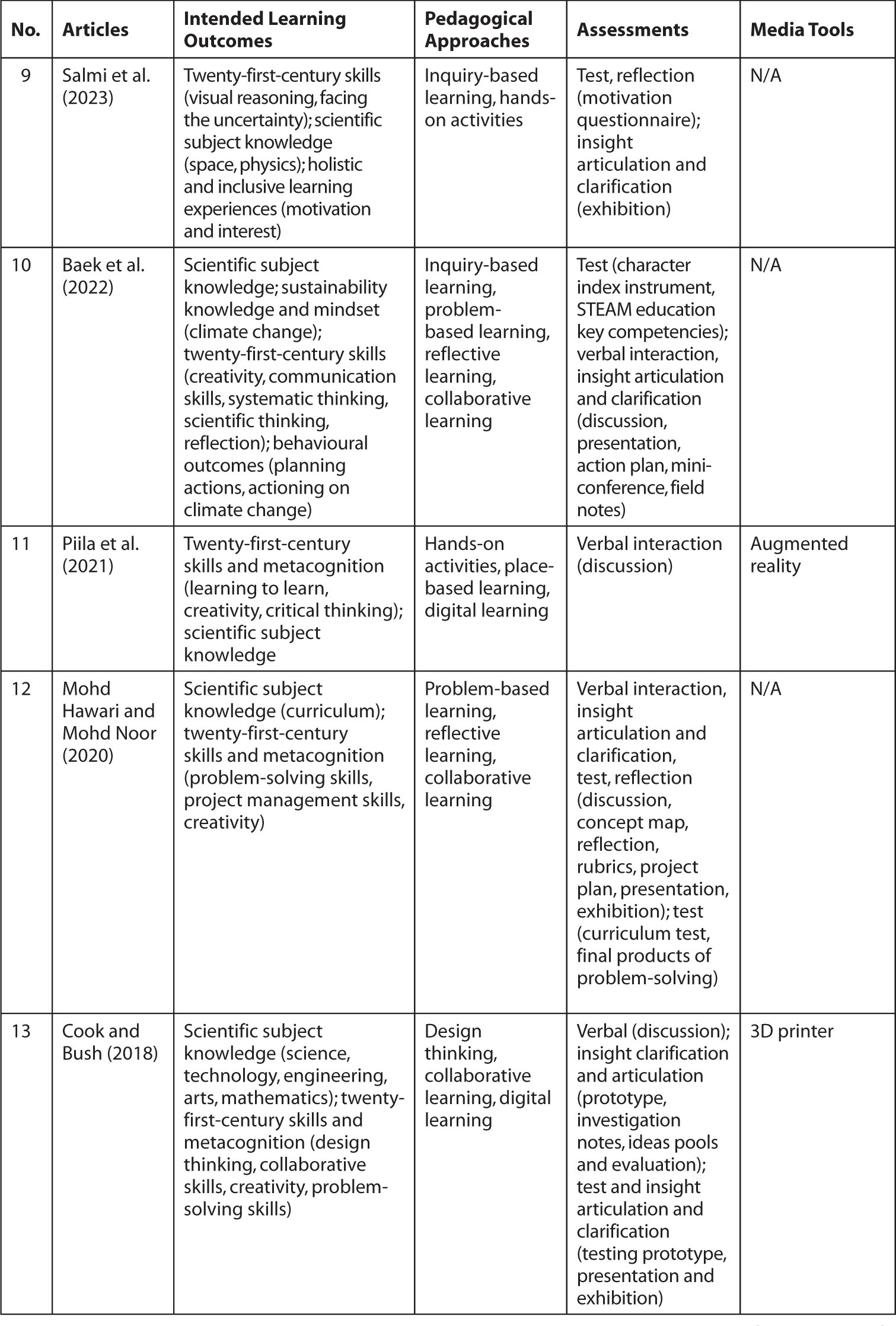
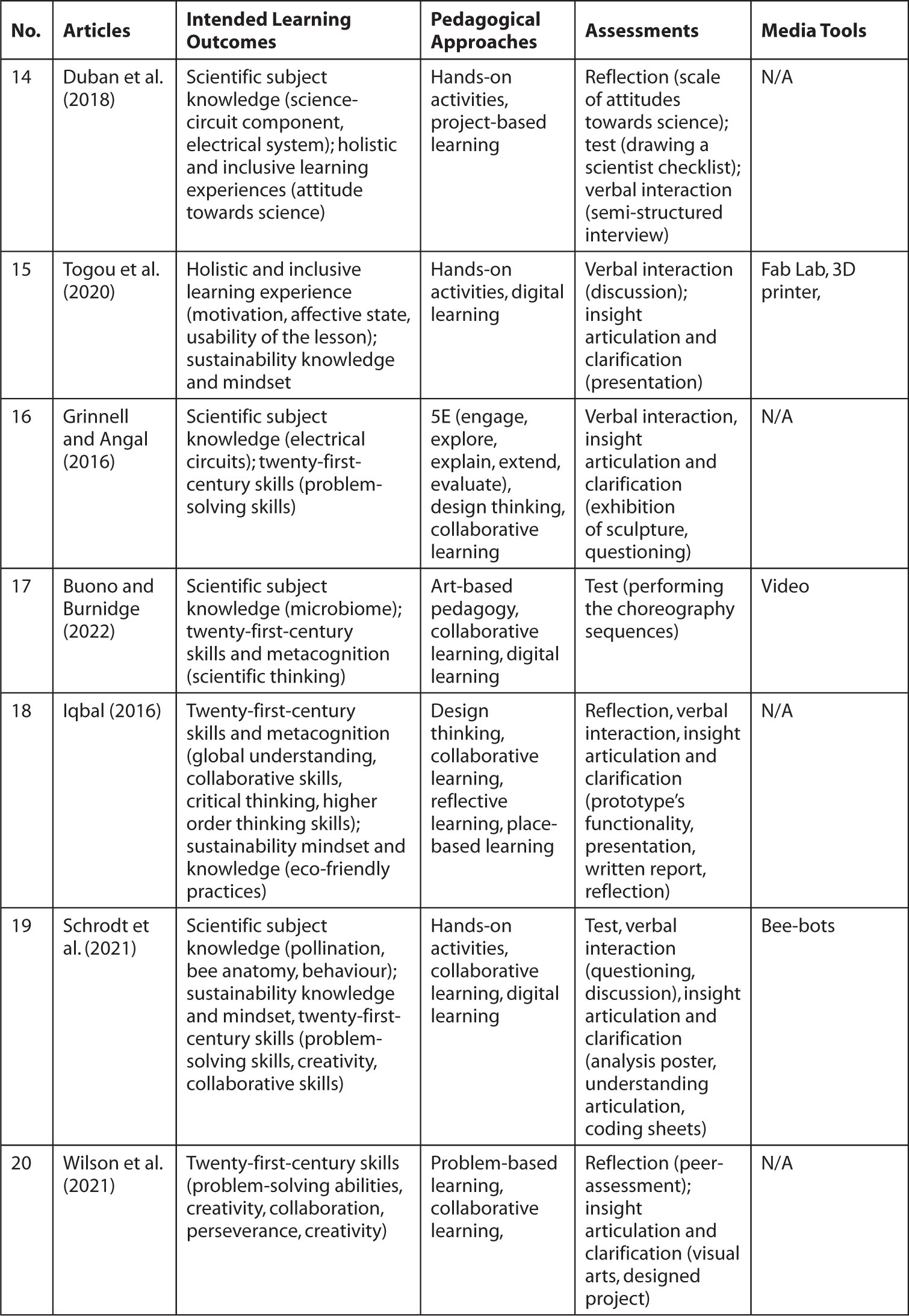
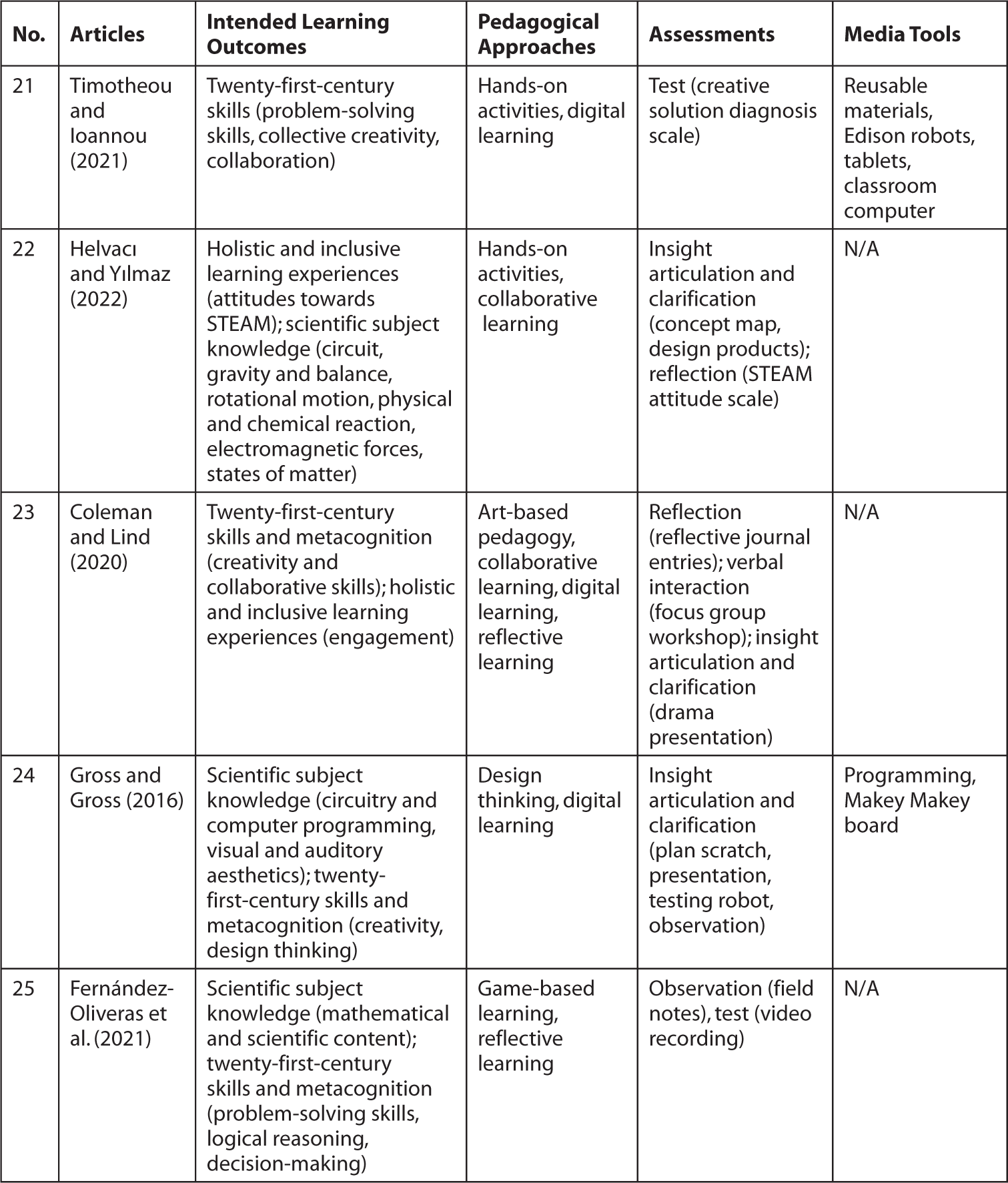
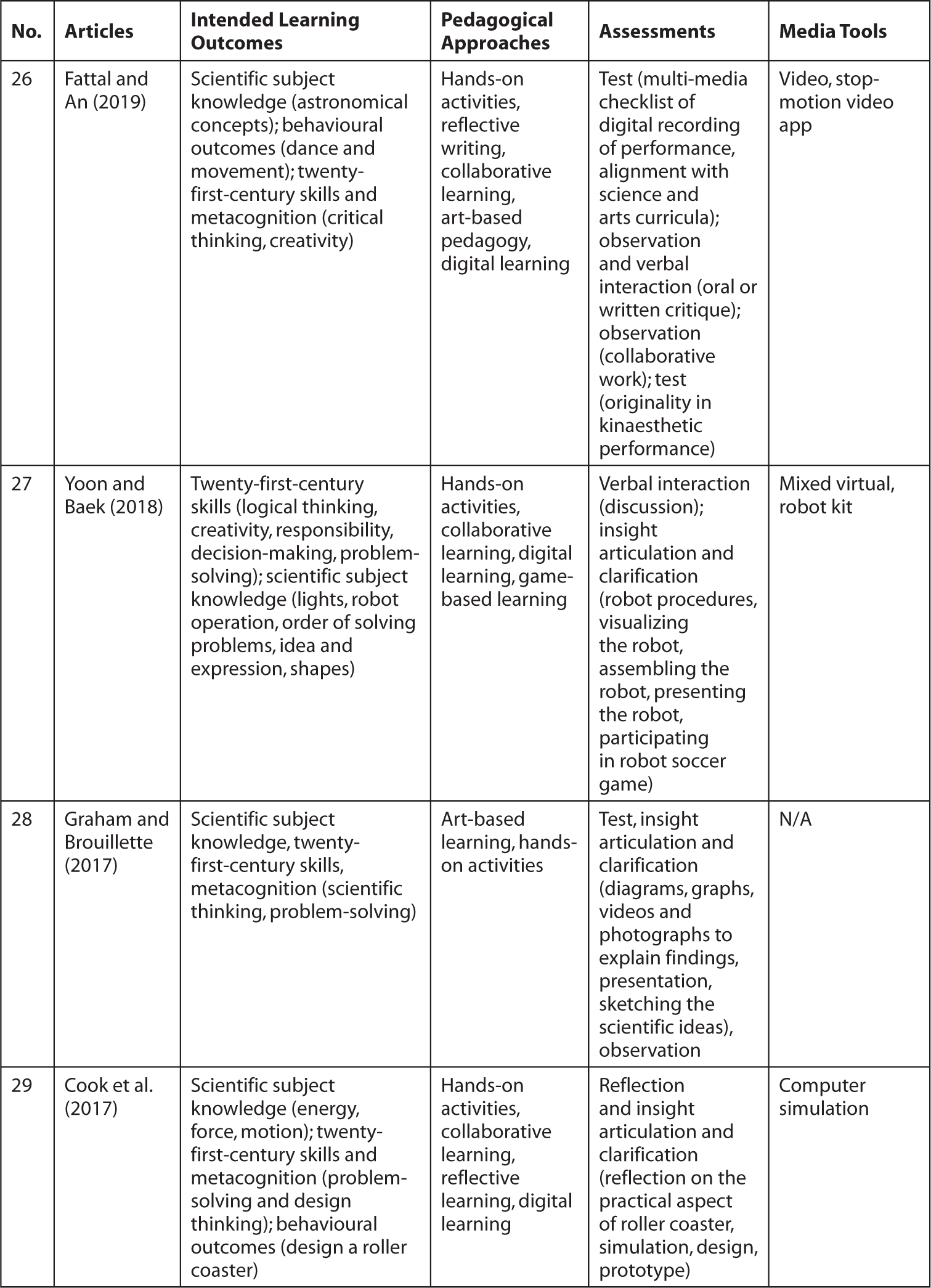
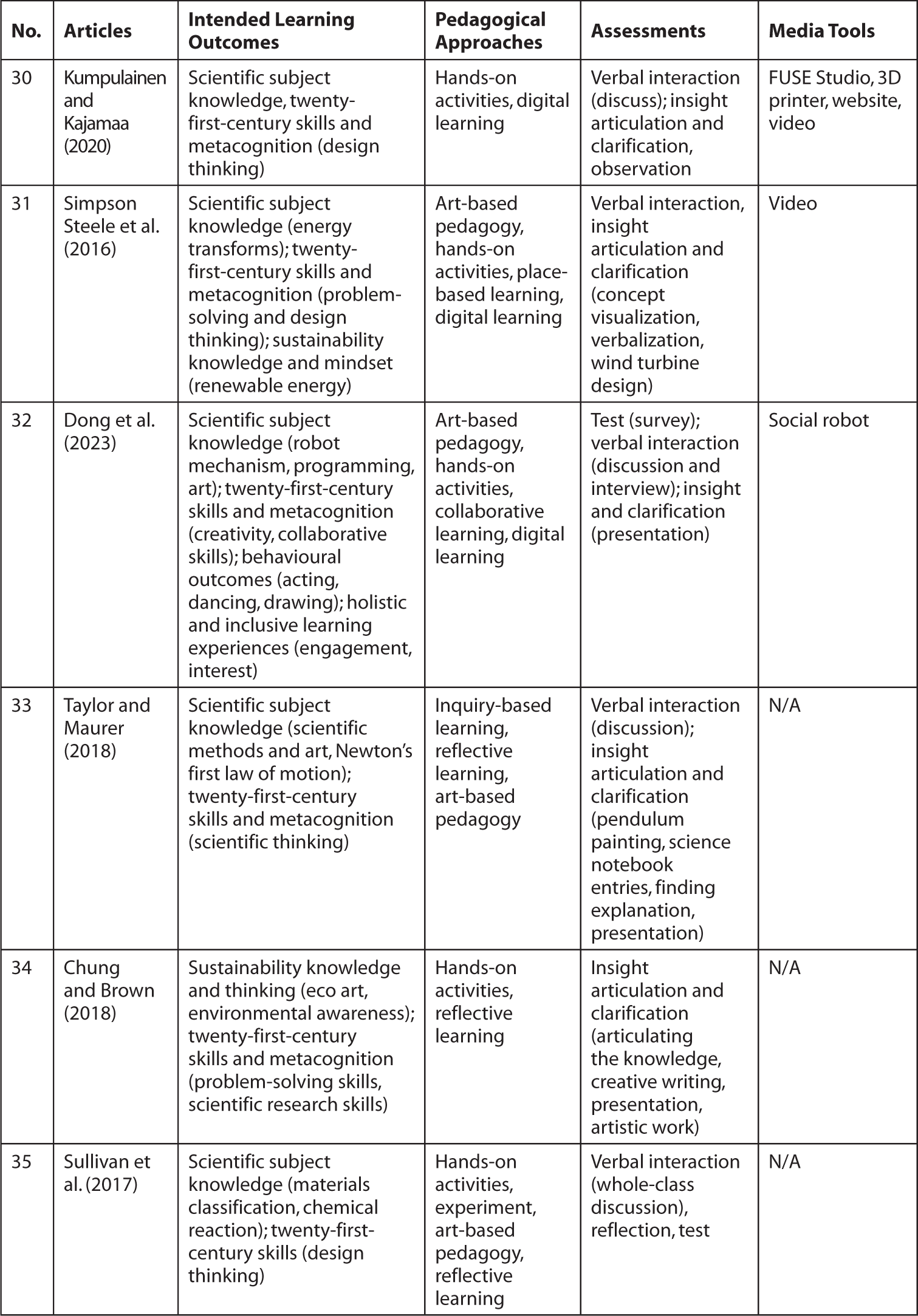
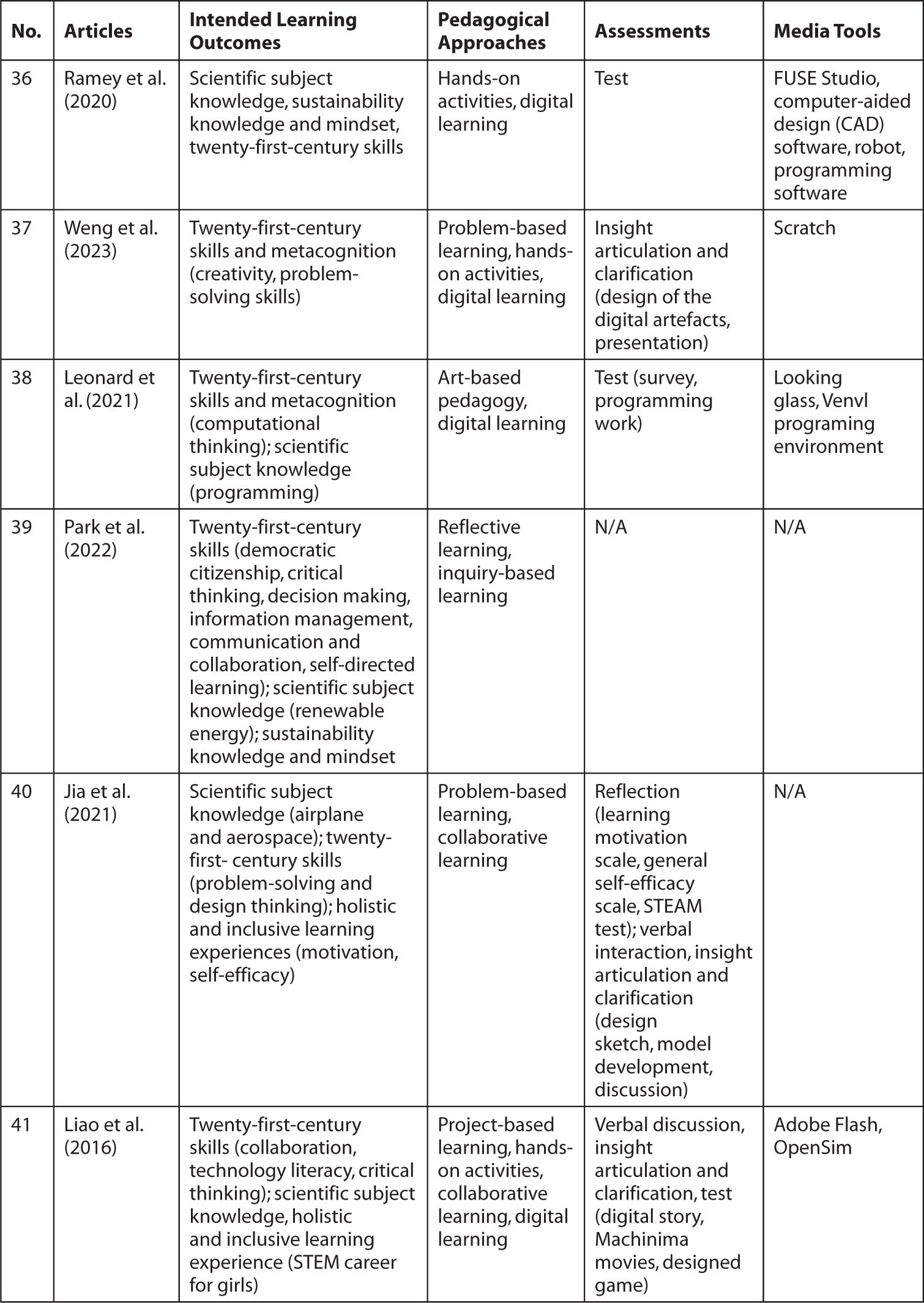
| No. | Articles | Intended Learning Outcomes | Pedagogical Approaches | Assessments | Media Tools |
| 1 | Thoma et al. (2023) | Twenty-first-century skills (literacy, multilingualism, digital literacy, entrepreneurship, cultural awareness); scientific subject knowledge (coding, geometry, nutrition, arts, citizenship); sustainability knowledge and mindset | Project-based learning, universal design for learning and inclusivity, collaborative learning, digital learning, game-based learning | Reflection (peer assessment, self-assessment with teacher-provided checklist) | eTwinning’s TwinSpace tools, videos, infographics, games, coding platforms such as Scratch and Photon education |
| 2 | Mereli et al. (2023) | Subject knowledge (knowledge and perceptions of natural disaster); sustainability knowledge and mindset | N/A | Test and reflection (questionnaires of attained knowledge and feelings) | N/A |
| 3 | Bassachs et al. (2020) | Twenty-first-century skills (scientific argument, problem-solving skills, collaborative skills, creativity); scientific subject knowledge (arts and science) | Inquiry-based learning, reflective learning, collaborative learning | Verbal interaction (discussion in focus groups) | N/A |
| 4 | Lu et al. (2022) | Twenty-first-century skills (creativity, problem-solving ability, cooperative learning attitude); scientific subject knowledge (programming, circuit connection, handicraft) | Problem-based learning, digital learning | Test (curriculum worksheets and creativity assessment packet) | BBC Micro: bit, LED light strips and sensors |
| 5 | Cabello et al. (2021) | Twenty-first-century skills (creativity, problem-solving, systemic thinking); holistic and inclusive learning experiences (curiosity, inquiry, positive attitudes towards learning) | Inquiry-based learning, art-based pedagogy, project-based learning, hands-on activities, digital learning | Test (survey), observation | Measuring tools, magnifying glasses, microscopes, scales, seismographs, augmented reality |
| 6 | Lage-Gómez and Ros (2021) | Twenty-first-century skills (collaborative learning); holistic and inclusive learning experience (active participation, motivation, satisfaction); scientific subject knowledge application in real-world context | Collaborative learning, field trip, hands-on activities | Observation, verbal interaction (interview); reflection (class journal); test (Likert-scale questionnaire) | N/A |
| 7 | Chen and Huang (2023) | Holistic and inclusive learning experience (engagement); scientific subject knowledge | Game-based learning, hands-on activities, digital learning | Test (quiz) | Online learning app: Transportation Learning System (TLS) |
| 8 | Vicente et al. (2021) | Scientific subject knowledge (science, technology, engineering, arts, mathematics); twenty-first-century skills (scientific-technological competencies, design thinking, problem-solving skills); sustainability knowledge and mindset; holistic and inclusive learning experience (participation and interaction) | Project-based learning, collaborative learning, problem-based learning, flipped classroom, digital learning, reflective learning | Test (competence in sustainability test); observation (sustainable city design project); insight articulation and clarification (presentation); reflection and verbal interaction (reflective discussion) | Robotics kit, Bitbloq online software |
| 9 | Salmi et al. (2023) | Twenty-first-century skills (visual reasoning, facing the uncertainty); scientific subject knowledge (space, physics); holistic and inclusive learning experiences (motivation and interest) | Inquiry-based learning, hands-on activities | Test, reflection (motivation questionnaire); insight articulation and clarification (exhibition) | N/A |
| 10 | Baek et al. (2022) | Scientific subject knowledge; sustainability knowledge and mindset (climate change); twenty-first-century skills (creativity, communication skills, systematic thinking, scientific thinking, reflection); behavioural outcomes (planning actions, actioning on climate change) | Inquiry-based learning, problem-based learning, reflective learning, collaborative learning | Test (character index instrument, STEAM education key competencies); verbal interaction, insight articulation and clarification (discussion, presentation, action plan, mini-conference, field notes) | N/A |
| 11 | Piila et al. (2021) | Twenty-first-century skills and metacognition (learning to learn, creativity, critical thinking); scientific subject knowledge | Hands-on activities, place-based learning, digital learning | Verbal interaction (discussion) | Augmented reality |
| 12 | Mohd Hawari and Mohd Noor (2020) | Scientific subject knowledge (curriculum); twenty-first-century skills and metacognition (problem-solving skills, project management skills, creativity) | Problem-based learning, reflective learning, collaborative learning | Verbal interaction, insight articulation and clarification, test, reflection (discussion, concept map, reflection, rubrics, project plan, presentation, exhibition); test (curriculum test, final products of problem-solving) | N/A |
| 13 | Cook and Bush (2018) | Scientific subject knowledge (science, technology, engineering, arts, mathematics); twenty-first-century skills and metacognition (design thinking, collaborative skills, creativity, problem-solving skills) | Design thinking, collaborative learning, digital learning | Verbal (discussion); insight clarification and articulation (prototype, investigation notes, ideas pools and evaluation); test and insight articulation and clarification (testing prototype, presentation and exhibition) | 3D printer |
| 14 | Duban et al. (2018) | Scientific subject knowledge (science-circuit component, electrical system); holistic and inclusive learning experiences (attitude towards science) | Hands-on activities, project-based learning | Reflection (scale of attitudes towards science); test (drawing a scientist checklist); verbal interaction (semi-structured interview) | N/A |
| 15 | Togou et al. (2020) | Holistic and inclusive learning experience (motivation, affective state, usability of the lesson); sustainability knowledge and mindset | Hands-on activities, digital learning | Verbal interaction (discussion); insight articulation and clarification (presentation) | Fab Lab, 3D printer, |
| 16 | Grinnell and Angal (2016) | Scientific subject knowledge (electrical circuits); twenty-first-century skills (problem-solving skills) | 5E (engage, explore, explain, extend, evaluate), design thinking, collaborative learning | Verbal interaction, insight articulation and clarification (exhibition of sculpture, questioning) | N/A |
| 17 | Buono and Burnidge (2022) | Scientific subject knowledge (microbiome); twenty-first-century skills and metacognition (scientific thinking) | Art-based pedagogy, collaborative learning, digital learning | Test (performing the choreography sequences) | Video |
| 18 | Iqbal (2016) | Twenty-first-century skills and metacognition (global understanding, collaborative skills, critical thinking, higher order thinking skills); sustainability mindset and knowledge (eco-friendly practices) | Design thinking, collaborative learning, reflective learning, place-based learning | Reflection, verbal interaction, insight articulation and clarification (prototype’s functionality, presentation, written report, reflection) | N/A |
| 19 | Schrodt et al. (2021) | Scientific subject knowledge (pollination, bee anatomy, behaviour); sustainability knowledge and mindset, twenty-first-century skills (problem-solving skills, creativity, collaborative skills) | Hands-on activities, collaborative learning, digital learning | Test, verbal interaction (questioning, discussion), insight articulation and clarification (analysis poster, understanding articulation, coding sheets) | Bee-bots |
| 20 | Wilson et al. (2021) | Twenty-first-century skills (problem-solving abilities, creativity, collaboration, perseverance, creativity) | Problem-based learning, collaborative learning, | Reflection (peer-assessment); insight articulation and clarification (visual arts, designed project) | N/A |
| 21 | Timotheou and Ioannou (2021) | Twenty-first-century skills (problem-solving skills, collective creativity, collaboration) | Hands-on activities, digital learning | Test (creative solution diagnosis scale) | Reusable materials, Edison robots, tablets, classroom computer |
| 22 | Helvacı and Yılmaz (2022) | Holistic and inclusive learning experiences (attitudes towards STEAM); scientific subject knowledge (circuit, gravity and balance, rotational motion, physical and chemical reaction, electromagnetic forces, states of matter) | Hands-on activities, collaborative learning | Insight articulation and clarification (concept map, design products); reflection (STEAM attitude scale) | N/A |
| 23 | Coleman and Lind (2020) | Twenty-first-century skills and metacognition (creativity and collaborative skills); holistic and inclusive learning experiences (engagement) | Art-based pedagogy, collaborative learning, digital learning, reflective learning | Reflection (reflective journal entries); verbal interaction (focus group workshop); insight articulation and clarification (drama presentation) | N/A |
| 24 | Gross and Gross (2016) | Scientific subject knowledge (circuitry and computer programming, visual and auditory aesthetics); twenty-first-century skills and metacognition (creativity, design thinking) | Design thinking, digital learning | Insight articulation and clarification (plan scratch, presentation, testing robot, observation) | Programming, Makey Makey board |
| 25 | Fernández-Oliveras et al. (2021) | Scientific subject knowledge (mathematical and scientific content); twenty-first-century skills and metacognition (problem-solving skills, logical reasoning, decision-making) | Game-based learning, reflective learning | Observation (field notes), test (video recording) | N/A |
| 26 | Fattal and An (2019) | Scientific subject knowledge (astronomical concepts); behavioural outcomes (dance and movement); twenty-first-century skills and metacognition (critical thinking, creativity) | Hands-on activities, reflective writing, collaborative learning, art-based pedagogy, digital learning | Test (multi-media checklist of digital recording of performance, alignment with science and arts curricula); observation and verbal interaction (oral or written critique); observation (collaborative work); test (originality in kinaesthetic performance) | Video, stop-motion video app |
| 27 | Yoon and Baek (2018) | Twenty-first-century skills (logical thinking, creativity, responsibility, decision-making, problem-solving); scientific subject knowledge (lights, robot operation, order of solving problems, idea and expression, shapes) | Hands-on activities, collaborative learning, digital learning, game-based learning | Verbal interaction (discussion); insight articulation and clarification (robot procedures, visualizing the robot, assembling the robot, presenting the robot, participating in robot soccer game) | Mixed virtual, robot kit |
| 28 | Graham and Brouillette (2017) | Scientific subject knowledge, twenty-first-century skills, metacognition (scientific thinking, problem-solving) | Art-based learning, hands-on activities | Test, insight articulation and clarification (diagrams, graphs, videos and photographs to explain findings, presentation, sketching the scientific ideas), observation | N/A |
| 29 | Cook et al. (2017) | Scientific subject knowledge (energy, force, motion); twenty-first-century skills and metacognition (problem-solving and design thinking); behavioural outcomes (design a roller coaster) | Hands-on activities, collaborative learning, reflective learning, digital learning | Reflection and insight articulation and clarification (reflection on the practical aspect of roller coaster, simulation, design, prototype) | Computer simulation |
| 30 | Kumpulainen and Kajamaa (2020) | Scientific subject knowledge, twenty-first-century skills and metacognition (design thinking) | Hands-on activities, digital learning | Verbal interaction (discuss); insight articulation and clarification, observation | FUSE Studio, 3D printer, website, video |
| 31 | Simpson Steele et al. (2016) | Scientific subject knowledge (energy transforms); twenty-first-century skills and metacognition (problem-solving and design thinking); sustainability knowledge and mindset (renewable energy) | Art-based pedagogy, hands-on activities, place-based learning, digital learning | Verbal interaction, insight articulation and clarification (concept visualization, verbalization, wind turbine design) | Video |
| 32 | Dong et al. (2023) | Scientific subject knowledge (robot mechanism, programming, art); twenty-first-century skills and metacognition (creativity, collaborative skills); behavioural outcomes (acting, dancing, drawing); holistic and inclusive learning experiences (engagement, interest) | Art-based pedagogy, hands-on activities, collaborative learning, digital learning | Test (survey); verbal interaction (discussion and interview); insight and clarification (presentation) | Social robot |
| 33 | Taylor and Maurer (2018) | Scientific subject knowledge (scientific methods and art, Newton’s first law of motion); twenty-first-century skills and metacognition (scientific thinking) | Inquiry-based learning, reflective learning, art-based pedagogy | Verbal interaction (discussion); insight articulation and clarification (pendulum painting, science notebook entries, finding explanation, presentation) | N/A |
| 34 | Chung and Brown (2018) | Sustainability knowledge and thinking (eco art, environmental awareness); twenty-first-century skills and metacognition (problem-solving skills, scientific research skills) | Hands-on activities, reflective learning | Insight articulation and clarification (articulating the knowledge, creative writing, presentation, artistic work) | N/A |
| 35 | Sullivan et al. (2017) | Scientific subject knowledge (materials classification, chemical reaction); twenty-first-century skills (design thinking) | Hands-on activities, experiment, art-based pedagogy, reflective learning | Verbal interaction (whole-class discussion), reflection, test | N/A |
| 36 | Ramey et al. (2020) | Scientific subject knowledge, sustainability knowledge and mindset, twenty-first-century skills | Hands-on activities, digital learning | Test | FUSE Studio, computer-aided design (CAD) software, robot, programming software |
| 37 | Weng et al. (2023) | Twenty-first-century skills and metacognition (creativity, problem-solving skills) | Problem-based learning, hands-on activities, digital learning | Insight articulation and clarification (design of the digital artefacts, presentation) | Scratch |
| 38 | Leonard et al. (2021) | Twenty-first-century skills and metacognition (computational thinking); scientific subject knowledge (programming) | Art-based pedagogy, digital learning | Test (survey, programming work) | Looking glass, Venvl programing environment |
| 39 | Park et al. (2022) | Twenty-first-century skills (democratic citizenship, critical thinking, decision making, information management, communication and collaboration, self-directed learning); scientific subject knowledge (renewable energy); sustainability knowledge and mindset | Reflective learning, inquiry-based learning | N/A | N/A |
| 40 | Jia et al. (2021) | Scientific subject knowledge (airplane and aerospace); twenty-first- century skills (problem-solving and design thinking); holistic and inclusive learning experiences (motivation, self-efficacy) | Problem-based learning, collaborative learning | Reflection (learning motivation scale, general self-efficacy scale, STEAM test); verbal interaction, insight articulation and clarification (design sketch, model development, discussion) | N/A |
| 41 | Liao et al. (2016) | Twenty-first-century skills (collaboration, technology literacy, critical thinking); scientific subject knowledge, holistic and inclusive learning experience (STEM career for girls) | Project-based learning, hands-on activities, collaborative learning, digital learning | Verbal discussion, insight articulation and clarification, test (digital story, Machinima movies, designed game) | Adobe Flash, OpenSim |
| 42 | Zollinger and DiCindio (2021) | Holistic and inclusive learning experiences (maintaining educational engagement and accessibility during the pandemic) | Place-based learning, digital learning | N/A | Video |
| 43 | Wilson (2018) | Twenty-first- century skills and metacognition (creativity, visual-spatial skills, deep thinking) | N/A | N/A | N/A |