




Abstract
Biodiversity decline and habitat destruction have drastically accelerated in recent decades, as reported by the International Union for Conservation of Nature and The Intergovernmental Science-Policy Platform on Biodiversity and Ecosystem Services. Increasingly, national and international legislation mandates those businesses report and manage the potential effects of their operations on biodiversity. Despite recent advancements in addressing environmental issues in business school curricula, there is a gap in the scholarship linking business education to biodiversity crises. What kind of education can address the pressing challenges of the twenty-first century, particularly the sixth extinction? Challenging prevailing human-centred (anthropocentric) norms in Education for Sustainable Development Goals (ESDGs), we argue that business education needs a transformative shift towards ecology-centred (eco-centric) eco-pedagogy and eco-literacy to educate responsible corporate leaders. This article contributes to scholarship on sustainability education by highlighting the need to reorient business schools to embrace curriculum and pedagogy that support biodiversity conservation. The article is poised to enhance global policy discussions related to the 2024 UN Summit of the Future and beyond.
Introduction
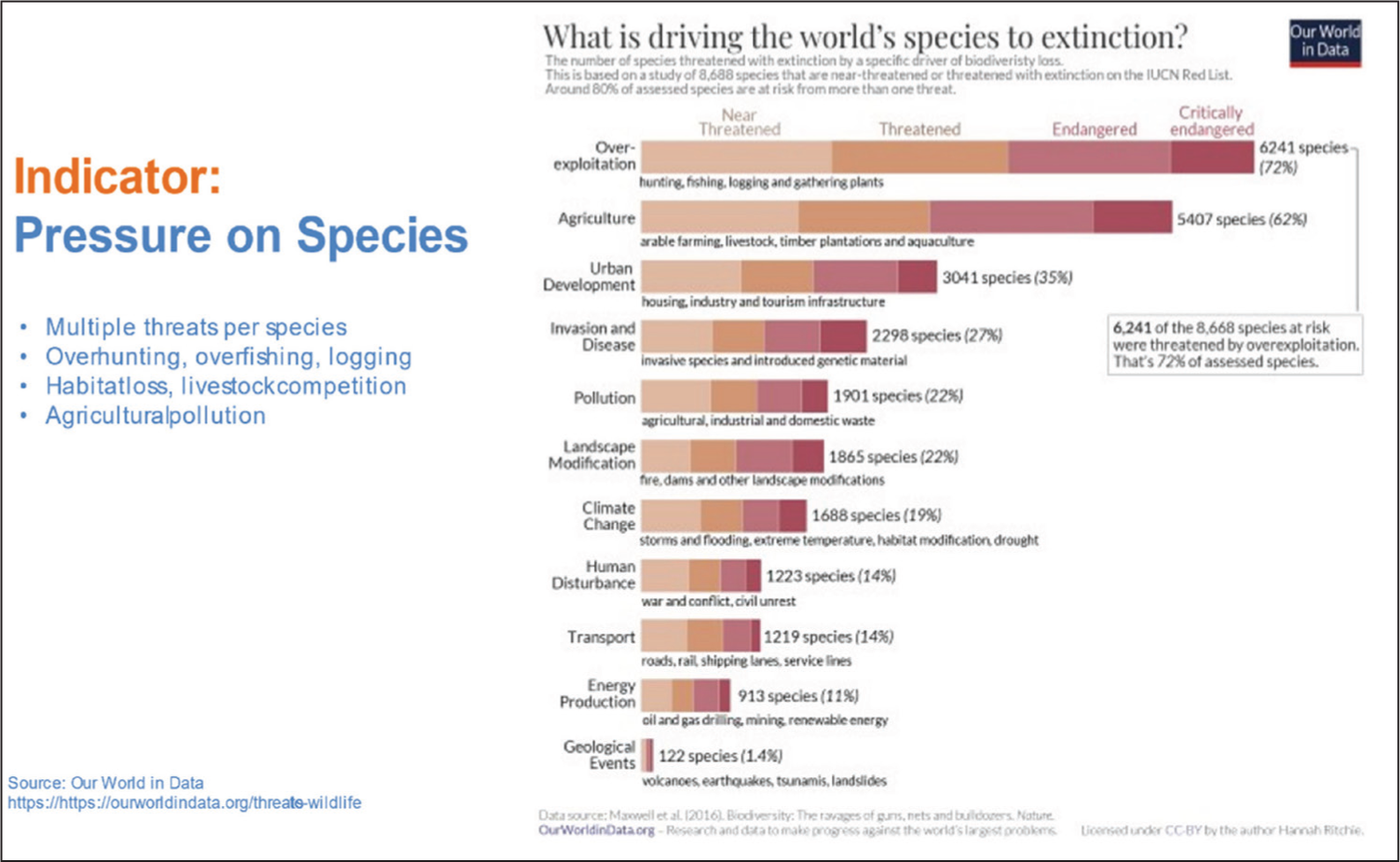
Biodiversity loss and extinction have drastically accelerated in recent decades (IUCN, 2022). The root causes of this decline are the destruction of habitats due to the expansion of the human population, land conversion for industrial development and agriculture, a rise in production levels (IPBES, 2019; IUCN, 2022) and an increase in the intensity of extractive industries and businesses (Davies et al., 2019; Wu et al., 2023) (see Figure 1).
What is Driving the World’s Species to Extinction?
‘Development’, whether it is conceived as economic or industrial ‘progress’, while dependent on natural resources, may, ironically, contribute greatly to nature’s demise. As such, sustainable development requires an orchestrated effort that concurrently furthers economic as well as social and environmental aspects (Harris, 2009; Sorour & El-Sakhawy, 2023). An environmentally responsible approach is necessary to counterbalance the negative spillovers of development on biodiversity and climate (Sorour & El-Sakhawy, 2023). The authors have also emphasized the important role that a political corporate social responsibility approach (CSR) can play in ensuring that businesses perform both their political and economic roles, which include preserving biodiversity. However, with a well-documented short-term-focused CSR in the extant literature (Sorour et al., 2021), one would not only question irresponsible business practices, but also business education that affects attitudes and beliefs regarding biodiversity and the environment in general (Id Babou et al., 2023).
Another challenge is the propensity to equate sustainable development with sustainability (when it represents only one component and requires consistent standards and monitoring). To address the challenge of equating sustainable development with sustainability, it is important to recognize that while the two concepts are related, they are not synonymous. Sustainable development refers to a process of improving human well-being while maintaining the ability of future generations to meet their needs, often emphasizing economic growth, social equity, and environmental protection (Brundtland Commission, 1987). Sustainability, on the other hand, is broader and involves long-term ecological balance, requiring consistent standards and monitoring to ensure that environmental, social, and economic systems remain viable over time (Meadows et al., 1972). Scholars have criticized the focus on sustainable development for often prioritizing economic growth, which can conflict with the deeper, more ecocentric principles of sustainability (Hopwood et al., 2005). Without clear and rigorous monitoring frameworks, sustainable development initiatives risk falling short of their intended goals (Moldan et al., 2012). Thus, conflating the two concepts can dilute efforts to achieve genuine sustainability in business and policy contexts.
Some critics argue that ESD ignores biodiversity, even in SDGs 14 and 15, when the focus is on its instrumental rather than intrinsic value (Kahn, 2006; Kopnina, 2020), potentially leading to a lack of appreciation for the intrinsic value of biodiversity (Washington, 2015). Responsible business education supports links established between business curricula and various SDGs, and is changing the overall picture (Kopnina et al., 2024). However, the pace of development in addressing biodiversity is slower. While business schools are facing rising pressures from accrediting bodies to embrace sustainability, they appear biased towards humans and not biodiversity.
Furthermore, greenwashing or the purposeful misleading of stakeholders to suggest that a product or service is ‘sustainable’ without mentioning biodiversity, is endemic (Gard, 2021; Senadheera et al., 2021), as is also the case when the ESDG refers to ‘sustainable production and consumption’ (SDG 12) (Kopnina & Bedford, 2024).
To a degree, the realisation that more must be done to protect biodiversity has reached international agendas and policy, and can also be seen in corporate agendas. Increasingly, national and international legislation mandates that businesses report and manage the potential effects of their operations on wildlife and habitats (http://www.businessandbiodiversity.org/obligations.html). A strong trend of sustainability assurance can also be observed, which marks voluntary businesses’ attempts to reassure various stakeholders regarding their sustainability practices (Wong & Millington, 2014). The Educational Consortium of Business Schools in the UK (https://iba-consortium.com/) promotes policy and education that support sustainable development. As such, the Consortium’s education may be insufficiently critical of economic and industrial development, instead supporting business as usual (Blühdorn, 2022a; Hummels & Argyrou, 2021). Despite recent advancements in addressing environmental issues in business school curricula, there is a gap in the scholarship linking higher education in business studies to the biodiversity crises. In (business) education journals there are hundreds of articles on ESD and ESDGs (UNESCO, 2017) prioritising knowledge and skills to promote sustainable development (Dean et al., 2018; Rashid, 2019) rarely considering the trade-offs of advancing development, maximising profit, and keeping the health of ecosystems intact (e.g., Kopnina, 2019, 2020; Washington, 2015).
As ESD and ESDG have become a priority in national curriculum-related policies, instead of asking what progress has been made in moving the world towards sustainable development, we ask what type of education can stand up to the challenge of biodiversity loss. Is biodiversity loss adequately addressed in the SDG-dominated business university curriculum? What kind of education can address the pressing challenges of the twenty-first century? Since sustainable development policies have not transitioned to the practice of education for biodiversity, especially within business schools, what can be the way forward?
To address these questions, this article will critique the objective of achieving sustainable development, and thus, education for sustainable development (or ESD) and education for sustainable development goals (or ESDGs) and identify areas where future research is needed. We argue in favour of returning to the foundations of environmental education, that is, the Tbilisi Declaration, supported by the United Nations Environmental Program (UNEP) and the United Nations Educational, Scientific and Cultural Organization (UNESCO), which highlighted the need for environmental education to address biodiversity loss and ecosystem decline (UNESCO, 1977).
Therefore, this article is a plea to return to the foundations of environmental education based on the Limits to Growth report (Meadows et al., 1972), formulated over half a century ago. This article will support eco-pedagogy (Kahn, 2006) and eco-literacy (e.g., Dentith et al., 2022; Kahn, 2006; Orr, 1994; Van Matre, 1978) as alternatives to highly anthropocentric and economy-centred ESD and ESDG. In doing so, this article aims to inform and enrich global policy discourse linked to the 2024 UN Summit of the Future and beyond.
Background of the Issue
Over half a century ago, biodiversity and ecosystems were central to environmental education due to the developments of the concepts of ‘Limits to Growth’ (Meadows et al., 1972), and developments in environmental ethics, including the concepts of ecocentrism or deep ecology and ‘ecosophy’ or eco-philosophy (Naess, 1973). In environmental ethics, eco-centrism recognises the intrinsic values of nature or biodiversity as a moral ‘good’ (Naess, 1973), which also has practical applications in biodiversity conservation (Kopnina et al., 2018; Taylor et al., 2020) and in Environmental Impact Assessment (EIA), the mandated decision-support tool (Bond et al., 2021) also used in business schools (Segoni, 2022). However, when critically examining nature’s contribution to people and their moral obligations to nature (Piccolo et al., 2022), we note that presently, education is still targeted towards an instrumental approach which focuses on what nature can do for people (shallow ecology or utilitarianism) (Naess, 1973). Naess’s call for deeper ecological thinking is gaining traction in education through emerging fields like ecopedagogy and ecoliteracy, which challenge the traditional anthropocentric focus. For instance, programs at institutions such as Schumacher College and the University of Exeter incorporate field-based learning and systems thinking, encouraging students to view nature as inherently valuable, not just as a resource for human use. Similarly, the University of British Columbia’s sustainability programs promote ecological literacy by integrating interdisciplinary approaches that connect biodiversity, conservation, and social responsibility. These shifts reflect a growing recognition of the need for ecocentric perspectives in education, aligning with Naess’s vision of a deeper ecological consciousness. For example, these programs explicitly refer to deep ecology:
Schumacher College offers programs that focus on ecological and regenerative practices, including courses in Regenerative Food, Farming and Enterprise, and Ecology and Spirituality. These courses emphasize sustainability and ecological approaches, supporting students in developing new models of business and farming that align with regenerative principles. UBC’s Sustainability Initiative integrates sustainability into various academic programs, research, and operational practices, emphasizing the university’s commitment to tackling environmental and social challenges. MIT Sloan offers a suite of sustainability programs, including their Sustainability Certificate and courses in Sustainable Business Strategy. These aim to equip students with the skills to lead in the transition to sustainable business models.
Schumacher College
University of British Columbia (UBC)
MIT Sloan School of Management
The Tbilisi Declaration underscored specific aims, targets, and fundamental principles of environmental education, emphasising fundamental ecological concepts, recognition of the state of the natural environment, underscoring empathy towards the imperative of conservation, and the acquisition of knowledge and capabilities to confront environmental issues (UNESCO, 1977, p. 1). The focus on ecological integrity has been reflected in educational practices ranging from conservation to outdoor education (e.g., Van Matre, 1978) to eco-pedagogy (e.g., Kahn, 2006) as well as education critical of sustainable development (e.g., Adelman, 2018; Kopnina, 2012, 2014, 2020).
Nevertheless, the Our Common Future report (WCED 1987) has prioritised ESD and ESDG (UNESCO, 2005), to promote knowledge and skills to support sustainable development (UNESCO, 2017). However, despite the progress achieved regarding some socially and economically focused SDGs (e.g., alleviation of poverty and hunger and promotion of economic growth), sustainable development seems woefully inadequate in addressing biodiversity loss or social inequalities (Adelman, 2018; Coscieme et al., 2020). Also, the root causes of even social and economic challenges (e.g., population growth and the increase in the need to meet the material needs of the growing middle classes globally) are rarely addressed (Blühdorn, 2022a, 2022b) and responsible business education remains myopic when it comes to negative effects of industrial, economic and demographic growth (Adelman, 2018). Business schools support the assumed desirability of economy-related benefits for business graduates, as Alimehmeti et al. (2024, p. 1) state, ‘students will need SDG-related skills to align with current job-market requirements… and getting better salaries’—which is entirely different from the need to address ecosystem collapse.
Following the calls for critical approaches to economic growth (e.g., Blühdorn, 2022a, 2022b; Haapanen & Tapio, 2016; Kopnina, 2020; Washington, 2015), this article contributes to the scholarship that supports pedagogical approaches that span a range of disciplines addressing biodiversity loss in the age of the Anthropocene, something that came to be known as the sixth extinction (Turvey & Crees, 2019) While species extinctions are ‘natural’, the present extinction is quantitatively and qualitatively different from previous ones in terms of both patterns and drivers. Crucially, as (Turvey & Crees, 2019, p. 982) emphasises, the new wave of extinctions occurs without replacement, beyond evolutionary time. Today’s massive biodiversity loss is “associated with continued human population expansion: overexploitation, habitat destruction, introduction of non-native species and trophic cascades or ‘chains of extinction” (Turvey & Crees, 2019, p. 982). Very little of this unprecedented change (and in ethical terms, perhaps a catastrophe) is reflected in sustainable development discourse and education (Kahn, 2006; Kopnina, 2012; Taylor, 2020).
This article aims to address the inherent challenges in using a sustainable development framework within business education to tackle this worldwide environmental crisis.
Developing Critical Thinking About Sustainable Development
The SDGs propose economic growth as a solution for the environmental crisis, not just for SDG8, which promotes decent work and economic growth, a consideration that is intertwined through all SDGs (Coscieme et al., 2020). Criticisms of development enterprises are often embedded in the critiques of neoliberalism, colonialism, racism, imperialism, patriarchy, white, Western and Northern privilege, and in particular, capitalism (D’Souza, 2021; Merchant, 1981; Mohai, 1990; Nadasdy, 2005). Teaching to address these criticisms could involve sociological studies of cross-gender, multi-ethnic and race scholarship and activism (Kings, 2017).
Various perspectives on the illusion of sustainable capitalism in higher education business school curricula and management (Beusch, 2014) have been questioned. A larger critique comes from environmentalists in the global South, eco-feminists (e.g., Merchant, 1981; Plumwood, 2012), indigenous environmentalism (Nadasdy, 2005), eco-queer movement (Sbicca, 2012), black environmentalists (Mohai, 1990), eco-socialists (Faber et al., 2021) and eco-anarchists (Toro, 2021). In a nutshell, criticism of (sustainable) development is already established in disciplinary areas critical of several associated hierarchical and hegemonic structures. Nevertheless, while such criticisms raise valid concerns, one of the more challenging points about economic growth is that while it is often criticised through the lenses of capitalism, capitalism may not necessarily outperform socialism regarding environmental degradation and production (Blaikie & Brookfield, 2015). Unless evidence shows that environmental outcomes exhibit significant disparities in policies and outcomes concerned with biodiversity protection in (former) communist or socialist nations (e.g., Nguyen & Jones, 2022; Teo, 2023), compared with capitalist countries, such criticism might be merely ideological, based in post- or neo-Marxist criticism and not empirically based (Blühdorn, 2022b).
Moreover, capitalism may not necessarily outperform socialism regarding environmental degradation through intensive production and extraction of resources. It is a critique of industrialism and economic growth, embedded in the concept of ‘development’ that needs to be highlighted (Washington, 2015). Whether or not the economic pie is divided equally, it is still consumed and limited. There is not one uniform geographic area in the world that is ‘to blame’—what is needed is a nuanced diagnosis and analysis of current unsustainable practices, including the trade-offs between social and economic wellbeing and the environment, and the need to ‘move beyond the established claims, hopes, and beliefs of post-Marxist analysis’ or the post-Marxist comfort zone (Blühdorn, 2022b, p. 576). While the growth of middle classes or high consumption habits is not geographically uniform or stable, it is hard to blame a single country or region. For example, meat consumption, in traditionally vegetarian Hindu countries, has increased, while elsewhere vegetarianism is gaining traction (Sexton et al., 2022). Teaching about these food consumption trends and geographical shifts in dietary preferences in business schools fits within the ‘traditional’ subject of marketing and CSR.
Derived from both the type of critical scholarship and in turn, its critique, there is a rising realisation that despite ideological differences, the ‘sustainable growth’ rhetoric, which (in a finite world) is an oxymoron, remains anthropocentric (Washington, 2015) and dominant in the (business) school curriculum (Kahn, 2006; Kopnina & Bedford, 2024; Misiaszek, 2023; Ross, 2020).
Ecopedagogy, Ecoliteracy and Education for Degrowth
Richard Kahn (2006), known for his work on eco-pedagogy, calls for a critical pedagogy that requires a radical ecoliteracy transformation in consciousness with the type of skills and knowledge in students that can bring about change. Instead of focusing on SDGs, such ecopedagogical approaches challenge the UN Decade of ESD and business as usual (Huckle & Wals, 2015), promoting intercultural dialogue, including Naess’ ecosophy (Zeng et al., 2024). These developments are related to an earlier call for ecoliteracy (e.g., Orr, 1994), with recent proposals to promote environmentally conscious behaviour in global curricula (Syaifudin, 2023).
One hopeful advancement is the increased attention to the subject of degrowth or post-growth in (business) schools’ curricula within business management, operations, logistics and supply chain management education (Kopnina, 2014, 2020; Kopnina et al., 2024; Jones, 2021). Degrowth and post-growth are both critiques of the current economic growth paradigm, but they differ in focus.
Degrowth advocates for a deliberate reduction in economic activity, particularly in high-consumption countries, to reduce environmental impacts and promote social well-being. It challenges the idea of continuous economic growth, emphasizing limits to resource use and advocating for simpler, localized economies (Kallis et al., 2020). Degrowth is more radical in its call for shrinking production and consumption to achieve ecological sustainability.
Post-growth, on the other hand, does not necessarily call for shrinking the economy but seeks to move beyond the obsession with GDP growth as a measure of progress (Jackson, 2009; Kallis et al., 2020). It envisions an economy focused on well-being, equity and sustainability, rather than growth for growth’s sake. Post-growth encourages a shift to qualitative improvements—like better health, education, and environmental quality—rather than quantitative increases in economic output (Jackson, 2009). In essence, while degrowth explicitly advocates for scaling down economic activity, post-growth seeks alternatives to growth-centred economics without necessarily demanding a reduction in economic size.
Economic growth has been determining the aims of business education. Eco-behavioural science, however, shows the potential to equip business school students to defend continuity and biodiversity (Finn & Philips, 2023). An emergent body of research identified that degrowth education helps to develop simplicity, challenge accumulation, and promote conviviality, and care, which can be achieved with eco-pedagogies promoting ecological conscientization of the symbiotic human interdependency with the wider biosphere, different species and others (Finn & Philips, 2023; Jones, 2021; Kopnina & Bedford, 2024; Misiaszek, 2023). Other studies promote degrowth by attempting to reconcile economic growth with promoting ecological and social sustainability by focusing on alternative transformational post-growth approaches to human prosperity, such as urban planning and degrowth (Xue, 2022) and businesses’ degrowth and geography (Nesterova, 2022). Overall, degrowth studies promise multiple learning and societal benefits not just in terms of product innovations, but also for the vision of the shared earth, togetherness, care and spontaneous creation, rather than competition as a transformational approach to educate responsible corporate leaders for the future (indicative Fitzpatrick et al., 2022; Kopnina & Bedford, 2024; Nesterova, 2020, 2022).
But here, again, enthusiasm needs to be tempered by critical thinking. There are different definitions of degrowth or post-growth, ranging from less production and consumption to Universal Basic Income (UBI), with some outcomes being potentially mutually exclusive regarding social equality and environmental sustainability (Howard et al., 2023; Langridge, 2024). While less production and consumption can have a direct positive effect on the environment, they say little about social (in)equality. UBI can increase consumption of natural resources if the incomes and material spending are increased and social equality, may be exacerbated (e.g., if some people receiving it have other savings and are significant, depending on their spending and saving patterns (Howard et al., 2023; Langridge, 2024; Pinto, 2020). Sceptics may also find that most degrowth enthusiasts believe in the impossible dream of sustained and across-the-board ‘decoupling’ of economic activity from negative environmental (and social) impacts.
We take a somewhat cautious, if not critical, view of the degrowth argument, particularly regarding the concept of absolute decoupling. While degrowth advocates argue for scaling down economic activity to reduce environmental harm, many place undue faith in the feasibility of decoupling economic growth from environmental degradation—both in terms of resource use and emissions. Evidence suggests that while relative decoupling (reducing the environmental impact per unit of economic output) is possible, absolute decoupling—where economic growth is entirely separated from environmental harm on a global scale—has yet to be realized (Haberl et al., 2020; Hickel & Kallis, 2020; Kopnina & Padfield, 2021). This casts doubt on the idea that we can maintain current levels of economic activity or growth without exacerbating ecological crises. Therefore, degrowth’s promise of achieving ecological sustainability while maintaining economic growth remains an unresolved and potentially unattainable ideal.
Essentially, the question of degrowth and post-growth needs to be understood concerning the environment based on empirical studies of initiatives, such as UBI, that are attached to the ‘degrowth’ label. So far, it is hard to tell how degrowth or post-growth can contribute to biodiversity protection, pointing out how critical eco-centric eco-pedagogies may be able to achieve greater compatibility between the business curriculum and the interests of environmental sustainability—or by making the business curriculum more approachable from the business-society and environment nexus.
A related question of degrowth has to do with the idea of absolute decoupling of natural resource consumption from the economy and/or poverty reduction, which might be impossible beyond the promises of ‘green growth’ (Kopnina & Padfield, 2021; Vogel & Hickel, 2023). Students may learn to think critically about the (im)possibilities of absolute decoupling and degrowth, a shift from production to services, and addressing indirect drivers of biodiversity decline through initiatives such as CSR’s investment in voluntary family planning but also more challenging advances towards degrowth (Kaufmann et al., 2019).
Balancing natural resource consumption with economic growth and poverty alleviation requires a nuanced approach that considers the needs of both developing and developed nations. The decoupling discourse, while largely focused on reducing environmental impacts in high-income countries, can be challenging for developing countries where poverty alleviation and economic growth are critical. Individuals living in poverty may not align with the concept of degrowth, which calls for reducing consumption, or even ‘green growth’, which focuses on decoupling economic activity from environmental harm. To incorporate the perspectives of developing nations into this discussion, several key points must be addressed:
Differentiated Responsibilities: Developing countries often argue that they should not bear the same environmental restrictions as developed nations, given their lower historical contributions to global emissions. Policies must allow for economic growth in these regions while minimizing environmental harm through targeted investments in clean technologies, sustainable agriculture, and renewable energy (UNEP, 2021). However, considering that previously developing countries like China, India, Argentina or Brazil are now major contributors to environmental problems, and because of high lifestyle aspirations and the ‘Western dream’ permeating various strata of society in different countries, a simple distinction between the countries that supposedly have a right to ‘grow’, and those that have to stop and shrink may be overly simplistic. Programs like the Green Climate Fund, aimed at financing low-emission projects, can support this balance. Many developing nations prioritize poverty alleviation, which may require resource-intensive growth. The SDGs offer a framework for pursuing economic development in ways that promote environmental sustainability, reduce inequality and improve living standards simultaneously (United Nations, 2015). These goals highlight the need for growth that is inclusive and sustainable, rather than focusing solely on GDP. Just Transition: For developing nations, the shift towards more sustainable economies must be socially just. This means creating green jobs and promoting economic diversification while ensuring that people currently dependent on natural resource extraction are not left behind. The concept of a just transition can be key to balancing environmental and economic objectives. Context-Specific Strategies: Applying a one-size-fits-all model of degrowth or green growth overlooks the diverse realities of developing countries. For instance, Costa Rica’s focus on ecotourism and forest conservation demonstrates how countries can foster economic growth through environmental stewardship, but such a model may not work in countries reliant on extractive industries. Solutions should be tailored to local contexts, recognizing that poverty alleviation often requires increased resource use in the short term.
Incorporating developing countries’ perspectives into the decoupling debate means acknowledging that they may need to prioritize economic growth differently, while still committing to sustainable development that, supposedly, benefits both people and the planet. However, as discussed above, while promoting economic growth in developing nations is essential for poverty alleviation, it can lead to increased environmental degradation, which in turn threatens the same countries. Developing nations are particularly vulnerable to the impacts of climate change, such as extreme weather events, biodiversity loss and declining agricultural productivity. These effects can exacerbate poverty and social instability, creating a vicious cycle.
Relying on resource-intensive growth could further strain ecosystems and contribute to deforestation, pollution, and carbon emissions, which may endanger long-term economic stability by depleting the very resources that developing countries depend on. For example, the expansion of agriculture into forests or the over-exploitation of fisheries might provide short-term gains but lead to irreversible environmental damage, thus jeopardizing future livelihoods (Dasgupta, 2021). This is especially problematic in regions like Sub-Saharan Africa and Southeast Asia, where communities are highly dependent on natural resources for their sustenance.
Moreover, climate change disproportionately impacts these regions, with rising temperatures, droughts, and flooding undermining food security and livelihoods. Pragmatically, allowing unmitigated growth without environmental safeguards could lead to worsening conditions, trapping developing nations in cycles of poverty driven by resource depletion and climate impacts.
A more sustainable path would involve investment in clean technologies, climate-resilient infrastructure, and policies that promote both economic growth and environmental conservation. This requires global cooperation, as wealthier nations must support developing countries through financial and technological transfers to balance growth with environmental protection (IPCC, 2022). How realistic such a path is remains to be seen.
Pragmatically, students may also learn about degrowth by studying the links between CSR activities, normative institutions created by the government and societies, and how businesses respond to such norms to maintain their moral legitimacy within an emerging participatory governance system (Sorour & El-Sakhawy, 2023; Sorour et al., 2021). These types of critical thinking discussions can be introduced in class.
Business school programs can effectively incorporate degrowth principles, biodiversity conservation, and CSR through innovative curricula and pedagogical approaches. Here are some specific strategies:
Integrating Degrowth into Business Models: Courses can introduce students to business models that prioritize social and environmental well-being over profit maximization. For instance, programs can feature modules on the circular economy and shared value frameworks, showcasing how companies reduce resource use and emissions. Case studies of firms like Patagonia, which emphasizes sustainable consumption and product longevity, can serve as practical examples of applying degrowth principles in business practices (Bocken et al., 2014; Kopnina & Bedford, 2024). Biodiversity in Supply Chain Management: Business schools can incorporate biodiversity conservation in supply chain management courses by examining companies that integrate ecological considerations into their sourcing strategies. Students can analyse, for example, how Unilever implements sustainable agricultural practices to protect ecosystems as part of its commitment to CSR. Evaluating certifications like Rainforest Alliance can provide insights into the impact of sustainability standards on supply chains (Jones & Comfort, 2019). CSR and Biodiversity Initiatives: CSR courses can focus on initiatives related to biodiversity, such as biodiversity offsetting and corporate natural capital accounting. Students can engage in hands-on projects, partnering with local businesses to design CSR strategies that enhance biodiversity, such as reforestation efforts or habitat restoration programs. For example, HSBC’s Water Programme, which addresses water resource management and ecosystem health, can be explored as a case study in linking CSR to biodiversity conservation (Deutz et al., 2020). Capstone Projects and Research Opportunities: Programs can require students to develop business strategies that align growth with biodiversity conservation. For instance, students could propose how companies in extractive industries might implement degrowth practices by scaling back production and investing in biodiversity restoration, thereby establishing a direct link between CSR initiatives and environmental stewardship.
By embedding elements of biodiversity conservation, degrowth principles, and CSR into business curricula, schools can better equip future leaders to navigate the complex intersections of business, biodiversity, and sustainable development. As Kopnina (2020) emphasizes, the integration of environmental education into business programs is not just an ethical imperative but also a practical necessity in addressing the pressing ecological challenges of our time. Future business leaders must be trained to understand and appreciate the intricate relationships between economic activities and ecological systems, as well as the social implications of their decisions. By fostering critical thinking and innovative problem-solving skills, educational institutions can prepare students to devise strategies that align business objectives with the principles of sustainability and biodiversity conservation. Such a holistic approach will empower graduates to contribute positively to their organizations and society at large, promoting a more sustainable and equitable future.
Conclusion
This article critically examined the goal of achieving sustainable development, as well as ESD and ESDGs, emphasizing their instrumental rather than intrinsic value, which may result in insufficient recognition of biodiversity. In this article, we supported a shift to a more biodiversity-inclusive, ecosystem-oriented business education and toward the precise aim of biodiversity protection. There are many ways in which this shift can occur, but it is not likely to happen through the presently dominant and hegemonic ESDG. Consequently, we have argued for a return to the foundations of environmental education based on the Limits to Growth report and the Tbilisi declaration on environmental education and by engaging students in critical thinking exercises embedded in normative institutions and governance.
Returning to the questions posed at the start of this article, we may conclude that biodiversity loss is not adequately addressed in the SDG-dominated business university curriculum. The type of education that can address the pressing challenges of biodiversity loss requires ecopedagogy and ecoliteracy. Other types of pedagogies that develop an understanding of the basic principles of social and ecological systems suggest the need for an interdisciplinary curriculum ranging from biodiversity conservation science to sociology, introducing business students to debates conspicuously absent from ESD and ESDG. Since sustainable development policies have not transitioned to the practice of education for biodiversity, especially within business schools, the ways forward would include the introduction of ecopedagogy, ecoliteracy and other types of didactic and theoretical approaches that involve interdisciplinarity and critical thinking about the root causes of biodiversity and oxymoronic goals of sustainable development.
Footnotes
Data Availability Statement
No data are available for this study as it is based solely on desk research.
Declaration of Conflicting Interests
The authors declared no potential conflicts of interest with respect to the research, authorship and/or publication of this article.
Ethics Statement
This study did not require ethical approval or informed consent, as it is based entirely on desk research.
Funding
The authors received no financial support for the research, authorship and/or publication of this article.