




Abstract
Japan is facing a problem of depopulation of rural and island communities. This research focuses on the island of Nakanoshima (Ama-cho), which has dramatically declined in population in the past 70 years. In 2007, the High School faced the threat of closure due to declining numbers, and were it to close would have further hastened the decline of the island. At that time, radical reforms were made by the local government and subsequently the Miryokuka project was created to save the school and make it into a centre of education to promote sustainable living in Ama-cho. During a visit to the island, observations and semi-structured interviews were carried out with different stakeholders. This focussed on the ways educational interventions have contributed to reversing population decline and rejuvenating the island. The research demonstrated the power of the school’s transformative place-based pedagogy to foster sustainable living in Ama-cho.
Keywords
Introduction
The Oki Islands is an archipelago in the Sea of Japan spread some 40–80 km from the mainland. Just four of the 180 islands are inhabited: Nakanoshima (Ama-cho), 1 Nishinoshima and Chiburijima, known together as the Dozen group, and the largest island Dogo. In the past 70 years, a dramatic decline in population has threatened the survival of their communities. Since 2005 intensive local government actions in Ama-cho have been carried out to revitalize the island (Abe, 2014; Quarshie, 2014).
This article focuses on the Miryokuka project which, at the outset, aimed to secure the future of Oki-Dozen High School 2 —the only high school in the Dozen group situated in Ama-cho. The school was threatened with closure in 2007 due to low enrolment. Were the school to close down, young people would have had to leave Ama-cho for their secondary education and may never return. This would further exacerbate the depopulation. The Miryokuka project implemented educational reforms to make the school a centre of education to promote sustainable living in Ama-cho (Chozang, 2017; MEXT, 2014, pp. 42–43).
In November 2019, I undertook fieldwork in Ama-cho that included interviews, focus group discussions (FGDs) and observations. This, along with school and other documents that I acquired, was used to find out about the practice of education for sustainable living at Oki-Dozen High School and its role in revitalizing the local community.
Background
The Oki Islands
The Oki Islands are the peaks of two volcanoes that are approximately 5 million years old and the oldest rocks in Japan have been discovered here. Signs of human inhabitation on the Oki Islands can be traced back to the Japanese Paleolithic Era (before 14,000 BC), which is when the earliest sign of human life is recorded in mainland Japan. Surrounded by unique geological formations and due to the remoteness of their location, these islands possess striking landscapes, unique ecosystems, rich marine diversity and distinct cultures and lifestyles. The Oki Islands were designated as one of the 120 UNESCO Global Geoparks
3
in 2013 in recognition of their rich geological heritage. The four inhabited islands and their respective sizes and population in 2019
4
are as follows:
Dogo
241
13,900
Nishinoshima
56
2,800
Nakanoshima (Ama-cho)
32
2,500
Chiburijima
14
605
Depopulation of Ama-cho
Ama-cho’s population in the 1950s was approximately 7,000, but due to the lack of job opportunities and the inconvenience of living remotely from the mainland, the population decreased by 60 per cent within a half-century. By 2005 the population went below 2,600 and in 2019 was 2,500. Moreover, Ama-cho’s aging population (65–) reached over 40% of the total population, whereas the youth population (0–14) was 10%. Besides migration from the Oki Islands to the mainland, a low birthrate has led to a significant drop in population. Rural–urban migration and an ageing population along with a lack of central government support were, therefore, making it difficult to sustain rural life.
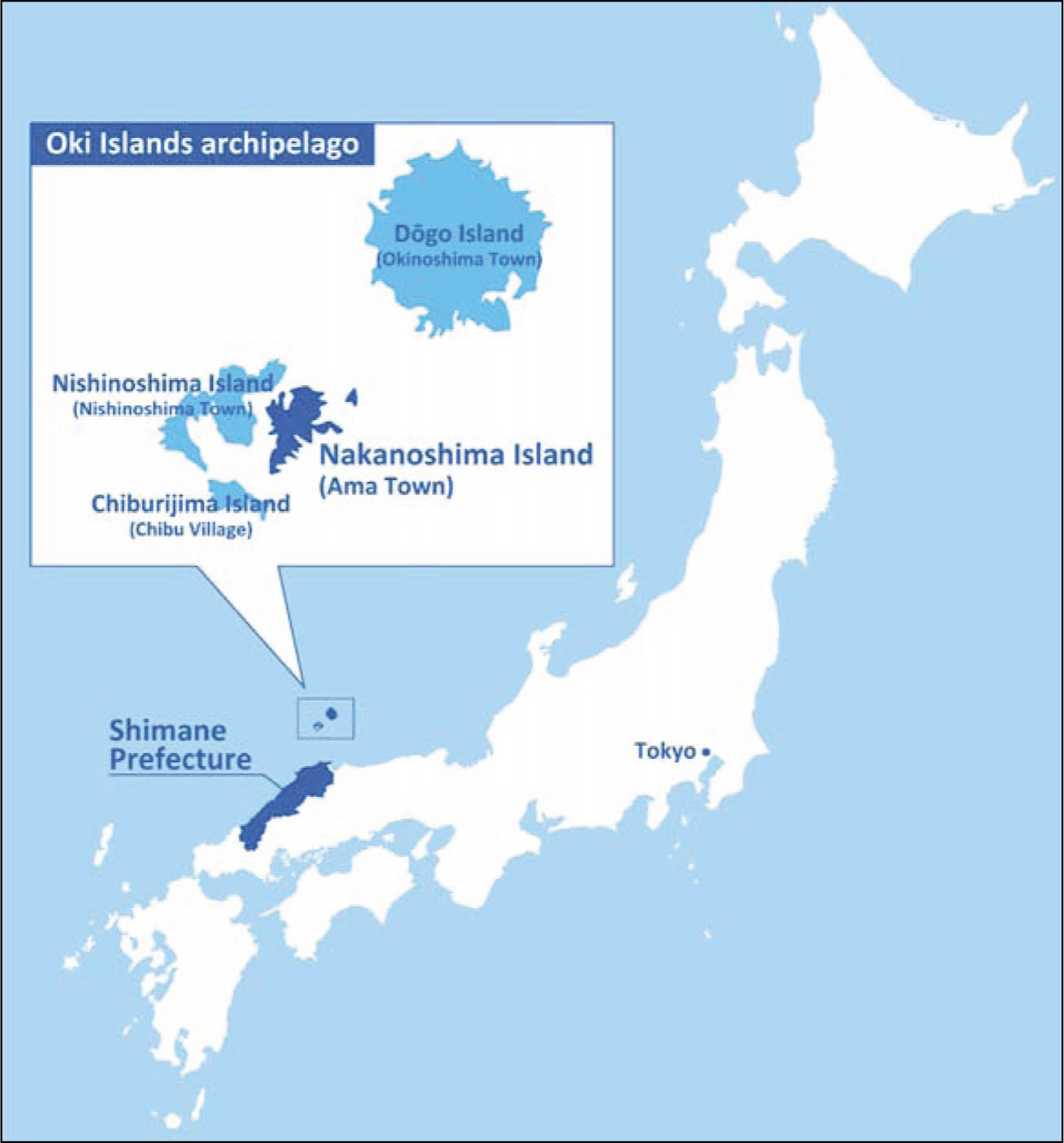
Ama-cho is significantly detached or isolated from economic or political centres, such as national or regional capitals. Nonetheless, the residents of Ama-cho were determined to demonstrate that a sustainable future can be achieved when a community defines what development means to them and pursues it wholeheartedly by using local resources and partnerships. The result was Ama-cho’s strategic plan drawn up in 2005.
Ama-cho’s Strategic Plan 2005
Depopulation in Ama-cho had severely affected the local economy and the island was on the verge of financial bankruptcy with a huge budget deficit. National tax reforms in 2002 cut funding for public services which took a toll on Ama-cho because public service was the main source of employment on the island. To address this situation Michio Yamauchi, Mayor of Ama-cho, drew up a strategic plan in 2005 to promote the town’s self-reliance that included both defensive and aggressive strategies. The defensive strategy consisted of a radical reform of administrative and financial operations. Yamauchi initiated a new start by cutting his own salary by 50% and up to 30% cut for town officials. Locals also offered to forego subsidies for transportation. At the same time, he adopted two aggressive strategies: developing products by branding the whole island and offering one of the nation’s highest-quality education programmes as a full-fledged effort of the entire town.
Regarding product development, the town hall set out to establish public–private partnership businesses that would utilize local resources. This resulted in a namako (sea cucumber) processing factory that exports some of its products to China. The partnership involved a lease of the building and equipment by the town hall on one hand, and the technical know-how and managerial competence of an ‘I-turn’ on the other. Loosely defined, an I-turn is a worker on the island whose hometown is on the mainland. I-turn residents are migrants from other parts of Japan and constitute approximately 10% of the town’s total population. They have played crucial roles in the town’s revitalization process. The town hall has leased empty houses from the owners who are currently living in the cities so that I-turners can occupy them at subsidized rents. This initiative has led to an inflow of I-turners to the island with their unique skills and expertise. In addition, businesses have been supported by ‘U-turns’—persons who originated from the island and have returned to work there.
Another business venture is a freezing/storage facility set up using an advanced technology that preserves the freshness of the product—mainly fish. The process called CAS (Cell Alive System), developed by ABI Co. Ltd in Chiba Prefecture, gives the venture a competitive edge on the mainland since the products stay fresh even after their long journey to market. In addition, two famous export commodities of the island are Oki beef and rock oyster. Behind the ventures is successful marketing with exclusive local branding and packaging, accompanied by high-quality products.
Such business ventures have created employment and made the community more self-reliant while reducing rural–urban migration. During the period from 2004 to 2012, 361 new people moved into Ama-cho, accounting for more than 10% of its population, and 204 people who were born there but had moved to other places returned to their hometown. Approximately 60% of these new and returned residents are now settled on the island.
Ama-cho, which was once destined to fade away in all aspects of the economy, administrative autonomy, population and local lifestyles, has reversed its path of extinction. Each village has at least one project designed to stimulate the village economy and realize the town’s long-term vision. Backed by regular monitoring and a tight feedback system, all ongoing projects have made notable breakthroughs. The administrative, fiscal and educational reforms undertaken by Ama-cho have been largely successful. Today, the narrative of Ama-cho has flipped and it is now considered a desirable place to relocate. Approximately 20% of the current population of Ama-cho has migrated from other regions of Japan or abroad over the past 14 years. The Oki Islands, now designated as a UNESCO Geopark, is turning into a popular holiday destination with fishing and sightseeing excursions.
In 2011, Ama-cho adopted ‘Nai-Mono-Wa-Nai’ to symbolize the island’s way of life, charm and personality (Edahiro, 2018; Yagi, 2012). It has two meanings. First, ‘What is not here … is not here’ with the underlying message: ‘We do not have it here, so just accept the situation’. A second meaning is ‘There is nothing that is not here’. In other words, ‘Everything is here’. Whilst urban life offers a materialistic lifestyle, Nai-Mono-Wa-Nai embraces (a) positive acceptance of island life—‘If we do not have it, that is OK’, (b) a sense of sufficiency—‘We already have everything that is important’ and (c) an attitude of ‘Together, let us create whatever we are lacking and enjoy the process!’ A society of mass consumption may offer a convenient lifestyle but it is ‘a society that has forgotten the joy of creating something together, instead of just buying it’.
In addition to establishing new business ventures, developing high-quality education programmes was also one of the offensive strategies of the Strategic Plan 2005 (Abe, 2014). This resulted in the Miryokuka project to revive the only high school in the Dozen Islands called Oki-Dozen—a project that was central to the revitalization of Ama-cho.
The Research in Ama-cho
The focus of the research in Ama-cho was on the role Oki-Dozen High School and the Miryokuka project had played in revitalizing the local community, reversing depopulation and promoting sustainable living. The main research questions were as follows:
In practice, what is education for sustainable living to revitalize Ama-cho, Japan? In what ways have the educational interventions in Ama-cho halted population decline and put the island on a path towards a sustainable future with a high level of well-being?
I visited Ama-cho from 24 to 27 November, 2019 and carried out research with semi-structured interviews with three teachers and the Miryokuka coordinator. Two of the teachers were Japanese, one taught history and the other mathematics. The other teacher was American Assistant Language Teacher (ALT) and Glocal coordinator. I also carried out some classroom and community observations and an FGD with 12 students. In addition to the fieldwork, I was able to review in advance documents about Ama-cho, the Miryokuka Project and the Oki-Dozen school found online or supplied by the school. The qualitative data were analyzed using a thematic content analysis.
Findings and Discussion
Oki-Dozen High School and the Miryokuka Project
In the school year 2019–2020, Oki-Dozen High School had 160 students, of which 96 students were from other parts of Japan and live in an on-site dormitory. Although the capacity is 240, the school’s future is currently secured and this is a completely different outlook from back in 2007. At that time Oki-Dozen High School was on the verge of being closed down by the prefectural government because of record-low-student enrolment numbers, just 28. A total of 55% of the Dozen Islands’ ninth graders chose to attend a high school on the mainland—the common conception was that students who attend Oki-Dozen High are unable to acquire a college degree. Thus, as the number of students and their families deserting the island steadily increased, the closer Oki-Dozen High edged towards reaching the public school closing standard of an enrolment rate of fewer than 21 students. If the school shut down, the youth of Dozen would automatically need to leave the island to attend high school, which would further exacerbate the population decline.
Driven by this sense of urgency, in 2008 the school and the local government of the three islands of Dozen joined forces and created the Miryokuka Committee 5 which had lengthy discussions on how to save Oki-Dozen High and make it an attractive school. Three local village administrations, the school, parents and guardians, local residents and a number of organizations set up a system where all quarters of society would participate in the plan, with the aim of creating a high school that would attract a large number of students. They carried out surveys to get feedback from local community members (youth and their parents) and found that the main deficits of Oki-Dozen High were that there was little competition and stimulation, limited opportunity to meet people with different and diverse values, and hardly any possibility of building new relationships. Based on this information, they created the Miryokuka Vision and began their journey to transform the school, which is called the Miryokuka project—an endeavour to create a sustainable future through transformative education. The project aimed to connect the school with the community, society and other countries. Miryokuka project could be translated as ‘project to improve the appeal, attraction or charm of the high school’. With this in mind, measures were aimed at encouraging students in the area to go to Dozen High School, and to increase the number of students coming in from outside through an exchange programme.
The project prioritized curriculum reforms by introducing additional syllabi on the island’s pressing sustainability issues, such as depopulation, declining birth rates and economic challenges. Community building courses were introduced to implement career education and guidance rooted in the local community. In addition, courses in island studies and regional studies were taught covering Ama-cho’s rich natural resources and their economic values, so that students are aware of how local resources can be utilized in business.
The idea was to turn the whole island into material for teaching by conducting lessons in problem-solving with local issues as the subject—a place-based education (e.g., Sobel, 2017). These subjects were introduced to foster human capital and infuse an entrepreneurial mindset, so that students can return to the islands after their studies and preserve the islands’ culture and ensure a sustainable future. Although students learn about these issues, they are also encouraged to come up with different ideas to overcome them. This is most evident in the ‘Yume-Tankyu’ or ‘Discovery of Dream’ student projects introduced below.
Miryokuka Project Goals
Enable Each Student to Achieve Their Dreams
Oki-Dozen High was not appealing because people believed that students did not receive a good education and that they would fail to get into college. Thus, it was vital that the school provided high-quality holistic education. Utilizing the island as an asset, they emphasized small-group teaching and one-on-one support. In addition, they formed strong school-community partnerships to actively implement place-based learning and also utilized technology-enhanced learning. By doing so, the Miryokuka created a learning environment that focused on nurturing each individual student and maximizing their capabilities to accomplish their aspirations.
Foster Human Capital That Can Brighten the Community’s Future
Before the project, over 90% of Oki-Dozen High students left the island upon graduation and only 30%–40% returned to live on the island in the future. If this trend continued, the island community would become obsolete. The project aimed to change students’ mindset from ‘there is nothing to do on the island’ and ‘the city is more convenient’, to a sense of pride and compassion towards the island community. Moreover, instead of thinking ‘I cannot live on the island because there is no work opportunities’, they hoped to foster an entrepreneurial mindset of ‘I want to revitalize my community and create new jobs there’. It was imperative that the only high school in Dozen produce human capital that would preserve the island’s traditional culture as well as ensure the future of the community.
Develop a Sustainable and Ideal School
Instead of being a school in fear of closing down any minute, Oki-Dozen High needed to be a stable school that also attracts motivated students from across Japan to relocate and study there. Surrounded by beautiful nature, a tight-knit community that values relationship-building, and a safe environment, Miryokuka aspired to rebrand and promote Ama-cho as the ‘education island’, which will attract a steady stream of young married couples with children and contribute to the island’s sustainability and development.
Examples of the Miryokuka Project Vision in Practice
Yume-Tankyu Project
The ALT/Glocal Coordinator spoke about the Yume-Tankyu or ‘Discovery of Dream’ place-based learning project. Yume-Tankyu engages students in solving local community problems which are seen as a primary source for learning. It is a project that lasts over the three years of High School. In the first year, there is training in some basic knowledge, such as collaborating skills and critical thinking. Place-based experiential learning in the form of fieldwork on some sustainable living issues in the local community takes place in the second year. Some of the topics mentioned were pollution, recycling and upcycling and organic farming. At the end of the second year, presentations take place and mark an important date in the school calendar. As well as the school body, the local community and the student’s parents are also invited to attend. In the third year, there is a focus on organizing students’ career vision by reflecting on their project-based learnings.
Students typically spend 1 to 2 hours per week on the project and sometimes work on weekends. The project is supervised by some of the coordinators and teachers, and the staff of the Oki-no-Kuni Learning Center (see below) is also involved. Students meet once a week for one hour with their supervisors.
The project is self-evaluated with questionnaires about leadership, collaborating skills, critical thinking and so on. In the FGD that I carried out, the students were enthusiastic about Yume-Tankyu. One student remarked that the project was ‘empowering and you can express yourself’. The Miryokuka Coordinator described the project as an aspect of ‘the human development side of education’. The project has made a significant contribution to not only the personal transformation of students but also the local community. According to Cloud (2017, p.39), ‘One of the key predictors of success of an Education for Sustainability (EfS) program in schools is the authentic project-based and place-based nature of the work of teachers and students in the context of their local community’.
Island Study Programme
The Island Study Abroad programme invites students from outside the island to create a more multicultural environment in the high school. In addition, local volunteers become island parents and take on the role of passing on the island’s traditions, culture and wisdom for living in harmony with nature. The project actively promoted and encouraged middle school students from mainland Japan to apply to Oki-Dozen High. This would not only save the school from closing down, but would also provide the desired opportunity for island youths to interact with peers from different backgrounds, beliefs and values. Through this effort, in 2012, Oki-Dozen High experienced an influx in the enrolment rate. In 2013, the number increased to 45 students, out of which 22 students applied from outside Dozen.
Oki-no-kuni Learning Centre
The Oki-no-kuni Learning Center was established as collaboration between the high school and the region to overcome the geographical barriers by using information and communication technology and local human resources. The centre operates after school up to 10
The Learning Centre staff communicates with the schoolteachers on a daily to weekly basis so that they can supplement their teaching in the most effective way possible. For example, each of the 10 full-time staff members are responsible for checking in on a certain group of students on a one-on-one basis and exchange information with the schoolteachers. The centre also creates independent learning opportunities linked to school studies. Besides academic support, the Oki Learning Centre runs several project-based and place-based learning programmes that are meant to help students develop and pursue their passions and dreams. These holistic education programmes are often co-facilitated by local community members and involve hands-on learning by going out into the community. Japanese and foreign companies as well as universities are approached for their cooperation to promote various student-led projects, for example, proposals to government measures, such as energy self-sufficiency. Moreover, the students and community members can use the Learning Centre space to work on their own individual extracurricular activities while many 1-day workshops and community events take place here as well. The centre also presents students with problems facing Dozen and are guided to produce creative, feasible solutions in groups and individually. It is envisaged that such efforts may lead to students choosing careers that benefit the island’s sustainability.
The centre organizes weekly career seminars where students are guided by the centre’s staff to develop and plan concrete steps to help them achieve their short- and medium-term goals, such as gaining admission to good universities or training colleges, organizing events, doing internships and volunteering overseas. Students are also taught business management models and concepts in the hope that they will use these tools to develop ideas that utilize Dozen’s resources.
Joint Long-distance Classes
Aided by distance teaching technology, the students at Oki-Dozen High regularly participate in joint classes with high-school students from other parts of Japan, which plays an important role in furthering the school’s connectivity despite being geographically isolated. Information and communication technology allows experts on the mainland or overseas to instruct students in real-time on a life-size screen. The partnering high schools are also located in rural parts of Japan that are also struggling with similar social issues, such as population decline and over-ageing. The students share and learn about each other’s communities and then help each other find solutions to their community problems. There is also an audio-visual library of lectures from reputable cram schools around Japan as well as the learning centre.
Super Global High School and Global Exchange
In April 2014, the Ministry of Education, Culture, Sports, Science and Technology and Technology launched the 5-year ‘Super Global High School (SGH)’ programme 6 to cultivate global leaders who will be able to play an active role on the international stage by choosing careers in international organizations (Clavel, 2014). Oki-Dozen High School was one of 56 schools that were selected which provided a boost in resources to support its on-going activities. During the 5-year period of the project, each school received an annual subsidy of ¥16 million (US150,000).
SGH had many elements that were already part of the Miryokuka project. It was designed to promote international understanding through active and inquiry-based learning that develops awareness and deep knowledge of social issues, communication ability and problem-solving skills. Students conduct multidisciplinary, comprehensive and exploratory studies on social and business issues at the global level, in collaboration with domestic and overseas universities, as well as corporations and international organizations that promote internationalization. This programme requires high-school students to conduct fieldwork both domestically and internationally on a research topic as part of their learning, in order to broaden their views and pursue their goals. The designated schools are expected to set specific research topics and education content in consideration of their regional characteristics and features of the schools.
A key term that the Miryokuka project uses is ‘glocal’ (global + local) which refers to students that possess the qualities of global leadership driven by their local community experience as well as local leaders who have a global perspective. Glocal leaders possess the quality of being empowered to create a sustainable regional society from their own backyard whilst promoting global sustainability. To foster glocal, Oki-Dozen High students go overseas to learn about other communities and to share their culture as well. Some countries that Oki-Dozen High students have visited include Bhutan, Singapore, Estonia, Bangladesh, Kenya, Russia, Malaysia and Australia. In the FGD, students were positive about global exchanges but one student remarked about ‘challenges to apply ideas gained and put into action’.
Ama-cho Tourism Project
Oki-Dozen High School students have developed a tourism plan for the island. They worked with local residents to accomplish a programme that included tours and workshops for other schools, municipalities, government officials and research institutes. The marketing strategy included generating news coverage of the island. The operation is part of a Tourism Club that is supervised by the Mathematics teacher. He said that they offered 10 tours that involve a home stay to get to know the locals. Typically visitors stay for 5 days/4 nights. It was described as a big success and a great way to get students involved in the local community.
Population Rebound
As a result of the Miryokuka project efforts, by the 2013 academic year, the high-school numbers had increased to 156 and had two classes in each grade. There were 59 students in first grade, 45 in second and 52 in third, with half of them having come in from urban areas. In 2016, student numbers had risen further to 180. More than 40% of students come from places outside the island. There are also a growing number of students who want to return to the island sometime in the future after completing university. Just as the high school has rebounded, the population of Ama-cho has also been rising since 2011 after consistently shrinking for the past 70 years.
Well-being in Ama-cho
UNESCO (2017) highlights four dimensions of sustainable living: environmental, social, economic and cultural well-being. I was interested to find out to what extent the collective efforts in Ama-cho have led to a higher level of well-being on the island and a path towards a sustainable future?
In 2017, The Institute for Studies in Happiness, Economy and Society (ISHES) conducted an independent citizens’ survey in Ama called Wagatoko (ISHES, 2018). This survey was an attempt to consider what well-being means in Ama-cho, and to measure it. It included areas such as the rate of household food self-sufficiency and the frequency of sharing in the community. ISHES also did a similar study at the national level to compare the findings.
Regarding ‘Nai-Mono-Wa-Nai’ (previously mentioned), approximately 60% of all the respondents had a positive impression of the concept. The survey asked how satisfied they are with their lives today, and approximately 75% of the respondents from Ama-cho answered that they were ‘satisfied’ or ‘somewhat satisfied’, which is 20 percentage points higher than the results of the national survey (at 55%). In response to a question for working people, approximately 70% of the respondents from Ama-cho replied that they were ‘very motivated’ or ‘motivated’ at work, which is much higher than the national results (approximately 47%).
When asked, ‘During the past year, did you share something with others in your community?’, 70% of the respondents from Ama-cho replied that they ‘shared often’ or ‘shared occasionally’, much higher than the national results (approximately 38%). In response to the question ‘During the past year did you speak to someone about your community?’, 57% of the respondents from Ama-cho responded that they spoke ‘many times’ or ‘sometimes’, much higher than the national results (approximately 21%). Another question asked, ‘During the past year did you support the activities of someone else in your community?’, 43.5% of the respondents from Ama-cho replied ‘Yes’, much higher than the national results (approximately 19%).
In 2015, Firouz Gaini carried out research in Ama-cho on the realities and dreams of Oki-Dozen High School students (Gaini, 2019). The results were positive for the future well-being of Ama-cho. He found that many students want to contribute to their island’s sustainable development, although they needed a period in mainland Japan—for further education and new exciting life experiences—before eventually (hopefully) heading back to Ama-cho. The students said that one good thing is that they can always turn and go back to the islands, especially if things go wrong. Social marginalization, in mainland cities, was contrasted with social participation and well-being in Ama-cho. In Ama-cho, the islanders feel a belonging that is difficult to substitute for a life immersed in companies in cities. Gaini (2019) also found that Ama-cho students expressed less future-pessimism than many young people elsewhere in the country. Their community inspires attempts to rekindle confidence in the future.
My own research also found similarities with that of the ISHES (2017) and Gaini (2019) research. One teacher who had only quite recently arrived in Ama-cho from a place near Tokyo remarked that ‘in Saitama, there are lots of people living alone who do not know their neighbours, but here in Ama-cho people know everybody and we especially look out for the elderly’. The Miryokuka coordinator echoed this by mentioning how people say hello when they meet in the street. He regards city life and Ama’s island life as two different cultures. For this reason, he is keen to arrange for the students a 3-month period in an urban area to understand the differences between city and rural life. He hopes that this will strengthen students’ appreciation of life in Ama whilst also broadening their minds and perspectives.
Another teacher expressed his delight in living in Ama-cho. He recounted how he was able to go fishing for his supper—something not possible in the previous places he had lived. He had also become a rice farmer and his last harvest produced 90 kg of rice—enough for at least 2 years’ consumption. On the question of contentment, he interestingly remarked that ‘I-turns still want more, whereas locals are more content with what they have’ (Nai-Mono-Wa-Nai).
In the FGD, the students also mentioned differences in city life compared to Ama-cho, ‘in the big city you do not have to interact with other people’. As for the future of the island, several students expressed concern about cultural sustainability: ‘elderly people know about cultural traditions but young people do not learn traditional culture so it is unsustainable’, ‘the wisdom of elderly people is not passed on’. The cultural dimension of sustainability may, therefore, need greater attention. However, in general, the evidence points to a high level of well-being in Ama-cho.
Conclusion
The Miryokuka project and interventions for a sustainable future have captured imaginations throughout Japan. Ama-cho has gained national attention by featuring in NHK (Japan’s public broadcaster) programmes. Many visitors flock to Ama-cho to find out about the educational reforms (Nagatomo, 2018). There are now many other Miryokuka projects throughout Japan which Ama-cho has helped to seed. A handbook (in Japanese) has been produced on how to set up a Miryokuka project 7 and also a book on the ‘Miryokuka project and a society in population decline’ 8 (my translation). The Ama-cho Miryokuka project gives support to coordinators in other towns who ‘sometimes feel isolated and have nobody with whom they can promote the project together’. To attract new students to Miryokuka schools, there are recruitment fairs in which schools work together on the promotion of their programmes.
The continued success of the Miryokuka project will depend a lot on the current generation of students. The FGD I had with students gives some hope for the future. The students demonstrated concern for the well-being of Ama-cho and they had a sound knowledge of the broader sustainability challenges facing the planet, such as climate change, waste, pollution, deforestation, species extinction and so on. One student remarked that ‘if we do not take care about nature it will vanish’. Another student passionately said that: ‘the balance between humans and animals is not sustainable right now. Humans are ruling the world and taking over everything on the planet—controlling everything. So we should not only focus on our lives but all living things on the planet’.
The students showed an awareness of the different dimensions of sustainability including concerns about the preservation of culture (not often brought up in my previous discussions on sustainability with other students). They were also enthusiastic about The Yume-Tankyu project. This place-based education connected the students with the local community, and they engaged in research on authentic issues. The goal is to promote a deeper understanding of the island and to act and transform communities and foster sustainable living.
The practice of education for sustainable living is now firmly established in Ama-cho with a vision and path to revitalize the local community and produce global-minded students. Population decline has been halted and with a dedicated team of educators and enthusiastic students there is an air of optimism about the future of the island.
Footnotes
Declaration of Conflicting Interests
The author declares no potential conflicts of interest with respect to the research, authorship and/or publication of this article.
Funding
The author received no financial support for the research, authorship and/or publication of this article.