




Abstract
Over the past decade, Japan’s rich tradition of environmental education-related policy has shifted to encompass international discourse concerning global competition and education for sustainable development. In view of this shift, this article explores environmental education-related policy enactment from the perspective of high school teachers. In-depth interviews were conducted with 16 experienced teachers and were analysed using the environmental education-related conceptual lenses of Lucas (1972) and Stevenson (1987, 2007). The findings suggest that the current policy enactment in Japanese high schools features a narrow interpretation of environmental education that emphasises knowledge acquisition and overlooks the development of practical skills, attitudes or democratic citizenship. This case study highlights the necessity that, for a progressive environmental education to become established, policymakers must find a way to balance local knowledge with the demands of international organizations, paying particular attention to curriculum ideology, policy competition and the teachers’ voice in policy creation.
Introduction
To avoid disastrous levels of global warming, the Intergovernmental Panel on Climate Change (IPCC) has called upon all governments to take ‘far-reaching and unprecedented changes in all aspects of society’ (2018, para. 1). Whilst government action, in the form of policy, funding and guidance, is crucial to mitigate environmental disaster, closer attention should be paid to the relationship between policy vision and policy enactment if a ‘climate catastrophe’ (IPCC, 2018, para. 1) is to be avoided.
Viewed in these terms, environmental education-related policy, alongside its enactment, has a significant role to play in progressing societal change towards a sustainable future. To date, Payne (2016, p. 71) contends that whilst a ‘stampede’ of global policies have been produced ‘under the slogans of sustainability, development, and citizenship’, these policies have been largely uncritical or indiscriminating. Further, where critique and questioning of the environmental education policy agenda has been attempted, Stevenson (2013, p. 154) assert that these voices are quickly ‘silenced and the agency of respondents is not acknowledged or supported’. This has lead Payne (2016) and Stevenson (2013) to call for an enhanced understanding of the expediency of the current policy process. In particular, they have called for further exploration of the principles that underpin current environmental education-related policies and how those policies are enacted in and by schools.
To date, few studies have responded to this appeal. One exception is Witoszek (2018), who explored how the UN-initiated education for sustainable development (ESD) has fared in schools across China, Ghana and Norway. Her findings suggest that whilst the amount of ESD policy had increased over the past decade across all three countries, somewhat surprisingly, related practice had declined. Further, the ESD encountered was said to be rooted in ‘a pervasive competitive and neoliberal mindset’ (Witoszek, 2018, p. 831). Witoszek’s research indicates that if formal education is to play a significant role in the armoury of slowing down environmental degradation, and in order to better comprehend the gap between policy and practice, a clear understanding of the purpose of the policies in question is required. Only then it is possible to ask if the policy is fit for the purpose.
This article extends Witoszek’s work and contributes to the research literature concerning national environmental education-related policy and enactment with a case study from Japan. We explore the national policy landscape and the enactment of environmental education/ESD national policies in schools as viewed by high school teachers. In focusing on policy enactment, we contribute to the significant work of Braun and colleagues (Ball et al., 2012; Braun et al., 2011) who have drawn our attention to the important, but often overlooked role, of context. We were intrigued by Japan as a context for policy enactment for three reasons. First, because of the country’s international reputation for their significant government support for environmental education and more recently the ESD agenda, particularly evident in their financial contribution towards the United Nation’s Decade of ESD (Lotz-Sisitka, 2016). That is, examining policy enactment in a country with seemingly well-established national policies concerning environmental education/ESD provides an opportunity to identify the consequences of policy enactment first-hand. Second, Japanese culture is tightly entwined with nature and landscapes (Asquith & Kalland, 1997). This can be observed through the national celebration of sukura (cherry blossoms) and through the greatly revered, and internationally marketed, images of Mount Fuji. However, as Japan is a volcanic island experiencing multiple earthquakes annually, there is an ever-present acknowledgement that people are living on nature’s terms, rather than their own. Third, by exploring environmental education in this cultural context, and extending the work of Witoszek, the study serves to broaden the prevailing geographical boundaries beyond the ‘narrow Eurocentric/Western notions of modern development and its/their sustainabilities in policymaking processes’ (Payne, 2016, p. 71). However, that said, we recognize that Japan has traditionally been set aside as unique in Asia as it has a highly developed free market economy and is a member of the G7—an international intergovernmental economic organization consisting of the world’s seven most advanced economies—and so has some alignment with the Western notions of development.
In this context, the article explores four questions: (a) what principles underpin environmental education policy in Japan? (b) how do high school teachers enact these policies? and (c) how is practice aligned with national policy? Ultimately, we are seeking to explore (d) to what extent is current environmental education policy and practice in Japan fit for the purpose? These questions, particularly the latter, contribute to discussions concerning how policy and practice should be shaped, if their intention is to have a positive impact on our environment.
First, we set out the landscape of environmental education-related policies in Japan, highlighting and analysing four key national policies. We use ‘environmental education-related’ here and throughout the article, as shorthand and for readability, encompassing all relevant policies (e.g., education for sustainable development); however, we are alert to the ongoing academic debate concerning the different principles guiding these movements (e.g., Berryman & Sauvé, 2016). Indeed, we attend to the debate below. Second, we briefly introduce the research field concerning policy enactment. We then present the research context and methods before setting out the four key findings. In our discussion, we reflect on the interplay between policy and practice and more generally what message can be taken from this case study of policy enactment.
Environmental Education-Related Policy in Japan
Since the modernization of the formal schooling system, some 70 years ago, environmental education in Japan has been consistently recognized as an important aspect of young people’s education evident across national cross-government department policy, guidance and funding. Emerging from Japan’s post-Second World War rehabilitation, environmental education had its roots in local community environmental issues (e.g., Social Education Act, 1949) (Ando & Noda, 2017). However, in recent times, the Japanese government has been consistently responsive to international environmental directives and treaties (e.g., Agenda 21 and the Millennium Development Goals), exemplified by their policy support for ESD (Lotz-Sisitka, 2016).
This shift of policy emphasis from local/national concerns to those driven by international directives is reflected in the four policies below. Spanning a period of 40 years, and corresponding with the emergence of environmental education in various countries around the world, the policies were selected as they were considered closely bound to, or had a clear intention to (alter) practice. That is, following Stevenson, we understood policy in its broadest terms, as a textual artefact/document imbued with an intention for creating ‘change, either desired or imagined, as it offers an imagined future state of affairs’ (2013, p. 153). The closely bound relationship between policy and practice was important as we wanted to explore teachers’ enactment (or not) of policy. To that end, we adopted a broad definition of policy that allowed various policy types to be included—from mandatory laws to non-mandatory guidance and single documents to a collection of related texts. Finally, as we have noted above, the stimulus of policy direction changes, and the policies selected illustrate this. The first policy originates from practice within local communities (i.e., bottom-up), whereas the three latter policies are to a greater extent informed by national government and international initiatives (i.e., top-down).
Course of Study (1970 Onwards)
The first policy we considered was the first of several course of study texts, documents of central importance in Japan’s school education that are revised every decade. The primary aim of the course of study is to ensure that all students ‘receive a uniform level of education no matter where they might live in Japan’ (Ministry of Education, Culture, Sports, Science and Technology in Japan (MEXT) 2013, Chapter 4). To explain its significance for this study, we return to the 1970s, prior to environmental education entering the Japanese lexicon. At this time, Kogai education in formal schooling was found to be flourishing. Ando and Noda (2017) explain Kogai as ‘education against environmental disruption aimed at teaching natural history, social history, history of the respect for humans, and the formation of citizens through the comprehensive study of the history and current state of pollution’ (p. 41).
Kogai education has been described as a grassroots movement, driven by local initiatives and issues identified by communities, teachers and students (Harako, 1997). That is, there was said to be a shared agency amongst a range of local actors on the content of environmental-related studies in school (Mitsuyuki, 2017). Kogai education was so popular with schools and educators that, in 1971, the Ministry of Education included it into the course of study for social studies (Haruhiko, 2017). For the first-time topics related to pollution—often referred to as pollution education—were mandatory across all public schools. Hence, this first policy is one where environmental education was driven by local practice.
In 1977, following the United Nations’ Tbilisi Declaration, the term environmental education enters the Japanese lexicon (Ando & Noda 2017). For some in Japan, environmental education unified similar but, until then, separated subjects including conservation education and Kogai education (pollution education) (Buttel, 1992; Nitta, 2003). However, critics such as Mitsuyuk (2017) argue that the new environmental education came to monopolize national practice. That is, they contend that as the environmental education introduced was driven by international priorities, in particular ESD, it came at the expense of local practice/environmental needs and it obscured environmental education-related elements within the course of study. Reviewing the following three policies that span the past 20 years finds evidence to support Mitsuyuk’s claim. That is, our analysis identified that there has been a significant shift in environment, education and environmental education-related policies in Japan from policy agendas focusing on local agency to those that align with the international UN-led community.
Revised Course of Study (2008 and 2009)
Building on the shift towards ESD identified above, the second policy texts are the 2008 and 2009 course of study revisions that introduced a requirement for high school students to understand a sustainable society (Haruhiko, 2017). Hence, ESD entered Japanese schooling, a move that Haruhiko (2017) argues triggered in the number of schools joining the UNESCO Associated Schools Project Network. That is, in 2006 only 20 Japanese schools were involved in the network, whereas in 2019 nearly 1000 schools had joined. Notably, Japan has one of the highest memberships out of the 180 member countries, compared, for example, to England which had 96 member schools in 2019. 1 Haruhiko (2017) asserts that these policies shifted environment education away from a nature-orientation towards an emphasis on political, social and economic aspects of the environment. Environmental education had gone international.
School Education Act (2001)
Turning to the third policy text, the School Education Act (2001) established the mandatory Sogo Gakushu no Jikan or a ‘period of integrated study’ across all public schools. The primary purpose for Sogo Gakushu no Jikan is to enhance students ikiru-chikara, that is, zest for living or ability to live. Ando and Noda (2017) suggest that this policy made a long-term contribution to the environmental education landscape within formal schooling. It required that schools include timetabled opportunities for subject integration through problem-based learning which might include hands-on activities and opportunities to experience nature. Schools are free to set themes that act as contexts for Sogo Gakush no Jikan. Since the institution of the Act, Ando and Noda (2017) report that local environmental practice (e.g., firefly hatching, river clean ups and waste and recycling) had become the chief vehicle for its implementation. However, what is less clear is if the number of high schools that choose to use the environment as a theme for Sogo Gakushu no Jikan has changed over the past 20 years or, for those schools that do, if the types of activities associated with the environment have changed.
Government Environmental Education-related Texts (Early 1990s to Present)
The fourth policy analysed concerns a series of non-mandatory environment education-related guidance texts produced by the government since the early 1990s. These texts, created for teachers, describe the aims of environmental education in schools, and the sorts of pedagogy that teachers should use. Considered together, they illuminate the shift towards international agendas that has occurred within Japan’s environmental education policy guidance. To explain, the first edition of the guiding principles of the Kankyōkyōiku shidōshiryō, (Teacher’s Guide for Environmental Education) defined environmental education as ‘education that engages in solving global environmental issues’ (Ministry of Education, 1992, pp. 7–8). However, the second edition, published in 2007, introduced additional concepts consistent with the international ESD agenda, by defining environmental education as ‘environmental education for a sustainable society’ with the aim of achieving a balanced development of environment, economy, society and culture (Center for Curriculum, National Institute for Educational Policy Research, 2007, p. 3). There has been no update to this environmental education government guidance since 2007. Although arguably, the 2016 publication ‘A guide to promoting ESD (Education for Sustainable Development)’ funded by the MEXT and Japan National Commission for UNESCO has superseded the earlier documents. The guidance states that ESD is to be delivered in each subject, during Sogo Gakushu no Jikan and ‘special activities’ (p. 6). As such, the teachers’ guides provided by the government have evolved from the sole focus of environmental issues to an explicit focus on sustainable development, thereby corresponding with the policy agenda evident in the 2008/09 course of study.
In sum, today, the policy landscape in Japan reflects a commitment to ESD through policy documents and teachers’ guidance. The ESD policy agenda, which Kodama (2017) suggests is the direct result of the United Nations’ Decade of ESD (2005–2014), has resulted in a shift away from environmental education. On the one hand, it could be argued that a focus on ESD offers a broader and multifaceted view of environmental issues by viewing them as interconnected with society and the economy (Stevenson, 2013). However, on the other hand, the more recent policy documents we reviewed present a predominantly narrow, human-centric and apolitical perspective, where local environmental concerns and actions, or education for the environment (Lucas, 1972), have been eclipsed by the ESD policy agenda. The findings of our analysis prompted questions about schools and teachers’ enactments of these policies. Specifically, we were interested in the ways that international agendas and cultural/historic environmental practices were evident in enactments of environmental education-related policies. In other words, how is environmental education being enacted in high schools in Japan today?
Policy Enactment
Before setting out how we explored this question, it is helpful to explain our understanding of enactment. Earlier we noted that our understanding of policy relates to the way these texts set out a desired future. However, policy visions do not necessarily translate readily to the realities of practice. As Stevenson (2013, p. 153) explains ‘in many ways policies eschew complexity. They are designed to provide a general overview, leaving a great deal of room for interpretation’. He goes on to observe that ‘policy is not sensitive to complex structures’, such as schools and their work of teaching and learning, which amounts to an inherent impediment for policies’ ability to achieve the desired future they set out. Stevenson (2013) argues that this is a particular problem for environmental education-related policy documents: ‘EE/ESD/EfS policy texts have little to say about the curriculum and pedagogical tensions and challenges in enacting the goals in local settings’ (p. 153). Hence, there is a need to explore and understand policy enactment.
Policy enactment can be viewed as the process that policy actors go through to turn policy, including curriculum, into practice. That is, the process can be both external as well as internal. As Perryman et al. (2017, p. 746) suggest, ‘as teachers engage with policy and bring their creativity to bear on its enactment, they are also captured by it. They change it, in some ways, and it changes them’. Policy enactment can also be considered as the outcome of the translation process, that is, the observed and articulated curriculum, the end product. This study, for the most part, explored the latter dimension. That is, we invited teachers to discuss what they did related to environmental education in their schools.
Methods
Study Participants
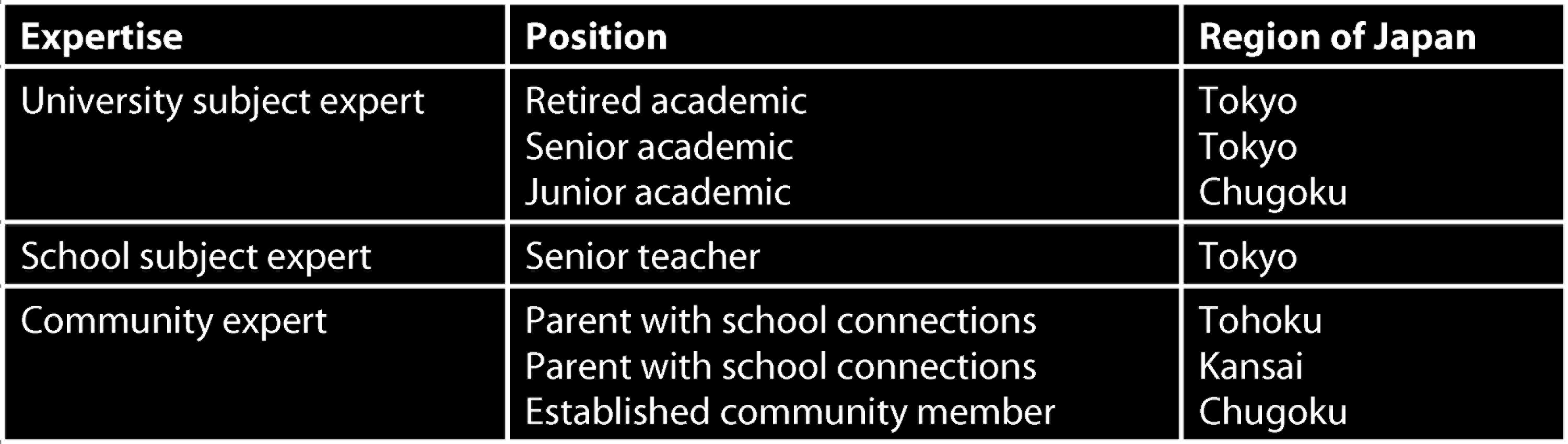
The study took a qualitative and interpretive approach. Sixteen participant teachers, from 11 Japanese high schools (12–18 years), were purposively sampled, identified on the basis that they were ‘experienced’ high school teachers (taught for more than 4 years) teaching a science (e.g., biology, chemistry, geology) or a humanities (e.g., social studies, geography) subject. The inclusion of subject teachers from science and humanities reflects our previous research that found environmental education was included in a broad range of subjects and not bound to one traditional school subject (Glackin et al., 2018). The recruitment of participants supported our exploratory study design and was not intended as a representative sample. The participant list was generated with the support of gatekeepers, that is, subject ‘experts’ and well-connected members tied to either the national education sector or local school communities across four regions of mainland Japan. Table 1 presents anonymized background information of the individuals. In addition, interviewees were invited to suggest teachers who taught a contrasting subject in their school to approach for interview.
Gatekeeper’s Expertise, Position and Geographical Region
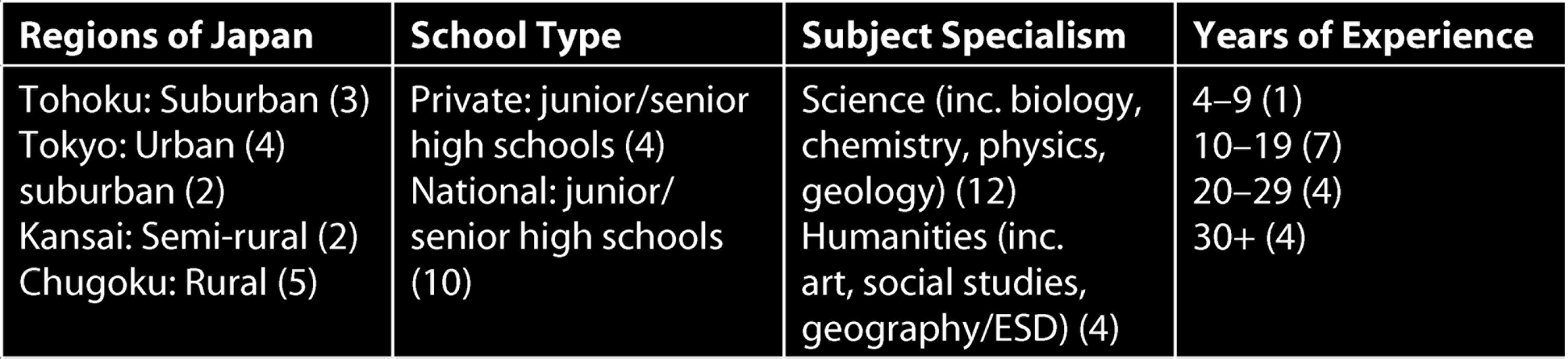
To capture possible contextual variation in the enactment of environmental education, the sample was geographically representative (across mainland Japan) and included teachers from schools located in rural and urban districts. Table 2 presents the range of regional locations, school types and subject specialisms included across the resulting 16 participant high school teachers. Most participants had worked as teachers for an extended period and, therefore, had experience with multiple iterations of the MEXT curriculum.
Participant’s School Region, School Type and Subjects (n = participant frequency)
Data Collection and Analysis
The data was collected over a 3-month period in 2019, as part of a Japanese government funded research programme aiming to promote international academic exchange and understandings of global concerns. Interviews were conducted in each participant’s place of work (e.g., school) or at a location convenient for them to meet (e.g., university). The interviews were semi-structured, with questions informed by the emerging themes pertinent to the environmental education policy context of Japan, including community-based environmental education programmes and Sogo Gakushu no Jikan associated activities. The interviews lasted between 45 and 75 minutes and the majority were conducted through a translator. The interviews were audio-recorded, transcribed into English and anonymized during the transcription.
The data analysis was guided by Stevenson’s (1997, 2007) typology of ideological visions for environmental improvement and Lucas’ (1972) conceptualization of environmental education (see Glackin & King, 2020) for a detailed explanation of this approach). Our thematic and conceptual analysis focused on how teachers viewed and enacted environmental education in their own practice and across their school. The emerging findings were shared with the above-mentioned education ‘experts’ who offered additional insights, amendments and re-framing suggestions. This was a particularly important step in the method as, aware of our outsider status as English researchers in Japan, we were sensitive to cultural differences and nuances that could be easily missed or misunderstood. Hence, the analysis was iterative, moving between the interviews and expert insights juxtaposed with the policy landscape. Below, we present the four key findings that were identified through this process.
Japanese High School Teachers’ Enactment of Environmental Education
Environmental Education Is Viewed as Learning ‘About’ Ecology and the SDGs
Participants frequently aligned environmental education in their teaching with the topics of ecology (n = 8) and teaching about sustainable development (4), more broadly. Other topics referred to less frequently include water pollution (2), air pollution (2) and climate change (3). To indicate the topics that they considered to be included under the environmental education umbrella, in keeping with teachers’ heavy reliance on textbooks for their practice, participants often referred to their subject’s textbook and commonly retrieved a copy to make their case. In doing so, with ecology taking up about a quarter of the biology textbooks, participants who aligned ecology with environmental education considered that the topic received much attention. Where school textbooks in Japan are required to diligently cohere with national policy, the component of teachers’ practice related to (ecology) subject knowledge—both in terms of depth and breadth—is closely aligned with national policy. Ecology topics included biodiversity, habitats, succession, sampling techniques and classification. Several participants mentioned that they incorporated local or national environmental issues that are unspecified in textbooks into their teaching, such as rice growing, moth and firefly life cycles. Allied with this, textbooks included a high number of photos and illustrations of plants and animals with particular attention given to species native to Japan.
For three humanities teachers, and two science teachers, environmental education concerned the teaching of the United Nation’s SDGs. For one science teacher this simply meant highlighting the existence of the 17 SDGs, whereas for the majority this meant teaching content related to the goals. The social studies and geography curriculum and subject textbooks explicitly mentioned the SDGs, whereas the science curriculum and textbooks did not. Hence, whilst some variance between science education policy and enactment was highlighted in the analysis for a small number of science teachers, it became apparent that these teachers’ inclusion of the SDGs was rooted in the anticipated 2020–2021 MEXTs biology teacher guidance document. Both science teachers were members of regional biology teacher associations and commented that they had recently been made aware of the impending curriculum changes. One of these teachers acknowledged that her approach was probably atypical compared to other colleagues, proposing that other science teachers were not teaching about the SDGs. She noted that ‘the inclusion of the SDGs is challenging as they are different from “normal” biology education’. She clarified this comment by explaining that science education was usually more about learning facts. Going on to further comment that including SDGs in lessons were ‘a bit difficult for biology to deal with alone’ (Science senior high teacher).
As noted above, most participants indicated the importance of textbooks for high school teaching in Japan. The apparent prevalence of the textbooks, and the rich illustrations found within them, accorded with the participants’ perception that students should learn ‘about’ the environment. That is, the textbooks presented the knowledge and skills required for understanding the world as rational, apolitical and non-critical. For example, the chemistry of climate change and the physics of the use of electromagnets in the recycling industry were presented as scientific phenomena responsive to technological solutions. Seen in terms of Stevenson’s (1987, 2007) typology, an uncritical technological response to environmental improvement prevailed.
The limitations of the environmental education offer in schools were acknowledged by one science teacher when she shared a concern that perhaps ‘we don’t teach it explicitly’, going on to explain,
But I want students to know about it, so I teach them about recycling, global warming, animals and plastic pollution. Unfortunately, I have a very short amount of time—but at the beginning of every class I will introduce something different/related to the real world to get their attention. Even students who don’t like science like these short inputs. The science seems more relevant. (Science junior high teacher)
That is, for this teacher there was a question mark over whether environmental education was more than just teaching about the environment. To counter this, she included some topical environmental issues into her science lessons—going beyond the textbook. These issues concerning the environment were used in the form that they supported students to consider the science learning from a practical and personal perspective. That is, she elicited in students an emotional connection to their science learning through their local interest in and for the environment, rather than limiting them to an apolitical or national/international perspective only.
Environmental education in the environment rarely occurred during formal curriculum time. On the two occasions where participants described incidents that included outdoor teaching, it was discussed as peripheral, rather than core, to their practice. For example, where a biology teacher described bringing her students outside to ‘do soil invertebrate and river investigations’, whilst referring to the textbook’s detailed diagrams for the two investigations, she went on to add that often she only completed the soil-related study outside, and supplemented the practical with the textbook material. This example illustrates the predominance of learning about the environment rather than in it. It further indicates that the curriculum and associated policy texts are reducing students’ opportunities to engage with or identify authentic local initiatives and issues as part of environmental education. To be clear, these findings relate only to formal subject-specific curriculum time. Participants also listed examples whereby students learnt outside the classroom; however, these examples related to after-school clubs or during Sogo Gakushu no Jikan. We return to this point later.
There Is Enough Environmental Education (of a Particular Kind)
Taken at face value, the majority (9) of teacher participants viewed there was ‘enough’ environmental education included in the high school curriculum, six viewed it as ‘too little’ and one teacher recognized that it was school dependent. A more complex picture emerged when we explored the rationales of teachers who perceived there to be ‘enough’. For example, two teachers rationalized ‘enough’ on a pragmatic basis: they viewed the curriculum as already overloaded with no more time for the inclusion of more (environmental) topics. Two other teachers responding ‘enough’ highlighted that their school ethos had recently changed to focus on a ‘global curriculum’. Their remarks suggested a conflation of environmental education with global education policy. Below, in the final finding, we explore this issue of competing policy agendas.
Another example of a rationale given for ‘enough’, and illustrative of the pervasiveness of the view that environmental education is subject knowledge acquisition, one teacher suggested that students received ‘enough’ environmental education currently and it was up to them to start using it. Related, but placing the emphasis on a deficit of the curriculum, a science teacher commented:
‘Students can acquire a lot of knowledge about environmental education; however, we think that students are not able to go further and apply the knowledge to a problem. They [the students] should take time to think about this’ (Science junior high teacher).
Chiming with the fore mentioned comment of the senior science high school teacher that the SDGs were ‘a bit difficult for biology to deal with alone’, a social science junior high school teacher remarked that environmental education could be viewed as both enough and not enough, but the issue was the current lack of integration. That is, they contended that subject teaching was in silos:
‘Enough, and also not enough. That is, in total it seems a lot but it is not integrated, it is separate. The character of the Japanese curriculum is for each teacher to teach their subject and concentrate on their major’ (Social science junior high teacher).
In a similar vein, but more critically, two teachers said that whilst there was ‘enough’ subject knowledge acquisition related to environmental education in the curriculum, there was insufficient focus on practical action. One of the respondents went on to highlight her lack of confidence in terms of pedagogy to incorporate action-oriented environmental education. Some 30 years ago, Stevenson (1987, 2007) similarly acknowledged this issue for environmental education, arguing that it was a result of the historical roots of education systems that prioritized subject knowledge acquisition over problem solving. Arguably, this situation, based on participant comments, persists in Japanese high schools today.
Relatedly, when participants were asked about curriculum opportunities to enable environmental advocacy, there was much pause for thought. The most commonly occurring response was ‘to research topics/issues’ and to do/make poster presentations (around the SDGs and local/national issues). This highlights that, for these teachers, the enactment of environmental education did not explicitly encompass or nurture a socially critical or action dimension, thereby leaving the topic bound to subject knowledge acquisition.
Turning to those teachers who viewed the current environmental education offer as ‘too little’, many addressed the perceived shortfall by offering opportunities outside the formal curriculum. Therefore, whilst the focus of this study was on environmental education within formal curriculum time it would be remiss not to highlight the extent to which environment-related activities occurred in Japanese high schools, after-school, at the weekend or during holidays. Further, whilst the focus of formal curriculum tended to be about the environment, beyond the curriculum were opportunities for students to develop environmental advocacy and skills of caring for and understanding the environment. Examples included environmental clubs, cultivating bee colonies, monthly visits to collect data at woodlands, overseas visits to experience contrasting habitats and cultures and intra- and inter-school environmental conferences and debates.
While these additional opportunities are commendable, two issues emerged concerning the fluid nature of environmental education enactment. The first relates to the long-term viability of these activities. That is, whilst these teachers said they were supported by their schools in offering environmental education-related activities, there were concerns about whether these extra activities would continue if they were to leave. These teachers were driven by their interest and passion rather than by national policy directives. Second, the number of students involved was typically low, and although this could be for many reasons, one possible explanation could relate to inclusion, and the commonly cited pressure of exams. That is to say, whilst many students might want to participate, the pressure of the university entrance examination might lead to school or parental pressure directing young people towards more academic or sport-related after-school clubs.
In sum, the participating teachers see there is a significant amount of curriculum time given over to environmental education-related material. Ecology takes up the bulk of this learning, dominated by subject knowledge acquisition. Where more expansive notions of environmental education are practised these are generally annexed outside the formal curriculum, driven by teacher passion and commitment rather than policy direction. However, even these practices on the fringes are not free from national policy interference, as student participation is frequently flattened by the dominating urgency of university entry exams. The combined effect is that, in multiple ways, student opportunities to engage with the local environment, identify local issues and advocate for the environment are constrained.
Responsibility for Environmental Education Is Dispersed and Unclear
Participants expressed that environmental education was not the responsibility of one single subject: A finding that is allied to the policy document ‘A guide to promoting ESD’ (2016). That is, teachers unanimously reported that ‘everyone’ had responsibility for environmental education in their schools: ‘No one subject is responsible. We learn about environmental education from different perspectives—these topics included: technology, home economics and physical education. In some schools if they want to study environmental education, they can add more’ (Science junior high teacher).
Alongside technology, home economics and physical education, participants listed the other subjects as responsible for environmental education as: art, science (including biology and chemistry), food safety, social studies, Japanese literature, peace education and English language. This finding again supports Stevenson’s (1987, 2007) assertion, as discussed above, that the separation of environmental topics across subjects is a result of the traditional model of education set up to facilitate knowledge acquisition above critical skill development or emotional growth. Further, given the majority (12) of respondents were science specialists and, as we saw above, that ecology was so closely aligned with environmental education, it is perhaps not surprising that science was frequently cited as having the main responsibility for teaching environmental education. That said, participants who located environmental education-related topics in science were also quick to note that these topics might also be considered from a range of perspectives through other school subjects:
‘No teacher (or subject) has responsibility. But perhaps mainly biology teachers. Air pollution, as a topic is responded by many curriculums: social studies, chemistry, biology, health studies’ (Science senior high teacher).
Notably, three participants indicated that their schools had a teacher with responsibility for environmental education. However, the remit had been enacted in various ways, resulting in the post being either very visible or undistinguishable. That is, in one school, unique in this study, a former social studies/history teacher was now a teacher of ESD. He taught ESD as a subject, supported the coordination of Sogo Gakushu no Jikan and, in turn, built relationships with the community. The post had evolved over the past 15 years and, building on the work of previously dedicated teachers, there was now an allocated laboratory and a specially designed meeting room alongside the formal ESD post. This contrasted with the other two schools whereby the post was more opaque. For example, one participant who identified their school had a teacher in-charge of whole school environmental education, was unsure what the role entailed or the benefit it brought:
There is a teacher, I think, who has responsibility, but they didn’t do anything last year, they don’t have a plan—they just have the title. Some schools have a senior person to do this—and in some students have to take on responsibility. (Science junior high teacher)
A different participant disclosed that they had responsibility for environmental education in the school. In this case, the reaction of the translator who was a member of the school staff was noteworthy: on hearing this news he reacted with surprise and commented that he had not been aware of this. These examples illustrate a lack of clarity concerning responsibility for environmental education, arguably, by virtue of its dispersed nature. Either everyone or no one is answerable or, on the rare occasion where roles are identified, there is a lack of clarity about what those roles are. We argue that the reported lack of clarity is tied to a policy landscape that has become detached from local contexts and enactments.
School Ethos Influences the Enactment of Environmental Education Related Policy
We found that each school’s ethos, values and history greatly contributed to the quality and purpose of the environmental education on offer. The study highlighted that schools were reacting to multiple concurrent government agendas. This situation created tensions, particularly concerning resourcing and curriculum, which impacted the quantity and type of environmental education offered. It was evident that schools’ reactions to policies and priorities related to their established history and the image they aimed to present to parents of prospective students.
Evidence of multiple agendas being enacted was seen in participants’ disclosure of the current use of Sogo Gakushu no Jikan, as discussed above, as a mandatory period originally established to integrate subjects for students to experience the environment/nature. Several of the participants (4) commented that the practice of Sogo Gakushu no Jikan had changed over the past decade with the explicit links to local environments becoming less visible. As stated earlier, the purpose of Sogo Gakushu no Jikan, as introduced in the School Education Act 2001, is to enhance students ‘zest for living or ability to live’, and it has been an important vehicle for environmental education in Japan. Ten participants reported that Sogo Gakushu no Jikan was now focused on career-related activities, whereas four participants reported that current Sogo Gakushu no Jikan activity was centred around environment-related activities. Two participants reported a combined approach to Sogo Gakushu no Jikan that included environment, careers and community foci. This finding illuminates how schools, and their teachers, enact competing policy agendas, arguably, to the detriment of some more than others. Above, for example, we see the enactment of the recent national policy turn towards career education (CEC, 2011) alongside remnants of a prior national focus on community-based education (MEXT, 2005). In such a competitive environment, these participants indicated a marginalization of environmental education relative to the dominant examination/career agenda.
Notably, the policies that individual schools and, more specifically, that teachers chose to enact were in keeping with their school’s ethos and history. That is, for the four participants who reported that their school maintained an environmental-related Sogo Gakushu no Jikan we identified either a rich history of environmental practice and/or a personal passion within the senior leadership team. For example, a science high school teacher reported that her school had originated as an agricultural college over 70 years ago and that history remained important to the school. The school not only maintained a rice paddy field, but the process of rice production was incorporated into the school curriculum (including learning about the history of rice production through to sowing, harvesting, processing and preparing the rice) across year groups and subjects. The school’s historical environmental roots were evident in their current educational principles—they were widely promoted and seen as a strength. Clearly, not all schools have rice paddy fields; however, this school’s Sogo Gakushu no Jikan activities also enabled students to learn about other regions of Japan by researching, visiting and completing a focused socio-cultural study in response to authentic local issues. Here the teachers’ enactment of environmental education was a result of both national policy and institutional history.
In contrast, another participant reported that their school had fully embraced the global education agenda by incorporating it into their ethos and values. Arguably, this school ethos was one of national policy allegiance and was a result of the recent ‘global education’ national policy introduced in Japan. This national policy followed calls from the international community, such as the OECD’s Programme for International Student Assessment (PISA), for a greater emphasis in national curriculum on cultural diversity and SDGs. The participant described that the national policy had led to the establishment of relationships with schools across the globe, international exchanges, delivery of school subjects in English, and an annual whole-school UN-type conference—a celebrated event in the school calendar. However, these actions had been to the detriment of an established community-based environmental education activity. That is, the participant recounted that for more than a decade he, with colleagues, had overseen a two-day river investigation and clean up with the local community. This had resulted in the creation of a longitudinal species data set and an established community service for students in the school. Whilst the school shifted to embrace a global dimension, the teacher informed us that there was a lack of support or resourcing to maintain the community-based work. Given that the school invested heavily in embedding the SDGs into their curriculum (e.g., the goals are displayed throughout the corridors and all lessons have to make links to them), the loss of this local environmental action seemed somewhat ironic. Whilst the study found pockets of established and maintained environmental education, this fourth finding points towards an overall decline of a whole-school prioritization of a local and, we argue, a more authentic environmental agenda.
Discussion
This research sought to explore the state of environmental education in Japanese high schools from the perspective of teachers. In particular, we wanted to understand how the participating teachers responded to and enacted national environmental education-related policies. The findings suggest that a significant amount of formal curriculum time is given over to environmental education characterized by knowledge acquisition, or as Lucas (1972) terms, learning about the environment. In the most part, teachers align environmental education with the subject of ecology, a topic which makes up a noteworthy third of the Japanese biology curriculum. In addition, we found that environmental education is recognized within the social science classroom as teaching issues related to, and including, the SDGs. For the majority of the participants, a lack of clarity existed in relation to the ownership and, therefore, the location of environmental education in their schools.
Broadly, these findings suggest that Japanese high school students experience an environmental diet bereft of opportunity for building their skills and capacities for environmental advocacy. Viewed through the lens of Stevenson’s (1987, 2007) typology of ideological visions for environmental improvement, the curriculum supports a technological approach to environmental reform. Conversely, the curriculum does not imbue the sort of socially critical approach to understanding the environment that might be generated by inviting students to deeply explore environmental issues in light of larger societal problems and in their own local contexts. Indeed, whilst some teachers did find opportunities to bring students outside to consider local issues, often such experiences were squeezed into the margins of their teaching, or as extra-curricular activities available to a narrow group of students. Alongside this general picture, were some significant local variations in the environmental education offer which, on the whole, were linked to the school’s ethos, mission and history and attributes of individual teachers.
These sorts of findings are not unique to Japan, indeed, in a similar study Glackin and King (2018, p. 1) found the environmental education policy offer in England was ‘patchy and restricted’ and lacked an articulated ideological vision. However, distinct to Japan, when compared to England, is the government’s clear endorsement of international directives, such as the UN’s ESD (Lotz-Sisitka, 2016) in their education policies. This endorsement is evident across current policy documents and was also observed in participant teachers’ turn of phrase that often resembled international policy rhetoric (e.g., SDGs, global education). Hence, these findings exploring the lived experiences of Japanese high school educators enactment of environmental education policy chime with broader education policy literatures that point to the complexity, messiness and ‘sometimes inchoate process’ of policy translation (Maguire et al., 2015, p. 498). That is, even when a country incorporates international sustainability policy directives into their national policy agenda, the enactment of those policies does not necessarily result in a different nor, arguably, richer environmental education. Rather, this research suggests that there are similarities in the overall picture of environmental education-related enactment in England and Japan despite the differing national policy discourses related to sustainability. Building on this point of comparison, the findings draw our attention to three important and interrelated issues concerning the gap between policy and practice: underpinning ideology, policy competition and teachers’ voice and local context.
Turning first to underpinning ideology, these research findings reconfirm the need for policymakers to be continually alert to the ideological direction of national environmental education-related policy, asking: what is the goal of the policy and does that accord with current enactments? When considered through the lens of Stevenson’s typology for environmental improvement, we argue that environmental education policy must offer young people opportunities that support democratic citizenship and that engender the necessary knowledge, skills, perspectives and attitudes for environmental decision-making. Arguably, such a policy goal would inspire a more relevant environmental education which, as expressed above by a participant teacher, is a requirement if we want to engage our students in pro-environmental action or learning in, about, and for the environment. Indeed, rather than an issue exclusive to Japan, Witoszek’s (2018) study revealed that teachers and students in Norway, China and Ghana all experienced environmental and sustainability education as lacking, what she termed, ‘the mobilizing story’ (p. 835). This idea for a mobilizing story aligns with Vare and Scott’s (2007) call for the why, and an important aspect for inclusion in policy that we have written about before (Glackin & King, 2020). That is, briefly, if environmental education becomes one dominated by ecological recall, important seeds such as ‘why do we need to know this?’ and ‘what can be done?’ are left unsown. However, it is not as simple as just adding these inquiries or calls to action into a curriculum.
Returning to the importance of the underpinning ideology, we contend that it is the current policy discourse towards ESD that is at fault, and agree with Witoszek’s (2018, p. 835) assertation that ESD leads to an ‘uninspiring’ and ‘vague’ why enquiry and rationale for action. ESD policies are rooted in a sustainability-through-growth paradigm. Our findings have drawn attention to the economic underlying principles behind the international sustainable development agenda and allied education programmes (e.g., Berryman & Savue, 2016), and how they have permeated the Japanese policy landscape. Although the policies, such as the SDGs, might make mention of local context, the fact that the goals are derived and delivered top-down finds schools orienting themselves towards the ‘global’, leading to less emphasis on localized, culturally and environmentally, relevant policies and enactments. Hence, the focus on Kogai education, the environment as a theme during Sogo Gakushu no Jikan, or general environmental reference points and actions (such as Mt Fuji or river clean ups) fade into the background. Whilst international policy directives are arguably well-intentioned, the evidence here suggests that their implementation is on the whole unsupportive of local, practical and action-based environmental education. Rather than the problem being the absence of a mobilizing story within textbooks or teachers’ pedagogy, following Kopnina (2020), we suggest that the ESD-aligned policy direction is partially culpable for the resulting restricted environmental education evident in Japan today.
The second, related, issue concerns the highly competitive international/national policy landscape that civil servants and schools have to negotiate, in which there will always be policy winners and policy losers. It is clear from this case study that schools and the government are reacting simultaneously to a number of international policy agendas, none more pervasive than the competition discourse that is mobilized through prominent transnational assessments (such as PISA). Our case study brings into sharp focus that teachers’ rationales for environmental education are inextricably linked with the pursuit of subject acquisition, in a way that is detrimental to environmental education. It also brings into focus that the emphasis on global education, and with it the undertow of competition, wins out over local enactments or action. These findings are in-step with those from a similar study in England (Glackin et al., 2018). Hence, this research contributes to the growing evidence and broader conversations concerning how best to proceed (e.g., Reid, 2019). That is, in implementing multiple international directives into a national school system it is becoming increasingly clear that local and action focused environmental education is being driven to the edges. This raises the question of how the education sector can appropriately find a way to balance international policy with local priorities. It also reopens the discussion of the role of individual teachers, an issue returned to below.
Further, the findings correlate with similar issues raised by Braun and colleagues (2011) related to policy enactment in schools. They identified the complexity that schools face as they deal with streams of policies over extended periods of time, informed by an array of political agendas and individuals’ views. Regardless of their specific foci, our findings suggest that education policies inadvertently influence the enactment of environmental-related policies in schools, with priority shifting towards, for example, the newest, most discussed or most familiar directive. For Japan, as with many other countries (Sjøberg, 2016), what is particularly evident is that, currently, national policy is strongly influenced by international agendas. This finds ESD dominating environmental education and, perhaps more significant is the influence of comparative data produced from international tests over all else. For example, the participants in the study highlight recent inclusions in their school of ‘global education’ and careers education. That is, with the introduction of the government’s careers agenda, several schools perhaps inadvertently deprioritize the original aim for Sogo Gakushu no Jikan, to ensure integrated local environmental activities, using the mandated time instead to incorporate careers education. We suggest that national policies, arguably introduced as a knee-jerk reaction to league table positions, are resulting in mission shift and contextually inappropriate policy inheritance.
To this end, and in line with the need for a new mobilizing narrative discussed above, national policies need to promote and support all education institutions to actively engender environmental literacy. A key outcome of this will be that schools’ ethos will genuinely embody a greener mission (see Glackin & King, 2020). However importantly, in light of Payne’s (2016, p. 71) concern that broadly environmental education policy discussions are co-opted by ‘narrow Eurocentric/Western notions of modern development’ localizing policy processes could also permit a culturally responsive curriculum. Here, Kopnina’s (2020, p. 5) discussion about ‘positive alternatives to hegemonic education’ are helpful, in particular related to the need for indigenous learning which, taken broadly, encompasses: localness, ancestral knowledge, spirituality, collective dispositions and their transference. This alternative form of learning, alongside others, would ensure that the cultural iconography and cultural-connectedness with the natural environment inherent to the Japanese way of life were given equal legitimacy in the policy landscape. In practice, this could lead to more examples such as the participant’s school described above that had created a whole-school programme centred around their local rice fields.
The third and final issue we highlight related to the gap between policy and practice concerns the need for teachers to be included in policymaking conversations. What is observed in this case study, like so many countries, is that whilst there are many well-intentioned policy directives, these have emerged from government offices, shaped by civil servants with input from special advisors in the knowledge of international directives. In practice, these policies are enacted in numerous ways. However, if policy enactment is to be more successful, as Maguire et al. (2015) have unequivocally articulated, policies need to be crafted with context enactment in mind. To this end, an inclusive educational policy culture needs to be designed. There are two aspects of this culture that we discuss here. The first concerns a more robust system to support national policy creation and scrutiny. Such a system would support policy creation and communication that is both top-down and bottom-up, driven by the inclusion of expertise at national government level (e.g., national government officials) and school level (e.g., classroom teachers). Implementing such a system would include and support school leaders and classroom teachers to become confident and capable to interrogate and critique international/national/local environmental education policy, shaping, rejecting and adding to them accordingly.
Relatedly, the second aspect of this culture concerns the need for policy creation and evaluation processes to incorporate and privilege the types of knowledge that is wedded to local enactment. Given that there are multiple factors at play within schools and classrooms that determine policy outcomes, the inclusion of teachers, and their knowledge, in the construction and evaluation of progressive environmental education policy is a crucial factor if policy objectives are to be met. Placing teachers at the forefront of progressive policy change will enable them to articulate what their young people require from an education relevant to their lives today and, more broadly, within the social and environmental context in which they live. To this end, policies need to acknowledge and, more importantly, support the development of teachers’ beliefs, their self-efficacy alongside their subject knowledge and pedagogy relevant to environmental education.
Conclusion
This study has argued that environmental education in Japanese high schools falls significantly short in offering the ‘far-reaching’ societal changes required to avoid a ‘climate catastrophe’ (IPCC, 2018, para. 1). Whilst, alongside other academics, we acknowledge the Japanese government’s proactive and responsive action related to international environmental commitments, we have questioned the way that the current international ESD policy direction privileges economic and global needs whilst losing sight of a socially critical perspective and the local knowledge and place-based concerns. Whilst Japan is considered here as a case study only, and the analyses are based on a small policy text and participant sample, we suggest the broader implication to be drawn is that all government policymakers must sit up and urgently review their national environmental education offer. In doing so, this research has drawn three important foci that require policymakers’ particular attention: the ideology underpinning environmental education-related policy and its localized effects; the harmony and discord of competing national policy agendas and their enactments; and, the centrality of teacher voice in policy formulation. Whilst such evaluations of national environmental education policy landscapes are likely to initially unearth more questions than they resolve, if carried out iteratively and in context, such processes will foster necessary spaces for the creation and (re)design of environmental education that is more fit for its purpose.
Footnotes
Acknowledgements
We thank Professor Itou Minoru from Tokyo University of Science for both hosting the fellowship and being so supportive of the study.
Declaration of Conflicting Interests
The authors declared no potential conflicts of interest with respect to the research, authorship and/or publication of this article.
Funding
This research was supported by a JPSP Short-Term Fellowship (PE18767).