




Abstract
Education for sustainable development (ESD) aims to empower future generations to address current global environmental threats, though it faces challenges to implementation, often linked to narrow perceptions of sustainability. To observe such changes in practice and draw their implications for ESD, we explore the effects of COVID-19 in perspectives and practices of sustainability across an education community. We reflect on how disruptions or threats can trigger a (re)imagination of individual and collective action. Our findings suggest that the COVID-19 pandemic and its effects on individuals and societies have altered perceptions and practices of sustainability through envisaging previously unimaginable global environmental restoration, and experiencing personal, professional and collective changes. Our study shows that the perceived restorative effects on the environment of the pandemic lifted the education community spirits and enhanced a willingness to change by leveraging the social network around the education community to promote collective action.
Introduction
The world changed and adapted dramatically and quickly in response to the COVID-19 disease outbreak that subsequently turned into a global pandemic. In Australia, like many other nations worldwide, some people were forced to remain in lockdown at home; those who could work from home, did; many jobs were lost across sectors; education at all levels was swiftly transferred to an indoor and online delivery with minimal to no face-to-face contact; and politicians warned of a looming economic recession, expected to rival that experienced during and after the Second World War (Lederer, 2020). Meanwhile, news stories and research from around the world purported the restorative benefits of reduced or halted human activity to outdoor environments and even to personal health and well-being (Le Quéré et al., 2020). Our everyday lives were significantly changed, and new patterns of ‘normal’ were established.
Research suggests that after experiencing a form of disruption or a significant life event, perspectival shifts, including refiguring of self-identity as well as new ways of constructing reality, may occur (Bankston et al., 1981). Psychological theories of cognitive adaptation suggest that during and after a significant event, a person may search for meaning in the lived experience, attempt to regain mastery over the new circumstances of their life and find ways of restoring self-esteem through self-enhancing evaluations (Taylor, 1983). In the context of sustainable development, while a person may have new-found interest in or willingness to change, research finds that it requires more than a positive environmental mindset to change behaviour (Kollmuss & Agyeman, 2002; Shove et al., 2012). Social psychology provides some explanation to the cognitive dissonance regularly observed among people regarding sustainability, highlighting that in the efforts to maintain behavioural change, developing a social identity is important (Hogg & Smith, 2007). Developing a social identity as a ‘dynamic system of meaning, which can shape ongoing commitment to a cause’ underpins the success of collective action (Thomas et al., 2009, p. 194).
While lifting the collective change spirit to lever communities to engage in collective action is strongly advocated for in education for sustainable development (ESD) and education for sustainability (EfS), 1 examples of this are scarce (Littledyke et al., 2013). Notable exceptions are linked to threats or crisis and include, for instance, the reactor accident at Chernobyl in the Soviet Ukraine on 25–26 April 1986, which changed the way much of the world viewed nuclear energy (Renn, 1990). Similarly, the 2011 earthquake and subsequent tsunami that caused the meltdown of three of Japan’s Fukushima nuclear reactors saw countries around the world review their energy plans (Kim et al., 2013). In essence, significant events can lead to shifts in perceptions and views for many, generate reflection and create conditions for innovative and new social practices to arise.
In this globalized and hyperconnected world, perceptions and interpretations of certain phenomena are regularly mediated by their portrayal by traditional media and increasingly social media. The messages and stories heard, as well as the narratives underpinning them, tend to vary greatly from one media outlet to another and mirror the sociopolitical profiles of viewers (Beasy & Corbett, 2021; Hepp et al., 2015; Sensis, 2016). Lockdowns instituted around the world to combat the devastating effects of COVID-19 led to increased exposure to sobering broadcast media messaging, focused mainly around disseminating information outlining public administration’s response to the pandemic, as well as official health and safety advice. Constant advertorial and editorial content urged ‘good citizens’ to follow rules designed to effect a rapid response for the imminent threat and consequences of the pandemic. Societies were indoctrinated daily on how to behave in a new COVID-19 world by mainstream media. Despite a reported increase of trust in reliable and valid scientific information as a source for knowledge during the COVID-19 pandemic (van Dijck & Alinead, 2020), which often highlighted a clear link between the disease outbreak and a global lack of biodiversity and the effects of climate change, a range of conspiracy theories, fake news and a global infodemic also emerged (Cinelli et al., 2020). Social media, however, also acted as an alternative space for hope, where images of ecosystem restoration due to a halt in human activity went viral, triggering emotional responses towards an ideal of an alternative, more sustainable world. Research in the field of communications has observed the transformative effect of such positive environmental stories and the need to look beyond the crisis and devise strategies to effect sustained transformation (Bodenheimer & Leidenberger, 2020).
In order to explore how a change in perceptions and practices can support a paradigm shift in ESD, we reflect on how personal experiences of COVID-19 may (or may not) have influenced a perceptual and behavioural shift in an EfS community in Australia. For the purposes of this study, we defined EfS/ESD communities as an open concept, including formal and informal (institutionalized vs. social) actors (ARIES, 2009). We selected an Australian not-for-profit organization, the Sustainable Schools Network (SSN) Limited, as a case study. In particular, we surveyed participants attending an online sustainability symposium organized by SSN in April 2020, which brought an EfS community together to scope and build the future of EfS in Australia. Utilizing the symposium as a platform for critical thinking around what sustainability looks and should look like in formal and informal community education settings, we combined a survey of symposium participants with in-depth interviews with presenters and organizers in the 3 weeks post-event to understand how the COVID-19 crisis affected their perceptions about sustainability and practice.
Literature Review
The following literature review focuses on understanding existing perceptions and practices of sustainability in education systems and has three main objectives: (a) to consider how sustainability is embedded in education policy and curriculum, particularly in Australia, our case under study; (b) to explore how sustainability is interpreted in education community contexts; and (c) to review the factors known to influence the implementation of sustainability in education to date.
Sustainability in Education Policy and Curriculum
The visible environmental effects of the current climate crisis have led to increased social pressure, calling for political and educational leaders to bring sustainability to the policy agenda (Holden et al., 2014). Sustainable development is the ethos of the United Nations (UN) Agenda 2030 and the Sustainable Development Goals (SDGs) framework, a reflection of a global recognition of the unsustainability of development by states around the world (United Nations, 2015). For the purpose of this article, we use the term sustainability and sustainable development interchangeably, favouring the former throughout the debate, though we acknowledge the existing fruitful debate regarding definitions that surround these terms (Mochizuki & Fadeeva, 2010; Redclift, 2005).
Currently, the global dominant paradigm (Lafferty & Eckerberg, 2013), sustainable development, is grounded on the notion of sustained (economic) growth, which considers nature as a form of capital (Adelman, 2017) and expresses an urge to develop policy that ensures resource conservation for human development. Thus, the very definition of sustainable development advanced by the pioneering Brundtland report Our Common Future reflects an anthropogenic view of sustainable development as ‘development that meets the needs of the present without compromising the ability of future generations to meet their own needs’ (UNWCED, 1987). Although a critical analysis of concept is beyond the scope of this article, it is important to highlight the effects of the inherent focus on economic growth embedded in policymaking for sustainable development (Holden et al., 2014) in the education system. At the same time, while pronouncements (e.g., from the UN and the Intergovernmental Panel on Climate Change) continue about the urgency of addressing global sustainability, there has been a slow/uneven response internationally. Some countries (particularly Scandinavian countries, see International Institute for Sustainable Development, 2017) have implemented ambitious goals; others demonstrate how quickly responses can change, such as the USA, which moved from a total denial of climate change during Trump’s administration towards a climate agenda under President Biden.
Despite the imperatives of climate change action and a recognition of the importance of bringing sustainability to the forefront of development, governments around the world have been slow at implementing sustainability strategies across the board. This might be in part since sustainability action requires a change in the economic paradigm, arguably a move from a consumption driven economic growth agenda to ideas of reduced consumption or degrowth (Kallis, 2011; Kallis et al., 2018) or even regeneration or restoration (Morseletto, 2020). However, under the threat of the COVID-19 pandemic, nations were quick to respond with unprecedented economic stimulus packages to safeguard the current neoliberal approach to development based on continuous economic growth at the expense of the environment and disadvantaged sectors in our societies.
The effects of the pandemic have, indeed, exacerbated the inequalities that lie within the education system, in terms of access (i.e., online learning), quality (i.e., Internet connection) and relevance of learning (Sonnemann & Goss, 2020). In Australia, the whole of the formal education system, from its primary to tertiary education levels, has been greatly affected by the COVID-19 pandemic. Take, for example, universities. The COVID-19 pandemic has highlighted the vulnerabilities of a highly casualized academic workforce in an economic crisis scenario. The apparent dysfunctional neoliberal business model underlying the tertiary education model in Australia, based on attracting foreign students for increased revenues and, recently, favouring public funding for degrees ‘fit for jobs’ faces enormous challenges to respond to the biggest challenge facing humanity (climate change) (Marshman & Larkins, 2020). A reduction in the workforce and reduced numbers of students in social sciences and humanities degrees hinder our capacity to equip young people with the necessary critical thinking skills to lead the change needed to achieve a balance the world is in desperate need of (Rickards & Pietsh, 2020).
Interpretation of Sustainability by Education Communities
At the global level, the world’s leading voice on education, science and culture, the United Nations Educational, Scientific and Cultural Organization (UNESCO) and even the World Economic Forum, among others, advocate the importance of ‘climate education’ (Ramirez, 2020) and ESD (Diop & Jain, 2020). In November 2019, during its 40th conference, UNESCO, adopted a ‘new’ global framework on Education for Sustainable Development 2030 (UNESCO, 2020). The proposed framework aims ‘to build a more just and sustainable world through strengthening ESD and contributing to the achievement of the 17 SDGs. The framework focuses on integrating ESD and the 17 SDGs into policies, learning environments, capacity building of educators, empowerment and mobilization of youth, and local level action’ (UNESCO, 2020).
In the Australian context, references in policy and/or curriculum to sustainability education exist across all education sectors. Overarching policy support exists in the most recent national declaration on education goals, the Alice Springs (Mparntwe) Education Declaration (Education Council, 2019, p. 2), which states, ‘we must…prepare young people to thrive in a time of rapid social and technological change, and complex environmental, social and economic challenges’. In the early childhood sector, the Early Years Learning Framework (EYLF) (Commonwealth of Australia, 2009) for children from birth to 5 years makes strong reference to embedding sustainability in learning. In the primary and secondary sector, the ‘sustainability cross-curriculum priority’ is included in the Australian curriculum (Australian Curriculum, Assessment and Reporting Authority [ACARA], 2016), which reflects advocacy for sustainability to be embedded in all learning areas of school education for students from Foundation to Year 10. In the higher education sector, the Talloires Declaration brings together universities committed to environmental sustainability via a 10-point action plan, including embedding sustainability in teaching, research, operations and outreach (University Leaders for a Sustainable Future, 2020). While sustainability in policy/curriculum exists across education sectors in Australia, educators constantly grapple with integrating sustainability into educational contexts (see Bosevska & Kriewaldt, 2020; Dyment et al., 2015; Higgs & McMillan, 2006; Salter et al., 2013).
Factors Influencing Implementation
A key factor influencing implementation of ESD is that across education sectors, it remains on the periphery as a non-mandated and non-assessed component of education. Additionally, literature highlights that understanding the purpose of ESD influences implementation; Kuzich et al. (2015) find that teachers unclear about the intent or purpose of EfS prioritize mandated and assessment curriculum items over EfS initiatives, even in a custom-designed sustainability school located in the region of Western Australia. These findings match observations among teachers in a range of schooling contexts also in the Australian region of New South Wales (Kennelly, 2011). Other studies reinforce the idea that because the cross-curriculum priority of sustainability is not what teachers and students are directly assessed against or ‘judged on’, it remains an optional extra (Almeida et al., 2018; Kennelly et al., 2011). Similarly, the support of school leadership in recognizing the importance of ESD is known to significantly improve embeddedness of ESD in school educational practices and programmes and can motivate teachers to incorporate ESD in classrooms (Bosevska & Kriewaldt, 2020; Evans et al., 2012; Kensler & Uline, 2019). More recently, Bosevska and Kriewaldt’s (2020) study of a K-12 school in Melbourne, Australia, revealed the potential of whole school approaches that work with the broader school community to support ESD implementation (Bosevska & Kriewaldt, 2020). Positioning sustainability as a priority for leaders and educators across education sectors in Australia requires holistic approaches and collaboration.
While ESD is peripheral in the existing policy framework, inclusion and delivery of sustainability is influenced by educators’ beliefs as well as knowledge of the topic. Currently, ESD delivery is underpinned by educators’ environmental beliefs and values (Almeida, 2013), in contrast to topics like literacy and numeracy that are firmly embedded in assessment and reporting requirements (Hardy, 2015). In the current policy landscape, this relationship implies that ESD is most likely to occur when educators’ values are aligned with sustainability. While a corpus of literature exists that explores the relationship between values and environmentalism, understanding how values change is a less developed area (Dietz et al., 2005).
Without adequate policy, ESD implementation depends on educators’ personal beliefs, though beliefs alone are not enough. Pedagogical and curriculum knowledge is needed to support ESD practice (Dyment et al., 2015; Higgs & McMillan, 2006; Martin & Carter, 2015). For instance, teaching for alternative futures, away from capitalist-based and fossil fuel–dependent societal models, is a fundamental principle of EfS (ACARA, 2016; Hicks, 1996), yet pedagogies that support envisioning futures remain under-utilized in education communities (Corcoran et al., 2017).
Sustainable Schools Network Sustainability Symposium: Contextualizing the Case
The SSN is an Australian not-for-profit organization that focuses on leveraging the education community around schools towards sustainable practices and behaviours. The SSN posits that ESD is most likely to occur when whole school communities participate and work together, including teaching and operational staff, students, families and community. The aim of the SSN (
The 2020 Sustainability Symposium offered learning opportunities to the whole school community to both inspire change and collective action leaving a legacy of relationships and resources to continue work towards creating a sustainable future. The theme of the 2020 SSN Sustainability Symposium was to ignite souls and inspire change by:
developing a common language regarding sustainability; empowering the youth leaders required for a sustainable future; aligning with SDGs to provide content focus (the event focused on SDG11 and SDG16); and building partnerships for the goals (SDG17).
Methodology
The second SSN (2020) Sustainability Symposium was held online via Zoom and brought together an ESD community, consisting of educators, parents, community and sustainability education service providers interested in ESD, to foster the development of partnerships and innovation for ESD. Although originally scheduled as a face-to-face event, a total of 60 schools and 80 organizations participated in various capacities in a series of online seminars due to COVID-19 restrictions. A total of 345 adult registrations were recorded. The broader project from which the data presented here are sourced investigated attendees’ ESD perceptions and practice. We, therefore, explore the following question:
Did perceptions and/or practices of sustainability at both individual and collective levels change due to the COVID-19 pandemic? If so, how?
A mixed-methods research design combined an online survey aimed at attendees and a series of semi-structured interviews, where symposium organizers and presenters (Creswell, 2015) were invited to reflect on their practices and perceptions of sustainability. The choice of mixed-methods research is useful for studies that are exploratory in nature and that address complex phenomena (Morse & Neihaus, 2009). The online survey was addressed to the education community attending the symposium, including teachers, school administrators, parents, sustainability education service providers, facilitators and government officials. The survey contained a mix of quantitative and open-ended questions and was administered and managed by the research team through the online platform SurveyMonkey. The survey responses informed the development of additional guiding questions for the subsequent interviews, providing a more flexible approach to exploring ESD perceptions and practices (Chevalier & Buckles, 2013).
Upon conclusion of the event, symposium organizers (i.e., SSN board members and volunteers), keynotes and presenters in the workshop sessions were invited to participate in short, semi-structured interviews. Throughout the symposium, the SSN actively promoted future participation on the survey and interviews, sharing information about the research and contact details of the research team for support. The online survey link was emailed out to all survey participants shortly upon conclusion of the online Symposium. A total of 39 participants completed the online survey during the 3 weeks post-symposium. Similarly, all organizers and participants were invited via email to participate in the interviews. Nine participants took part in the interviews conducted in the third week post-symposium.
Thematic analysis (Braun & Clarke, 2006) was adopted to analyse data using NVIVO, a qualitative data analysis (QDA) computer software package. Author 1 analysed the data, applying a mix of deductive and inductive coding, surface reading survey question responses and transcripts identifying the main themes in the data set. Initial coding was reviewed by Beasy to ensure validity. Subsequently, thematic codes were developed, and relevant data were coded. Initially, identified themes included the effects of human activity on the environment, individual practices of sustainability and changes in perceptions around sustainability. Further analysis revealed additional themes related to opportunities for sustainability education. To further enhance validity and inter-coder reliability of the system, Ripoll Gonzalez conducted additional analyses and provided critical feedback on the initial interpretation of the data. Anonymity of participants is maintained in the article through the assignment of a numbered code for references to individual survey (i.e., S1) and interview (i.e., I1) responses.
Data Analysis
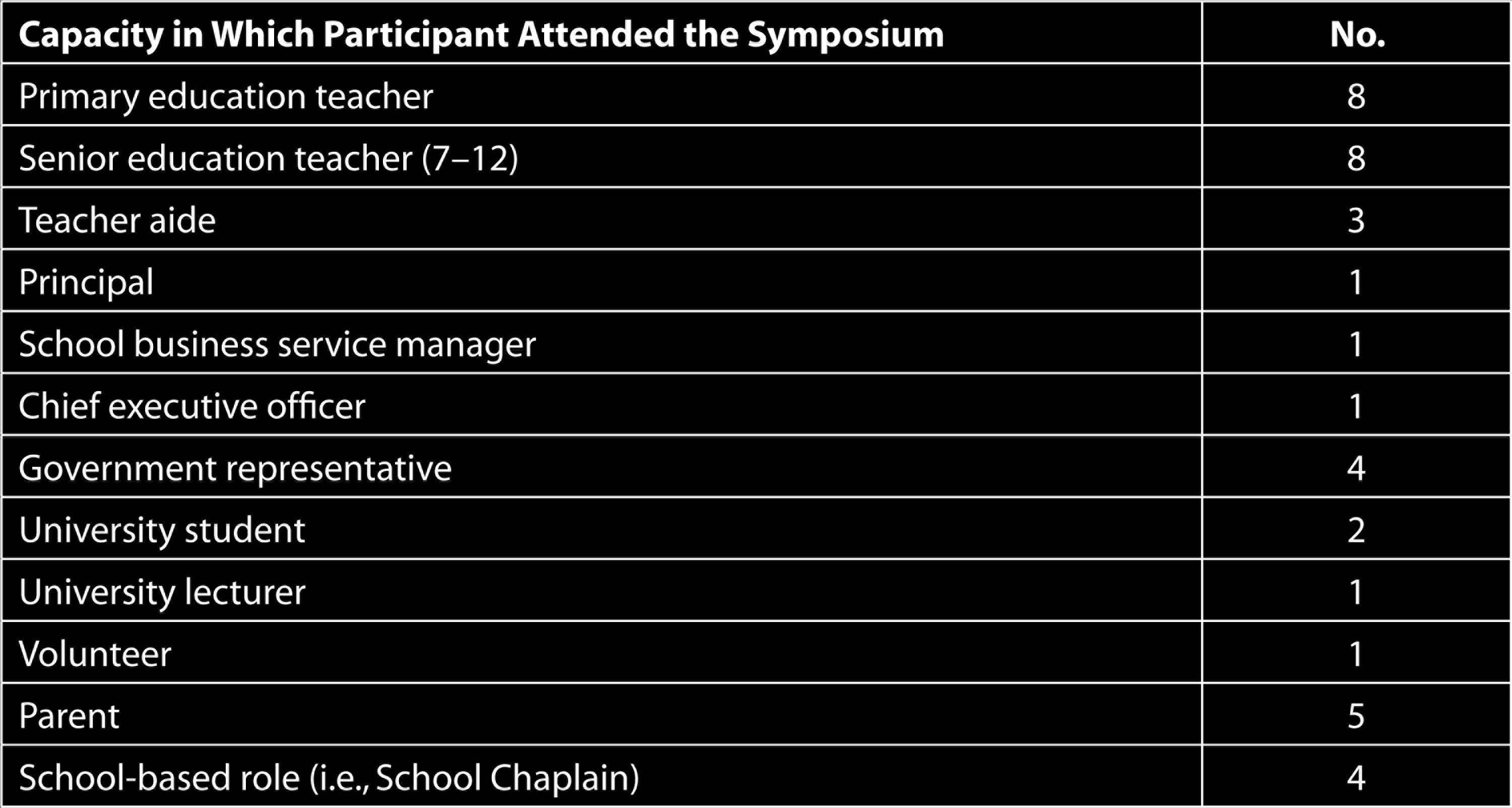
Most survey participants were females (82%), aged between 30 years and 59 years (85%) and resided in Queensland, Australia, where the symposium was ‘scheduled’ to take place and where the SSN headquarters are. The capacity in which survey participants attended the event is presented in Table 1. The sample had long been engaged in the education community, since the average number of years that participants had been engaged in working with children was 15 years. Interview participants included members of the SSN board, small business owners/environmental consultants and environmental/ESD education service providers.
Capacity that Best Represented Participants’ Attendance in the Symposium
General Perceptions
A total of 72% of survey respondents agreed that their perceptions or practices of sustainability had changed due to the COVID-19 pandemic, and most interviewees suggested that their perceptions or practices had changed in some way. Furthermore, 26 survey participants provided extended written qualitative feedback. An analysis of the qualitative responses revealed that eight participants discussed the ways in which the pandemic had demonstrated that significant change to human behaviour is possible, with seven identifying the opportunity to change personal practices in response and five expressing hope and increased appreciation for the environment ‘being repaired’ in response to less human activity witnessed through mainstream and social media. Other themes emerging from the open-ended questions in the survey included perceptual changes (i.e., inequity between countries in their ability to respond to crises); the significance of social, community and collaborative approaches to sustainability; and how COVID-19 had enabled time for reflection, as it ‘slowed down’ (S1) the pace and provided opportunities ‘to pause, think and make choices that have a positive impact’ (S12). These themes were similarly found among interviewees’ responses. Interestingly, the interviews revealed an additional key theme related to the need for innovation in ESD for more sustainable practices, which was linked to the perceived lack of training by educators in ESD. This may reflect the level of knowledge around ESD and background of interviewees from the broader school community network, including, for instance, business stakeholders. In what follows, we present the main findings emerging from both the survey and interviews from a ‘change’ perspective (individual, group, systemic or collective change) in more detail, and we discuss its implications for supporting future EfS implementation.
‘People’ Can Change
Qualitative comments from both interviews and surveys reflected a willingness to change and a new sense of hope in raising the profile of sustainability in education contexts, informed by their perceived positive impacts of restricted human mobility due to the spread of COVID-19 on the environment. Participants noted that observing the collective uptake of social isolation demonstrated people’s capacity to change and provided examples of the impact that this can have for sustainability, which they became exposed to through their engagement with traditional media and, particularly, social media: blue skies in highly polluted areas (S30; I1; I3; I4) and seeing fauna returning to human-dominated environments (S30). Participants also reflected on how their time in isolation forced a change in lifestyle, time for reflection and a slower pace of living that motivated them to continue shifting their practices towards more sustainable approaches and educating for sustainability, hoping the observable collective action had the same effect on others, as noted by one survey participant:
If anything, I have become more focused on and eager to make change than ever before. I feel the conversation about ‘WHY’ is easier as people are seeing worldwide change and improvement but seeing that it needs everyone doing their bit to make this change happen. (S20)
Even though symposium attendees are generally already interested and involved in ESD, the aforementioned quote shows a reinforced motivation to promote change, resulting from an observation of concrete examples of how individual efforts visibly contribute to large-scale positive environmental change. COVID-19, thus, enabled participants to participate in change and to reflect on how abstract concepts like global environmental damage and inequality could be influenced by individual and collective action. New threats or crises, like the one brought about by COVID-19, can motivate individuals to be part of collective action initiatives, and help sustainability and environmental educators overcome challenges in designing teaching models for alternative futures, away from capitalist-based and fossil fuel–dependent societal models (Hicks, 1996).
The positive and perceivable environmental outcomes portrayed in traditional and social media globally encouraged a sense of hope and optimism among participants in the role of EfS. The images and stories on nature restoration flowing from around the world in the public sphere supported a general feeling that positive environmental change on a collective scale is, indeed, possible and, consequently, resulted in an increased willingness to support a change in practice towards a sustainability education paradigm. Some examples include ‘I’m hopeful now that the world is improving environmentally that the world will make changes for the future’ (S34) and ‘Seeing how everybody staying at home has benefited the environment has taught me that saving our earth from negative human influence is possible as long as we all work together’ (S7).
This change in belief reflects theories of collective action and highlights how changes in the environment (crises or threats) provide people with the opportunity to work collaboratively towards a broader collective goal (Blanton, 2016). Participants premised hope for continued change, drawing out similar observations about the environment and how it had changed, or how they themselves have changed, and reflected a sense of aspiration for such change to continue (Kelly, 1993). In this instance, media contributed to participants’ interpretations of how COVID-19 was impacting on the environment (Hepp et al., 2015; Sensis, 2016).
‘I’ Can Change
Dominant discourses of sustainability often focus on changes in individual consumer behaviour and daily practices, like engaging in waste management and using modes of active transportation (Beasy, 2019). A reduction of travel due to lockdowns, which enabled working and learning from home, was noted by participants as having a positive effect for sustainability. In addition, a perceived level of agency afforded through COVID-19 to live a life they felt was more aligned with sustainability aspirations was notably emphasized in participants’ responses. For instance, an interviewee (I1) provided an account of newly found patterns of sustainable production and consumption and practices established to reduce their carbon footprint while in isolation ‘…of course, we’re driving less. We’re not flying in airplanes. That’s huge. I’m shopping more at the farmers market than I did before…. So that’s good. So actually, it’s really improved my sustainability’. Similarly, survey participants reiterated these sentiments and highlighted how a slower pace has allowed them to ‘invest time’ in sustainable practices. For instance: ‘I have been able to practice local food production because I have time as I do not travel to my job’ (S35) and ‘I am driving less, won’t be travelling overseas, have consumed less’ (S10). These comments and perceptions reflect broader debates on the level of agency of individuals in creating change towards sustainability. Often, practices like travelling to work and consumption options constrain individuals’ ability to engage in sustainable practices (Beasy & Corbett, 2021). Notably, in this study, participants reported a perception that they had to implement sustainability initiatives in their personal lives prior to COVID-19 social responses. This might be in part since participation in the symposium warrants interest in ESD. In this sense, despite the existence of interest and willingness to engage, positive behaviour change for sustainability and social practice theory research has long contended that it requires more than a positive environmental mindset to change behaviour (Kollmuss & Agyeman, 2002; Shove et al., 2012). Participant reflections, therefore, suggest that when conditions like disruption to accepted norms related to ‘going to work’ arise, change perhaps becomes possible.
In addition, participants suggested that COVID-19 had encouraged a reflection on personal priorities and how these were lived daily. For example, ‘It has motivated me to follow a more sustainable way of life. To listen more to nature (literally and figuratively), we tend to forget that we can. To be able to pause, think and make choices that have a positive impact’ (S17). The time and space away from daily routines because of responses to COVID-19 encouraged some participants to reimagine what their lives could look like. Finally, participants’ accounts highlighted a willingness to transform their practices beyond changing consumer behaviour towards collective action towards regeneration: ‘I am even more inspired to get us (the world) on a better path. This fork in the road presents immense opportunity for us to reevaluate our practices and do things better’ (S1).
The ‘Environment’ Can Change
Participants’ ideas regarding capacity to change were underpinned by a belief that positive environmental change had occurred from reduced human activity. The idea that ‘[COVID-19] has reset the Earth’ (S15) was shared among participants. As aforementioned, specific examples seen through the media were mentioned: ‘The canals in Venice have cleared’ (I6). Others commented more broadly on the positive impact of human inaction: ‘I see this time as an opportunity to rejuvenate the environment. The people have been sent to their rooms, the world is on pause and the environment has been given an opportunity to repair. It is a really important message that we have been given an opportunity to repair damage, we need to make the most of it’ (S6). Participants connected how these examples/media stories can be useful to influence EfS agendas as shared practical and palpable examples and demonstrations of how changing the environment positively is possible through collective action.
The positive environmental impact may have been significant for participants because so much behaviour change advocated for in ESD is underpinned by a need for collective action to create large-scale environmental change, though few examples of such impact exist (Littledyke et al., 2013). While participants were enthused by the positive environmental changes that occurred, their perceptions seemed still bound to an anthropocentric binary logic of humans as separate from nature (Kayumova et al., 2019). This binary infers humans are disconnected, dominant and in control of the non-human world. In line with these assumptions, ‘…if we do stop these things, and we make plans to stop these, that the environment is actually gonna adapt and change really positively’ (I7), ‘we have been given an opportunity to repair damage’ (S5) and ‘seeing how everybody staying at home has benefited the environment’ (S7) while unexpected, reinscribes humans in positions of power to determine non-human activities. The responses suggest that ESD perhaps needs to go beyond technical–scientific understandings of sustainability towards more whole-of-system and holistic approaches, like that embedded in the SDGs framework, that are human rights–based, but challenge human agency in the Anthropocene.
‘Work’ Can Change
In the interviews with sustainability education service providers, COVID-19 was recognized to have changed work practices in unexpected and positive ways. Participants noted that through COVID-19, their work environment, including their interactions with others, their reach and the projects they were working on had changed. One participant suggested that ‘people have worked out how productive they can be in their own home without going to work. And employers have been forced to trust that their employees are doing their jobs from home, which…everybody knew that was possible’ (I2). Another participant commented on how the company’s interactions with clients had changed because of COVID-19:
People who pay obviously expected you to show up face to face, [but are now] much more open to video conferencing and hopefully, you know, who knows, but maybe that will continue…But a lot of my work … […] is all through Australia…up until COVID, people would fly me out to remote parts of Queensland or…anywhere, to work with communities and doing that work virtually has just been totally fine. It’s zero impact on the outcome. (I6)
These comments allude to a pre-COVID-19-shared resistance to relying on technological advances like digital modes of working and connecting that have been overcome during the COVID-19 restrictions. Participants noted that adaptations required to respond to COVID-19 challenges not only resulted in positive environmental outcomes but also realization of the flexibility in their work practices. Such process of adaptation is similarly linked to a process of change, embracing new scenarios and practices for work and life, and scoping the trade-offs in the transition towards more sustainable practices. In fact, participants noted that the increased reliance on digital technologies encouraged the development of innovative methods of service provision and increased business exposure. A participant (I7) in the business of learning expeditions for schools and teachers suggested that COVID-19 had provided time to develop additional materials, including online lesson plans, presentations and worksheets, that add value to students’ experiences. Another participant noted that:
COVID-19 changed the way we do business. In two weeks’ time, we’re taking the […], which is usually people coming in, right across Australia, in a virtual showroom. So we’re actually filming the whole center, and then going back and educating schools and offering it for free right across the educational network. So we’re seeing this COVID-19 give us a great opportunity to actually share what we have [in the state]. (I3)
This participant went on to comment on the ways their business practice have changed in response to the success of connecting and communicating virtually. After presenting at the symposium, they were inundated via LinkedIn and other platforms with enquiries. This might signal the lasting impact that COVID-19 may have on a continuous innovation trend in the design of the products and services that sustainability education service providers offer schools. However, we acknowledge that this does raise broader questions about equitable access for schools and communities, where digital technology is not readily available (Burgess & Sievertsen, 2020; Nash & Eynon, 2020).
In line with the recognition that time enables personal projects, participants also spoke about the professional ‘wish list’ they were actioning due to COVID-19. For example, one participant noted, ‘projects like going paperless and looking at how [the business] can become carbon neutral… And kind of slowing the company down has also given us that opportunity to evaluate us as a company, what impact we’re having and how do we make sure that we are more sustainable’ (I7). Overall, participants described many examples of innovation, adaptation and flexing to the new conditions created by the social restrictions put in place to control COVID-19. This suggests that a change of paradigm in participants’ workplaces and a change of individual mindsets with regard to personal change towards sustainability might act as a springboard for a change of ESD paradigm.
Discussion
Participants’ narratives around how COVID-19 restrictions in Australia altered their perceptions and practices of sustainability captured after the SSN sustainability symposium were marked by positivity, possibility and the opportunities to create new ways of working and learning together. Participants expressed their sense of encouragement to pursue or continue pursuing the EfS work they do in their various capacities from their experiences of the COVID-19 pandemic. Social restrictions due to COVID-19 offered an opportunity to reimagine what life, work and school may look like. Moreover, the adaptation to COVID-19 conditions, including embracing technological advancements despite outright resistance, offered hope that change is possible, and that alternative approaches supporting ESD are needed. The impact that reduced consumption and ‘slowing down’ can have on the environment and on personal and professional lives was highlighted. The pandemic and the associated crisis of current development models demanded that education communities find new ways of teaching and learning—and that they do it quickly. The pandemic challenge unexpectedly and suddenly disrupted accepted binaries that have historically underpinned capitalist modalities of work, including a separation of work from home (Tilly, 2019). The above-mentioned changes were experienced by participants as radical, noteworthy and, oftentimes, empowering.
Participants suggested that COVID-19 had enabled them to experience and imagine what was previously unimaginable regarding global environmental restoration. Their reflections and perceptual changes were informed by the ranges of news media and stories they had access to (Author 2018; Sensis, 2016). These new-found imaginaries energized momentum within the ESD community under study to advocate and create positive change in personal and professional capacities. These ideas reflect known challenges in EfS regarding the ability to envision alternate futures (Ojala, 2017; Rieckman, 2012), as well as the importance of understanding the ‘institutional, cultural and biophysical context’ in which individuals engage in collective action, including the processes of teaching and evoking social norms (Ostrom, 2000).
It is important to remind the reader again here that participants of this study were already engaged in ESD and to some degree in sustainability practices as proven by their commitment to attend and take part in the facilitated discussions during the symposium. It is possible that their interests in ESD, experiences and the media accounts of changes in the environment they accessed during the pandemic may have influenced how they made connections between COVID-19, collective action and ESD practice (Hepp et al., 2015). Anecdotally, although it is beyond the scope of this article to analyse the SSN social network, the SSN acted as a third space and SSN organizers as facilitators in the process of collective identity formation and action for collective change towards sustainability. Our analysis highlights, nonetheless, the psychological and social transformation brought about by participation in the symposium, including a critical reflection of individual and collective behaviours around sustainability, an opportunity that rarely presents in formal educational institutions (Frisk & Larson, 2011). This might be an indication of the relevance of alternative governance and institutional arrangements needed to support systemic transformative and collective approaches to ESD, as advocated for by Schnitzler (2019). Under a not-for-profit structure, the SSN brought together all stakeholders in the education community and acted as facilitator, linking all stakeholders around a conversation to scope how change towards more integrated ESD may occur and what ‘alternative’ training for educators might look like. The SSN symposium highlighted existing community expertise and presented best practices in the education industry as well as a window to what can be learnt from companies working on sustainability (i.e., constructing, renewable energies, recycling). In this setting, ESD was regarded as both a conceptual framework to envision the earth’s future and an applied subject, linked to real-life scenarios, hands-on and often community-led initiatives (in opposition to normative, hard sciences like mathematics or language that are part of National Assessment Program: Literacy and Numeracy [NAPLAN] or curriculum). We argue that the ESD community, in order to realize existing sustainability aspirations in the community and achieve its purpose to contribute to a more sustainable world, needs to develop a framework and the appropriate conditions for more co-creative approaches for social learning (Barth & Michelsen, 2013), with spaces to rethink, transform and change, similar to those emerging from crisis or threats.
Conclusions and Implications
In sum, this article has explored how a global threat to society, the COVID-19 pandemic, shifted perspectives and practices of sustainability in one Australian ESD community. The article first situated how sustainability is embedded in Australian education policy and curriculum, how it is interpreted in both formal and informal educational contexts, and outlined impediments to the implementation of sustainability in education to date. Our aim was to explore how the cognitive adaptation and perspectival identity shifts that followed as a result of the crisis triggered by the COVID-19 pandemic (Bankston et al., 1981; Taylor, 1983) could inform a transformative more inclusive framework for ESD.
The social and lifestyle changes generated during COVID-19 may serve as a contemporary example of ‘how quickly is it possible to change’ when needed, informing the development of ESD curricula. Educators may also draw on COVID-19 to exemplify the ways in which changing human activities can influence the environment, aided by media stories (and, therefore, teaching stimulus) easily available in the public sphere (i.e., Le Quéré et al., 2020). As stated earlier, the current institutional context in which ESD occurs has influenced the evolution (or lack thereof) of practice. Notably, the disconnection between practices and the lack of clear theoretical frameworks to be included in the curriculum is reflected in educators’ perceptions of ‘lack of training’. However, our study has highlighted that there is a willingness to invest in ESD, and that the ESD community can change and must focus on developing flexible models of delivery based around inclusive and aspirational sustainability goals. The SDGs, we argue, might offer potential as a framework to guide ESD practice.
Nonetheless, there are still many challenges associated with developing inclusive or holistic approaches to ESD. We recognize the immense pressure that our educators, parents and children have had to (and continue to) endure as a result of the pandemic, including a shift to online delivery, to ensure protecting our children’s human right to education in the midst of a pandemic (noting the inequities of children in disadvantaged societies with no access to online infrastructure and technology to support continuous learning) and managing financial constraints and their own anxieties about the future. Our analysis revealed a more positive note, in that those businesses connected to education through the provision of EfS experiences and products are recognizing the benefits of shifting online. While this has the potential to improve resources to support EfS, this must be underscored by acknowledging disparities that exist in schools’ access to reliable digital technologies, as well as the mixed experiences of effectiveness of online delivery.
Despite the single case study of a Western and Anglo-Saxon nation, and the limitations of a small study size, the case presented here has successfully assisted the exploration of how a major event or disruption can offer transformative learning opportunities for the community around ESD and how the SSN symposium assisted the change process by bringing a community around EfS together. Further research should be conducted to observe the responses of education communities from culturally diverse nations and regions, as well as in the developing world. From the analysis, we argue that change of paradigm for ESD is needed, even perhaps a reimagination of the current and restrictive definition of ESD in education curricula. COVID-19 has provided the ESD community with an opportunity to rethink where I, you and we stand and to re-evaluate individual and collective value systems and aspirations around sustainability across the board. Media accounts of both positive and negative events from around the globe linked to the COVID-19 pandemic encouraged reflection on sustainability, including addressing basic ontological questions around (a) why does it matter, (b) what are the implications of non-action, (c) do we have a collective understanding of sustainability, (d) can we articulate a common purpose beyond the crisis and (e) what are the necessary governance arrangements to bring stakeholders around the education community together to collectively develop the ESD needed to sustain a brighter, more equitable and sustainable future?
When humans carry on business as usual, limited opportunities to reflect or change are available. The SSN symposium provided an opportunity to reflect on practices that were enhanced in the context of the global COVID-19 pandemic. Jointly, the SSN symposium and COVID-19 not only constructed a space and time for attendees to reflect on their understanding of ESD but also, and more importantly, the true value of sustainability. Further research could also observe how not-for-profit organizations or universities can act as third spaces to brokerage institutional constraints and facilitate collective action towards ESD.
It is our hope that the findings of this study will inform future developments in EfS, particularly around leveraging the education community as a system to bring about collective change towards inclusive and holistic sustainability perceptions and practices. Further theoretical and empirical investigations should also explore, in more detail, the importance of participation of all stakeholders in the education system network in the development of a social identity that shapes long-term collective action towards sustainability outcomes for all. Finally, we encourage additional research exploring, scoping and testing the applicability and operationalization of the UN’s SDGs framework in ESD practice.
We would like to acknowledge the deep loss and tragedy that has occurred around the world because of COVID-19. We recognize that the participants in this study are some of the most privileged global citizens in one of the least affected nations by COVID-19, and that their experiences are in no way intended to be representative of any experience beyond their own.
Footnotes
Declaration of Conflicting Interests
The authors declared no potential conflicts of interest with respect to the research, authorship and/or publication of this article.
Funding
The authors received no financial support for the research, authorship and/or publication of this article.