




Abstract
The current pandemic might temporarily slow down environmentally destructive economic growth. However, claiming that we are flattening the curve of (un)sustainability is dangerous. The global sustainability crisis is not just being driven by uneconomic growth but also increasing global inequality and social stratification. Teaching this key lesson requires widening the repertoire of sustainability pedagogy from the conventional wisdom of pedagogical monism to the radical approach centred on both pluralism and pedagogical citizenship.
Growthmania
Suggesting that COVID-19 is a pathway to sustainability is tempting (Carrington, 2020). Oil transnational corporations (TNCs) have halted production. Oil prices have tumbled. Plans for new oil explorations have been halted. Shale gas companies are folding up. Air travel has plummeted. So has road travel. Consequently, emission levels have dropped. Skies have cleared. Rare and remote species of animals appear to be back in sight. However, as recently demonstrated by BIOS Research Unit (2020), some of this optimism is based on questionable information (see Daly, 2020). Others can be questioned for comparing long-term socio-ecological change with short-term outcomes of a pandemic (Obeng-Odoom, 2020a). Still, humanity seems to have rediscovered its sacrosanct relationship with nature. The ramifications are wide-ranging. Some employers now recognize that work can be done from home. With so many virtual conferences now taking place, it appears that international travel is not so much needed. Maybe not so many people are needed either. The Economist (2020) appears to welcome the death of so many old people who are no longer productive. Perhaps the reduction in unsustainable population growth could also be welcomed. A world that is small and serene has come.
Is this a plausible pathway to start the journey described in The Limits to Growth (Meadows et al., 1972)? The update of that work (Meadows et al., 2004) suggests that whatever the pathway, we must have limits to growth. That is evidently the argument made by political economists such as Ezra Mishan (1967) who coined the name ‘growthmania’ in The Costs of Economic Growth, published about a decade before The Limits to Growth.
Growthmania has become even more problematic in recent times. So, in an impressive collection of articles by leading writers on sustainability, the editors observed what is now a well-known proposition:
The general consensus of the papers seems to be that climate change can only be arrested by bringing an end to economic growth, and this necessarily means confronting the irreducible imperative of capital to accumulate. (Goodman & Rosewarne, 2011, p. 9)
From this perspective, only a pandemic (Hill, 2020), a major rupture like COVID-19, can disrupt the path of unsustainable growth. Humanity appears to be dying for sustainability. However, the critique of the degrowth movement (see, for example, Borowy & Schmelzer, 2017) shows that the current socioecological crises are far more complex (Obeng-Odoom, 2021; Research and Degrowth, 2010). Uneconomic growth, as Herman Daly (2007) calls it, is only one of them. The global sustainability crisis is not just driven by uneconomic growth but also increasing global inequality and social stratification. Teaching this key lesson requires widening the repertoire of sustainability pedagogy from the conventional wisdom of pedagogical monism to the radical approach centred on both pluralism and pedagogical citizenship.
The rest of the article is divided into four sections. The ‘Limits to Inequality’ section shows the interconnections between unlimited inequality and socio-ecological crises. The ‘Just Sustainabilities’ section puts forward the case for considering not just sustainability, but a just sustainability, while the ‘Pedagogical Demonstration’ section provides a range of examples of how just sustainabilities (Agyeman, 2008, 2013) could be taught effectively.
Limits to Inequality
Inequality is fundamental to the sustainability crisis. For the Global South, addressing inequalities has been the central sustainability challenge. This point was echoed in the famous Brundtland Report which declared that ‘This inequality is the planet’s main “environmental” problem’ (Section 17). The report promoted ‘sustainable development’ as an antidote. Yet, this idea was, in effect, sustainable economic growth. Such contradiction in ambitions can be seen in the current SDGs as well (Hickel, 2018).
Growthism has taken a strong resurgence. Critics (see Paton, 2008) have, consequently, blamed the pursuit of sustainable development as the primary reason. Not only has sustainable development come to erode, corrupt and dilute the lofty ideals of ‘limits to growth’; the argument goes, it has also expanded and justified more growthism, enabling the catechists for growth to hide behind the poorer world for their own gains. Consequently, ‘limiting growth’ has become a major preoccupation of many environmentalists and activists.
Yet, it is imperative to recognize and address the centrality of inequality and social stratification to socio-ecological crises (Obeng-Odoom, 2021). Limits to inequalities is what the South demands; not limitless growth. Social movements around the world today seek to challenge the rise of the 1%, a shorthand for inequality. Thomas Piketty’s book, Capital in the Twenty-First Century (Piketty, 2014), which has had world-wide acclaim, is on inequality. The #MeToo movement and #BlackLivesMatter are both about addressing inequality and social stratification. This demand is theoretically sound. What is even more striking is that leading thinkers such as Herman Daly and others (1994) and Wilkinson and Pickett (2010, 2019) have all made the point. Fleshing it out requires considering the ramifications of maintaining status, seeking to catch up, and monopolizing privilege (three crucial indicators of inequality) on the environment.
Consider maintaining status. Inequality fosters consumerism. The wealthy seek to maintain their status. Temptations to buy more and more due to position is much higher when the world is unequal. Binge purchases and consumption sustain unsustainable volumes of production meant for the wealthy. At the national level, such processes are quite well-known, but similar comments apply to global inequalities too. Status shapes global consumerism. Among the wealthy countries of the world, there is a race to show position: whether it is spending more and more on arms, going to space, or building new and more modern transportation systems. This desire to maintain the ‘leisure class’, as Thorstein Veblen (1899) famously argued, is especially pronounced among the very rich countries and the middle-income ones. Maintaining it is injurious to the environment, especially because it sets in motion problematic forces of mimicry.
That is why ‘Catching up’ is related to maintaining status. So long as inequality persists, the concern among the middle-class and some poorer countries is to seek catching up as progress. Often though, this maintenance of privilege gives world development organizations, usually located in the same wealthy nations, the power to impose these standards on the poorer nations. Catching up becomes development. With this dynamic in place, opportunistic pressures to pollute to similar levels as the wealthy lend themselves. In this process, polluter pay arguments are transformed into how Western payments for nature through carbon sinks in the Global South can save the planet.
Yet, this transfer of land from the South to the North, disguised as a way to ensure ‘catch up’, is, in fact, maintaining the monopoly of privilege. Globally, absentee landlord wealthy nations and their TNCs continue to monopolize the land commons in the Global South. As recent research (Obeng-Odoom, 2020c, 2021) shows, not only do they control the global value chains and the global commodity chains, they also control the downstream transport and fuel industries. They make decisions and influence world mineral pricing, while shaping the demand and supply of such resources. They transport fossil fuels over long distances to be refined. They return the waste products to the South. Significant pollution and dispossession arise from this inequality of ownership and control. Increasing rentierism, absentee ownership, dispossession and systemic environmental accidents arise as a result of these unequal property relations.
Within nations, the concentration of land in the hands of a few generates and perpetuates unequal and unsustainable national transformation. Rental increases drive sprawl and longer commuting patterns (Ahrens & Lyons, 2020). Land concentration also explains widespread insecurities which, in turn, drive the rise of gated housing estates (Ehwi et al., 2019). This trend is concerning. Not only does the building sector, dominated by a small powerful hierarchy of TNCs and absentee estate developers, generate 30% of global annual emissions, it also consumes 40% of the global energy pool (UNEP, 2009).
These inequalities have become more complex with time. So have the ecological crises. Both are intertwined (Stilwell, 2019) and these socio-ecological problems, in turn, create social stratification (Obeng-Odoom, 2021). They tear communities apart. Broken, society cannot be sustainable. When farms are replaced with fences and fences with gates, where the desire for rent drives the pursuit of land, and when more and more land is concentrated in a few hands; what is needed is not just sustainability, not even a just sustainability, but rather just sustainabilities (Agyeman, 2008, 2013).
Just Sustainabilities
There cannot be any sustainability without equity. ‘Pure environmentalism’ is like ahistorical religious fundamentalism. Not only is this type of sustainability a neocolonial project of separating nature from economy and society, pure environmentalism is also an environmental fetish (Nelson, 2004). Typified by indoctrination that offers a secular version of paradise on earth, this pure environmentalism is focused on one deity—environmental sustainability. Material needs are sacrificed on an altar of emergency (Cobb, 2019).
The talk of a ‘climate emergency’ without justice is quite similar to the Christian claim that we live in the end times and, hence, the need for Christians to ‘win more souls’ for the heavenly kingdom, while converts live in grinding earthly poverty. Salvation is very much on the minds of many environmentalists seeking to save the Amazon, for example. Evangelical adherents worship socialism and regard capitalism as a sin. The original sin, however, was the transformation of rural areas. Likened to the Garden of Eden where everything was perfect, cities become the embodiment of evil, where fallen human beings are cast and morals are rotten. The pursuit of pure environmentalism, the worship of nature and the journey to communism, through social democracy, become the attempt to restore Eden (Nelson, 2019). If the religion of capitalism claims that there is no alternative to it, the same is true of ecosocialism as a religion. The idea that there is no alternative to one vision of sustainability, often the version canvassed by some privileged Western activists and academics, is quite common.
If the religion of growthism is becoming fundamentalist, so is the religion of pure environmentalism. Both religions are problematic. There is growing evidence of doubts about them. Their visions are narrow and static. They undermine ‘just sustainabilities’ (Agyeman, 2008, 2013). Global inequalities and social stratification necessitate sensitivity to social strata such as race, class and gender. Environmentalism that ignores or treats these superficially, that overlooks history, property relations and the social construction of nature is both debatable and damaging. So is the view that only growth and technological modernization are important. Well-meaning, but politically wobbly, this approach is now at crossroads with environmental justice movements (Rodríguez-Labajos et al., 2019). Associated with neocolonialism (Adams & Mulligan, 2003) and white privilege (Agyeman, 2008), most Indigenous people do not want to have anything to do with ‘greenies’ (Connor, 2011, pp. 259–260.).
Analytically, the dominant environmental paradigms pay only lip service to inequalities and social stratification. Their analytical frames are located in the realms of mechanistic marginal analysis or stiff structuralist considerations. In their flight to support the environment, they neglect society and economy. Blaming cities for crisis, they put their faith in the country. These analyses neglect intersections and interdependencies. If there is any useful analytical lesson from COVID-19, it is that our methodologies need to be holistic and our analysis historical (Toivanen et al., 2017). Without these transdisciplinary approaches (Nagatsu, 2019) and transformation in how we study sustainability (Soini et al., 2018), we risk overlooking just sustainabilities and reifying environmentalism.
Daniel Bromley, who for nearly 50 years edited the leading journal, Land Economics, notes in a recent interview published in the African Review of Economics and Finance (Obeng-Odoom & Bromley, 2020, p. 50) that
The social construction of what we wish to call ‘nature’ is an ongoing process. It comes down to the central idea of purpose. What is the purpose of that river over there? At one time, the purpose of that river was to carry away human and industrial waste. Of course, fish were probably sacrificed, but fishing was not yet a widespread socially approved pastime. Proper fish came from mountain streams, deep lakes, and the ocean. When rivers gradually came to have a new purpose, we gradually realised that discharging wastes into rivers violated what those rivers ‘were for’…. To some, nature is only for looking at and revering. We must see these contests as addressing the purpose of nature.
Economy has a place in nature. Some growth could be good for inequality reduction (Gore, 2007), good for lifting the poor out of poverty and good for nourishing the environment. Redirecting labour from the production of arms to the cultivation of food crops or to assist health personnel in need of support is one example, preferred by the Australian political economist, Frank Stilwell (Stilwell, 2020). Wealth creation through the commons is another. Trade that corrects historic transfer of rents from the Global South to the Global North is a third, and considering local resources for their local use—not commodity value (Obeng-Odoom, 2020b)—, a fourth.
Reparations to minorities within nations (Darity & Mullen, 2020) and between nations (Beckles, 2013) must also be part of the discussion. Much like indigenous and local employment that seek to correct historical marginalization, decent work and alternatives to private land tenure, governed on principles of commons and community-based development, provide another alternative (Obeng-Odoom, 2021). The Global South provides empowering lessons in sustainability science (Nagendra, 2018) and insights which link economic liberation to ecological and social sustainability.
Pedagogical Demonstration
Pedagogical Monism
How can these lessons be taught and engaged in higher education? Education for sustainability is now well-established as a part of the university curriculum. The dominant approach is pedagogical monism (Bryant & Stilwell, 2019). Typified by its emphasis on one view of sustainability, its other characteristics can be illustrated with environmental economics education. Not only does it tend to frame environmental problems within economistic frameworks such as market failure, it also does so within one school of thought: neoclassical economics. In the best cases, environmental economics courses 1 also consider new institutional economics. Focused on the ‘tragedy of the commons’ (Hardin, 1968) as a driver of environmental problems, this new institutional environmental economics education proposes to remedy the environmental crisis through the institution of private property rights. Other forms of mainstream environmentalism are associated with urban planning, sustainability science and spatial engineering.
Courses that are underpinned by such pedagogical monism do not question economic growth. They endorse it. Such courses teach that growth can be decoupled from nature. With more markets, environmental externalities can be addressed. With more growth, sufficient resources could be found to invest in both technology and new market-based solutions. Not only do these courses neglect how economic systems shape sustainability, they also overlook how different schools of economics consider environmental problems. Students also tend to be indoctrinated to become uncritical of the market-based framing of the environmental problems they are trained to consider. The notions of efficiency, externality and optimality are all accepted without critical scrutiny. Critics (e.g., Bryant & Stilwell, 2019; Mulkey, 2017; Nelson & Goodwin, 2009) advocate pedagogical pluralism as an antidote.
Pedagogical Pluralism
Pluralism is a fundamentally different pedagogical philosophy. Not only does pluralism provide a critique of monism, it also offers alternatives to it. Mainstream economics is a common target. Addressing its failings takes different forms (Decker et al., 2019). In some cases, ecological economics and feminism are taught as part of mainstream micro and macroeconomics. As carefully described by Nelson and Goodwin (2009), there are several ways to achieve pedagogical pluralism in sustainability education. One seeks to develop counterpoints to, and controversies about, mainstream environmental economics. Another approach is to simply frame the nature of the sustainability problem broadly. Next is to use real world complex examples which defy simple solutions and require appealing to several points of view. These premises give teachers the justification to present ‘broader questions and bigger toolbox’ from which students can choose. Economics in context: goals, issues and behaviour is one of such courses. Macroeconomic activity in context is another. Both are on offer at Tufts University, USA, where the Global Development and Environment Institute appears to offer this education.
Much wider and more comprehensive approaches have been developed elsewhere. Consider the Political Economy of Environment course at the University of Sydney in Australia (Bryant & Stilwell, 2019). The course begins with environmental economics, showing what it is, how it formulates the environmental crisis, and why it fumbles. That premise is the point of departure to probe alternatives. They range from heterodox ecological economics and Marxist ecological economics to eco feminism. Not only does this course seek to be pluralist in content and school of thought, but it is also pluralist in terms of values, teaching aims and political commitments. The course seeks to develop the critical thinking of students. While enabling students to challenge economic and political bias; the course also substantially broadens the repertoire of possible alternatives to the ways in which sustainability may be pursued. Instead of resolving externalities; limiting growth appears to be a stronger commitment and pathway for challenging capitalism.
A third example is broader still. Widely called the ‘Unity College Experiment’, the sustainability science course at the Unity College in Maine, USA (Mulkey, 2017), goes beyond economics. While the sustainability science programme engages economics, it is transdisciplinary. Rooted in a broad liberal arts tradition, this programme combines humanities and sustainability, along with community participation. Offered as a college-wide compulsory course for all students, teachers of the ‘Unity College Experiment’ are also from diverse fields. Thus, although they all commit to a pluralist education for sustainability, they draw on their vastly varied backgrounds.
These examples develop pluralist pedagogies. They seek the right balance between orthodoxy and heterodoxy. The courses maintain the commitment of teachers to multiple perspectives. Finally, they also aspire to develop the critical thinking and environmental consciousness of students. Pedagogical pluralism, therefore, appears quite comprehensive. Even when it is the cornerstone of political economy and, hence, political-economic concerns become a central tendency, the resulting sustainability course is still much more comprehensive than pedagogical monism can offer.
Yet, in a recent contribution to Nature, Harini Nagendra (2018), a Professor of Sustainability at Azim Premji University in India, suggests that pedagogical pluralism needs to do more. As these alternatives do not necessarily address the question of unequal power relations between the Global South and the Global North, their contribution to education for sustainable development is limited. According to her:
At Azim Premji University in Bangalore, my colleagues and I see sustainability differently. We have moved away from framing it exclusively around limits to growth and conserving natural resources. Instead, we emphasize the connections between communities, ecosystems and social justice. In an online course, for instance, we discuss the ‘3 Fs’—finitude (or limits), fragility and fairness. (Nagendra, 2018, p. 486)
Nagendra’s pedagogical emphasis is on integrating uneven power relations in sustainability education. That must entail reworking the whiteness of sustainability curriculum. Alternative sustainability education must also be more than teaching ‘limits to growth’. Limits to inequality and social stratification can be a stronger pedagogical emphasis. Doing so requires embracing pedagogical citizenship.
Pedagogical Citizenship
Citizenship shares the commitments of pluralism. Yet, it has other emphases. In terms of sustainability, citizenship treasures and develops a stronger voice for minorities (Voice). Sustainability is a crosscutting theme (C); not a focus for only sustainability courses. Land is a central pillar of the courses (L). Linked to inequalities both at the local and global levels (I), this emphasis on land can be seen in terms of historical and contemporary power imbalance between the Global North and the Global South (I). To address these complexities, pedagogical citizenship must also be transdisciplinary (T). Some students might summarize these emphases in the mnemonic sentence,
Developed by leading teachers and philosophers such as bell hooks, Derrick Albert Bell Jr, Paulo Freire, John Dewey, Jean-Jacques Rousseau and Plato, pedagogical citizenship has also been developed by the International Association for Citizenship, Social and Economic Education, which has become a major organization for promoting the interlocking relationship between citizenship and education (for a detailed discussion, see, for example, Obeng-Odoom, 2017; 2019a; 2019b). Regarding education for sustainability, however, pedagogical citizenship needs further clarification.
Both in terms of input and output, citizenship is much broader than pluralism. Course development built on the principles of citizenship is, similarly, much wider. So are how sustainability courses are evaluated. While pluralist educators favour coherent course designs, expanding students’ horizons, and developing their critical thinking skills about diverse schools of thought, the evaluation of pedagogical citizenship must also include who gets to have a say on a course in sustainability, the class, and identities of those who are read by students. Expanding the diversity of the teaching staff is a similar commitment. These are bold steps towards ‘an inclusive academy’ (Stewart & Valian, 2018) and ‘the good university’ (Connell, 2019).
So, developing pedagogical citizenship for sustainability education is a lengthy and laborious process. The considerations and coverage are considerably more considered. For example, in developing its sustainability course, the University of Helsinki invites students and staff to discuss what the learning objectives and outcomes of the course need to be. What could be acceptable student skills and knowledge about sustainability and how might these be taught? This is led by students such as Lotta Ruippo, Saara Pörsti and Arttu Jokinen, along with Rami Ratvio, a teacher who is a Fellow of the Teachers' Academy. A public blog is opened where the analyses of student views and staff reflections are shared to the public (University of Helsinki, n. d.).
This approach is consistent with the University of Helsinki Strategic Plan 2021–2030. According to the Plan, ‘The themes of sustainability will be exhaustively integrated into all education programmes to ensure that the University produces experts who will steer the world towards sustainability and responsibility. Our objective for 2030 is to be an attractive multidisciplinary hub of sustainability science and teaching that enjoys international recognition’ (University of Helsinki, 2020, p. 21). While the plan’s uncritical acceptance of UN Sustainable Development Goals (see University of Helsinki, 2020, pp. 21, 23) must be robustly challenged (Hickel, 2018), by singling out critical perspectives on fossil fuels (University of Helsinki, 2020, p. 21), the University of Helsinki strikes a crucial link between land and sustainability.
Just Land
Just land is a concept that I have been trying to develop as the pivot of pedagogical citizenship. Just land emphasizes inequality and stratification as the root problem. Just land can address the structural problem. Historically, land economists have, perhaps, been the most devoted to pedagogical citizenship and sustainability. The nineteenth century social reformer, Henry George, set the pace in making land the central question of sustainability (Obeng-Odoom, 2016a). The efflorescence and flourishing of several community schools and adult education on Georgist land economy continue to this day.
In university courses, however, Richard Theodore Ely, the leading urban land economist and prominent member of the first conservation movement, developed this tradition. As he explained himself (Ely, 1917), he would usually start his classes with terminological clarifications, stressing the meaning of land rent. He then examined both the history of economic ideas and economic history with special emphasis on land. He would then return to other theoretical questions. With the ground cleared, he would raise sustainability (in his words, ‘conservation topics’). His key questions here were
To what extent is there a conflict of interest between the private owner of land and society when we consider landed property from the point of view of conservation? And the remedy? and, to what extent do the interests of present and future generations conflict in conservation policies? (Ely, 1917, p. 29)
From these questions, he would proceed to consider the ‘socialisation of land’. How to make the land serve social purpose was a key emphasis. Public ownership was a major interest. Whether at the city, state or national level, he favoured public ownership. For him, doing so prevented urban sprawl and provided the foundations for inclusive prosperity. He and his students considered taxation, substitutes for free land. Land policy was then considered, enabling him to study land banks and various ways of holding the land, an exercise that enabled him and his students to be global in their study. This course was successful. The flourishing of land economics to this day is a testimony. Many of his students were also sufficiently inspired. It also led to the founding of early approaches to study and seminal contributions too (Obeng-Odoom, 2016a, pp. 174–176). In describing his course outline, Ely pays tribute to Henry George:
The present writer feels that we owe a debt of gratitude to Henry George. We need not speak about his devotion to the public good, about his integrity, about his sincerity of purpose; all of these have been abundantly recognized. I think Henry George is to be praised because he has brought forward the land problem as one of paramount importance. I agree with him that its solution is necessary for the salvation of society. It is the great economic problem of the twentieth century. (Ely, 1917, p. 33)
Many others developed land and sustainability as an approach to teaching. Donald Denman, for example, pioneered a British and Commonwealth version (see Denman, 1975) at the University of Cambridge. Today, the Department of Land Economy continues to successfully offer courses in sustainability. The Nordic countries have also had this tradition. Perhaps, no one has developed it better than the preeminent Finnish urban economist, Anne Haila. Not only did she work in this tradition, she considerably expanded it. Her course, ‘The Land Question and Sustainable Urban Development’, is a case-in-point. Offered at the University of Helsinki, the course has for many years attracted students from within and outside the Nordic region.
Apart from a vastly diverse reading list that pays respect to Southern ideas and authors, the course is taught by a gender and racially diverse team of students and teachers from around the world particularly the under-represented Global South. Between 2019 and 2020, the students and teachers who were involved in the team-teaching pedagogical practice, including the selection of readings and the preparation of exercises, were from Thailand, China, Indonesia, Ghana and South Korea. The rest were from Turkey and Finland. A mini United Nations is created both in terms of its students and teachers. Course examples and essays are about the Global South, the Global North, and their uneven relationship. Her approach has inspired many around the world (see, for example, Obeng-Odoom, 2016b).
Personally, I have also been teaching sustainability within this land and sustainability framework. Within the last ten years, both at the undergraduate and postgraduate levels, my courses would typically begin with problem ‘reformulation’. The emphasis is not environmental problems but socio-ecological problems, their distribution, and their trends over time and space. Over time, my reframing has shifted the problem from simply environmentalism and growthism, to inequality, especially social stratification. By reformulating my courses based on what black political economists (e.g., Darity, 2009; Obeng-Odoom, 2020a; 2020c) have called ‘stratification economics’, I explicitly stress that the inequalities underpinning the sustainability crises are not random, but systemic. They are patterned after global social strata such as class, gender and race, underneath which are unequal access to and control of land. This focus expands my commitments as a teacher from pluralism to pedagogical citizenship.
Showing the centrality of land and property development to the crisis is a second step. The focus on land has significant pedagogical advantages. One of them is what has been called ‘teaching with historical perspectives’ (Tavasci & Ventimiglia, 2018). Not only does historical contextualization provide a sense of the continuing importance of land, but it also helps with resolving questions about causation and promoting transdisciplinarity (Fuller, 2018; Obeng-Odoom, 2017). Consider the example of studying the theories of property rights. Doing so shows that sustainability questions predate economics. They travel back into philosophy and religion. While sustainability questions have always had political-economic and material biases, they predate capitalism (e.g., the Lockean labour theory of property) too. In this approach, students can think through the problem of slavery. It provided the West with ‘green energy’ at the expense of serious ethical questions (Showers, 2014). So, material and imperial interests conditioned much of its theorizing. The justification for dispossessing slaves of their land is one example. The neocolonial declaration of frontier and free land is another.
Within this context, it is still useful to examine alternative framings. The emphasis, however, is not just between neoclassical foundations and other economics schools. Sustainability science and engineering foundations must be included. The emphasis on population problems and new technologies has been a long-standing part of the sustainability debate. So, it must be a part of the programme. The focus is on limits to growth, but also limits to capitalism. This pluralism serves to fight political bias, to demonstrate awareness of social justice and sustainability, and to stir commitment to exploring just alternatives.
Course design is also important. Mine has been influenced by context, feedback and feedforward. Students, then, are citizens. Suggestions by colleagues are important too, as are the reflections of past students. This smorgasbord of feedback is rich in sustainability lessons. Consider decolonizing reading lists. All white curriculums have provoked protests from students around the world. The backlash by students from the University College London and universities in South Africa (UCL, 2014) show the need to include minorities and writers from the Global South in compulsory reading lists; other teaching materials (e.g., images and videos) and teaching staff. So, I have been trying to do so. About half of the writers on my obligatory reading list in Theories of Development are non-White. They are minorities. The rest of the writers provide classical and conventional materials to probe the uneven relations between the Global North and the Global South. Within this framework, raising issues of race and gender, along with the traditional political economic concerns about class, is a complementary exercise. So is giving opportunities for minorities to teach sustainability.
Just land also implies seeking alternatives to the current crisis. They must not simply be anti-capitalist, but also ante-capitalist. Alternatives to the commodification of land meet these dual criteria (Obeng-Odoom, 2021). Public land, trust land, Indigenous land and customary land tenure systems provide some alternatives to the commodification of land. They nurture the growth of alternative social enterprises that provide green jobs. These commons also inspire alternative systems of innovation and transformation.
In this pedagogical citizenship, sustainability is a cross-cutting theme. So is voice. For example, in response to students’ concerns that they feel unprepared when they confront questions of disability and sustainability, I introduced a class on disability in Theories of Development. Inviting another teacher with more experiences in the Global South and the Global North to teach disability has been part of a long-standing strategy of encouraging co-teaching with its established merits of transdisciplinarity (Fuller, 2018).
Flipped learning is also pivotal. Prior to in-class or online meetings, students ‘study’ (annotated) lecture slides and notes. They are required to prepare detailed responses to two sets of contrasting readings. These reflections are posted online to ensure peer-to-peer learning ‘before’ class commences. In the classroom, I give lectures, invite students to lead tutorial discussion (if reflections are not shared prior to class meetings) about their reflections on the readings, and ask them to debate key propositions. Discussion is usually led by students. So are debates, which are also adjudged by students. I send personalized feedback to students and make general comments about debates, while participating in tutorial discussions myself, but the study is student-led.
I try to make my instruction crisp and clear. Typically couched in stories, short video clips and pre-class notes, I encourage problematizing; not proselytizing. These are well-established indigenous modes of communication that emphasize study over instruction and indoctrination (Pinar, 2005). My lectures complement ‘study’, so do my assessments. They both are designed to align with the values of pedagogical citizenship. They include asking students to write theoretical essays (e.g., Theories of Development and Property and Political Economy). Inviting students to prepare case studies (e.g., Cities in the Global South and Urban Economics) enables them to develop in-depth historical and contemporary analyses. Local contexts, in this sense, can be deconstructed ‘by applying key concepts’ that we study in class. Both classroom debates and the study of contrasting pre-class readings emphasize ‘sharing’, ‘listening’ and ‘engagement’. Enabling students to formulate their own positions is, therefore, both a part of the process and a desired outcome.
Outcome: This Changes Everything
‘You have opened my eyes to the expansive world of economics’, wrote one student in Naomi Klein’s book, This Changes Everything (Klein, 2014), given to me as a memento of our shared teaching and learning. ‘I, like you, hope to impact people’s perception of current economic systems. I hope you find this book interesting and informative. Thanks for being the most outstanding, personable lecturer’, continued the message. Klein’s book argues that socio-ecological crises have changed everything. Addressing the crises must also involve changing everything. The student’s note implied that pedagogical citizenship also changes everything.
Table 1 shows that student overall evaluation of most of my courses has been 4 out of 5. Urban economics has had the worst overall student ratings. Yet, students strongly acknowledged its sustainability lessons. Students became more aware of social justice and environmental limits to growth after taking urban economics. Indeed, six out of every ten students developed either very strong, or excellent, awareness about social justice, while slightly more than five out of ten students very strongly or excellently appreciated the ‘environmental limits to growth’. Students also reflected on social impact. The university social impact framework statement was useful for this purpose. According to that position, the question was whether the course could be said to ‘contribute to increased public good, social mobility and equity; support the creation of enabling environments for communities to thrive; [and] positively influence and impact the public, the individual and the systematic forces that shape justice’. About 68% either agreed or strongly agreed.
Student Evaluation of Courses About Sustainability, 2017–2019
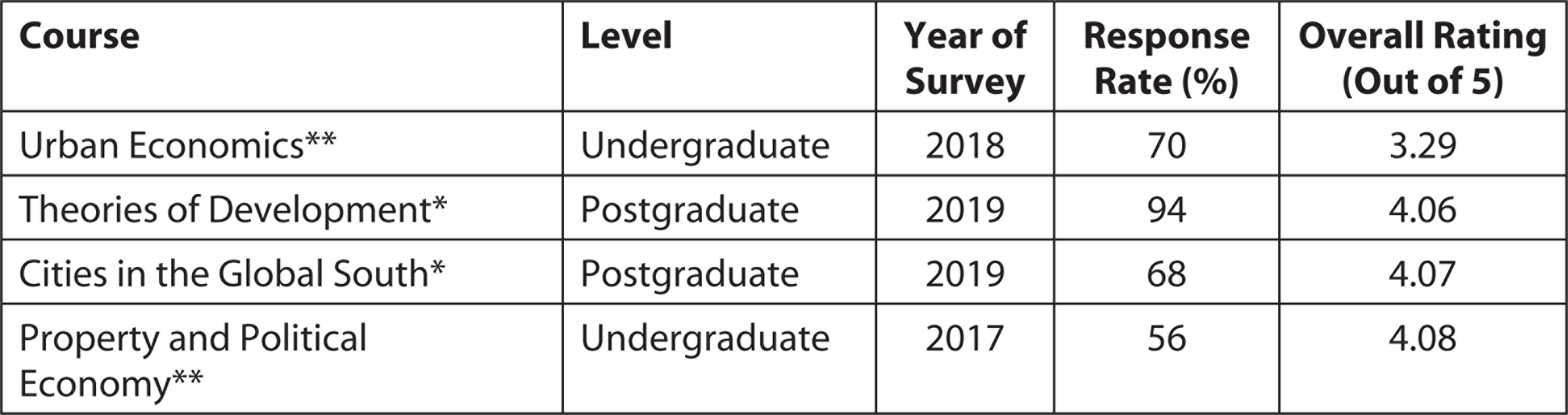
Awareness was not all. Nearly half of the students (47.31%) developed very strong, or excellent, personal commitment to pursuing social justice. Even more (51.11%) became better aware of environmental questions and their limits to growth, along with even stronger awareness of social justice (60%). These shares are much higher than courses devoted entirely to environment. For instance, in one of such courses, less than 50% accepted the environmental limits to growth, and oppressions and inequalities rated much less than 20% (Bryant & Stilwell, 2019, p. 19). In the Urban economics class, on the other hand, some students noted, ‘I have become more aware of social issues in cities, especially environmental’, ‘I have a much deeper understanding of urban economies and how they are formed and the injustices that come from these forces’, ‘I am also more concerned about capitalism and the effect that this has on our economy and our environment’, and students learnt ‘new ways of looking at topics such as climate + poverty’.
Teaching cannot all be assessed based on what happens in the classroom. As shown in an extensive review by the Crisp et al. (2009), the preparation before the class, what happens in the class, and continuing teacher education or commitment to improvement must all be part of how we evaluate courses. Assessments can be diagnostic in the sense of finding out teaching shortfalls in order to address them. Others might be formative in the sense of being ongoing exercises to develop one’s teaching. The rest may be summative, highlighting a point-in-time comprehensive assessment.
To make my course units respond to the problems that limit sustainability courses around the world, I make sustainability a crosscutting issue. In addition, I incorporate Southern voices and perspectives. In seeking to avoid Western biases, reading lists, examples used for teaching, and the teachers invited to speak about sustainability are far more diverse. The central focus on global inequality and social justice is an additional strength, reflecting a teaching philosophy that strongly promotes inclusion.
This expansion of pluralism to citizenship is important. Thinking globally must be widely embraced. As Bret Anderson et al. (2019) recently noted, the mainstream approaches to study abroad and exchange programmes may be too expensive for poorer students. Indeed, even if other students from elsewhere are brought in, local students might be exposed to only a particular type of students. Those who can afford travel or do not have dependents, such as kids who may make trave difficult, tend to be more mobile. Consequently, racial diversity is a must in sustainability courses. Students must not be required to travel in order to experience this inclusiveness. Indeed, in this age of nativism, global citizenship is particularly important. ‘A recent, large-scale study…suggests that on-campus experiences with diversity may be the single most important factor in determining whether students increase their intercultural competence…’ (Terzuolo, 2016, p. 163). Providing this opportunity to students in my courses, while broadly embracing the principles of pedagogical citizenship, therefore, is one indirect indication of progress.
More systemic evaluations affirm this interpretation. University teaching committee assessment of a teaching demonstration I gave in 2018, rated my teaching 5 out of 5. Elsewhere, this pedagogical citizenship has also been well-received. For example, my book (Obeng-Odoom, 2016a), from which I teach Urban Economics and Cities in the Global South, is the principal teaching text at many universities. At one prominent university, the book is used to teach ‘urban movements and sustainable urban development’. Other teachers of sustainability seem to endorse my book. For example, Elliott Sclar, Director of the Center for Sustainable Urban Development, Earth Institute, Columbia University, has written a strong positive review (Sclar, 2018), so have others in journals such as Australian Universities’ Review.
Conclusion: Beyond Limits to Growth
The emphasis on growthism as the central and only problem of sustainability has brought us far, but it can take us no further. Continuing to insist on it prioritizes environmental sustainability over and above social and economic sustainability (the ‘Growthmania’ section). Growing inequality and social stratification undermine environmental sustainability and ecological justice. Placing limits on inequality and stratification is, therefore, crucial (the ‘Limits to Inequality’ section). For holistic and fundamental transformation, what is needed is not just sustainability but a just sustainability (the ‘Just Sustainabilities’ section). How to teach these lessons can be approached from pluralistic perspectives, but cases of pedagogical citizenship appear to be much broader (the ‘Pedagogical Demonstration’ section).
Thus, if more research is needed on education for sustainable development, it should not only be on finding another way to advance pedagogical monism or pedagogical pluralism centred on the damaging ramifications of economic growth because they are both narrowly centred on ‘limits to growth’. Although important, what is urgent is education for sustainability within the context of limits to inequality and socio-ecological stratification.
Footnotes
Acknowledgements
Many thanks to Dr Kaisa Korhonen-Kurki, Dr Michiru Nagatsu, Dr Jussi T. Eronen, Dr Milutin Stojanovic, and Dr Andreas Exner for their excellent feedback. The Voices for Sustainability team, especially Miia Mänttäri and Laura Kalliokoski, deserve thanks. Their feedback strengthened the earlier shorter version of this article. Dr Rami Ratvio and Lotta Ruippo, who are leading the design of the university-wide course in sustainability, deserve special thanks. Lotta, in particular, provided constructive suggestions on improving my earlier draft. I appreciate the encouragement of the referees for the Journal of Education for Sustainable Development.
Declaration of Conflicting Interests
The author declared no potential conflicts of interest with respect to the research, authorship and/or publication of this article.
Funding
The author received no financial support for the research, authorship and/or publication of this article.