




Abstract
According to the curricula in various countries, teachers in the subject areas of science, social science and language are often expected to collaborate on cross-curricular issues such as sustainable development (SD) in the 9-year compulsory school. This study is based in Sweden and investigates teachers’ teaching traditions. The overall aim of this study is to understand what educational content teacher teams can offer students through cross-curricular collaborations. The specific aim in Part 1 of this article is to discern the distribution of teachers’ teaching traditions from different subject areas. Part 2 offers a reflection tool for teachers and teacher teams to discern teaching traditions. The results show that teachers from different subject areas stress different yet complimentary aspects of environmental and sustainability (ESE) teaching. A fair distribution of teaching traditions in a teacher team will offer students better learning opportunities to develop and enhance their action competence for sustainable development.
Introduction
This article begins with a discussion about understanding educational content in a broader sense than solely mixing subject matter content and using more exploratory methods. This is followed by an empirical example of discerning approaches to teaching and learning, which here are called teaching habits/traditions. The participants are secondary school teachers working in compulsory school, teaching students of grade 7–9 (13–16 years). The teachers are teaching in different school subject areas according to the Swedish context, such as science (chemistry, physics and biology), the social sciences (history, geography, civics and religion) and language (Swedish, English and modern languages such as Spanish, German and French). In Sweden, science and social science teachers usually teach all subjects in the subject area. Language teachers usually teach two or three languages. It is also common that schools in the Swedish context form cross-curricular teacher teams from these three subject areas to be able to teach and handle complex teaching of environmental and sustainability (ESE) issues such as climate change or fair trade.
This article consists of two parts. In Part 1, teachers’ teaching traditions in the subject areas of science, social science and language are discerned in an empirical survey and interview study. In Part 2, a reflection tool for teachers and teacher teams to discern their own teaching traditions is described and complemented with instructions about how it is used in practice. This is done by answering seven open-ended questions in an research enquiry, individually or in a group. Each question is related to an important educational aspect of teaching ESE, which is then used to discern the methods and perspectives described by the teachers—orally or in written form—in the enquiry research. Each educational aspect is connected to the other by being a point of departure for mainly the how, that is, the conduct of the teaching, and together they form a teaching tradition. The answers to the questions related to the educational aspects make a teaching tradition more visible, so that it can be communicated and discussed with peers, changed or further developed.
The results of the reflection tool imply consequences at both the individual teacher level and the school level for the teaching of ESE. The results guarantee that teacher discussions about a developed ESE teaching will include, beside content and methods, the opportunities to practice abilities and discussions about values and ethics. The distribution of teaching traditions among different subject areas in school are important to recognize in cross-curricular thematic teaching collaborations in ESE, such as energy use and production, global fair distribution of natural resources or, merely, local school development issues such as instalment of recycling facilities and their informed handling and maintenance. A fair distribution of different teaching traditions in a teacher team will offer students better learning opportunities to develop and enhance their action competence. The implications of the results can also be fruitful in discussions about how educational traditions evolve.
Background
Cross-curricular Teaching
According to the Swedish curriculum (Education, 2011) for the 9-year compulsory school (13–16 years), teachers in all subjects and subject areas have the responsibility to teach and promote sustainable development (SD). This is often done by teachers individually, where they try to teach in accordance with the ESD approach that is stressed in UN policy documents (Hofman, 2015; UNESCO, 2005, 2017). The same curriculum emphasizes that teachers should collaborate on complex issues such as SD using a cross-curricular teaching approach. Teachers from different subject areas are expected by peers and the school management to carry this out in practice. This means, for example, that language teachers are expected to participate in teaching sustainability issues. Collaborations also provide opportunities to share knowledge and learn from other teachers in the areas in which they have little understanding (Borg, Gericke, Höglund, & Bergman, 2014; McClam & Diefenbacher, 2015).
One starting point for this study is that teachers’ disciplinary backgrounds and pedagogical aims play an important role in forming specific teaching approaches related to different subject areas in cross-curricular teacher settings in compulsory school. In educational research, these types of settings are sometimes called multidisciplinary or interdisciplinary; however, both these terms are most often associated with contexts of higher education and academic disciplines. A trans-disciplinary approach is yet another concept, which mainly refers to a higher societal level regarding the need for collaborations between the educational sector and society to accomplish real societal change (Nordén, 2018).
In this study we will use the term cross-curricular teaching as a way to describe curriculum integration of subject areas when teaching ESD in a secondary school context. The curriculum integration can be seen as a supplementary opportunity to use disciplinary knowledge in certain well-planned contexts (McPhail, 2018), where sustainability issues is one example. Curriculum integration, while a commonly used educational term, remains a challenging concept to define and examine both in research and in classroom practice.
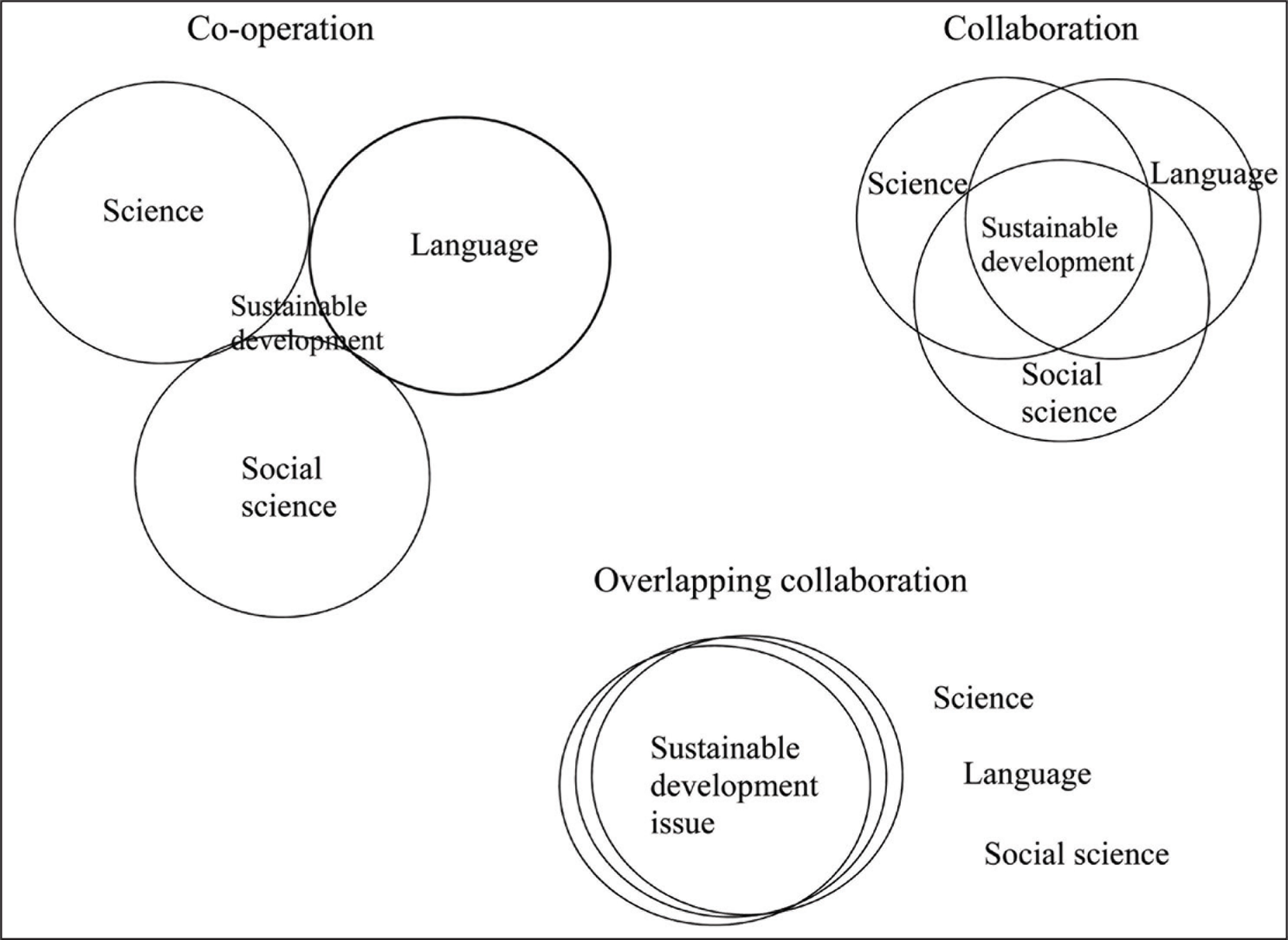
Numerous types and definitions of curriculum integration exist in educational research (MacMath, 2011). There is a large spectrum of classroom activities labelled curriculum integration (Relan & Kimpston, 1993). On one end of the spectrum, parallel (Drake, 1998) or multidisciplinary units keep the subjects or disciplines separate and distinct (McPhail, 2018). Disciplines are considered natural entities that involve different types of knowledge, thereby making it important to keep the lines between subject areas visible (e.g., teacher clarifying for students when they are working on science versus language). This is a common approach in co-operations (Figure 1). In contrast, at the other end of the spectrum is the restructured teaching units (Applebee, Adler, & Flihan, 2007) with no distinctions between disciplines. Here, teachers seemed to fuse subject areas and design units around key problems or questions (MacMath, 2011). This is a common approach in collaborations (Figure 1). As can be seen from this overview of curriculum integration, multidisciplinary teaching is a co-operation without common aims, while interdisciplinary collaborations have a more coherent common mission (Blaye, Joiner, & Sheldon, 1991; Hudson, 1995). Collaboration across subjects and subject areas in a compulsory school context is here called cross-curricular teaching (Hudson, 1995). Cross-curricular teaching in the Swedish context refers to designing thematic units about common themes, such as sustainable development, in subject area collaborations where different types of teaching approaches meet.
Figure 1 shows one way of illustrating subject area relations and contributions (Hudson, 1995; Sund & Gericke, 2020). A circle represents the teaching approach in a subject area. These circles will in this study be discernible in teachers’ responses through the curricular and pedagogical dimensions of what, how and why. The circles to the left show three subject areas that are co-operating. They may give inputs on a common SD theme, but there is no collaboration when it comes to content, methods or aims. They all have specific contributions to make. The subject areas to the right collaborate and partly overlap in many pedagogical ways, for example, content, methods and purposes, but also have subject-specific contributions outside the common area. In the third circle model at the bottom of Figure 1, all the subject areas are doing more or less the same teaching about a more specific ESE issue.
Educational Content in an Overarching Way
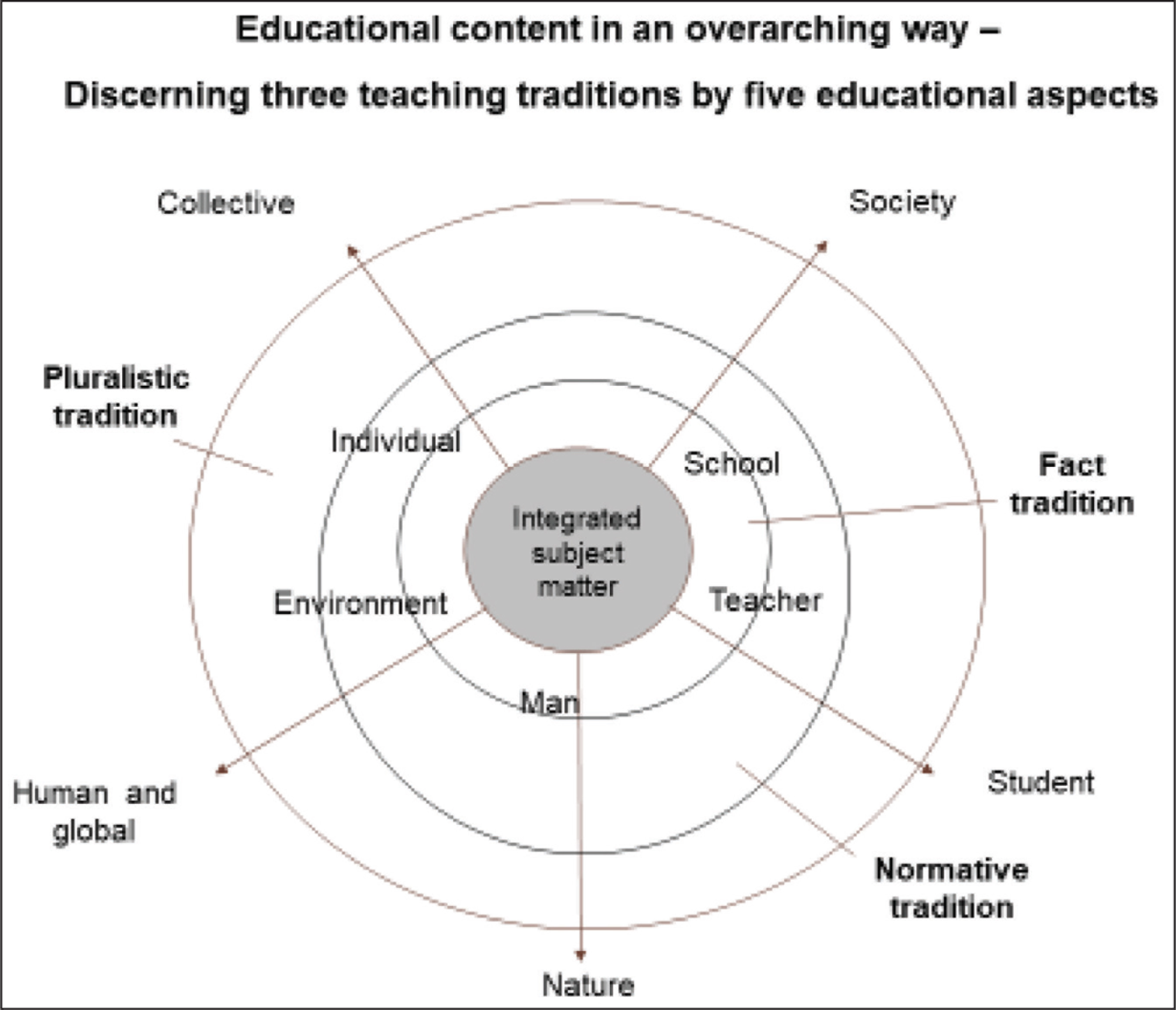
The transition towards ESE entails introducing new curriculum content and new approaches to teaching and learning. For example, in UNESCO documents this transition is described as a teaching approach that gently supplements ecological issues with social and economic considerations (UNESCO, 2012). In the latest Swedish curriculum for the compulsory school, preschool class and the recreation centre (2011), sustainable development is expected to be taught in all school subjects. A starting point for this study is that many teachers in Sweden are uncertain about the difference between environmental education (EE) and ESD and therefore teach a mixture of the two according to the national school agency (Education, 2002). In this article, ESE is used to describe a developed teaching approach towards sustainability. This is an attempt to take the best of EE and ESD teaching in a pedagogical manner and steer clear of it becoming a part of an ongoing critical research debate about EE or ESD (Hesselink, van Kempen, & Wals, 2000; Jickling, 1992; Scott & Gough, 2003; Sumner, 2008). However, in understanding the transition of EE to ESD and the further development to ESE, it is clear that there is more to it than simply discussing the intended content and the teaching and learning approaches that best accomplish it. It is also necessary to study how the intended subject area content is transformed through the various teaching and learning approaches of teachers. A content study like this needs to include not only the factual content but also the values that are conveyed to students. Subject content issues are often treated as unproblematic in curriculum reform discussions. Many assume that adding peace, justice, health or climate change issues will make the content more ESE-like. The common argument on content issues thereby focuses on the integration of the subject matter from different school subjects or subject areas. But what happens to the educational content if the teaching and learning approach is changed, for example, from solely focusing on factual knowledge to also including actions in society, or if teacher teams are formed in order to teach ESE collaboratively? It has been found that, for example, methodological changes in teacher approaches lead to the communication of other kinds of educational content through both speech and action to students (Sund, 2008). Different teaching methods convey different messages, which also constitute and build up the educational content (see Figure 2). This is what in this article is called educational content in an overarching way, including content, methods and purposes from subject areas such as science, social science and language.
Companion Meanings
The American philosopher John Dewey refers to this implicit socialization by value-laden messages in teaching that apparently takes place during education as ‘collateral learning’ (Dewey, 1938/1997). Dewey exemplified this by describing students’ attitudes towards what they like and dislike and whether they consider themselves as individuals who want to learn more. Using the terminology of Roberts and Östman (1998), the content included in the collateral forms of learning is referred to as companion meanings, which can be comprehended as value-laden ‘meta-messages’ accompanying subject content. Such companion meanings can, for example, focus on the nature of scientific knowledge (facts and/or attitudes) or people’s relationships with nature (for human interest or containing intrinsic values).
The empirical study in this article examines and illustrates the teachers’ communicated meta-messages in written enquiries and complementary individual follow-up interviews. Individual orientations around the content can be categorized into selective traditions (Östman, 1995). The clusters of teachers’ companion meanings or meta-messages that are communicated to students about the subject content, for example, regarding its purpose and importance, comprise the socialization content (Englund, 1998) surrounding the integrated subject matter content. This socialization content, in combination with the subject content, can be regarded as a mild persuasion or ‘indoctrination’ of students towards specific actions. It could involve messages about using nature for the interest of man or preserving natural resources for the sake of nature. The empirical example examines how selective traditions in teachers’ socialization content can be made visible by using the concept of educational aspects (see Figure 2) of ESE developed in earlier research (Sund, 2008).
In previous research, socialization content has often been regarded as deliberately fostering, for example, the maintenance of specific societal norms. The use of the concept in this article is not regarded as conscious fostering, and there is no differentiation between whether socialization content is intentionally or unintentionally communicated by teachers. In this context, socialization content is rather understood as content that consists of offers from teachers to students to deepen their meaning in their learning process (Roberts & Östman, 1998). The different companion meanings that are communicated by teachers in their teaching activities constitute the socialization content (Englund, 1997, 1998).
Teaching Traditions
Given that teachers make different choices in their teaching, their standpoints may become visible as a variety of teaching traditions. As teachers make habitual choices, the points of departure for the socialization content are often tacit. Moreover, these habitual choices often constitute specific educational contexts, which can be studied by paying particular attention to the socialization content. One consequence of the different educational habits of teachers is that important value-laden content, which is hidden within the teaching content, can contribute to the development of selective traditions (Östman, 1995). These habits should not be regarded as simple, repetitive actions. A habit is something that is continuously developed as a result of encounters between earlier and current experiences. Teachers live within a school culture as an individual does not live in a vacuum (Dewey, 1938/1997). If many individuals act in similar ways in similar situations, they can be described as having collective habits or developing a common tradition. Earlier research has identified selective traditions which are here called teaching traditions (Sund & Wickman, 2011a, 2011b). It is commonly known that teachers have their own developed views about which content and methods constitute good teaching. When teachers choose content and methods in a systematic way, the choice is made in accordance with a teaching tradition. Dewey’s (1922) discussion of individual views, and their interplay with a collective level (for example, institutionalized disciplinary traditions), seems to be an accurate description of how teaching traditions in ESE teaching evolve.
The discussion about teaching traditions can be related to the purpose of education. Two major ways to approach ESD teaching have been proposed by Vare and Scott (2007). ESD 1 is supposed to facilitate a change in our ability to deal with present problems and how we live now by promoting behavioural change, a change in our habits, or a change in how things are thought about, where the needs have been clearly identified. ESD 2 is expected to facilitate a change in our ability to deal with an uncertain and unknown future by developing students’ capacities to think critically.
ESE Teaching Traditions
Three teaching traditions have evolved in ESE in Sweden (Sandell, Öhman, & Östman, 2005): the fact-based tradition, the normative tradition and the pluralistic tradition. In the fact-based tradition, environmental problems are said to be due to a lack of knowledge and can be solved by learning more science. The pedagogical task is therefore to teach students the right and true knowledge. In the normative tradition, environmental issues are primarily a question of values, where people’s lifestyles and their consequences are major threats to the natural world. Increased uncertainty about environmental issues is an important point of departure for the pluralistic tradition. Here, environmental issues are viewed as both moral and political problems. Many researchers and educators consider the pluralistic approach as important for continuing to develop an environmental and sustainability education for a more sustainable future (Lundegård & Wickman, 2007). The importance lies in the teacher’s focus on getting students to use their knowledge in action, not solely a belief that learning facts and norms is enough to make the change for a better future.
Socialization content is the value-laden content consisting of a teacher’s companion meanings that are communicated to students when teaching and embed the subject matter. For example, teachers in the fact tradition work closer to the centre. Starting with the school–society aspects, the teaching is more situated in a school context, is teacher-centred, focuses on human interests using natural resources, focuses on the relation with nature without social and global consequences and teaches objective scientific facts for the individual student’s use in everyday life.
Educational Aspects
In Figure 2, the socialization content is described by means of five important educational aspects, all of which answer one question of central importance for ESE as also presented in Table 1. Also, Figure 1 includes a continuum dimension from the centre of the figure outwards as represented by the arrows. These arrows represent that the educational content is more connected with the surrounding world the further it is positioned away from the centre, that is, from formal schooling towards authentic experiences. Teachers can position their teaching in each educational aspect in their accounts of their ESE teaching in a continuum from the centre towards the surrounding world. The integrated subject matter is placed in the inner circle (i.e., the inner circle is the starting point for each educational aspect; see detailed explanations in Tables 1 and 2), and how this subject matter is enacted in the teaching in relationship to the surrounding world is shown by the arrows. Teaching can sometimes go beyond school and make study visits or invite guests to present something of contemporary importance in the local society.
Discerning Teaching Traditions
By combining the results from the five educational aspects, a broad description of teachers’ EE/ESE teaching can be identified. The fact-based tradition focuses on facts in school in the circle next to the integrated subject matter. The normative tradition is more oriented towards nature (biocentrism) and found in the middle. The pluralistic tradition or pluralistic approach (arrows outwards from the centre) connects more deeply with the surroundings. However, note that the representations of the selective traditions, that is, the two circles and the arrows, do not provide an exact measure of which teaching tradition a teacher belongs to, but rather an indication of where the most weight is given. The outer circle is included to show that the subject content is embedded in the socialization content constituted by companion meaning. The socialization content at the centre of Figure 1 mainly concerns subject matter knowledge. Besides this ‘factual context’, other companion meanings concerning society and students’ participation are communicated outwards from the subject content in the centre as valuations of which actions are good, attitudes and different power relations. Together they constitute the educational content in a more overarching way.
One important difference between a pluralistic teaching approach to ESE and EE is the purpose of teaching. ESE teaching focuses on students’ abilities to embrace and develop a ‘democratic action competence’, whereas EE is more product-oriented and oriented towards learning specific facts and attitudes. In EE, the focus is often on the learning of interdisciplinary content and attitudes (the fact and normative traditions), while in ESE, the content is the tool that is used to develop and practise abilities such as critical thinking (pluralistic tradition). However, this does not mean that the content is less important in ESE teaching, and Dewey (1916/1999) has already concluded that practising abilities without meaningful content is nonsense. ESE teaching focuses on the development of abilities. The learning of content is a simultaneous process in which content is suggested to be learned in action.
Knowledge about the various teaching traditions can help teachers to more deliberately and in an informed way change their approach to teaching towards a pluralistic tradition and students’ development of action competence towards sustainable development (Jensen & Schack 1997; Mogensen & Schnack, 2010). Knowledge is also useful in the development of teaching, because it acts as a tacit framework for teachers’ selection of content and method (Sund & Wickman, 2011a). The teachers know more clearly what they emphasize the most in their teaching: facts, attitudes or abilities. Thus, understanding more about teachers’ teaching from different disciplines is important in order to determine the possible distribution of teaching traditions in a multidisciplinary teacher team. This knowledge guarantees a better environmental and sustainability education that includes facts, attitudes and good opportunities in a coherent way to develop students’ action competences, where including emotions is an important aspect (Ojala, 2013).
Part 1: A Study of the distribution of teaching traditions in different subject areas
The Complexity of ESE Teaching
In classroom discussions, sustainability issues are often complex and difficult for any one individual teacher to grasp. Research indicates that teaching in ESE is a holistic endeavour (Boeve de Pauw, Gericke, Olsson, & Berglund, 2015; Pigozzi, 2007), which is often described in terms of working with different perspectives and multidisciplinary teaching (Scott & Gough, 2003).
Collaboration in Cross-curricular Teacher Teams
One way of approaching this in a Swedish school practice is for teacher teams, consisting of teachers from different disciplines, to teach sustainability issues to a common group of students. In these teams, eight to twelve science, social science and language teachers work together with their common groups of students (three–four classes) on interdisciplinary themes, such as climate change or the development of sustainable cities. Cross-curricular teaching through multidisciplinary teacher teams in compulsory school is thus conducted from many perspectives (ecological, social and economic) and teaching traditions. However, there is a risk that some teaching content and approaches will dominate and that others will be neglected, for example, that all the teachers in the team focus on conveying factual knowledge of their own subject or a normative approach and do not offer students opportunities to practise and develop abilities for an enhanced action competence as indicated in a study by Boeve de Pauw et al. (2015). Knowledge about teaching traditions in different subject areas can reduce this risk when assembling teacher teams in schools for cross-curricular thematic work.
During teacher education, student teachers are socialized into disciplinary traditions, where they often identify themselves as ‘science teachers’ or ‘social science teachers’ and are taught how to teach their subject in school. Teachers also develop their own individual view affecting their teaching traditions in relation to disciplinary traditions. These developed and often habitual approaches are here called teaching traditions and reflect the teachers’ own teaching experiences and their ideas about how their subject should be taught.
This research enquiry and the discussions investigate secondary school teachers (13–16 years) in Swedish compulsory school from different disciplines and investigate by means of written responses and individual discussions how teachers’ teaching traditions, of different school subject areas, relate to ESE.
The aim of the empirical study is to understand the distribution of teaching traditions among secondary teachers working in different subject areas such as science, social science and language.
The teaching traditions and the educational aspects related to them can be used as tools in educational studies of practical work, or to discern the differences in teachers’ teaching by means of a written enquiry (Lidar, Karlberg, Almqvist, Östman, & Lundqvist, 2017). This research enquiry sets out to discern teachers’ teaching traditions by analysing their responses to a written enquiry using analytical questions based on the specific educational aspects as described earlier (Table 1).
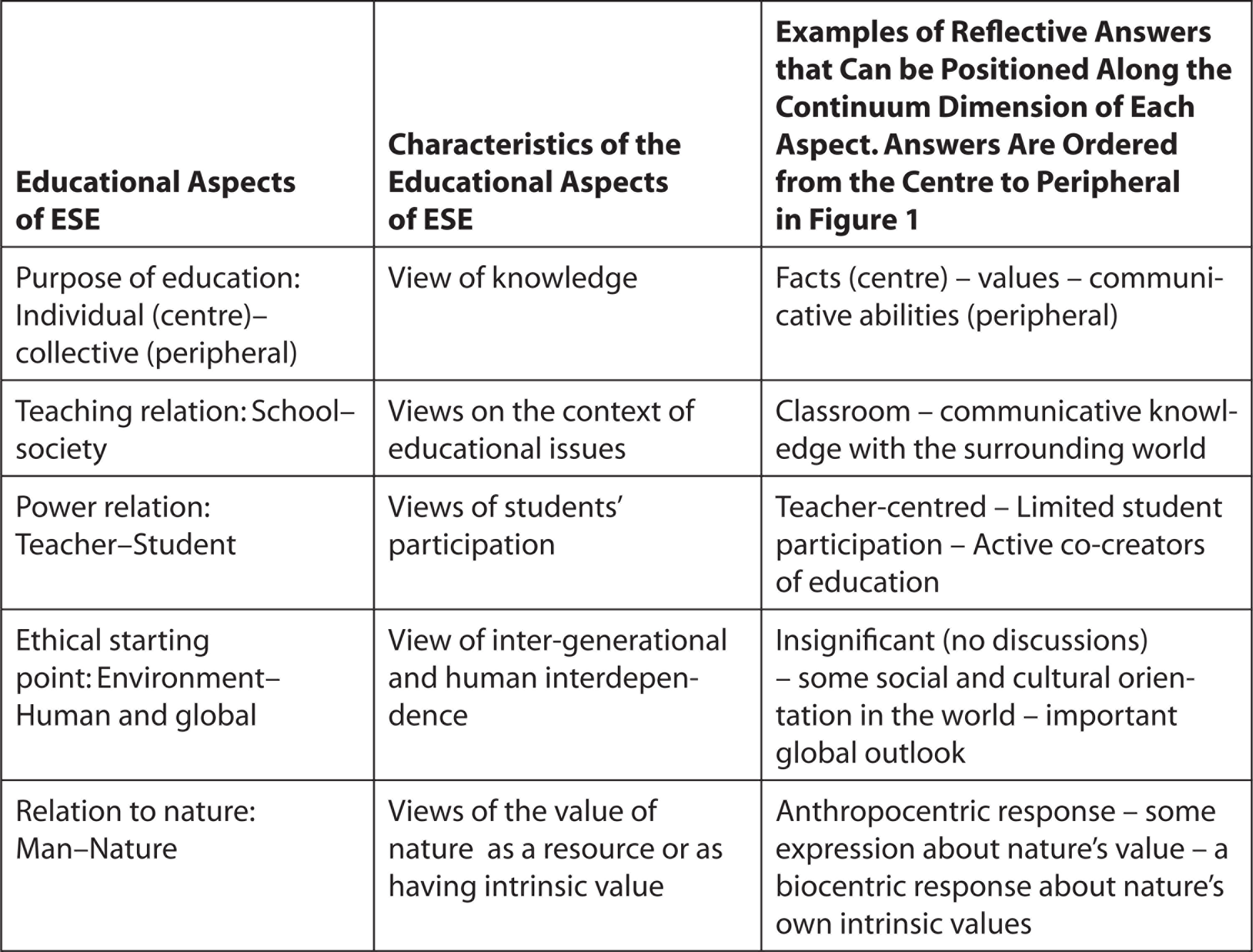
Table 1 shows the five analytical questions relating to the essential educational aspects of environmental education and sustainability education that help to make teachers’ socialization content visible. Teachers’ ways of answering these questions highlight the companion meanings that they communicate to students in their teaching. The companion meanings can in turn point to teachers’ approaches to the various value-related educational aspects of teaching. In the right-hand column, an opposition of positional terms is identified in relation to each aspect at the end of the arrows in Figure 2.
Method
Selection
Our research enquiry questions are based on five educational aspects (Table 1). A written research enquiry consisting of seven open-ended questions relating to these educational aspects was initially sent to 36 teachers in five different schools. Two weeks later, the same teachers were invited to take part in a group discussion, in which the first part consisted of an individual oral exercise in which the five educational aspects were the foci. The two datasets are complementary.
Five Analytical Questions Relating to Essential Educational Aspects of Environmental Education and Sustainability Education
The selection of teachers from three different subject areas from each school started with the idea of presuming them to become future or, in some cases, already active ESE collaborators in the local school. Teachers from different subject areas form curriculum-integrated teacher teams and they teach the same students. Teacher groups from the subjects of science (chemistry, biology and physics), social science (civics, history, geography and religion) and language were chosen from five different secondary schools (13–16 years of age) in two different municipalities in Sweden. The language groups consisted of teachers of Swedish, English and modern languages. Three schools were chosen as they were schools participating in local ESE implementation projects and two in another municipality as a way to recognize any local differences, but that became less of a focus. The teachers in the groups have worked for some years at the same school. The participating teachers had 2–32 years of teaching experience, and most of them had previously participated in some cross-curricular work. The data was collected from March to November 2017.
Analysis
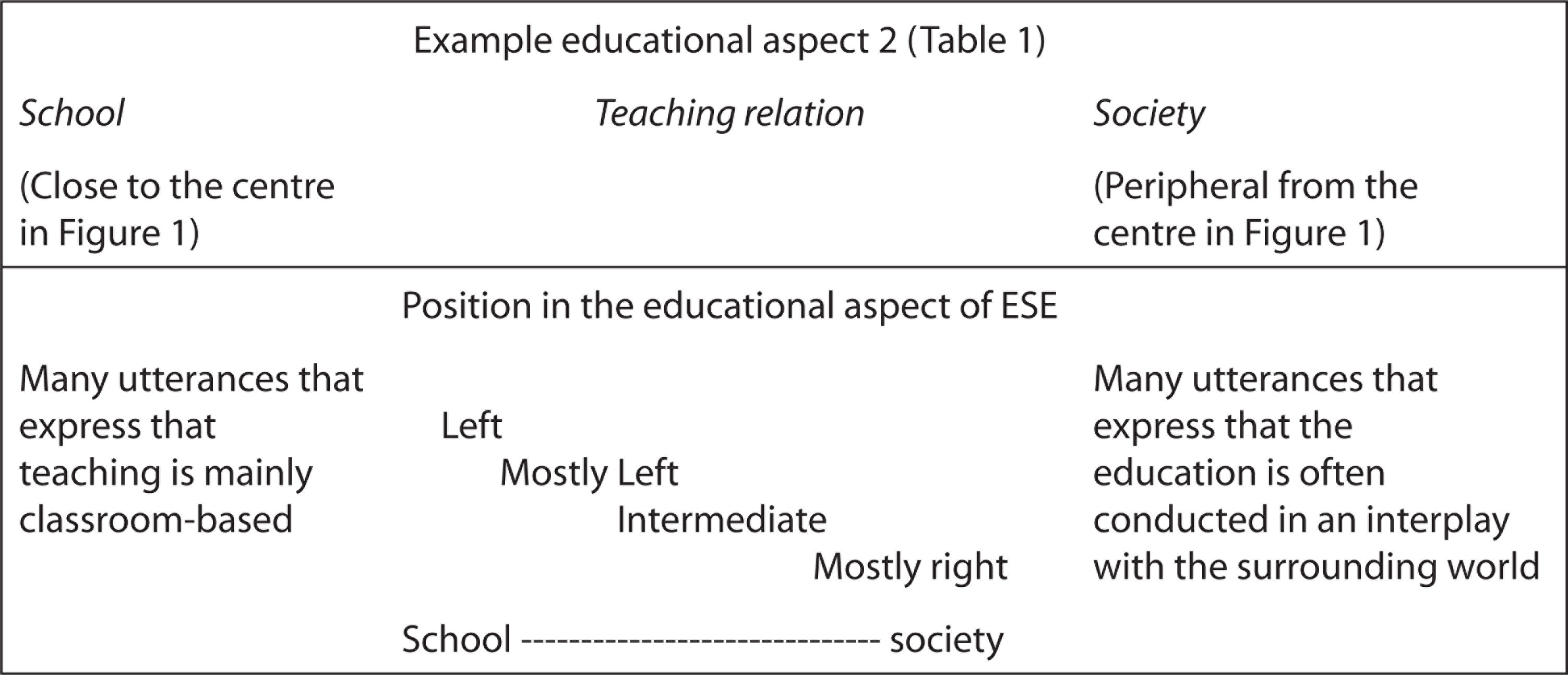
Table 2 facilitates an assessment of how the different educational aspects of teachers’ socialization content constituted by their communicated companion meanings (Östman, 1998) can be positioned on a scale. The number and ratio of the statements position a teacher relatively close to one of the oppositional terms of each educational aspect. As a convention for describing a teacher’s habitual position in this more finely tuned way, the positional descriptors left, mostly left, indeterminate and mostly right are used (none of the teachers positioned themselves only to the right). In Figure 1, it is shown how the educational aspects are weighed together to form a distance from the centre, an overall position in all five aspects, to form a teachers’ teaching tradition. The result of the analysis in is presented in Table 3.
Table 2 shows an example of a quantitative estimation of the position of teachers’ answers for an educational aspect. Several teacher-written answers and/or utterances towards one or the other end-term in the educational aspects could be described as a position.
An Example of a Quantitative Estimation of the Position of Teachers’ Answers for an Educational Aspect
Result: The Distribution of Teaching Traditions
Table 3 shows that there are some differences in the distribution of three well-described teaching traditions among teachers from different disciplines. The science teachers of the study work in all three teaching traditions, whereas the social science teachers mainly work in the pluralistic tradition. The language teachers in this small sample mostly work in the normative tradition.
The Distribution of Teachers’ Teaching Traditions in the Different Disciplines

Table 3 shows the distribution of teachers’ teaching traditions in the different disciplines as discerned from the teachers’ responses to the written research enquiry.
For the reader we include here some examples from utterances in the enquiry being classified as representing each tradition:
Fact tradition: ‘In their education, pupils should develop factual knowledge that can be used to critically examine different tasks or issues’. Normative tradition: ‘Humans have exploited nature for a long time and this is no longer sustainable. I demonstrate this using words, films and actions. I think that it is an important message that as a teacher I can pass on to the next generation’. Pluralistic tradition: ‘They should also be able to use their knowledge to discuss and argue in order to hopefully spread their knowledge wider in discussions with friends and family and in their future careers’.
The excerpts show that facts are the main focus in the fact tradition to be used in school while the example for the normative tradition is focusing on the negative value relation towards nature (exploited) and the responsibilities teaching has towards coming generations. The third example shows a focus on the ability to use knowledge in discussions and argumentations in an overall context outside school.
Discussion on the Empirical Study
The pluralistic tradition, which involves students practising their abilities to form an action competence, seems to be used by teachers from all three subject areas. This approach focuses on the development of students’ abilities, emancipation and a will to participate in real societal development. This approach is strongly supported by the Swedish national curriculum (2011) and Swedish research (Lundegård & Wickman, 2007). The fact-based tradition occurs mainly in the science subject area and can be understood as science teachers’ views of the role of science as a producer of reliable and ‘true’ knowledge, which is similar to earlier studies (Borg et al., 2012). The normative tradition of language teachers’ ESE responses is often connected to NGOs’ and the media’s way of communicating the urgency of lifestyle changes, wherein activist approaches are common. This can be understood as one of the major and important sources when discussing ESE issues in their teaching. Social science teachers mainly work in the pluralistic tradition, wherein writings and utterances connected to the educational aspect of inter-human relations are common and regarded as important.
The Practical Implications
Based on the results of the study, it is clear that teachers from different disciplines teach differently. For example, the social science teachers all follow the pluralistic tradition. We can then conclude that multidisciplinary teaching by a multidisciplinary teacher team has the potential for allowing all three teaching traditions to be enacted for the same topic, such as sustainability, and that it is important for the participating teachers in the teams to be aware of these different approaches. However, these differences could cause confusion if students encounter different views and practices of ESE in the classroom, for example, if some teachers stress facts while others emphasize the development of abilities, especially if these are not properly related to each other by the teaching team. When forming multidisciplinary teacher teams, it is important to choose teachers working in different teaching traditions but at the same time ensure that all three dimensions of sustainability—ecological, social and economic—are covered by disciplinary knowledge. The most fruitful set-up of multidisciplinary teams covers both the factual knowledge dimension of sustainability and the various educational aspects of teaching that build up different teaching traditions with different teaching purposes. The aim of such multidisciplinary teaching would be to guarantee a better environmental and sustainability education that includes facts, values, attitudes and good opportunities in a coherent way to develop the different ESE abilities of students in order to enhance an informed action competence. This implies a teaching approach that enhances students’ action competences and their ability to use their knowledge in everyday situations (Jensen & Schnack, 1997; Mogensen & Schnack, 2010).
Part 2: A reflection tool: discern your own teaching tradition!
This article offers a tool that helps teachers and teacher teams to reflect on their own teaching traditions. In understanding the transition towards a more developed environmental and sustainability teaching, it is clear that there is more to it than simply discussing the intended content and the teaching and learning approaches that will best accomplish it. A teaching tradition cannot always be explicitly expressed by a teacher directly, but can be discerned by reflecting on the patterns of his or her own actions. However, before starting to reflect on them, it is essential to acknowledge the traditions, because this will guide you in your search for ways of changing them (Wickman, 2012). Knowledge about your own teaching tradition is the first step in individual teaching development and group discussions about teaching together in multidisciplinary teacher teams.
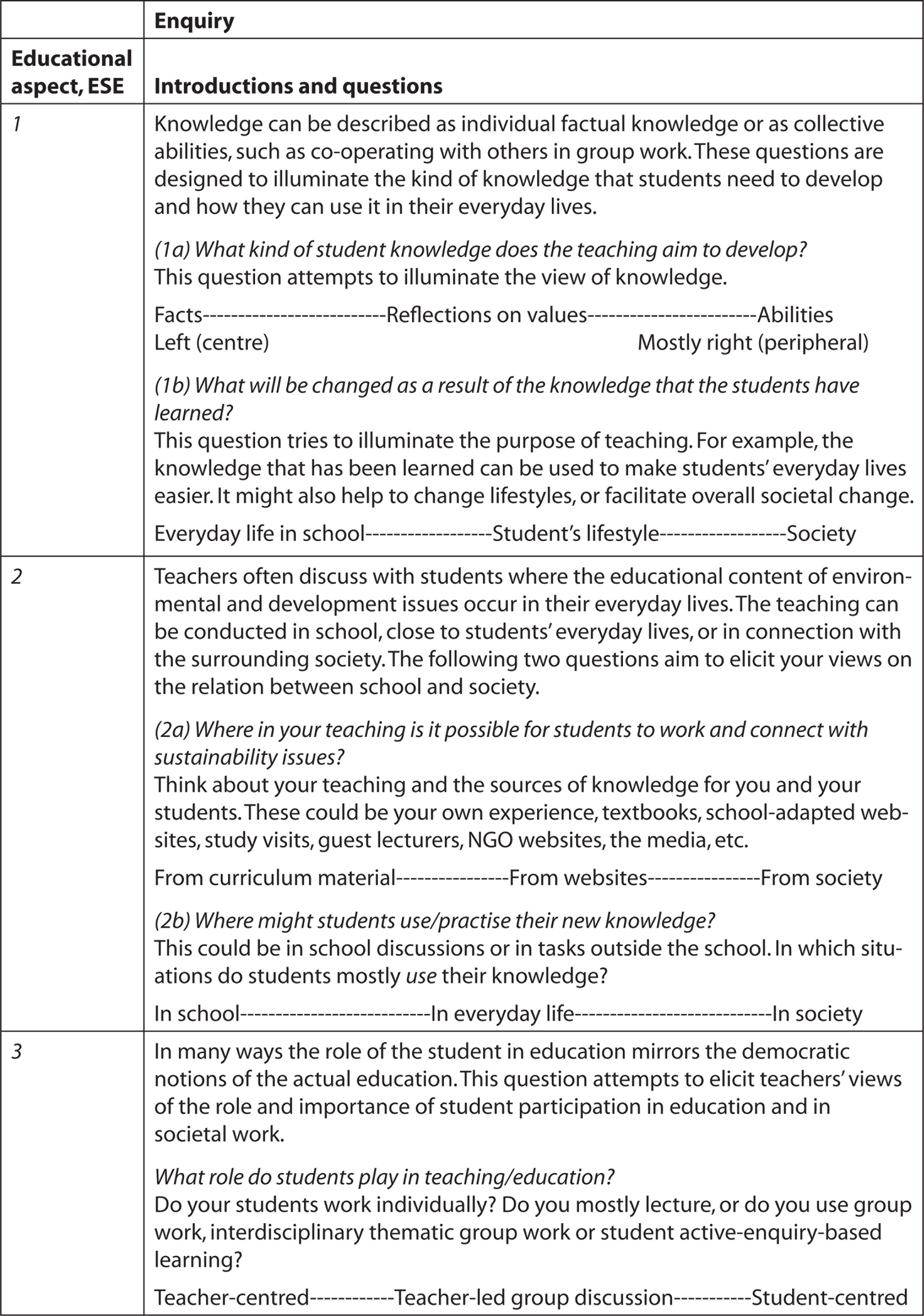
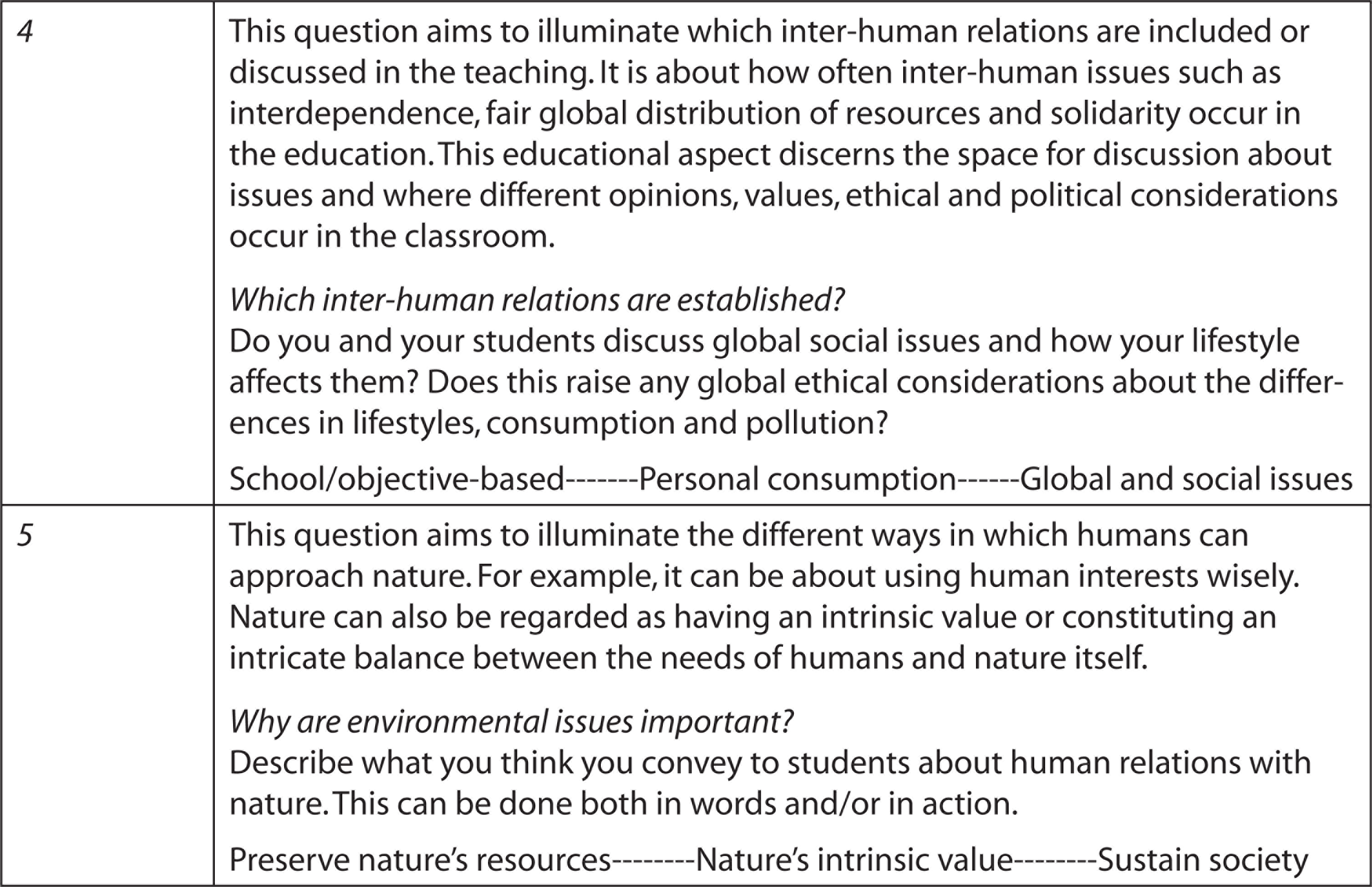
For this, a written enquiry (Table 4) has been developed from Figure 1. The questions used to discern the educational aspects could be reformulated to constitute a reflection tool for teachers or teacher groups. The five educational aspects could also be reformulated into seven reflective questions that together form a written enquiry and serve as a reflection tool for teachers or teacher groups.
Answering the questions in the enquiry makes it possible to position yourself in each educational aspect (see example in Table 2) and get a sense of your ‘own’ teaching tradition. This does not mean that you will always use a certain approach, but it simply indicates how you usually work and what you value as important when teaching ESE issues. There are different teaching foci too, such as facts, attitudes, action competence and ethical and political considerations. The exercise can be done individually in writing or orally together in a teaching team. The example in Table 2 facilitates an assessment of how the different educational aspects can be positioned on a scale (Table 3). The number or ratio of the statements positions a teacher relatively close to one of the oppositional terms of each educational aspect. As a convention for describing a teacher’s position in a more finely tuned way, the positional descriptors left, mostly left, indeterminate and mostly right are used. Figure 1 shows how the educational aspects are weighed together to form a distance from the centre, an overall position in all five aspects, and help a reflecting teacher to discern his or her own teaching tradition.
Discerning Teaching Traditions Through Educational Aspects
The reflection tool is a written enquiry (Table 4). About 30 minutes should be allowed for the exercise. It is beneficial to think of a specific class and have your planning and other curriculum material readily available when responding to the questions. This will help to keep you as close as possible to your everyday teaching practice. Try to describe what you actually do, not what you would like to do.
There are no ‘rights or wrongs’ here, only different ways of approaching teaching and learning. To each question below, there is a line/dimension of an aspect (left is from the centre of Figure 1 to the right and the peripheral part). When you answer the questions, start to reflect on your teaching, planning and curriculum material, and in each dimension mark where you think your teaching is positioned. Mark your seven positions with an X in the enquiry (Table 4).
The next step is to look at your responses and reflect on them. Estimate your utterances/written statements to position yourself on each dimension of the seven questions. If you mainly marked to the left in each dimension, you are oriented towards the fact tradition. If you mostly marked in the middle of each dimension, you mainly work in the normative tradition. Finally, if you mostly marked to the right, you mostly work in the pluralistic tradition. There may occur some contradictions, such as left in one aspect and right in another, but you can probably discern a tendency when you look at all the dimensions together and see whether they are left, middle or right. Left means mainly teaching in the fact tradition, the middle is mainly normative, while mostly right indicates a pluralistic teaching approach.
It is common to emphasize different teaching traditions when teaching different topics. No teacher works solely in one tradition, as this can vary, but many teachers work mainly within one tradition. No teacher can be solely identified as ‘one tradition representative’, and no tradition is ‘better’ than the others. They can be used differently in different topics. However, the pluralistic tradition is often considered by research as the approach that deals with complex issues, such as sustainability, more comprehensively (Lundegård & Wickman, 2007; Öhman, 2008; Sund & Lysgaard, 2013). Different teaching traditions are preferably used in teaching with different purposes and aims. The fact-based approach can be suitable for, say, a foundation course in ecology. When teachers know which approach and tradition they work with most, they are able to change their teaching in an informed and well-reflected way towards a desirable teaching approach whereby, for example, ESE issues can be integrated into the overall educational content that students encounter in the classroom or in societal actions (Wickman, 2012).
Enquiry
Cross-curricular teaching by teacher teams has the potential of allowing all three teaching traditions to be enacted for the same topic, such as sustainability, and it is important for the participating teachers in the teams to be aware of these different approaches. However, these differences could cause confusion if students encounter different views and practices of ESE in the classroom, for example, if some teachers stress facts while others emphasize the development of abilities, especially if these are not properly related to each other by the teaching team. When forming multidisciplinary teacher teams, it is important to choose teachers working in different teaching traditions. Possibly, the most fruitful set-up of collaborative multidisciplinary teams (Figure 1) covers both the factual knowledge dimension of sustainability and the various educational aspects of teaching that build up different teaching traditions with different teaching purposes. The aim of such multidisciplinary teaching would be to guarantee a better environmental and sustainability education that includes facts, values and opportunities to develop students’ action competence in a coherent way. If you and your peers begin to discern your teaching traditions individually or together in a teacher group, the possibilities for informed reflective discussions about a developed ESE teaching will be enhanced.
Footnotes
Declaration of Conflicting Interests
The authors declared no potential conflicts of interest with respect to the research, authorship and/or publication of this article.
Funding
This research was supported by ROSE (Research On Subject-specific Education), Karlstad University.