




Abstract
A core aim of Education for Sustainable Development (ESD) is to link local action with global thinking. In this systematic literature review, we quantitatively and qualitatively analyzed a sample of 158 peer-reviewed articles on school gardening. Our particular interest was in Virtual School Garden Exchanges (VSGEs). In VSGEs, learners plant school gardens and use digital media (e.g., videos, photos, video conferences) to engage in virtual communication about their gardens and related topics. Because this is a new area of research, we approached the broader topic of the ‘school garden’ from three perspectives: (1) the embedding of the global perspective of ESD, (2) the use of digital media, and (3) the establishment of international exchanges between school gardeners. Just 14 articles directly incorporated these three perspectives and were thus analyzed in more detail using a qualitative content analysis. As a result, we identified possible directions for future research on VSGE.
Keywords
Introduction
Global challenges such as climate change, migration and the loss of biodiversity are becoming more and more visible. A large body of scientific data shows that the current production and consumption patterns of the growing world population exceed the planet’s capacity for renewable resources (Crutzen & Stoermer, 2000; Hardin, 1968; Meadows, Meadows, Randers, & Behrens, 1972; Rockström et al., 2009). These data suggest that a transformation towards sustainable development is required to secure livelihoods.
Since the 1992 United Nations Conference on Environment and Development (UNCED) in Rio de Janeiro, there has been international recognition that a change towards sustainable development requires a thorough change in consciousness at all levels (UNCED, 1992, p. 329 f.). This conference marked the beginning of the official promotion of Education for Sustainable Development (ESD). Different concepts of ESD exist in practice and theory due to the fact that ESD combines different educational traditions such as environmental education, development education and consumer education (Scheunpflug & Asbrand, 2006; Schreiber & Siege, 2016, p. 31). In this study, we define ESD as a holistic, problem-solving, future- and action-oriented approach, which addresses social, ecological and economic aspects of different themes of sustainability and the local and the global perspectives on these themes, the latter of which is particularly important in this research (Amariei, Büker, & Castanheira, 2016, p. 3; Rieckmann, 2012, 2018; Scheunpflug, 2001, p. 87; Schreiber & Siege, 2016, p. 84). ESD responds to the global challenges that can be tackled through a new way of learning and teaching (Barth & Rieckmann, 2008; Scheunpflug, 2001, p. 87) and offers a significant contribution to the transformation of our society (Amariei et al., 2016, p. 3).
The United Nations’ Decade on ESD (2005–2014) was followed by the Global Action Programme on ESD by UNESCO, which seeks ‘to generate and scale up concrete actions in ESD’ (UNESCO, 2014, p. 9). ESD can contribute to the 2030 Agenda, which was adopted by the UN in 2015 (UNESCO, 2017). This Agenda includes 17 global Sustainable Development Goals (SDGs), one of them being ‘quality education’ (SDG 4). Target 4.7 states that by 2030:
All learners acquire the knowledge and skills needed to promote sustainable development, including, among others, through education for sustainable development and sustainable lifestyles, human rights, gender equality, promotion of a culture of peace and nonviolence, global citizenship and appreciation of cultural diversity and of culture’s contribution to sustainable development. (UN, 2015, p. 21)
School gardens and the global perspective of ESD
ESD can be implemented in a large number of different settings and in work with many different target groups. One possible learning location where the global perspective of ESD can become tangible are school gardens (Richards, n.d.; SGGN, 2010; Slabe, 2017; Tempel, 2013; Wolsey & Lapp, 2014).
School gardens are often planted on school grounds or located near schools. They exist all around the world, have different shapes and sizes, and serve different purposes, for example, learning, recreation or food production (FAO, 2010, p. 2; Milicevic & Nowikow, 2017, p. 2). School gardens have a long tradition: ‘in different historical contexts, school gardens have had different priorities’ (FAO, 2010, p. 5). In the Global North, 1 school gardens have predominantly been used as laboratories for science, environmental studies and other subjects. More recently, the aim of school gardening has been to reconnect youth to nature and the origin of their food. In the Global South, the focus has been more on ‘vocational agricultural training and food production for consumption or cash’ (ibid.). In some countries of the Global South (e.g., Costa Rica), ‘long-established policies of associating school gardens with school food and improving children’s nutrition and eating habits’ (ibid.) exist.
School gardens provide a plethora of opportunities to integrate the global perspective of ESD and make the interconnectedness of our realities tangible worldwide. This can be achieved by identifying the origin of crops, discussing and analyzing agricultural trade, and/or getting in touch with global food cultures (Ackerdemia e.V., 2018; SGGN, 2010; Slabe, 2017; Tempel, 2013). However, school gardening often does not get much further than composting, although gardens offer many ways to address global challenges to learners (Richards, n.d., p. 3).
Several non-academic organizations and publications have focussed on the practical integration of the global perspective of ESD in school gardens, for example, the British Schools Global Gardens Network (SGGN), which strives to bring the global dimension into the school garden (SGGN, 2010). Also, the German Pedagogical State Institute Rheinland-Pfalz (PL) provides a collection of best practice activities in its ‘Practical Guide for School Gardens – ESD’ (Tempel, 2013, p. 127 f.). Another example is the German school garden programme GemüseAckerdemie, which provides twenty modules about local and global issues for teachers (Ackerdemia e.V., 2018). Goldschmidt, who works as a coordinator for school gardens in Germany, describes school gardens as a holistic living and learning venue, where, in particular, competencies that are future-oriented are required and can be developed (Goldschmidt, 2014). One of the competencies she describes is the ability of ‘cosmopolitan perception and change of perspectives’ 2 . This can be achieved by growing vegetables or herbs from other countries and processing them for cooking typical dishes from other parts of the world (Goldschmidt, 2014). Plants can be a starting point from which to learn about other cultures and natural environments (Tempel, 2013, p. 12). Learners from different cultural backgrounds are offered the space to talk about their culture and their home country or to integrate plants from their country in the garden (Vogel, 2003, p. 13 f.). Also, the design of the garden can be based on international models (Hampl, 2003, p. 17 ff.; Tempel, 2013, p. 127). The fact that school gardens exist worldwide is a good basis for international cooperation (Spieler & Nowikow, 2006). The common language of gardening creates ‘a window on the world’ (Potterton, 2010, p. 1), and the benefits of school gardens and school partnerships can be combined into a school garden partnership.
These examples illustrate that in practice, there are many examples of how the global perspective of ESD can be integrated in school gardens. In academic research, the attention paid to the integration of the global perspective in the school gardens seems to be very minimal (Lochner, 2016).
Use of digital media for virtual exchanges
Although traveling and school exchanges are something exclusive because they can often be very expensive, nowadays, an exchange via digital media is feasible for a large number of schools. The use of digital media is a way to make learners experience our globalized existence (Schreiber, 2001, p. 176; Schreiber & Siege, 2016, p. 65) and to combine analogous learning activities such as gardening with digital learning activities such as the creation and use of photos or videos (e.g., embedded in a virtual exchange [VE]).
VEs already have quite a tradition. As early as in 1988:
The Copen Family Foundation (…) linked 12 schools in Moscow with 12 schools in New York State (…) in a pioneering demonstration that education could be enhanced and the quality of life on the planet improved if young people were to have the opportunity to use telecommunications technologies to engage in collaborative projects. (IEARN, n.d.)
In the early twenty-first century, programmes such as eTwinning, Soliya and Chat of the worlds have evolved, all of them using digital media to link learners globally. A process of reciprocal exploration of the living and learning conditions of others has led to cooperating on common projects. Also, mediated email contacts and moderated newsgroups have been facilitated through email communication (Schreiber, 2001, p. 176 f.).
There are various online platforms 3 or blogging communities 4 that schools and learners can use to exchange information with other students from other parts of the world (Graffin, 2013). Also, video conferences allow students to exchange information in real time. It is an activity that allows learners to engage in emotional participation through direct visual and voice contact (Schreiber, 2001, p. 214).
One disadvantage of the use of digital media is the competition that digital media might have with education involving real nature (Corleis, 2015, p. 3). More and more actors in education, however, now rely on a combination of the two approaches (Corleis, 2015, p. 3; Giest, 2010, p. 69; Michel, Siegmund, Ehlers, Jahn, & Bittner, 2014, p. 7; Siegmund et al., 2014, p. 20 f.). An example is VEs between learners working in school gardens: the combination of local gardening with global thinking and the ability to engage in VEs via digital media. The range of our own actions thus reaches beyond the direct and tangible environment (Schreiber & Siege, 2016, p. 70).
Virtual school garden exchangeS
In this study, we define the linking of local gardening with global VEs as a Virtual School Garden Exchange (VSGE).
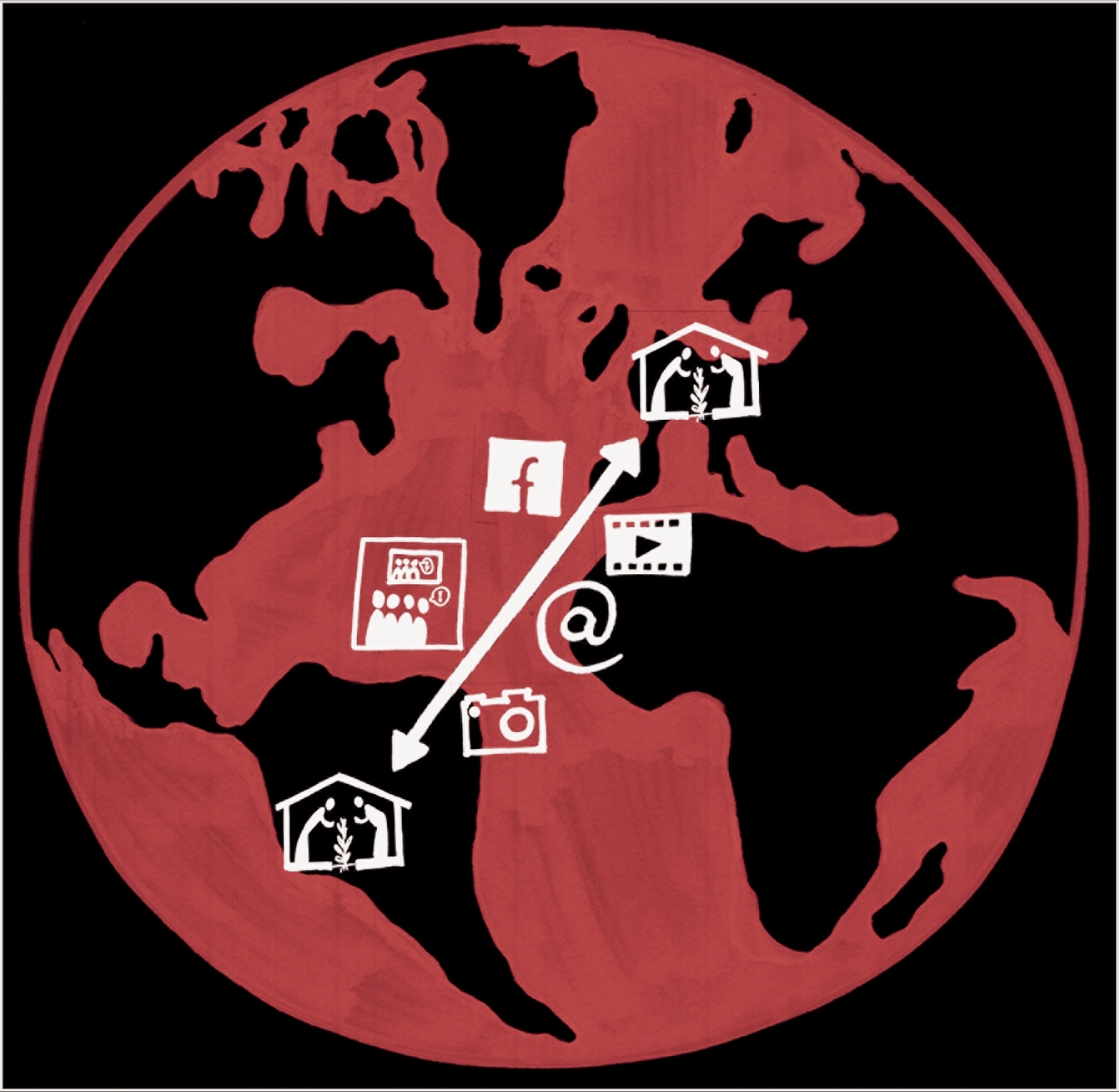
VSGE is a special form of VE, which ‘is a practice (…) that consists of sustained, technology-enabled, people-to-people education programmes or activities in which constructive communication and interaction takes place between individuals or groups who are geographically separated and/or from different cultural backgrounds, with the support of educators or facilitators’ (Evolve, 2018). In a VSGE, learners from primary or secondary schools around the world who are engaged in school gardening can communicate in the virtual world about their garden experiences and related topics using media such as emails, photos, films or video conferences (see Figure 1).
There are different examples of VSGE. Besides many commonalities, such exchanges differ with respect to the concrete form of implementation, and each project has set individual thematic foci.
The earliest developments in the practice of VSGEs that we are aware of date back to 2001: The ‘Food for Thought School Linking Programme’, a project between England and Uganda organized by Devon Development Education (DDE, n.d.), and the ‘North–South Education, school garden project in Germany and Ecuador’ from the organization Inka e.V. with a particular focus on old crop varieties (INKA e.V., 2003). Both projects mainly exchanged via letters, drawings and photos. In 2004/2005, there was an ‘International School Garden Network’ among schools in Brazil, Germany, Russia, South Africa, Taiwan and the Czech Republic that promoted the exchange of German school gardens with school gardens worldwide. The exchange primarily took place between multipliers who worked with school gardens and were able to introduce the global perspective into the classroom with photos and emails (Lochner, 2016, p. 30 f.). From 2013–2017, a follow-up project was conducted: the ‘Global Classroom’ project (Grüne Liga, 2018). In 2015, three more exchanges between individual teachers from Europe and Africa and their schools ranging from one to four months in length took place (Lochner, 2016, p. 33 f.). Two larger programmes were the ‘Global Garden Exchange E-Pen Pal Program’ (GGE) from Slow Food USA and ‘Go! Global Garden’ (GGG) from the ESD Expert Net (Lochner, 2017, p. 142 ff.). The GGE connected 80 schools in 2016 and 2017, but by 2017, the programme was closed. In 2015 and 2016, GGG conducted two pilot studies with learners from South Africa, Mexico, Germany and India exchanging via videos, photo collages and video conferences. GGG is now embedded in Go! Global (ESD Expert Net, n.d.).
Research design
The combination of VEs and school gardens is a relatively recent innovative development. To provide an overview of this area of research, to ‘describe and explain current knowledge’ (Fink, 2014, p. 7) and to identify gaps, we conducted a systematic literature review. Our work was inspired by Barth and Rieckmann’s (2015) research design and followed the systematic review approach outlined by Fink (2014). By following this approach, our goal was to provide a systematic and replicable search and analysis strategy that was fully documented and transparent. Going through the steps of (1) data collection, (2) data processing and coding and (3) data analysis, we produced a bibliometric overview that combines quantitative analysis with qualitative content analysis.
As the particular interest of this systematic literature review is on the position of VSGE in peer-reviewed articles since 1992—the year that UNCED occurred in Rio de Janeiro—and a direct search for VSGE did not provide any results, we chose to approach it from three directions: the integration of the global perspective of ESD, the use of digital media, and the international exchanges/ partnerships in school gardens (see Figure 2). As VSGE is embedded in the research landscape of school gardens, this was the starting point and focus of the systematic literature review. We addressed the following research questions:
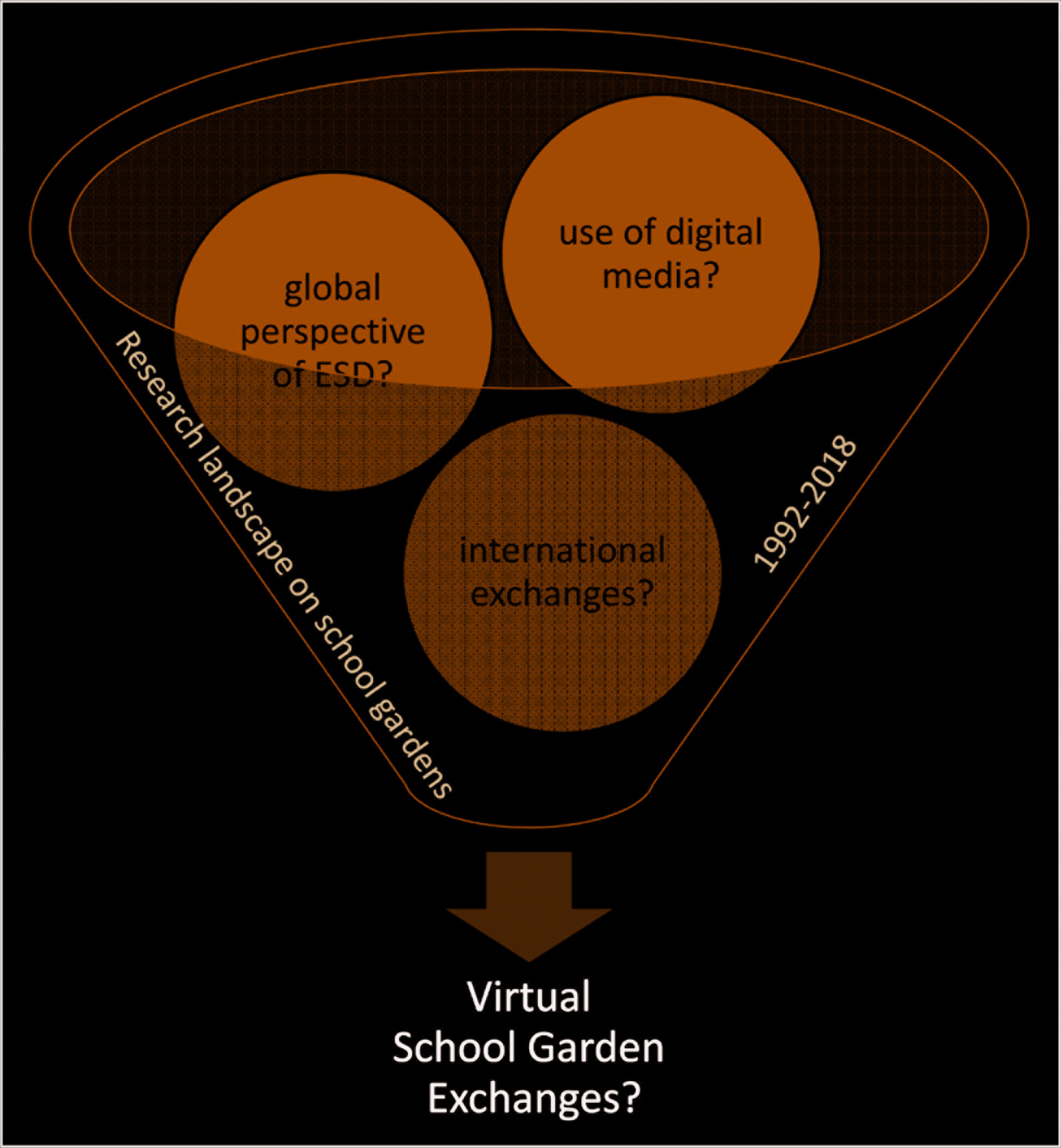
Which developments in school garden work have been documented in the scientific literature since 1992 regarding…
…the embedding of the global perspective of ESD in school gardens? …the use of digital media in school gardens? …the establishment of international exchanges/partnerships between school gardens?
Data Collection
The literature search was conducted in two databases: Scopus and Education Resource Information Centre (ERIC). Elsevier’s Scopus is the largest abstract and citation database of peer-reviewed literature covering the social sciences. ERIC is an online library of education research and information, sponsored by the Institute of Education Science of the U.S. Department of Education (IES, n.d.).
Using the following search terms: (‘School garden’ OR ‘Learning garden’ OR ‘garden-based education’ ), the search produced 234 hits in Scopus and 206 hits in ERIC, with a very small overlap. Subsequently, the hits were screened using predefined criteria. Only articles published between 1992 and 2018 were considered because 1992 marked the beginning of the international discourse on Education for Sustainable Development. Only peer-reviewed articles with an English-language abstract were included. For articles to be included, the terms ‘school garden’, ‘garden-based education’, or ‘learning garden’ had to be used in the sense of a garden in a school 5 (no college, university, or early childhood education) or school-like context and/or surrounding used for educational purposes. The subject of the study had to be the educational use of the garden—not as a location for conducting an environmental analysis (e.g., on soil or air pollution) or school gardens in the context of urban agriculture. This screening process resulted in a sample of 153 articles. For a review of potential blind spots, the sample was sent to international experts in the different fields we identified as relevant for the research question. As a result of this review process, five articles were added, and the final sample was expanded to 158 articles.
Data Processing and Coding
Using the MAXQDA software, a database was created out of the final sample, including all available bibliographic data, keywords, and abstracts. A first organization of the data into specific variables was automatically implemented by MAXQDA, which we complemented by providing additional variables regarding the location of the author, the location of the school garden and the research topics. We tried to find missing information by conducting a manual web search.
To obtain an overview of the sample, all titles, abstracts and keywords were coded regarding the bibliometric variables: name(s) of the author(s), location(s) of the author(s), institution(s) of the author(s); location of research topic; keywords; journal and year of publication.
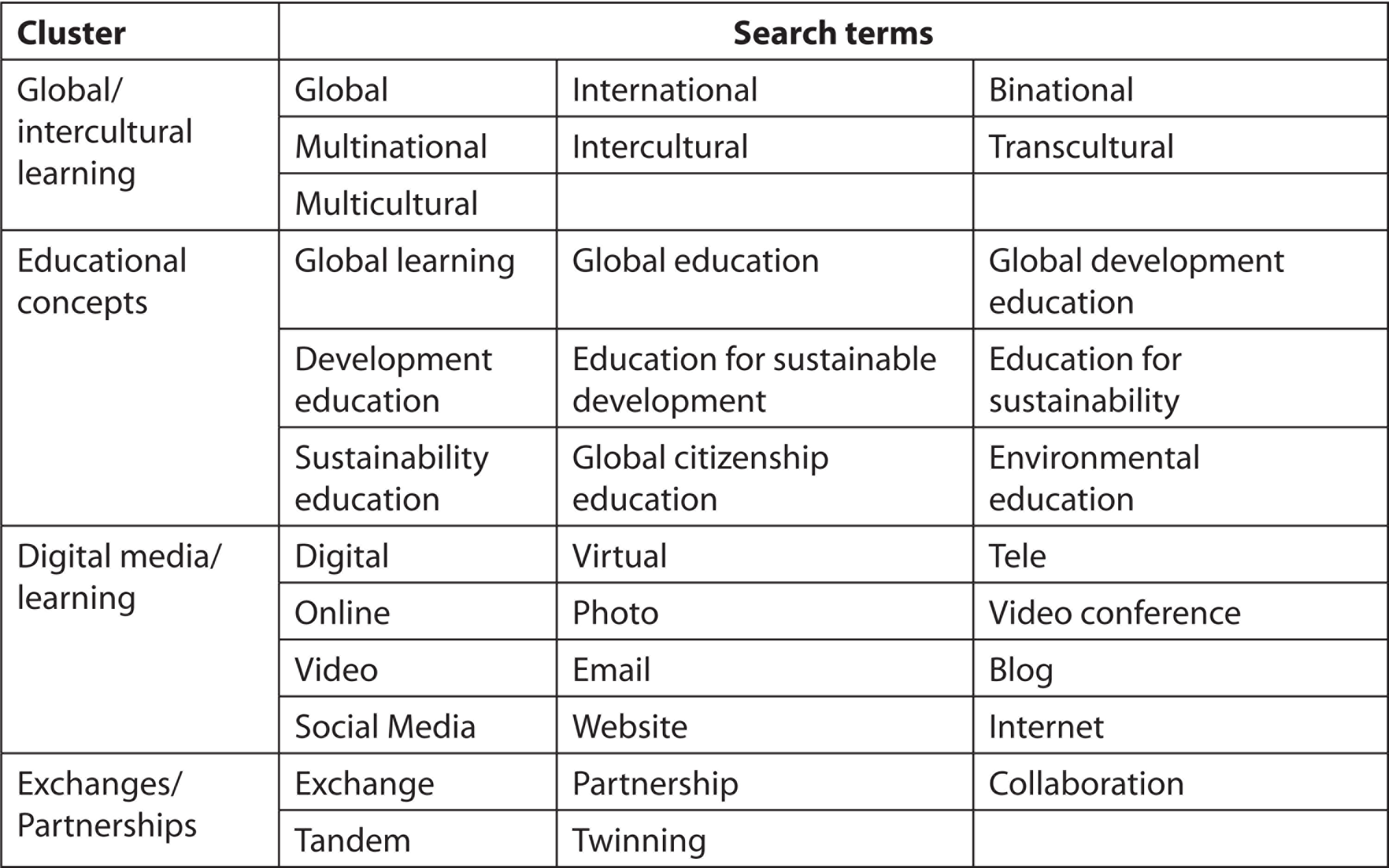
To determine whether there were articles that had a relation to the global perspective of ESD in school gardens, the use of digital media, or international exchanges or partnerships between school gardens, we first conducted a quantitative analysis. Using the ‘autocoding with dictionary’ function in ‘MAXDictio’, all abstracts, titles and keywords were coded with pre-selected search terms (Table 1), which are often used synonymously even when they do not have the same meaning. We applied a manual correction of the autocodes and a manual coding of the sample based on the same clusters. This resulted in the identification of some more relevant papers.
Pre-Selected Search Terms for the Quantitative Analysis of Titles, Keywords and Abstracts
Based on the quantitative analysis, 14 articles were identified as relevant for answering the three sub-research questions. We coded the complete articles in an inductive manner twice—the first round to create codes and the second round to use the final codings in all articles (Mayring, 2000). The following coding system was created:
Global perspective of ESD in school gardens embedded through…
content related to global ESD multicultural learning and English as a second language garden design school garden exchanges Digital media was used in the school garden for…
teaching documentation or reflection providing information monitoring the garden/plants ‘communicating’ with plants interacting with other people International exchanges/partnerships between school gardens
Data Analysis
The bibliometric variables were analyzed statistically. Based on the autocoding of the MAXQDA function ‘MAXDictio’, the frequency of the search items was analyzed. This was complemented by an analysis of word frequency within the keywords. In the last step, a qualitative content analysis of the selected 14 articles took place in accordance with Mayring (2000).
Findings from the literature review
Overview of the School Garden Research Landscape 1992–2018
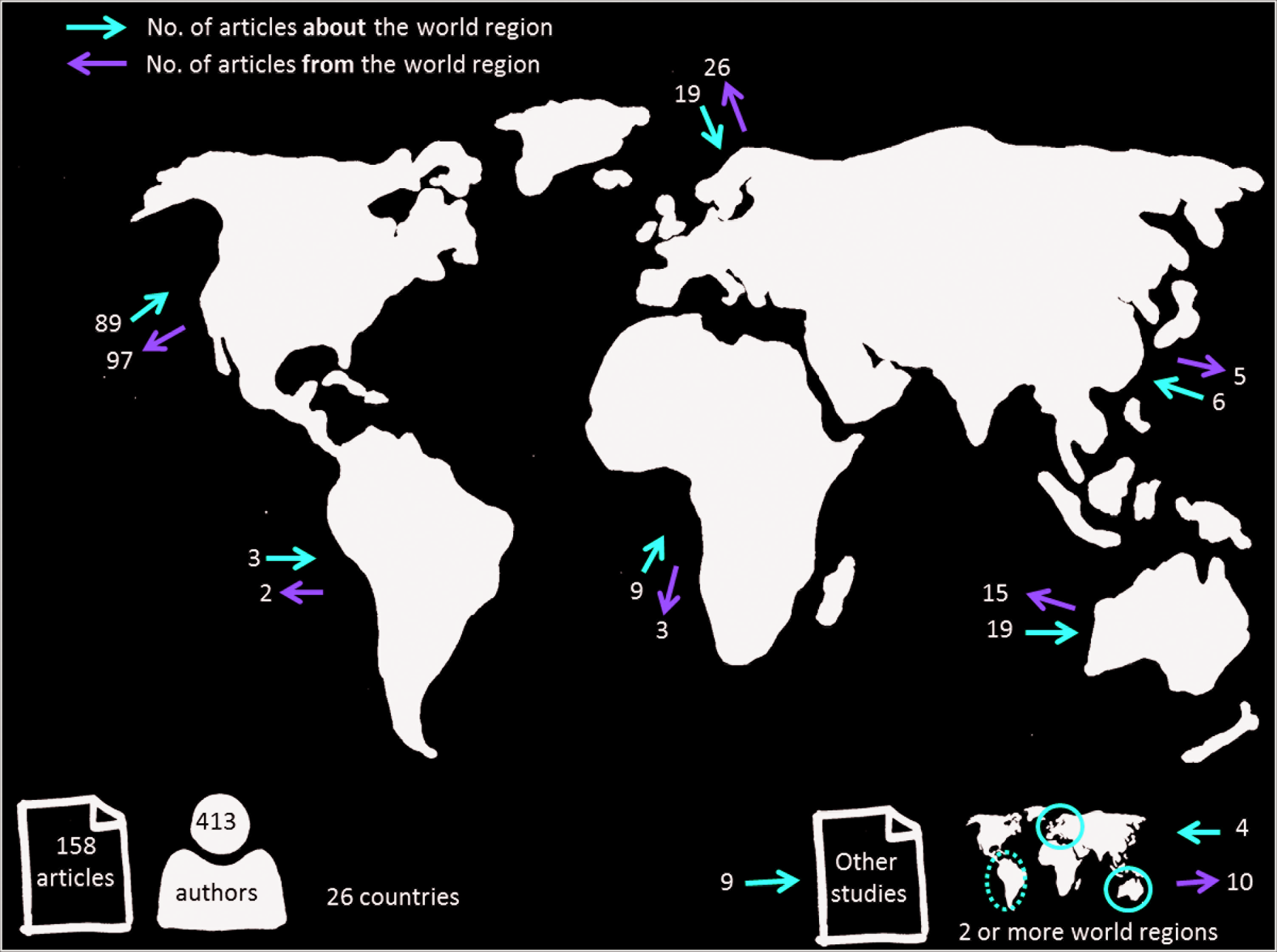
A total of 413 different authors and co-authors from 26 countries published the 158 articles. Most authors were involved in three or fewer articles, and just nine authors were involved in four to seven. 86 per cent of the articles were written in North America, Europe and Australia/Oceania (see Figure 3), most of them in the United States, the United Kingdom and Australia. Ten of the papers were written by authors located in two or more different continents, of which six were authored by teams based exclusively in the Global North, and the remaining four were collaborations between authors in the Global South and Global North. Just four papers described research on school gardens from two or more world regions (e.g. in the form of comparative studies). There were nine articles that reviewed other studies and had no specific regional focus.
The numbers in Figure 3 illustrate that there is an imbalance between the number of articles from a world region to the number of articles about a world region. There are, for example, nine articles written about school gardening in Africa. Three of them were written by authors based in institutions in Africa, two of them were written by authors located in Africa in collaboration with authors located in Europe or North America, and the remaining four were written by authors based in institutions in Europe or North America.
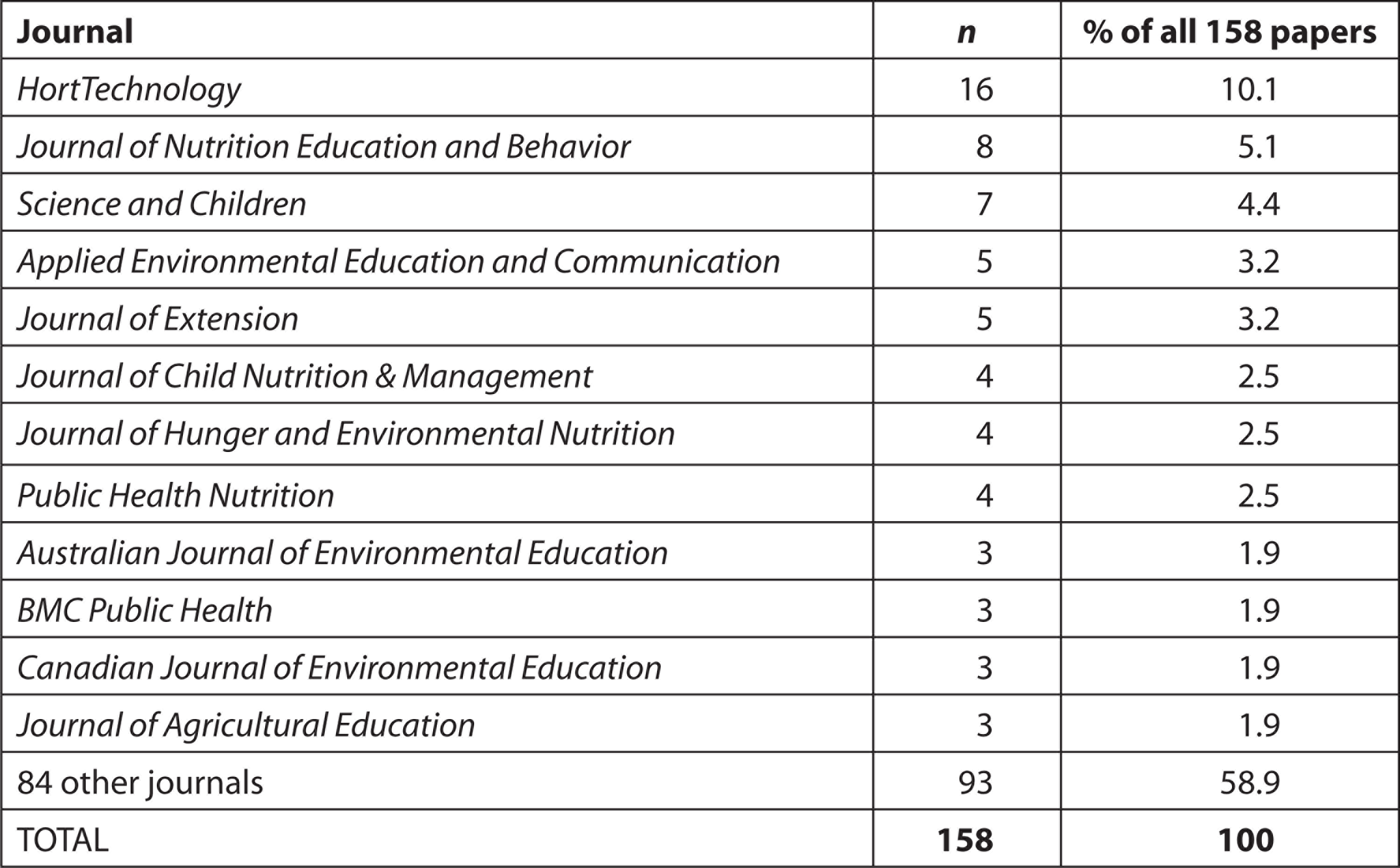
The 158 articles were published in 96 different journals. The journal HortTechnology published the largest number (16) of articles in the field, while 84 journals published only one or two articles related to school gardens. Of the 12 journals that published three or more articles, five had titles that referred to nutrition and health (see Table 2). This provides the first impression of one of the main foci in this field of research.
Key Journals Containing School Garden Research
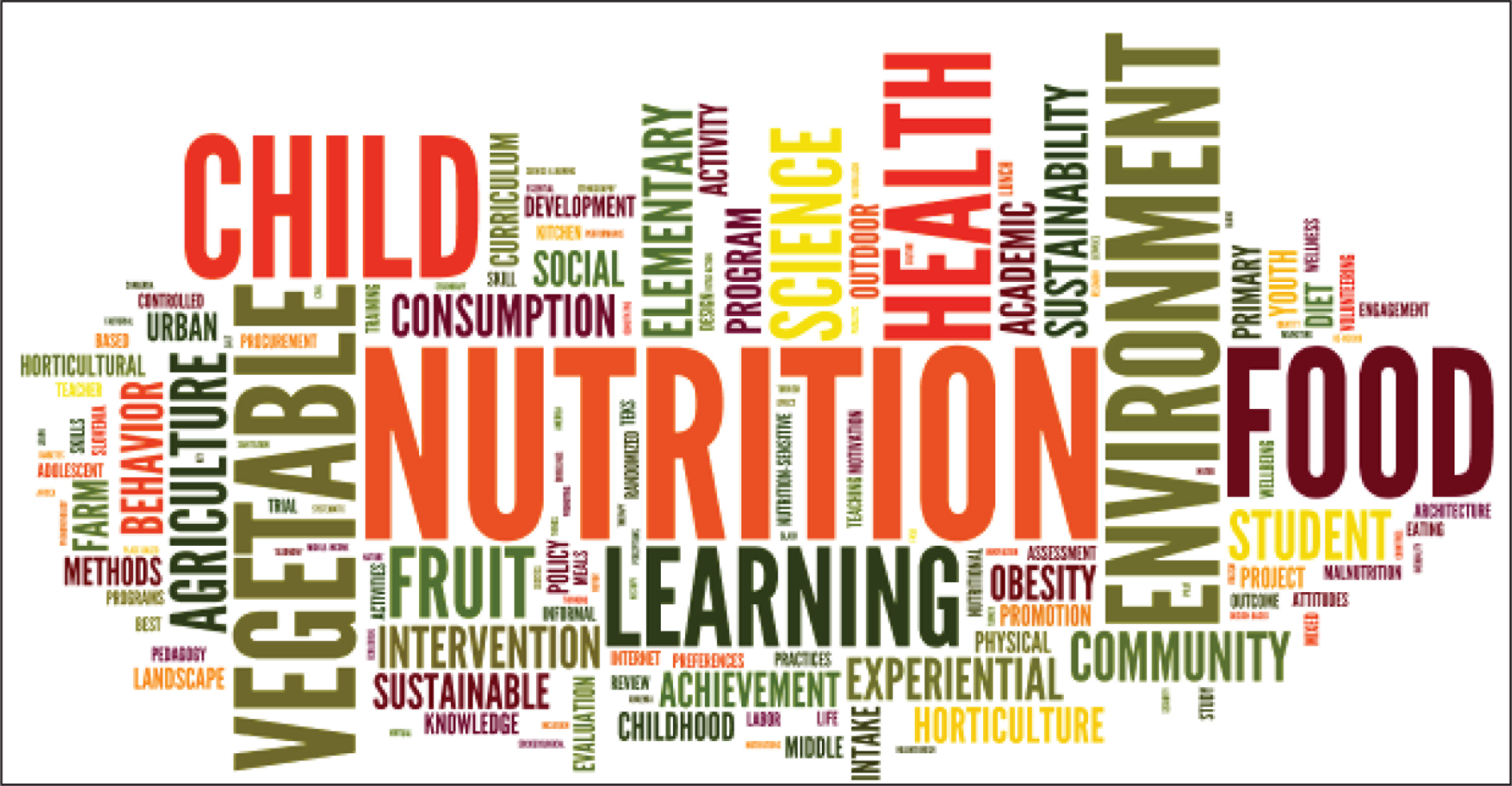
The word cloud in Figure 4 provides a graphical overview of the main research topics. It is a compilation of all keywords in the sample, but just 125 articles provided keywords other than the three obviously most common ones: ‘education’, ‘school’ and ‘garden’. The font size reflects the frequency of occurrence of the terms: The bigger the word, the higher the occurrence. The word cloud shows that the focus of research on school gardens since 1992 has primarily been on topics such as nutrition, health, or children as learners and the environment and not on global aspects and digital learning.
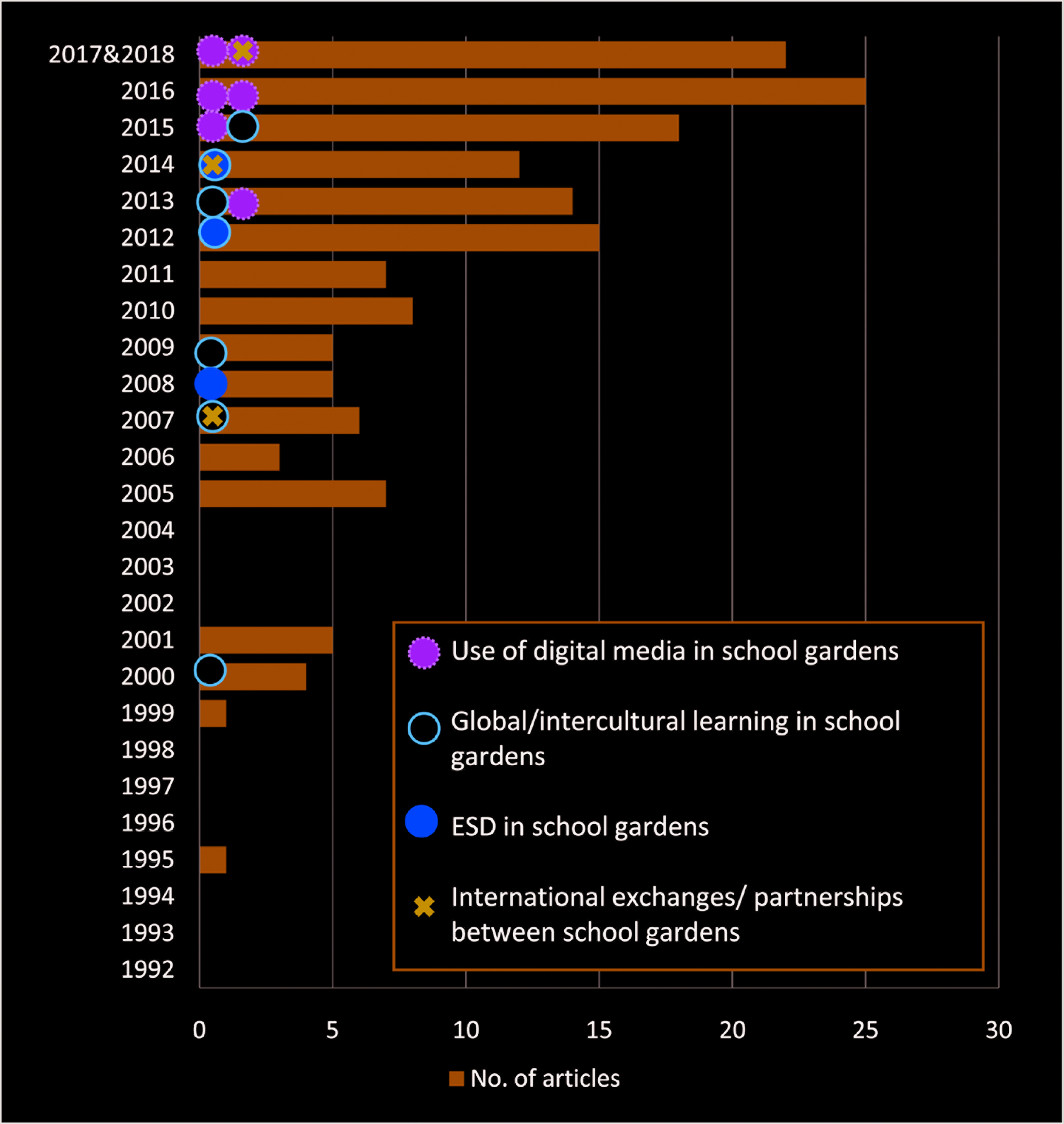
The growth in the number of articles over the time period that we analyzed is presented in Figure 5. It shows that it took about 10 years from the emergence of the first article to see a notable growth in quantity. Since 2012, the number of articles has surpassed the number of 10 per year, and since 2016, more than 20. The highlighted papers regarding the four different clusters are the ones that fulfilled the criteria for the qualitative content analysis, which will be presented in the next section. It is outstanding that the use of digital media in school gardens is something very recent, whereas the topics of global/intercultural learning and ESD in school gardens had already emerged in articles as early as 2000.
Embedding of the Global Perspective of ESD in School Gardens Since 1992
The quantitative analysis provided a first answer to the question of how the global perspective of ESD has been embedded in school gardens since 1992: The frequency of the search terms from Table 1 regarding global and intercultural learning and educational concepts provides a first overview.
From the first cluster regarding global and intercultural learning, we found four of the related search terms in the titles, abstracts and keywords of 11 articles: ‘Global’ was used seven times in three articles, ‘multicultural’ was used 10 times in four documents, and the terms ‘international’ or ‘binational’ were used seven times in five articles. All other terms did not appear in any of the articles. Of these 11 articles, three used the terms in a different context. Of the other eight articles, Johnsons (2012) and Wolsey and Lapps (2014) used the terms with respect to connecting local gardening with the global context and were of particular interest in the context of this paper. The other articles described school gardens as places for multicultural learning (Cutter-Mackenzie, 2009; Sloan, 2013; Williams & Anderson, 2015) or drew international comparisons between school gardens (Bowker & Tearle, 2007).
Table 3 displays the use of terms related to educational concepts in the sample of articles. In 11 per cent of the sample, the authors highlighted an educational concept in the abstract, title or keywords.
Frequency of Terms Regarding Educational Concepts Found in the Abstract, Title, or Keywords
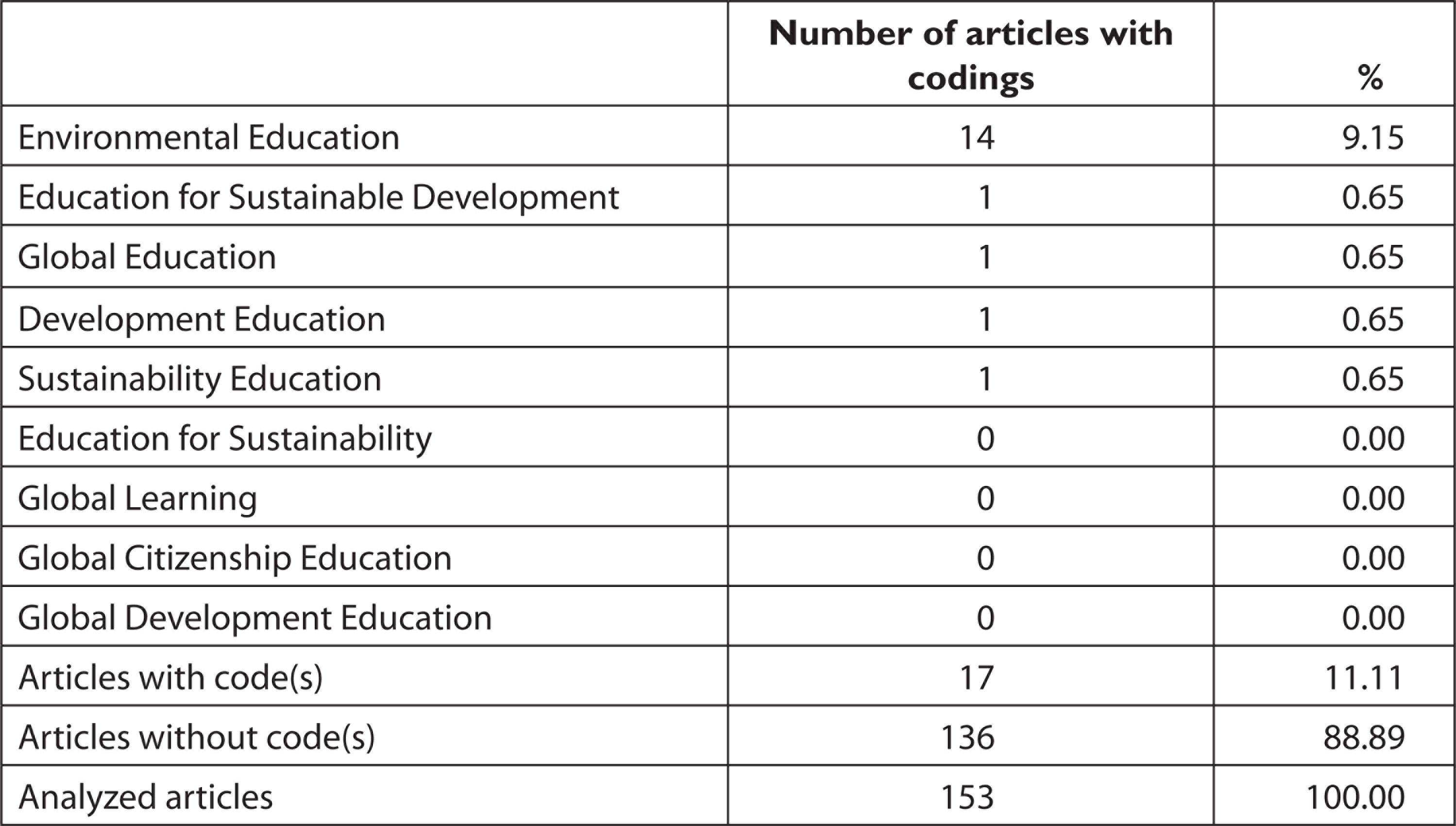
In 14 articles (9 per cent of the sample), Environmental Education was mentioned 21 times. The remaining 2 per cent was comprised of the terms Global Education (1/1 6 ), Education for Sustainable Development (2/1), Development Education (1/1) and Sustainability Education (1/1). As ESD and Development Education were used in the same article (Johnson, 2012), there were three articles that explicitly referred to the context of the research question. Two of the three articles were the same ones (Johnson, 2012; Wolsey & Lapp, 2014) that were mentioned in the context of the cluster ‘global/intercultural learning’. The third article was ‘Sustainability Education’s Gift’ by Williams (2008). The article by Marturano (2000) was added by manual coding.
A total sample of eight articles relating to the global perspective of ESD was analyzed to answer the research question: How has the global perspective of ESD been embedded in school gardens since 1992? The four codes were addressed with the following frequencies:
Content related to global ESD (addressed in six of eight papers) Multicultural gardening and English as a second language (addressed in four of eight papers) Garden design (addressed in four of eight papers) School garden exchanges (addressed in two of eight papers)
Content Related to Global ESD
There are different examples that show how specific content can be used to integrate a global perspective of ESD into the school gardens: ‘Using the experience of growing crops to teach children about current global issues concerning food, including our dependence on each other and the importance of using natural resources in a sustainable way’ (Bowker & Tearle, 2007, p. 84). Specific crops (e.g., beans) are recommended as entry points for teaching children about ‘soil fertility, water use, pollution, climate change, world growers’ (Johnson, 2012, p. 586 ff.). Also, the centre of origin of different crops shows how ‘global’ the garden is (Johnson, 2012; Marturano, 2000; Sloan, 2013; Williams & Anderson, 2015). Sloan (2013) gives the example of ‘carrots (which) are an excellent and fascinating plant (…) to explore the origins of where, who, how and when carrots were first grown and spread around the world through exploration expeditions and nomadic cultural geographical movement’ (Sloan, 2013, p. 27). Also, the different cultural uses of plants can be a topic that has the potential to bring the global perspective of ESD into the school garden (Johnson, 2012; Sloan, 2013; Williams & Anderson, 2015; Wolsey & Lapp, 2014). Various uses in cuisine, households, religion and medicine can be found through Internet research (Sloan, 2013, p. 27 ff.; Williams & Anderson, 2015, p. 36). Also, learners with different cultural backgrounds can share their own experiences with plants (Sloan, 2013, p. 27; Williams & Anderson, 2015, p. 27 ff.; Wolsey & Lapp, 2014, p. 56). Williams and Anderson (2015) described how the sensory perception of crops can bring back memories, which can lead to storytelling about different cultural or family traditions (Williams & Anderson, 2015, p. 35 ff.).
Multicultural Gardening and English as a Second Language
If the group working in the school garden has a diverse cultural background, as already mentioned, it can be a rich resource for including the global perspective of ESD in the school garden activities. Cutter-Mackenzie (2009) provided the example of linking ‘gardening and teaching English as a Second Language’ (Cutter-Mackenzie, 2009, p. 130): The garden can be a space for interacting and using English in a hands-on environment so that the needs of ‘multicultural and multilinguistic students’ can be addressed (Sloan, 2013, p. 27). Another format for multicultural gardening is ‘the practice of “gardening buddies,” namely parents/guardians/grandparents (typically new arrivals to Australia) as well as community members working with children in creating food gardens’ (Cutter-Mackenzie, 2009, p. 125), which provides an opportunity to bring people of various cultures and different stakeholders together.
Garden Design
Linked to the origin of the crops is the idea of dividing the school garden into continents and countries and grouping the crops according to their origin (Marturano, 2000, p. 34). A similar approach linked to multicultural gardening is the idea of growing plants that are associated with students’ ethnic origins (ibid.). The school garden is supposed to reflect and honour the cultural heritage of the learners (Cutter-Mackenzie, 2009, p. 125 ff.; Williams, 2008, p. 48), and specific wishes regarding crops can be integrated (Williams & Anderson, 2015, p. 31).
School Garden Exchanges
Two authors mentioned VSGEs in their articles: Bowker and Tearle (2007) wrote about the beginning phase of the project Gardens for Life, in which school gardeners from England, Kenya and India shall, amongst other things, exchange with each other. ‘In this way, it is hoped that children can share their knowledge, ideas and experience, and hence gain insight into other cultures and ways of life’ (Bowker & Tearle, 2007, p. 84). Also, Johnson (2012) addressed links between learners from around the world, suggesting that in this way, ‘children can find distributed knowledge that engages them emotionally and clarifies their place in the world, their values and attitudes’ (Johnson, 2012, p. 591).
Use of digital media in school gardens since 1992
From the third cluster ‘digital media’, we found nearly all of the search terms in the titles, abstracts and keywords of 19 articles. In 13 articles, the terms were used in the context of the methodological approach. The remaining hits led us to six articles that used the terms in the pre-defined understanding: either the use of digital media such as photos (Chen, Lou, & Shih, 2013; Thorn, Rye, & Walls, 2017), video conferences (Smith, Wright, Hrncirik, & Deen, 2017), videos (Dzubak, Shaw, Strohbehn, & Naeve, 2016), or the adjectives digital (Zuiker & Wright, 2015) or virtual (Valpreda & Zonda, 2016) in the context of the educational programmes in the school garden. Through the manual coding of the sample, no article was added, but from the eight articles related to the global perspective of ESD, three (Johnson, 2012; Sloan, 2013; Williams & Anderson, 2015) made reference to the use of digital media and therefore appeared twice in the analysis. A total sample of nine articles related to the use of digital media in school gardens was analyzed to answer the research question: How has digital media been used in school gardens since 1992? The following six codes were addressed:
Digital media was used in the school garden for…
… teaching (addressed in four of nine papers) … documentation or reflection (addressed in four of nine papers) … providing information (addressed in three of nine papers) … monitoring the garden/plants (addressed in two of nine papers) … ‘communicating’ with plants (addressed in three of nine papers) … interacting with other people (addressed in five of nine papers)
Teaching
Digital media have been used, for instance, to create online courses (Dzubak et al., 2016) or provide websites on different garden-based lessons and learning units (Zuiker & Wright, 2015, p. 558). Dzubak, Shaw, Strohbehn, and Naeve (2016) provided the example of an online course on food safety and good agricultural practices: ‘The validated curricula include four or five short video modules, activities, instructor/facilitator lesson plans, knowledge assessment quizzes, and instructor manuals’ (Dzubak et al., 2016, p. 1).
Teaching can also happen through an application (app), which assumes the role of the teacher and helps the learner to garden (Valpreda & Zonda, 2016). Another way to teach is via video conferences: Smith, Wright, Hrncirik, and Deen (2017) described a programme in which a U.S. university used video conferences to train school garden staff in Burundi. Also, photos can be used as a tool to bring the garden indoors: With the photographic App GigaPan, learners can zoom in on panoramic ‘zoomable’ images to take a closer look at the details of a school garden (Thorn et al., 2017).
In most of the articles mentioned here, the use of digital media aims for a larger impact and/or to bring a ‘new’ topic into the school garden. This can include topics such as food safety, good agricultural practices (Dzubak et al., 2016), or food waste (Valpreda & Zonda, 2016). But they can also be designed to increase food security (Smith et al., 2017) or to raise awareness for details and motivate learners to have a closer look at things (Thorn et al., 2017).
Documentation or Reflection
There are different ways to document and to reflect on the learning processes that happen in the garden. Digital media can play a role in this. One option found in the literature analyzed here is the creation of powerpoint slides to capture certain gardening activities and to reflect on them (Chen et al., 2013, p. 2050). Experiences can be captured by taking photos (l. c., p. 2051; Williams & Anderson, 2015, 26) as a starting point for storytelling, which is particularly valuable for English as a second language learners (Williams & Anderson, 2015). Another reflection process via photos was described by Thorn, Rye, and Walls (2017): ‘to disclose students’ prior knowledge and pique interest, we asked students to write down questions they had about the image and share examples orally’ (l. c., p. 46). If sensors are used to collect data on factors influencing the garden, in a parallel activity called ‘data conversation’ (Zuiker & Wright, 2015, p. 567), the teacher and learners can view, observe, and ask questions about the graphs.
Providing Information
Digital media can be used to complement garden activities and provide the learners with information, for example, in the form of Internet research (Johnson, 2012, p. 588) or with the help of a special encyclopaedia embedded in a garden app (Valpreda & Zonda, 2016, 11). In addition, sensors can be used, e.g., to obtain information about certain factors that influence the garden. One article stated that, ‘based on these data, the app and website can also generate graphs of sensor data in real time and over time’ (Zuiker & Wright, 2015, p. 560). Valpreda and Zonda (2016, p. 1) proposed such a combined system in the form of a virtual avatar aimed at providing the learners with all the information they need.
Monitoring the Garden/Plants
Zuiker and Wright (2015) provided an example of how learners could monitor their gardens by means of photo documentation, visual observation, or scientific instruments. With the help of probes, ‘data about four environmental indicators in real time and over time (…) and alerts related to threshold values (are provided)’ (Zuiker & Wright, 2015, p. 567). Also, the design of the garden can be organized and refined on the basis of the ‘observations of the physical environment and evaluations of data from a networked digital probe’ (l.c., p. 556).
Valpreda and Zonda (2016) described an app that regularly provides learners with data collected by sensors and compared ‘with the values that are preferred for optimal growth of the plant’ (Valpreda & Zonda, 2016, p. 4 f.).
‘Communicating’ with Plants
‘Technology has the ability to connect humans and environments through virtual portals’ (Sloan, 2013, p. 28). As we already described under ‘monitoring’, ‘cyber-physical systems’ (Zuiker & Wright, 2015) provide many opportunities for interaction, for example, a virtual avatar who:
displays the attitude/mood of the plant through facial expressions and text bubbles. If the child clicks on the avatar he will be asked to input certain data related to the physical conditions of the plant (amount of leaves, status of the soil and other observations). This data will be used to further determine what actions appear in the to-do list, as well as the appearance of the plant and what it will tell and ask the child to do. (Valpreda & Zonda, 2016, p. 8)
Interacting with Other People
Digital media can also be used to interact with other people. Via the Internet, people are much better and more easily connected today than they were a few decades ago (Sloan, 2013, p. 28). Social networking (e.g., via a blog) provides many options to engage in and exchange experiences with other learners working in a school garden (Johnson, 2012) or people using the same garden-based app (Thorn et al., 2017; Valpreda & Zonda, 2016). In addition, as we already mentioned under ‘teaching’, technology such as video conferences can be used to exchange with or teach people from distant parts of the world (Smith et al., 2017).
Establishment of international exchanges/partnerships between school gardens since 1992
The search terms included in the international exchanges and partnerships cluster were used in seven articles but not in accordance with the pre-defined understanding, which is: exchanges in a global, intercultural context, ideally an exchange between learners from two or more schools with school gardens. But it can also be an exchange between a school and an NGO or another institution in a different country. In seven articles, the terms were used twice in the context of school-community partnerships, and in the five other papers, they were used in the context of a partnership with, for example, a local producer. However, in none of the seven articles was an international partnership named.
In the qualitative analysis of the papers related to the global perspective of ESD and the use of digital media, two categories referred to international exchanges between school gardens: ‘school garden exchanges’ and ‘interactions with other people’ (see above).
However, whereas Johnson (2012) and Sloan (2013) referred just very generally and incidentally to the option of exchanging with school gardens from another part of the world, Thorn et al. (2017) and Valpreda and Zonda (2016) identified social networking as a way to share experiences, but they did not discuss it in more detail. Smith et al. (2017) reported on an exchange between a university and school garden staff, a point that is interesting but does not represent an exchange between school gardens. Closest to the definition (see above) was the planned exchange described by Bowker and Tearle (2007): In the project Gardens for Life (GfL), the schools in India, Kenya and England were supposed to have an exchange twice a year.
The global context is central to the work of the project and brings with it richness and diversity in cultural, communication and geographic issues. Exploring this diversity is undertaken through the common purpose of ‘growing food’ which is the focus of the GfL project and allows all involved to have a reason and common basis for communicating with each other and sharing practices. (Bowker & Tearle, 2007, p. 87)
The study by Bowker and Tearle (2007) was conducted in the beginning phases of the GfL project and primarily focussed on the different ways of experiencing and perceiving the school garden in the three different countries. At the end of their article, Bowker and Tearle (2007) mentioned:
It would be interesting to see whether, as opportunities for (discussion and exchanges with children in other cultures and locations) are promoted and facilitated, the situation changes, and whether children associate the gardens with learning about global issues and the positive actions that they can take as individuals with regard to food and agriculture. (Bowker & Tearle, 2007, p. 98)
The authors also presented a hypothesis: ‘It could be that, as the global links grow and become more active, children can use their different perceptions and knowledge bases positively, and can begin to learn from each other via their shared focus of gardening and growing’ (Bowker & Tearle, 2007, p. 98). They also refer to Desmond et al. (2004) who noted that ‘there is an urgent need for the practitioners of garden-based learning in both the “developed” and “developing” worlds to learn from one another’ (Desmond, 2004, p. 73). Bowker and Tearle (2007) finalized this outlook with a set of questions about how VSGEs might affect learners (ibid.).
Discussion of methods and findings
The systematic literature review provided us with a picture of school gardens as a diverse and heterogeneous field of research. Although we applied a thorough and systematic search strategy, the process shed light on a number of limitations. Because not all articles, especially from the early 1990s, have been digitized and made available in databases, there might still be some articles that are missing from our sample. As the research foci are so diverse, there is not a single specialized journal for the field, and the articles have been published in a wide array of journals, and not all of them are easily accessible and indexed in databases. Thus, for us to have provided an overview that was as complete as possible, intensive additional search steps would have been necessary.
In terms of authorship and distribution of research, our results show a strong predominance of North American, British and Australian researchers in the field whose studies also focus primarily on the countries of the Global North, and there is still no indication of any change in this respect. Given the development of school gardens in countries in the Global South, it appears we have much to learn. Encouraging, supporting and conducting more research in these as yet underrepresented regions will help us better understand the relevance of different contexts as well as general drivers and barriers to the use of school gardens. Future research will also help integrate the global perspective of ESD into school garden work and will contribute to the crossing of colonial boundaries.
In this context, it is worth emphasizing that a clear limitation of our study is that it was restricted to articles with an English-language abstract. Including articles published in French, Spanish and Portuguese, for instance, would probably show a much stronger contribution to school garden research from Africa and Latin America. Nevertheless, it is important to take into consideration the fact that international scientific discourse is heavily dominated by the English language. Thus, although it would be important to include articles in other languages in future literature reviews, it remains true that a stronger participation of non-Western researchers in the leading research journals of the field of ESD and school gardens (see Table 2) and collaborative and comparative research would be important for creating a real North–South dialogue.
Apart from the limitation resulting from including only articles with English-language abstracts, the fact that many different wordings were used in different contexts influenced our results. We used school garden, garden-based learning and learning garden as the entry point for our database research, but in the review process, we noticed that there were some more terms used synonymously with school gardens such as kitchen garden in the Australian context or butterfly or eco-garden, with a stronger focus on biodiversity aspects. A similar problem appeared with respect to the phrasing ‘Virtual School Garden Exchange’. The large number of words that were synonymous with ‘virtual’ and ‘virtual exchange’ and, by extension, an even larger number of possible combinations with ‘school garden’ led to a rather complex and sometimes inconsistent terminology. Therefore, our strategy was to start with the more frequently used terms such as ‘school garden’, and then we used the search terms (see Table 1) to narrow the results down until we arrived at a condensed sample that might give some hints about VSGE. Thus, 14 articles were identified, and their analysis led to some valuable insights.
Drawing from the systematic literature review, we were able to answer the three research questions regarding the embedding of the global perspective of ESD, the use of digital media, and the international exchanges in and between school gardens.
Eight articles provided examples of an integration of the global perspective of ESD into the school garden in the form of content, multicultural gardening, the garden design and school garden exchanges. In just three of the eight articles, the authors used the actual term or synonyms of ESD. This shows that the embedding of a global perspective of ESD into the practice of school garden work (Richards, n.d.; SGGN, 2010; Slabe, 2017; Tempel, 2013) is almost not reflected in academic discourse. It is also possible that some researchers and practitioners do not identify their work as ESD. This poses a major challenge for a systematic literature review. The four codes that were defined in the inductive coding process were in line with the potentials identified, for example, by SGGN (2010) or Slabe (2017) regarding the integration of the global perspective of ESD into school gardens. This shows that practice and theory in this field do match and have recognized the same potentials.
Nine of the 14 articles described the use of digital media (e.g., photos, online courses, applications, blogs, sensors, video conferences) for teaching, documentation or reflection, providing information, monitoring of gardens and plants and interacting with plants or other people. Interacting with other people through digital media is in most cases different from what has been described by Schreiber (2001) and Schreiber and Siege (2016) regarding VEs. The combination of local gardening and VEs seems to be recognized as a field with potential (Johnson, 2012; Sloan, 2013) but one that has not yet been analyzed in research. These nine articles were published within the last six years (2012–2018) and show that it is quite a recent development and that strong further development in the upcoming decades may be possible (see Figure 5).
This leads to the last research question regarding international exchanges between school gardens. Only a few papers covered this issue. Out of the pool of articles on the integration of the global perspective of ESD into the school garden, Bowker and Tearle (2007) mentioned exchanges among school gardens in India, Kenya and England as part of the analyzed programme. However, their study was conducted before the exchange had been established, and therefore, it could not provide any insights of relevance for our review. The analysis of the use of digital media resulted in some articles that covered cases of digital media being used to interact with other people, also internationally (Smith et al., 2017), but not between two or more school gardens. Compared with selected examples of VSGE described by Lochner (2016), which show that the practice of VSGE has become more common, the research landscape of school gardens is still limited.
Nevertheless, there may be more research on VSGE that we have not identified in our review process due to the circumstances already described above. It is possible that a systematic literature review using ‘virtual exchange’ 7 as a starting point instead of ‘school garden’ might reveal more studies in the field.
Conclusion
The systematic literature review carried out in this study illuminates the scientific literature on school gardens from 1992 to 2018. We selected 158 peer-reviewed articles with an English-language abstract and a specific understanding of school gardens. We used three different angles to determine whether VSGE or a similar approach had been described in any of the articles. The first angle, regarding the embedding of the global perspective of ESD in school gardens, highlighted two papers that described exchanges between school gardens. The second angle referred to the use of digital media in school gardens and provided insights into different uses. The use of digital media to communicate with other people described in five papers was particularly interesting because it is a core element of VSGEs. For the third angle, we analyzed articles regarding international exchanges or partnerships between schools. The VSGE concept was described in only a single article but before the exchange actually took place.
The findings of our systematic literature review led us to conclude that no scientific literature—at least not fulfilling our conditions—has been published on the experiences gathered during the implementation of VSGEs. Bowker and Tearle (2007) formulated some hypotheses in their paper, such as the assumption that ‘as the global links grow and become more active, children can use their different perceptions and knowledge bases positively, and can begin to learn from each other via their shared focus of gardening and growing’ (Bowker & Tearle, 2007, p. 98). Future research could address questions such as: How does participation in a VSGE affect the knowledge/values/competencies of the learners? Are there differences between the use of different digital media regarding the learning outcome? How do language and language competences influence the outcome of a VSGE?
Because the link between local acting in the school garden and global thinking and learning in a VSGE seems to hide a great deal of potential, we suggest further implementation accompanied by research.
Footnotes
Declaration of Conflicting Interests
The authors declared no potential conflicts of interest with respect to the research, authorship and/or publication of this article.
Funding
The authors disclosed receipt of the following financial support for the research, authorship, and/or publication of this article. This work was supported by a studentship for J. Lochner awarded by the Heinrich Böll Foundation. Further support was granted by the Interdisciplinary Centre for Educational Research at Humboldt Universität zu Berlin.