




Abstract

Dear Editor,
Fibromyalgia syndrome (FMS) is an intriguing syndrome of widespread pain with fatigue, sleep disturbance, cognitive issues, and multiple somatic complaints. 1
Alpha-gal syndrome (AGS), a relatively new revelation, is a potentially fatal delayed allergic reaction to the flesh/meat (and its derivatives) of non-primate mammals. It is a tick-borne disease (TBD) associated with the bite of the lone-star tick that results in a rather intriguing IgE antibody response to galactose-α-1,3-galactose (alpha-gal), an oligosaccharide-antigen. The allergic reaction is delayed, occurring typically 3–8 hours after exposure to the allergen. 2
From January 2021 to January 2024, we studied a total of 301 patients diagnosed with FMS at our Rheumatology service. The diagnosis of FMS was made by applying the 2016 criteria from the American College of Rheumatology. 1 AGS was diagnosed based upon classic historical delayed allergic reactions to non-primate mammalian products including flesh/meat (beef, pork, venison, lamb), medications, personal products, etc., plus an elevated serum level (>0.1 IU/mL) of IgE antibody to alpha-gal. 2
Of these 301 FMS patients, 33 had concomitant AGS. Their baseline clinical characteristics are shown in Table 1. The main demographic features were: 100% American Indian (AI) race, 90% male gender, age range 25–70 years (mean age 45 years). Only 10 out of the 33 patients were able to remember a tick bite (attached) within the preceding 5-year period. Eleven of the 33 patients had tolerated mammalian flesh for several years following tick exposure before developing FMS and concurrent AGS. On a plant-based nutrition plan and by avoiding exposure to mammalian-meat-derived products, the symptoms of FMS abated completely within 1–3 months in all 33 patients. All 33 patients now carry an epinephrine pen at hand for incidental exposure to the allergen.
Baseline Clinical Characteristics of the 33 Patients with FMS and AGS.
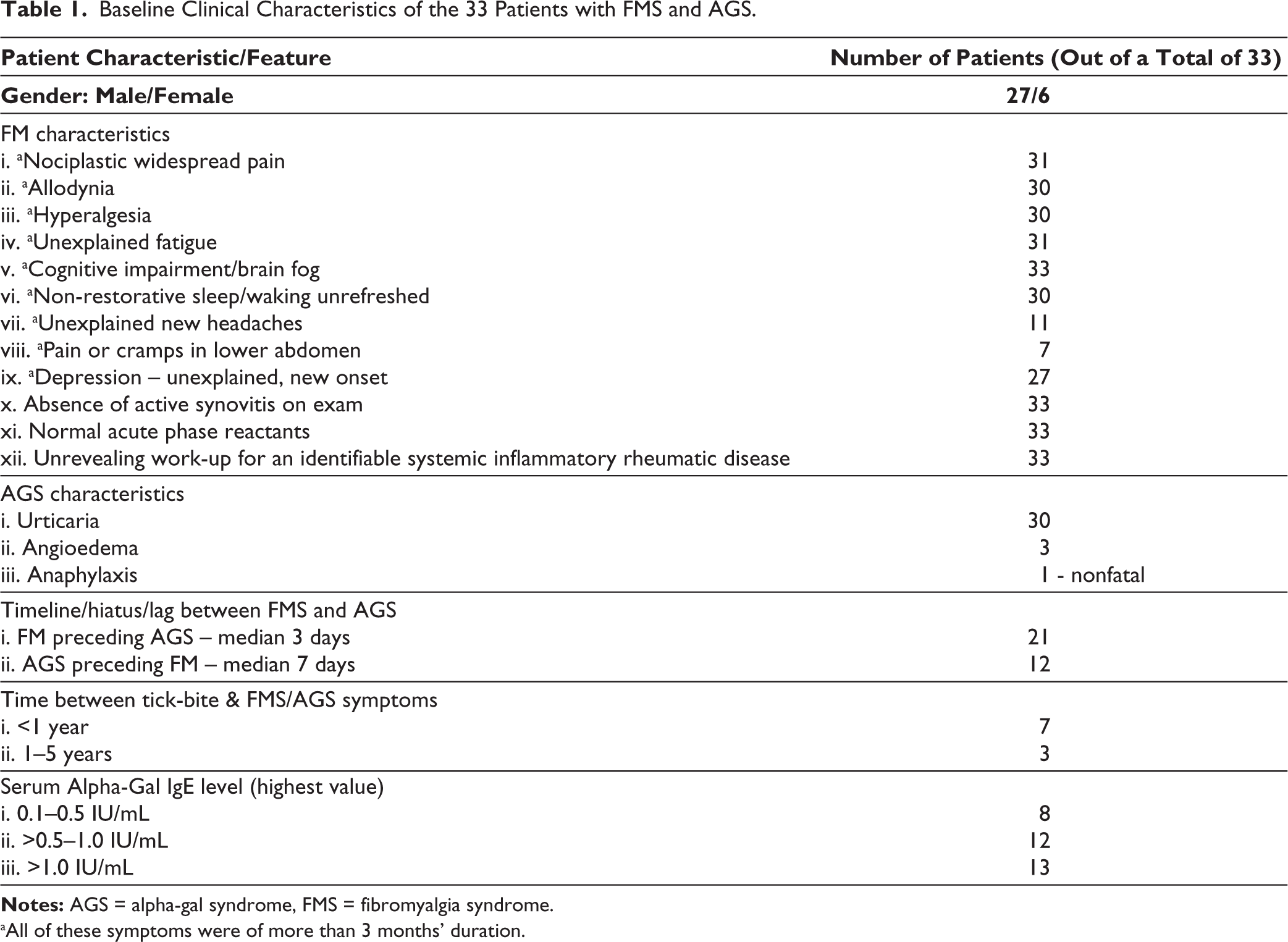
aAll of these symptoms were of more than 3 months’ duration.
FMS remains a challenging condition for patients and healthcare professionals for multiple reasons: there are no known specific biomarkers to confirm or refute the diagnosis; nociplastic pain is accompanied by a wide range of ancillary symptoms that may not easily align with established medical diagnostic categories; and, there is a paucity of effective pharmaceutical therapy.
TBDs are an emerging public health issue. In a recent largest-to-date population-based cross-sectional serosurveillance study of AGS in the United States (US), alpha-gal IgE was associated with musculoskeletal symptoms in the southeastern US. 3
There is an increase in the incidence and prevalence of AGS. 2 In addition to the US, cases have now been observed worldwide including Europe, Australia, Japan, and South Africa. 4 This observation will lead to an increasing level of awareness amongst healthcare providers about the unusual presentation of AGS as FMS and the total reversibility of FMS in this subset with lifestyle strategies, including avoiding exposure to the inciting allergen, that is, non-primate mammalian meat and products derived from it, including perfumes, deodorants, detergents etc.
Our clinical experience in the past 3 years continues to reveal a strikingly vast spectrum, and quite an unusual presentation of various rheumatic diseases in the unique AI population. 5
We are still waiting for a revelation about a plausible theory behind AGS manifesting as FMS.
Footnotes
Declaration of Conflicting Interests
The authors declared no potential conflicts of interest with respect to the research, authorship and/or publication of this article.
Funding
The authors received no financial support for the research, authorship and/or publication of this article.