Abstract

Takayasu arteritis (TA) is a systemic large vessel vasculitis which predominantly affects young females of the child- bearing age group. Amongst the various clinical features of TA, renovascular hypertension is one of the most important clinical features and a significant cause of morbidity and mortality. Moreover, if we look at the pattern of arterial involvement, abdominal aorta and renal artery involvement in TA are much more common in Indian patients than in their Western counterparts 1 . Thus, the management of hypertension becomes a much more significant challenge in Indian patients of TA. As TA is more common in young women, the management of pregnancy in patients with TA is of great importance in clinical practice. Like non-pregnant patients, the management of hypertension becomes a significant challenge in TA patients with pregnancies. The challenge in managing hypertension in pregnancy lies in the fact that pregnancy is known to increase intravascular volume, thus exacerbating pre- existing hypertension. Besides, it is not uncommon for the patients of TA to present with hypertension for the first time in pregnancy. Hypertension can worsen the cardiovascular status and can lead to intra-uterine growth retardation, stillbirth, maternal heart failure, or even maternal mortality. Apart from the management of hypertension, other aspects of the management of TA patients, like managing immunosuppression during pregnancy, also warrant attention.
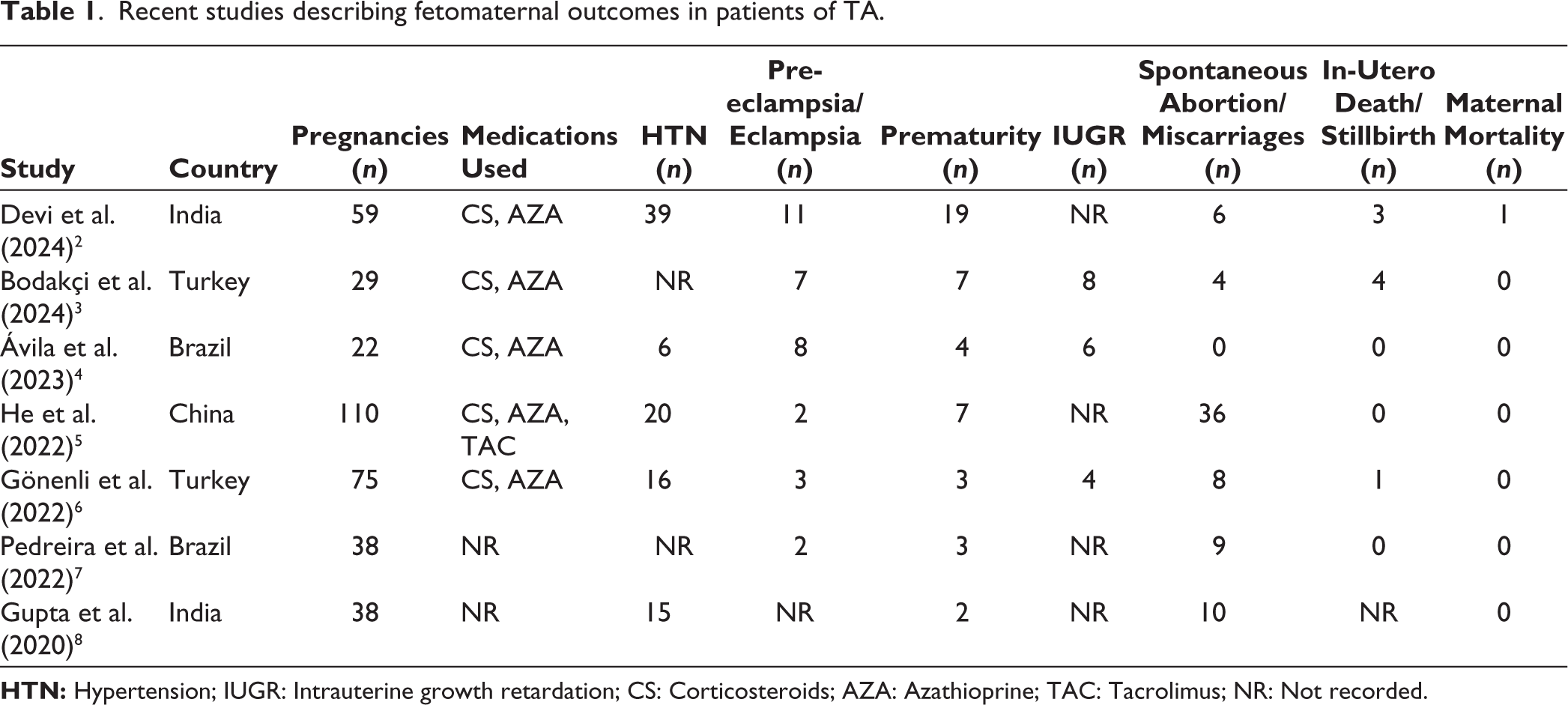
In this current issue of the journal, a retrospective study by Devi et al. discusses the maternal and perinatal outcomes in patients of TA 2 . Authors have analyzed the feto-maternal outcomes amongst 38 TA patients. New onset hypertension or worsening of pre-existing hypertension and preeclampsia/eclampsia are the most common maternal complications found in that study. On the other hand, prematurity and spontaneous abortion were the most encountered fetal complications. Previously, several studies looked at the pregnancy outcomes among TA patients. The results of the recent studies are summarized in Table 1. Similar to the current study, most of these studies found that new-onset hypertension is the most encountered pregnancy complication in patients of TA, followed by preeclampsia and eclampsia. The risk associated with hypertension is irrespective of prior treatment by antihypertensives. It has been seen from previous studies that additional factors like the active disease, diagnosis of hypertension and renal artery involvement before pregnancy are associated with adverse feto-maternal outcomes 5 . These subsets of patients need closer follow-up and more intensive control of disease activity and blood pressure to avert adverse pregnancy outcomes. Indian patients with TA are known to have more tendency to renal artery involvement. The current study by Devi et al. also highlights this fact. They have also found that 34% of patients have had renal artery involvement, and 66% of patients are suffering from chronic hypertension in their cohort, thus partly explaining the comparatively higher incidence of complications like hypertension exacerbation or preeclampsia/eclampsia than other studies. Therefore, this study by Devi et al. emphasizes the critical importance of close monitoring of TA patients in pregnancy in improving feto-maternal outcomes, especially in Indian settings.
Recent studies describing fetomaternal outcomes in patients of TA.