



Abstract

To the Editor,
Antineutrophil cytoplasmic antibody (ANCA) associated vasculitis is a rare multisystemic small vessel vasculitis in children. Advancement in management has led to improvement in mortality. 1 However, several patients continue to experience poor quality of life and increased morbidity because of relapsing-remitting course and adverse effects of medications. There is increased distress in children owing to neglect from peer groups, further adding on to the disease morbidity. 2
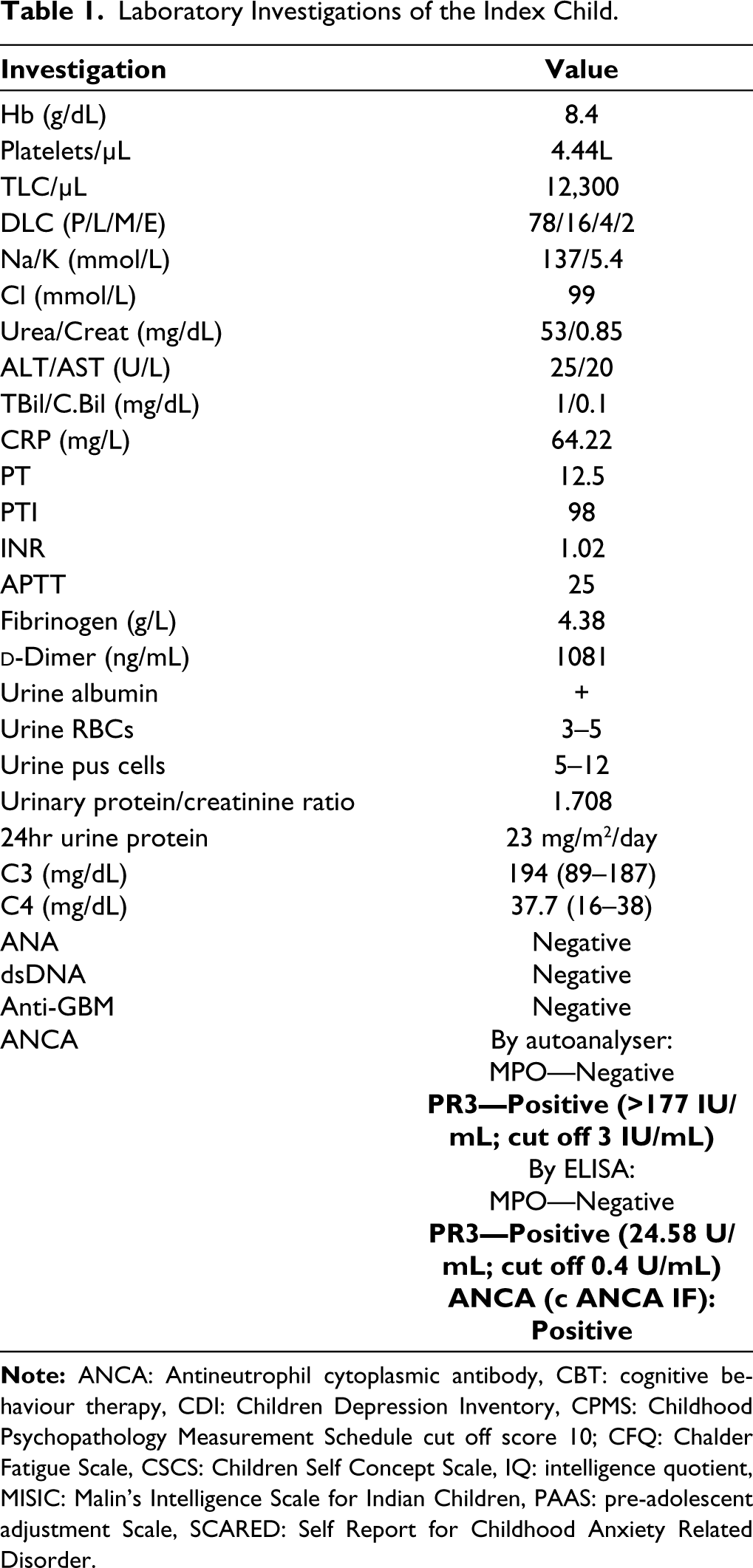
A 10-year-old girl presented to us with pain at multiple large joints for 1 year and acute onset febrile illness associated with epistaxis, haemoptysis, respiratory distress and red eyes. She was diagnosed with ANCA vasculitis with diffuse alveolar haemorrhage, renal involvement and episcleritis (laboratory investigations are summarised in Table 1). Injection pulse methylprednisolone (30 mg/kg/day for five days) was administered followed by oral prednisolone (2 mg/kg/day initial dose followed by tapering), cyclophosphamide (500 mg/m2/month for six months) and azathioprine (2 mg/kg/day). She achieved clinical remission at nine months of therapy.
Laboratory Investigations of the Index Child.
Her mother started noticing declining school performance after diagnosis and initiation of treatment. She complained of inattention and loss of interest. She shared good peer relationships prior to the onset of illness. However, she realised that her friends were not treating her well and avoided her in multiple instances. She was also concerned about her physical appearance, hair loss, weight gain, fatigue, pain and stretch marks over shoulders and feet.
ANCA-associated vasculitis may have a great psychosocial impact due to poor peer relationships, adjustment disorder, 3 anxiety, depression, 4 changes in lifestyle and poor quality of life. 5
The index patient had average intellectual abilities with several behavioural issues. She was evaluated for psychopathology, anxiety, depression, fatigue, adjustment and self-concept before and after therapeutic interventions. Given her age and complex behavioural issues, her mother was assigned as a co-therapist for a 12-week period of weekly 2-hour sessions. Cognitive restructuring skill training was used to encounter negative beliefs and better interpret situations along with psychoeducation, and social skill training to strengthen parent-child relationships and lessen family conflicts.
Her pre-assessment scores were suggestive of high anxiety and severe depression. She was unable to cope up with the unpredictable nature of the disease. Similar findings have been reported in adults. 4 ANCA vasculitis also affects physical functioning in terms of easy fatigability and social functioning. 5
She had low self-esteem and scored low on physical appearance, anxiety and happiness sub-scales of children’s self-concept scale. As she was going through a transitional period of development, she could not handle the additive stress of disease. She also had significant adjustment problems at school, at home and with peers. She showed significant improvement in her scores following cognitive behavioural therapy (CBT) based intervention. Her compliance to medications also improved.
It is important to identify psychosocial issues in children with ANCA-associated vasculitis. Timely intervention using CBT may improve compliance with therapy and overall outcome.
Supplemental Material
The supplemental material for this article is available online.
Footnotes
Author Contributions
AG and AJ were actively involved in the diagnosis and management of this case. RS1 and RS2 were involved in the psychological part of management and behavioural interventions. AS and RS1 wrote the manuscript. AJ and AS edited the manuscript. AJ supervised the entire manuscript preparation.
Declaration of Conflicting Interests
The authors declared no potential conflicts of interest with respect to the research, authorship and/or publication of this article.
Funding
The authors received no financial support for the research, authorship and/or publication of this article.
Informed Consent
Written informed consent was obtained from parents of children included in this study for publication as clinical images.