




Abstract
Building on theoretical foundations from communication and disability studies, we ran an online experiment to study the influence of online constructions corresponding to the medical and social models of disability on attitudes toward wheelchair users. We recruited students from a public university in the Mediterranean region and, after a pretest on their attitudes toward wheelchair users, we had them read social media posts and online news items that corresponded to the medical model (medical experimental group), the social model (social experimental group) or were neutral (control group). The participants received the stimuli via email during a five-day period after the pretest and were then posttested. Pro-social stimuli produced a significant mild change in the expected direction, while the corresponding effect of pro-medical stimuli was not significant. Both social and medical group posttest means were significantly different from the control group posttest mean, suggesting that exposure to online constructions based on both models influences attitudes toward disability. A repeat posttest, administered one week after the posttest, showed stability of the observed changes. The study adds to the limited existing knowledge about the influence of online constructions on attitudes toward persons with disabilities.
Keywords
Attitudes toward persons with disabilities is a subject of study that has attracted strong interest in the research community (de Laat et al., 2013; Vornholt et al., 2013). Traditionally, these attitudes were affected by stereotypical constructions of physical and mental disability by the mass media. These constructions were typically built on individualistic conceptions and traditional models of disability, predominantly the medical model, which conceives disability as an impairment demanding medical treatment, and the charity model, which conceives disability as a humanitarian issue inviting pity and support from others (Bendukurthi & Raman, 2016; Holton et al., 2014; Priyanti, 2018). The social model of disability appeared as an alternative approach suggesting that what matters is not the medical condition of disability but how disability is constructed and treated by society (Oliver, 1990). The social model was embraced in both theory and practice, leading to the development of disability studies and the emergence of resistance movements (Ellcessor & Kirkpatrick, 2017; Fleischer & Zames, 2011).
The effect of traditional media content on attitudes toward disability has been studied widely (Lu et al., 2018; Reinhardt et al., 2014). With the advent of new media, research focus has turned to the relationship between online content and various aspects of disability, including the stigma of mental disorder (Kroska & Harkness, 2021), perceptions related to work and productivity (Reinhardt et al., 2014), and competitive sports (Bartsch et al., 2018; Ferrara et al., 2015; Shirazipour et al., 2015).
Yet, little is known about the effect of online medical and social model representations of disability on attitudes toward persons with disabilities (Dirth & Branscombe, 2017). The present study, which is located at the intersection of communication and disability studies, adds knowledge in this area by explicitly focusing on these two models of disability. Specifically, it contrasts the effects of internet content that promotes the medical model with the effects of internet content that promotes the social model on attitudes toward wheelchair users.
Background
Models of Disability
The medical model defines disability as a dysfunction, a pathological condition resulting from sickness, injury, or other medical cause, and it confines the disabled person within the limits of the medical profession (Oliver, 1990). It leaves no space for distinguishing impairment from disability. Disability is conceived as an individual problem, an impairment that must be treated, hopefully fixed, or at least rehabilitated, by professional intervention (Oliver, 1998). As such, disability is a deviation from what is physically or mentally ‘normal’, a violation of norms that are set by medical institutions and broadly accepted by society. Persons with disabilities must struggle to succeed in coming or returning to normality, to the extent that this is objectively possible. Disabled individuals are then considered unable, pitiful, and dependent (Koch, 2001; Smart, 2009).
This connects to the charity model, which, based on the same individualistic foundation, prioritises philanthropic principles: persons with disabilities, as naturally or otherwise challenged, are victims of circumstances outside their control and they are to be pitied. They deserve support, special services, and special institutions and the primary means of delivering these is philanthropy (Retief & Letšosa, 2018). The charity model relies on images of tragedy and despair; thus, inevitably, persons with disabilities are depicted as suffering a devastating impairment that deprives them of a potentially happy life. This can be seen in charity campaigns that depict disabled persons as miserable human beings (Shakespeare, 1994).
In contrast to these conceptions, the social model is based on the assumption of socially constructed reality. It rejects individualistic explanations and replaces individual pathology with societal inadequacy. Persons with disabilities are not disabled due to their impairment but due to ‘disabling barriers’ that exist in society (Oliver, 2013, p. 1024). According to this critical approach, by constructing disability as a matter of individual pathology, society does not acknowledge its failure to accommodate the diverse needs of its members. This construction has dire consequences for persons with disabilities, those very consequences that the medical and charity models uncritically endorse as objectively inevitable. According to the social model, persons with disabilities are able—not unable—to be incorporated into society and this calls for inclusion—not exclusion—practices (Finkelstein, 2004; Hughes & Paterson, 2006). The social model does not deny the existence of an impairment, but it differentiates it from disability: while the former is a set of limitations that result from conditions of the body or the mind, the latter is a set of limitations that result from the way society responds to the former (Campbell & Oliver, 2013; Shakespeare, 2006).
Extending the social model’s critical implications, the human rights model postulates improvement practices, predominantly those pertaining to basic human rights and human dignity (Degener, 2017). The human rights model brings into consideration the civil, political, economic, social, and cultural rights of persons with disability and supports these considerations with emphasis on the diversity of identities and membership in minority groups or disadvantaged strata, correcting, in a sense, the failure of the social model to appreciate diversity concerning race, gender, sexuality, and age (Oliver, 2013).
Social Influence
We now turn to the question of how representations of disability can influence attitudes. According to theories of social learning (Bandura, 1986) and social influence (Turner, 1991), individuals learn to think, feel, and behave through interaction with others. These learned thoughts, feelings, and behavioural tendencies are the building blocks of attitudes, which are generally defined as relatively stable evaluations about an object (the object can be anything from a person or group to behaviors, actions, or institutions). Social influence can result in attitudinal change in the direction of others’ attitudes and expectations, termed normative influence, or attitudinal change in directions consistent with information provided by others, termed informational influence (Deutsch & Gerard, 1955). The former process typically results in compliance or superficial change in attitudes, as in the famous experiments by Asch (1951). The latter process is more likely to produce a more lasting change, as it involves information processing but still relies on information provided by others as evidence that what the individual thinks and feels about reality is valid (Festinger, 1954).
When individuals are subjected to social influence, they are more or less likely to shift their attitudes depending on what they already feel and believe. Thus, prior attitude is important in predicting the probability and range of possible change. Social judgment theory (Sherif & Sherif, 1967; Sherif & Hovland, 1961) posits that if others’ opinions and attitudes are within one’s latitude of acceptance (i.e., close enough to opinions that the individual already accepts), change is more likely; whereas, if others’ opinions and attitudes fall outside this range and are consequently located in one’s latitude of rejection, change is less likely.
The importance of others becomes more well-defined if we take into consideration the role of reference groups and group norms (Tajfel & Turner, 1979). Group norms are expectations of the group in which an individual belongs and the tendency, assuming sufficiently successful socialisation, is to conform to these expectations (Deutsch & Gerard, 1955; McDonald & Crandall, 2015). Perceptions of group norms are formed through interaction with others in the wider process of socialisation, where the media are important agents.
The internet has brought radical changes in the producer–audience relationship, especially in the Web 2.0 environment, where the audience can interact, create content, and share ideas (Bruns, 2008; Jenkins, 2006). This interactive connection between source and audience can be multi-modal and multi- contextual (Ouirdi et al., 2014). Visual anonymity and physical isolation, in particular, seem to enhance, rather than impede, social influence (Spears, 2021). Sources of influence can also be more broadly conceived, as reference groups can be anything from one’s significant others, online friends, followers, and followees, to large online groups and communities, to society at large (Grincheva, 2015). Further, as the case is in traditional influence, normative and informational influence can operate together (Price et al. 2006). In experimental research on online influence, the nature of the stimuli is more diverse, including, inter alia, social media posts, online news items, and online comments (see Stylianou & Sofokleous, 2019, and next section). Group influence theory applies to contemporary research on online influence with both continuities, such as the role of uncertainty, user motivations, and reactance, and changes, such as the role of interface designs and algorithms and the interpretation of users’ online behaviors (Kim & Hollingshead, 2015).
Media Effects
A long research tradition has established that media content affects attitudes; albeit, in more subtle rather than profound ways (Severin & Tankard, 2001). Traditional media monopolised the social construction of reality until the late twentieth century and have played a crucial role in shaping audiences’ percep- tions and attitudes (McQuail, 2010). Regarding disability, the media have traditionally sustained stereotypical representations, consistent with the medical and charity models (Ellcessor & Kirkpatrick, 2017), as well as other individualistic conceptions, such as the supercrip model (Bartsch et al., 2018; Shirazipour et al., 2015). Rodan et al. (2016) have argued that the new media, too, can reproduce traditional stereotypes about disability; yet, internet users are more likely to critically evaluate and reject hegemonic representations.
Experimental research has generally supported that stimuli designed to influence attitudes toward disability are effective in this respect. Most studies have focused on persons with disabilities in competitive sports, typically using stimuli consistent with the supercrip or inspiration models of disability, which conceive disabled individuals in a positive (but still stereotypical) way, as possessing special skills, rather than having special needs. Shirazipour et al. (2015) found that stereotypical media representations of Paralympic champions have an admiration-inducing effect on non-disabled experimental participants, compared to disabled participants. Smith et al. (2017) found that, for experimental participants without disabled close friends or family members, the highest levels of motivation to watch Paralympic sports resulted from exposure to supercrip narratives; whereas, participants who were more familiar with disabled persons reported higher levels of aesthetic and aggression-induced motivation. Bartsch et al. (2018) found that television spots had a positive effect on empathy and interest as well as on feelings of closeness, elevation, and pity.
Other studies have looked at the effects of constructions of disability related to personal experiences, work, and productivity. Lu et al. (2018) ran an experiment where undergraduate students watched videos with personal experiences and views of persons with disabilities. Compared to a control group, the explicit attitudes of these students toward persons with disabilities became more positive, while their implicit attitudes became more negative, a finding that implies that cognitive evaluations of persons with disability are more consistent, compared to emotional reactions. Reinhardt et al. (2014) found that positive experimental stimuli (a short film favourably depicting a paraplegic police officer) had a positive effect on nondisabled participants’ evaluations of the employability of disabled persons in the Police.
Research on the influence of stimuli deliberately designed to represent the medical and social models is scarce. Notably, Dirth and Branscombe (2017) have shown that such stimuli influence attitudes in one correlational and two experimental studies. In their experimental studies, social model stimuli had a positive effect on pro-disability policy attitudes, mediated by awareness of structural disablism, and medical model stimuli had a negative effect on pro-disability policy attitudes, mediated by pro-status quo legitimising attitudes.
Reviewing this limited literature shows that more research on the effects of new media content on attitudes toward disability is needed. The few available studies show that such effects are present, opening roads for further investigation and accumulation of evidence that will, in turn, support the effort for the cultivation of pro-disability cultures and the application of inclusive policies. In this respect, even less is known about the influence of online medical and social constructions of disability. The present study has been designed following these considerations.
Hypotheses
The question guiding the present study is whether and to what extent exposure to online constructions of disability affects attitudes toward disability. We have chosen a focal category that is emblematic of physical disability and recognisable without further explanation or specification, namely, wheelchair users. Our focus is on online content that promotes conceptions of disability corresponding to either the medical and charity models or the social and human rights models. We refer to the former condition as medical and the latter as social. Respectively, we refer to pro-medical and pro-social content, conceptions, and attitudes. We use a single scale, ranging from pro-medical to pro-social attitude; thus, we refer to a measure of pro-social attitude, with higher values standing for more pro-social and lower values standing for more pro-medical attitudes.
Following social influence, we hypothesise that the stimuli (social media posts and news items) will cause attitude change in two directions:
These hypotheses call for observations of individual change in attitude within each group and they are examined through paired samples methodology. Two more hypotheses concern differences between groups exposed to different stimuli. Given the advantage of experimental design to rest on the ceteris paribus condition, we compare the change caused by different stimuli, thus:
These hypotheses call for group comparisons that take into consideration both within and between-group variation; thus, they are examined by linear regression.
Finally, our design operationalises informational rather than normative influence (Deutsch & Gerard, 1955). The participants were in isolation and there were no specific reference groups behind the stimuli. Yet, as our focus is on any effect of online content, we are not contrasting normative vs. informational influence hypotheses. Overall, we expected that any observed change in attitude, will involve some information processing and therefore will be lasting rather than short-lived. Therefore, our fifth hypothesis is:
Methods
Experimental Design
Our design is based on the model of the true experiment, which includes a pretest, a posttest, and experimental control. The latter condition was not fully met, as our measurement was done in the physical field and online, not in the lab. Still, we applied a matching process based on gender, field of study, and prior attitude to achieve group equivalence. The participants were pretested during recruitment, then placed in three groups, and posttested after the treatment. The stimuli were sets of messages sent via email. In addition, we also ran an online repeat posttest. Our design largely follows Stylianou and Sofokleous (2019).
Instruments and Pilot Test
To obtain valid and reliable measures of attitudes toward wheelchair users, we constructed two versions (pretest and posttest) of a 16-item questionnaire, based partly on previous studies (Dirth & Branscombe, 2017; Goreczny et al., 2011). Specifically, the pretest questions were slightly modified to produce an equal number of equivalent posttest questions. For example, the pretest item ‘The main issue for wheelchair users is not disability but negative social treatment’ was modified to ‘The main issue for wheelchair users is not negative social treatment but their disability’. The items were all statements about wheelchair users and participants were asked to express agreement or disagreement on a seven-point Likert scale (from fully disagree to fully agree). The number of items was eventually reduced to twelve, as explained next.
The two versions were pilot-tested for face validity and equivalence through anonymous administration in three undergraduate audiences (total N = 29) which were excluded from the main sample. The students answered the first version, dropped it in a ballot, and then answered the second version. For paired comparison, the two questionnaires were identically numbered for each participant. A pretest and posttest score for each participant was calculated by the addition of the 16 scored answers (coded from 1–7 in the pro-social direction). Pearson’s correlation coefficient between pretest and posttest scores was fairly good, but paired samples t-test showed a statistically significant mean difference. Based on these results and to keep an equal representation of pro-medical/pro-social statements, four items were dropped. The remaining 12 items behave well in terms of instrument equivalence, with r = .735, p < .001; mean difference = 1.27 units, t(28) = 1.12, p = .270, and in terms of item equivalence, based on paired comparisons. 1 Thus, we consider that the pretest and posttest instruments are equivalent.
Experimental Procedure
The experiment (conducted during the fall of 2021) included nine steps which are outlined in Table 1 and presented in detail in the following sections.
Experimental Procedure.
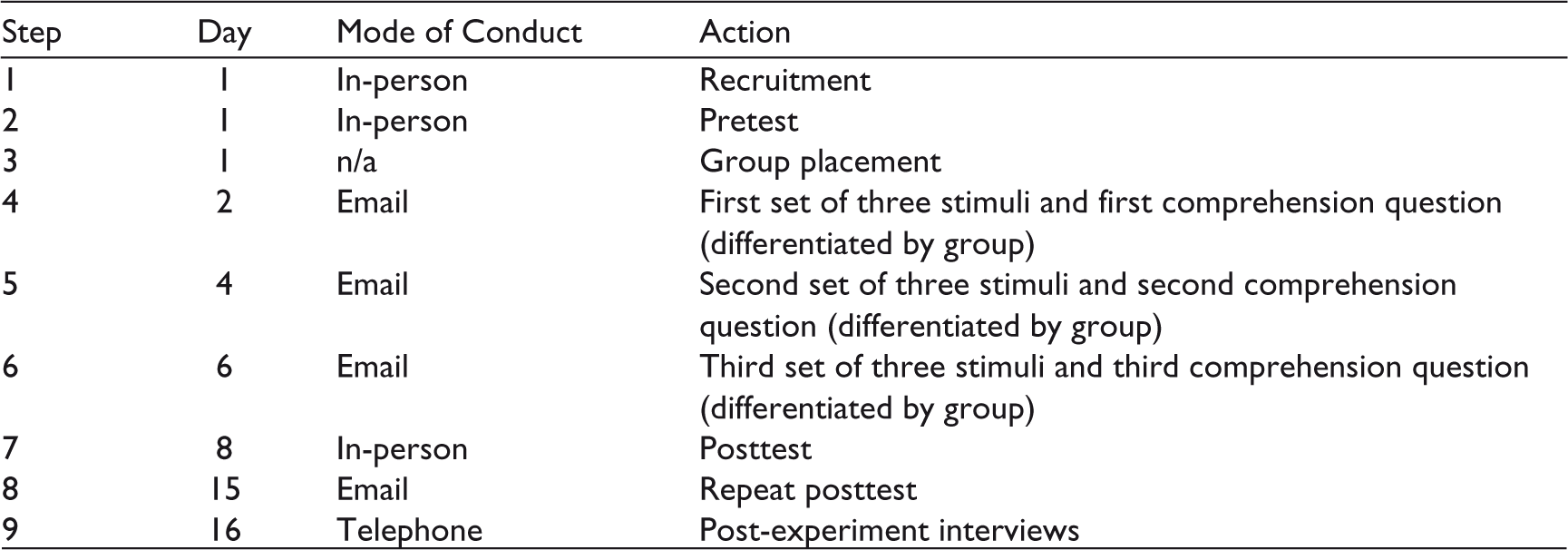
Recruitment, Pretest and Group Placement (Steps 1–3)
We recruited 130 undergraduate students from a public university in a Mediterranean society. The participants were approached at central university locations at different times on six consecutive weekdays. We applied quota sampling to balance the gender composition of the sample and to secure participation from five Schools of the University. We excluded students majoring in health sciences and students who had family members or close friends with disabilities. To minimise testing effects, we told students that the subject of the experiment was digital literacy. Once they agreed to participate, they signed a consent form, they were pretested, and then placed in groups based on gender and pretest score. As shown in Table 2, this matching produced three groups with roughly equivalent pretest mean scores and of roughly the same composition in terms of gender and School.
Sample and Group Composition.
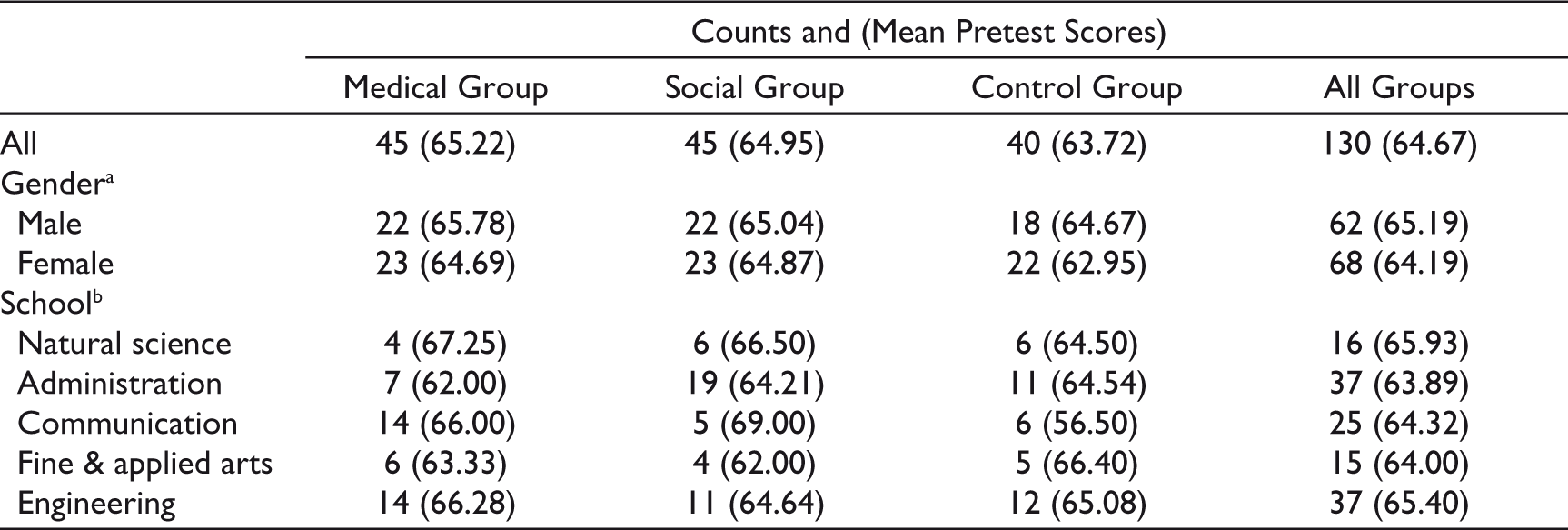
b Means comparison (ANOVA): F(4, 125) = .389, p = .816
Experimental Stimuli and Comprehension Questions (Steps 4–6)
The application of the experimental stimuli started for each participant on the day after recruitment. An email message was sent on that day and two more messages two and four days later. Each message contained three short social media posts or news items, differentiated by group. In total, each participant was exposed to nine short texts. The content of the stimuli was clearly consistent with constructions of disability representing either the medical and charity models (medical group) or the social and human rights models (social group) or was neutral (control group).
Except for three texts that we composed based on existing posts and on Symeonidou (2014), the stimuli were chosen from 520 social media excerpts and news items, which we had collected in a separate study. The criteria for selection were comprehensibility (easy), tone (mild), strength of the expressed opinion (moderate), and word count (the total length of each set of three messages was between 231 and 344 words). Minor editing was applied to some items. Pro-medical stimuli (medical group) presented wheelchair users as suffering an impairment that is a personal issue, dysfunctional (e.g., burdening work and family life), and can best be dealt with by charity. Pro-social stimuli (social group) included claims that society causes problems for wheelchair users by burdening them and that wheelchair users do not need mercy or charity but respect, protection of their rights, and accessible structures. Neutral stimuli (control group) were announcements or reports about events for or accessible by wheelchair users, not suggestive in any direction. 2
With each email message, the participants received a true/false comprehension question, which could be answered easily by reading the message, and were instructed to answer it by replying to the message. This was done for three reasons. First, it confirmed that the experiment was about digital literacy. Second, it ensured that the participants had read the texts. In case the answer was wrong, another question of the same type and difficulty was sent and the participant was given a second chance to answer correctly. Third, this test was part of a reward scheme, which had been announced during recruitment. The participants had been told that they would receive 20 euros if they answered all three questions correctly.
Posttest, Repeat Posttest and Post-Experiment Interviews (Steps 7–9)
Upon receiving the final email answer from each participant, an in-person appointment was arranged, during which a printed posttest was administered. The participants were also paid the monetary reward as promised. A week later, the repeat posttest was administered using the posttest questionnaire in electronic form (via email). The final communication with the participants was a telephone interview one day after the repeat posttest. Its purpose was to perform a manipulation check and to collect information about external events and communication among the participants.
Results
Engagement
The engagement of the participants was assessed with the comprehension questions. Each participant answered three questions, one for each set of stimuli. Ninety-nine of the 130 participants (76.15%) answered all questions correctly, 25 (19.23%) made one mistake, six (4.61%) made two mistakes, and no one made three mistakes. In total, 328 of 390 answers (84.10%) were correct and 62 (15.89%) were wrong. Every time a wrong answer was received, the participant was given a second chance, and this proved beneficial, as all answers to the second question were correct. Based on these results, we conclude that engagement was satisfactory.
Manipulation Check
The manipulation check, performed after the experiment through telephone interviews with 127 of the 130 participants (three did not answer the phone), included two questions about the stimuli. The first asked whether the nine texts influenced the way the participants think about wheelchair users, with set answer options. Forty-five participants (35.43%) said that they were influenced a little bit, 37 (29.13%) a good deal, and four (3.15%) very much. The percentage that gave any of these three answers in the medical group is 70.5%, in the social group 81.4%, and in the control group 50%. The difference between the experimental groups and the control group is large and in the expected direction. Taking into consideration that our stimuli were mild, these results are judged satisfactory. Still, 41 participants (32.28%) answered that they were not at all influenced. This applies to 29.5% of the medical group, 18.6% of the social group, and 50% of the control group. The percentages for the experimental groups are worrying; yet, they are significantly smaller than those of the control group. This shows that the stimuli were effective, albeit less than expected.
Further, participants who answered anything other than not at all were asked to elaborate. The majority in the medical group said that the stimuli provoked understanding of the difficulties faced by persons with disability and about one-third said that they did not agree with the messages about challenges concerning work and family. This suggests that the influence of the stimuli in the medical group may have been limited due to prior attitude. Answers by members of the social group were more straightforward, confirming that the pro-social stimuli were effective in the expected direction. Finally, some members of the control group said that the stimuli were mostly in directions consistent with the social model. Overall, this section of the manipulation check supports the validity of the experiment to a satisfactory degree, leaving space for some results to be interpreted accordingly.
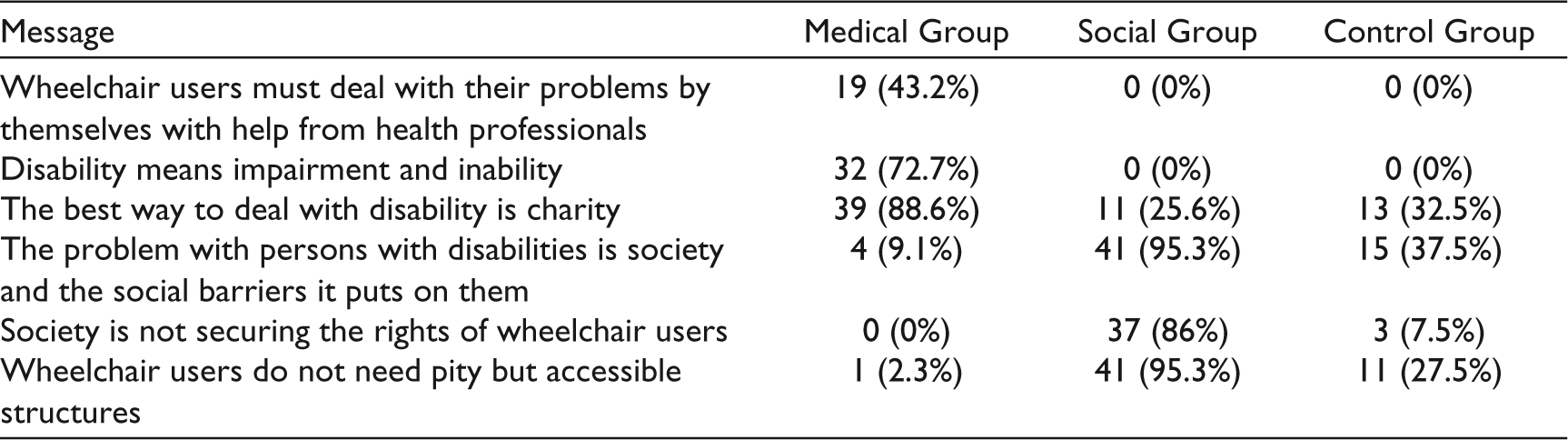
The second question asked during the telephone interviews was whether the nine textual stimuli promoted any of six given messages, three in the pro-medical and three in the pro-social direction. The answer options were yes and no. The results, presented in Table 3, are very favourable. Each of the first three (pro-medical) messages received yes answers by large percentages in the medical group, confirming that these messages were promoted by the pro-medical stimuli and each of the last three (pro-social) messages received yes answers by large percentages in the social group, confirming that these messages were promoted by the pro-social stimuli. The results in the control group partly support this conclusion, as only small to moderate percentages of yes answers were received; yet, some testing effect seems to be present and will be discussed.
History and Diffusion Check
During the telephone interviews, the participants were also asked whether any external event related to disabilities, such as something in the news, took place during the days of the experiment and, if so, what. Nine participants (7.1%) answered affirmatively. We judged this exposure significant and potentially contaminating for five of these cases and therefore excluded them from further analysis. The participants were also asked whether they had had any communication with other participants during the experiment and, if so, what was the content of that communication. Only 12 participants (9.4%) answered affirmatively and we judged that none of these communications posed a significant threat of diffusion.
Counts and Percentages Agreeing that the Stimuli Promoted Certain Messages.
Descriptive Statistics
Descriptive information about the final sample is presented in Table 4. Of the 130 participants who completed the experiment, 14 were excluded from the analysis, five because of significant exposure to external events (see above) and nine due to unrealistic change (more than 10 units on the post-pre difference scale; see the empirical range of the variables in Table 4, presented next). Two participants are also missing from the social group repeat posttest because they did not answer the phone.
Descriptive Statistics—Final Sample.
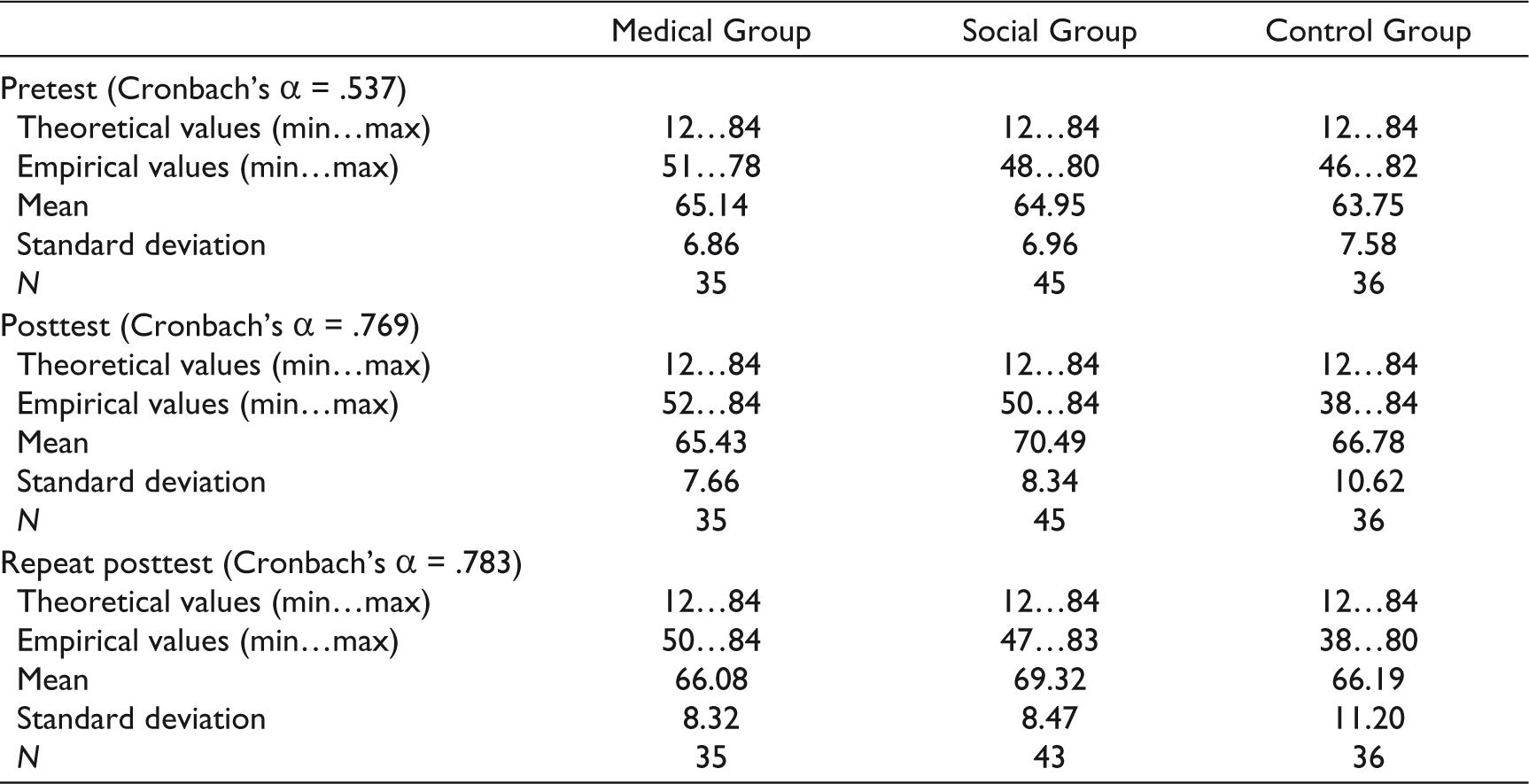
The pretest and posttest score for each participant was calculated by the addition of the twelve 7-point Likert answers, coded from 1–7 in the pro-social direction; thus, all variables range from 12 to 84 with higher values representing more pro-social attitude. All pretest means are between 63 and 66, showing that the baseline attitude is well in the pro-social direction. This is reasonable in a student sample and an important consideration in evaluating the magnitude of change. The only concern in these results is the low reliability of the pretest index. To address this inconsistency, we tried excluding items to improve the coefficient, without achieving significant improvement. Thus, we proceeded with this limitation in mind.
Hypothesis Testing
To test H1 and H2, we performed paired samples means comparisons. The results are presented in Table 5. The change in attitude is given by the post-pre change score (the result of subtraction of the pretest score from the posttest score), with positive values representing change in the pro-social direction and negative values representing change in the pro-medical direction. The theoretical minimum and maximum change is the same for each group as it stands for the theoretical shift from a maximum pre- to a minimum post- pro-social score (12 – 84 = –72) and from a minimum pre- to a maximum post- pro-social score (84 – 12 = 72) respectively. The empirical minima and maxima are naturally much smaller in absolute terms.
Paired Samples Post-Pre Change Mean Comparison.
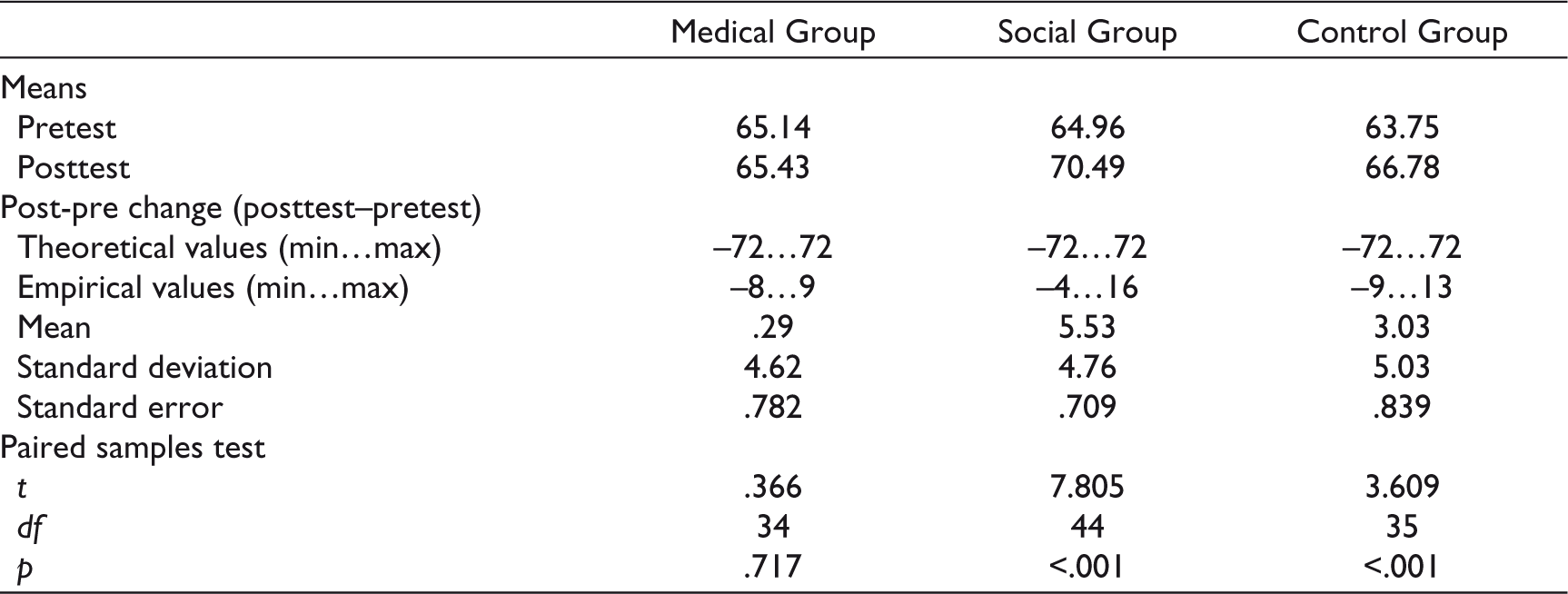
The change in the medical group is .29 units, a negligible value in substantive terms. In statistical terms too, the result of the paired samples comparison yields a non-significant difference, therefore, H1, which predicts that because of the experimental stimuli the attitudes of the medical group would shift toward less pro-social values, is not supported. The change in the social group is 5.53 units. In substantive terms, this is a mild change. The paired samples comparison shows that this is a significant difference, therefore, H2, which predicts that, because of the experimental stimuli, the attitudes of the social group would shift toward more pro-social values, is supported. The change in the control group is 3.03 units, which is small in substantive terms, but statistically significant. This result was not expected, as the stimuli in the control group were neutral. The testing effect that was detected in the manipulation check seems to be manifesting here.
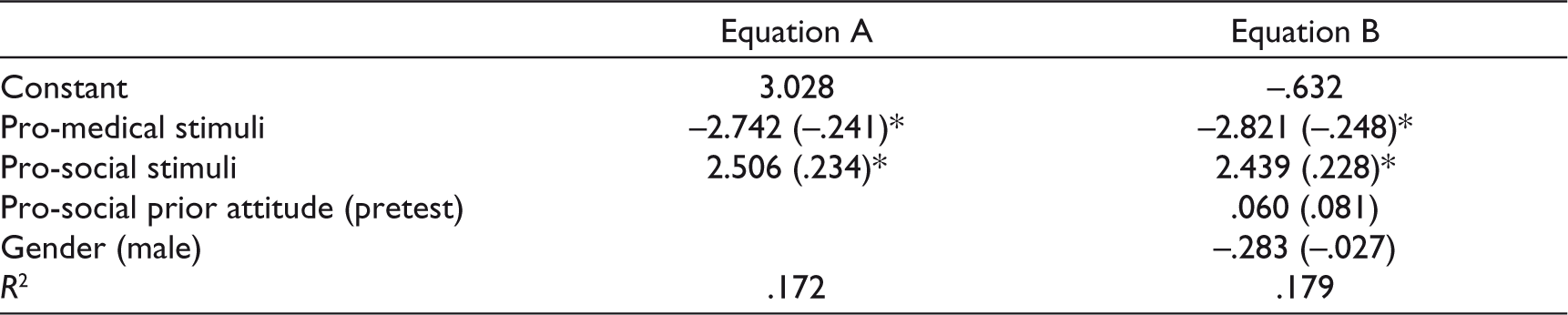
To test H3 and H4, we modelled the post-pre change in attitude as the dependent variable in two linear regression equations, with the experimental stimuli as predictors. Two binary variables were constructed with the control group as the reference category to allow for comparison of the effect of the pro-medical stimuli against the neutral stimuli and of the effect of the pro-social stimuli against the neutral stimuli. To enhance internal validity, we included gender and prior attitude as control variables. The results are presented in Table 6. Equation A contains only the focal predictors while the control variables are added in Equation B.
Unstandardised and (Standardised) Linear Regression Coefficients for the Effects of Experimental Stimuli and Control Variables on Attitude Change.
Note. * p < .05; Valid N for both equations = 116.
In Equation A, both binaries return statistically significant coefficients in the expected direction. The pro-medical binary produces a reduction of 2.742 units in pro-social attitude and the pro-social binary produces an increase of 2.506 units in pro-social attitude against the control condition. The effects are moderate in conventional terms (the betas are –.241 and .234 respectively). The experimental stimuli alone explain 17.2% of the variation in attitude change. In Equation B, prior attitude produces a coefficient not significantly different from zero. Thus, the intensity of prior attitude does not seem to affect attitude change. The gender coefficient is also not statistically significant. Controlling for gender and prior attitude, the pro-medical binary still produces a significant reduction of 2.821 units in pro-social attitude and the pro-social binary still produces a significant increase of 2.439 units in pro-social attitude against the control condition. The effects are moderate in conventional terms (the betas are –.248 and .228 respectively). Together with the control variables, the experimental stimuli explain 17.9% of the variation in attitude change. Based on these results, both H3 (exposure to pro-medical online content will cause a larger change toward a less pro-social attitude toward disability, compared to exposure to pro-social and neutral online content) and H4 (exposure to pro-social online content will cause a larger change toward a more pro-social attitude toward disability, compared to exposure to pro-medical and neutral online content) are supported.
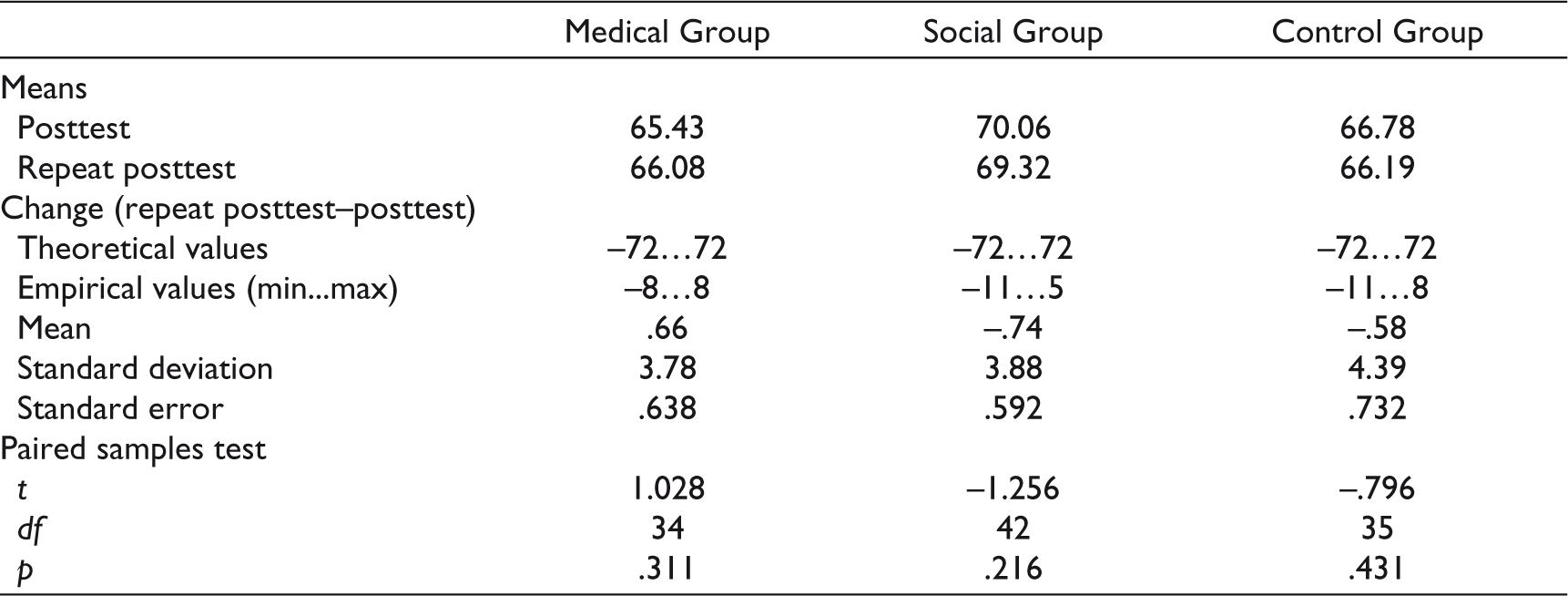
To test H5 we examined the results of the repeat posttest which took place one week after the posttest. As the medical condition did not produce an effect, the hypothesis only applies to the social group. As shown in Table 7, the change is very small and not statistically significant; thus, H5 is supported: attitude change resulting from exposure to online content is stable for at least a short period of time.
Paired Samples Posttest–Repeat Posttest Mean Comparison.
Discussion
The question guiding the present study is whether and to what extent exposure to online constructions of disability affects attitudes toward persons with disabilities. We studied this question with respect to the medical and social models of disability, focusing on wheelchair users. Our overall conclusion is that online constructions of disability have a mild influence on attitudes toward persons with disabilities. Specifically, compared to a neutral condition, pro-social constructions produced more pro-social attitudes and pro-medical constructions produced less pro-social attitudes. We also support that these effects are not superficial, as they seem to last for at least a short period of time. These findings are consistent with theories of social learning and social influence, especially given that our stimuli were more of informational rather than normative nature and that what we captured was a result of cognitive processing rather than emotional reaction (Lu et al., 2018).
Further theoretical connections can be made. Connecting to context collapse theory (Marwick & Boyd, 2011), our findings are suggestive in the (positive) direction of sharing content with multiple audiences (Beam et al. 2017). By sharing social media posts, news items, and other types of content not examined in our study, internet users contribute to the dissemination of messages that can promote more favourable conceptions of disability. Supporting hypotheses about influence also connects to agenda setting theory (McCombs & Shaw, 1972; McCombs et al. 2014). Like traditional news media, online news media are setting the everyday agenda for users—as, in a sense, we have done in our experiment—prompting opinion formation processes. Finally, frequent and long-term exposure to issues of disability can be connected to cultivation theory (Gerbner et al., 1986; Laskar & Amir, 2022; Morgan et al., 2015), as such exposure helps audiences become more familiar with a reality about disability constructed in more favourable terms, compared to stereotypical constructions of the past. Our answer to Morgan et al.’s (2015) question whether ‘today’s (and tomorrow’s) new media are offering more meaningfully different and diverse messages than did yesterday’s new media in terms of their underlying lessons about life and society’ (p. 687, emphasis in original) is affirmative.
Our design included several validity-enhancing elements based on which we can rule out possible effects of certain validity threats. At the same time, some weaknesses and limitations also apply. We proceed to discuss these considerations. First, we tried to make all groups equivalent in terms of demographics and prior attitude; thus, selection bias has been minimised. Second, we ran a pilot administration to ensure that our pretest and posttest instruments were operationally equivalent and thus rule out the chance that the observed change in attitude was due to instrumentation. Third, the application of multiple stimuli during a five-day period (see also, Lu et al., 2018; Stylianou & Sofokleous, 2019) and the comprehension questions secured that the participants were sufficiently exposed to the stimuli. Fourth, based on the manipulation check, our stimuli seem to have been sufficiently proper. Some concern arose, as about one-third of the medical group participants said that they were not influenced by the stimuli, which we explain as a consequence of our stimuli being mild in tone and moderate in opinion strength by design, and about one-third of the medical group participants said that they did not agree with the messages contained in the stimuli regarding challenges concerning work and family, which we explain as a limitation due to prior attitude. Fifth, we used a face-to-face paper-and-pencil mode of administration for both pretest and posttest; thus, separating the pretest, the treatment, and the posttest in time, space, and method to minimise testing effects. Additionally, in this manner, participants could not look up information or cues, in the email messages or elsewhere, while answering the pretest and posttest questionnaires. Still, some testing effect seems to have occurred, as indicated by the shift in the control group toward more pro-social attitudes. We cannot rule out that some ‘feel good’ effect (Clore & Schnall, 2005; Ferrara et al., 2015) is present. Stylianou and Sofokleous (2019) suggest that such ‘liberal’ shifts should be expected in student samples. This explanation is further supported by the result of our pretest, where the mean (pro-social) attitude was high in all groups. Sixth, diffusion and history effects have been ruled out based on the post-experiment interviews and the removal of contaminating cases. Finally, as is common in experimental designs, the external validity of our study is limited by the nature of the sample.
Given these considerations, we believe that our study is a worthwhile contribution to the limited research on the effects of online constructions of disability on attitudes. More studies are needed to establish a solid body of empirical knowledge concerning this matter. Experimental designs may prioritise either or both internal and external validity. Concerning internal validity, the independent variable can be further specified to include stimuli of various degrees of intensity, of different forms (text, images, videos), of different types of content (manifest vs latent), and from various sources (comparing, for example, the effects of content posted by disability organisations, politicians, and academics, to the effects of online news and social media posts from the general population of internet users). Beyond these possible comparisons, models of influence can be specified to include the possible role of emotions (Wang & Hickerson, 2016). Further, given the lack of studies addressing online influence with a dedicated focus on models of disability (which has been a major motivation for the present study), future research can further contrast the effects of medical model online constructions of disability to those of online social model constructions. External validity can be enhanced by studying samples from the general population. The nature of the matter allows for online recruitment or the use of existing samples that are sufficiently representative and sufficiently large to allow generalisations of findings to the general population of internet users but also to groups defined by age, gender, and socioeconomic status. Such investigations will probably have to run fully online, which has become common practice. Combining these possibilities with the proposed elaboration on the nature, types, and sources of stimuli (discussed above) will also answer to what degree different audiences are influenced by different stimuli. Another direction for future research is to expand the research question to include different kinds of disability, including mental conditions. Finally, qualitative inquiries will offer a deeper understanding of how attitudes are affected by online medical and social representations of disability.
We believe that studies such as the present are necessary for solidifying the emerging field of disability media studies, where communication and disability studies meet and interact. This intersection is of great academic merit, but it also has a political extension (Ellcessor et al., 2017). In this respect, our study is in support of communicative actions that promote the social model of disability. Consistent with the literature (Kroska & Harkness, 2021), our reported effects are mild; yet, we offer evidence that social and news media can influence attitudes in the pro-social direction. This suggests that efforts to promote inclusion, reduce stigma, and enhance social justice through new media are worthwhile. Such efforts have a good potential to shape public attitudes and cultivate favourable perceptions of persons with disabilities (Fisher & Purcal, 2017). Pro-social public attitudes, coupled with the development of positive identities and active physical and social participation (Mitchell et al., 2021) can accelerate social change in the direction of replacing ableist with inclusive discourses.
Footnotes
Declaration of Conflict of Interest
The authors declared no potential conflicts of interest with respect to the research, authorship and/or publication of this article.
Funding
The research received funding from the Cyprus University of Technology and from the Cyprus Youth Board Program Φοιτητές σε Δράση [Students in Action], grant no. 28/2019.