




Abstract
Researchers often point out a wide rift between school culture and students’ home culture, especially for Adivasi students whose culture, language and knowledge systems are played down by the mainstream discourse. We believe that such deficit perspectives must be countered to work towards an equal and just society. For this purpose, in this study, we explored the funds of knowledge of Adivasi communities of Central India with regard to forests and conservation. We also examined school textbooks from the standpoint of these communities to understand how connected or disconnected they are to the life-worlds of Adivasi students. The study adopted a participatory design and drew upon the principles of critical ethnography. For data collection, we used a strategic combination of ethnographic observations, informal interactions, focus group discussions, personal interviews and field notes. The findings indicate a strong need for developing learning material that is contextually relevant, meaningful and transformative for students.
The Rift Between School-world and Students’ Life-worlds
Adivasis are a significant segment of the Indian population not just because they form a sizable proportion but also as a group with a rich and varied cultural heritage. It is striking that despite constitutional provisions for their welfare and development, and protection against violence to their languages and cultures, they lag way behind in terms of various socio-economic indicators (Xaxa et al., 2014). Ironically, the education system has been a significant factor in the marginalisation and invisibilisation of Adivasi interests (Veerbhadranaika et al., 2012). Deficit discourses about them seem common among teachers and textbooks, leading to discrimination and abysmally low expectations from tribal students (Sarangapani, 2003). The knowledge and skills that the tribal communities have historically accumulated and have been using for survival for generations are undervalued and denigrated (Sundar, 2010). Moreover, since their native language is different from the medium of instruction in schools, they face severe problems in expressing themselves and learning, in general (Devy, 2017). Consequently, mainstream schooling leads to the alienation of children from their language and culture (Gupta & Padel, 2019). Thus, a wide gap exists between the school-world and the life-worlds of Adivasi students that needs to be bridged to make learning relevant and meaningful for students.
The National Curriculum Framework (NCF) also emphasises the importance of contextualising education and ‘to make the boundary between the school and its natural and social environment porous’ (NCERT, 2005, p. 30). Although it recognises the challenges involved in integrating traditional knowledge and official curriculum, the NCF insists that it is essential to do so, for ‘unless learners can locate their individual standpoints in relation to the concepts represented in textbooks and relate this knowledge to their own experiences of society, knowledge is reduced to the level of mere information’ (p.30). Ethnographic accounts of classrooms (Batra, 2017; Dalal, 2015) caution us, however, that teachers continue to have difficulty in understanding this principle advocated in the NCF and, therefore, distort this connection. As a result, the dominant school ethos is one where children from marginalised socio-economic and cultural backgrounds continue to be stigmatised, excluded and treated as non-epistemic entities.
Sarangapani (2003) draws attention to the differences in the foundational character of formal education and the pedagogic traditions in indigenous communities. For example, modern schooling presupposes a certain idea of childhood, whereas childhood as a distinct phase of life may be unknown in a subsistence-based society like that of the Adivasis. Similarly, premises regarding the nature of knowledge, learning and the relationship between the learner and the pedagogue are disjunct. Therefore, as a first step towards bridging the gap between the world of the school and the child’s world, Sarangapani calls for going beyond the metaphorical sense of this gap by studying what constitutes the differences in these two cultures in terms of form, content and practice.
In our study, we attempted to bridge this gap by documenting aspects of students’ everyday knowledge and life-worlds and exploring the possibilities of connecting the same with school education. Focusing on a theme in ecology, we intended to explore select Adivasi communities’ understanding of forests and their conservation. These ideas interest us because Adivasi communities are known to have intimate knowledge of nature and knowledge systems rooted in their life-worlds, beliefs and traditions that embody ecological harmony as reflected in anthropological works like Verrier Elwin’s writings as described in Guha (1996). Such a worldview is starkly different from the one that modern science espouses which is premised on the human-nature binary, objectifies nature and aspires to ‘dominate’ nature (Keller, 1982). Listening to and building upon narratives from diverse social backgrounds could help us learn ways of relating to nature by ways other than domination and exploitation (Batra, 2021).
Funds of Knowledge as a Theoretical Framework
We have adopted the funds of knowledge (FoK) perspective as the theoretical framework to understand the question of students’ everyday knowledge, concerns, values and practices. The FoK perspective recognises the significance of various cognitive and cultural resources that students from diverse communities bring to the classroom as having great potential for teaching-learning (Moll et al., 1992). It disregards the power hierarchy between school knowledge and traditional knowledge by positioning minority students as rightful experts of certain knowledge applicable to school science, and is, therefore, closely linked to the idea of epistemic as well as social justice (Hogg, 2011). Bringing marginalised students’ life-worlds to the classrooms could help them make connections with the school curriculum. The set ways of thinking within the school subjects (and mainstreamed mindsets) could also gain insights from marginalised communities’ ways of living and values and challenge the negative stereotyping of these communities.
In this study, we critically examine the academic and everyday discourses of select Adivasi communities on forests and conservation which sets the platform for conceptualising contextually relevant, meaningful and transformative learning material for forest-dependent communities.
Study Design
The study is situated in the context of four villages in the Kesla block of Hoshangabad district in Central India. Kesla has a sizable population (46.18%) of Adivasi communities (mostly, Gond and Korku). Most people in the region depend on small-scale cultivation, labour work and forest produce for subsistence. Kesla has a long history of people’s organisation, struggle and collective action around issues such as the rehabilitation of those who were displaced by the Tawa dam, Satpura Tiger Reserve and the Taaku proof range of the nearby ordnance factory. The area has been a base of previous work by various organisations, which have fostered an environment of critical and political awareness in the region.
The study commenced when the COVID-19 pandemic situation was gradually coming under control in the country and access to schools was restricted. Therefore, we decided to run a few informal learning centres in the region and regularly interact with students through those centres. These centres have been envisaged as spaces for activity-based collaborative learning and are facilitated by educated youth within the community for middle school children in their neighbourhoods. For this study, we have built on the genial relations that we started developing with the students, teachers and parents in the focal villages.
In the context of the villages in Kesla, surrounded by Satpura forests, wildlife sanctuaries and rivers, the theme of forests and conservation predominantly came up during our initial interactions in the community. We felt that this theme provides possibilities to raise questions that are meaningful to students from forest-dependent communities. Thus, in this study, we attempt to bring forth the rich yet marginalised perspectives and the cognitive and cultural resources that lie with the young and adult members of these communities, particularly their understanding of forests and conservation. Further, the study aims to analyse how the school curriculum negotiates students’ life-worlds as a prerequisite to developing curricula that are contextualised and meaningful to the community.
The study can be situated in the research paradigm of ‘critical qualitative inquiry’ (Guba & Lincoln, 1994) in which researchers aim ‘to create conditions for empowerment and social justice’ (Kincheloe et al., 2018, p. 421) by laying bare the structures of power and control that lead to the marginalisation of non-dominant groups and putting forth their voices, concerns and experiences that are otherwise subdued. With regard to research methodology, we have drawn upon critical ethnography (Madison, 2005) to design methods of data collection.
The study followed a participatory design. Seven community volunteers were also part of the research team and are addressed in this article as ‘field associates’ (FAs). The FAs reviewed all the research instruments and helped us refine the tasks and questionnaires for interviews and focus group discussions. In our group meetings, they would often question the activities, ask for the purpose, frame interview questions differently, suggest additional questions and share their interpretations. They also contributed to identifying key respondents in their villages, facilitating community interactions, as well as analysing the data.
For data collection, we used a strategic combination of qualitative research methods: ethnographic observations, semi-structured interviews, 1 focus group discussions (FGDs) and researchers’ field notes. Further, to study how the official curriculum deals with focal themes, we analysed two chapters, namely, ‘Forests: Our Lifeline’ (Grade 7) and ‘Conservation of Plants and Animals’ (Grade 8) from science textbooks 2 followed in their schools.
Interactions in the community were semi-structured and explored issues ranging from cultural practices and customs followed in various festivals, traditional and present-day crops, their dependence on forests and the traditional knowledge around the forest produce and also sociopolitical issues related to the agrarian crisis they are facing and displacement of villages caused by the Satpura Tiger Reserve. As the FGDs and interviews were conducted at the homes of the respondents or their courtyards, sometimes another person would also join in the conversation. Thus, for some of the interviews, there were a pair of respondents. In total, we interacted with six community members on a one-to-one basis and 12 community members in paired settings.
A four-day workshop was organised in one of the study villages in which about 35–40 students ranging from Grade 5 to Grade 8 participated. The workshop was conceptualised as Bal Mela (kind of a summer camp) in which activities and discussions were sandwiched between games and other extracurricular activities like origami and toy making. This was crucial to keep children’s interests alive for the whole duration. The workshop focused on exploring students’ conceptions of forests, their relationship with forests, their values and practices associated with forests and their understanding of interdependence, conservation and development.
We obtained verbal consent for recording respondents’ voices on an audio recorder, taking notes while they talked and taking their photographs during our interactions. Students’ consent was taken for video recording the workshop sessions so that we do not miss out on any details. In our reporting, we have used the pseudonyms of the respondents. The analysis focused on examining the knowledge, values, beliefs and practices of young and adult members of the community concerning forests and conservation. The textbook chapters were analysed from the standpoint of the forest-dependent Adivasi communities of Central India to understand how connected or disconnected the chapters are to the lived experiences, practices and concerns of these communities.
Since all the interactions with respondents happened in Hindi, the audio-visual data (about 30 h) was first transcribed in Hindi. The student workshop resulted in 7 h of audiovisual data. Selected parts of the data were translated into English for broader discussion and writing purposes. The data were analysed using thematic coding (Thomas, 2006). Codes emerged through inductive and recursive analysis of the data. The trustworthiness of the findings was ensured by providing thick descriptions in the reporting of data, peer debriefing at regular intervals, member checks to ensure data is not being under or over-interpreted and triangulation across multiple data sources (Merriam, 2009). Since some team members were outsiders to the community, we have tried to be conscious of our positionality (Clarke, 2003) and maintain greater reflexivity (Charmaz, 2017) on our worldviews, language and practices, and how they might affect the way we view our participants, data and analyses. Reflective memos were maintained by the research team on a shared document.
Communities’ Funds of Knowledge Related to Forests and Conservation
In our interactions with students and the wider community, we explored their conceptions of the forest, their relationship with it, their values, practices and knowledge associated with the forest and their ideas on the conservation of forests. We describe below some of the themes that emerged during the analysis.
The Forest as a Continuum Between the Natural and Social Space
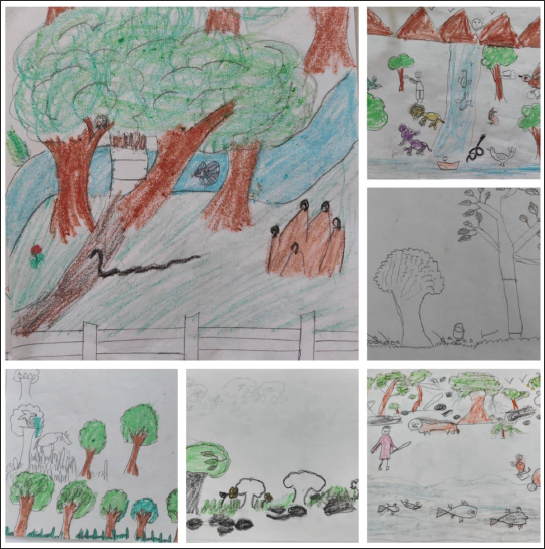
During the elicitation workshop, students were asked to draw pictures of their village and the forest adjacent to it. Figure 1 shows a collage of a few students’ drawings of the forest. Apart from drawing wild animals and birds, trees, hills and water bodies brimming with aquatic life, about 40% of students drew people involved in activities such as picking Mahua 3 or fishing. An equal proportion of students drew an artefact showing human presence like a basket left among Mahua. While wild animals abound in the drawings, along with their shelter or source of food, there were also domestic animals grazing there.
Collage of Students’ Drawings of Their Forest.
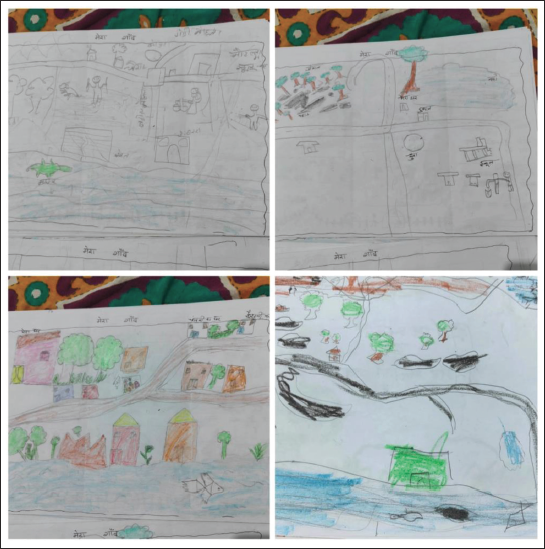
On the other hand, when they drew a picture of their village (Figure 2) over 60% of students drew the nearby forest, hills and rivers along with fishes and crocodiles. The presence of the local shrine, physically located in the forest, was more prominent in drawings of the village than those of the forest. Thus, the village and the forest seem to flow into each other in these students’ drawings; they are not separate entities for the children but together form their habitat. One of our FAs pointed out that for her people there is no clear boundary between the village and the forest as ‘fencing wires have come up now, we have been living here since so long’ (excerpt from data analysis workshop).
Students’ Drawings of Their Village.
This was also evident in another activity in which each student had to name something found in the forest, starting with a Hindi letter they picked at random. The students associated forests with a wide variety of wild animals and birds and also domestic animals who depend on the forests for fodder. They included plants of various kinds—flowering herbs and shrubs, trees with edible fruits, medicinal ones and those whose leaves are offered at the local shrine. They also mentioned abiotic elements like the cool breeze, people’s livelihoods (e.g. snake charmer) and supernatural, cultural entities like spirits.
Students’ responses in these two tasks indicate that they conceive of the natural and the social world as a continuum. We see such a continuum related to the forest in other aspects of the community too. For instance, the deities are not confined to temples but dwell in natural spots—under a tree or among mounds of stones by the river marked by a stone or a flag. The second instance is that of the connection between life and the afterlife for the Gond community in the region. Two FAs who belong to the Gond community described how the forest is a place for their ancestors to stay in their afterlife rather than a separate hell or heaven.
The Forest as an Ecosystem
Students represented various interlinked elements in their drawings—from different kinds of plants to herbivores and carnivores along with hills and water bodies. There were also ecological niches depicted in the forest from grasses to tree tops to ponds and rivers, with shelter and food for various creatures. During a subsequent discussion, on what would happen to animals in case forests were no longer there, students displayed an elaborate knowledge of the interconnections in nature. Here is an excerpt from a small-group discussion in which different students raised these concerns:
The weather would get affected by either very little or torrential rains and there will be ill effects of both. With less rain, the vegetation would dry out and without the roots holding the water in the soil, the rivers and lakes would also become dry. The temperatures would soar. With no food and water, animals will die. Deer and jungle buffaloes as well as domestic animals like cows would not get fodder. Birds would not get fruits or places to make nests, so where would their eggs and fledglings be? Jal murgi (a water bird) will also lose its place to stay. The red-faced monkey, black jungle fowl, and foxes will not get food or water. Snake charmers will be in trouble if there are no snakes as snakes would not get frogs to eat. Butterflies will not get flowers. If there are no fresh leaves and fruits, caterpillars will have difficulty, ants will also not have food. (Excerpt from student workshop, Day 2)
Evident in this discussion is students’ complex understanding of how different abiotic components like the soil and water are linked with biotic components like the roots of trees and how the absence of one could affect the others. Students also had a sense of possible human–wildlife conflicts due to deforestation:
If there is no forest, where would all the animals stay? If they come to the village, then people will not be able to get out of their houses. Those animals will eat the hen and the cattle. If the bees don’t get to make hives in the forest, they will come to the village and people may break those hives. (Excerpts from Student Workshop, Day 2)
The elders in the community also saw rich biodiversity as an essential feature of the forests. One of the elders in Mandikhoh described a good forest as one with abundant water resources and a diversity of vegetation and contrasted this with an area where there is just teak or bamboo. Such an area is usually a plot where the State Forest Department plants mostly teak under the afforestation scheme. Madan, a member of the community speaking during the FGD in Bardha, rejected the idea of calling such a plantation a forest. A diversity of vegetation supporting a variety of life forms is an essential feature that the community sees in a forest.
Forest as a Safety Net
With only small patches of land mainly for subsistence farming, the communities in our study villages have a critical dependence on the forest to support their everyday lives and livelihoods. On the question of how children in the village would be affected if there were no forests, students provided a long list of things that the villagers get from the nearby forest. It seems to provide for the community in varied ways—for food, fodder, shelter, livelihoods and medicine. No wonder, the children saw the forest as a safety net that protects them from climate change and poverty. One of the students, Payal (Class 7), said, ‘If there is no good crop, there’s no money or food, we can still go to the forest for sustenance. What would we do if there were no forests?’ It is disconcerting that this security net of the forest is weakening with time affecting diet and health. In Bardha, during the informal interactions, several respondents noted that sources of food such as leafy vegetables like chirota and tubers like chani are now a rare find in the forest.
Forest as Commons
How the Adivasi values and practices related to the forest enable fair access to the forest for all is evident in the manner in which the people share the bounties of Mahua. While joining some community members in picking Mahua flowers in the forest adjacent to Mandikhoh, we got to know about the economy of Mahua and the norms related to sharing resources. Each family marks a few Mahua trees in the forest by hanging a piece of cloth around it. The villagers are aware of which tree is marked by whom and they would just pass them by, even when there is no one to supervise the fallen Mahua. Everyone would get a share of the Mahua depending on how many members of the family were involved, how much time and effort they could put in and if they had any special needs that year. If there were any disputes, the elders in the village mediated and resolved them in a deliberative manner.
A Korku woman in Bardha, during an informal interaction, remarked that there is a Mahua tree on her farm. She described how the fallen Mahua attracted many visitors—boars, bears, sambar deer, monkeys and birds, in addition to cattle. However, she narrated this in a calm, matter-of-fact kind of way rather than complaining about the animals as pests. She recognised that Mahua is food for other animals too which is indicative of her comfort with living peacefully with the other organisms in nature. This kind of sharing of common resources with fellow human beings and other animals seemed to be in direct contrast to the hoarding culture inherent in a consumerist society.
Conserving Forests Through a Mutual Relationship
Despite a critical dependence on forests, the communities’ relationship with the forest seemed more than just a utilitarian one. For instance, while discussing ‘what if there were no forests’, Abhay (Grade 7) expressed concern about how everything would be deserted and desolate without forests (‘Jungle nahi honge to sab soona soona ho jaayega’). During several interactions, adults as well children of the community described how they felt a profound sense of care towards the forest due to which they take resources judiciously (just about enough for their needs), collect only dry twigs and branches and take care to prevent forest fires. Many of their festivals indicate that they practice restraint in using forest resources. One example is Chaitis, a festival celebrated in late monsoon by the region’s Gond and Korkus. Leafy vegetables are not eaten before this festival even though they begin growing soon after the rains. It appears that this practice allows the wild plants adequate time to grow before they are harvested.
Such traditional ecological knowledge was also behind the work of the Tawa Matsya Sangh (TMS), a fisherfolk’s union which struggled and won fishing rights in the reservoir that drowned their land when the Tawa dam was built. Bholaram from Bardha, who was part of the collective, informed us that in the 10 years that TMS worked, the fish population increased because of practices such as catching only adult fishes beyond a particular size (allowing the younger ones to grow) and suspending fishing in the monsoons when the fish breed. Not that such sustainable practices were unique to the TMS but are typical of many traditional fishing communities’ ways of working, for example among the Kolis of Mumbai region. However, they were distinct from the modus operandi of private contractors that the TMS was fighting, whose mechanised fishing with the sheer motive of profit was destroying the ecology of the reservoir and its long-term productivity in terms of fish catch (Mayaram, 2009). Demonstrating how conservation and people’s livelihoods can go hand in hand, this was also markedly different from the conservation practices of the state. The reservoir was finally declared a part of the Satpura Tiger Reserve and fishing was banned. On the other hand, the tourism department made Tawa a popular tourist destination with a lavish resort and cruise boats. A member of the Kisan Adivasi Sangathan in Kesla asks how such commercialisation does not pose a problem for conservation while the livelihood (or even mere survival) of people dependent on the forests is seen as a threat. While discussing the issue of displacement of people for the sake of conservation projects, students opposed the idea strongly. Sharad (Grade 5) found the idea contrary to common sense and exclaimed ‘Yeh toh ulto hi ho gayo!’
Depiction of Forests and Conservation in School Textbooks
A relic of the colonial approach to education, the textbook remains the most pervasive tool to transact curricular content in Indian schools. For this study, we examined two chapters from the state science textbooks followed in the region: (a) Forests: Our Lifeline and (b) Conservation of Plants and Animals from Grades 7 and 8, respectively. While the chapter on forests attempts to explain what forests are, what they look like and the interdependence between different components of forests, the chapter on conservation focuses on deforestation, its causes and consequences and the need for wildlife conservation and protected areas like biospheres and national parks.
Although there is a mention of forests as a habitat for plants and animals, there is a heavy emphasis in both chapters on forests as a resource for human beings. This utilitarian perspective is illustrated in the concluding section of the Grade 7 chapter which stresses the point that ‘we get various products from the forests surrounding us’. Picking up from here, the chapter in the next grade opens by saying ‘A great variety of plants and animals exist on earth. They are essential for the well-being and survival of mankind’ (Grade 8 textbook, p. 77, emphasis added). Further in this chapter, it is said that even small animals should not be ruthlessly killed because ‘by killing them we are harming ourselves’ (p. 83). This indicates a rather anthropocentric way of looking at nature, where the safety of nature is justified and sought after only to fulfil human needs.
Moreover, the description of forests in the textbooks does not include any cultural or spiritual aspects of the relationship that people traditionally living in or near forests have with them. Rather, the forests are depicted as mere ‘objects’ for investigation for their function and use. It is noteworthy that all the trees depicted and mentioned in the chapter are mostly those known for commercial purposes such as teak, and bamboo, or known commonly, such as neem or mango. Mahua, a tree that shares a cultural connection with many tribes in central India and is one of the major sources of livelihood for them, does not figure anywhere. When it comes to discussing animals and birds, both chapters largely focus on exotic, exclusive and endangered species, such as the giant squirrel, tiger, cheetah and wild buffalo. This indicates a view of nature as an exotic other.
The chapter on forests does not acknowledge the diversity of forest landscapes, and risks giving a generalised, over-simplified and stereotypical picture of forests for learners who have not been to forests while denying the experience of many students who live near forests, but perhaps a different kind from what is portrayed. The textbook does not include any prompts inviting the knowledge that Adivasi students have about the local diversity of plants and animals in forests. A more significant concern is the exclusion of Adivasi epistemes, values, practices and experiences related to forests in the dominant narrative.
While discussing the reasons for the loss and degradation of forests, the chapter on forests indiscriminately blames local people for usurping land for agriculture and sustenance as well as development projects, undermining the vast scale at which the industries, markets and infrastructure projects exert extractive pressures on forests. Moreover, the chapter on conservation goes on to say, ‘It is a pity that even protected forests are not safe because people living in the neighbourhood encroach upon them and destroy them’ (p. 82).
Having first examined how the chapters argue for the need for the conservation of forests, we further analysed its approach towards conservation. While the government is shown in the role of a torchbearer leading the way for forest and wildlife conservation, the textbook leaves out the pivotal role that local communities have played in conserving forests for centuries. Moreover, several instances in the chapter on conservation give the impression that conservation projects are indeed pro-people. However, there is no discussion on how much harm the state’s conservation efforts have caused to forest-dwelling communities and how these efforts would protect the rights of those people.
Discussion and Conclusion
The study sheds some light on Adivasi students’ rich knowledge of their neighbourhood, values and practices related to forests and conservation that shape their worldviews. Below, we summarise the key findings and discuss the implications of the study.
Juxtaposing the Textbook and Students’ Everyday Discourses on Forests and Conservation
We note that the natural and social environment are part of a continuum for the Adivasi students. Kothari (2014) asserts that the more we learn how ecological and human systems defy neat disciplinary boxes, and how landscapes cannot be strictly divided into the natural and the human, the more we can teach in holistic ways, and better understand nature and our place in it. Students in our study expressed an intimate understanding of the forest as an ecosystem and the various ecological connections between its elements. Their cultural and spiritual relationship with forests is reflected in their deep attachment to the place. They practice restraint in using forest resources and feel a sense of responsibility towards forests. The forest is a safety net for them that fulfils their everyday needs, especially in adverse times. Nevertheless, they do not see forests in a utilitarian way but instead have a symbiotic relationship fostering both ecological resilience and human wellbeing. 4 They believe in and practice a peaceful coexistence with other animals in the wild and see forests as commons. Indicating a sense of ecological justice, they acknowledged the rights of even the smallest of non-human species over their habitat. Official recognition of such an ethical position acknowledging the rights of ecosystems and the species inhabiting them has shown the promise to serve as a tool for people to defend nature and themselves (Kothari, 2014).
In contrast, the textbooks’ approach to forests and wildlife conservation is utilitarian and anthropocentric. Forests are seen as a pool of resources and all the pro-conservation arguments are made keeping human welfare as the prime concern. Gadgil (1989) points out that the root cause of deforestation is such a view of forests as resources and a particular structure of its usage where state authority is utilised ‘to systematically undervalue biomass, and even more so biological diversity and organise its supply to those in power at highly subsidised values’ (p. 358). One of our FAs from the community remarked during a discussion meeting that the chapter seems to have been written by someone who has never lived close to a forest. She pointed to the stark difference between the pictures depicting forests in the textbook and the forest drawn by students which is symbolic of the difference in their perspectives. While the pictures in the textbooks mostly present a view of forests from afar with only canopies seen, students drew a detailed image of the forest and its inhabitants.
Food chains are described briefly in the chapter on forests, and it is noted that many food chains are linked. Without delving any deeper, it is mentioned that everything will be disturbed if one component is removed like trees. However, students in our study gave elaborate mechanisms of such interconnections and what would happen if they were disturbed. It is ironic that instead of recognising such indigenous knowledge, the textbooks directly implicate the forest-dwelling communities for harming forests for their benefit and yet, unabashedly talk about their rights to forests. The conservation model that underlies the discourse in these textbooks is that of ‘fortress conservation’ which is
[A] conservation model based on the belief that biodiversity protection is best achieved by creating protected areas where ecosystems can function in isolation from human disturbance. Fortress, or protectionist, conservation assumes that local people use natural resources in irrational and destructive ways, and as a result cause biodiversity loss and environmental degradation. (Robbins, 2007, p. 704)
Another important insight that emerged in the analysis is the class and caste character of the textbook discourse evident in the examples discussed in the two chapters and the Sanskritised language used to present the content. Forest-dwelling communities’ lived experiences, knowledge, practices, questions and concerns do not get any mention in these chapters. The phrase ‘by non-Adivasis, for non-Adivasis’ best captures this aspect of our analysis.
From the standpoint of forest-dwelling communities, it is striking that the textbooks provide no space for students to share their experiences, concerns, questions or knowledge on issues so central to their lives. Thus, they exert nothing but a kind of ‘symbolic violence’ (Bourdieu & Paaseron, 1977) by promoting the dominant narrative and silencing the voices of the marginalised. The exclusion and marginalisation of Adivasi epistemes, values, cultural ethos and experiences in the mainstream discourse also reflect a colonial mindset that is premised on the epistemic supremacy of modern worldview over indigenous knowledge systems. Scholars such as Connell (2012) and Santos (2018) advocate decolonising the curriculum and argue that recognising multiple ways of knowing the world could advance the cause of social and environmental justice. What is, therefore, important from the point of view of social, environmental and epistemic justice is to create a space where Adivasi students’ knowledge and culture are valued, a space where they can freely share their experiences and critically engage with issues that matter to them. This would perhaps help bridge the wide gap between the school world and the life-worlds of those students.
Nonetheless, is it possible at all to create such a space in the textbook that caters to students across contexts? As Nawani (2010) asserts, though it is perhaps difficult to have an ideal textbook which will address the pedagogic needs of the curriculum, the developmental needs of the learner and the specific needs of the sociocultural contexts of learners, it is important to pay attention to the meaning drawn from the textbooks by the learners and the nature of experiences offered by textbooks. Since treating textbooks as a de-facto curriculum (Kumar, 1991) is still a dominant reality in the Indian educational scenario, it is crucial that we critically look at the ideas conveyed in the textbook and attempt to create pedagogical opportunities to connect with learners’ lives. Even in textbooks that are supposedly addressed to students across contexts, such opportunities could be provided through questions, activities and other such prompts interspersed through the chapters. However, we want to advocate a more radical approach and make a case for a contextual, culturally relevant and transformative science education.
Centring the ‘Local’ and ‘Critical’ in Conceptualising Alternative Learning Resources
Advocates of critical science and environment education centred around the ideals of social and environmental justice urge for an issue-based curriculum organised around themes that are significant to students (Hodson, 2011). Layrargues (2000) exhorts that local environmental problems, as opposed to global environmental issues, provide a meaningful context closer to the lived experiences of the community and render possibilities of action. The importance of the local context in making learning meaningful to students has been emphasised by educators worldwide who are concerned about students’ alienation from their communities and the natural environment. The idea of a place-based education emerged in the mid-1990s to address the alienation problem by providing students with the opportunities to engage with the human and natural environments that they inhabit (Smith, 2013). It is equally essential for educators to not lose sight of the macro picture, that is, larger structures and processes while focusing on local. Thus, the idea of a ‘critical pedagogy of place’ (Gruenewald, 2003) makes more sense to us while conceptualising a learning unit on contextually relevant topics.
In the context of villages in Central India surrounded by Satpura forests, wildlife sanctuaries and rivers, the theme of forests and conservation provides affordance to raise questions that are meaningful to students from forest-dependent communities and that they can relate with easily. We believe that as communities whose lives are intimately connected with forests, Adivasi views and voices on this issue matter. Yet, it is ironic that while learning about forests and their conservation, their concerns and experiences remain sidelined.
As Kothari (2014) asserts, conservation is a cultural construct and its meaning has been shaped by dominant worldviews. Narrowly defined by bureaucratic and scientific approaches, this has led to conflicts over protected areas, marginalised Adivasi communities further and often backfired on the attempts at conservation itself. Nevertheless, recently there has been a shift in the conservation paradigm towards respect for the rights of people and nature, community participation and the need for accountability and transparency in conservation-related projects (Kothari et al., 2013). Community-based conservation is increasingly being accepted globally as an inclusive and sustainable way to protect ecosystems through co-management of protected areas with a synergy between local communities and other agencies as well as recognition of the areas that have been traditionally conserved by the indigenous and other local communities (like Devrais or sacred groves in the Western Ghats). We argue that this shift needs to be reflected in the educational discourse on this issue. Moreover, a lot can be learnt from the indigenous communities’ experience of combining the social, spiritual, democratic and economic dimensions of forests towards conserving them for future generations.
Having a dialogue with students of Adivasi communities, similar to the Gond and Korku communities with whom we interacted in the context of this study, will be crucial for developing such a critical understanding of forests and their conservation. Developing learning material that is contextually relevant, meaningful and transformative for learners can help towards this goal. Guided by values of social and environmental justice, such material could question the dominant idea of development and present alternatives for more inclusive, community-based ways of conserving nature.
Footnotes
Acknowledgements
We are grateful to the study participants including the children, youth and elders from the Kesla block as well as the people associated with different organisations in the region for opening up and sharing their perspectives with us. This study would not have been possible without their generous support. We also acknowledge the diverse kinds of support from the Transforming Education for Sustainable Futures (TESF) India hub, the Indian Institute for Human Settlements (IIHS) and the Eklavya Foundation.
Declaration of Conflicting Interests
The authors declared no potential conflicts of interest with respect to the research, authorship and/or publication of this article.
Funding
The authors disclosed receipt of the following financial support for the research, authorship, and/or publication of this article: This research is part of the Transforming Education for Sustainable Futures (TESF) project, and we gratefully acknowledge a partial grant from the Economic and Social Research Council, UK (ESRC) [Award title: UKRI GCRF Transforming Education Systems for Sustainable Development (TES4SD) Network Plus (Grant (ES/T002646/1)]. Also, the research reported in the article was made possible (in part) by a grant from the Spencer Foundation (#202200234). The views expressed are those of the authors and do not necessarily reflect the views of the ESRC or the Spencer Foundation.
