




Abstract
This paper presents an ethnographic account of the support and mutual aid mechanisms evolved by members of an app-based cab drivers union in Karnataka during the recurrent ‘waves’ of the COVID-19 pandemic. It also describes the app-based-driver-led infrastructures of support that were in place during ‘normal’ times, even before the pandemic. The paper deploys ethnographic methods and a feminist political economy lens to analyse the workings of platform capital and its processes of value extraction. While previous scholarship has presented platform workers’ everyday acts of mutual support as ‘resilience’ or as indicative of the ‘embeddedness’ of labour, this paper adopts an analytical lens drawing from Marxist and socialist feminist scholarship on social reproduction. I draw attention to the ‘productive’ work that everyday practices of support and mutual aid do for ‘technology platforms’ like Uber and Ola, and illustrate the mutual dependence and relation between the (capitalistically) ‘productive’ sphere and the reproductive sphere of life-making, and the heightened crisis of the latter engendered by newer modes of production. This paper reveals the gamut of unpaid and invisible labours which workers expend on an everyday basis and from which platform businesses extract value. It contributes to emergent scholarship on platform work and social reproduction feminism by pointing to spaces outside the home and institutions other than the family in providing reproductive labour that is generative of value for (platform) capital.
Introduction
On 16th April 2020, roughly three weeks into the announcement of the national lockdown in India, a video posted on the Facebook page of Karnataka Chalakara Trade Union 1 (KCTU hereafter), a drivers’ union in Karnataka, caught my eye. Unlike during the preceding days and weeks, when the president of the union addressed the page’s followers via lengthy Facebook ‘live’ videos and updated them about the state government’s lack of political will to respond to the plight of app-based drivers during the lockdown, this video clip was dramatized and already had some 10,000 views. In it, a middle-aged couple discusses how to survive the lockdown, the husband remarking that ‘driving is all he knows’ and that the lockdown has prevented him from earning a living. Soon we are shown the man clutching a little bottle of poison and the wife trying to snatch the bottle away from him. A little girl spots the ensuing commotion between the couple from her balcony, alerts her mother and calls a ‘police inspector’ who rushes to the house where the suicide is being attempted. Meanwhile, the president of KCTU is also made aware of this situation and he too rushes to the house. Both the policeman and the union leader admonish the driver for attempting to kill himself. As immediate relief, a sack of dry groceries is handed over to the couple. The president of the union also emphasizes to the couple that driver unions and associations in the state are leaving no stone unturned in demanding financial assistance from the state government and that drivers can rely on the union. ‘No driver should ever have to utter the word “suicide”’, he insists towards the end of the video.
This paper discusses the role of KCTU and the aid mechanisms evolved by its driver members that helped them survive the pandemic and the recurrent lockdowns in India. On 24 March 2020, the current Indian Prime Minister Narendra Modi announced a national lockdown with just four hours of notice. As part of the conditions of the lockdown, no cabs were allowed to ply the roads, rendering millions of drivers—like many more millions of informally employed, daily wage workers—without means to earn a livelihood. Studies conducted by aid organizations and academics have revealed sharp increases in urban unemployment, decreased incomes and the struggles of a large majority of the working population to subsist, especially in contexts such as India where a predominant portion of the labour force is engaged in informal work without guaranteed work, salaries or social security, and remain largely invisible to the state (Bhalotia et al., 2020; Deshingkar, 2022; Jha & Kumar, 2020). The financial distress faced by app-based drivers who were ‘partners’ of Uber and Ola (the two main cab aggregators in India) was especially severe, since they not only lost their means of livelihood during the lockdown but also faced the immediate threat of not being able to service the many debts that app-based work and its short-lived promises had compelled them to take on.
Government spending and support to help people tide over income losses and hunger during the lockdowns, especially in India, has been abysmally poor (Ghosh, 2020; Jha & Kumar, 2020; Nileena, 2020). Familial support thus emerged as a primary safety net that workers, especially migrant workers, depended upon in the absence of support from the state and capital (Carswell et al., 2022; Shah & Lerche, 2020). 2 As several commentaries and scholarly articles have pointed out, the pandemic revealed, but was not the cause, of the ‘crisis’ of care and social reproduction (Gordon-Bouvier, 2021; Shah & Lerche, 2020; Stevano et al., 2021). As Mezzadri (2020) reminds us, a majority of the global informally employed workforce has primarily relied on family ties and kinship networks to meet their social reproductive needs, that is, the basic necessities which sustain life. Families have for long been absorbing these needs of workers for which both capital and the state take little responsibility.
The case of app-based workers who are cast as ‘micro-entrepreneurs’ by businesses such as Uber and Ola is an apt example of capital’s unrelenting efforts to reduce labour costs and evade responsibility towards the workers from which it extracts value. An unabashedly pro-business state, such as the government currently in power in India, legitimizes these tactics of capital by celebrating ‘start-ups’ and ‘unicorns’ as symbols of national identity and pride while diluting labour protections (ETNow, 2021; Jaffrelot et al., 2019; Nanda, 2020; Newsclick, 2019; The Hindu, 2021). Whilst the experiences of platform workers who continued to work during the pandemic have been documented, revealing the enhanced risks to their health alongside reduced incomes (Muszyński et al., 2022; Qadri, 2021; Rachmawati et al., 2021; Rani & Dhir, 2020), we know barely anything about the ‘partners’ of platforms who were rendered jobless, with little compensation from platform businesses or support from the state. In this paper, I aim to plug this gap by presenting the strategies of coping, mutual aid and solidarity among app-based driver members of a popular drivers’ union in Bengaluru, the capital city of the southern Indian state of Karnataka. I use the lens of social reproduction to analyse workers’ support for one another and their dependence on app-based work. However, I depart from predominant understandings of social reproductive labour by decentring the role of the family/household in providing invisible and unpaid labour, and focus instead on the support infrastructures provided by drivers to each other within (and outside) the context of a union.
While it is possible to analyse these acts of solidarity using a framework of ‘agency’ or ‘mutual aid’, such a framing leaves little room to account for the ‘productive’ work that these invisible labours do for platform capital. Therefore, by adopting the lens of social reproduction, this paper extends current analyses by discussing questions about value creation and capital accumulation. The lens of social reproduction allows me to theorize in a new light the invisible and unpaid labours sustaining platform workers—in this case, app-based cab drivers both during ‘normal’ times and during the pandemic—and demonstrate how such labours create value for platforms. Second, it empirically strengthens feminist and anthropological assertions that the seemingly disparate realms of ‘production’ (producing goods and services for capitalist profits) and ‘reproduction’ (life-making activities often regarded as ‘unproductive’) are intimately entwined and co-dependent. Third, this approach also allows for a class critique by demonstrating how the social reproductive needs of affluent, urban customers are reliant on a large army of app-based workers who engage in a variety of unpaid and invisible labours, in the process exposing themselves to grave dangers including the loss of lives, to earn their livelihoods on platforms.
The paper is structured as follows. The following section discusses the ethnographic context and methods through which data were gathered. The third section discusses current scholarship on mutual aid practices of platform workers. It engages with feminist debates around social reproduction to forward a more comprehensive and political framing to analyse everyday forms of support and solidarity provided by platform workers to each other. In the fourth section, I discuss my findings. This section is divided into two sub-sections: The first focuses on the different ‘waves’ of the pandemic in 2020 and 2021, the resultant lockdowns and the role of KCTU in supporting driver members at that time. The second subsection goes on to show that the informal support systems utilized during the pandemic were not new, but drew on the everyday forms of support and unpaid, invisible labours which drivers provided one another even during ‘normal’, pre-pandemic times. This discussion is followed by the Conclusion.
Ethnographic Context and Methods
This paper is based on a broader ethnographic study (2018–2022) carried out with predominantly male app-based cab drivers and food delivery workers in the city of Bengaluru, India. In-person, pre-pandemic field research was conducted between June 2019 and March 2020. The final phase of my fieldwork was disrupted as it coincided with the first round of national lockdown from 25 March 2020. With the announcement of the lockdown, the struggles that drivers had been enduring until then only worsened. In addition to lacking a source of income and means of subsistence, drivers had to continue to pay loan instalments on their cars attached to Uber/Ola. To give an idea of the extent of debt amongst app-based drivers (only counting unpaid loans on cars and not other debts), out of 34 participants who identified as ‘owner-driver’ (33 men, 1 woman), only four had managed to fully pay off the bank loans on their cars (Table 1).
Research Participant Details by Type of Car Ownership.
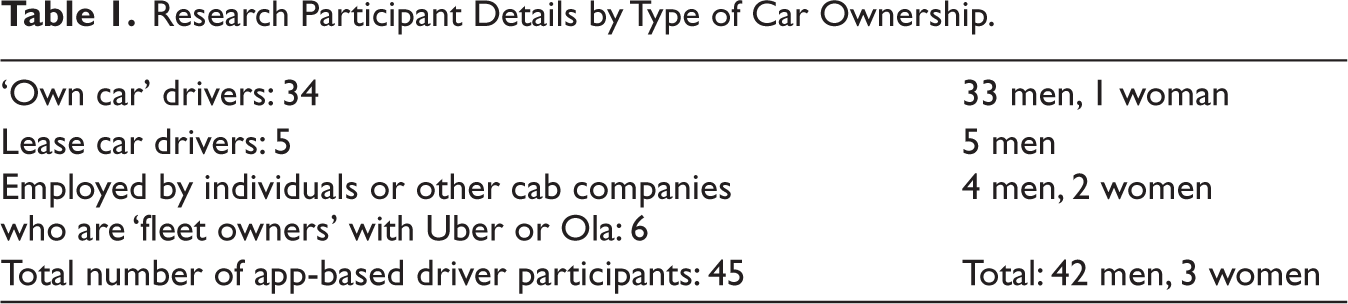
‘Owner drivers’ or ‘own-car’ drivers are those who had taken bank loans to buy their own cars, in contrast to drivers who were using cars ‘leased’ to them by Ola. ‘Lease car’ drivers had to pay an upfront deposit to the platform and a daily rental on the car, along with the mandatory commission on fares and other charges payable to the platform. Yet another category of app-based drivers I met were employed by other individuals or taxi businesses who in turn were attached as ‘fleet owners’ with Uber and Ola. In all, I met 42 male drivers and three female app-based drivers.
Except for one male participant, all 44 participants worked full-time as app-based drivers. With respect to caste identity, only 6 out of the 45 participants belonged to Dalit or Adivasi caste groups. The rest belonged to farming and land-owning communities such as Gowdas, Vokkaligas, Kurubas or Lingayats, caste groups which are politically dominant in the state. Drivers self-identified as ‘middle class’ but largely belonged to the lower strata of the ‘middle classes’, with a large majority of middle-aged and older participants (35–55 years old) having previously worked as drivers for non-platform cab companies in the city or as drivers employed by a household. They were surely not poor, as one needs some amount of economic and social capital to invest in a car. The heightening crisis of rural livelihoods, together with the lofty promises made by businesses like Uber and Ola about the high incomes that could be earned, had drawn many young men (20–25 years of age), from different parts of Karnataka to become ‘driver-partners’ in Bengaluru (Surie & Sharma, 2019). Unlike in app-based food delivery work which had a considerable number of out-of-state migrant workers, app-based drivers were predominantly from Bengaluru and rural areas of Karnataka.
During the period of my fieldwork in 2019–2020, the ‘honeymoon period’ which drivers experienced when both companies entered the market in 2014–2015 had long ended. As is well known, businesses such as Uber and Ola refuse identification as taxi or transport services, asserting their (self)-identity as ‘technology platforms’ (Pujadas & Curto-Millet, 2019)—a claim that governments in India have not contested. This is made evident by state authorities labelling these businesses as ‘aggregators’. Cast as ‘micro-entrepreneurs’ or ‘partners’, it is drivers who self-finance all the required inputs for work—cars, fuel, smartphones, accessories, repairs, maintenance and vehicle insurance. However, in India only owners of ‘commercial’ vehicles, that is, vehicles registered as taxis under state Motor Vehicles Acts, are allowed to ‘attach’ cars with Uber/Ola (unlike in several other countries, where drivers do not require taxi driver licences). In Karnataka, drivers are required to have a commercial vehicle driver’s licence, pay an annual tax for such vehicles, and periodically renew a slew of certifications as specified under the Motor Vehicles Act and rules to legally drive cabs. Although the government demands that drivers attached to Uber and Ola adhere to all the regulations required of a ‘commercial driver’, Uber and Ola are not required by the state to guarantee drivers the cab fares that are set and periodically revised by the state transport department. Uber and Ola provide drivers with no entitlements or protections, not even health or accident insurance. Thus, in India, the discourse of ‘technology platform’ or ‘aggregators’ has been very effective in establishing these businesses as ‘mere intermediaries’ or ‘neutral’ facilitators of transactions between two or more parties (Gillespie, 2010). However, as is well established, these businesses closely control workers, subject them to surveillance, and manipulate pricing, while also consistently downgrading remuneration and work conditions with little liability or accountability (Amorim & Moda, 2020; Edward, 2020; Shapiro, 2020). The discourse of ‘platforms’ and ‘entrepreneurship’ thus becomes an innovative tactic by capital to continually devalue labour power and benefit from the regulatory vacuum surrounding platforms businesses in most parts of the world, including India (Edward, 2020; ILO, 2021).
In 2019, drivers expressed that per kilometre rates had been cut in half and incentives reduced by as much as 80% in the preceding two to three years. Drivers in most big cities, including Bengaluru, had been protesting against Uber and Ola since 2017 when rates and incentives were drastically cut by these businesses after initially attracting many drivers with generous fares, incentive pay and bonuses (Hindustan Times, 2017). Allowing drivers to believe that remuneration rates would remain the same, drivers invested in expensive cars (sometimes buying several cars as platforms fuelled entrepreneurial desires) by partnering with government schemes and nationalized banks providing quick loans (Business Standard, 2016; Kashyap, 2015; Tandon, 2015). In India, app-based drivers did not have un/under-utilized assets to ‘monetize’, but had to take out loans to finance car purchases. Little did they know that the rates and incentives offered to them would be slashed, and as sharply as they were. Initially, driver protests were directed at Uber and Ola to demand better rates per kilometre and a reversion to the initial incentive component of pay (Ray, 2019). When Uber and Ola barely responded to these demands and affronted drivers by further worsening pay and work-related conditions—as was the case when I was doing fieldwork in 2019–2020—there was little hope amongst drivers that these businesses would listen to their woes.
In Karnataka, this led to driver unions like KCTU (which I introduce below) demanding intervention from the state. KCTU, as well as other cab driver associations, demanded that Uber and Ola be made to follow state-mandated fares applicable to all taxis in the state. Another prominent demand by driver associations, especially KCTU, was that all taxi drivers be allowed to fix metres and solicit customers on the streets, like in Mumbai or Delhi, to decrease their dependence on Uber and Ola for their livelihoods (Chatterjee, 2019). These demands have fallen on deaf ears. During conversations with drivers about their demands and the responses of the government, their utter lack of trust in the government was evident, with drivers using strong expletives in Kannada (the regional language) to abuse politicians. They often remarked that politicians and governments ‘were in the pockets of Uber and Ola’ or ‘danced to the tunes played by these businesses’.
My ethnographic ‘site’ was the city of Bengaluru, now dubbed the ‘start-up capital’ of India. Ethnographic fieldwork with app-based drivers was challenging since drivers did not have a regular spot where they waited for work (unlike app-based food delivery workers). So, I walked the streets of Bengaluru to find app-based drivers resting or waiting for rides in popular neighbourhoods, usually under the shade of large trees, off the main roads in upmarket localities. Pre-pandemic interviews with drivers usually took place inside their cars while they waited for trips. I usually met drivers parked close to shopping malls, IT parks or large apartment complexes, in the parking lots of railway stations and or head offices of Uber and Ola. Sometimes conversations turned into group discussions as more drivers joined an ongoing conversation, intrigued by a fellow driver ‘talking to someone who looked like a journalist’.
Having lived in Bengaluru for most of my life and being a fluent speaker of Kannada, it was easy to approach drivers who were surprisingly forthcoming in sharing their experiences and reflections of life and work. In all, I met 45 app-based drivers on the streets of the city and engaged in in-depth conversations with them about living in the city and working as a ‘driver-partner’ of Uber or Ola. A subset of driver participants (12 of them) who agreed to share their phone numbers with me, turned into long-term participants with whom I conversed more regularly. Although I tried to plan to repeat face-to-face interviews with the participants, these plans rarely materialized. Uber and Ola drivers could be allocated trips from any part of the city and therefore participants could never predict where they would be or when they would have some free time. Their steadily declining incomes also made it an imperative for drivers to extend their working hours, some younger drivers even working seven days a week to make up for decreasing incomes. All this translated into drivers having very little leisure time or days off to accommodate meeting me. Therefore, phone calls and voice notes on WhatsApp and Telegram became a means of staying in touch with my long-term participants. Conversations with drivers included discussions about changing work conditions, their financial circumstances, everyday support systems, and drivers’ associations and unions. This was how I learnt about KCTU, which more than one-third of my participants seemed to know of, a few even being its registered members.
KCTU is one of several taxi driver and autorickshaw associations and unions in Karnataka representing the struggles of app-based drivers in Karnataka. It is one of two main organizations (as of mid-2021), the other being the Ola, Taxi and Uber (OTU) Driver’s and Owner’s Association. Formed in 2017 following the biggest protest action mobilized by Uber and Ola drivers in the city till now, KCTU had close to 8,000 formally registered members at the time of my interview with its president in 2019. KCTU stressed its identity as an independent trade union. However, even when not explicit, trade union allegiances were often implicit. Despite KCTU’s avowed non-alignment with any political party, a key person in the union leadership is closely linked to the Congress Party and is revered by the union’s members. The membership drive, despite having started with organizing app-based drivers, has extended to include auto-drivers, drivers ‘attached’ to non-platform cab companies, and drivers working for goods carriers (including app-based services such as Porter). Although the members are predominantly from Bengaluru, between 2019 and 2021 the union made inroads into other districts of Karnataka, with ‘branches’ [ghataka] in close to 20 other districts in the state. The Facebook page of KCTU and that of its President Harish Gowda 3 have followings that exceed the union’s official membership. These are the main sites for the dissemination of updates and information about the union’s activities.
Early in my fieldwork, in August 2019, I visited the KCTU office and interviewed its President, Harish, who insisted that I ‘follow’ his and the union’s Facebook page to keep track of events and mobilization efforts undertaken by the union. We also kept in regular touch via phone calls and voice notes and met each other at protests organized by the union, all this enhancing familiarity and trust between us. When the pandemic struck, barring four of my long-term driver participants who stayed in Bengaluru, the rest (eight) had all returned to their hometowns or villages.
A week after the announcement of the national lockdown in 2020, a chance voice message exchange with Harish about the plight of drivers led him to ‘add’ me to the union’s Telegram channel, which at that time consisted of around 4,000 members. I regularly followed the conversations, photos and videos shared by drivers on both Telegram and Facebook between April 2020 and October 2021. Drivers were aware of who I was and of my presence on the Telegram channel because I often left voice notes updating drivers on laws or protests in other parts of the world or translated news reports or government guidelines concerning app-based drivers into Kannada. While the ten months of in-person ethnography helped me better understand the financial crises and dilemmas that had become an everyday reality for app-based drivers even before the pandemic, the online spaces helped me to stay in touch with drivers and learn about the support systems they were drawing upon to survive the pandemic and to remain as ‘driver-partners’ for Uber and Ola.
The (Invisible) Labour of Mutual Aid Practices
Literature on platform workers’ practices of support has demonstrated, first, that workers are not as individualized and atomized as platforms would like them to be, and second, that workers use a range of online and offline strategies to keep in touch with each other and build ‘networks’ of support that do not always take the form of resistance to capital (Malik et al., 2021; Nowak, 2021; Qadri, 2021) Discussing ‘gig workers’ who do remote work, Anwar and Graham (2020) explore forms of worker agency which enable workers to cope with platform work and its extremely unequal power relations. Drawing on Katz’s (2004) disaggregated formulation of agency, they usefully point to agential practices which are not always ‘resistant’ to customer or platform excesses and discuss workers’ acts of ‘resilience’—sharing of work accounts and laptops—shedding light on the everyday coping mechanisms of remote platform workers. While online modes of communication are a significant tool used by gig workers to advise each other on how to survive and optimize earnings (Woodside et al., 2021), Panimbang (2021) and Frey (2020) discuss how app-based cab drivers and motorcycle taxi drivers in Indonesia use both online and offline tools to engage in forms of mutual aid, especially during emergencies. All this points to a range of strategies that ‘partners’ have evolved to deal with the normalized risks to life and costs of platform work (Mpofu et al., 2020).
However, while these accounts are indeed insightful for showing how workers engage in reciprocal acts of support, I posit that shifting the analytic frame from ‘agency’/ ‘resilience’ to the lens of social reproduction helps us to recognize the work that such acts of resilience do for platform capital. Such a framing allows us to politicize the everyday acts of support performed by ‘partners’ that enable them to continue selling their labour via platform businesses, and which directly benefit these businesses by making them popular both in the eyes of customers and funders who pour millions of dollars into them (Lanard, 2021). I suggest that such an approach will sharpen current insights about the co-existence of ‘embeddedness’ and increasing commodification of platform labour (Wood et al., 2019) by making explicit how value creation within the (platform) capitalist social relation is sustained by the productive and unpaid and invisible reproductive labours that drivers expend in their everyday lives as ‘driver-partners’.
To do this, I draw from Marxist and socialist feminist contributions that centre their analyses of capitalist surplus extraction around the processes, spaces and relations that structure social reproduction. Social reproduction defies standardized definitions, but can be said to comprise all the labour involved in the daily and generational reproduction and regeneration of people (cooking, cleaning and caring), as well as social relationships and socio-economic systems such as the capitalist social relation (Dowling & Harvie, 2014; Ferguson, 2016). Although social reproduction may seem like an all-encompassing concept, it is primarily an ‘approach’ or an analytical lens with which to make visible all the invisibilized and devalued labour essential to a capitalist mode of production (Bhattacharya, 2017). In this way, it pushes forward the classical Marxist understanding of social reproduction as the reproduction of the capitalist production system. This rather narrow understanding of social reproduction was broadened by Marxist feminists in the 1970s, who asked if the waged labourer is necessary to reproduce capitalist relations and keep the accumulation process in motion, who then reproduces or regenerates the waged labourer from one day to another.
Early feminist interventions on social reproduction in the 1970s primarily identified the site of the home and women’s gendered, invisibilized and unpaid work (cooking, cleaning, childcare) as fundamental for regenerating people’s capacities to labour, thereby sustaining and subsidizing the processes of capitalist production and accumulation (Dalla Costa & James, 1975; Federici, 2004). Most famously, a campaign demanding ‘wages for housework’ became a means to politicize the patriarchal control over women’s bodies to service the capitalist accumulation process. However, the activism and scholarship of black feminists and postcolonial feminists, and more recent scholarship on social reproduction feminism, have broadened conceptions of social reproductive labour by decentring it from the space of the home and women’s unpaid labour within it (see Ferguson, 2020; Hall, 2016; Valiavicharska, 2020 for an overview of these theoretical developments). These scholars emphasize the multiplicity of spaces and social relations that absorb both the state and capital’s increasing onslaught on people’s capacities to meet their social reproductive needs and highlight the reproduction of intersecting social oppressions. At its crux, social reproduction feminism problematizes the widely held idea (in neoclassical economics) of the distinct spheres of ‘production’ (workplace) and ‘reproduction’ (‘private’, domestic sphere), and the devaluation of the latter. It emphasizes the intertwined, mutually dependent nature of the productive and reproductive spheres and labours and foregrounds the profound significance of reproductive labour in making life (Ferguson, 2016).
Although I do not in the least imply that households’ and women’s role in providing socially reproductive labour has diminished, in this paper, I specifically draw attention to other sites, institutions and forms of embodied labour that fulfil similar roles and contribute to the regeneration of workers’ capacities to labour (see also Banks, 2020; Mullings, 2009). These include the work done by co-workers, friends or institutions such as community centres or trade unions to replenish and reproduce people for yet another day of underpaid and exploitative work.
The question of social reproductive labour and value creation continues to be debated despite the close affinities shared by scholar-activists who differ on the question of ‘value’ (for a recent discussion, see Ferguson, 2020, pp. 123–130; Mezzadri, 2019, 2021). However, the empirical insights from this paper encourage me to agree with Mezzadri’s (2019, 2021) argument that social reproductive labours indeed create value for capital. Emphasizing the need to understand informal and informalizing labour relations through the lens of social reproduction, Mezzadri argues that it is untenable to maintain neat boundaries between realms of value and ‘non-value’. Schling (2017) also makes a similar case by showing how the boundaries of work/life, production/reproduction and value/non-value are blurred, as she discusses how practices of discipline and control seep from the factory floor into the walls of the migrant labour dormitories that she studied. I build on these insights by demonstrating how the everyday unpaid, and invisible strategies of support that drivers provided each other enabled them to remain in platform work and sustain their lives, while also enabling the reproduction of the ‘technology platform’ and ‘partner’ social relation.
‘Brothers, We Only Have Each Other’
As mentioned previously, the app-based cab-driving workforce in Bengaluru has a significant presence of male drivers who have migrated from other districts of Karnataka. Consequently, when the lockdown was announced there was an exodus of drivers who returned ‘home’, where they were guaranteed at least two square meals a day: ‘At least in my ooru [village/town] we have a ration card with which we can at least get [from the government] rice and sugar’, ‘we can grow green leafy vegetables in the backyard and not sleep hungry’, ‘we don’t have to pay rent or expensive electricity bills’. These were some of the reasons cited by participants for leaving Bengaluru, which signify very clearly that basic survival—staving off hunger and having shelter—was at stake for a majority of my participants.
However, not all drivers had welcoming families or homes to go back to. Drivers chose to stay back in Bengaluru if there was no space to accommodate them (and their families) in their parental houses. Several drivers, despite having resources such as agricultural land and a house, ruled out going back to their hometowns due to estranged or tense relations with their families. For instance, two of my participants whose inter-caste ‘love-marriages’ had not been accepted by their families even after several years could not access the kind of family-based support that most others could readily tap into. In the absence of family support and assets acting as shock absorbers, more indebtedness and a drastic cut in consumption were strategies they deployed to manage their households during this period of lack of an income (see also Kesar et al., 2021). A long-term woman driver participant and the wife of a male driver participant were more forthcoming about their daily struggles to purchase food. One evocatively mentioned that her family was getting used to the taste of black tea because even buying a half-litre packet of milk had become a luxury. Both men and women drivers expressed in personal communications and on Telegram channels that it was a challenge to find moneylenders willing to lend to Uber/Ola drivers, because they were well known to be ‘drowning in debt’ [mai thumba saala] even before the pandemic.
It was at such a juncture that the drivers’ union became an important source of support for its members. The support that driver members accessed during the pandemic not only enabled them to sustain life during the lockdown but also ensured that they could continue to sell their labour to Uber and Ola when the lockdowns were lifted. In the following subsection, I discuss KCTU’s role in ensuring drivers’ social reproduction during multiple ‘waves’ of the pandemic. In the second sub-section, I show how these support structures were already present before the pandemic, signalling that workers, even during ‘normal’ times, depended on each other to absorb the costs and risks of platform work to reproduce themselves.
Surviving the ‘Waves’ of the Pandemic
The pandemic had upended the already precarious lives of drivers, especially those of ‘own-car’ app-based drivers, who even before the pandemic struggled to ‘save their car’ from being impounded by financiers and keep up with payments towards their loans. Conversations with driver participants, even before the pandemic, revolved around the constant ‘tension’ and pressure they faced to earn enough to cover their costs of driving (including loan installments) and be left with at least ₹500–700 to take home every day. More than one driver admitted to having contemplated suicide. During group discussions drivers casually brought up how Uber, Ola driver suicides will soon replace the infamous farmer suicides in India. Such comments demonstrate the distress that drivers were under even before the pandemic as they stared at steadily declining incomes, longer working hours and deteriorating health conditions. Against such a background, KCTU’s apprehension that the national lockdown would trigger driver suicides is hardly surprising and the dramatized video with which I began this paper reveals this concern. In this section, I iteratively and chronologically discuss the quality of interventions by Uber and Ola, and those of the governments in power at the state and the centre to make explicit why KCTU became increasingly relevant in the lives of its members.
In the initial weeks of the lockdown, in March and April 2020, Facebook and Telegram channels became affective spaces where drivers and their families shared their struggles to reproduce themselves. Videos uploaded by drivers, women family members and children of drivers populated the union’s Facebook page timeline. These videos described their everyday struggles to survive and the family members of drivers demanded that the state government offer monetary relief for drivers of commercial vehicles. The central government had marginally increased food rations during the lockdowns and also announced a monthly cash aid of ₹500 for three months to women who held Jan Dhan bank accounts. 4 However, the experiences of my participants as well as conversations on Telegram indicated that drivers living in the city did not have access to any of these welfare schemes. Dramatized videos, such as that mentioned above, or those of people refusing to pay utility bills and shooing away bill collectors not only helped validate feelings of frustration and helplessness but also made people’s struggles to reproduce themselves less individualized. The ‘live videos’ posted almost daily by KCTU’s President, Harish, were replete with anger at the state’s apathy toward the predicament of platform drivers and other ‘toiling populations’ [‘dudiyo janarige’/‘dina-gooli kelsa maaduvavaru’] whose ability to meet the basic needs of life had been decimated overnight. This shows how demands articulated around social reproduction can indeed create solidarities crossing occupational boundaries.
The lockdown saw KCTU and other cab and auto driver associations in Karnataka leaving rivalries aside to form a united front to lobby the state government to support drivers. Constant reminders via photos and videos of the lobbying efforts with the state’s opposition party leaders, or of union representatives submitting memorandums to the ruling party demanding immediate financial assistance, were posted online to assure drivers that something was being done and that their struggles would find some respite soon. Together with this, state-level drivers’ associations and IFAT (Indian Federation of App-based Transport Workers)—a budding national-level federation of app-based workers—represented the struggles of drivers on news channels and mainstream media and even organized online campaigns. One such campaign depicted drivers and their families taking selfies while banging empty vessels at home, signifying the lack of food in drivers’ houses (Bhat, 2020). In Karnataka, KCTU also organized a postcard campaign in which drivers flooded the chief minister’s office with postcards demanding that the government take notice of the plight of drivers and offer them immediate monetary relief.
These efforts, despite not resulting in any immediate improvement of their situation, nonetheless provided a source of hope for drivers who were constantly reminded that the union was working for their interests and that they were not alone. Witnessing the plight of commercial taxi and auto drivers, with reports of driver suicides too making the news (Chauhan, 2020), KCTU decided to distribute the annual membership fees it had collected to help its struggling members. Members received ₹1,000 each, which though not a lot of money, was timely assistance to help them at least buy groceries. KCTU also distributed a limited number of dry grocery kits to members who were in dire need of help.
Meanwhile, platform businesses, including Ola and Uber, sought contributions from customers to support drivers by opening crowdfunding pages to supplement funds which they claimed to be putting aside for ‘driver welfare’ (Medappa & Taduri, 2020). Ola offered ‘interest-free loans’ of ₹3,000 to drivers as financial assistance (Mahale, 2020), while Uber announced a one-time (non-repayable) grant of ₹3,000 to its drivers in April 2020. Assessing the welfare measures rolled out by Uber to pay its ‘partners’ for income losses and healthcare in the United States, Katta et al. (2020) argue that this could be read as platforms assuming more responsibility for the welfare of their ‘partners’. However, such an interpretation might be premature, since the claims and actions of these companies need to be assessed contextually. For instance, while Uber offered financial assistance even to those drivers in the United States who had to self-isolate due to pre-existing health conditions (Uber, 2020), in India drivers were only offered an insurance policy that covered hospitalization due to COVID-19 (Parameshwaran, 2020). Moreover, in India platform companies made many claims of supporting drivers, but very few drivers received the token financial support and grocery kits that platforms promised. This was evident in the surveys carried out by IFAT as well as in the angry queries made by app-based drivers to media channels about the fate of funds raised in their name (Bhalla, 2020; IFAT & ITF, 2020).
In May 2020, due to the pressure mounted by various activist groups and worker collectives, the Karnataka government rolled out a one-time cash relief of ₹5,000 for drivers of commercial vehicles (Indian Express, 2020). However, this relief had to be claimed via an online application. Once again, it was union members who educated one another about how to navigate the online system, which—as shown by screenshots and voice notes shared on Telegram—threw up arbitrary ‘errors’, rejected drivers’ applications due to the restrictive eligibility criteria, or simply did not credit the relief money into the accounts of drivers several weeks after a successful application (Balakrishna, 2021; Ravi, 2020). This situation frustrated drivers and left them disheartened by the government’s lack of ‘concern’ [kaalaji] towards drivers and their half-hearted attempts to appease them.
The moratorium on paying loan instalments announced by the Reserve Bank of India (India’s central bank), while did come as a relief for driver participants, was revealed to be short-lived as banks continued to call participants ‘advising’ them to pay their instalments, reminding them that interest on their loans would continue to accumulate despite the moratorium. As several participants and discussions on Telegram also pointed out, ‘what moratorium exists for loans taken from money lenders?’ Despite the easing of the national lockdown after June 2020 (although state governments had different policies, some extending restrictions), drivers who went back to work struggled to even cover fuel costs as customers were hard to find. Demands made to Uber and Ola by state-level driver unions and IFAT to reduce commission rates went unheard and platforms continued to charge 25% commission (Ranipeta, 2020).
It was in the latter half of 2020 that KCTU began a ‘welfare trust’ to meet emergency financial needs of drivers. This welfare fund became a source of assistance for drivers who were suffering ill-health or could not afford medical expenses of their immediate family members. Updates were shared about a sick parent or a child needing surgery, and drivers contributed to the trust however much they could spare. In December 2020, one of KCTU’s very active union members, a young man in his early 30s, committed suicide, leaving his young wife and daughter behind. He had started as an app-based driver and later tried his hand at floating a ‘fleet’ of cars attached to these platforms by taking cars on lease from individuals. With steadily declining rates and incentives, he increasingly fell into debt, as he had to take loans to meet his expenses, some of them at very high-interest rates, as high as 10% per month. A close friend of the deceased driver shared how several other drivers were also going through experiences of depression, extreme levels of stress, or strained family ties because of indebtedness. 5 Driver members of KCTU collected money to take care of the funeral expenses of their ‘brother’ and even carried out some of the rituals during cremation. This incident spurred a slew of emotional messages from drivers, emphasizing the fraternal ties they shared through KCTU and how the union and its work were taking ‘the place of blood relatives’.
The need for mutual support only increased with recurrent ‘waves’ of the pandemic, sky-rocketing fuel prices, the refusal of platforms to reduce their commissions and the state government’s failure to take seriously the demand in Karnataka to bring ‘aggregators’ like Uber and Ola under state-mandated taxi fare regulations. Until January 2021, updates from drivers on Telegram groups were largely about ‘dull business’ and messages of caution about protecting oneself from Covid. In 2021, as platforms had made it mandatory for drivers to be vaccinated, they regularly shared updates about vaccination drives in the city and reminded each other to take necessary precautions, for instance avoiding ‘airport trips’ as much as possible. Harish even consulted a doctor and shared a prescription of medicines (paracetamol and vitamin supplements) to buy if drivers or their family members contracted the virus. Drivers also shared recipes of herbal concoctions which were believed to enhance immunity levels.
The steadily rising fuel prices in early 2021 seemed to be a cruel joke compounding the distress created by the pandemic, which also translated into the increased cost of essentials such as vegetables, which increased the costs of living (Inani, 2021; Kaushik, 2021). Amidst this, due to the raging ‘second wave’ of the pandemic in India, the Karnataka state government announced another lockdown at the end of April 2021 (DNA, 2021), once again throwing drivers and other ‘non-essential’ daily wage workers out of work or other means of income while doing little in terms of support.
There was a qualitative difference in KCTU’s approach to the second wave of the pandemic and lockdown in 2021. From videos filled with anger, sarcasm and critique of the BJP-led governments (both in Karnataka and at the centre) and their misplaced priorities in 2020, this time Harish and other drivers shared long voice notes advising each other to find ‘badalavane’ [change] or badali maarga’ [alternatives]. In late 2020, Facebook blocked Harish’s account after right-wing groups had ‘reported’ to Facebook that Harish had made incendiary comments. Harish had uploaded a ‘live video’ criticizing the Hindu fundamentalist BJP government’s crowdfunding campaign to build the Ram temple in Ayodhya when common people were starving during a pandemic that was far from over. Right-wing thugs had even tried to physically attack Harish near the KCTU office. Online hate campaigns, the threat of violence and the sheer apathy of governments and employers to provide meaningful assistance to struggling people and workers led the union to push members to take individual responsibility to find ways to socially reproduce themselves, ‘save their cars’ and remain hopeful for ‘business’ to pick up again.
While ‘own-car’ drivers struggled to ‘save their cars’ and keep up with loan instalments, they at least had access to a motor vehicle which they could depend on for a livelihood. ‘Lease’ car drivers of Ola lost access to their cars soon after the lockdown was declared because Ola demanded that these cars be returned to them. As of late-2022, ‘lease’ car drivers continue to demand and wait for their cars to be returned to them by Ola; cars on which they had paid years of daily rentals and which they were made to believe they would eventually own (see also Chabra, 2021). 6
Being compelled to find ways to sustain themselves and their dependents, in 2021, many drivers shifted to app-based food delivery work, which continued to be categorized as ‘essential service’. Several drivers shared posts about their work as security guards, construction workers, or loaders, while some sold vegetables and fruits house-to-house to meet their expenses. While some drivers regretted their fate and posted voice clips lamenting how ‘Uber and Ola had brought them to the street’, others lifted the spirits of fellow drivers by emphasizing that no work is ‘small’ and that anyone who does ‘hard-work’ to earn one’s livelihood should be proud of themselves. This time, the dominant message of the narratives on Telegram groups was ‘to adapt to changing times and find alternative livelihoods’.
KCTU—perhaps better prepared and better funded in 2021 7 —acted very quickly in distributing grocery kits for free to its members who expressed a need for them. They widely publicized that drivers could request dry grocery provisions on their Facebook and Telegram groups. Pictures were posted of driver members standing in the middle of rooms filled with vegetables, herbs, sacks of rice and dal, some cutting vegetables, some cooking, others packing, as local committees in KCTU had also started distributing hot cooked food to its members in their locality and even to other poor families and daily wage workers. Forms of support during this time were largely focussed on the space outside of work, the ‘living environment’ on which everyday survival was dependent (Smith, 2019; Zlolniski, 2019).
KCTU had already begun its ambulance service (in late 2020) for drivers and their immediate families for a nominal charge. They extended this service to neighbours of drivers too during the ‘second wave’ of the pandemic in 2021, as shortages of oxygen cylinders, beds and medical services in India made international news (Ellis-Petersen, 2021). We do not know how many drivers contracted Covid or succumbed to it, but Uber and Ola, as well as the government, did nothing to insure the lives of its ‘frontline workers’/‘partners’ who died, leaving behind more indebted families and children whose futures now are to be spent in repaying debts (Kaushik & Gurmat, 2021).
On a Telegram channel labelled ‘members discussion’ group, Harish advised drivers on financial matters in 2021, as more and more drivers faced the threat of losing their cars. In 2021 ‘loan re-structuring’ replaced moratoriums on loan instalments (TNN, 2021). Driver participants on the Telegram group and Harish shared frequent voice messages from bank managers advising drivers to approach their banks to request the ‘restructuring’ of loans. Drivers also advised each other to wear the union uniform, visibly carry their union ID card and wear the red and yellow Karnataka flag colours (whose significance I discuss in the next section) to assert their cultural-professional and collective identity when they went to meet bank managers for discussions about loans.
It was not just Harish who was mediating with creditors. Members continued supporting each other, connected through neighbourhood or local level office bearers of KCTU and spared time to accompany fellow members to banks, finance company offices and informal moneylenders, all of whom were harassing drivers and repossessing vehicles for defaulting on loans (Philip, 2021; Salman, 2021). One of the many pictures and videos posted on a Telegram channel of the union in June 2021 showed seven drivers smiling ear to ear in front of a house in a low-income neighbourhood. The driver members (some of whom the aggrieved driver barely knew) had all intervened when an informal creditor started harassing the driver by creating a ruckus in front of his house. Such acts of support carried out by KCTU in negotiating debts and ‘saving the car’ of drivers blurred the ‘work-home boundary’ (James & Vira, 2012). As Narotzky (2015) argues, forms of value extraction under conditions of flexible capitalism are increasingly dependent upon and ‘…favour a fully embedded labour force, one whose economic alienation is predicated on its linkages to other forms of reciprocal obligations and value regimes’ (p. 192). The social pressures faced by male drivers to perform their roles as ‘providers’ for the family, the loss of social status at having one’s car impounded by finance companies or creditors, the affective attachment to the ‘partner’ identity, as well as the empathy which drivers shared with one another, all worked in keeping businesses like Uber and Ola in motion, even though they remained unperturbed about their partners’ struggle for survival.
Pre-pandemic Infrastructures of Support
Although I have discussed the socially reproductive work that KCTU and its driver members performed for each other during a ‘crisis’ situation like the pandemic, it is important to recognize that these relationships of support existed even before the pandemic. While the pandemic and the lockdowns undoubtedly heightened KCTU’s presence in the lives of its members, drivers had been relying on one another’s support to weather the insecurities and risks inherent in platform driving even during ‘normal’ times.
During in-person conversations with drivers before the pandemic, it was clear that they believed that platform businesses cared little about their welfare and that their interests would always be subordinated to those of customers. Therefore, drivers had to rely on one another to educate each other, protect themselves and manage the increasing costs of work and risks to life if they were to remain in app-based driving. Uber and Ola drivers receive little support from these companies in case of emergencies like accidents, run-ins with the police and disagreements with customers, and so rely on WhatsApp and Telegram groups to ask for help. Drivers spoke about posting ‘live locations’ and voice messages on online chat groups of the union, or on groups they had created with friends detailing the problem they were facing. On the union’s Telegram page, other drivers in the vicinity would reply with assurances or immediate help, later also posting photos of resolving the problem.
In the absence of platform assistance, drivers shared experiences of posting pictures of unclear messages from their ‘partner app’ (regarding insurance payments, documentation and penalties slapped on them), with other drivers chipping in with their inputs or past experiences in response to questions raised. Such assistance was especially crucial in 2020 and 2021 as platforms saw the pandemic as an opportunity to lay off thousands of workers who worked in lower managerial and support functions (Medhi, 2020). Such invisibilized and unpaid labour of workers continues to serve as a subsidy to platform capital and allow these businesses to not provide effective support for their ‘partners’.
Certainly, differences amongst drivers—such as the extent of land ownership, level of indebtedness, supplementary income (from rent, money lending, farming activities) and the ability to tap social networks—this tied to one’s caste-class background and gender identity—variously determined the capacities of driver participants to withstand the inherent and unforeseen costs and dangers in platform work. Many drivers’ high levels of indebtedness translated into being unable to quit platform-based driving. ‘We are trapped’ [sikk-haakondideevi]. ‘I may get a salary of ₹15,000 as someone’s driver, but my car loan EMI [equated monthly instalments] alone costs that much; at least here I can work for 16-–18 hours and earn a little more’. ‘Neither can we swallow, nor can we spit it out’ [attha nungakku aagalla, ittha ugiyakku aagalla]. Such expressions articulated drivers’ predicament of being ‘stuck’ in platform driving. The commodification of basic social reproductive needs such as housing, food, education or healthcare and the imperative to meet these needs constrained workers from protesting against the unfair practices of Uber and Ola, leaving most with little choice but to labour for these businesses.
Even during ‘normal’ times, platform driving is not without its dangers. Drivers shared experiences of being mugged or escaping by a whisker from being attacked by thugs late at night. They emphasized the lack of ‘response’ by Uber and Ola when drivers informed customer service about these experiences. However, such experiences became lessons for others when shared on Telegram or WhatsApp groups, or in the airport parking lot where drivers usually socialize face-to-face. Since it was common for drivers to sleep in their cars and not go home for several nights to reach targets or to reduce the cost of fuel on driving home, drivers had learnt about some safe spots in the city where they could park close to other drivers’ cars at night to take a nap or to sleep. They thus created a web of cars on certain streets in the city, providing safety for each other while being available for customers 24/7. However, it must be emphasized that these infrastructures of support were more common amongst male drivers, especially those from Karnataka, who found acceptance in unions or within a ‘friends circle’ of drivers more easily. Women formed a minuscule proportion of app-based drivers, and although KCTU had a handful of women drivers as members, most of my women participants (doing driving and food delivery work) had to depend on individual strategies to produce safety for themselves.
Drivers had also devised supplementary income-generating mechanisms to make up for the steadily declining incomes from app-based driving. Since driving enabled personal interactions and the space and time to have conversations with customers, some drivers had developed ‘personal customers’ (through app-based work and other jobs), who would call on them directly. When drivers could not serve their customers, they ‘passed’ these trips to others by posting trip details on a Telegram channel dedicated especially for this, thus helping other drivers enhance their earnings. Such Telegram groups were common even outside KCTU, and app-based drivers usually kept an eye on these Telegram groups. Drivers were happy to take these trips because fares on these trips were often better than Uber/Ola rates, and also because they did not have to lose a fourth of their fare by way of commission charges. But these trips could not be relied upon for a livelihood and mostly plugged falling incomes in app-based driving. While these acts of solidarity were certainly not intended to serve the interests of platform businesses, they did help to mitigate the losses and low incomes which drivers experienced in app-based work and for which Uber/Ola took no responsibility. Some older drivers with families also spoke about informal rotating savings and loan groups [cheeti groups] they had created amongst each other as a safety net to make up for the inconsistent (and declining) earnings from platform driving.
Significantly, online modes of interaction in KCTU were supplemented with face-to-face events and celebrations amongst drivers, which enhanced feelings of fraternity and strengthened the emotional bonds amongst them. Driver members were categorized into geographically specific ‘constituencies’ 8 and ‘wards’, 9 each also having its own WhatsApp/Telegram groups. Office bearers of each of these constituencies and/or wards often organized membership drives in playgrounds or other public spaces or organized blood donation camps on public holidays. Members (mostly male) also met for ‘chaha kootas’ [meetings with tea] and posted pictures of these kootas on Facebook and Telegram groups.
Driver unions and associations—both cab and autorickshaw—in the state have historically been associated with groups or movements that promote the Kannada language, and identify very strongly with the Kannadiga identity (Nair, 2000). For this reason, annual celebrations such as Kannada Rajyotsava [state formation day] or the birthdays of prominent Kannada (male) film stars such as Vishnuvardhan and Shankar Nag—who are revered amongst the driver community for their portrayal of honest, hard-working drivers in cult classic films—became occasions for drivers to meet and build friendships with each other. Drivers unfailingly donned the red and yellow colours of the Karnataka flag in the form of ‘shawls’ or stoles worn over their white or brown uniforms during these public events. These events built a sense of fraternity, professional identity and pride amongst drivers. Drivers also viewed these celebrations and meetings as an antidote to the monotony and isolation they experienced in app-based driving, these events emotionally replenishing them for another day of work. Although constraints of space preclude a more thorough discussion, the Kannada identity together with the social and material devaluation drivers faced, at times reproduced dangerous and exclusionary tendencies such as demonizing ‘outsiders’ [horaginavaru] or migrants from other states of India—often sweepingly dubbed as ‘Hindi people’.
These ethnographic findings show that the boundaries between production and reproduction, work and life are far from distinct, and how the everyday material and affective support systems which drivers provided to one another during the pandemic (and even before it) ensured and replenished workers’ capacities to labour for platforms. Life, labour, sociality and fraternity bled into and enabled each other. The spaces of the street, cabs, the airport and online communication channels were sites which enabled both production (for platform capital) and reproduction (leisure, recuperation, ensuring safety, finding ways to cushion financial risks), these being mutually enabled. The labours and affective ties that workers provided for each other and built both ‘at work’ and ‘off work’ not only replenished them from one day to another, but also, as I have shown, helped to mitigate, to some extent, the costs and risks which the platform business model foists on ‘micro-entrepreneurs’. Ironically, drivers were also dependent on other monopolistic digital platforms like WhatsApp, Facebook, Telegram and GooglePay to find ways to cushion themselves from their exploitation by Uber and Ola. As Mezzadri reminds us, ‘…only interpretations of social reproduction activities and realms as value-producing can advance our understandings of labour relations of contemporary capitalism’ (2019, p. 33). This paper shows how contemporary forms of capitalism, in this case embodied by ‘disruptive’ business models hailed as ushering in a new ‘future of work’ (Manyika, 2017; Vijaykumar, 2021), extract value from the many invisibilized and unpaid labours that ‘partners’ have to perform to remain in platform work. It is these devalued and unpaid labours which also serve as a subsidy to customers of app-based services who patronize these businesses for their rather affordable services. The social reproductive needs of customers (their everyday transport, meals, groceries delivery needs), often belonging to more affluent class positions, are thus satisfied by the increasing exploitation of the devalued and unpaid labours of the urban poor and lower middle classes trying to earn a livelihood through digitally mediated labour platforms.
The prospect of driver solidarities turning into a powerful oppositional force looks bleak in India, especially with the adulation showered on ‘start-ups’, the absence of political will to bring about any meaningful regulation of these businesses, and the intensification of people’s financial vulnerabilities in the face of an economic crisis and unemployment in India worsened by the pandemic. Despite KCTU’s relentless struggles to protest against Uber and Ola, its most recent efforts being a ‘log-out campaign’ carried out by some drivers on certain hours and days in May–June 2021, nothing changed in terms of rates. Drivers posted voice notes of how Uber/Ola offered better incentives on those days to appease striking drivers and lure them back to work. However, these better rates and incentives vanished soon after the threat of strikes had passed. The Karnataka state government, despite reluctantly passing an order stipulating that Uber and Ola should follow state-mandated cab fares following the suicide of a driver at Bengaluru airport on 30 March 2021 (Arakal, 2021; Rakheja, 2021), has failed to implement its order—Uber and Ola still do not pay its ‘partners’ these fares. In such a context, support structures created by unions like KCTU and those evolved by app-based drivers more generally, do valuable work by cushioning ‘partners’ from the exploitative, unjust practices of these ‘lean’ businesses, in turn enabling the regeneration of these very businesses and their business models.
Conclusion
Drawing from Marxist and socialist feminist scholarship on social reproduction, I empirically demonstrate how ‘driver-partners’ of Uber and Ola create value for ‘technology platforms’ by undertaking a slew of invisibilized and unpaid labour that cushion them from the many risks and dangers of platform work. Such unpaid labours act as a subsidy for ‘asset light’ platform capital, which conveniently casts workers as ‘micro-entrepreneurs’. I use such framing to analyse practices of mutual aid amongst app-based workers, for it helps to account for the ‘productive’, ‘valuable’ work that such unpaid labours do for platform capital. It also illustrates that production (for capital) and reproduction (daily regeneration of people and their labour power), far from being disparate realms, are ‘mutually constitutive and in tension’ (Katz, 2001, p. 710) with one another.
I have argued that platform businesses benefit from and are reliant upon workers’ unpaid and invisibilized labours, labours which I posit function as socially reproductive labour. Such labours compensate for the lack of responsibility taken by platform businesses and the state to ensure fair working and just living conditions for workers, a reality made especially stark during the pandemic. Union-evolved support structures became more significant during the lockdowns enforced due to the pandemic when drivers were left without a means of earning for many months and had barely any support from platform businesses or state and central governments to sustain themselves and their dependents.
Through this article, I contribute to scholarship on social reproduction and its role in capitalist value creation. First, socially reproductive labours are performed not only at home but also outside of it, as seen in how app-based drivers enabled both work and life for one another. Second, these labours indeed create value for platforms by absorbing the disproportionate costs and risks that ‘partners’ are forced to bear within this labour regime, thereby subsidizing capital, ensuring happy customers, as well as higher ‘valuations’ for these businesses. Third, defying classical economist understandings of the spheres of production and reproduction as distinct, I show how the ‘state, household and market are integrally linked’ (Ferguson, 2016, p. 50) in people’s efforts to make life.
A degree of hesitancy or discomfort is inescapable in making sense of people’s actions, especially of union members’ acts of mutual support, as productive for capital. I could perhaps be accused of positing a ‘capitalocentric’ (Gibson-Graham, 2006) view of people’s life-making efforts. It is certainly not my intention to reduce all practices of mutual aid and solidarity to be at the service of capital accumulation. However, I think it is important to politicize the valuable work that the everyday labours of mutual aid do in reproducing the platform worker from one day to another, while also sustaining a social relation that seeks to fetishize and mystify exploitation by using the discourse of entrepreneurship. Whilst such a lens allows to provoke a politics that recognizes the unpaid labours which sustain both workers and platform businesses, as Bhattacharya (2017) reminds us, the sheer necessity for social reproduction, while rendering workers vulnerable to follow the rules set by capital, can also be the very grounds on which a broad-based collective can emerge to flout these very rules. The many acts of protest and efforts undertaken by app-based workers to confront capital are testimony to this (Cant & Woodcock, 2020; Rossi, 2019; Weise & Scheiber, 2022). Importantly, by bringing together struggles for better labour conditions with struggles around the decommodification of social reproduction needs (food, housing, education, and health services), we can perhaps suture the fractures in people’s movements to pose a stronger threat to capital and demand more accountability from the state.
Footnotes
Acknowledgements
I would like to thank Professor Geert De Neve, Dr Rebecca Prentice and Dr Benjamin Hunter for their detailed feedback on earlier drafts of this article. I would also like to thank Professor Carol Upadhya and two anonymous reviewers for their encouraging and constructive feedback that have informed this article.
Declaration of Conflicting Interests
The author declared no probable conflicts of interest concerning the authorship, research and publication of this article.
Funding
The author disclosed receipt of the following financial support for the research, authorship, and/or publication of this article: This research was fully funded by Chancellor’s International Research Scholarship awarded to me by the University of Sussex, Falmer, United Kingdom.