




Abstract
Bangladesh frequently suffers from acute riverbank erosions and, as a result, every year a large number of people internally migrate to new places mainly in search of livelihoods. While very few studies focus on the multifaceted nature of vulnerability experienced from riverbank erosions, the present study examines to what extent different drivers of vulnerability affect socio-economically disadvantaged internal migrants living in riverbank erosion-prone areas in Bangladesh. Empirical evidence from two north-western riverbank erosion-prone districts in Bangladesh demonstrates that the disadvantaged internal migrants and their household members were exposed to a range of vulnerabilities connected to economic, institutional, infrastructural, environmental, and social drivers. It is contended that evidently there are different types of vulnerability some of which are perceived to be more severe than others in the study areas. This study, therefore, suggests extending some specific support programmes including income generation schemes, access to institutional credit for the landless, improved inexpensive means of transportation, and improved communication. This article also proposes improving rural infrastructure including irrigation facilities, inexpensive transportation means for agricultural inputs or other farming materials, reasonable prices for daily necessities, and improved health care benefits.
Keywords
Introduction
It is widely recognized that the impacts of climate change and other natural hazards accentuate human vulnerability and often shape the pattern of human mobility (Adger et al., 2015). There is a growing realization that one of the most significant trends in human mobility continues to be internal migration within a specific country (IDMC, 2017; Rees et al., 2016). In Asia, for example, internal migration and displacement due to natural hazards are thought to be alarming (International Organization for Migration [IOM], 2014) perhaps due to larger populations and greater socio-economic inequalities (Mayer, 2013). For instance, in 2013, 17 out of 20 largest displacement events worldwide were recorded in Asian countries (Internal Displacement Monitoring Centre [IDMC], 2014). It is further anticipated that by 2050, the number of displaced people may rise to 26 million in Bangladesh, 20 million in India and, 73 million in China (Biermann & Boas, 2010). This article focuses on Bangladesh as it offers an important case study in understanding human vulnerabilities, internal migration and forced displacement associated with natural hazards. Bangladesh, one of the most densely populated countries in the world, experienced no less than 200 natural hazards over the last three decades; in 2019 at least 260 people were killed due to multiple extreme events (Asian Disaster Reduction Center, 2019) such as cyclones, flash-flooding and seasonal flooding, drought, and riverbank erosion. According to the Global Climate Risk Index (2019), the country has experienced a series of extreme weather events between 1998 and 2017 and ranked seventh among the worst affected countries (Eckstein et al., 2019). Although recent studies (e.g., Islam & Hasan, 2016; Mallick & Vogt, 2014; Rahman et al., 2015) endeavoured to capture different environmental and non-environmental factors influencing human mobility in response to environmental hazards including cyclones, tidal surges, flooding and drought in Bangladesh, vulnerability of the internal migrants as a result of riverbank erosions still largely remains unexplored. This is particularly important as riverbank erosion is a recurrent natural hazard in Bangladesh, causing enormous loss of land and large-scale displacement within the country (Islam & Rashid, 2011; Rahman et al., 2017). To illustrate, in 2013, riverbank erosion affected 94 out of total 489 sub-districts in Bangladesh, causing displacements (or involuntary internal migration) and increased vulnerability of the people living in riverine areas (Government of Bangladesh, 2014). While the impact of riverbank erosion as a whole is alarming, existing studies rarely explore the multifaceted nature of vulnerability affecting the livelihoods of the poor and marginalized, including their left-behind non-migrant family members who continue to live in erosion-prone areas. In most cases, the pattern of damages on human lives (e.g., health and wellbeing) and properties remain undocumented due to the geographical remoteness of these affected places (Uddin & Basak, 2012). This is particularly visible in one of the major initiatives namely Char Livelihood Programme 1 which recognizes river bank erosion as an instrumental element for displacement and distress for poor people in the country. However, despite an apparent focus on deprivation experienced by households living on hard-to-reach remote chars in Bangladesh this initiative also fails to recognize and address the multifaceted nature of vulnerability experienced by the affected people (see World Bank, Rapid Social Response & Global Facility for Disaster Risk Reduction and Recovery [GFDRR], 2013; Pritchard et al., 2015).
Against this backdrop, this article examines how different drivers of vulnerability affect internal migrants and their household members. More specifically, it sheds new light on how marginalized and disadvantaged people struggle against a combination of drivers of vulnerability (associated with socio-economic, institutional and environmental challenges in the riverine areas) and may accept leaving their ancestral places as one of the possible coping strategies. Generally, various subgroups such as the economic poor, outcaste communities or ethnic minorities are often defined as the most vulnerable groups in comparable contexts. However, such a view could be too simplistic for understanding vulnerabilities in the riverine areas of Bangladesh (Lein, 2009) as many wealthy families can become landless (and thus highly vulnerable) once affected by riverbank erosion. While classifying human vulnerability in important policy frameworks (e.g., from the Intergovernmental Panel on Climate Change), Bhuiya et al. (2017) and Azam et al. (2019) offer a more holistic view by exploring a range of indicators that potentially contribute to higher vulnerability in the riverine areas of Bangladesh, namely, frequency of riverbank erosion, exposure to other extreme events, demographic sensitivity (percentage of children and elderly), lack of land productivity, chronically ill family member, proximity to health centre, common local diseases, and lack of sanitation facilities, amongst others. In assessing vulnerability in riverbank erosion-prone areas in Bangladesh, this study adopts this broader view in identifying the most vulnerable groups. The findings of this study aim to contribute beyond environmental push theory by detailing the interlinkages among vulnerabilities of marginalized people living in remote areas, role of different institutions (covering public and non-profit sector) and internal migration from places exposed to natural hazards, thereby adding to a greater nexus of socio-environmental inequalities approach in this regard (Hunter et al., 2015; Piguet, 2013). This is also coherent with how poor, marginalized and vulnerable people in remote chars respond to different drivers what Lahiri-Dutt and Samanta (2013) describe as konomate beche thaka. 2 In doing so, this study focuses on two north-western riverbank erosion-prone districts in Bangladesh, namely Rajshahi and Chapainawabganj. Every year thousands of people in these locations become displaced and migrate internally due to riverbank erosion (Bhuiyan et al., 2017; Karim, 2014). Moreover, people living in these locations are largely socio-economically disadvantaged and marginalized adding further uncertainties to their livelihoods. A total of 27 in-depth interviews with internal migrants, two focus group discussions (FGDs) (comprised of 24 respondents), and 8 Key Informant interviews with professional staff (see the third section for more details) were convened to explore assorted drivers of vulnerability (combining bio-physical as well as social drivers of vulnerability) in understanding short-term internal migration and their response to different vulnerabilities as a result of river-bank erosion.
The structure of the article is as follows: The next section provides a review of migration associated with natural hazards, and of the drivers of vulnerability in the existing literature. This is followed by research methods (the third section). The main findings of the study are organized into five broader thematic areas (the fourth section). Based on the findings, further contextual analysis and recommendations are offered in the fifth section. Finally, we offer a conclusion (the sixth section).
Migration and Displacement in Hazard Research
There is no consensus about how climate change and other natural hazards influence migration patterns, as debates continue on how environmental shocks may induce migration, have least or no impact on an individual’s decision to migrate from vulnerable places (Abel et al., 2019). However, migration is common parlance for human beings, and natural hazards are contributing to increase vulnerabilities for many people leading them to migrate for survival and/or better livelihood opportunities. From an alarmist discourse, the term ‘climate refugee’ (Myers, 1995, 2002) received widespread media and intellectual attention with a prediction that by 2050 the number of displaced people can exceed 200 million worldwide (see Myers, 2002; Biermann & Boas, 2010). This view, however, received criticism from scholars in the field of migration studies. Influential scholars such as Hunter and Piguet have argued that population movements associated with environmental factors have moved beyond environmental ‘push’ theories and towards a greater nexus of socio-environmental inequalities (Hunter et al., 2015; Piguet, 2013). While the latter strand of wisdom is becoming strengthened, organizations such as the International Organization for Migration (IOM 2014) and Christian Aid (2007) persistently cautioned that by the end of this century mostly in Asian and African countries, ever-larger numbers of people would become displaced impacted by an increased number of environmental hazards. For example, the Global Estimates Report (2019) mark the year 2018 for the highest number of newly displaced people in 50 different countries; about 17.2 million people were newly displaced due to natural disasters whereas political conflicts displaced nearly 10.8 million people (see IDMC, 2019).
Despite some variations in above projections, it is widely accepted that a majority of these climate change influenced migrants are travelling shorter distances rather than crossing international borders. In contrast to traditional refugees, who are often forced to leave a country due to conflict or political pressure, climate-vulnerable migrants tend to move within their own countries; examples include migrants searching for livelihoods in nearby or larger cities. While some migrants stay in the cities for longer periods, others may prefer spending shorter periods (e.g., during lean period difficulties) to support family members remaining in rural areas (see Cai et al., 2016; Rees et al., 2016). There seems to be no ubiquitous pattern in this regard. Nevertheless, Black et al. (2011), Bardsley and Hugo (2010) and Hunter (2006) all argue that the vulnerability pattern for short-distanced and short-term migrants across the world can be influenced by salient features of natural hazards at their habitual places, while different hazards affect different groups to different extents (Ogie & Pradhan, 2019). Most of the existing studies examining the association between climate vulnerability and migration tend to pay more attention to large-scale major natural hazards such as cyclones, tsunamis, droughts and flash flooding.
There is a gap in the existing literature linking riverbank erosion with human displacement in different parts of the world even though the impacts of riverbank erosion on vulnerable groups can be widespread. For example, the erosion of the Busu River in Papua New Guinea permanently displaced people living in the riverbanks (Sekac & Jana, 2014). The riverbank erosion along the Nile in Africa and Pannonian Basin in Serbia affected several countries’ agricultural production (Dragicevic et al., 2013). In past decades, Avon and Heathcote rivers in New Zealand; the Mississippi, Missouri and Haw rivers in the United States; Murray Darling and Gordon rivers in Australia; and, the river Danube in Europe exhibited significant bank erosions, which not only caused losses of farmlands, infrastructure and livelihoods but often displaced local settlements. The Asian picture of riverbank erosion and displacement is particularly bad due to these countries’ higher population density. Historically, riverbank erosion in the lower Mekong basins (see Miyazawa et al., 2008), the Yellow River (Huang He) erosion in China (see Ma et al., 2012), the Irrawaddy and Chindwin rivers in central Myanmar and the River Ganges and Brahmaputra in India caused massive landscape degradation displacing millions of people (Sarma & Acharjee, 2012; Mili et al., 2013).
Bangladesh is a riverine country and is well known for its frequent floods, cyclones and other natural disasters. Riverbank erosion is considered as the topmost destructive natural hazard in the country for the volume of land removed, destruction of property and livelihoods and size of population displacement (Bhuiyan et al., 2017; Das, 2011; Rahman et al., 2016; Rahman & Gain, 2020). It is estimated that the total number of displaced people within the country due to riverbank erosion may rise up to 2 million by 2050 (Displacement Solutions, 2012). Despite the propensity of even higher number of displacement events in future, research on internal migration or displacement in relation to riverbank erosion in Bangladesh, especially how these affected people perceive their own vulnerability in their habitual places, are very scarce. To illustrate, existing studies on riverbank erosion in Bangladesh have mainly focused on geographical and geological changes in landforms and river channels in course of bank erosion (see Dewan et al., 2017). Some studies have also used quantitative or mixed-method approaches to capture not only biophysical loss, such as loss of lands (Bhuiyan et al., 2017) but also increased livelihood difficulties due to riverbank erosion. The latter strand of research informs us about the increased cost of living (Ferdous et al., 2019), loss of financial capital (Azam et al., 2019) and poor economic condition of people (Rahman & Gain, 2020) in the riverine areas of Bangladesh. A handful of studies also provide richer detail on coping strategies during the floods (Rahman et al., 2015) and on the impacts of riverbank erosion on rural women (Akter et al., 2019). However, the multi-faceted nature of vulnerability and its impacts on disadvantaged internal migrants in riverine areas have received little scholarly attention.
This article aims to address this gap by examining differing drivers of vulnerability through the lived experiences of the affected people, migrants and their household members who were still experiencing the impacts of riverbank erosion. Understanding assorted drivers of vulnerabilities through the narratives and lived experiences of the affected people is an important scholarly endeavour given that one of the major global development initiatives of current times, the Sustainable Development Goals (SDGs), in its Goal 1 ‘ending poverty in all forms everywhere’ intends to create nationally appropriate social protection systems for vulnerable people by 2030. More specifically, by 2030, Target 1.5 of Goal 1 states to ‘build the resilience of the poor and those in vulnerable situations and reduce their exposure and vulnerability to climate-related extreme events and other economic, social and environmental shocks and disasters’ 3 (United Nations, 2019). In this context, fresh empirical evidence and arguments presented in this article complement and add to the current scholarship on climate change-related displacement of vulnerable groups with particular focus on the multi-faceted and interconnected (see Cairns et al., 2017) nature of drivers commonly experienced by shorter-term internal migrants. The next section offers a brief account of the drivers of vulnerability approach before outlining research methods and presenting the empirical evidence of this study.
Drivers of Vulnerability
A general view of vulnerability involves a threat or exposure to hazard, not only determined by bio-physical risks but also by various aspects of social vulnerability (inability in society to withstand shocks) as part of a complex exchange of social, economic, historical, political, institutional and environmental factors and processes (Adger, 1999; Adger, 2006; Adger & Brown, 2009; Cutter et al., 2003). Thus, human wellbeing is not only tied up with environmental change, but socio-economic systems (such as governance or wealth distribution in society) also act as drivers of interdependent vulnerabilities (Adger & Brown, 2009). Though more frequently used in natural science, in social science the term ‘drivers’ of vulnerability primarily refers to socio-economic stressors such as inequality and lack of entitlement, which can also be exacerbated by environmental forces that are deemed to be harmful to individuals, groups and their wellbeing in a certain context (Tucker et al., 2015). This approach provides richer details on how multiple stressors negatively affect a certain community, population or households at risk (Carling & Collins, 2017; Tucker et al., 2015). Given that the association between natural hazards and human vulnerability is both multifaceted and context-specific, adopting a non-linear approach also helps to identify factors that are hidden and remote from triggering the event (Mavhura, 2019). Unlike constructing universal vulnerability indicators and their rankings based on statistical or large geo-spatial data, there is no rigid methodological guideline to examine the drivers of vulnerability. In its place, drivers of vulnerability frequently use qualitative, quantitative or a mixture of both qualitative and quantitative data, and interpret findings by giving voice to the affected groups (Rohat, 2018). Studies on the drivers of vulnerability approach also consider individual characteristics (such as ageing of the population, physical disability, lack of skills and health condition), socio-cultural barriers (including the dimension of gender and lack of cohesion in the community), and external pressures beyond the control of a community, while describing how some factors can be experienced at a higher level of intensity than others (Dougill et al., 2010).
For instance, Diaz et al. (2018) captured a range of variables to represent external drivers of drought vulnerability of cattle producers in Uruguay and characterized those as bio-physical (such as soil degradation and access to water) and economic (such as income, saving or access to credit). In the United States, Roser-Renouf et al. (2016) and Syal et al. (2011) explained how infrastructural, institutional or social capacity (such as access to health care services) act as key drivers to exacerbate or moderate health vulnerability to climate change impacts. In Muzarabani district of Zimbabwe, Mavhura (2019) highlighted complex relationship between multiple bio-physical (such as heavy erosion, siltation and cyclone) and socio-economic drivers in increasing community’s social vulnerability to flooding. The author concluded that none of these drivers alone making the community vulnerable to flooding, instead, these are mutually inclusive where each one is reinforcing the other. In brief, the drivers of vulnerability can manifest the contextual issues in a way that is more dynamic and embraces combined effects of multiple stressors within a hazard context (Tucker et al., 2015).
One key question emerges, that is, to what extent can this approach effectively be used in understanding different vulnerabilities of disadvantaged groups in riverbank erosion-prone areas in Bangladesh. Or, whether and how can short-term internal migrations be explained through this lens? While the extant literature is somewhat shy in combining different drivers of vulnerability, this seems to be more common in Bangladesh. However, Etzold et al. (2014) examined the impacts of changing rainfall patterns in northern Bangladesh and found that food insecurity and social inequality are much stronger drivers of internal migration compared to bio-physical drivers of vulnerability. In this article, we propose that understanding different drivers of vulnerability can generate useful evidence to develop or evaluate existing vulnerability indicators, thereby enriching existing knowledge on actions leading towards climate adaptation or maladaptation, and generate practical evidence to develop new policy or evaluate existing policy actions in climate-vulnerable countries like Bangladesh (Alam, 2017; Gbetibouo et al., 2010). Before moving on to our empirical evidence, we present a brief note on research methods.
Research Methods
Study Area
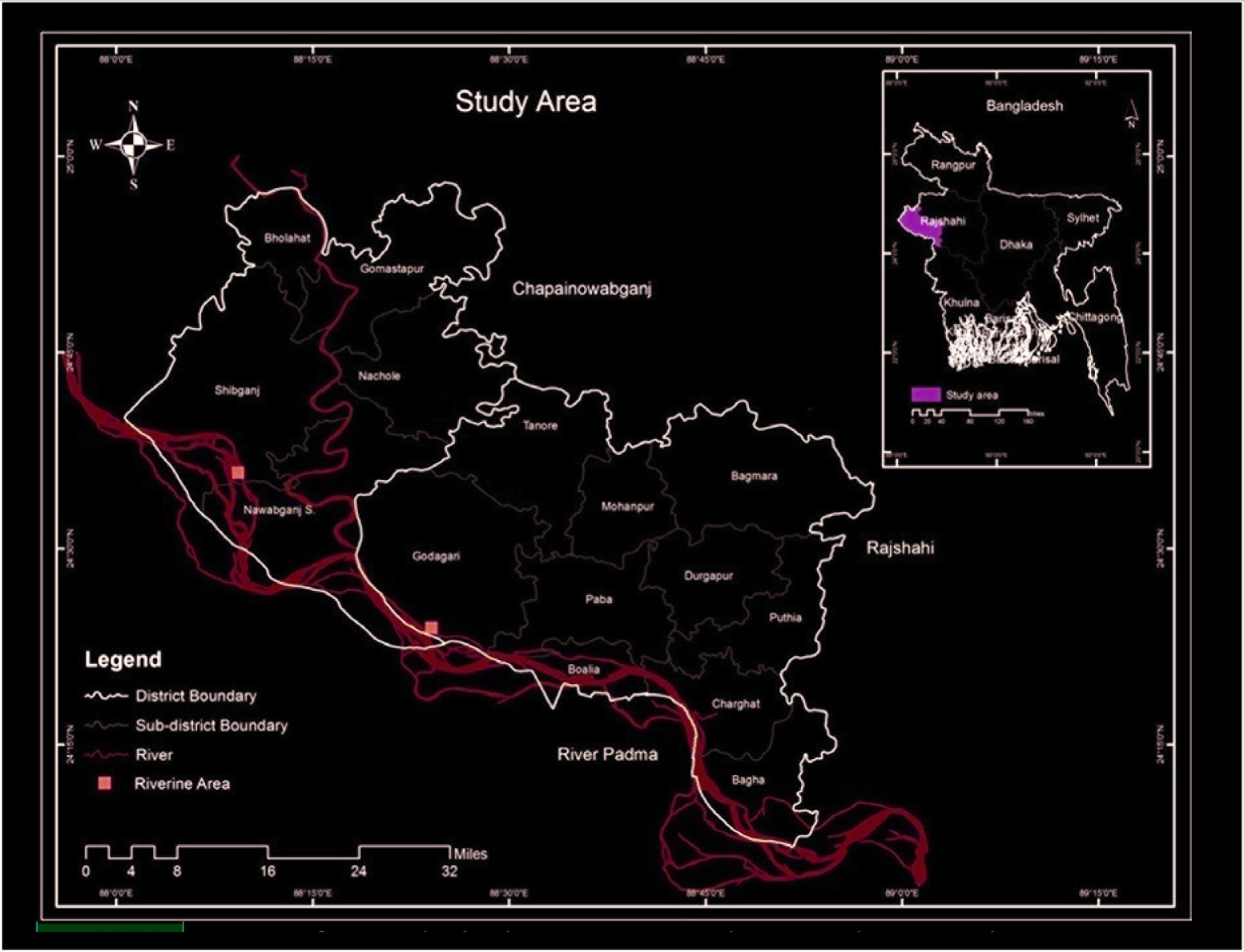
Two sub-districts adjacent to the river Padma 4 (namely Godagari from Rajshahi district and Shibganj from Chapainawabganj district) in the north-west of Bangladesh were selected for this study as both sub-districts faced severe riverbank erosion during the last two decades (Martin, 2018). In order to select the locations most adversely affected by riverbank erosion, we consulted with 22 professionals from the offices of the local government in each sub-district, offices of each district administration, and representatives from two local non-government organizations (NGOs). Based on a variety of information offered by these key informants, two Unions, 5 one from each sub-district, were finalized for this study: Ashariadoho in Godagari sub-district and Uzirpur in Shibganj sub-district (see Figure 1).
Map of Bangladesh Demonstrating Study Locations.
Selection of Participants and Data Analysis
Primary data were obtained through semi-structured interviews with open and close-ended questions, FGDs, and key informant interviews. Participants for interviews were initially selected through rapport building between the community members and one of the researchers (the lead author). This then followed a ‘snowball’ sampling technique. In many cases, short-term migrants 6 were found at home whereas long-term migrants 7 were mostly away from home. In the absence of any long-term migrants, an adult household member of the migrant was chosen for semi-structured interviews. In total, 27 individual cases of internal migration (24 short-term and 3 long-term) were interviewed in this study. Informed consent was obtained prior to recording the interviews. In addition, two FGDs were conducted, one from each sub-district. FGDs were organized with the help of local community leaders who along with the researcher explained the objectives of the FGDs and obtained consent from participants. In total, 24 individuals were involved in two FGDs.
Moreover, this study selected eight key informants from different professional backgrounds including local government officials (one), local NGO representative (one), Union Council (UP) Member (one from each union, a total of two) and influential members of the community (two from each union, a total of four). During the interviews and FGDs, participants were asked to discuss the key difficulties (or drivers of vulnerability) affecting them and their family members along with their coping strategies. Key informants were asked to share their views on similar issues based on their professional or lived experiences with the riverine community.
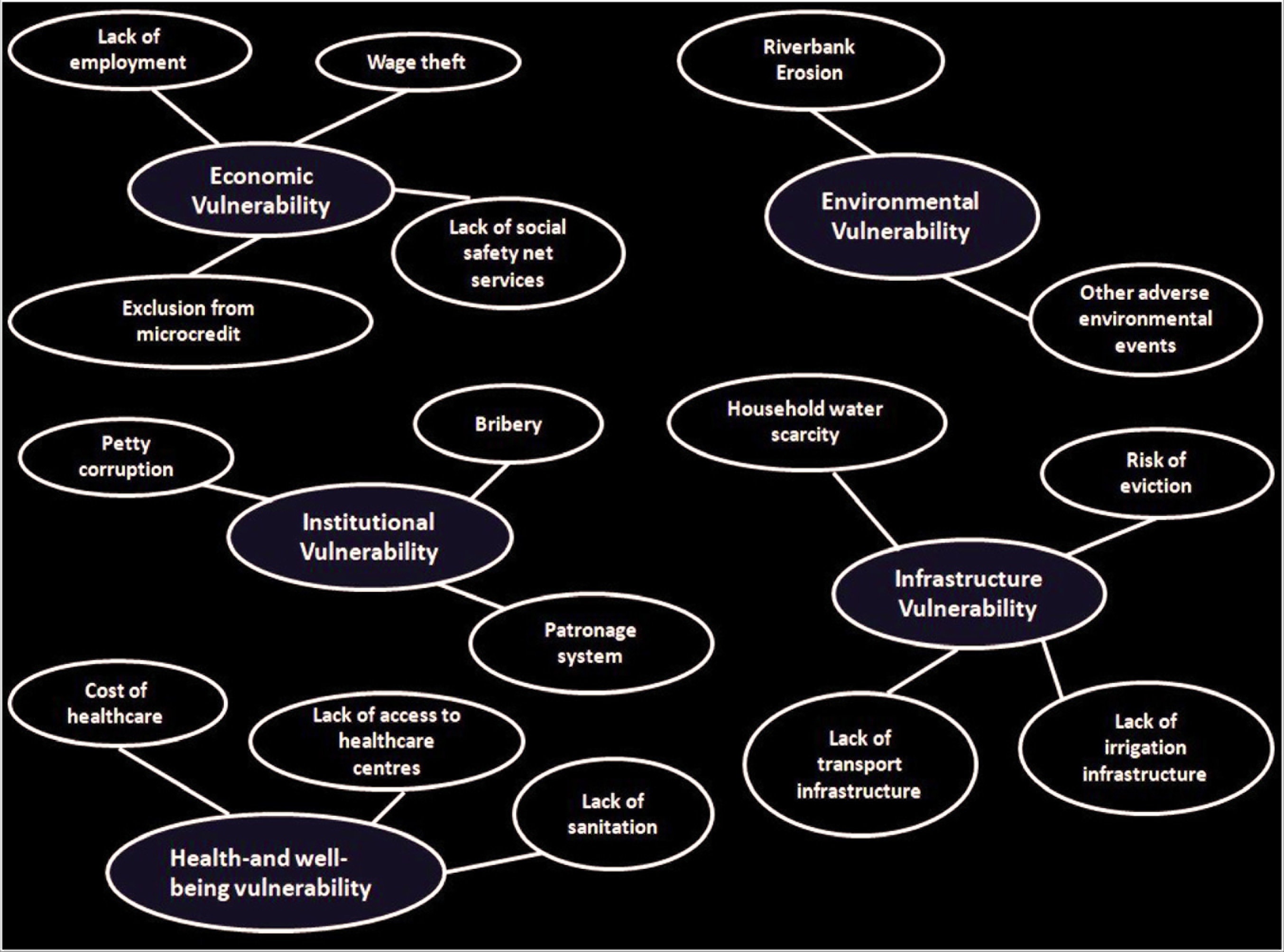
After completion of fieldwork, recorded interviews were transcribed and translated from Bengali into English. All transcripts (from semi-structured interviews, FGDs and KIs) were reviewed multiple times as part of an open coding technique, which segmented data into meaningful concepts and described them in codes (in short sequences of words) (Blair, 2015). Nvivo-10 was employed to organize the translated data. After reviewing the emerging code list several times and comparing those to identify any similar or different patterns, a total of 16 broader codes under five thematic areas were identified (see Figure 2). For us, each of these codes represents one type of driver of vulnerability. The main thematic areas include economic vulnerability, institutional vulnerability, infrastructural vulnerability, environmental vulnerability, and health-and-wellbeing vulnerability. Figure 2 shows the links between these themes and related drivers.
Spider Diagram Presenting Themes and Drivers of Vulnerability Identified by Data Coding Process.
Results
This section offers empirical evidence on the drivers of vulnerability as perceived by the participants of this study. Five different types of vulnerability were identified (e.g., economic, institutional, infrastructural, environmental, and health-and-wellbeing) in the study areas. These are elaborated below. In presenting empirical evidence, we have only disclosed age, gender and location of the displaced internal migrants and their family members, and the occupation for the key informants.
Economic Vulnerability
Economic vulnerability indicates a lack of financial capacity, and resources required to fulfil basic needs and manage environmental shocks/risks for the household members. With limited or almost non-existent access to economic resources (such as land and other capital), participants feel their ability to cope with other vulnerabilities are restricted. Economic vulnerabilities are intertwined with internal migration, because when one’s income cannot make ends meet people migrate elsewhere to provide for their families. There are four key sub-drivers of economic vulnerability: lack of employment, wage theft, lack of social safety net services, and exclusion from microcredit. The following paragraphs illustrate these sub-drivers.
First, lack of employment was identified as key to economic vulnerability. Families often go through unemployment due to shortages of local economic activities. Seasonality also plays a role as most families rely on agriculture and cognate activities. For example, during the dry season (December–April) and monsoon (May–July), there is a significant decline in agricultural activities causing widespread unemployment in the study areas. Generally, sharecroppers and day labourers suffer most during this type of unemployment (for example, 14 out of 27 participants in our semi-structured interviews were sharecroppers, with household’s average income of US$102.6 per month). While the government-run irrigation programme supports multi-cropping in the mainlands, an absence of it (further details provided in infrastructure vulnerability) does not allow multi-cropping as a feasible option in most parts of the sandy river islands studied. In a fragile local wage labour market, unemployment persists throughout the year. Most people in Ashariadoho Union were experiencing this unless they migrated elsewhere looking for employment. For example, a participant reported:
We remain unemployed almost the whole year. As you can see, we are poor day labourers and sharecroppers. Apart from some short-term employment opportunities, say for 3 weeks during a harvesting season, there are not enough jobs for us. This situation forces us to travel elsewhere to find a job. (33-year-old male, interview, Ashariadoho)
Second, in its most basic form, wage theft refers to employers’ failure to pay employees in return for the work they do (Bobo, 2011; Meixell & Eisenbrey, 2014). In this study, wage theft mainly involved local dalal’s (sub-contractor) and/or employers’ refusal to pay wages that are rightfully owed to the participants involved in low-income jobs. Usually, the local sub-contractors (dalal) recruit workers for various casual labour-intensive jobs (e.g., works on construction sites, brickfields, etc.). During seasonal lean periods, many subsistence farmers and farm labourers travel to nearby places to find work and end up with laborious jobs through the sub-contractors. Most often they suffer from no-payment or reduced payment by their contractors after working for weeks or months. Jobs on construction sites are described as the worst as sub-contractors do not regularly pay the labourers while repeatedly promising to pay them in full at the end of their contract. Sometimes, partial or very small amounts are paid and overtimes are frequently ignored. Payments are rarely paid in full as stated in the informal ‘oral contract’. The sub-contractors steal from the actual wages and there is no effective mechanism for the poor to recover their wage. This is illustrated further in the following statement:
Most of us did not get the accurate wages from the contractors. We lack the means to recover our money by enforcement. By contrast, the contractors often exhibit intimidating behaviour and force us to return home without payment. (45-year-old male, interview, Ashariadoho)
While wage issues in the garment sector of Bangladesh have been widely reported in previous studies and the media (such as Menzel & Woodruff, 2019; The Guardian, 2019), internal migrant workers in construction sites and brickfields are suffering in silence with a lack of investigation on their wage stealing.
Third, in some rural areas, government-run social safety net services include old-age allowance, widow allowance, disability allowance, short-term (for 100 and 40 days) employment activities, amongst others (Uddin, 2013). Some safety net programmes engage the landless, unemployed, and other destitute groups in short-term wage employment activities, such as road construction and maintenance, and building embankments. However, the majority of the participants of this study claimed that the allocation of such employment activities covers only a portion of the total unemployed people, and as a consequence, a large number of them remain unemployed:
The 40 days activities involve only 40 people per day. Again, it lasts for 40 days of a year. So many people join the queue and it is difficult to get a job in that programme. (29-year-old male, interview, Ashariadoho)
A study on the effect of such Employment Generation Programme for the Poorest (EGPP), an important government-run safety net programme, on the rural poor, was conducted across 20 districts in Bangladesh (covering both mainland and riverine areas), where the beneficiaries emphasized the need to increase such employment by at least 50% for more realistic coverage (Bangladesh Institute of Development Studies [BIDS], 2018). While such activities might offer short-term food security for some of the households, often they fail to provide a sustained impact. The lack of year-round employment opportunities or economic activities results in extreme financial stress and food shortages where many disadvantaged households continue to live in a near-starvation situation.
Fourth, the disadvantaged households in Ashariadoho Union lacked access to microcredit, except for some villagers who were in a better financial situation. Due to their perceived financial incapability of repaying the loan and the risk of involuntary displacement in the long run (as a result of riverbank erosion), the people living in Ashariadoho Union were largely excluded by organizations/NGOs offering microcredit for the poor. Many households in Ashariadoho Union were landless and residing in barren lands without any official document. The microcredit institutions identified the risk of involving ‘floating individuals’ (people with no land ownership) for not operating a microcredit programme in Ashariadoho, as quoted below:
As you can see, we are floating [landless] people. If we take a loan [microcredit] we may fail to pay the instalments. The NGO staff are afraid that we may flee in the case of credit default. That is the reason why they are not offering us any microcredit. (32-year-old male, interview, Ashariadoho)
Institutional Vulnerability
Institutional vulnerability identified in the study areas refers to the public sector being unable or unwilling to carry out its role and responsibilities in providing basic services, protecting human rights or offering other necessary public services. Weaknesses in the process of how the local government is offering different services strongly affect the livelihoods of the community, especially those who are already vulnerable to natural hazards (United Nations Office for Disaster Risk Reduction, 2016). Three sub-drivers of institutional vulnerability were identified: petty corruption, bribery and patronage system.
First, petty corruption refers to daily abuse of power by the local government representatives in their interactions with local citizens trying to access basic services, employment, emergency aid and other welfare benefits. For example, participants in our study alleged that the local government elected representatives (e.g., local politicians and their associates) responsible for listing ‘eligible’ recipients of government welfare had pocketed social safety net benefits (such as the 40-day Income Generation Programme stated above) at the expense of the distressed poor.
We could not enlist our names in the 40-day employment programme. The [UP] members and contractors used fake names, so that they can take money home, without employing us. (46-year-old male, interview, Ashariadoho)
It was further claimed by a local government official in Godagari sub-district that he identified massive irregularities in listing the names of the candidates for the 40-day programme:
When I physically visited a site in Ashariadoho Union to investigate how many of the day labourers were present for a particular day, only 22 out of 40 people were physically present and working. That means they [local UP representatives and local contractors] provided fake names for the remaining 18 people who did not actually participate in that particular day’s activities. These fake names are made up by the local Union Council members, along with the respective work contractors. (Key Informant 1, Local Government Official, Ashariahodo)
Second, the Government of Bangladesh has been extending social welfare programmes (e.g., old-age allowance, the widow or abandoned-women allowance, and the disability allowance) at the rural level for the last two decades (Government of Bangladesh, 2019). While these programmes reach only a small portion of the targeted population (Haider & Mahamud, 2017), corruption such as bribery at the local government level further deprives many elderly people of accessing such benefits. In theory, Union Council should supply the eligible list of participants to the government offices with a priority to include the most disadvantaged individuals and struggling widows. Frequently, the local government representatives exclude the most disadvantaged from the list, while favouring others for financial (or political) benefits:
We do not get any widow allowance here. We heard that those who paid some cash in advance [bribed a local government representative] were listed for such allowance. (63-year-old female widow, FGD 1, Ashariadoho)
Third, the participants accused the Union Council representatives of creating a patronage system that consequently excludes the most vulnerable groups from accessing social safety net benefits. This situation can be further illustrated from the experience of a 76–year-old widow in Ashariadoho Union. She was suffering from arthritis, malnutrition and other unknown diseases while also lacking supporting family members in the house. She went to the Union Council several times to seek old-age allowance. Despite several visits, the Council members refused to add her name to the old-age allowance list. She alleged that the refusal was due to the Council’s patronage system, as she did not know anyone locally influential. She suspects other women much younger than her were receiving the benefit perhaps because of political allegiance or other social connections.
Similar issues were reported in the study examining effects of government-run EGPP (BIDS, 2018). The BIDS report found that the beneficiary selection process was not transparent, formation of a selection committee is often politically biased, and corruption is manipulating the beneficiary selection process of the employment generation programme. Illustrations on the above three drivers are indicative that the similar issues can be visible in distributing various safety net benefits (not only the employment generation programme for the poorest) across different parts of the country.
Infrastructure Vulnerability
Infrastructure vulnerability refers to the chronic underinvestment in the infrastructure required to sustain the basic livelihood and long-term stability of the associated community (Pescaroli & Alexander, 2016). Here infrastructures comprise essential set-ups for daily living and livelihood activities, such as transportation networks, utility infrastructure and farming infrastructure amongst others (Havkoa et al., 2017). Infrastructure vulnerability often increases risks to the community and household economy both in the short and long term. The drivers of infrastructure vulnerability identified in the study areas are lack of transport infrastructure, lack of irrigation infrastructure, household water scarcity, and risks of eviction.
First, the study areas are isolated from the mainland as there were no bridges or roads connecting those villages with the mainland of Bangladesh. A typical journey from the study area to the mainland involves about two hours of travel combining multiple trips by boat and walking. While many poor families cannot afford transport costs, families with school/college-going children have no choice but to pay for daily boat fares to reach schools on the mainland:
Though the distance to the mainland is not great, people have to walk and take boats to transport daily necessities to their home.… Students are particularly in hardship. Some children have stopped going to school or college because of the high transportation cost. (Key Informant 1, Local Government Official, Ashariadoho)
Additionally, as the roads and walkways (mainly consisting of dusty sand tracks) are in poor condition and vulnerable to annual flooding the mobility of the local residents is further restricted.
Second, participants in the study area suffered from poor irrigation infrastructure mainly because of exclusion from the government’s Barind Multipurpose Development Authority (BMDA)—operated groundwater irrigation scheme (which is focused on drought-prone mainlands but hardly helping fragile Char population living in changing landscapes) and absence of electric supply in such isolated area.
8
The majority of farmers are involved in monsoon-dependent seasonal agriculture and during the dry season, most of the arable land remains uncultivated. Due to poor infrastructure, a group of local providers offer diesel-run irrigation services at a much higher price. While this private service may be of some use to relatively well-off farmers, the poor farmers are being priced out and constrained from farming activities throughout the year, as illustrated below:
If you buy diesel from the mainland markets [and transport here], it becomes almost three times higher than the actual price. Therefore, the cost of irrigation will become very high, if someone intends to access it. (35-year-old male, interview, Ashariadoho)
Third, the majority of the participants in Ashariadoho Union rely on hand-pumped tube-wells for drinking water and household consumption. As a large number of villagers cannot afford to set up and maintain hand-pumped tubewells, they (especially women of those households) require to travel some distance to collect water for daily needs. People in the study area also suffer from various health issues related to the scarcity of safe drinking water, as described below:
Our tubewells are not working during the dry months of the year. When we drink pond water, our children often get diarrhoea. (24-year-old female, interview, Ashariadoho)
Fourth, it is observed in this study that landless people residing in temporary or unofficial settlements are at the highest risk of eviction. This is evidenced in the lived experience of a group of people interviewed in this study who became displaced two decades ago due to river erosion and were living in a mango garden through an informal rent arrangement with the garden owner. Life for a displaced community is hard enough but when rent goes up and financial opportunities are limited, the fear of forced eviction becomes real, with no places to go to and with the added stress of losing the social networks:
As you can see, the place where we are residing is a private mango farm. We pay rent to the owner to stay here. If we fail to pay regular rent, the owner becomes harsh. Our landlord recently increased the rent and keeps telling us to pay. If we don’t pay, he will force us to leave this place. We are afraid of being evicted. (45-year-old female, interview, Ujirpur)
While the risks of eviction are reported in some studies and news media in the context of urban slums in Bangladesh, eviction risks of such vulnerable groups in remote riverine areas go largely undocumented.
Environmental Vulnerability
While places in the riverine areas are exposed to multiple environmental hazards, the participants identified their main environmental vulnerabilities as land removal due to riverbank erosion and a few other adverse environmental events, such as heat waves, flooding and storms.
First, riverbank erosion poses devastating threats to the people in the study area. As there is no protective embankment in Ashariadoho, some parts of the village will submerge in the next few years. Members of several households have experienced repeated cycles of displacement due to riverbank erosion and lost their temporary accommodations in the process. Riverbank erosion destroys whatever cultivable lands they possess, making the affected families homeless and forcing them to search for alternative shelters. Homelessness is found to be difficult as households lack food, shelter, and social protection at that stage. Many villagers build temporary accommodation in unsafe open places. A common autonomous relocation strategy involves searching and taking possession of the government Khas lands 9 in nearby locations. Failure to do that compels vulnerable families to migrate to a more distant place, such as to another sub-district. For the majority of the affected communities, it usually takes years to find some degree of normality. For some that never happens.
People who become homeless for the first time often go through a mental shock. Migrating to a new location and setting up a new life is extremely difficult, as can be seen from the following statement. Some are forced to choose occupations they never imagined they might end up in, ranging from day labouring to street vending to begging:
Before the riverbank erosion, I was a farmer. I owned land and had other necessary things for life. When my land was submerged in River Padma, I got broke, I am now struggling for daily existence. Some people had no option but to go begging door-to-door. (50-year-old male, interview, Ujirpur)
Second, the participants reported other vulnerabilities as a result of adverse environmental events. The dry hot days (except monsoon and winter) are particularly hazardous for newborns, the sick and elderly household members. Extreme temperature also results in crop damage, given that no irrigation infrastructure is accessible for the marginal farmers in remote riverine areas:
My daughter has a newborn baby at home now. It’s so hot, my grandson is suffering from breathing problems … also, my husband, being old, needs special care in hot weather. (50-year-old female, interview, Ujirpur)
The monsoon follows the hot and humid days when the river overflows and causes flooding. Floodwater damages agricultural crops as well as infrastructure such as houses, livestock, healthcare centres, irrigation infrastructure, roads, and embankments:
Our Uzirpur Union had a healthcare centre. But ever since a flood-damaged it about two decades ago, we haven’t been able to rebuild it.… Before the flood in 1998, we used deep tubewell machines for irrigation. All of them were damaged in that flood. (Key Informant 2, Union Council Member, Ujirpur)
Generally, moderate floodings affect the Char areas every two to three years and cause temporary displacement for people living there. However, not all floods are severe. The floods of 1998 and 2007 are described as the worst ones that submerged most of the lands within our study areas, removing many people from their ancestral lands. Monsoons also bring storms, strong winds, hail, thunder and lightning, causing serious damage and at times destroying fragile households. Moreover, all participants reported an increased number of thunderstorms and lightning that killed both humans and animals in the study areas, adding to the struggles of life in this riverine region.
Health-and-Wellbeing Vulnerability
Health-and-wellbeing vulnerability increases the susceptibility of disadvantaged social groups (especially during natural hazards) and often prevents individuals from participating fully in society. The drivers of vulnerability identified under this theme are lack of access to healthcare, cost of healthcare, and lack of sanitation.
First, there were no hospitals in the study area at the time of the fieldwork. There are a few health centres with poor infrastructure (often closed, health-care professionals are frequently unavailable, not enough medication stocked). Healthcare professionals, especially those who are residing on the mainland, are reluctant to undertake a precarious journey to the Char every day, the participants claimed. When severely ill, people in Ashariadoho Union have no option but to travel long distances by precarious means of transportation as poor road infrastructure makes transportation of people very difficult. Family members carry critical patients on bamboo-made stretchers for a few kilometres (depending on the location of the house) to reach the riverbank and access the boats to reach the mainland. After crossing the river, the patients can be transported to the sub-district hospitals by ambulance or by other local vehicles. Deaths of patients during such journeys are not unusual, leading some people in the study area to become reluctant to take someone to a hospital even in critical conditions.
Second, financial constraints are considered as the major barrier to pursuing required medical treatments. Many participants cannot afford to buy the complete course of medication prescribed by doctors:
As soon as we feel some comfort after taking medicine in the first few days, we often stop taking medicines. We discontinue because of the higher price of medications. (34-year-old female, FGD 2, Ujirpur)
As quoted above, individuals often discontinue a course of medication once they feel relatively better from an illness. Higher fees of a qualified doctor also force disadvantaged people to buy medication from local pharmacies and quacks. Such practice often causes long-term health consequences.
Finally, poor sanitation is deemed to increase vulnerabilities in the study areas. Absence of pit latrines is common 10 and many participants defecate in the river, ponds, and other open places, including fields, bushes, forests, ditches and canals, where non-pit latrines (only upper structure is fenced with plastic, papers, or bamboo framing) are commonly visible. Such practice has made the community, especially children, vulnerable to diarrheal and waterborne diseases. Moreover, a key informant in Ujirpur Union reported that some latrines were built by an NGO about a decade ago but were damaged in floods and never got repaired. The lack of sanitation and drinking water in the study area seems to be worse than the overall situation of the country (as in 2017, nearly 3% of people in Bangladesh lack clean water close to their home and about 25% still have inadequate toilets) (United Nations Children’s Fund & World Health Organization, 2019).
Discussion
Empirical evidence demonstrates that the disadvantaged rural migrants and their household members in the study areas were exposed to a range of different drivers of vulnerability that are connected to various economic, institutional, infrastructural, environmental and social (health-and-wellbeing) issues. In particular, this study (a) provides evidence of different types of drivers that are perceived as severe by internal migrants or their household members in riverbank erosion-prone areas; and therefore and (b) suggests extending economic opportunities and social benefits for the migrants households to manage future involuntary long-term migration within Bangladesh.
First, the findings of this study illustrate that many drivers of vulnerability were directly or indirectly linked to the geographical isolation and limited income opportunities in the study areas. More particularly, the drivers of infrastructure and economic vulnerability undermined the wellbeing of these disadvantaged communities, even posing greater welfare risks for the migrants and their household members. Often, increases in transport costs (due to a difficult transport system) cause higher prices for daily necessities and agricultural inputs. Year-round unemployment is reported by most of the participants as a major problem along with a lack of access to government and non-government social safety net benefits. However, some drivers involve external factors beyond the control of the local community such as petty corruption, patronage system and bribery, which hinder channelling social safety net benefits to the most disadvantaged groups such as the elderly, widows and persons with disabilities. In contrast, few other external factors such as a weak relocation programmes by the government put the currently displaced community at risk of further displacement or forced eviction. The results section also contextualizes drivers with the specific locale, thus illustrating how some drivers (such as lack of local employment while travelling elsewhere is difficult, exclusion from microcredit, lack of transport infrastructure, lack of irrigation infrastructure, risks of eviction, riverbank erosion, lack of access to healthcare and lack of sanitation) are more adversely affecting the riverine people as opposed to the general rural populace in Bangladesh. Already lower levels of access to resources and a declining asset base, especially land, allow a few drivers (such as risk of eviction, exclusion from microcredit) to bring further adverse effects on these riverine populations compared to many other rural households in the country.
The results also indicate that a considerable level of structural inequality exists in channelling government and non-government benefits to remote riverine areas, adding to the discussion that hazard related movements should be looked through beyond environmental ‘push’ theories and incorporating a greater nexus of socio-environmental inequalities (Hunter et al., 2015; Piguet, 2013). For instance, a lack of access to electricity and no BMDA irrigation infrastructure restrict local agricultural activities to single cropping per year, which mostly depends on monsoon rainfall. In addition, the landless households in riverbank erosion-prone areas were excluded by NGOs/institutions offering microcredit, which subsequently limits their coping abilities during lean period difficulties. Moreover, lack of access to healthcare services and the reluctance of healthcare professionals to travel to remote areas not only bring poor health outcomes but also cause life-threatening conditions. During medical emergencies, patients are reported to be dead while being transported to the mainland hospitals.
Nonetheless, it is also clear that exposure to environmental hazards, such as the slow form of riverbank erosion, poses greater risks to the livelihoods of the study population. Despite persistent risks of removal from household lands and infrastructures by riverbank erosion, most of the landless households in the riverine areas did not consider this particular slow-onset hazard as posing direct or immediate risk. However, first time experience of encountering riverbank erosion was described as catastrophic, particularly for those with land ownership who suffered sustained loss of property, occupation and social ties.
Results of this study also reveal that once individuals and their households are residing in a place for a longer time, they prefer not to relocate to a new place, unless significantly adverse circumstances are experienced. Despite the dangers of riverbank erosion and potential loss of household infrastructures, the people in the riverine areas tend to live in the same area, rather than migrating regionally or to more distant places. In some cases, the adult earning members of the households migrate to other places within the country, but often for shorter periods. Such coping strategies allow the rest of the family members to stay in their current locations. Indeed, the majority of the participants were short-term migrants, some even move around multiple times within a year for employment and send remittances to the household members back ‘home’. This observation complements a body of academic research suggesting human mobility as an adaptation response to changing climatic impacts and as a way to build resilience in adverse socio-cultural and environmental circumstances (see Bardsley & Hugo, 2010; Black et al., 2011; Blocher, 2016; Gemenne & Blocher, 2017; McLeman, 2017;). Our observations, however, also challenge some of the existing national policies that oversimplify internal migration as a failure to adapt to climate change (see Martin et al., 2017) as well as question the Char Livelihood Programme’s claim to have increased resilience against economic shocks and poverty reduction for almost one million vulnerable people (World Bank, Global Social Response & GFDRR, 2013).
While internal migration in Bangladesh can serve as an adaptive option for climatic change, unmanaged migration can also be prevented by extending welfare benefits into the disadvantaged remote areas. Hence, there is a need to better understand the country’s internal migration, climate change adaptation and rural development policies, because internal migrants’ household members often reside in remote places of origin and are likely to continue to live there. As part of the country’s climate change adaptation actions, local support and service-oriented programmes should be strengthened in such areas. These supports must improve the effectiveness of social safety nets (such as lean period income generation programmes), access to institutional credit for the landless, means of transportation for people, agricultural inputs including irrigation facilities, and health care benefits. Last but not least, reforms within various institutions and their current practices should be identified as a priority to reduce local corruption by the elected local representatives for delivering and ensuring quality of social services in the riverbank erosion-prone areas. We contend that such bespoke actions at the national level will ultimately contribute to achieving the targets and goals set in the SDGs for poverty reduction, including building resilience from climatic change and natural disasters among the most vulnerable and securing a fair right towards economic resources for such disadvantaged groups (see the first section for more details). Understanding the synergy or nexus among different drivers and how the affected people respond to these drivers (see for example Cairns et al., 2017) could be helpful to strengthen interconnected thinking between multidisciplinary research communities and decision-makers (Leach et al., 2012).
Conclusion
The study conducted in two sub-districts in north-western Bangladesh demonstrates a range of different drivers of vulnerability impacting lives of internal migrants and their family members. The rich details on underlying drivers of vulnerability demonstrate how environmental factors, especially hazards associated with riverbank erosion, coexist with other drivers of vulnerability (i.e., economic, institutional, infrastructural and health-and-wellbeing) and cause impacts that are greater than any individual stressor shaping people’s livelihood opportunities. Although these are partly reported in terms of bio-physical exposures to riverbank erosion and people’s higher dependency on natural systems, a wider range of drivers and of deep narratives from the lived experiences of affected people lead us to argue that different drivers of vulnerability are produced by economic and infrastructural inequalities. Therefore, we assert that many of these drivers are mutually inclusive and not making the community vulnerable on its own. The overall vulnerability of communities exposed to riverbank erosion is thus not solely an outcome of extreme environmental exposure or other bio-physical components or economic matter such as unemployment. Rather, they result from multiple interdependent drivers, related to economic, institutional, infrastructural and geographical inequalities often exacerbated through weak social infrastructure and corrupt political practices. Consistent with the works of Hunter et al. (2015), Piguet (2013) and Lahiri-Dutt and Samanta (2013), this piece also argues for adopting a more context-specific approach to understanding the multifaceted nature of vulnerability of internal migrants due to natural and climatic hazards. Future studies should also explore the presence of drivers linked with religion, caste, ethnicity, and political view besides poverty, landlessness and economic inequality.
The fifth section suggests some measures that will be useful to context- specific policy development and implementation, especially endeavouring the welfare of involuntary migrants, their family members and their non-migrant neighbours who continue to live in riverbank erosion-prone remote areas of Bangladesh and other similar settings. Before initiating involuntary migration, disadvantaged people in the study areas tend to rely on localized coping mechanisms, scopes of which are often dependent on government and non-government interventions. While many of these people tend to migrate for a relatively short term (especially during lean periods), the family members of these migrants continue to stay in their places of origin, be it their ancestral places or newfound ‘homes’. This study, therefore, points to a need to address the weaknesses of some specific support programmes, including lean period income generation schemes, access to institutional credit for riverine areas, improved and inexpensive means of transportation and communication, irrigation facilities for farmers, inexpensive transportation means for agricultural inputs to boost small holder farmers’ product access to markets, reasonable price for daily necessities and improved health care benefits. It is also important to mainstream marginal voices in governance processes through participation and capacity building in order to better address the SDGs from a bottom-up perspective (Desai & Schomerus, 2018; Gabay & Ilcan, 2017). Finally, while emphasizing the need for improved support to riverine areas where vulnerable migrants and their family members are living, this study also clarified that short-term migration by adult family members can reduce the burden of vulnerability for those family members left at ‘home’.
Footnotes
Declaration of Conflicting Interests
The authors declared no potential conflicts of interest with respect to the research, authorship and/or publication of this article.
Funding
The authors received no financial support for the research, authorship and/or publication of this article.