




Abstract
The article examines two aspects of development presented through an ethnographic study of the project ‘Nagaland Empowerment of People through Economic Development’. First is the discursive construction of project beneficiaries as poor, underdeveloped and backward in modernist literature. Second, the article captures inter-household negotiations around developmental resources in the context of microcredit. Drawing on participant observations, oral histories and household interviews, I explore the micro-politics of everyday life to reflect on the contesting representations of ‘beneficiary community’ and ‘project experts’. In addition, I analyse the struggle within the community for resources made available by the project. This illuminates the actors, networks and institutions involved in community development programmes and problematizes ideal conceptualization of communities as a site for collective participation. The article highlights practices of objectification and the creation of a populist discourse on participation that overlooks multiple layers of patronage, public and self-interest exercised by project beneficiaries in community development programmes. Additionally, the article investigates how the lack of ‘care’ in modernist participatory agricultural development discourse undermines the community’s aspirations for development and establishes a rupture between policy and practice.
Introduction
In this article, I engage with the moral economy of development that ‘never fails’, as projects continue to build on their failures and successes through a discourse of ‘improvement’. As David Mosse argues, project success and failure are more a practice of interpretation than realities on the ground (Mosse, 2005, p. 18). This observation also applies to the Nagaland Empowerment of People through Economic Development (NEPED) intervention in Sadar 2 village, which is the subject of this article. I also analyse arguments by Mosse (2005) and Pigg (1992) that community-led development projects have an inbuilt rationale of progress and moral improvement, cast through the objectification of beneficiaries as ‘primitive and backward’ and as recipients of aid and subsidies (see NEPED, 1999, 2007). In development projects that are technically driven by ‘experts’, elite ‘indigenous knowledge’ keepers act as brokers by influencing project outcomes that expose not only the ideologies of donor-driven development (top-down) approaches, but also make us think about the agency of individual beneficiaries or project recipients (Green, 2000).
While building on arguments put forward by Mosse, the article adds to the analysis of development policy and practice by examining the lack of ‘care’ within critical sustainable development discourse and the absence of a pluriversal ethos in decentralized bottom-up schemes. I also examine the controlling nature of community-driven development projects as represented in the NEPED project literature. Project beneficiaries lose their autonomy and agency as they are characterized as ‘primitive’, ‘underdeveloped’ and ‘non-enterprising’. Similarly, indigenous knowledge systems on farming practices are not seen as equal to scientific ways of agriculture, based on a distinct ontological ethos of crop care and management.
The study deals with slash-and-burn farming (locally known as jhum) among the Naga tribes in the upland areas of Northeast India (Naga Hills), which has attracted much scholarly attention in the last decade as a transnational ‘upland massif’ ‘Zomia’ (Scott, 2009) and a ‘biodiversity hotspot’ region of the Eastern Himalayas (Myers et al., 2000). This attention is evident from the global interest of donors and conservation non-governmental organizations (NGOs) in the region who work to bring about improvement by integrating communities’ ‘social capital’ with the ‘indigenous ecological knowledge’ of jhum cultivators. By engaging with the project texts and communities’ responses to a development intervention, I will discuss the moral economy of households and the micro-politics of everyday life in rural Nagaland. My novel intervention explored here concerns ‘microcredit’, circulated through revolving funds, that is, funds provided to beneficiaries to plant cash crops that are designed to circulate from one group of beneficiaries to another once the first start making profits.
The article will contribute to broader arguments about how to integrate the agency of the actors who participate in jhum improvement programmes as well as discussions of development interventions. To put it differently, while designing community development programmes, donor and project-implementing agencies should take into consideration the ontological sensitivity by taking seriously others’ socio-material bases of knowing/making (Arora, 2019).
The article is divided into three parts. In the first section, I discuss the model village and the wider context of NEPED’s selection of the village as an experimental beneficiary test site. In the second section, through case studies I examine how villagers enrolled themselves as beneficiaries and reshape project goals to give new meaning to project successes and failures. In the third part, I consider how modernist development practice fails to care for the village jhum farming community for whom the project is designed and how people rework the scheme.
The Context
Naga society, unlike caste Hindu communities in mainland India, is based on lineage and social organizations distinct from those of the plains (Elwin, 1969; Furer-Haimendorf, 1939). Naga clans (kuk in Yimchunger Naga dialect), khels (ward colonies), village headmen and chiefs play important roles in ordering social relations and community solidarity through clan and lineage. In much of the ethnographic literature produced through ‘notes and queries’–style colonial monographs, the Naga societies are described as egalitarian and autonomous ‘village republics’. The villagers draw on communal household labour and consume surplus through ‘feasts of merit’ after the harvest season (Furer-Haimendorf, 1939; Hutton, 1921; Mills, 1922).
Recent studies among tribal societies in Northeast India have shown how once-egalitarian communities are consolidating landholding in villages because of incentives provided by the government and NGOs working towards agrarian change and rural development (Karlsson, 2011; Kuchle, 2016). In the Naga socioeconomic structure, land belongs to the community (village clan). Private tenure developed when a clan or tribe member permanently cultivated the land without any fallow period. In jhum cultivation plots, sedentary farming was impossible. Therefore, the permanent right to own land by a single family could not be established if jhum fallows were to be maintained. But this has been rapidly changing, with the increasing pressure of population on land, outmigration of village elites for government jobs and popularization of plantation farming. Households which can secure plantation seeds and afford to live without depending on their land for food crops include salaried government servants, village intermediaries and political party workers. These households plant permanent tenure trees and horticultural plants on land that slowly becomes their private property and hence inaccessible to subsistence slash-and-burn farmers. As a result, families that do not have the resources to plant or grow horticultural crops are alienated from communally owned land, which is shrinking in Naga villages. Alongside the popularization of plantation and cash crops, the Baptist Church and the state’s agriculture developmental policies since the 1950s have been promoting rice farming. The cultivation of paddies in ‘wet terraced’ fields has further consolidated landholding for households that were once free to grow jhum crops on communal land. In this way, land relations have changed to the disadvantage of poor farmers who cannot consolidate landholding through plantation and rely on the patronage of influential patrons within the clan. Until the late 1980s, these schemes were popularized through centralized development interventions from the state, conceived within five-year plans.
The 1990s saw the ushering in of a decentralized, bottom-up approach to participatory development that was designed to supplant the hegemonic bureaucratic top-down control of development programmes through participatory local governance. The Indian constitution’s 73rd amendment to the Panchayati Raj system guaranteed local decision bodies, the gram panchayats’ authority to carry out development work in villages. The motivators for this change came from popular environmental and NGO movements, like Chipko in the Garwah Himalayas and Anna Hazare’s successful local water harvesting programmes in Maharashtra that espoused community participation and endorsed ‘people’s knowledge and people’s power’ (Rangan, 2000).
The state of Nagaland comes under the Sixth Schedule areas. 3 The decision-making power in the villages rests with the village headmen (gaon burah) and their councils. Democratic decentralization in Nagaland took a new turn in 2000 with the passing of the Nagaland Commoditisation of Essential Services Act and the constitution of elected village development councils (VDC) and village development boards (VDB) that were meant to work together and bring about all-round sustainable development and peace to the counter-insurgency affected region (Angami, 2008). The NEPED project was an experimental outcome of GONGO (government-organized non-governmental organization) initiatives that focused on communities’ ‘social capital’ and ‘local knowledge’. The goal of the project was to commercialize farming through ‘microcredit’ and the creation of ‘self-help groups’ in villages that would replenish the cash funds to expand the cultivation of commercially valued plantation crops, such as cardamom and ginger, for cash income. The underlying rationale was to sedentarize farmers in order to curtail rapacious slash-and-burn agriculture and, thus, to kill two birds with one shot—greenhouse gas emissions through the creation of ‘carbon sinks’ and the reduction of harm to soil and forest cover by permanent/sustainable crop husbandry.
The NEPED Project and Modernist Discourse
The NEPED project began in 1995, as a jhum development and alternative livelihood regeneration programme based on community participation and the local knowledge of the farmers. It was supported by Canadian International Development Research Centre (IDRC) and India–Canada Environment Facility (ICEF). The Nagaland government was the intermediary local stakeholder that oversaw the project by providing manpower and infrastructure to set up the office and by establishing NEPED as a GONGO. There were other stakeholders in the project who, in different project phases, provided technical support and ‘expert knowledge’. 4
Sadar is located at an elevation of 1,300 m above mean sea level and was already popular in the district as one of the best French long bean (kholar) producers among the Yimchunger villages. Long bean production has revolutionized farming, and it has, in recent years, become one of the staple food crops of the village, replacing Job’s tears (Coix lacryma-jobi – buckwheat) and millet from their diet. The intensification of long beans and the relay cultivation of maize established a healthy jhum cycle in several farms where farmers could now work in a single plot of land for several years without shifting their fields. Fields close to the village settlements were already becoming permanent sites of cultivation, with multiple agro-horticultural plantations, and belonged to powerful households in the villages who were beneficiaries in multiple rural agrarian diversification programmes.
The NEPED project had two phases. The first phase lasted for 5 years, from 1995 to 2001. During this period, the project officials claimed that 6 million trees had been planted in jhum fields, covering 854 villages (NEPED, 1999). The thrust of the project shifted to provide better livelihood through economic empowerment programmes like microcredit and the formation of self-help groups during the second phase. The idea of micro credit was experimented with in the form of a revolving fund (microcredit made available to farmers), which was introduced to wean people away from a ‘subsidy culture’ and to induce agricultural activities, such as the cultivation of cash crops (like ginger, cardamom, passion fruit, chillies and other horticultural crops) under shade trees and as creepers (NEPED, 1999, pp. 99–123). The fund was rotated as a loan with a soft rate of interest and was managed by the village council (VC) and VDB members (NEPED, 2007).
The NEPED project was among many such programmes designed in the past that were constituted with a decentralized administrative setup with support and cooperation from the VC and VDB’s elite village representative. They worked in liaison with project operation unit (POU) staff ‘experts’ selected randomly from different government departments such as soil, irrigation and water harvesting. A third tier of casual project staff was recruited as village level facilitators of community conservation (FCC), who were selected from the beneficiary villages. The project heightened people’s expectations of more loans and cash as disposable income, which beneficiaries rationally used to satisfy pressing family needs rather than farm improvement. It was only in a few plots that farmers experimented with the introduced crops. The crops were successfully grown by farmers, who received constant support from the agency, had built market links with town merchants and had multiple farming plots to satisfy their family food crop needs. In the fields of other farmers, who only received saplings for plantation, the project was associated with crop failure, due to the absence of formal training and the lack of a reciprocal labour supply during the critical growing season. Many used NEPED’s revolving fund for non-farm activity, which they expected to recover at the end of the five-year period through interest, they would earn by re-loaning money to fellow villagers and traders who could not become beneficiaries, as they lacked the goodwill of the village elites. The consequences of these initiatives will be discussed later in the article.
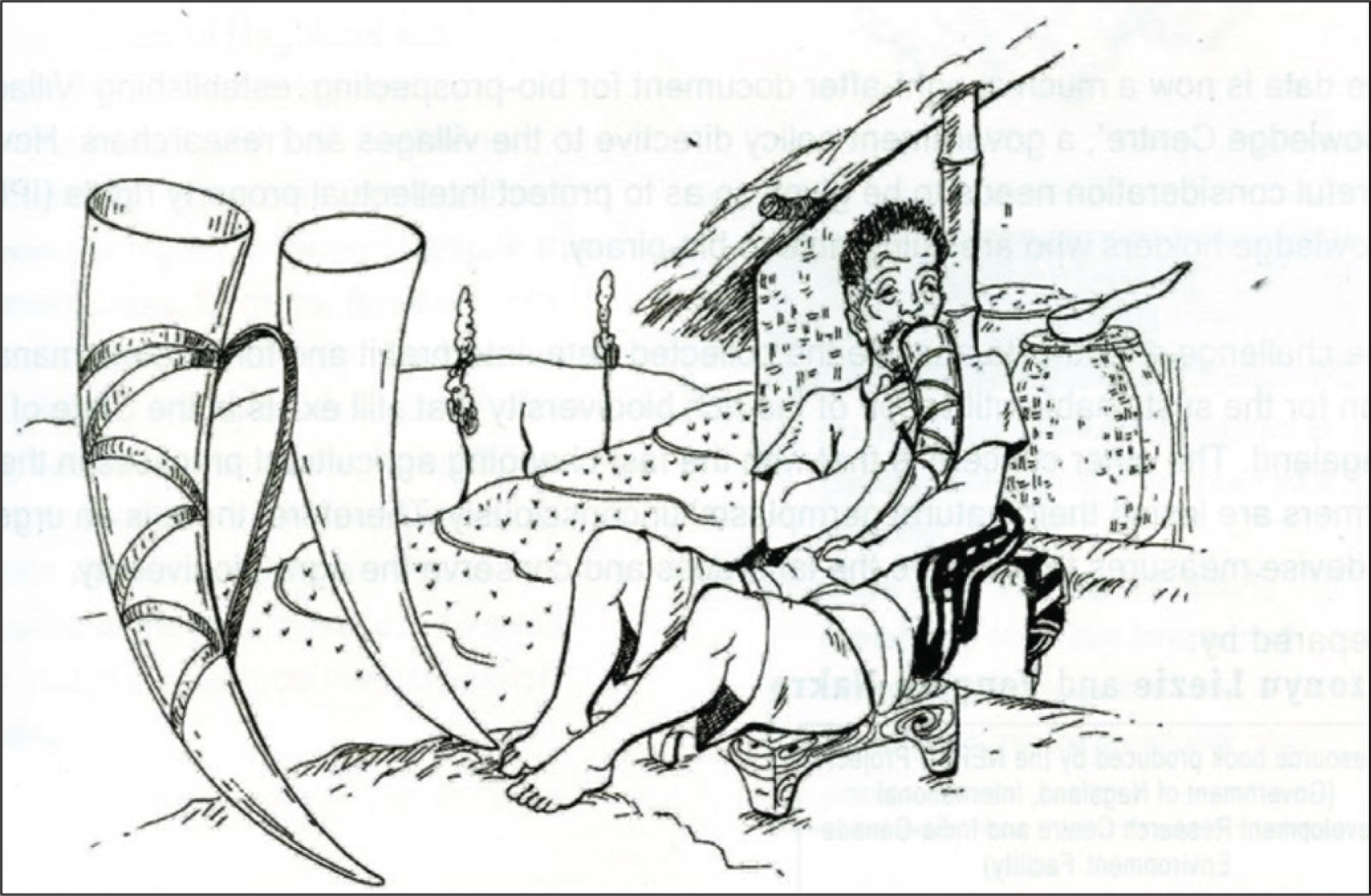
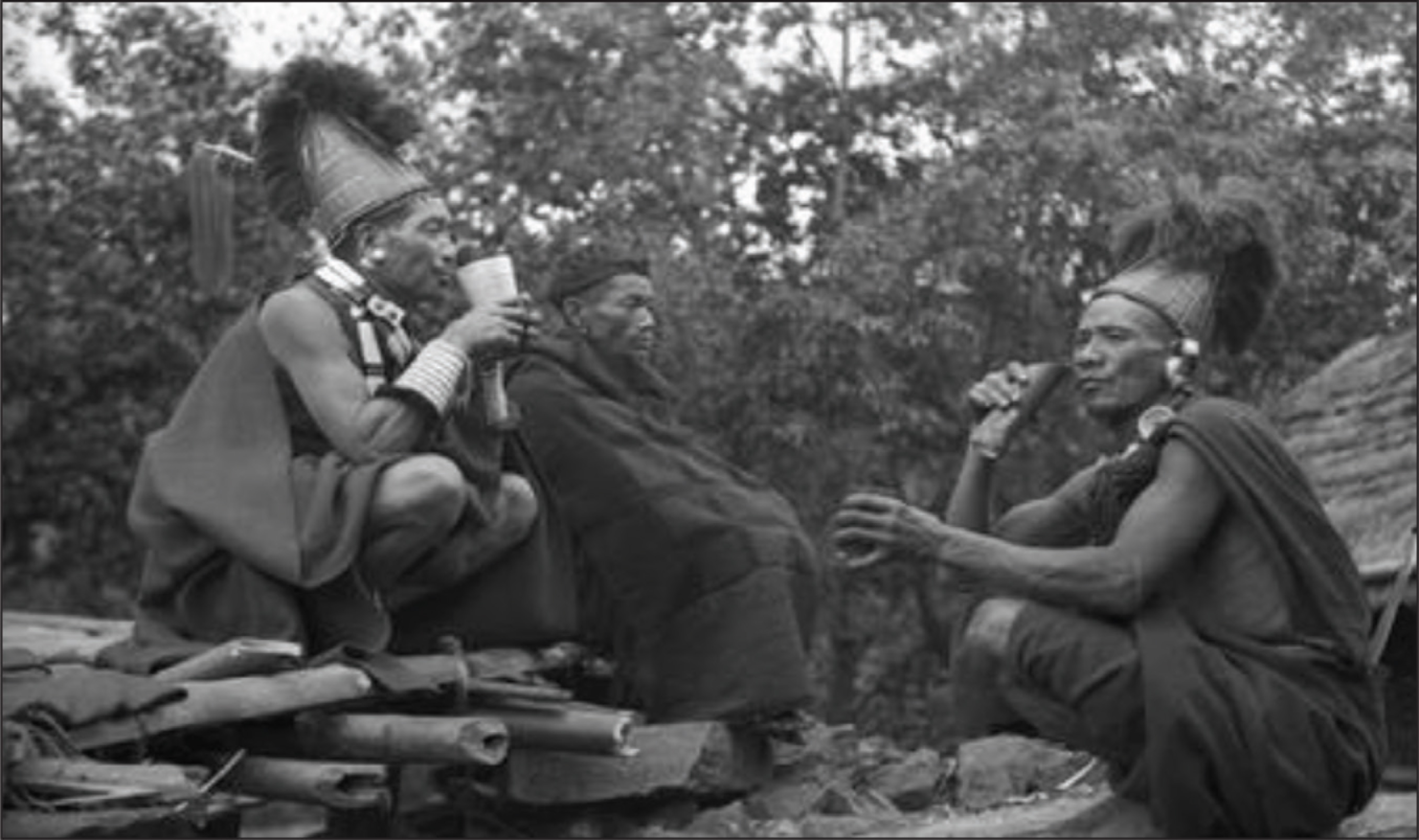
The villagers, who are represented in the project literature as ‘objects of development’—as simple and poor beneficiaries—exercise their agency in ways that significantly shape project outcomes. In this discourse of farmers’ development, the project villagers are represented in NEPED publications by emphasizing the outcome of implementation through sketches that depict poor marginal villagers aspiring for ‘improvement’ as ‘ignorant’ (Figure 1). These sketches, which are powerful images of ‘simple, ignorant villages’ as recipients in need of aid, admonishing their rationality, thinking but showing them responding to development, also influenced outcomes (Hobart, 1993). The pictorial description of beneficiaries as ‘ignorant and simple’ displays a modernist development discourse, a representational politics of control. It has clear parallels with the colonial ethnographic representation of Naga through photographs as ‘noble savages’ (Figure 2).
The Model Village
During the first visit to Sadar during 2008–2009, I was not aware of the fact that it was a model village presented by the POU team as a success story in the transition from jhum farming to more sustainable relay cropping (a form of farming in which leguminous crops such as long beans are grown in combination with soil exhaustive crops, like corn, so that the soil does not lose its fertility).
As a result of the POU report, the village became a major recipient of a revolving fund during the second phase of the NEPED project (2001–2006). The village was already a success much before the NEPED development intervention had taken place. However, during the third phase (2008–2012), funding was withdrawn, as project officials on ground became aware that their loan grant had not made a significant impact and failed to bring about the expected results from the relending of the ‘revolving fund’ among beneficiaries and the failure of cash crops. Villagers reported that the POU members who monitored the programme were non-cooperating and unwilling to visit the village at the end of Phase Two. The POU, on the other hand, realized that the farmers had failed to achieve the desired goals and were not repaying the loans; nor, in many cases, had they succeeded in growing cardamom (introduced as a cash crop) for the market, thus failing the project mandate.
The introduced incentive to grow ginger as a cash crop also failed, while cardamom was partially successfully grown by a few farmers who were, nonetheless, finding difficulties in protecting their crop from the vagaries of weather and market price fluctuations. The 2009 dry season almost wiped out the remaining cardamom plants. When interviewed, farmers reported that they were ‘not finding adequate time’ to grow cardamom as they had more important food crops to sow and harvest during the cropping season. The incentive from the market was low due to the weak link established between the farm and the place of sale. Only elite farmers who regularly visited the towns and had built good networks with local merchants sold a few bags of cardamom annually, and they did so at very low prices, as they had very little power to bargain. The uncertainties of cardamom crop production caused many families, who were initially select beneficiaries in the NEPED cardamom plantation project, to default on their loans. The project officials branded the villagers ‘lazy, non-enterprising and corrupt’ as was revealed by farmers, saying that this was the reason for the demise of the revolving fund and for the lack of cardamom plantation. This was how the NEPED project was phased out in the village.
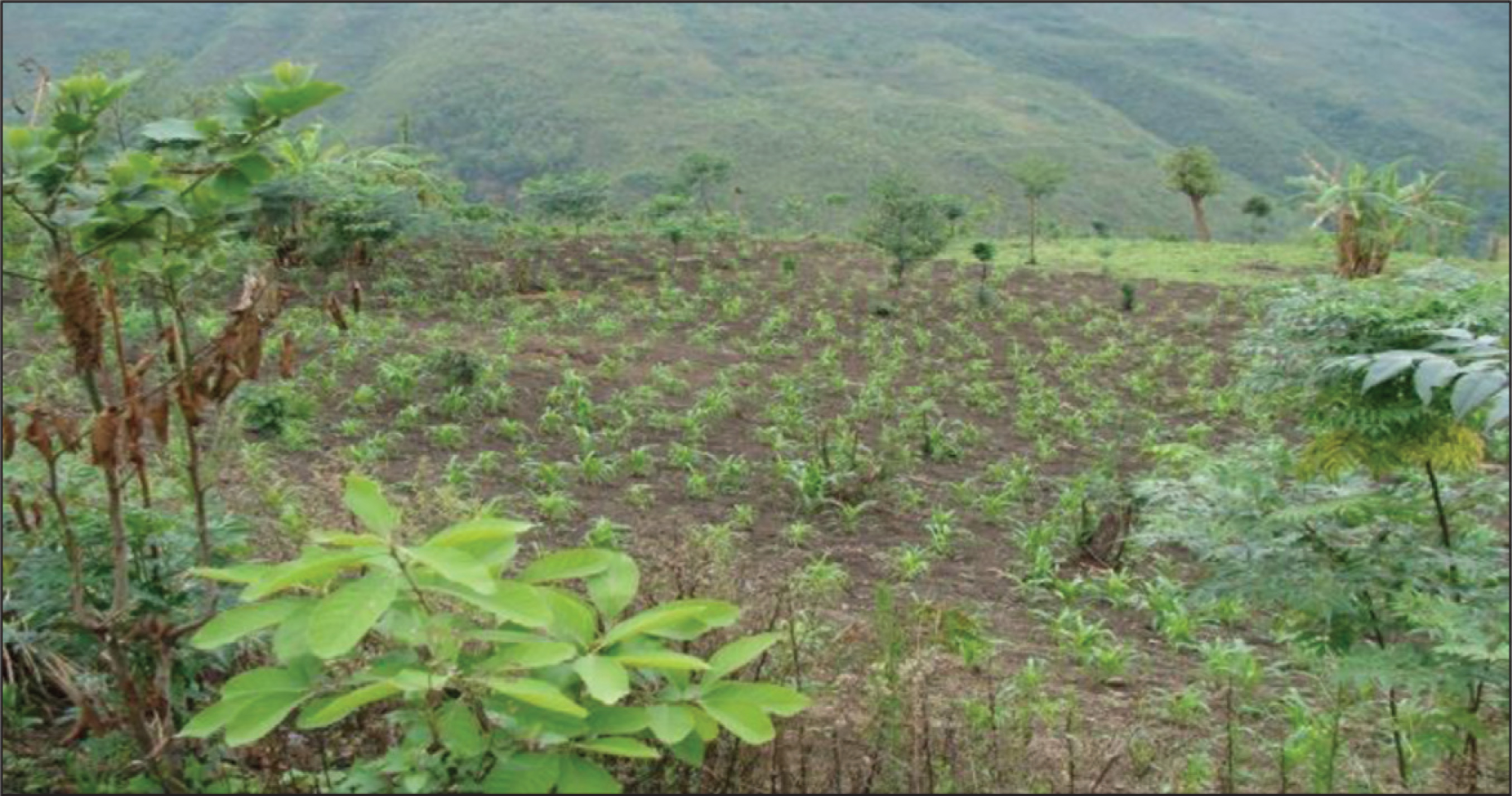
The picture, as presented by recipients and project staff, is complicated. During the fieldwork, I was initially unable to determine why the cardamom plantation failed, whereas farmers had been successfully growing long beans as a commercial crop for many years. Indeed, it was based on this success that the village had been selected for cardamom and ginger plantation. Twenty families were identified as beneficiaries in the cardamom plantation programme during 2003–2007. However, only a few had been able to continue the project on their individual farms by the end of the project phase. The village agrarian economy was dominated by the relay cropping of maize and long beans, while there was no trace of the newly introduced crops, except in a few plots where farmers struggled to grow and maintain their cardamom and ginger bushes. The failure, later discovered, was due to planners’ ‘expert’ understanding that had discounted farmers’ needs, caring principles, local labour networks and local networks of demand and supply. Farmers cared least for the newly introduced cash crops, cardamom and ginger, as they found it hard to grow, nurture and care for once there was no incentive in the form of loans, manure and seed supplies. They had no previous experience of cultivating and selling cardamom. The vagaries of weather also impacted the process, turning initial experiments into failure in many plots, as farmers complained of a high sunshine factor, implying that there was no shade to protect the young cardamom plants. The NEPED soft loan scheme that placed its faith in the revolving fund (microcredit) automatically suffered a setback. The POU members, who were excited by the villager’s innovative crop rotation with kholar as the cash crop, soon realized that their recipients had mismanaged the loans by not using them productively to expand the cultivation of ginger and cardamom saplings. This led to the retrenchment of support and the subsequent loss of interest on the part of the farmers, who were focused on increasing the production of kholar in their jhum plots to sustain both food crop production and farm income (please see Figure 3).
Village Organization and the Project Operation Unit: Winners and Losers
In Sadar, the rural kulaks are the village headmen and political party intermediaries who claimed to be the khel heads. The village council registered 198 households for Mahatma Gandhi National Rural Employment Guarantee Scheme (MGNREGA) man days, while, according to the electoral roll, there were only 159 households. In my study, I recorded only 140 households, on which I carried out my baseline survey, 106 households among which participated in my interviews. 5 I concluded from my fieldwork that the village was divided for the MGNREGA man days programme into nine units (wage groups), each of which had a khel head and a khel secretary, who were responsible for overseeing and ensuring the participation of their khel’s households.
The POU member who initiated the project in Sadar was related to the village, as he had married one of the women from the Jangra clan. His father-in-law, Mr Joseph, 6 was the link in the village and was made responsible for the implementation of the programme. Joseph, as I discovered in my fieldwork, had a vibrant history: in the 1960s, he had lived in a neighbouring village, serving as village pastor, and later joined the Naga National Movement for a few years and went underground. Dissatisfied with the struggle for independence, he returned to his village. Then, after becoming a government primary school teacher, he was posted to Sadar. After a few years of service, he had to take voluntary retirement and became a member of the village citizen group. In the past decade, he has been involved with the Rural Development (RD) department and acts as the manager in charge of the distribution of corrugated galvanized iron (CGI) sheets in the village under the Indira Awas Yojana (IAY) government housing schemes. His children (nine daughters and three sons) had mostly migrated to the cities and towns. One of his daughters was married to a sub-divisional officer (SDO) in Kohima town, and this son-in law was the person in charge of implementing the project in Sadar. The officer visited his father-in-law’s home annually and was, himself, a Yimchunger Naga and knew the village well.
The NEPED project planning unit entrusted him with the job. Mr Joseph, in his interviews, proudly claimed that the cardamom project was initiated by him in the village. The loan offered to each project beneficiary family was £250. The village council, along with the VDB members, selected 20 beneficiaries. Among them, there were three gaon burah (headmen), Mr Joseph himself, the ex-village pastor and the village guard commander, among others who were also beneficiaries of the project. The villagers were given training in Zhonoboto district on how to plant and grow cardamom before the seeds were dispersed. The subsidies of £250 were given to buy seeds, manure and farm implements. Mr Joseph’s farm became the test plot and focal point for dissemination.
My interviews with the beneficiaries revealed that the crops had failed in their individual plots. The plants survived in only two plots, in Mr Josephs’s plot and in a gaon burah’s plot. In 2009, the lack of rain meant bad produce for cardamom. Equally, farmers like Mr Joseph could not sell the cardamom, even in Tuensang market, which lay some 65 km away from the village. The limited production also meant that it was not profitable to sell the produce in such distant markets. The NEPED POU member who oversaw the project complained that the farmers were not as enthusiastic in the cultivation of cardamom as in the cultivation of long beans. They further clarified in my interviews that the villagers’ lack of attention and care for crops had potentially inhibited the project. These remarks were not different from what NEPED bosses would tell me in their headquarters in Kohima, the state capital. For every success story, the NEPED officials took full credit for their intervention, while failures were labelled as due to farmers’ laziness, corruption and disinterest towards improvement.
The POU members, in their interviews, did not reveal who were the beneficiaries of the cardamom project and on what basis they were selected in the project. It was quite obvious that the beneficiaries were shortlisted based on clan patronage and personal connections with village development board and council members. The micro-politics of village patron–client relations is central to understanding project success and failure. For any mode of farming to succeed, labour contribution is required. Interviews with the beneficiaries revealed that their interest in the plantation was due to the (diverse) circumstances and conditions in which they were living and not necessarily for farm improvement and diversification of livelihood. For the ex–village pastor, gaining access to a NEPED loan was a means to redeem his debt and to procure food for his family. For the village guard (VG) commander, these were added funds to invest in new property in the village, while, for others, the money was important to meet their immediate household needs and for investment in tangible assets, like buying agricultural plots, a house or a hunting gun. Those who had genuinely invested in cultivation of cardamom could not maintain their fields, as there was no immediate return in the first year and it was, thus, too costly to engage the labour that was involved in other staple food crop production. For the gaon burah and Mr Joseph, their role as brokers in the project had facilitated the patronage they had built with clan and lineage members, who, in return for becoming beneficiaries, were obliged to offer free labour to them. Their social position in the village as brokers in the development project had many supporters who were ready to lend help in return for subsidies and financial benefits. Brokerage entailed both the material and symbolic benefits they enjoyed with villagers as experienced in other parts of South Asia: see, for example, Mosse and Lewis (2005). 7 By the end of the project’s second phase in 2006, the cardamom plantation in the village had been reduced to few plots of land.
The NEPED beneficiaries also complained in their interviews that the POU members were not very happy with the villagers at the end of the project’s second phase due to the project’s poor performance. The POU members restricted their visits to the village after 2007, when the final review of the second phase was completed. The last time they visited the village was in 2009, when I was in the field. This time, the POU staff came with a grand new idea of conserving biodiversity through spreading awareness of endangered species among villagers and consulting village stakeholders to create a hunting and poaching protection force.
The use of the revolving fund gives important insights into how funds are managed by village beneficiaries who are also responsible for the implementation of the programme, along with NEPED staff and their village co-coordinators.
The Predicament of Project Implementation and its Outcome
The household survey I conducted was completed among 106 families in Sadar village. Based on the survey, I marked individual families’ clan affiliation in each khel. Sadar had five clans, among which the Jangra clan had the largest number of households. The clan division was an important aspect of identity formation and group affiliation. The numerically bigger Jangra clan had four divisions within them and seven gaon burahs (head men) who were members of the village council. Likewise, the Jangra clan members had within them political party workers, government servants who acted as intermediaries in development projects. During elections, the Jangra clan played a decisive role, as they were numerically the largest. Anybody who could garner the Jangra vote would win the election. The village had two grocery stores and several small stores, where essential commodities like betel nut leaves, cigarettes, tea, biscuits and milk powder were sold among other household goods. The village also had two Nepali households who had now become Yimchunger after marrying local villagers.
There were many brokers in the village who were government employees or political party actors. They often contested the traditional authority of the village headman and influenced their actions. As they knew better the rules of governance and public policy on rural development, they had established patronage over the village. They acted as influential people in the village and were held in responsible posts, such as village council chairman. However, these posts were highly contested and abused by influential men in power. During fieldwork, the post was held by the second gaon burah, as the person who was formerly holding the post was charged with corruption. The NEPED project came to the village council through the SDO’s father-in-law, who was also the village facilitator for the CGI sheet scheme under the Indira Awaas Yojana. He informed me in confidence that the villagers are ignorant, illiterate and poor and can be easily manipulated. This disadvantaged them greatly with respect to village elites and government servants, who knew the bureaucracies and could easily benefit from government programmes as beneficiaries.
According to my baseline household survey, there were 28 households who were beneficiaries in the NEPED project. All these villagers got revolving funds (microcredit) between ₹5,000 (£50), and ₹20,000 (£200), to be repaid at the end of the term with an annual interest rate of 5 per cent. Of the 28 households, the Church pastor was one of the beneficiaries. He received ₹100,000 (£1000) of the total fund (10% of the total grant). The villagers understood the revolving fund scheme in an innovative way. The pastor re-loaned the money among town businessmen and some Muslim shopkeepers in the village at a 10 per cent rate of compound interest per month (120% annually). It proved to be a failure, as beneficiaries who were re-loaned monies could not repay such high interest. The pastor, in his interviews, reflected that he was not interested to re-loan the money among villagers, as they did not have surplus cash income at hand and would soon default on payments. Many of his borrowers (mostly migrant grocery store owners and petty businessmen) ran away with the loan money and never returned to the village. At the end of the project, the pastor was unable to repay even the principal amount. However, his social position as a religious head meant that the beneficiaries did not dare to question his integrity. His social capital and support within the village council as one who would rescue villagers when in need further established his social position and prestige.
I now present some household case studies to show how the NEPED fund was utilized as a measure to materialize well-being and social protection through microfinance by the NEPED project team members. It must also be highlighted that 48 households—nearly 50 per cent of the village—did not receive any funds from any of the government programmes running during my fieldwork, and hence were excluded from loans and subsidies. 8 Public service employees were denied loans on the grounds that they had a fixed source of income and also were eligible for loans from their service departments. However, there were exceptions. The person through whom the NEPED cardamom plantation subsidy was received in the village was a government employee, but because he facilitated the whole process (as an intermediary), he became a beneficiary in the cardamom plantation through the NEPED loan and training/capacity-building programme.
The head of Household 5 in the upper khel was selected as one of the beneficiaries in 2000. 9 He received ₹10,000 as loan money and used it for his immediate family’s need to build a house. He could only repay the loan with interest in 2008. The NEPED project ended within 5 years, but he, like many beneficiaries in the programme, was unable to repay the loan on time. The revolving fund based on the interest generated out of the initial allotment of fund never materialized in practice. In order to get these loans, people had to show collateral in land and household assets. Despite failing to repay the loan money on time, the households were lucky not to have faced confiscation of their property, as they were on good terms with the village council elites. For many farmers, the loan money was a resource for building new assets, buying land and sending their children to better schools.
The overall mandate of the project was, therefore, reworked by the villagers through their individual and pressing financial needs and for the necessities for which they cared most. This identified how project policy and practice are influenced by recipients and that, often, it is unhelpful to clinically divide the two actors in aid-driven community development. As Rossi (2006) has emphasized, we need to think less in terms of interfaces between separate worldviews and more in terms of positioned strategies and perspectives when identifying donors and recipients in development programmes. Some of the household heads (that of Household 13, for example) were not in a position to receive a NEPED loan, as they had limited collateral and very little social capital to convince the village council that they could repay the loan amount. Farmers like my host James 10 did not bother to associate with the programme as it was managed by another influential villager who had all the resources to mobilize labour and NEPED benefits to his farm. Instead, James nominated his brother, the village commander and his sister’s husband (the ex– village pastor) who were enrolled as beneficiaries in the NEPED programme. With this, he established his social position as a benefactor and strengthened kinship ties through his blood relations.
For the cardamom plantation, the village council formed a group of 20 farmers under the NEPED scheme. Thirteen farmers received a sum of ₹20,000, while the remaining received ₹10,000 each. For 2 years from 2006, Household 17 sold cardamom and made profit. In 2009, due to bad weather, all the cardamom bushes were destroyed by strong sunshine and there was no prospect of growing them anymore, even for the most prosperous farmers who had maintained the plots with the NEPED loan and farm labour offered by the beneficiaries. The cardamom that was produced was sold to a local merchant from Kerala (a South Indian state) who bought them at ₹55 per kilogram. The household was able to sustain a cardamom plantation, as his farm was selected as the test plot. Farmers who joined the project were obliged to work on his farm during the initial period in order to receive pullies (seedlings) from the test plot in return. They devoted a portion of their weekly work towards the maintenance of cardamom. Once the bushes were ready for transplantation in the field, the loan beneficiaries cooperated with the household head on his farm. The obligation remained one-way, as the beneficiaries could only get the saplings when they participated in Joseph’s test plot field. Once the saplings were distributed by individual participants onto their farm, they failed to take care of the plantation, as they had no formal training in horticulture nor lived experience of nurturing these cash crops. The relay cropping of long beans and maize that evolved out of a practice of ‘care’ and reciprocal/convivial sharing of farm labour supported by the village Church voluntary youth group Christian Youth Endeavour (CYE) was different. Their own farm work for food crop production was more important than these new plantations, which required enormous attention and often conflicted with their own crop cycle and labour supply in the village. With the subsidies, they were encouraged to maintain the plantation. Once the NEPED fund was distributed and there were no avenues for fresh subsidies, farmers stopped bothering with their cardamom plantations. The expected produce also fell and few individual households took the initiative to sell their produce in the market. For the next phase, the NEPED project staff did not shortlist Sadar as a project village.
Similarly, rural elites have access to the towns and they constantly bring new ideas, luring villagers into new schemes and programmes for agriculture development. For Household 21, a NEPED loan was out of the question, as they were too old to work hard or invest in agriculture to generate the repayment of the loan. As one farmer observed, only households that had established trust with the village council members and those who were engaged in village politics had the credentials to get a NEPED loan. The loan distribution was also linked to the personal affiliation of village members and their status within the Church. Deacons, who were very close to the Church, VC and VDB members and political intermediaries were the most affluent and influential men who managed these loans and registered as beneficiaries.
From the household survey as described above, it can be inferred how individual households strategized their livelihood priorities in respect of the NEPED revolving fund scheme that was primarily instituted to improve livelihood through farm activities. While a few farmers utilized the loan for agriculture, not all were successful in cultivating cardamom and ginger. For other farmers, building houses, their children’s education and investment in more tangible assets were far more important than investing in farming foreign-introduced cash crops in which they had no experience and to which they had no attachment. Other loan recipients often used the loan money to develop innovative strategies of patronage with fellow villagers: redeploying the rationality of credit (loans), they became village moneylenders. Though unsuccessful in recovering the loan money, they clearly showed how cash can be productively reinvested to earn a speedy profit. The net result was that investment in cash crop cultivation became the farmers’ last choice. Only the beneficiaries who owned multiple agricultural plots and were well connected to the market invested the revolving loan amount in cardamom plantation. The uncertainties of monsoon rain, harsh weather conditions and low incentives from the market meant that the initial interest waned. By the end of 2007, POU members from the NEPED department ceased to make regular visits to the village. The project outcomes were far below their expectations. Many of the loan beneficiaries became loan defaulters, as they did not invest the money in productive assets that could generate income. The NEPED officials had nothing left to promote in the village. During that period, the NEPED Phase Two had also come to an end and the project staff were gearing up for the third phase, which aimed at creating alternative/different empowerment and livelihood options centred around conservation and the maintenance of biodiversity.
The important questions that arose out of these case studies revealed how the ‘idealized’ notions of ‘community’ and ‘social capital’ were mediated by identities, interests and factions within a project site as well as the concept of ‘care’ for the environment linked with indigenous communities’ livelihood and subsistence. Also, they were mediated by how the community actors, beneficiaries and project recipients build their relationships and participate, often rationalizing decisions based on their family needs and care for food crops rather than following the broad policy goals of donors or project planners. While languages of the project may describe them as primitive and lazy, as a timeless community par excellence and as rural folk, the project ‘beneficiary community’ presents a more complex history and represents nodes of power hierarchies that destabilize fixed images produced in the project text as idealized tribes and homogeneous, unstratified village communities. The idealized modernist utopia has rationalized the principles of community participation and commoditization programmes in Nagaland.
This draws my attention to what Li (1996, p. 502) highlighted in her study on Indonesian hill peoples, that struggle over resources is also a ‘struggle over meaning’, which shapes project outcomes and helps us understand the ‘agency’ and strategies of grassroots actors in development. Programme interventions based on ‘rapid appraisal’, as was done in NEPED project evaluation repeatedly at the end of each project phase, produced lists of typical tasks, assets, outcomes, learning and needs but missed the subtleties of relationships and processes that defined projects. They failed to document the strategies adopted by the individual households that determined the project outcome. While farmers enthusiastically grew long beans, this did not automatically translate into farmers adopting cardamom or ginger as a cash crop to improve household income. The physical isolation, distance and remoteness also made Sadar challenging for agribusiness. Nonetheless, the failure to grow cardamom had less to do with the sophistication of commercial farming and more to do with the project planners’ failure to understand communities’ interests, motivation and strategies of action that are linked to questions of care, conviviality and communities’ attachment to particular food crop production—rice, maize and millets—in my case study. The contingencies add to the ‘high managerialism’ and ‘high modernism’ of project practice that simplifies communities, their values, their knowledge system and their ‘capital’ (Van Ufford et al., 2003).
The fact that some people’s actions constitute other people’s constraints meant that one cannot study individual behaviour in isolation—in the language of economic analysis, one cannot ignore externalities. People’s behaviours depend not only on what other people are doing but also on the form and social quality of the social relationship among them (Berry, 1980). Farmers use agricultural loans for ceremonial expenditure in part because such expenditure serves to affirm or enhance their commitment to principles of interaction (among kinsmen, neighbours) (Parker, 1972) or, more broadly, adheres to the principal of care and conviviality. These principles, in turn, shape farmers’ access to productive resources through reciprocity and kinship obligation. Similarly, I have shown in my analysis how farmers utilized soft loans to relend them to kinsmen who could not become recipients but were in desperate need of cash. Thus, denial and access to resources were shaped by the unequal power and patronage enjoyed by individuals within the community that also shaped project outcomes.
The other point that demands attention here is the role of the brokers and intermediaries who were involved in implementing the project. These brokers worked within both the development institution and the project village. The intermediaries played a very important role in producing a coherent development idea. The development programme staff, as seen from my case study, intervened in the field as a broker attached to his beneficiaries and the project community through the project. Similarly, village brokers who take part as elite mediators express a unique relationship. As I have shown, the NEPED project came to the village with the help of the block development officer, who acted as a POU member and who was the son-in-law of an influential villager. His relationship with the village was more than that of a project professional. Similar was the case with other project officials, who were members from the same community and who were often citizens of the village who worked for the agency. Project staff members have a multifaceted relationship with the beneficiaries. They also share unique relations of power and patronage, which makes them obliged to reciprocate. In Sadar, the end of the second phase also marked the termination of the block development officer as a POU member and he was recalled from deputation duties by the NEPED team. With a new POU member in place, who came from a different district, villagers felt less obliged to cooperate. Thus, development brokerage plays a critical role in shaping interpersonal relationships between villagers and project professionals, who were also presenting, in their day-to-day talk, communities as ‘backward’.
Every farmer who could secure a NEPED grant had their own life history of utilizing the revolving fund. Only farmers who had networked with the village institution—the Church—and who were members of the village council, managed to become beneficiaries. Moreover, the selection and distribution of grants were influenced by the decision of the village headman and council, which judged people on their ability to refund the money. The council members informed during my interview that large grants can only be given to farmers who can provide collateral and who the council feels will be in a position to return the money. The risk-taking farmers in the village were council and village development board members who had both access to government loans and land to show collateral for grants. However, the NEPED action plan was based on participatory development and was decentralized on the grounds that it had been reworked by village households who establish their patronage network through government schemes. The bulk of the revolving fund entered non-productive services and ended up as additional cash in the hands of villagers who were wealthy enough to manage their own farms already.
The distribution of the fund clearly showed that people who were close to the Church, owned multiple plots of land and enjoyed a convivial relationship with the village headmen and council members received the grant. The ‘project reviewers’ hired as consultants were not in a position to take these factors into account when evaluating the project. The main measure used by the NEPED officials was the number of beneficiaries and not how the beneficiaries were selected or how the funds got allocated and what motivated the diverse use of cash for non-farm activities. They were engaging in narrating project success by describing the success story of relay cropping in Sadar as a positive precondition for development intervention. The NEPED revolving fund, thus, created new avenues for resource appropriation.
Project Outcome and Village Realities
In a paper published by Faminov and Klein (2001), who served as the director of the NEPED project from 1998–2000, the authors applauded the project success by statistically proving that the number of plantations carried out in Nagaland initially in test plots were later scaled up. This was presented as a project success in the first phase (1995–2001). The results were, as the authors put it, ‘extrapolated’ from project villages and they present a sanguine picture of the project success (Faminov & Klein, 2001, p. 219). My interviews with project beneficiaries in Sadar disclosed that in most cases village elite beneficiaries described existing forest areas as newly planted forest when the project officials came to verify the test plots. Some farmers who had planted teak (tectona grandis) a decade earlier under a different government programme also showed these areas as part of the NEPED success story of replication and intensification of tree plantation. Similarly, as the project report authors themselves recognize, farmers ended up planting and adopting commercially profitable trees as opposed to indigenous ones, which they put to everyday use as firewood and for building houses. Their choices were also influenced by the project emphasis on agro-forestry, the planting of commercial crops and the likely economic benefits associated with timber tree plantation. On the downside, such rampant forestation has also made planted forestry vulnerable to forest fire, and many planters in Sadar reported that their plantation was destroyed by the annual forest fire during the dry season. Such divergence between social agendas is assumed by ‘modern’ understandings of the world and reflected in the political ecology (Mohanty, 2016, p. 228). However, it undermines humanity’s interdependent relationship with nature. Policies that trigger insensitive development practices are based on assumptions about the appropriate form of distributive justice whereby aggregate utility of resources is a variable (Klinsky & Dowlatabadi, 2011). Therefore, the conversion of a forest into a ‘mono-species’ or industrial plantation may be perceived as a necessary driver for economic growth (Adhikari et al., 2004).
For the NEPED team members, ‘sustainable, livelihood redevelopment and capacity building’ through participation and farmers’ ‘social capital’ was a coherence-bounded idea that was to be maintained for future funding. Ultimately, meeting the participatory protocol procedures and the physical targets kept the project staff busy and deepened the indifference for the interests of poor swidden farmers. The village beneficiaries tailored the project to their needs and aspirations: all opportunities for loans, grants and training were used to build upon their existing personal wealth and patronage. The object of development was, thus, shaped both ways, by the ideal participatory model of the funders and the individual subjectivities of beneficiaries, who established their ‘will to improve’ (Li, 2007), fitting into the mandate of projects and enrolling themselves as recipients. The various disjunctions that emerged in project policy and practice were concealed, subsumed and overstepped by new opportunities provided by funding mandates; each time, success seemed to be far away.
Conclusion
In the conclusion, I would like to highlight and shed new light upon the issues discussed so far by extending the debate on the disjointedness between project policy and practice into the realm of ‘care’ and ‘conviviality’. This would help in qualifying the current decentralized approach to participatory development focused on a community’s participatory networks, knowledge system and social capital. Project beneficiaries acted in ways that benefited their self-interest and showed a lack of care for project-supplied seeds and new plantation crops. Why did this happen and why were the project goals not achieved in the study village? Based on my discussion with project interlocutors, I gathered that they felt the lack of care expressed by the project field staff. The scheme was designed to introduce new crops that would change the agro-ecological landscape of the village, which farmers could not care for because this had no connection with villager’s clans, khels and faith-based networks of labour contribution and reciprocity. The only interest that drew beneficiaries to the project were the free seed supplies and loan money that they could use for things they valued and for transformative changes in their lives, for example, children’s education, building new houses and meeting rising medical expenses.
The success story of long bean and maize cultivation is directly linked to farmers’ natural choice of these cash crops and the ways that the Church’s faith-based programmes in the village and wage labour organization shaped farmers’ care for these crops, which developed out of voluntary labour contribution during the sowing and harvesting season. This was absent in the introduced crop cycle. Few farmers who were selected for training and had the social status to gain maximum loan money from the project managed to achieve some success. Although the NEPED team grounded their project intervention, championing the ‘local knowledge’ and ‘social capital’ of farmers, they introduced non-native species for afforestation. The farmers who planted these trees cared less about their ecological suitability for subtropical conditions. They were persuaded by the prospect of free seed supplies and timber harvesting in the future. When forest fires broke out and destroyed many plantation farms, beneficiaries were assured that a new project would help them replant.
For jhum farmers, burning was always a controlled activity, and years of experience ensured that care was taken not to damage valuable matured forest. The project mandate mismatched the expectation of jhum farmers, whose local knowledge was only endorsed on paper during public and focus group consultations to ensure that the principles of participation were recorded in the project’s published literature. To this extent, I agree with Chattroy’s argument that ‘participation works as a rhetorical state strategy even in the face of widespread incredulity’ (Cattaroy, 2005, p. 443). But my point goes beyond that. From an epistemological and ontological point of view, the participatory framework on which the project aimed to create sustainable livelihood for swidden framers by introducing a new credit system and plantation crops reproduced the modernist hegemonic discourse of development, side-lining community-lived knowledge of farming, plant protection and care for the environment. It is this incompatibility that needs to be addressed in community-driven sustainable development programmes alongside critiquing the incredulity between project policy and the practice of development. As Arora and Strangers have argued elsewhere, ‘caring practices require a new style of concern demanding that the dream of control and mastery be given up’ (Arora, 2019; Stengers, 2015). Community-driven sustainable development projects such as NEPED, as discussed in the article, must take communities’ and experts’ ontological foundations seriously (Candea, 2011; Viveiros de Castro, 2003;). Only then we can think about transformation through participatory development.
Footnotes
Declaration of Conflicting Interests
The author declared no potential conflicts of interest with respect to the research, authorship and/or publication of this article.
Funding
The author acknowledges the generous financial support of the Felix Scholarship, Emslie Horniman Anthropological Scholarship Fund and the Fürer Haimendorf Fund for Anthropological Field Research without which fieldwork could not have been possible.