




Abstract
Background:
Happiness is a subjective emotional state, and there lie individual differences in the way happiness is perceived and derived. It is important to understand that the socioeconomic status of families impacts the way children derive happiness, owing to the excess or deficit of exposure and access in a child’s life. However, little research has been done regarding children’s sources of happiness in India. This study aims at exploring the sources of happiness of children in the age group 7–10 years, from different socioeconomic backgrounds.
Method:
The socioeconomic status was determined using the Kuppuswamy socioeconomic scale. The sources of happiness were explored through drawings made by children in response to the prompt, “Draw any five things that make you happy.” The drawings were analyzed using content analysis and were explored further to understand the differences in the lower and upper socioeconomic groups. The results indicate the possible impact of exposure to worldly experiences on what makes a child happy.
Results:
The findings revealed that children from the upper socioeconomic group seek happiness mainly through “receiving material things”; on the other hand, for the children from the lower socioeconomic group, family relationships appear to be the main source, with a special mention of their homes being a source of happiness.
Conclusion:
The findings in the study may help in designing interventions for increasing positive affect by understanding how children perceive their environments based on their contexts.
Introduction
The understanding of the term happiness is often interchangeable with that of well-being, as also suggested by Seligman. 1 Higher levels of happiness lead to healthy coping mechanisms as well as more optimism despite certain risks that one may encounter, thereby contributing to the overall well-being of the individual. 2 Research has suggested multiple ways of attaining happiness. 3 However, a layperson’s definition of happiness can differ from the definitions formulated by researchers. A layperson’s perception of what contributes to happiness essentially shapes what they seek in life in order to become happy. It is only natural to identify these sources of happiness to enable better well-being. Though studies on happiness have largely focused on exploring the views of adults, the same remains lesser explored among children.
Children’s happiness has been found to be associated with a variety of material possessions, pets, or personal achievements. 4 The cultural values and socioeconomic factors might also shape the perception of these sources. In collectivistic societies like Malaysia, children consider the welfare of their families as their source of happiness. 5 Easterlin 6 in a seminal writing compared overall happiness among 29 countries and found the rich countries to be consistently happier than the poor. Self-fulfillment has been found to be the most important source of happiness in children from low-income backgrounds. 7 Another study by Holder et al., 8 conducted among children from two schools, found that activities, relationships, other-oriented personal feelings, and receiving were common things that made children happy. Interestingly, the responses of the children differed between the two schools, which the author suggested may be due to the differences in their socioeconomic backgrounds.
Research on children in diverse Indian educational settings 9 reveals that self-fulfilment, like taking part in hobbies, achievements, and supportive family and peer relationships are core source of happiness. Though this was irrespective of their economic status, children from lower socioeconomic backgrounds reported significant barriers to happiness. Another study found clear links between higher socioeconomic status and enhanced self-esteem, identity, and psychological well-being. 10
Overall, there appears to be a dearth of literature exploring what young children might perceive as a source of happiness. It is of paramount importance to explore children’s sources of happiness for the following reasons. First, children might derive happiness from slightly different sources given their developmental stages, and findings from the adult perspective cannot be superimposed on children. Second, early emotional experiences and perception would also shape their perception of sources of happiness as adults. Next, the available literature comes mostly from the Western part of the world and thereby missing the unique role Indian culture might play in shaping young children’s sources of happiness. Moreover, studies have combined samples of young children and adolescents. The adolescents’ sources of happiness might differ from those of young children as a result of differences in their emotional and cognitive development. Finally, there is little literature available comparing sources of happiness between lower and upper socioeconomic groups. Knowing children’s sources of happiness based on their socioeconomic backgrounds might inform the social interventions to promote well-being in children. Therefore, the present study aims at exploring the sources of happiness among Indian children from different socioeconomic statuses of ages ranging from seven to ten years.
Materials and Method
Participants
The sample for the present study was constituted of 18 children in the age range from seven to ten years and belonging to either the upper or lower socioeconomic strata in Delhi, India. All children were selected through purposive sampling, allowing the identification and selection of sources best suited to get in-depth information about the phenomenon.
Initially, 15 schools in Delhi NCR were approached for permission. Two schools granted permission for data collection. The screening form was sent to a total of 390 parents. There were 168 responses obtained, and thus the response rate was 43.07% for the survey. Twenty-one fulfilled the criteria and thus were contacted by the researcher. Three parents denied consent. The final sample consisted of 18 children. Ten children belonged to the lower socioeconomic group, whereas eight belonged to the upper socioeconomic group.
Measure
Kuppuswamy Socioeconomic Scale 11
The scale has been used to measure socioeconomic status (SES) in urban and rural settings in India. It quantifiably measures education, occupation, and income per month of the head of the family and gives a score between 3 and 29, categorizing families belonging to different SES. The latest version of the scale was used, as this scale undergoes a revision every year based on the consumer price index.
Qualitative Data Collection Through Drawings
The children were asked to “Draw any five things that make you happy.” Once the children were done with their drawings, they were requested to describe their drawing, and notes were made of the descriptions. Drawings were selected as the method of exploring sources of happiness as they are considered a non-threatening and fun activity that gives children the opportunity to express themselves. 12
Procedure and Ethical Considerations
The present study was conducted from 2021 to 2022. The study protocol was approved by the Institute Review Board (vide reference no. CU:RCEC:APPROVAL:12/21). After obtaining the ethical clearance from the IRB, a screening form was developed that included the basic demographic details of the child, such as age and gender, demographic information about the parents, and the Kuppuswamy socioeconomic scale. 11 Two schools within the Delhi NCR region were approached for permission to conduct study. After obtaining permission from the school authorities, the screening form was sent out to the parents via the online medium. The responses were screened for inclusion criteria, and those fulfilling the criteria were approached for consent from the parents for their ward to take part in the study. After obtaining the parental consent, the informed assent was also obtained from the child. The data collection took place in the presence of the participants’ parents/guardians.
Data Analysis
The drawings made by the children were analyzed using content analysis. 13 Holsti 13 defined content analysis as a “technique for making inferences by objectively and systematically identifying specific characteristics of messages.” For the present study, manifest content analysis was used, where the observable content is coded and then grouped under themes. This allowed for the qualitative exploration of what was drawn, allowed for quantification of emerging themes, and exploration of the different patterns in both groups.
Triangulation was used in order to ensure validity. Investigator’s triangulation was done by the set of data being analyzed by two researchers and then being discussed to arrive at the final codes. Method triangulation was done by using the data from drawings’ content, descriptions of the drawings, and field notes documented by the researcher during the data collection.
Results
The screening form was sent to a total of 390 parents. There were 168 responses obtained, and thus the response rate was 43.07% for the survey. Twenty-one fulfilled the criteria and thus were contacted by the researcher. Three parents denied consent. The final sample consisted of 18 children. Ten children belonged to the lower socioeconomic group, whereas eight belonged to the upper socioeconomic group. The age and gender distribution of the sample is given in Table 1. Two groups are almost comparable except for the fact that the lower SES group had more females (70%) than the upper SES group (37.5%).
Demographic Characteristics of Study Sample.

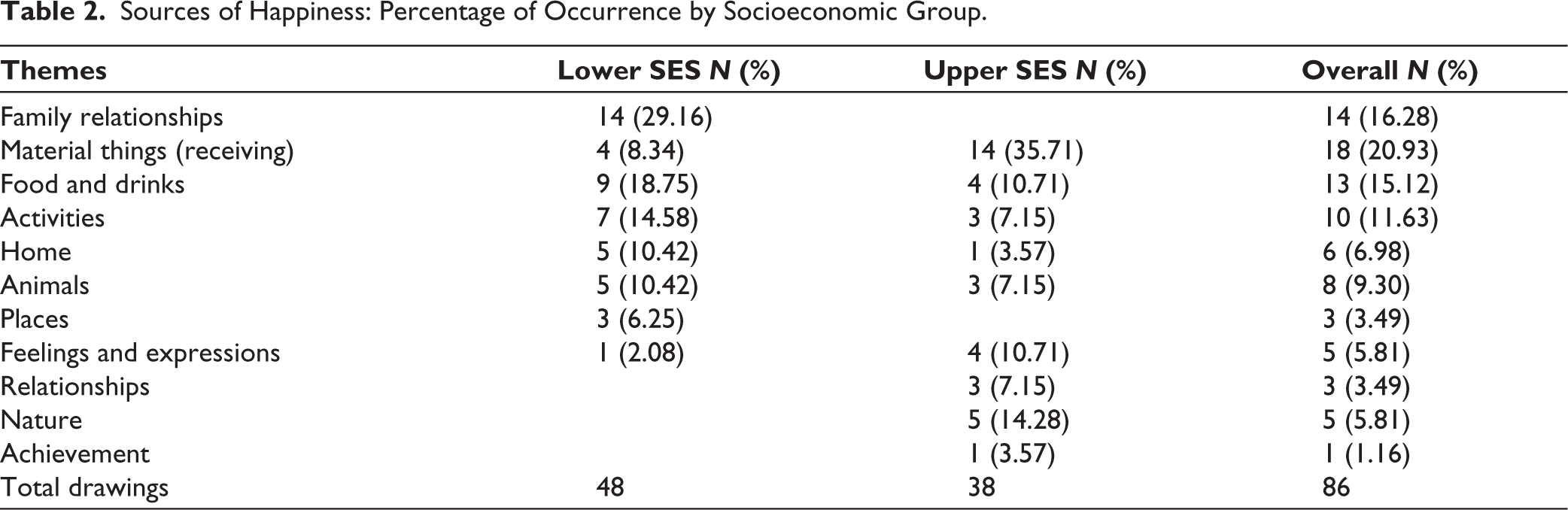
A total of 86 drawings (LSES = 48; USES = 38) were analyzed for the present study, as four drawings lacked sufficient clarity to be analyzed for themes. The themes which emerged from the content analysis of the drawing were tabulated for frequency as a function of socioeconomic group (Please refer to Table 2). Table 2 shows that both LSES and USES groups mostly had common themes, except for the theme “achievement,” which emerged in the USES group only. However, it is noteworthy that the frequencies of common themes across the groups vary. The findings revealed that the two most common sources of happiness for children in the LSES group were family relationships (29.15%) and food and drinks (18.75%), accounting for almost half of the themes in this group. On the other hand, the two most common sources of happiness for children in the USES group were material things—receiving things (35.17%) and nature (14.28%), again accounting for almost half of the themes in this group. It is noteworthy that the theme of feelings is relatively uncommon in both groups; it remains the least common theme for LSES groups (2%).
Sources of Happiness: Percentage of Occurrence by Socioeconomic Group.
Discussion
The sources of happiness in this study were explored using drawings that the children made in response to the prompt “Draw any five things that make you happy/bring happiness to you.” The results for the LSES group indicate family relationships to be the main source of happiness, followed by food and drinks, activities, home, animals, material things, places, and feelings. The value of family relationships may be contextual to the community to which they belong. Similar to collectivistic societies, where the welfare of their families is what individuals consider to be their source of happiness. 5 However, several studies indicate the coexistence of individualism and collectivism in India, 14 which may indicate the differences in the results of the USES group, which will be discussed further. The results of the USES group indicate that material things (receiving things) are where most of the group derives happiness from. Romadhani 7 explored the sources of happiness among fifth graders in Indonesia and found that children of this age feel happy when they are full, that is, when they engage in activities that make them happy or through certain achievements and feel self-fulfilled.
Material things like remote control toys, mobile phones, makeup, and earphones were a few of the things that children from the USES group drew. Children associate material possessions with happiness and the lack of them with unhappiness from the perspective of an outsider. Young children (8–10 years old) were able to appreciate the value of possessions based on emotional attachment, personality association, and social meaning, particularly those belonging to the LSES group. 15 Children from the USES group often perceive happiness as requiring instant gratification. Research indicates that the meaning of happiness among youth based on class differences, points out the difference in discourse around happiness, its meaning, and attainment. The USES group determines happiness as the objective of one’s life in comparison to the LSES group where happiness is determined by sociocultural factors. 16 Feelings of love, kindness, and affection were some of the feelings that brought happiness to children from the USES. Studies have found that children of the LSES group have better emotional perception in comparison to the USES group. 17 Few USES children associate their happiness with others, which was the highest in the present research for the LSES group. However, this notion of intersubjective spaces, based on relationships being a primary source of happiness, has also been explored and suggested by Thoilliez 18 as well. Thoilliez’s 18 study also explored the fact that children’s desire for self-improvement was subject to the way their parents valued them, similar to how a child from the USES group reported in the current study. She was reinforced with treats when she did well in school, but was often criticized for things she was unable to do or scolded when she tried to ask her mother for anything. Interestingly, the child also drew love as a source of happiness. In this scenario, there may be an association between the desire for self-improvement through grades and the love the parents shower on her for achieving certain goals, which brings her happiness. It is crucial to note that there were more females (7) in the LSES group and more males (5) in the USES group. The focus on family relationships, in comparison to material things, as the source of happiness can be attributed to gender, as studies suggest that women derive happiness from social relationships, and harmony in relationships is a better predictor of well-being. 19
Different activities contributed as a source of happiness for both groups. Some children drew more than two activities that made them happy. Research also suggests that voluntary leisure activities boost self-confidence because it grants one a sense of autonomy, 20 which in turn makes them happy.
In the USES group, the concept of home has come up only once in comparison to five times in the other group, which may also fulfill the physiological as well as the safety needs as per Maslow’s hierarchy of needs. The understanding remains that sources of happiness are idiosyncratic and formally based on the experiences and motivation of the individual. However, similarities exist between members of communities that may face common difficulties. The SES has a direct impact on a child’s well-being and resilience, and identifying a few sources of happiness and creating awareness about the same may help children to cope better with different circumstances regardless of their situation. These sources of happiness can be used as resources to deal with and manage emotions.
Despite the abovementioned interesting findings, the present study has a few limitations. First, the study only included children belonging to either LSES or USES. Inclusion of children from middle SES would have enriched the results, as middle SES has its own very unique challenges and strengths. Second, the drawings were analyzed only for the manifest content. Analysis of latent content, possibly through a projective lens, could have added further to the depth and richness of the data. Finally, given the very constricted age range of the study participants, the results of the study are not generalizable to all children. Larger studies with quantitative methodologies will help to increase the generalizability of the results from this study.
The present study set out to explore the sources of happiness for children belonging to different SES. The study revealed that children from different SES derived happiness from very different sets of constructs. The study highlighted that the main source of happiness for children from LSES is family relationships and home, whereas for children from USES, happiness is sought through receiving material things. These findings may help the scientific community in understanding the children’s future goals and their ability to overcome difficulties by moving toward their aims through positive adaptation. The findings from the study can inform the interventions at both micro as well as macro levels. At micro levels, these findings might help clinicians dealing with children presenting with mental health issues, such as childhood depression, in designing interventions to enhance positive affect. At macro levels, these findings can inform community-based interventions for promoting positive mental health outcomes in children, keeping in mind their SES.
Footnotes
Acknowledgements
We would like to express our most sincere gratitude to the staff members at St. Columba’s School, Delhi and Babul Uloom Public School, Delhi, for allowing and facilitating our data collection process with utmost openness.
Authors’ Contribution
Chelsea Dean has contributed in the conceptualization, data collection, data analysis, and the preparation of the manuscript. Mohammed Afsar has been involved in analyzing the data and in critically reviewing and revising the content. Vatsal Priyadarshi Pandey has contributed to the conceptualization and in critically reviewing and revising the content. All the authors approve of the final version of the manuscript to be published.
Declaration of Conflicting Interests
The authors declared no potential conflicts of interest with respect to the research, authorship, and/or publication of this article.
Funding
The authors received no financial support for the research, authorship, and/or publication of this article.
Patient Consent
Not applicable.
Statement of Informed Consent and Ethical Approval
The study was accorded Ethical Committee Approval vide Institutional Ethics Committee (No. CU:RCEC:APPROVAL:12/21, dated December 15, 2021). Written informed consent was taken from parents. Written informed assent was taken from all participants. The study was carried out in accordance with the principles as enunciated in the Declaration of Helsinki.