




Abstract
Background:
The use of mixed methods research (MMR) has become progressively important in the field of behavioral and social sciences. This article makes an argument for the combination of quantitative and qualitative methods in the study of childhood trauma. It focuses on the role of MMR in effectively exploring the traumatic life experiences and narratives of children and adolescents.
Methods:
The mixed method approach is beneficial for multi-dimensional research strategies, thereby surpassing the quantitative-qualitative divide. We also discuss the key characteristics of the mixed methods approach applicable to these behavioral studies.
Results:
This article concludes with a study example from the author’s MMR-driven doctoral research on the topic of divorce-related child custody issues in India.
Conclusion:
The implications for MMR use in future childhood trauma research are discussed.
Introduction
The areas of social and behavioral sciences were traditionally quantitatively oriented. However, the importance of qualitative studies has been acknowledged, over the years.1–3 The use of qualitative research is valuable for its ability to explore phenomena and build theory, which is vital in researching sensitive issues such as childhood trauma.4,5 This will subsequently aid in the development of psychosocial interventions toward the recovery of traumatized children. 6 A 2009 study by Creswell and Zhang highlighted the fit of mixed methods research (MMR) in trauma studies. 1 This can be explained by the traditional use of objective scales and other quantitative measures in complementarity with qualitative measures and analysis. The integration of these qualitative and quantitative branches in MMR results in a comprehensive and holistic understanding of the childhood trauma impact and related narratives that could not have been attained by separate qualitative and quantitative studies.7,8
Childhood Trauma, Divorce and Custody Issues
In childhood trauma, children experience a range of adverse childhood experiences such as neglect, abuse, abandonment, victimization, natural disaster and violence, in both the familial and social contexts. 9 Childhood trauma seems to be a critical etiological factor in the development of psychiatric disorders both in childhood and later adulthood. 10 Childhood trauma is characterized by long-term adverse impacts such as flashbacks or memories of the traumatic incident, fears/phobias specific to the trauma, and changes in views about self, others, life, and the future. 11 These events have profound physiological, emotional and social impacts, leading to long-lasting negative impacts on children’s mental health and well-being.11–13
Among various traumatic events, divorce and related child custody issues have a significant impact on the child’s life. The increasing rates of divorce have left more and more children to adjust and accommodate parental separation and related life events.13,14 This major life event of parental divorce affects the concerned children and often results in traumatic stress, thereby detrimentally impacting their mental health.15–18 Literature shows that children of divorced parents experience more mental health issues than children of non-divorced parents. 19 Divorce of parents affects children in various ways, depending upon factors such as the age of the child at the time of the divorce and how the child viewed the home situation before he/she learned of the possible divorce. 19 The first trauma experience is when the children become aware of the parental decision to divorce or separate. 20 This is traumatic, especially to those children who were unaware of the parental disputes and are caught by surprise and denial of the same. There is a subsequent need to adjust to this new life event that may result in relocation, change of school, residence, change in financial status, etc.20,21 Also, in cases of parental separation, there is often a period before and/or after divorce, when the child is used as a “pawn” against the other parent. Following the divorce, the child is expected to redefine their relationships with parents and stepparents in case of remarriage. Besides these, in school and social contexts, the child is often left to deal with the stigma of being a child of divorced parents or labeled as having a broken home. In addition to this, parental discord over the child’s custody results in the triangulation of the child between parents, and other family members, lawyers and friends. This high level of conflict further elevates the stress in children.20–23 All of these traumatic experiences resulting from divorce impact the child’s feelings of security, stability and personal happiness. Therefore, divorce and subsequent child custody issues result in adverse childhood experiences and trauma, that invariably impact the children involved.20,22 Due to these complexities in the divorce experiences of children, they cannot be treated as a homogenous group. The experiences and narratives of each child are unique and need a nuanced understanding of the phenomenon. Therefore, the use of MMR is ideal and significant in the study of the psychosocial complexities in the area of childhood trauma like parental divorce and related child custody issues.1,24
Mixed Method Research and its Characteristics
The highlight of the MMR approach is the integration of two or more approaches wherein they maintain their paradigmatic nature but are also interlinked and interconnected with the goal of an in-depth understanding of the study area.7,8,25 Here the focus is to interpret the findings of the integrative process. Additionally, in MMR, the motivation to choose the method depends on the researchers’ goals of complementarity versus confirmation. 26 In confirmation, the results from different data collection methods are triangulated to verify the findings derived from one another.7,26,27 In complementarity, they try to find the connection in the findings derived from different methods. 27 However, due to the complexities in the topic of childhood trauma, it is often challenging for researchers to specify their rationale behind the selection of a mixed methods methodology. Therefore, the researchers look at both complementarity and confirmation of their findings. 24
Besides the rationale for choosing the method, it is also important to consider the key characteristics of MMR. First, it encompasses both quantitative and qualitative data in its analysis. Here, the researcher collects both open-ended and closed-ended responses from the study population. 28 Second, the process of collecting data should be rigorous and follow a good research design, such as selection criteria, sampling, multiple data sources, process fidelity, etc. 28 The third component of MMR is the integration of quantitative and qualitative data by way of merging, connecting, or embedding. 29 In merging, the quantitative and qualitative data merge in a table or matrix format to show the side-by-side comparison of the findings. This helps in comparing and complementing the findings from the different data sets, which finally dissolve into one during the discussion. 29 In the connecting method, the findings from one dataset are used to plan the data collection procedures of the next data set. For instance, a trauma researcher may first conduct a survey using a questionnaire and then use the findings to purposefully identify individuals for a follow-up, in-depth qualitative study. In the process of embedding, a supportive database is added within a larger database to augment the findings. For example, the data from a focus group discussion is embedded into a clinical trial to facilitate a better understanding of the topic and design an effective intervention plan. The last characteristic is about the implementation of the two databases. The data can be implemented concurrently at the same time or sequentially with one building on the other. This depends on whether the study has taken an inductive or deductive theoretical drive. 30
When we discuss the MMR, it is important to understand its two key models, namely explanatory versus exploratory.1,3 The explanatory model of MMR follows a sequential Quan-to-Qual design wherein qualitative interviews are used to support the quantitative results. In this design, the findings are interpreted through the connections between the quantitative and qualitative phases. In the exploratory model of MMR, a sequential Qual-to-Quan design is adopted. Here, the researcher starts with qualitative data collection and analysis and builds on the results with quantitative data collection and analysis. This helps in building on the richness of the qualitative themes with objective quantitative findings.1,3 In this article, we explain the potential of the MMR approach in understanding and researching the field of childhood trauma, with a study example on the issue of divorce-related custody cases from India.
A Study Example from India
The first author conducted a doctoral study on the topic of divorce-related child custody issues in India. The author’s doctoral research applied and imbibed the key model and characteristics of MMR to explore and understand the traumatic experiences and impact associated with child custody in divorce cases. In this study, the author adopted a mixed method approach which could be labeled as a sequential Qual → quan → QUAL design, wherein the word in upper case denotes the more dominant design of the two, that is, a qualitative approach with emphasis on multiple viewpoints of key stakeholders as well as exploring the phenomenological interpretations of the lived experiences of children in custody disputes.
The study was divided into three sections – Section A, Section B and Section C. Section A explored the legal and familial complexities of child custody cases through qualitative key informant interviews and analyzed using thematic analysis. This was followed by Section B of the quantitative phase which used a descriptive design to measure variables such as familial factors and emotional and behavioral problems of the children involved. Subsequently, in Section C, the phenomenological approach of qualitative research was used to study the issue of custody disputes as experienced by the children involved. This was analyzed using interpretative phenomenological analysis. This enabled us to understand the perspectives of those children in the process of the child custody dispute, wherein the central meaning or the essence of the experience is explained. Thus, integrating qualitative and quantitative methods as part of MMR gave the study the advantage of complementarity of the findings from different stakeholders to formulate child-centric custody-related recommendations for use in the judicial system.
The key emergent findings from these three sections are summarized and represented in a tabular format using the merging technique. This process of side-by-side comparison using methodological triangulation ensured the attainment of the goals of complementarity and confirmation of study findings. The following Table 1 depicts the contents of the methodological triangulation in MMR.
Table 1 illustrates the consistencies in the key domains across the three sections of the study through color-coded markings. The following is the summary of the triangulation findings.
Methodological Triangulation of Consistent Findings in the Context of Child Custody Disputes.
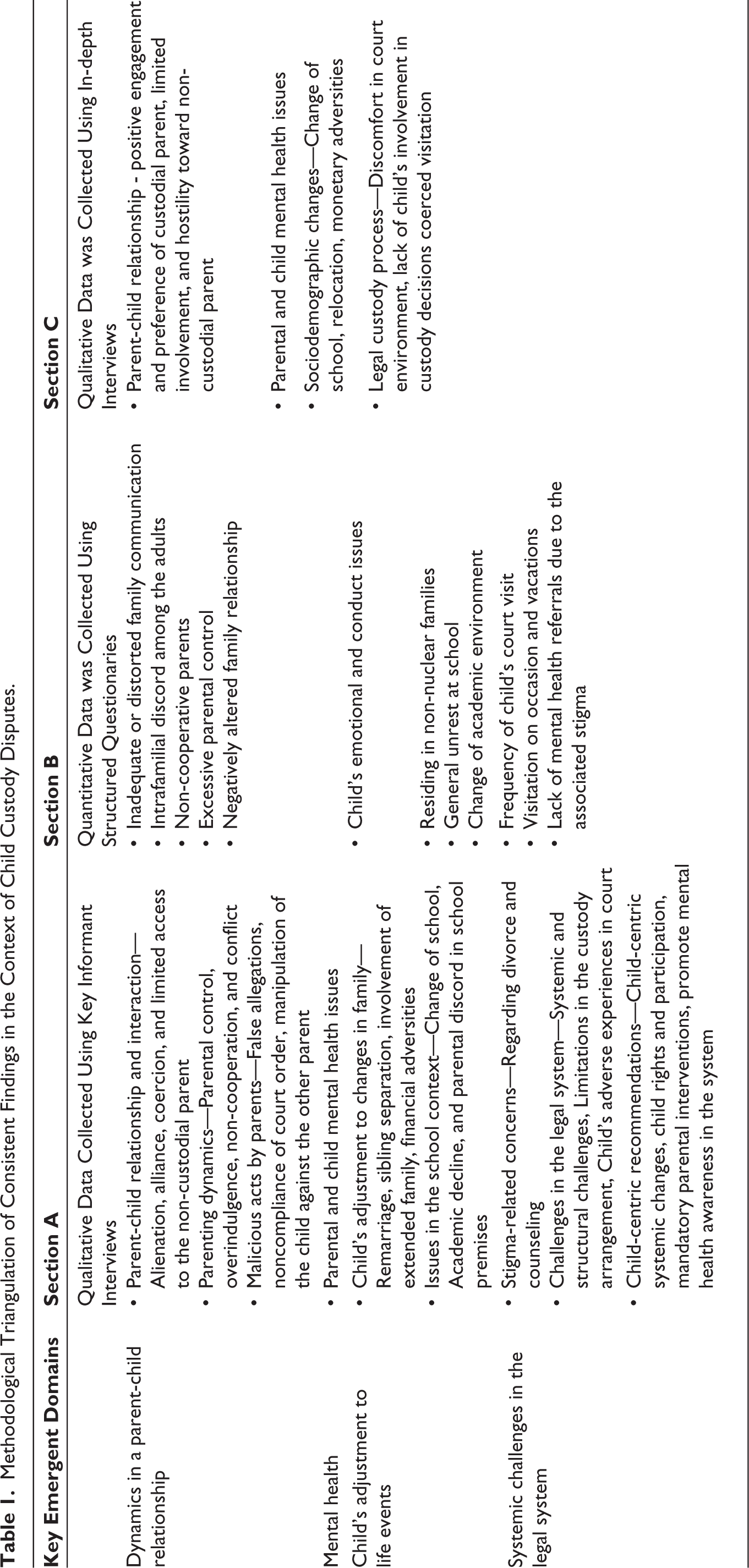
Dynamics in parent-child relationship: This revealed consistent findings of skewed patterns of parent-child interaction, controlling, and overindulgent parenting practices. It also showed the parental non-cooperation, discord, and limited access to the non-custodial parent that could have contributed to the alliance and preference of custodial parents and hostility toward non-custodial parents.
Mental health: This showed the consistent findings of mental health issues in both the child and the parents.
Child’s adjustment to life events: This showed the consistent findings of the child’s difficulties in adjusting to changes in their lives post-parental separation in terms of parental remarriage, separation of siblings due to custody arrangement between the parents, change in living arrangements including extended family and financial adversities. It also discussed issues relating to the change of school and subsequent difficulties in adjustment.
Systemic challenges in the legal system: This showed the consistent findings of systemic and structural challenges in the legal system that result in limitations in the custody arrangement, non-involvement of the child in the custody decisions, and the child’s negative experiences in the court setting. It also reflected the lack of mental health referrals and stigma associated with mental health interventions. This has therefore highlighted the need for child-centric recommendations such as family and child mental health interventions and the promotion of mental health awareness in the legal system.
Therefore, the use of MMR in this study example enabled us to analyze the different perspectives of stakeholders and see the consistencies or inconsistencies in the results. It enabled us to explore the deeper meaning and establish a clearer understanding of the phenomenon of child custody issues in India. 31 This approach helped to understand the perspectives of those children who are experiencing the process of child custody dispute, wherein the central meaning or the essence of the experience is explained. Thus, the use of mixed methods gave the study the advantage of complementarity of the findings to formulate child-centric custody-related recommendations for use in the judicial system.
Discussion
In the study example, priority or weightage was given to the qualitative aspects. Since the study focused on the lived experiences of children in the context of the divorce-related custody battle between their parents, the qualitative narratives of the children and other stakeholders were given more weightage. The quantitative numerical data was used as a way to complement and generalize the findings.28,32 Additionally, with regard to the data collection process, the researcher adopted a sequential mode wherein the qualitative and quantitative data were collected at different stages. This way of exploration ensured both subjective and objective understanding of the child’s divorce-related custody experiences. The use of MMR also helped in establishing data complementarity and triangulation. 28 The process of triangulation as shown in the table helped in the convergence of findings from the qualitative and quantitative data, thereby making it more reliable and corroborative. The complementarity of data was established by clarifying the qualitative findings with that of the quantitative results.
In the above study, the use of MMR also enabled us to combine the strengths of both qualitative and quantitative research approaches. This approach also enabled the expansion of different facets of the phenomenon with its detailed and richer understanding. While qualitative data focuses on the processes and dynamic aspects, quantitative data focuses on the characteristics and statistical aspects. The results obtained from the in-depth key informant and child interviews, along with the structured questionnaires enriched and improved our understanding of this sensitive topic. This nuanced knowledge about the phenomenon under study will thereby foster renewed ideas about them and help answer complex research questions that are difficult using a single research approach. 33 The use of MMR is thus significant in the field of childhood trauma research.
Conclusion
This article focused on the value of MMR for understanding psychosocial issues, adverse lived experiences, realities and trauma endured by children and adolescents, with a study example on the issue of divorce-related custody cases in India. The application of MMR will help researchers in transcending and subverting various epistemological and ontological assumptions pertaining to childhood trauma. This approach to trauma research will help in innovative and out-of-the-box thinking. It will theorize the complexities pertaining to such sensitive topics, beyond the quant-qual divide. The use of MMR is therefore significant in integrating a multi-nodal approach of inquiry in behavioral sciences to explain and explore the adverse childhood experiences and related trauma among children and adolescents.
Footnotes
Acknowledgements
The authors express gratitude to those who participated in the study.
Declaration of Conflicting Interests
The authors declared no potential conflicts of interest with respect to the research, authorship and/or publication of this article.
Funding
The study example was part of the first author’s (PN) doctoral research supported by University Grant Commission Junior Research Fellowship, India (UGC – JRF; Ref:1299/JUNE 2015). There are no other financial interests to disclose among authors.
Statement of Informed Consent and Ethical Approval
The study example was part of the first author’s (PN) doctoral research. All the necessary permissions and written informed consent and assent were obtained from the participants for the study. The study was accorded Ethical Committee Approval vide Institutional Ethics Committee dated 10.1.2019 [Ref: NIMH/DO/IEC(BEH.Sc.DIV)/2018]. The study was carried out in accordance with the principles as enunciated in the Declaration of Helsinki.