




Abstract
Background:
Bullying in school is a vital issue as researchers increasingly find that it can be detrimental to students’ well-being and academic excellence. From an ecological systems theory perspective, examining school bullying reveals that numerous psychosocial factors influence student behavior. Hence, the present study aims to investigate the role of sociodemographics—at the individual (age, gender), microsystem and mesosystem (grade level, school type), exosystem (region), macrosystem (socioeconomic status), and chronosystem (shift from traditional to virtual classroom during COVID-19) levels—in the victimization of traditional and online bullying.
Methods:
After obtaining ethical clearance, an online survey form was deployed to collect sociodemographic information and assess traditional and online bullying victimization among 120 school-going adolescents from the Southern regions of India.
Results:
A linear regression analysis showed age and region (urban and rural) predicting traditional and online victimization, respectively. Other sociodemographic factors of gender, school type, and grade level did not predict either victimization type.
Conclusions:
Sociodemographic factors play a significant role in the victimization experiences of students both in traditional and online.
Keywords
Introduction
Bullying, according to the United Nations International Children’s Fund (UNICEF), 1 is an aggressive behavior characterized by unwanted, negative actions repeated over time and an imbalance of power or strength between the perpetrator and the victim. One in every three children is experiencing bullying throughout the world, and its prevalence differs based on factors such as age, gender, and geographical location of the child. Children who are male tend to be more involved as both bullies and victims and more likely to be involved in physical bullying (hitting, kicking), whereas girls are more often engaging in psychological bullying (intimidating, manipulating); however, at the global level, no gender differences were reported in the prevalence of bullying. As age increases, physical bullying, psychological bullying, and the overall prevalence of bullying are also seen to decrease. The overall prevalence and type of bullying among children again vary from place to place, with the highest being reported in sub-Saharan Africa (11.3%) and the lowest in Central America (4.1%). The geographical changes in the nature and prevalence of bullying could also be linked to the cultural dimensions, especially individualism and collectivism. 2 Previous literature states that socioeconomic status,3-5 gender,6,7 region,8-10 age,11,12 and school type 13 contribute to bullying victimization mainly in traditional settings. Online bullying also varied based on sociodemographic variables,9,14 digital literacy,15,16 and computer usage. 17 Studies have shown that students experience bullying in traditional and online classrooms, but more so in the traditional setting. 18 These fragmented results warrant further literature that envelopes the understanding of the role of sociodemographic factors on bullying victimization across traditional and online settings.
India has the second-largest population globally, 19 with around 260 million school students, making it the country with the most significant number of students globally. 20 Additionally, one in every five people between the ages of 10 and 19 is from India, making it home to the largest adolescent population in the world, with approximately 253 million adolescents, 21 and most vulnerable to school bullying. With the recent increase in online teaching and learning, it has become essential for students to be available online for educational purposes, which increases their access to devices and may influence the occurrence of bullying in virtual learning environments. There are limited mental health support systems available to students in Indian schools. 22 Therefore, understanding the sociodemographic factors that contribute to bullying is essential to identify and support vulnerable students. However, studies on bullying are less in India when compared to the Global North. Besides, most of the available literature in India focuses on traditional classrooms and has emerged from the northern regions of India. Despite the increased access to online classes, the literature on the role of sociodemographic factors in online bullying victimization is scarce. 14
The present study examines school bullying in traditional and virtual classrooms in urban and rural areas in southern parts of India. The methodological quality of many studies could have been more precise and/or questionable, with few studies reporting the psychometric properties and details of the tool used. The quantitative tools chosen for this study have been used in the global and/or Indian context and show good psychometric properties (Cronbach’s alpha 0.66-0.84). Further, review studies published by Thakkar et al. (2021) 23 and Srinivasan et al. (2022) 24 on school bullying recommend that due to the diverse nature of India and its population, more research needs to be conducted to understand the context-specific factors contributing to bullying experiences. This study uses the lens of the Ecological Systems Theory to examine the role of factors at the individual (age, gender), microsystem and mesosystem (grade level, school type), exosystem (region), macrosystem (socioeconomic status), and chronosystem (shift from traditional to virtual classroom during COVID-19) levels.
Material and Methods
We collected data through an online meeting during which the researcher described the study’s details and the participants’ rights. The students were sent a PsyToolkit-created25,26 online survey form to collect data. Sociodemographic data such as name, gender, age, grade, and socioeconomic status were collected through a participant profile sheet. For assessing traditional bullying victimization, we used the four self-report questions on bullying involvement, 12 selected from the Revised Olweus Bully/Victim Questionnaire. 27 Online victimization was examined through the General Online Victimization subscale of the Online Victimization Scale for Adolescents. 28 The data obtained were stored in a password-protected Cloud storage system and analyzed using Jamovi (2.3.24). 29 The study was approved by the ethics committee of the CHRIST (Deemed to be University) [Approval No.: CU:RCEC/00243/11/21]. As the collected data were not normally distributed, we transformed them using Templeton’s two-step procedure. 30 A linear regression analysis was used for prediction.
Results
The participants in the present study included 120 school-going adolescents from two states in South India. There were 60% male and 40% female participants from the urban (55%) and rural (45%) areas. The participants were middle school (41.5%) and high school (57.5%) students, with a mean age of 13.3 years. Ninety per cent belonged to middle socioeconomic status, and 84.2% studied in private schools.
Predictors of Bullying Victimization
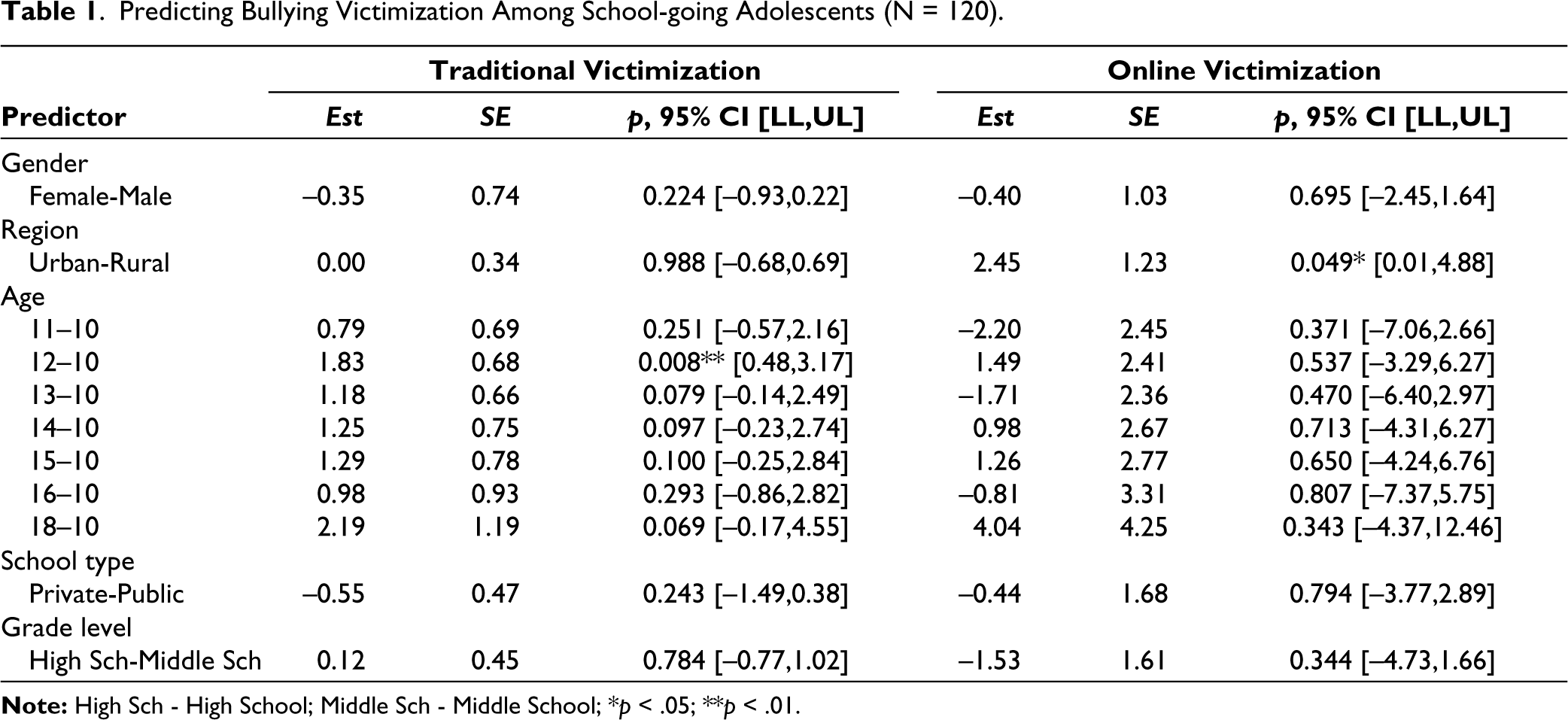
The role of sociodemographic factors in traditional and online victimization was assessed through a correlation test with age (rtv = 0.15, ptv = .091; rov = –0.005, pov = .959) and t-tests with gender (ttv(118) = 0.49, ptv = .628; tov(118) = –0.14, pov = .887), region (ttv(118) = 0.63, ptv = .528; tov(118) = 2.11, pov = .037), school type (ttv(118) = 1.70, ptv = .091; tov(118) = 1.49, pov = .140), and grade level (ttv(118) = –1.31, ptv = .192; tov(118) = 0.41, pov = .679). We utilized a linear regression analysis to determine how sociodemographic factors predicted traditional and online bullying victimization (Table 1). The age of the participants predicted traditional bullying victimization (12–10, β = 1.83, p = .008), and their region predicted online bullying victimization significantly (urban-rural, β = 2.45, p = .049). Other sociodemographic factors of gender, school type, and grade level did not predict either victimization type.
Predicting Bullying Victimization Among School-going Adolescents (N = 120).
Discussion
Traditional victimization differed significantly between students aged 10 and 12. The students at age 10 (M = 4.49, S.D. = 0.93) had the lowest scores, and those at age 12 (M = 6.34, S.D. = 1.48) had the highest scores for traditional victimization. Previous studies have also reported age differences in victimization. However, high bullying among younger children was opaque.31,32 It could be an external indication of the internal conflict of Identity versus Role Confusion as outlined in Erik Erikson’s (1950) psychosocial stages. Bullying could be a means or consequence of students trying to gain acceptance and social prominence among their peers during this developmental stage. 33 Existing literature in India indicates that children of the age group 12-16 years were more likely to be involved in bullying.11,12 The increased reports of victimization among 12-year-old students may reflect the increased pressure to conform to societal, cultural, and gender norms, as expected in a collectivistic society. 2
Students from rural areas experienced significantly more online victimization than those from urban areas. This disparity may be attributable to urban parents being more technologically literate and likely to supervise and guide their children’s online behavior.10,15,16 Certain studies indicate that bullying and victimization were more significant in rural than in urban schools,34,35 but others indicate the opposite. 8 A study reported that cyberbullying was more prevalent in rural areas of Spain than in urban areas, which could be attributed to rural areas’ increasing access to the internet. 9 Additionally, research has indicated that fewer rural students used computers when compared to urban students15,17; thereby, a difference in students’ digital literacy skills based on their location could also influence their ability to protect themselves from online victimization.
Strengths and Limitations
The study examined school bullying across different demographics (urban and rural) and settings (traditional and virtual classrooms) providing a good basis for future research. However, the majority of the participants in this study were of middle socioeconomic status; consequently, the findings primarily apply to this group. This study was limited to specific regions of two states in southern India, limiting the generalizability of the results. Due to the COVID-19 protocol, the data collection for this study was conducted online, which has limitations; for example, only students with convenient access to devices, the internet, and basic technological skills could complete the forms. Nevertheless, the tools used in the study have good psychometric properties ensuring the validity of the data collected.
Practical Implications
In traditional classroom settings, students who are either 12 years old or in the sixth grade require careful supervision to prevent bullying. One way to address this issue is to provide students with training sessions on bullying awareness, social and communication skills, and assertiveness, which can help them regulate bullying victimization. In rural areas, schools can conduct training sessions to improve both their students’ and parents’ technological literacy and ability to handle online victimization.
The stakeholders in the school, as a team, can create contracts for the institution and individual classrooms that establish the conduct expected of the students. To curb bullying, instructions delineating bullying actions, reporting channels, and the repercussions of such behaviors should be provided to students, parents, and educators at the outset of the academic year. Furthermore, instructors and school counselors can receive training to identify at-risk students and furnish guidance as needed.
Conclusion
According to the study, age predicts traditional bullying, and region predicts online victimization. Sociodemographic factors play a significant role in student victimization in both traditional and online settings. The school community should consider these factors when designing and implementing activities aimed at assessing, regulating, and preventing bullying.
Footnotes
Declaration of Conflicting Interests
The authors declared no potential conflicts of interest with respect to the research, authorship and/or publication of this article.
Funding
The authors received no financial support for the research, authorship and/or publication of this article.
Statement of Informed Consent and Ethical Approval
Necessary ethical clearances and informed consent were received and obtained respectively before initiating the study from all participants. The study was carried out in accordance with the principles as enunciated in the Declaration of Helsinki.