




Abstract
Background/Aim:
It is well known that caregivers of children with neurodevelopmental disabilities (NDD) face challenges. These challenges increased further due to the coronavirus disease 2019 (COVID-19) pandemic and the related restrictions. There was very little data from India on these challenges. This study was done with the primary aim to gain insights about the challenges faced by parents of children with NDD through their personal stories.
Methods:
Participants were recruited using purposive sampling method and semi-structured interviews were conducted through a telephone or in person. Data saturation was achieved by the sixth participant and 2 more interviews were performed for further confirmation. Interviews were transcribed, and a 7-step Colaizzi’s phenomenological method was used to identify different themes.
Results:
The impact of COVID-19 on caregivers of children with NDD can be summarized into 4 broad themes. First, there were challenges related to “therapy” which included closure of day-care centers and schools, inaccessibility to professionals, and disruption in home-based learning. Second, there were “child” related challenges which included inappropriate behaviors. Third, there were “family” challenges which included misunderstandings between parents and difficulties in adhering to family routines. Lastly, there were “personal” challenges related to physical and psychological health.
Conclusion:
The personal stories of caregivers of children with NDD highlight the pressing need to provide appropriate support and formulate holistic models to enhance well-being of caregivers during difficult periods.
Introduction
Caregivers of children with neurodevelopmental disabilities (NDD) are more vulnerable in comparison to caregivers of other children. 1 Coronavirus disease 2019 (COVID-19) pandemic related restrictions had created challenges for caregivers of children with NDD. A comparative study done by Hoffman on parents showed that families with NDD children were experiencing elevated levels of stress compared to parents of typical children or children with other chronic diseases. The pandemic is likely to have worsened the situation. Studies have shown that the COVID-19 pandemic has interfered with the carer’s life and negatively impacted their quality of life as well as mental health. 2
A study conducted by Gillespie-Smith et al looked at the impact of COVID-19 restrictions on the psychological distress of caregiving family members of children with NDD in the United Kingdom. The study reported that uncertainty about the disease and government protocols, loss of routine, and lack of respite had negatively impacted the caregivers. 3 Most prominently reported challenge was the increase in challenging behavior which could be associated with social, cognition, and adaptive skill deficits which are characteristics of NDD. Managing these behaviors lead to increased stress levels in caregivers.4,5 In addition to that the closure of schools/day-care centers had resulted in caregivers needing to take up additional work. Loss of recreational and community-based opportunities and financial instability were other reasons that were cited. 6
The data available on the challenges faced by caregivers during COVID-19 is predominantly from other countries. To the best of the knowledge of the authors there was no literature from India on the impact of COVID-19 on caregivers of children with NDD during the time the study was conducted.
It was important to understand the impact of COVID-19 on caregivers of children with NDD, as this could help professionals to provide appropriate support and will also allow the formulation of holistic well-being models to support the caregivers of children with NDD during future crises.
Method
The study followed a phenomenological approach to understand the personal stories of caregivers of children with NDD. Using a qualitative approach allowed for an in-depth understanding of their experience during COVID-19 pandemic from January to September 2022.
The study was carried out in accordance with the principles as enunciated in the Declaration of Helsinki. The current study focused only on the caregivers of children with NDD who visited the hospital to follow up on therapy. In this study, we interviewed 8 caregivers. Data saturation was achieved at 6 caregivers. We studied 2 more to confirm the same. Nonrandomized, purposive sampling was used to recruit participants for the study. The primary inclusion criterion was that the participant should have been the primary caregiver of the child with NDD during the pandemic and that the child’s initial diagnosis should be made before the pandemic. Participants signed a written informed consent form after the first contact and also provided oral consent at the start of the interview. A list of probes was prepared after careful consideration of the literature and expert opinions. Data were collected using probes through an in-person interview as well as through telephone at the time of their convenience without disrupt- ing therapy sessions. Interviews were carried out by a female psychologist. The participants were assigned numbers (P1, P2, and so on) to maintain confidentiality and anonymity. The length of the interview ranged from 45 min to an hour.
The interviews were transcribed. A descriptive phenomenological method was used to identify emergent themes and their interwoven relationships. The 7-step Colaizzi method which was a strong method of seeking verification from participants was used. The 7 steps include familiarization of the data by reading and rereading, identifying significant statements related to the phenomenon, formulating meaning, similar kinds of formulated meanings clustered into themes, developing an exhaustive description, identification of fundamental structures by removing reductant and extra information, and seeking verification of fundamental structure. 7
Results
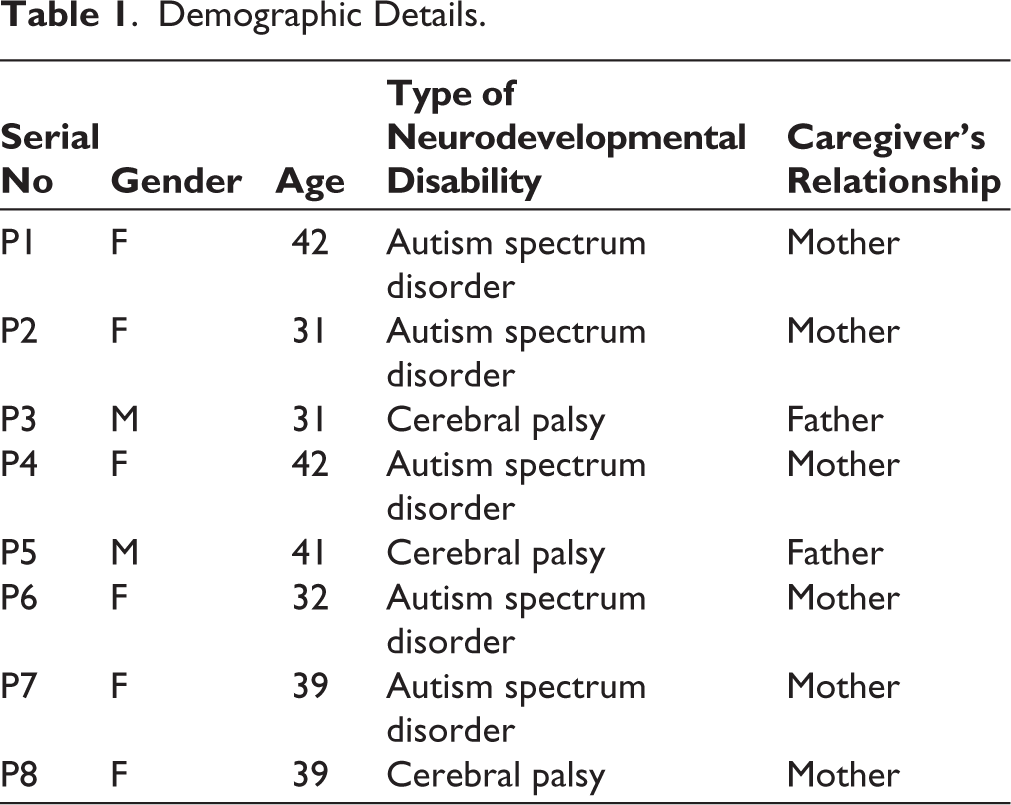
The sample consisted of 8 participants, out of which 6 were females (mothers) and 2 were males (fathers). Five children were diagnosed with autism and the remaining 3 were diagnosed with cerebral palsy. The demographics of the sample are presented in Table 1.
Demographic Details.
The impact of COVID-19 on caregivers of children with NDD could be summarized in 4 broad themes, which included therapy-related challenges, child-related challenges, family-related challenges, and personal challenges.
Theme 1: Therapy Related Challenges
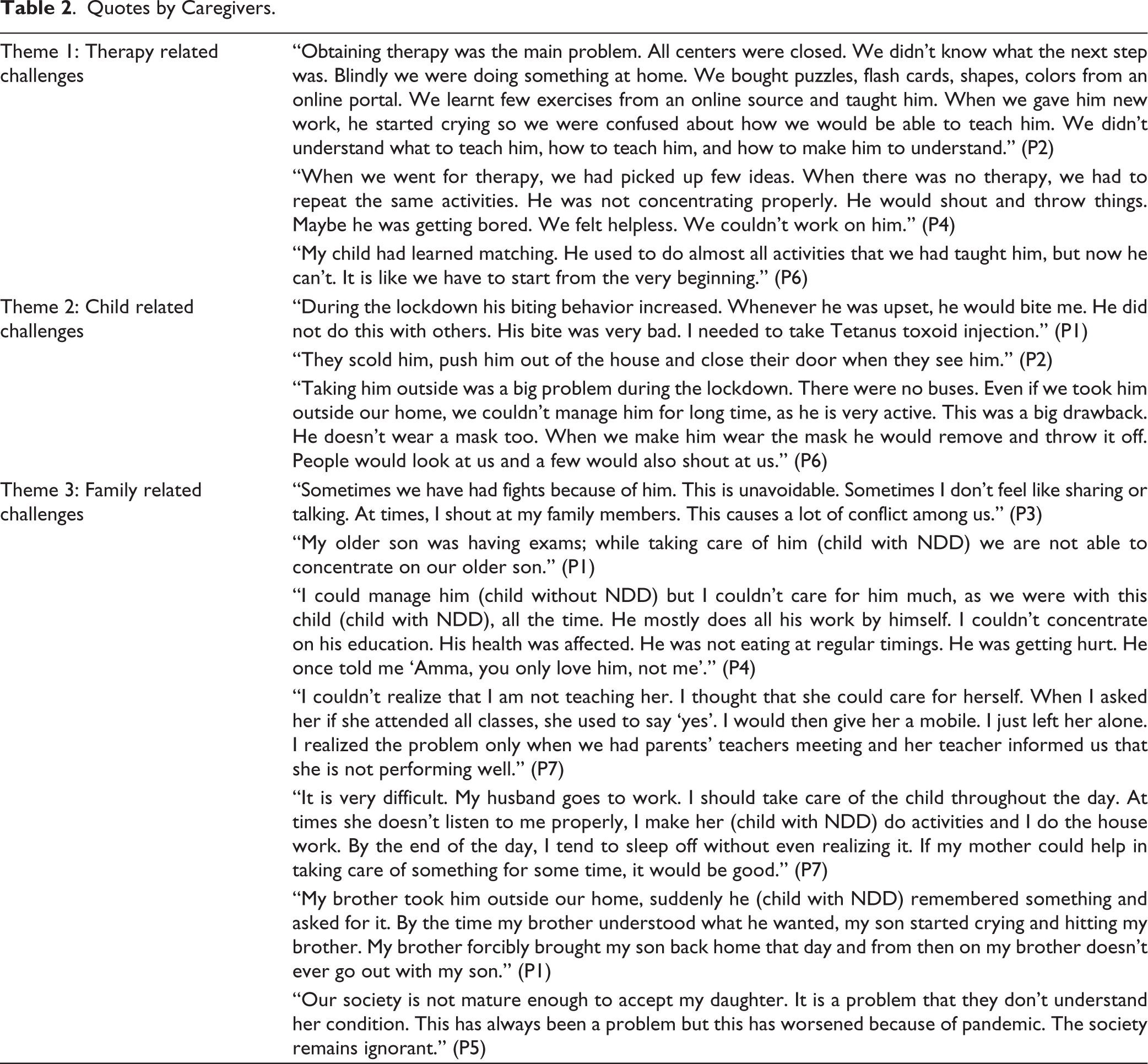
The caregivers of children with NDD shared their personal stories in relation to therapy related challenges faced during the COVID-19 pandemic. There were 3 subthemes
The quotes by caregivers are mentioned in Table 2.
Quotes by Caregivers.
Theme 2: Child Related Challenges
The major concerns that the caregivers reported were divided into 2 subthemes.
Initial period: Few caregivers reported that during initial days of lockdown the behavior of children improved as the parents spent most of their time with the child. There was improvement in the children’s ability to listen to instructions and do their activities. They had better moods and improvements in their eating and sleeping behavior.
Latter period: During the latter period, caregivers had mainly 2 challenges. One was development of new and inappropriate behaviors and the other was the feeling of being isolated by neighbors.
New and inappropriate behaviors: As the days passed, it was challenging for caregivers to manage child’s behavior as behavior problems started to increase in intensity and frequency. The behavior changes that were reported as significant by caregivers were an increase in shouting, smiling to self, hitting, biting caregivers and self, tantrums, irritability, addiction to technological devices, and decrease in ability to adhere to routines and on-task attention. Caregivers felt anxious and stressed due to these behaviors shown by their children. They also reported that the children would have more inappropriate behaviors when they were not taken out to parks or when they saw their parents or neighbors going out.
Isolated by neighbors: The other challenge related to the child was regarding stigma towards their condition. Two out of six parents reported that people around them could not understand child’s condition and were treating them badly. All the parents reported that they felt stigmatized. The other concern reported by 4 parents was that it was difficult to take their kids outside even for a short period of relaxation, as they were not able to understand the restrictions. Due to this reason, they had been verbally abused and were isolated in a few situations.
The quotes by caregivers are mentioned in Table 2.
Theme 3: Family Related Challenges
Family related challenges had 3 subthemes which included misunderstanding between parents, concerns about their other child, and lack of extended family support.
Misunderstanding between parents: Five out of eight caregivers reported that they had misunderstanding with their spouse, at times because of child’s externalizing behaviors and at other times for not adhering to follow child’s routine. Few also reported that due to a lack of understanding on how to explain the child about COVID-related restrictions, they blamed each other which resulted in occasional fights. This led to reduction in support and warmth for each other.
Concerns about their other child: Four caregivers reported concerns about their other child, as they spent most of the time with child who had NDD and could not spend time with other child. The other child’s health as well as education was affected.
Lack of extended family support: Six out of eight caregivers reported that there was lack of extended family support. Most of the participants also felt that their family members’ inability to understand the condition of the child was one reason why they were not willing to support. Even if they were willing to support, they were not aware of how to handle the child at times and so they hesitated to support. Friends and neighbors were not able to understand too. Rather than helping or giving hope few showed pity and few blamed the caregivers that they were not teaching the restriction norms like wearing mask and social distancing to their children.
The quotes by caregivers are mentioned in Table 2.
Theme 4: Personal Challenges
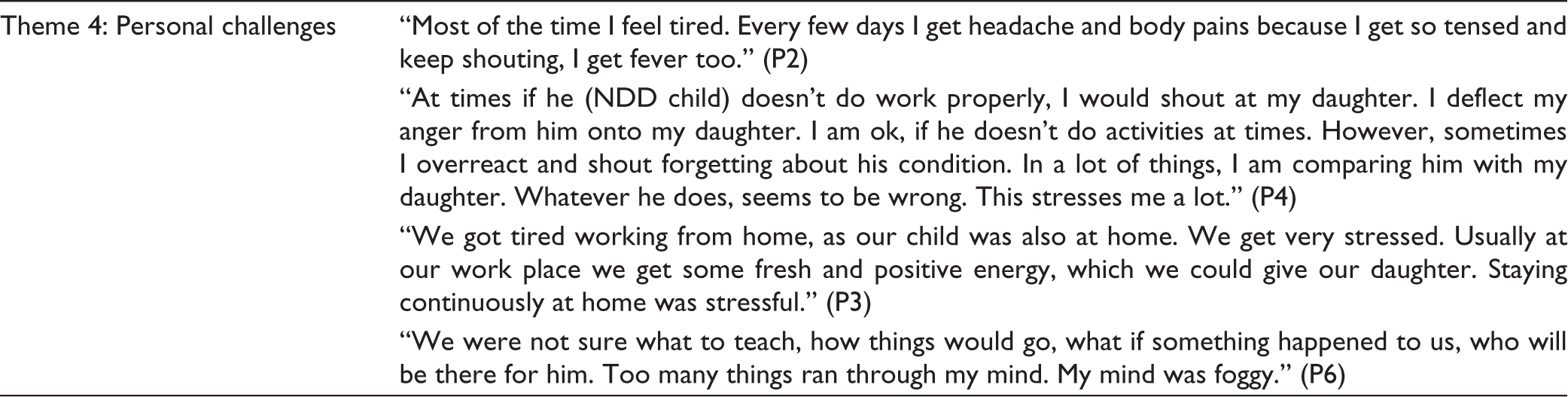
The personal challenges faced by caregivers included physical health issues, the additional role of being a teacher, lack of time for self, change in daily routine, psychological distress, and worry about child’s future.
The physical health issues reported by the caregivers were that they were neither able to eat at regular timings nor had proper sleep or rest. They reported that because of these issues, they had frequent headaches and body aches. They also felt feverish and exhausted most of the time.
The caregivers had to do all the household work, take care of the child all through the day because of the closure of day-care centers and schools take on the additional role of doing the work of a therapist or teacher at home. All the participants reported that they felt unprepared, inadequate, being stuck. They reported being worried that they will not be able to teach their children without any help.
The caregivers reported that as everyone in the family was at home because of COVID-19 restrictions. They had additional works to do in the mid of which they had no time for themselves. All the 8 caregivers reported that they could not adhere to daily routines because of sudden changes in online class timings for their other children, behavior issues with the child with NDD and increased workload. This made them tired. Apart from that, the COVID-19 pandemic by itself was very overwhelming.
Psychological distress related to expressed emotion, stress, guilt, angst, and displacement: Three out of eight participants reported that their workplace was a place to relax, distant from all the negative emotions, which allowed them to come back to their home fresh and ready to work with the child in the evenings. The lockdown took the opportunity away, and they found it stressful to stay at home fulltime to manage the child. Five caregivers reported that they felt guilty for not being able to teach their children well. They felt helpless in controlling their child’s behavior. They were unable to explain to their children about the pandemic. Three out of eight caregivers showed the anger or helplessness related to a child with NDD on their other child or family members. This had in turn led to misunderstandings.
Most of the caregivers were also worried about child’s future if something were to happen to them during COVID-19. Prolonged and consistent in-person interactions solely with one’s own family members led to a decreased interest and enthusiasm to interact with them as the days passed. This was reported by most of the caregivers.
The quotes by caregivers are mentioned in Table 2.
The above results provide a snapshot of challenges that caregivers of children with NDD had faced during the COVID-19 pandemic. These personal stories shared by caregivers make it evident that caregivers also faced other challenges like general beliefs around the cause of the disability, difficulty in making decisions regarding the care of the child and uncertainty regarding every aspect of the child.
Discussion
The purpose of this study was to gain insights about the challenges faced by parents of children with NDD in India through their personal stories. The stories clearly demonstrated the enormous impact that the COVID-19 pandemic had on all 4 themes that emerged from their personal stories. The theme that had maximal impact was challenges related to therapy followed by personal challenges.
One of the main challenges because of the pandemic related restrictions was the closure of day-care centers, therapy centers, and inaccessibility of medical professionals. This had a greater impact on the child as well as the family. Specifically, as the children started to lose previously learnt skills and were not able to pick new skills, parents got worried, felt stressed, and clueless. These had a great impact on their well-being.8,9 Therapy centers and day care centers have been most helpful for parents and have been shown to prevent or lessen stress and burnout. 10 They provide parents with information on interventions for children. They also provide an opportunity to focus on other work/take break and were also a source for social support. Lack of therapy and day care centers caused disruption in regular routine which had in turn increased challenging behaviors in children and psychological distress among the parents.11,12 A study has shown that teleconsultation was found to be supportive and has positively impacted care of children with NDD. However, the participants in our research had not used online therapy options by the time of the study. 13
One interesting theme that was found during the initial phase of the lockdown, which was reported by a few parents was the improvement in behavior of children. This was in the form of listening to instruction of parents, doing activities, experiencing better moods, and also improvement in eating and sleeping behaviors. This was also reported in a scoping review done by Shorey et al. They mentioned that caregivers were heartened by their child’s developmental gains during quarantine. 12 This was because the parents were able to spend most of the time with the child. However, it did not last for long, as children started showing new and inappropriate behavior.
Reese et al in a study found that children with autism frequently engage in aggression to gain access to ritualistic or repetitive behaviors. There are studies showing that the negative behaviors such as aggressive behaviors can lead to negative outcomes for caregivers including increased stress levels, and negative impact on day-to-day family life and well-being which was also observed in our study. 14 The behaviors such as shouting, smiling to self, hitting, biting parents and self, tantrums, irritability increased in frequency and intensity. 12 These behaviors had a huge impact on caregivers. One of the parents reported that she was given a tetanus toxoid injection for being bitten by the child. Another reported that she had persistent headache as the child was screaming (verbal stimming) most of the time. In our country, we pay the least attention to these aspects. In fact these problems can be a really stressful 15 and difficult for the parents to overcome. Few studies have already shown how challenging behaviors have negative impact on parents.16,17
Parents had experienced great distress due to feelings of being isolated by neighbors due to stigma which worsened during pandemic, strained relationships with loss of warmth and support from their spouses and immediate family members, because of child’s inappropriate behavior, child not adhering to follow their routines, and lack of support from extended family and friends. This limited support is largely due to a lack of understanding regarding child’s condition. A study has reported that social support reduces distress in parents and also that parents who have high levels of social support show better psychological adjustment. 18
Lack of adequate sleep and feeling exhausted most of the time are symptoms of psychological problems. 19 Additional roles of being a teacher, lack of time for self, change in daily routine, and not being able to take care of other child created a lot of stress in the parents. A study has reported that not being able to care for the sibling made the parents feel guilty. 20 Parents under all the aforementioned stressors found it difficult to regulate themselves and displaced their anger on others including the child with NDD as well on their other children. If these continued for longer periods it could have had greatly impacted the functioning of both the child and parent.21,22 In the current research it was seen that lack of adherence by parents to coping strategies was reflected as individuals feeling helpless, and being stuck. Studies have highlighted the importance of coping strategies which has largely focused on the role of problem-focused strategy of coping in predicting the well-being of caregivers. 23 Problem-focused ways of coping, strategies aim at managing or altering the cause of the stressor, which generally is associated with positive outcomes. 24 This was observed in our study. Two out of eight parents reported that they took the support of their spouse or family members when they were stressed. They thought even though the support was not constant, the minimal amount of support/or time they got played a major role in handling themselves and for restoring their energy. While rest of the 6 caregivers reported that lack of support made them feel helpless and lack of self-confidence at times. 25
Our paper focuses on challenges faced by caregivers during the COVID-19 pandemic. However, there is also another perspective, which is looking through the lens of children with NDD. All of a sudden, they are exposed to traumatic events. The pandemic restrictions disrupted their daily routine and created an uncertain environment. This is likely to have had varied effects on children with NDD depending on their diagnoses and disease severity. This stress is likely to overwhelm their coping to make them respond in inappropriate ways. This makes it difficult for the parents. 26 This too needs to be explored and understood. It is possible that there is a bidirectional relationship in problems faced by both parents and children with NDD. If these families get the much needed help in uncertain situations it could help in improving their overall well-being. Unfortunately, there is a gap in the literature regarding new behaviors that emerge and challenges that parents have to face. This can help us understand why and how to deal with these challenges. In this study, we tried to bring these to light, so that both children and caregivers can be helped.
While all the challenges that were discussed did not culminate in any major event, which would have otherwise attracted clinical attention, these occurred in small, subtle, and slow ways which affected both the child and caregiver without attracting clinical attention and care.
Conclusion
The personal stories of caregivers of children with NDD highlight the pressing needs of the caregivers. Caregivers themselves offered certain solutions like support groups for parents and teleconsultation for therapy. We hope that this study will further inspire researchers and therapists to explore, provide appropriate support, and formulate holistic models to enhance their well-being so that they are better equipped to face uncertain situations.
Footnotes
Acknowledgements
The research would like to acknowledge and thank the parents who gave their time to complete the study and for helping us to understand the challenges faced during COVID-19.
Declaration of Conflicting Interests
The author declared no potential conflicts of interest with respect to the research, authorship, and/or publication of this article.
Ethical Approval
The study was accorded Ethical Committee Approval vide Ethics Committee (Institute Research Board) IRB Min No.14439 dated January 19, 2022.
Funding
The author received no financial support for the research, authorship, and/or publication of this article.
Statement of Informed Consent
Written Informed Consent was taken from all the participants. The study was carried out in accordance with the principles as enunciated in the Declaration of Helsinki.