



Abstract
Background:
Deictic gestures are the first intentional form of communication that predict the emergence of first words. Deictic gestures include reaching, pointing, giving, and showing.
Method:
Forty-five Tamil-speaking children (28 male and 17 female) and their parents participated in this study. They were divided into three groups (ASD, DS, and TD). The parents were instructed to play and interact with their children, as they do at home, using the provided toy set, and this session was video-recorded. Deictic gestures such as reaching, pointing, giving, and showing were analyzed with a specific coding scheme.
Results:
On a Kruskal–Wallis test, a statistically significant difference across the three groups (P < .05) was obtained for the total frequency of deictic gestures, use of pointing, giving, and showing gestures. The total frequency of deictic gestures and their types, such as pointing, giving, and showing gestures, used by the ASD group was less compared to the DS and TD groups.
Conclusion:
This study highlighted that, along with speech and language difficulties, children with ASD have deficits in producing deictic gestures. Children with DS have speech and language difficulties, but they use deictic gestures in order to communicate with their parents during interaction. This varied profile of deictic gesture use can be used for early identification, differential diagnosis, and setting intervention goals.
Introduction
Before young children produce their first words, they use gestures to communicate, and these gestures indicate the content and quantity of their vocabularies in speech. For instance, the earlier the child gestures toward an object, the earlier the word related to that object will appear in the child’s spoken language. 1 Deictic and representational gestures are the two major types of gestures that are frequently produced by children. Deictic gestures include reaching, pointing, giving, and showing. These gestures appear in infants aged 7–9 months. 2 According to Bates et al., 3 infants produce deictic gestures in two functionally distinct ways: declarative and imperative. Declarative gestures are used to attract another person’s attention and convey information about their interest in a certain thing, activity, or person. Imperative gestures are used to control other people’s behavior so that the desired activity or object can be obtained. 2 On the other hand, representational gestures express a certain semantic meaning. 4 Knowing about the development of gestures can also help in the differentiation of groups of children with communication disorders. 5 The varying profile of gesture usage in children with various communication impairments, such as autism, Down syndrome, William’s syndrome, and intellectual disability, suggests that these children’s communication development is underpinned by various cognitive and neurological processes. 6
Autism spectrum disorder (ASD) is a neurodevelopmental disorder in which limited gestural use is considered one of the diagnostic criteria. 7 Colgan et al. 8 collected home video recordings of children with ASD and TD and investigated gesture production during the social interactions of ASD and TD children from the 9th to the 12th month of age. The researchers found a correlation between the reduced variety of gesture use and the diagnosis of ASD. Additionally, they reported that children with ASD exhibit not only lower gesture rates but also a smaller variety of gesture types, demonstrating a less varied gesture production. Compared to their peers, who are typically developing, and to children with developmental disabilities, children with ASD acquire gestures later. While it is common for children with ASD to use imperative gestures, like reaching for a desired object, they have significant difficulties using declarative gestures, such as pointing to an object to draw an adult’s attention.9,10
Down syndrome (DS) is a genetically based neurodevelopmental disorder that is caused by a partial or complete duplication of the 21st chromosome. 11 However, one of the most severely compromised areas of functioning in DS is language, which may also be a major obstacle to independent living and meaningful community engagement.12,13 Contrary to specific verbal production deficits, gestural communication is used more effectively for a longer period of time in children with DS than it is in children who are typically developing. 14 Franco and Wishart 15 examined the production as well as comprehension of pointing gestures in a sample of DS children with a mean age of 37 months. During interactions with their mother and other children, these children effectively employ pointing. According to Caselli et al., 16 children with DS have much wider gesture repertoires than do typically developing children who were matched for word comprehension.
There are studies that compare gesture production in children with ASD, DS, and TD. Toret and Acarlar 17 examined gesture production in prelinguistic Turkish children with autism, DS, and TD during naturalistic interaction utilizing an observational coding scheme. They found that children with DS used a greater number of gestures than the other two groups. Children with autism used the fewest gestures compared to the other two groups. Additionally, the three groups’ mean usage of deictic gestures was greater compared to the use of representational gestures. When compared to the other two groups, children with DS used more representational gestures, and TD children used them more frequently than children with autism. Mastrogiuseppe et al. 18 analyzed gestural communication in children with ASD during spontaneous mother–child interaction using specific gestural coding. In this study, children in the ASD group were matched with two groups (ASD and DS) for developmental age. According to the results, children with DS produced a higher total number of gestures than children with ASD, supporting the idea that the gesture deficit is autism specific. Children with ASD showed the lowest rate of pointing gestures and the highest proportion of ritualized requests.
Current Study
There are many studies investigating Indian parent–child interaction behaviors; however, to our knowledge, no studies have been conducted on deictic gestures in children with ASD and DS in a Tamil-speaking environment. Hence, this study was initiated to find whether there is a difference in communicative gestures used by children with ASD, DS, and TD during dyadic interaction.
The specific objectives of the study were:
To profile and compare the frequency of deictic gestures across the three groups of children. To profile and compare the types of deictic gestures across the three groups of children. To profile and compare the functions of deictic gestures across the three groups of children.
Method
Study Design
In this study, a cross-sectional study design was followed. For the purpose of conducting the study, institutional ethics committee approval was acquired. Prior to the investigation, the parents’ informed consent was acquired.
Participants
Forty-five children (28 male and 17 female) and their parents participated in this study. They were divided into three groups of children with their parents, as mentioned below:
Group 1: The ASD group consisted of 15 children with ASD in the age range of 2.6–8 years. Group 2: The DS group comprised 15 children with DS in the age range of 2.8–8 years. Group 3: The TD group included 15 typically developing children in the age range of 1–4 years.
Ninety percent of the parents who participated were mothers. Tamil was the predominant language of communication for all parent–child dyads, who were all Indian. Based on the Revised Kuppuswamy’s Socioeconomic Status Scale, 19 all parents were from a middle socioeconomic class. Consistent with the previous study conducted by Mastrogiuseppe et al., 18 children in the three groups of this study were matched based on their developmental age. The developmental screening test (DST) 20 was used to assess each child’s developmental age in the clinical group (ASD and DS). The developmental age of children in the TD group was assumed to be equivalent to their chronological age. The characteristics of children and parents in the three groups are represented in Table 1.
The Child and Parent Characteristics in the Three Groups.

Measures
The Indian Scale for Assessment of Autism
The Indian Scale for Assessment of Autism (ISAA) is a promising tool, specifically for use with Indian children, for diagnosing autism and its severity. Disability levels are determined based on the severity scores. 21
According to Patra and Arun, 22 ISAA is a convenient and feasible instrument for use in regular clinical settings.
Developmental Screening Test
The DST 20 is a basic, quick intelligence test for children between the ages of 1 and 15. It provides a quick and reliable evaluation without requiring performance tests. There are 88 total items spread among the age ranges of 3 months, 6 months, 9 months, 1 year, 1.5 years, 2–13 years, and 15 years. At each age level, items are drawn from behavioral fields such as individual social development, speech and language development, and motor development.
Assessment of Language Development
An evaluation of a child’s receptive and expressive language skills between the ages of birth and 10 years is done using the ALD, 23 a standardized, norm-referenced, and performance-based test that is used with Indian children.
WHO 10-question Disability Screening Checklist
It is a rapid clinical screening tool performed on parents. It has 10 questions and is used to check for developmental disabilities. 24
Description of Three Groups
ASD Group
Prior to participating in the study, children with ASD had received a diagnosis. Using the ISAA test and clinical judgement based on the DSM-V (Diagnostic and Statistical Manual of Mental Disorders, Fifth Edition) criteria, the diagnosis of ASD was confirmed by a clinical psychologist as a part of regular assessment for children. The developmental age of each child was assessed using the DST, and it was found to range from one to four years. The language level of the children in this group ranged from non-verbal to verbal. Children who received fewer than five speech and language therapy sessions were included. Children with no significant deficits in hearing, vision, and motor skills were included. Children with any co-morbid conditions, including seizures or any other syndromic conditions, were excluded.
DS Group
Children in this group were selected based on the following criteria: the karyotyping-confirmed existence of a free trisomy 21; no significant deficits in hearing, vision, and motor skills; absence of autistic traits; and a negative history of seizures or psychiatric disorders. Children in this group were found to have a language level ranging from non-verbal to verbal. The developmental age of each child with DS was investigated using the DST, and it was found to range from one to four years.
TD Group
For all children in this group, a “WHO 10-question Disability Screening Checklist” was administered, and those who did not have any cognitive, motor, or communicative problems were included. Language skills were evaluated using ALD, and all children were found to have age-adequate language skills.
Procedure
Communicative gestures were studied by observing the interaction between the parents and children naturally during play for 10 minutes in a quiet room at the clinic. All participants were provided with a set of toys, including boy and girl dolls, two balls (big and small), a tea set, a brush, a comb, a car, a bike, a telephone, rattles, and two books. These items were commonly used by children in their daily lives. Using the provided set of toys, the parents were instructed to play and interact with their children as they usually do at home. All the parent–child interactions were videorecorded and transcribed using the Eudico Linguistic Annotator (ELAN). 25 ELAN is a software used for analyzing speech, language, and gestures. Using ELAN software, the primary investigator transcribed and coded the communicative gestures and their types. The frequency of each deictic gesture and its types were found and documented.
Coding System for Deictic Gestures and Its Function
Based on literature,17,18 a coding system for deictic gestures was developed. All deictic gestures produced by children in the three groups were classified into one of the below-mentioned categories. Deictic gestures comprise reaching, pointing, giving, requesting, and showing.
Reaching entails “extending the arm with an open palm or opening and closing the hand repeatedly towards an object, person, or location.”
Pointing is commonly characterized as “index finger extension and isolation.”
Giving is the “act of offering a toy to another person.”
Showing consists of “holding up or extending a toy towards another person.”
Reliability
Coding reliability was examined by having another trained speech-language pathologist for 20% of the samples in each group. The percent agreement between the coders was 77% for classifying deictic gestures into their types, such as reaching, pointing, giving, and showing, in each group.
Statistical Analysis
This study considered the three groups (ASD, DS, and TD) as independent variables and the total and types of deictic gestures (reaching, pointing, giving, and showing) as dependent variables. Descriptive statistical analysis was conducted to obtain the mean and standard deviation for the frequency of total and types of deictic gestures. The Shapiro–Wilk test of normality was performed to check the data distribution, which warranted non-parametric tests. The Kruskal–Wallis test was done to determine the level of significance across the three groups. A Mann–Whitney test was used to determine the level of significance between the groups.
Results
Frequency of Deictic Gestures
The results of descriptive statistics for the frequency of total deictic gestures used across three groups are described in Table 2. This indicated that the total frequency of deictic gestures used by the ASD group was lower compared to the DS and TD groups. The total frequency of deictic gestures used by the DS and TD groups was very similar.
Differences in Frequency of Deictic Gestures Across the Three Groups.
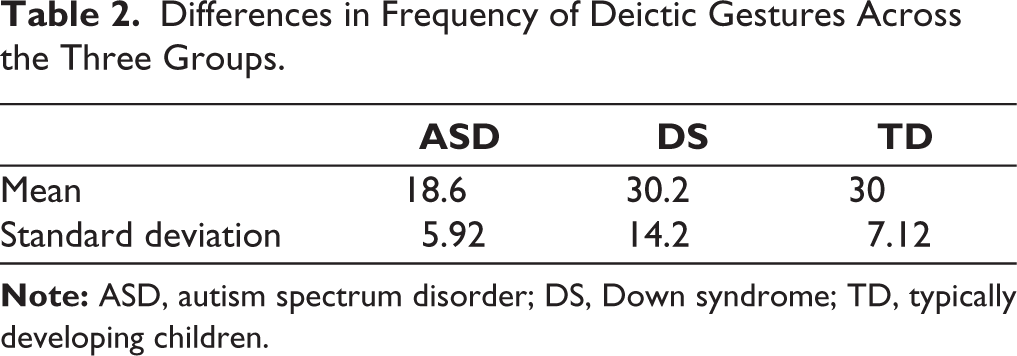
The results of the Kruskal–Wallis test indicated a statistically significant difference across the three groups, χ2(2) = 12.44, P = .002, with the ASD group attaining a mean rank frequency of total deictic gesture of 13.40, the DS group 26.3, and the TD group 29.27. For group-wise comparison, the Mann–Whitney test results indicated a significant difference between the ASD and DS groups (P < .05) and the ASD and TD groups (P < .05), while there was no significant difference between the DS and TD groups (P = .6).
Types of Deictic Gestures
Reaching
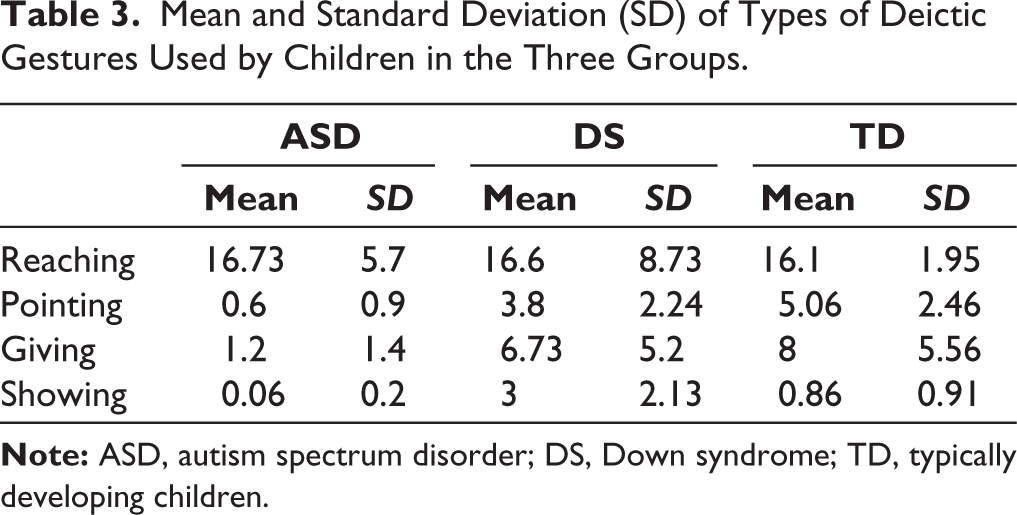
The results of the study with reference to the reaching gestures as represented in Table 3 indicated that all three groups exhibited a similar frequency of reaching gestures during parent–child interactions. The results of the Kruskal–Wallis test revealed no statistical difference (P > .05) across ASD, DS, and TD groups for the frequency of use of reaching gestures. For group-wise comparison as depicted in Table 4, the Mann–Whitney test results revealed no significant difference between ASD and TD groups, ASD and DS groups, and DS and TD groups (P < .05).
Pointing
Table 3 indicates that the ASD group used the least frequency of pointing gestures compared to the other two groups. DS and TD groups exhibit a near-similar frequency of use of pointing gestures. The results of the Kruskal–Wallis test revealed a statistically significant difference across the three groups, χ2(2) = 21.38, P < .05, with the ASD group attaining a mean rank frequency of pointing gesture of 10.47, the DS group (27.53), and the TD group (31.00). For group-wise comparison, as represented in Table 4, the Mann–Whitney test results showed a significant difference between the ASD and DS groups and the ASD and TD groups (p < .05), while there was no significant difference between the DS and TD groups (P = .46).
Mean and Standard Deviation (SD) of Types of Deictic Gestures Used by Children in the Three Groups.
Giving
Table 3 also indicates that giving gestures were used less frequently by the ASD group compared to other groups. DS and TD groups exhibited a near-similar frequency of use of giving gestures. The results of the Kruskal–Wallis test revealed a statistically significant difference across the three groups, χ2(2) = 25.532, P < .05, with the ASD group attaining a mean rank frequency of giving gestures of 9.43, the DS group 27.30, and the TD group 32.27. For group-wise comparison, as indicated in Table 4, the Mann–Whitney test results showed a significant difference between the ASD and DS groups and the ASD and TD groups (P < .05), while there was no significant difference between the DS and TD groups (P = .19).
Showing
The results of the study with reference to showing gestures, as represented in Table 3, indicated that the ASD group used less frequency of showing gestures compared to other groups. The DS group was found to use more showing gestures compared to the TD group. The results of the Kruskal–Wallis test revealed a statistically significant difference across the three groups, χ2(2) = 3.0490, P < .05, with the ASD group attaining a mean rank frequency of showing gestures of 11, the DS group 35.87, and the TD group 22.13. For group-wise comparison as depicted in Table 4, the Mann–Whitney test results showed a significant difference between ASD and DS groups, ASD and TD groups, and DS and TD groups (P < .05).
Group Comparison of Types of Deictic Gestures Used by Children in the Three Groups.
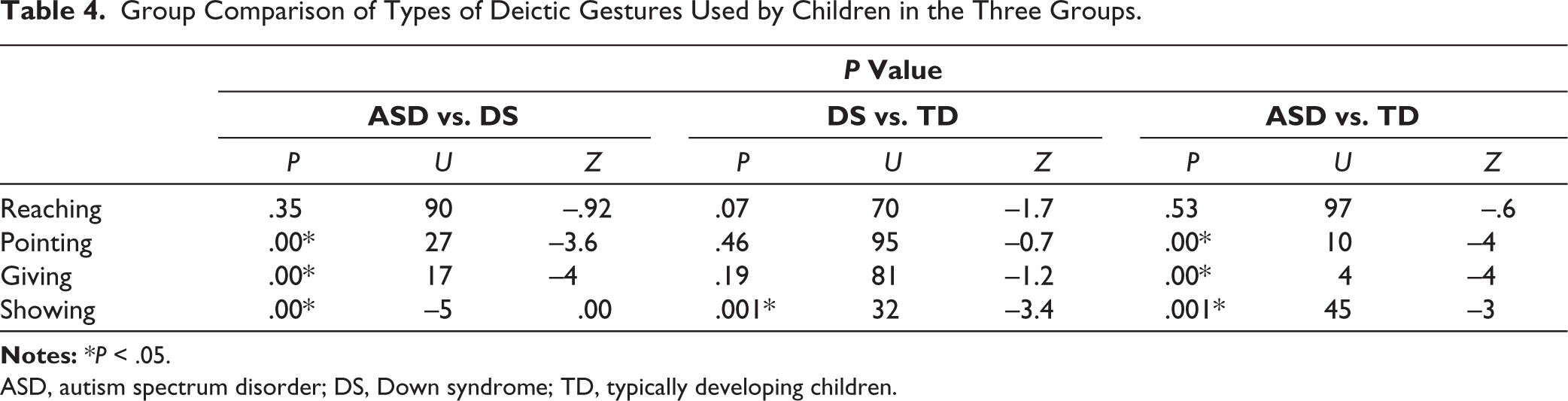
ASD, autism spectrum disorder; DS, Down syndrome; TD, typically developing children.
Discussion
This study aimed at profiling and comparing the deictic gestures and their types in children with ASD, DS, and developmental age-matched TD during dyadic parent–child interaction.
To our knowledge, this is the first study in the literature that has analyzed deictic gestures in Indian Tamil-speaking children with ASD, DS, and TD during parent–child interactions and focused on the identification of various types of deictic gestures (reaching, pointing, giving, and showing) by employing a comprehensive observational coding scheme for analyzing the interaction.
In the present study, the frequency of total deictic gestures produced by children with ASD was less compared to children with DS and developmental age-matched TD children. This finding is consistent with the results of earlier studies.17,18 Deictic gestures play a crucial role in the prelinguistic communication of children since they emerge before language, enable children to communicate in sophisticated ways, and are closely linked to the emergence of early words and syntax. As a result, there is a direct connection between the development of deictic gestures and language. 26 Also, the development of gestures has been directly related to the emergence of intentionality. 27 The act of communication requires some level of social engagement, and to participate in intentional communicative behavior, some understanding of social causality is required. 3 Deictic gestures, which predict the emergence of first words, are the first intentional form of communication. 28 Therefore, in this study, compared to children with DS and TD, children with ASD exhibited reduced deictic gestures, which indicated deficits in the development of communication intention.
In this study, it was seen that there was no significant difference in the total frequency of deictic gestures and their types, such as reaching, pointing, and giving, produced by children with DS and TD during parent–child interactions. As reported by Miller and Leddy, 29 DS is characterized by a relative strength in non-verbal communication skills. However, for children with DS, it is easier to learn and produce gestures than spoken words. Due to certain delays in language acquisition, children with DS frequently communicate nonverbally to compensate for their linguistic difficulties. 30
Moreover, the results of this study revealed that there was no significant difference in the use of reaching gestures by children with ASD, DS, and TD. This is in line with the previous study done by Toret and Acarlar. 17 Also, this could be attributed to the fact that since children were provided with toys during parent–child interactions, they were all involved in reaching the toys and exploring them. Also, it was observed that children with ASD were found to use more reaching gestures compared to other deictic gestures. This is because reaching gestures are regarded as primitive gestures, and their frequency decreases when there is the development of other gestures and language. In this study, children with ASD were observed to have reduced communication intent, decreased use of other deictic gestures, and inadequate language skills; hence, reaching gestures were observed more by children with ASD compared to other deictic gestures. This finding has added to the literature on the distribution of reaching gestures across the total frequency of deictic gestures.
Furthermore, the results of this study revealed that children with ASD used a lower frequency of pointing gestures compared to children with DS and TD. This is in coherence with the earlier studies.17,18 Based on communicative function, pointing can be classified into imperative pointing (for obtaining a desired object) and declarative pointing (for sharing interest in or informing about something). Additionally, in this study, it was observed that children with ASD used less declarative pointing compared to children with DS and TD. This finding is in line with previous studies.31-33
Additionally, it was found that children with ASD used a significantly lower proportion of giving and showing gestures compared to children with DS and TD. This finding highlights the deficits in joint attention, or social interaction, and understanding the rules of communication during interaction in children with ASD. It was reported that children with ASD displayed deficits in gestural joint attention ability. The term “gestural joint attention skills” is defined as “children’s use and comprehension of conventional gestures such as pointing to objects and showing objects to other people.” These behaviors assist in coordinating attention among interacting social partners to share awareness of things or occurrences. 34 Mastrogiuseppe et al. 18 reported that children with ASD have an impairment in their ability to use showing gestures during a naturalistic parent–child interaction.
Another interesting finding of this study was that children with DS produced more showing gestures compared to TD children during parent–child interactions. This indicated the gestural advantage that was observed in children with DS compared to TD children.16,35 This result was further supported by Mastroguseppi et al.’s 18 findings, who reported that because of increased chronological age, children with DS produced more showing gestures compared to TD children during mother–child interactions. This may also be the reason for the findings of the current study, where DS children had the highest chronological age compared to TD children.
Though current research provides few relevant insights about the frequency and types of deictic gestures used by children with ASD, DS, and TD, future studies with a large sample size of Indian Tamil-speaking children with ASD, DS, and TD are needed to confirm these findings. Also, in this study, deictic gestures were investigated during naturalistic play-based parent–child interactions. Future research in this direction may develop systematic and structured tasks in order to examine the types of deictic gestures.
Conclusion
The present study contributes to an expanding corpus of knowledge of deictic gestures in children with ASD and DS. Specifically, these results add significant information about the deictic gesture repertoire of Indian Tamil-speaking children with ASD and DS, focusing on the distribution of types of deictic gestures. The detailed analysis of the total frequency of deictic gestures and their types during parent–child interactions revealed that children with ASD exhibited lower deictic gestural behavior compared to children with DS and TD. Finally, this study highlighted that, along with speech and language difficulties, children with ASD have deficits in producing deictic gestures. Children with DS have speech and language difficulties, but they use deictic gestures in order to communicate with their parents during interaction. This varied profile of deictic gesture use can be used for early identification, differential diagnosis, and setting intervention goals.
Footnotes
Declaration of Conflicting Interests
The authors declared no potential conflicts of interest with respect to the research, authorship, and/or publication of this article.
Ethical Approval
The Institutional Human Ethics Committee of the Sree Balaji Medical College and Hospital (BIHER) approved this research (Ref. No. 002/SBMCH/IHEC/2023/1944).
Funding
The authors received no financial support for the research, authorship, and/or publication of this article.
Informed Consent
Prior to the investigation, the parents’ informed consent was acquired.