




Abstract
Background:
Adolescent rights refer to moral or legal entitlements that are reasonable, justifiable, and include provision (care), protection (safety), and participation (self-expression), which can be categorized as nurturance rights and self- determination rights. Studies from the global north have established links between the rights of children/adolescents and parenting practices, with endorsement of self-determination rights. However, with a changing sociocultural landscape, this concept has received little attention in the Indian context.
Aim and Objectives:
To explore adolescents’ attitude toward their rights, their relationship with the perceived parenting style, and identifying the predictors of their overall rights in a South Indian metropolitan city.
Methods:
The sample consisted of 186 adolescents (100 women and 86 men) between 14 and 19 years (median age = 17 years). Modified Child Rights Attitude Questionnaire and Parental Authority Questionnaire – Mother and Father Form were used in the study. The data were analyzed using Wilcoxon’s Test, Kendall’s Tau, and multiple linear regression.
Results:
The findings indicated that the adolescents expressed a positive attitude toward nurturance rights over self-determination rights. A significant correlation was found between adolescents’ attitude toward overall rights and the perceived parenting styles: fathers’ permissive, authoritarian, and authoritative-flexible parenting styles and mothers’ authoritarian and authoritative-flexible parenting styles. Gender, academic performance, birth order, and time spent with parents emerged as significant predictors of adolescents’ overall attitude toward their rights.
Conclusion:
The study highlighted the endorsement of nurturance rights by adolescent participants which has potential implications for understanding the rights of adolescents in the contexts of self and family, autonomy, education, and the need for awareness and acknowledgment of rights.
Keywords
Introduction
The rights of children and adolescents essentially refer to respectful, equal, and dignified treatment toward them, irrespective of their age. 1 The Convention on the Rights of the Child (CRC) 2 in Article 12 outlines the role of children as having the same privileges and freedom as that of adults 3 and classifies children’s rights into two broad categories: nurturance rights and self-determination rights. Nurturance rights are conceptualized as “giving children what’s good for them,” related to care and protection, while self-determination rights are considered as “giving children the right to decide what’s good for themselves” related to autonomy and control over one’s life.3, 4
Both nurturance rights and self-determination rights are considered for healthy growth, development, and well-being 5 , and they may not be equally provided and accessed by children and adolescents at all times. 6 Nurturance rights are often fulfilled by adults (e.g., parents and guardians) and do not require specific competencies for children to exercise them. Whereas, self-determination rights are gradually acquired by children through participation and environment and they learn the ability to use them in safe and appropriate ways. 4
Studies from the global north have found that children and adolescents’ endorsement of self-determination rights is related to a family environment that supported children’s choices and “expressions of disagreement and dissent,” whereas the endorsement of nurturance rights has been related to parental warmth and involvement.7, 8 In general, home and school environments that practiced authoritative parenting styles, provided opportunities to participate in decision-making, and allowed freedom to express themselves were found to be predictors of adolescent’s self-determination rights.7, 9 Some studies10, 11 have raised concerns about the role of culture in the endorsement of rights, especially where self-determination rights may not be explicitly recognized as rights in some collectivistic cultures. Additionally, the difference between mothers’ and fathers’ parenting styles serves as an important factor in the Indian context, where fathers are traditionally considered as the income provider associated with authoritarian parenting style, and mothers are considered to take care of family and children, associated with authoritative parenting style.12, 13 However, studies also have found an increasing shift in these traditionally perceived roles and styles of parents, with fathers from middle-class urban families being engaged with children’s lives with more warmth and affection.14, 15
In a country such as India that hosts a multitude of cultures, a blend of individualistic and collectivist cultures 16 in the urban settings, there is limited research on what adolescents think about their rights in relation to parenting practices, and what can influence their perception or attitude toward their rights, especially in a changing sociocultural landscape. Considering this gap, the need to study adolescents’ rights becomes important to explore the factors influencing/predicting their rights and whether their rights are related to the way they perceive their parenting styles of mothers and fathers. From this standpoint, this study encompassed three main objectives. First, it aimed to explore adolescents’ attitude toward their rights and the kinds of rights they endorse- whether nurturance rights or self-determination rights and the extent of their usage. The second objective was to examine the relationship between adolescents’ attitude toward their rights and their perceived parenting style. Finally, the third objective was to identify the predictors of the overall rights of adolescents within the urban context of a South Indian city.
Material and Methods
This study employed exploratory cross-sectional and correlational research design. Demographic factors such as age, gender, parents’ education level, time spent with parents, birth order, socioeconomic status, academic performance, and domicile were considered as predictor variables, and adolescents’ nurturance rights, self-determination rights, overall endorsement of rights and perceived parenting styles were measured as outcome variables.
Participants
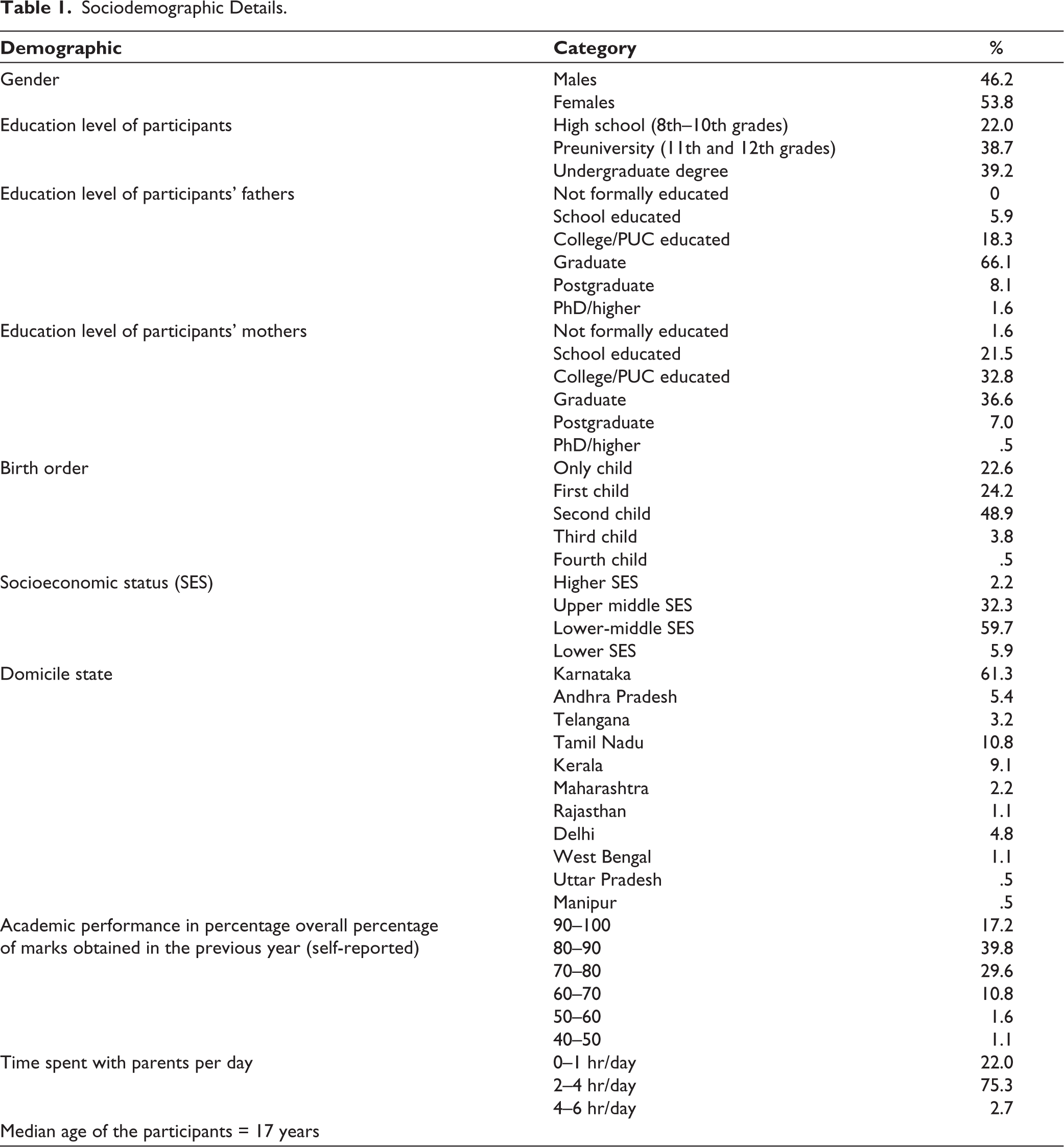
A total of 186 students from high schools and colleges in urban Bangalore (within the age range of 14–19 years) comprised the sample for this study. The sample size was estimated to be a minimum of 172 based on power analysis using G Power with an a priori computation of moderate effect size and α error probability of .05 and a power (1–β) of .95 with 10 predictors. Convenient sampling technique was used to recruit participants from English-medium private education institutes in Bengaluru. An initial sample of 216 was obtained, out of which 19 reported not having one of the parents and hence did not answer part of the questions; 8 did not belong to the age group specified, while three of them did not consent to participate. Hence, a total sample of 186 was available for analysis. The detailed demographic characteristics of the sample is given in Table 1.
Sociodemographic Details.
Tools and Procedure
Participants were given two questionnaires to measure the outcome variables. Adolescents’ rights and their attitude toward nurturance rights and self-determination rights were measured using the Children’s Rights Attitude Questionnaire (CRA). 17 This is a 40-item questionnaire that elicits opinions about children’s rights, with a 6-point scale from strongly disagree (1) to strongly agree (6). Internal consistency reliabilities for the nurturance scale (after removing one item) for children was .73. Although this scale was constructed two decades ago, the items in the scale provide insights to gain a fundamental understanding of rights. This scale was modified to suit the Indian context based on five subject experts’ validation. The original scale measured the endorsement of 22 self-determination and 18 nurturance rights in the context of the home, the school, and the world at large, whereas the modified scale consisted of 20 self-determination and 14 nurturance rights, making it a total of 34 items. An additional question “I feel I am able to exercise my right as an adolescent in general” was included to gauge if participants felt they could exercise their rights. Since the scoring of the original scale followed that higher scores indicate greater endorsement or agreement with that type of “right,” the modification of items did not change this interpretation.
To measure perceived parenting styles, the Parental Authority Questionnaire (PAQ) 18 was used. The PAQ measures three of Baumrind’s parenting styles, namely authoritative, authoritarian, and permissive parenting styles, as perceived by the child separately for mothers and fathers. This is a 30-statement self-report questionnaire that uses a Likert Scale, with 10 statements in each parenting style category. The 30 statements yield 6 separate scores, 3 scores each for mother and father, respectively. The highest of the three scores indicates the dominant parenting style of each parent. The test-retest and internal consistency reliability for mothers’ parenting styles were .78 and .82, and fathers’ parenting styles were .82 and .85, respectively. Criterion validity in mothers was found to be .76 and in fathers, it was found to be 0.78.
Mainstream English-medium private schools and colleges (ICSE, CBSE, and State board) in Bangalore were approached to carry out the study. After obtaining permission from school/college authorities, informed consent from parents and assent/consent from the participants, the CRA and the PAQ were administered in the school/college classroom setting. Parent consent was sought by obtaining signatures on the informed consent form sent out through the school/college. To reduce researcher-bias, the names or any identification details of the participants were not asked and the participants were first asked to the fill the questionnaire and then the sociodemographic sheet which were later matched with codes. Measures were taken to ensure participants responded to the questionnaires independently without discussing among themselves, and without the teacher’s or college administrator’s presence in the classroom while answering the questionnaires.
Results
The data obtained were analyzed using Statistical Package for the Social Sciences (SPSS) version 19. Data were subject to normality tests after which non-parametric tests were used because the data were found to be skewed. Median and interquartile range were calculated to determine the attitude toward rights and the extent of their use. Wilcoxon’s test was used to analyze the differences between adolescent’s attitude toward nurturance and self-determination rights. Multiple linear regression analysis was performed to study the predictors of adolescents’ endorsement of rights. Kendall’s Tau was performed to analyze the relationship between attitude toward rights and perceived parenting styles.
Sociodemographic Details
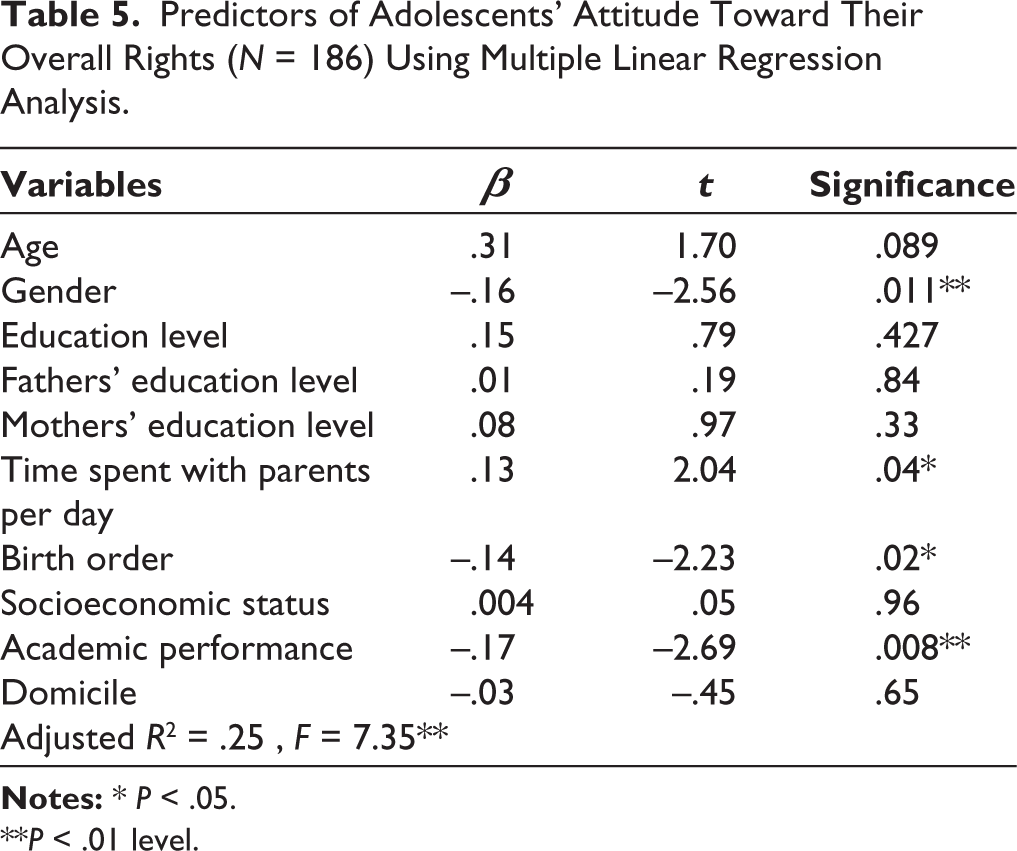
The adjusted R2 (with F significant at 0.01 level, Table 5), suggested that the independent variables predict 25% of variance. Among them, the variables that significantly predicted the adolescent’s overall attitude toward their rights were gender and academic performance (at 99% confidence interval [CI]); and time spent with parents and birth order (at 95 % CI).
Discussion
This study aimed at examining the adolescents’ (N = 186, median age = 17 years) attitude toward their overall rights, self-determination rights, and nurturance rights; the relationship between adolescents’ attitudes toward rights, and perceived parenting styles of mothers and fathers; and the factors predicting the attitude of adolescents toward their overall rights.
Adolescents’ Attitude Toward Their Rights
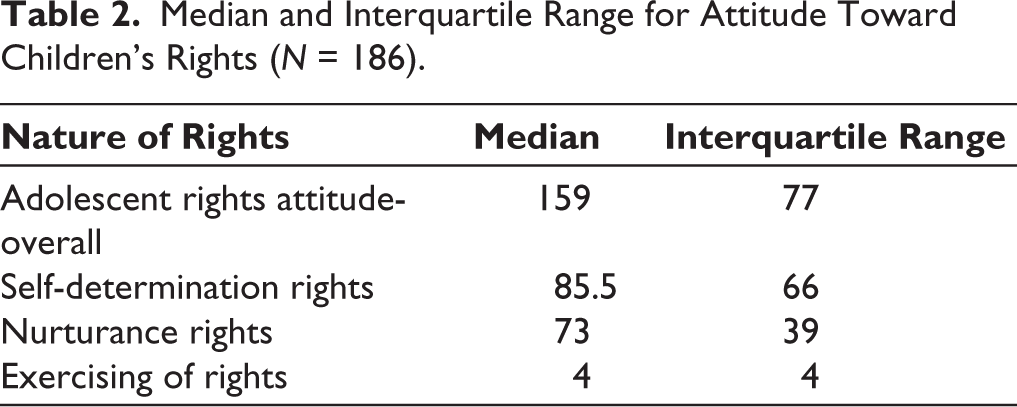
The adolescents’ attitude toward their rights was measured using the CRA, modified to suit the Indian context, which measured the attitude toward nurturance rights (provision and protection) and self-determination rights (participation). The overall attitude toward their rights obtained in the study (median = 159, range = 77), indicated a favorable or positive attitude toward rights in general. This has been consistent with many studies,17, 19 where children between 8 and 12 years of age showed greater support for nurturance rights, while adolescents between 14 and 16 years of age endorsed both nurturance and self-determination rights. 20
The extent of using the rights by adolescents (Table 2) was found to be moderate (Median = 4). This was in line with cross-national studies8, 21 involving perspectives of children between 12 and 14 years of age on their rights from China, the Czech Republic, France, India, Russia, Thailand, and the USA. They found that the respondents indicated a moderate to high degree of exercising their rights at home as opposed to school. This becomes important to reflect on the extent to which adolescents practically utilize their rights in appropriate contexts, such as, at home where they may have more liberty when compared to school.
Median and Interquartile Range for Attitude Toward Children’s Rights (N = 186).
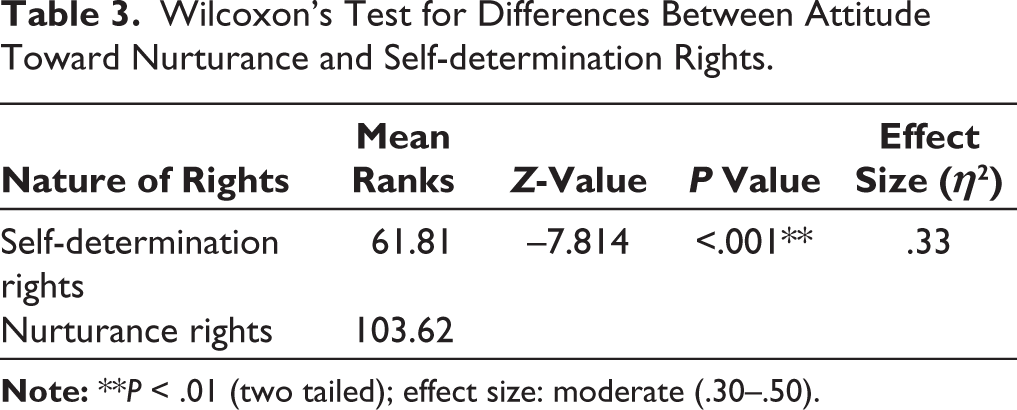
Nurturance rights were significantly endorsed more than self-determination rights (Z = –7.81, P < 0.01), with a moderate effect size in this study (Table 3). Endorsement of self-determination rights has been found to be associated with early separation from family, which facilitates adolescents to advocate for themselves. Also, greater support for self-determination rights has been related to adolescents striving for more freedom and autonomy and less parental oversight. 22 However, in the Indian context, adolescents and young adults continue to live with their parents and other family members sometimes even until they find employment or get married and beyond marriage as well. This may not be the case in the West where adolescents launch out early and fend for their livelihood and higher education. Hence, the perceptions about rights, particularly self-determination rights can vary to a great extent, depending on the cultural context, and perhaps our participants endorsed nurturance rights over self-determination rights.
Wilcoxon’s Test for Differences Between Attitude Toward Nurturance and Self-determination Rights.
Attitude Toward Rights and Perceived Parenting Style
The relationship between adolescents’ attitude toward their rights, and perceived parenting style was examined using Kendall’s Tau (Table 4). A significant positive correlation was found between adolescents’ attitude toward overall rights and perceived parenting styles of father [permissive (rτ = .32, P < .01), authoritarian (rτ = –.45, P < .01), authoritative-Flexible (rτ = .41, P < .01)], and mothers’ authoritarian (rτ = –.25, P < .01)], and authoritative-flexible (rτ = .33, P < .01) parenting styles.
Relationship Between the Dependent Variables Using Kendall’s Tau Test (N = 186).
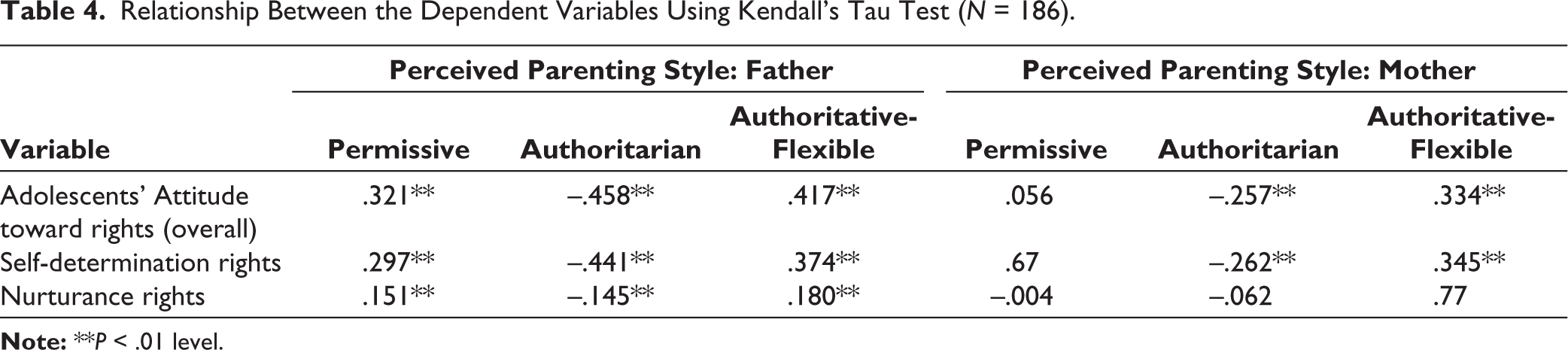
In terms of self-determination rights, there was a significant negative correlation with both perceived fathers’ (rτ = –.44, P < .01) and mothers’ (rτ = –.26, P < .01) authoritarian parenting styles, while a significant positive correlation was obtained for fathers’ permissive (rτ = .29, P < .01) and authoritative-flexible (rτ = .37, P < .01) parenting styles and mothers’ authoritative-flexible parenting style (rτ = .34, P < .01). However, perceived mothers’ permissive style was not significantly correlated. Existing literature suggests a strong relationship between a supportive family environment and parental autonomy in influencing problem behaviors of children and adolescents. 23 In the context of rights, this supportive family environment also includes nurturance and self-determination rights. In a study 9 on Jewish and Arab children between 12 and 14 years of age, family values and practices were significantly correlated with the approach to children’s rights, although its explanatory power was weaker. It showed a significant correlation between the parenting style and children’s approach to their rights, wherein, more democratic and less patriarchal families showed more support for children’s rights. In the Indian context, the correlation between perceived fathers’ parenting style with attitude toward overall rights could be rooted in the patriarchal views the families could perhaps hold, given that the maximum respondents in this study were from lower-middle socioeconomic strata. For instance, a study in India 24 found that though many parents and teachers were aware of children’s rights, they still thought children need not exercise their “rights to freedom of expression and association.” This could also be corroborated with a study 25 involving participants from lower-middle-class families in Mysore, that examined Indian children, adolescents, and adults’ reasoning about autonomy and responsibility in the context of spousal relationships. They found that children and adolescents were more likely to emphasize personal autonomy for fathers and interpersonal responsibility for mothers, reflecting the hierarchical nature of Indian marriages. Participants (male children especially) were more likely to make the judgment that it was all right for a husband to do what he wants than for a wife to do what she wants. This could perhaps explain the discrepancy between the perceived parenting styles and conceptualization of rights in India and the West.
Nurturance rights were positively and significantly correlated with perceived fathers’ permissive (rτ = .37, P < .01) and authoritative-flexible (rτ = .54, P < .01) parenting styles. There was a significant negative correlation with perceived fathers’ authoritarian parenting style (rτ = –.44, P < .01). Surprisingly, again, no significant correlations were found with mothers’ perceived parenting styles. Some studies9, 17 have found that children and adolescents’ positive attitude toward nurturance rights were facilitated by responsive, autonomy supportive, and democratic family and school environments. In this study, perceived fathers’ parenting styles-particularly permissive and authoritative styles were correlated with adolescents’ rights. This finding was not consistent with some of the studies that have found maternal factors being related to children’s attitude toward rights. For instance, a previously reported study 17 found that mothers’ responsiveness as perceived by their children was positively correlated with endorsement of both nurturance and self-determination rights. This indicated that parents’ warmth and sensitivity to children’s needs had greater explanatory power in shaping children’s attitudes toward rights than setting clear expectations for behavior. Also, mothers’ support for self-determination rights was negatively related to maternal conservatism, which was equated to the authoritarian parenting style of the mother. A similar trend was observed in this study where perceived mothers’ authoritarian style had a significant negative relationship with attitude toward overall rights, self-determination rights, and extent to use of rights. Interestingly, the perceived parenting style of mothers was not found to have a statistically significant relationship with attitude toward nurturance rights. This could perhaps be due to the cultural views held about mothers as all accepting and seen as the epitome of nurturance, thereby taken for granted. That is, irrespective of the (perceived) parenting style of the mother, the children expect that their mother should provide them with nurturance.
Predictors of Adolescents’ Overall Attitude Toward Rights
The study also identified the predictors of adolescents’ attitude toward their rights. Independent variables such as age, gender, socioeconomic status, education level of adolescents, parental education level, academic performance, birth order, domicile, and time spent interacting with parents daily, were considered as predictor variables. The findings (Table 5) indicated that the independent variables predicted 25% of variance (R 2 = .25, F = 7.35, P < .01). Among them, gender, academic performance, birth order, and time spent with parents significantly predicted the adolescents’ overall attitude toward their rights.
Predictors of Adolescents’ Attitude Toward Their Overall Rights (N = 186) Using Multiple Linear Regression Analysis.
**P < .01 level.
The predictors of adolescents’ attitude toward overall rights are discussed below:
Gender: Male gender has been found to be a significant predictor of the overall attitude (β = –.16, P < .01). Previous studies3, 19 reported that males endorsed a more positive attitude toward rights and self-determination rights, in particular. This might reflect patriarchal values 9 , which offers possible explanations for that where some Indian families support boys more than girls, and that girls may be granted fewer rights than boys, especially self-determination rights such as rights to privacy, and choice of friends. Many of these differences are also culturally sanctioned.
Academic Performance
Better academic performance has been found to be predicting greater endorsement of rights (β = –.17, P < .01). This could be because high-achieving children and adolescents may tend to have a greater sense of self-control, which could perhaps enable them to evaluate the concept of rights, thereby having a positive attitude toward them. Also, most children who demonstrate high academic performance are usually subject to privileges granted by parents, which could also perhaps influence their positive attitude toward rights. This stance needs further research since not much literature is available examining the relationship between academic performance and attitude toward rights.
Birth Order
Birth order was found to be a predictor, where children without siblings and firstborns were found to have greater endorsement of their overall rights (β = –.14, P < .05). Since there is no consistent literature supporting the role of birth order in predicting the attitude toward rights, it could possibly be speculated that children without siblings and firstborns may have more entitlement in most Indian families as a result of which they may be likely to endorse positive attitudes toward their rights. It is also interesting to note that second-born children were found to be the maximum respondents in this study which may further contribute to discrepancies about the role of birth order. Additionally, birth order status may also be affected by gender, where family roles may be correlated with birth order and with expectations of caregiving and/or decision-making. In that sense, linking birth order, particularly first born/only child to their involvement in decision-making or enjoying privileges because of gender may direct the possibility of the role of birth order in predicting the adolescents’ attitude toward their rights. However, more studies in the area might be further recommended.
Time Spent with Parents
Time spent with parents daily of about 2–4 hours was found to be a predictor of adolescents’ attitude toward their rights (β = .13, P < .05). This is moderate when compared to 0–1 hour and 4–6 hours or more. Time spent with parents may be an indication of parental involvement with their children. There have been numerous studies supporting the evidence that quality family time leads to better well-being in children. For example, it was found that in India’s nationally representative Global School-based Student Health Survey (GSHS) in 2007, parental involvement (homework checking, parental understanding of their children’s problems, and parental knowledge of their children’s free-time activities) with both male and female adolescent children were associated with reduced odds of poor mental health among those children. 26 Similarly, parental knowledge of how children spent their free time was a significant predictor of reduced odds of depression and anxiety. 27 The strong association between youth well-being and parent-child relationships is robust across cultures. 28 Also, children and adolescents were found to be more competent with parental warmth, and emotional availability along with moderate restrictiveness in the form of reasonable limits, while at the same time allowing them reasonable autonomy to explore the environment. 29
Other Variables
While in this study, variables such as parental education, socioeconomic status, and age were not found to be significant predictors of adolescents’ attitude toward their rights, many studies have found them as significant predictors. For example, a few studies30, 31 reported that reasoning about rights in children and adolescents between 8 and 16 years of age from lower to upper-middle-class backgrounds differed according to the type of right under consideration (e.g., nurturance versus self-determination), where older adolescents and those from upper middle class endorsed more self-determination rights than nurturance rights. Also, students who had less perception of the existence of rights came from families with lower educational levels. 33
A few studies conducted in India24, 34 have focused on parents’ and teachers’ perspectives on children’s rights. However, one study 35 conducted in informal settlements of Mumbai from lower socioeconomic strata found that the level of awareness of rights in adolescents was not high, though the acknowledgment of rights was higher in older adolescents, specifically among girls. These rights were mostly regarding right to free speech, access to food, money and choice of clothing, reflecting more of nurturance rights. In comparison, the participants of our study also endorsed nurturance rights, despite the majority of them hailing from lower and upper middle socioeconomic strata, with a moderate extent of use, reflecting the cultural similarity toward nurturance rights despite geographic variations. More studies are required to elaborate on the geographic and cultural variations within our country with respect to children’s and adolescents’ rights.
Conclusion
Considering limited research in the area of adolescents’ rights in India, this preliminary study aimed to explore the attitude of adolescents toward their rights and their relationship with perceived parenting styles and the predictors of their rights in an urban city of South India. The adolescents in this study expressed a positive attitude toward their overall rights, though their extent of exercising them was moderate. Nurturance rights were endorsed more than self-determination rights and their attitude toward overall rights were significantly related to the perceived permissive, authoritarian and authoritative-flexible parenting styles of fathers and perceived authoritarian and authoritative-flexible parenting styles of mothers. Gender, academic performance, birth order, and time spent with parents emerged as significant predictors of adolescents’ overall attitude toward their rights. The findings from this study and comparison with studies from different parts of the world highlight the geographical and cultural variations in adolescents’ attitude toward their rights.
The key messages to carry home from this study were: (1) it provides insights into endorsement of self-determination and nurturance rights by adolescents in the Indian context, where our participants endorsed nurturance rights; (2) adolescents expressed a positive attitude toward their overall rights, though their extent of exercising their rights was moderate; (3) permissive and authoritative-flexible parenting style of fathers as perceived by adolescents were related to higher endorsement of their rights; (4) adolescents’ overall attitude toward their rights are influenced by their gender, academic performance, birth order, time spent with parents; and (5) acknowledging adolescents’ rights by adults may have implications in conflict resolution.
Implications
This study provides preliminary insights that have theoretical and practical implications. In terms of theoretical implications, the study has emphasized the need to explicitly acknowledge the concept of the rights of children and adolescents since it has been positively endorsed by the respondents. From the perspective of self and family, the findings may be used to further study the relationship with psychological distress that may be due to an underlying, implicit disagreement of rights between parents and children. Another important implication is the role of rights in the context of smartphone and social media usage, which can be explored in further research. In terms of practical implications, the findings serve as a rudimentary framework to utilize rights-based approaches in family, school, and clinical settings that are context-specific and culturally relevant.
Limitations of the Study
From a conceptual point of view, the rights issue has been studied only from the adolescents’ perspective and not considered parents’ perspectives. Also, along with the attitude toward rights, reasoning about the right, family environment, and school environment need to be considered. Also, the understanding of rights and attitude toward them can be influenced by many other factors such as siblings, and social media exposure, among others, which this study has not been able to account for.
From the methodological and analytical point, the convenient sampling and skewed data may not allow in easy generalizability of the results, nevertheless, it provides insights that can guide further research in children and adolescents’ rights in India. The study could have incorporated a mixed-methods design, with models of moderation and mediation and qualitative methods could have captured the nuances and other factors influencing the attitude toward rights.
Footnotes
Acknowledgements
The authors would like to thank all the participants of this study, and Prof. Michele Petereson-Badali for permission to use and modify the Children’s Rights Attitude Scale for this study.
Declaration of Conflicting Interests
The authors declared no potential conflicts of interest with respect to the research, authorship, and/or publication of this article.
Statement of Informed Consent and Ethical Approval
This study was accorded Ethical Committee Approval vide Ethics Committee (National Institute of Mental Health and Neuro Sciences [NIMHANS] Bengaluru; protocol number NIMH/DO/IEC [BEH. Sc. DIV]/2019, dated June 13, 2019). Written informed consent was obtained from all the participants. The study was carried out in accordance with the principles as enunciated in the Declaration of Helsinki.
Funding
The authors received no financial support for the research, authorship, and/or publication of this article.
Necessary ethical clearances and informed consent were received and obtained respectively before initiating the study from all participants.