




Abstract
Supportive psychotherapy occurs in almost every doctor-patient encounter and is the psychotherapeutic treatment provided to the vast majority of patients who are seen by residents and fellows in psychiatric clinics and mental health centers, yet very few scholarly articles are written that help explain its principles or how it works.
Introduction
Supportive psychotherapy is the most commonly provided form of psychotherapy and occurs in almost every therapeutic encounter. This is particularly true in community clinics and mental health centers, and it is the most common form of therapy provided by residents and fellows in training programs, yet very few scholarly articles are written that help explain its principles or how it works. 1
When Freud began to develop the techniques of psychoanalysis, which served as a foundation to all the other psychotherapeutic modalities, he was working with patients who were predominantly upper-middle and upper-class members of Victorian–Austrian society and their problems were mostly intrapsychic. 2 In contrast, many of the patients that are seen by psychiatrists and residents today also suffer from problems that have sociopolitical and economic origins and are also extrapsychic, such as poverty, social and political oppression, and abuses of power in relationships that threaten to overwhelm their coping capacities. For these patients, supportive therapy is the treatment of choice. 3 The majority of residents and fellows practice supportive therapy with their patients without being aware that this is occurring and usually do it by intuition, or at a “gut level,” so in order to elevate the level of understanding and the quality of this therapeutic skill, it is important to begin a more formalized training of this skill at the residency and fellowship level. 4
Theoretical Framework for Supportive Psychotherapy
Supportive psychotherapy is a dyadic treatment that aims at ameliorating symptoms, maintaining, restoring, or improving self-esteem, ego functions, and adaptive skills. It was developed in the early twentieth century and its objectives are more limited than those of the psychodynamic therapies, which are ultimately aimed at producing character change. 1 This therapeutic modality focuses especially in developing adaptive capacities taking into account the patient’s limitations. These include (a) personality issues, such as structural deficits in the character structure and defense mechanisms, (b) native ability, such as having impaired reality testing, decreased cognitive functioning, lower IQ, or learning disabilities, and (c) the problems associated with life-circumstances, such as having lower levels of education, low socioeconomic status, limited social support systems, and problems related to migration. 5 There is a two-way connection between mental illness and poverty. Poverty increases the risk for mental illness and mental illness takes people into poverty. 6 To understand this better it is helpful to review the work of the sociologist Oscar Lewis, who in 1965 published the controversial document titled, “The Culture of Poverty” 7 in which he argued that in order to adapt to their environment, people who live in poverty for long periods of time develop a series of coping mechanisms that become engrained and paralyzing and that affect the individual, the family, the slum community, and the community in relation to society, causing for these individuals to become frozen in their environments and making it very difficult for them to exert change. In these individuals, supportive therapy can serve as the first bridge out of their social isolation and marginalization, since the two most important elements of supportive therapy are as follows: (a) the therapeutic alliance, which allays anxiety, helps support the patient’s healthy defenses and enhances adaptive skills and, (b) a conversational style. 4 This style avoids analytic abstinence, which can confuse and intimidate the patient and engages the patient in a collaborative discussion decreasing the power differential. Supportive therapy is also the treatment of choice in individuals with severe personality disorders, at least in the initial phases of treatment, because many individuals with personality disorders resent and fear the power differential that results from a more analytic stance, given that many of them have experienced abuses of power in early life and if this is not addressed early in the treatment, it could lead to treatment resistance or avoidance, acting out behaviors on the part of the patient or even a psychological re-traumatization of the patient. 8 Most psychotherapies have in common a reliance in the therapeutic alliance, but in supportive psychotherapy it is considered to be the most important and central element. 4 In patients who have chronic disorders, unsatisfactory living conditions, and little hope for change in their lives the therapist represents to the patient (a) a figure of stability, (b) a contact with the outside world, (c) a representative of the broader world, and (d) an example with whom to identify, imitate, and follow. Another contribution of supportive psychotherapy is that it helps patients begin to develop a new vocabulary for their emotions, because gaining comfort with one’s emotions adds a dimension to life and a new understanding of one’s world.
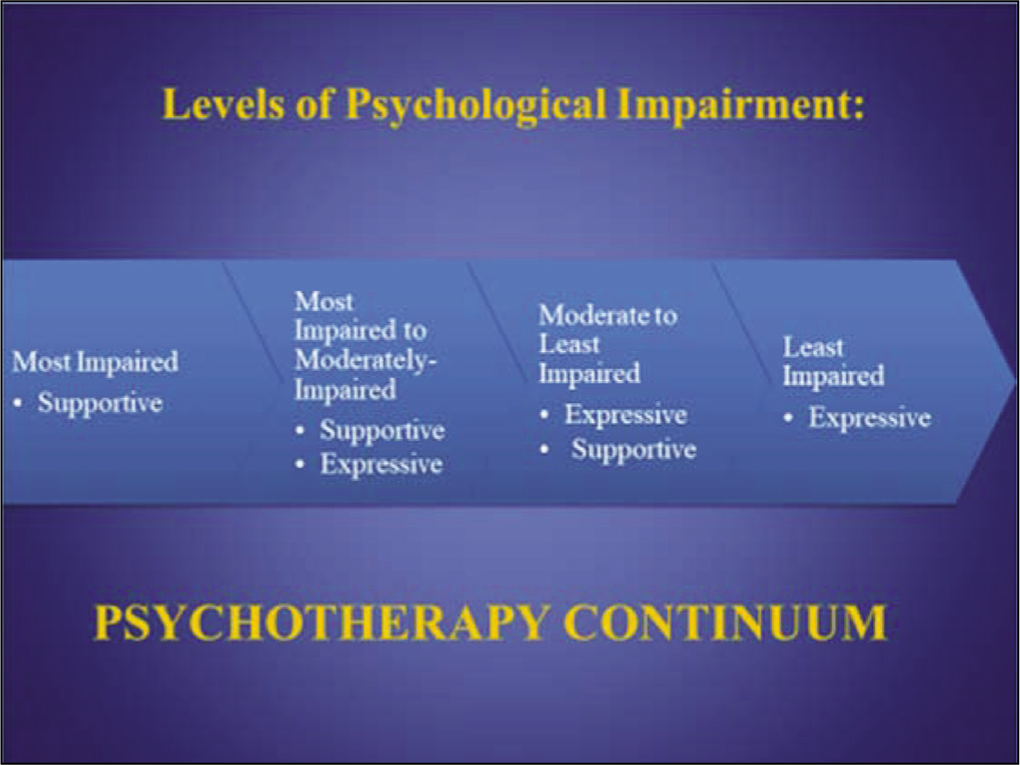
Supportive psychotherapy stands in contrast with the psychodynamic-expressive therapies, which seek to accomplish personality change through (a) analysis of the relationship, (b) exploring previously unrecognized feelings, thoughts, needs, and conflicts, and (c) the development of insight. Supportive therapy also includes some of these elements, so the therapist must move through a “psychotherapeutic continuum.” The therapist takes into account the patient’s cognitive abilities, reality testing, thought process, capacity to organize behavior, affect regulation, and capacity to relate to others in order to determine the patient’s location in the continuum. 4 Purely supportive interventions are chosen for patients with disorganized behavior, thought disorder or cognitive impairment, limited intelligence, lower levels of education, and socialization and for patients with personality disorders, moving across to more psychodynamic-expressive therapies with the least impaired patients. It is important for the therapist to be hopeful that the impaired patient can eventually move across to a more psychodynamically oriented supportive therapy and beyond. Affect regulation is one of the most important goals of supportive psychotherapy. 7 More regressed patients commonly have difficulties with affect regulation, which produces a state in which the patient is so ridden with anxiety that he cannot attend or think and which interferes with the capacity to self-reflect (Figure 1).
The Supportive Psychotherapy Continuum4.
Specific Indications for Supportive Psychotherapy
Some of the indications for supportive therapy include the following: (1) Stressful life circumstances: Such as bereavement, divorce, socioeconomic difficulties, menopause, physical illness, and academic difficulties. (2) Severely disturbed character structure or poor ego strength, including patients who are limited by chronic conditions such as schizophrenia, severe affective disorders, and personally disorders. (3) Lack of curiosity about self and about individual psychological functioning, (4) as an emergency detour from insight oriented therapy, when anxiety becomes too strong for the coping capacities, (5) as an ego building measure, or a preparation to moving on to more insight oriented therapies, (6) as a form of symptom relief without any self-initiative in patients with limited capacity for self-initiating behavior, and (7) when available resources limit the possibilities of a more intensive psychotherapy. 9 Supportive psychotherapy is also the gateway into other therapies, since it is primarily based on establishing a strong therapeutic alliance. The nonjudgmental stance of the therapist clarifies symptoms and problems, inspires hope, and facilitates experiences of mastery, which alleviates the patients’ sense of powerlessness to change themselves and their environment. In the process, the therapist underscores the importance of understanding emotions and does not assign homework, reducing the risk that the patient may feel that he or she has failed the therapist’s expectations. 9 By establishing a strong therapeutic alliance at the onset of treatment, the therapist sets the foundation for other important interventions, since without this alliance, patients may not trust the doctor to accept medications or to engage in other more expressive psychotherapeutic interventions such as cognitive behavioral therapy (CBT), or psychodynamic psychotherapy. 10
How to Teach Supportive Therapy in Child Psychiatry Fellowship Programs
The majority of psychiatry residency and fellowship training programs in the United States and other countries are located in public hospitals that provide care for underprivileged patients and expose residents to ancillary services associated with social and community psychiatry, such as community mental health centers, day hospitals, community residencies, addiction treatment clinics, assisted living facilities, school consultation programs, family-based community clinics, prison programs, and homeless shelters. Yet, few residency programs provide a formal curriculum to teach supportive psychotherapy, which is the most appropriate psychotherapeutic paradigm that addresses the realities that result from the social determinants of health and the particular problems that afflict these populations. In many cases, residents learn the principles of supportive psychotherapy by “doing” in their daily contact with these patients, and the experiences are incorporated at a “gut level” without a formal methodological discussion of the principles of this therapeutic perspective. 11 This highlights the need for a more formal curriculum to teach these skills at a residency and fellowship level.
In the United States and in other Western countries, training in child and adolescent psychiatry is undertaken after the individual has received training in adult psychiatry and the first months of training are dedicated to inpatient child and adolescent psychiatry, followed by an outpatient experience. However, in some countries, the trainee enters directly into a child and adolescent psychiatry training program without any formal training in any of the psychotherapeutic modalities. If the individual has already completed adult and general psychiatry training, one assumes that the person has received variable degrees, or at least a minimum of training in psychodynamic psychotherapy, CBT, and group therapy, depending on the orientation of the program. In either case, supportive psychotherapy should be introduced in the first months of training by way of formal lectures and in clinical supervision. Further focus on this therapeutic modality can occur in grand rounds, case presentations and discussions, and clinical case write-ups. At least two to three formal lectures should be devoted to explaining and reviewing the principles of supportive psychotherapy in addition to the specific interventions that can be used in treating children and families with this therapeutic modality. 9
Teaching the Basic Principles of Supportive Psychotherapy
There are two key components that are necessary to practice supportive psychotherapy: (1) Adopt a conversational style. In contrast to psychoanalytic therapy, where the therapist attempts to remain anonymous in order to encourage transference to develop, in supportive psychotherapy the therapist instead creates a therapeutic alliance based on the relationship with the patient. This includes: asking directive questions, allowing natural inflection in your voice, making natural gestures, and discussing opinions. Some therapists are uncomfortable with this style because they feel more “transparent,” whereas other therapists feel more natural authentic and free, allowing for greater spontaneity and creativity. In most instances, a patient naturally develops good feelings toward the therapist over time as a result of repeated empathic interchange. In supportive psychotherapy, the therapist may acknowledge these good feelings but should not interpret them for unconscious underpinnings and should address the transference only if it is negative. If the patient develops hostility or anger toward the therapist, this can be addressed by acknowledging the validity of the patient’s angry feelings, gaining an understanding of the patient’s role in the conflict and apologizing if the apology is sincere, offering solutions to improve the conflict and providing reassurance that working through the conflict will strengthen the therapeutic relationship. In spite of the fact that in supportive therapy the therapist usually does not interpret resistance or unconscious conflicts, patients sometimes benefit from reviewing their role and perceptions in the conflict once their anger has subsided, since waiting for the negative transference to resolve on its own usually is not a good strategy. 12
(2) Reducing anxiety: In supportive psychotherapy, the primary goal is to lessen the patient’s suffering. Reducing anxiety means not only helping the patient talk about painful matters but also allowing him or her to avoid topics that are too uncomfortable to endure. 13
Teaching Specific Interventions in Supportive Psychotherapy
Guidance
Guidance is part of everyday child care and education but can be particularly difficult to practice with adolescents, who may not be as receptive because they are in the process of trying to individuate and ascertain their independence from adults. However, in the case of the parents of these patients, guidance is aimed at addressing the specific problem that leads to distress and maladjustment, very commonly this is related to conflicts with the child or adolescent.
Tension Control
Various techniques such as relaxation exercises, self- hypnosis, meditation, and biofeedback can be helpful for parents and for children and adolescents. However, it is important to remember that these are usually palliative, and their value is more when these are used along with other forms of psychotherapies.
Manipulation of the Environment
Environmental manipulation may include techniques such as home treatment, hospitalization, residential treatment and for the parents, day hospital care or attending a rehabilitation center and group therapies for substance abuse for adolescents and parents, such as Alcoholics Anonymous and trauma focused therapies. In these cases, supportive therapy can enhance and augment the effect of the other supportive interventions.
Externalization of Interest
Under stressful situations, many individuals, children, and adults, withdraw themselves from interests that are part and parcel of healthy living. In such a situation, the patients are encouraged to resume activities that were once meaningful to them, or the therapist can help them to develop new interests to fill their leisure time.
Reassurance
Reassurance is part and parcel of all kinds of psychotherapies. The very presence of the therapist may be soothing for the patients who do not have the capacity to handle their anxiety by using their own resources and look forward to seek comfort from an idealized parental figure.
Prestige Suggestion
Prestige suggestion plays an important role in every psychotherapeutic relationship. Generally, the parent or the child or adolescent has a tendency to select things which they want to hear. At times, suggestions may be used as part of supportive therapy in the form of directives given with authoritative emphasis to influence the patient in calculated ways. Symptoms that are ameliorated by suggestion probably resolve because of the unconscious need of the patient to obey and to seek and obtain approval from the therapist, who represents an idealized parental figure. Suggestion works best, where the symptoms have minimal defensive purpose and where the need for symptom free functioning is a powerful incentive.
Persuasion
Persuasion is the assumption that the patients themselves have the power to modify their pathologic emotional proneness by their will power or by using common sense. As part of persuasion, the therapist may serve as a guide and or as a mentor to make the patients revise their perceptions and life-views. The objective of persuasion is to change the habitual maladaptive attitudes against which the patients are struggling and to provide them with new and more realistic goals that will help to improve their adaptation to reality.
Pressure and Coercion
These are authoritative measures that can be used in a calculated manner to stimulate the parent or the patient to act in a positive way and may be useful for some individuals with dependent personalities who face life only when forced to comply. Coercion may also be used in emergencies where the individuals endanger their life or the life of others and where other methods have failed. In the case of children and adolescents the therapeutic pressure may be exerted in the form of assigned pursuits. It is important to remember that these measures could backfire since adults will resent being treated like a child and in the case of children and adolescents, the therapist will assume the role of the coercive parent creating a negative transference that may result in defiance against the therapist, even to the point of the patient leaving therapy. Hence, when used, pressure and coercion should be used only as a temporary measure and in a critical situation. In the case of inexperienced trainees, these techniques should only be performed under strict supervision.
Confession and Ventilation
Confession “talking things out” or “getting things off one’s chest” in a professional relationship is an important supportive psychotherapeutic technique. This can be equally important and useful for children, adolescents, and adults. This allows for release of pent up feelings and emotions that have never been verbalized before, allowing for the very first time, an objective understanding of these feelings, beliefs, or ideas.
The mere verbalization of things about self, of which the patient may be ashamed, fearful, or perplexed, helps to develop a more constructive attitude toward themselves. Verbalization of fears, hopes, ambitions, and demands as part of ventilation often gives relief. Verbalization of faulty ideas and beliefs also provides an opportunity to the therapist to clarify concepts and to correct the misconceptions. Repeated verbalization of unpleasant and disagreeable attitude and experiences permits the patient to face past fears and conflicts with lesser inner turmoil. 9
Other important techniques used in supportive psychotherapy include: 1) behavior goal setting, 2) encouragement, positive-reinforcement, 3) shaping behavior, and 4) modeling. Children respond to the influence of their parents by first imitating them and gradually by internalizing aspects of the parents by the process of identification. They later also identify with other important figures in their lives. Some important aspects of these identifications include a) the development of a stable sense of self, b) of a capacity to modulate anxiety so that it does not lead to defensive distortions of reality, c) a benevolent conscience that allows for a reasonable pursuit of pleasure without unreasonable guilt and d) a capacity to love without fearing a loss of the self in experiences of fusion, or of excessive anxiety in the face of separations. 8 For change to take place in therapy, interpretive work needs to occur with the patient’s increasing capacity for self-reflection, but modeling by the therapist provides some of the first and most fundamental building blocks for change.
Supportive therapy may also include educating the patient and the family members about the illness and about the patient’s potentials and limitations, establishing realistic goals, addressing issues in the life of the patient that will reduce stress and anxiety, and helping the patient and the family improve their adaptive skills. Including limit setting and appropriate reward and punishment with children and helping the patient, the family, and those involved, to understand the patient’s functional and cognitive limitations, as in the case of parents who have unrealistic expectations of their children and adolescents. 5
Teaching Other Important Aspects of Supportive Psychotherapy
It is imperative that when teaching supportive psychotherapy, residency training directors should alert and educate the residents, as well as the hospital medical staff, that the space and time for psychotherapy with patients should not be disrupted. This presents a challenge in public hospitals and community mental health centers where these interruptions are the norm, rather than the exception. Students of supportive psychotherapy must learn that the therapist must attend to the patient’s physical comfort in therapy and try to avoid being interrupted by phone calls or beepers during the sessions, this can present a challenge for psychiatry residents who have to always be responsive to calls from the hospital staff and from supervisors. The resident must establish conditions of emotional safety, such as addressing issues of substance abuse, self-harm, and domestic abuse and avoiding an “interrogation style.” This may also present a challenge in residency programs where the resident is constantly being rushed and competing against the clock in order to perform his or her duties. In contrast to the more psychodynamic oriented therapies, when practicing supportive therapy with more vulnerable or regressed patients the resident must be careful not to be incisive. Clarifications, interpretations, and confrontations of the patient’s behavior may embarrass the patient, increase the patient’s anxiety to a level that the patient is incapable of modulating and may also reawaken memories of abuse. These interventions are more appropriate for treating patients with neurotic defenses, which are analyzed and examined and the conflicts underlying the defenses are identified. 8 In supportive psychotherapy, the therapist first and foremost fosters a strong therapeutic alliance by conveying to the patient acceptance, interest, respect, and admiration for his or her accomplishments, thus supporting the patient’s self-esteem. Conscious problems are addressed, and defenses are only questioned when maladaptive. The therapist gives the patient undivided attention during the session and a commitment to the therapeutic relationship, treating the patient with honesty and respect.1, 5 These goals are also sometimes difficult to accomplish in university clinics, when residents rotate in and out every July and patients are transferred, without their say in the matter, to novice residents. In these cases, many patients develop a strong therapeutic relationship with the case managers, social workers, or the clerical staff of the clinic, which represents the only hope for consistency and continuity.
Sociocultural Issues in Supportive Psychotherapy
Many patients in Community Mental Health Centers and clinics are of minority backgrounds, with these patients, so for therapists in training it is important to take into account the barriers to treatment encountered by these patients, such as economic, geographic, cultural and stigma-related issues, distrust, and past persecutory experiences. The therapist should learn how to listen closely for the “Idioms of Distress,” which are the characteristic way in which members of different cultures describe what is wrong and which may differ from the expressions found in the mainstream culture. It is also very important to explore the patient’s life history for adverse life events and to listen to the metaphors or therapeutic stories for adverse previous personal and medical experiences. In many cases, the patients “life-meaning story” is closely related to previous traumas that account for treatment resistance. In some cases, the patient fears a repetition of these traumas, such as in the case of psychiatric hospitalization, which may elicit fears of oppression, abuse, and incarceration.8, 14 Finally, first and foremost, when teaching supportive psychotherapy, the therapist must learn to negotiate a therapeutic alliance that preserves the authority, the voice, and the agency of the patient and supports the patient’s self-esteem.
Footnotes
Declaration of Conflicting Interests
The author declared no potential conflicts of interest with respect to the research, authorship, and/or publication of this article.
Funding
The author received no financial support for the research, authorship, and/or publication of this article.