



Abstract
Introduction:
Child sexual abuse (CSA) is a worldwide problem. It is associated with a range of adverse consequences. There has been no report assessing media reporting of CSA in Nepal. We aimed to assess the pattern of reporting of news by media on the topic of CSA in Nepal.
Methods:
We did a content analysis of articles from online archives in the two most popular English-language newspapers published in Nepal on reporting of CSA from the period between June 1, 2020, and August 31, 2021. A predesigned proforma was used and a descriptive analysis was carried out.
Results:
A total of 142 English newspaper articles reporting on CSA were analysed. The majority of reports (83.1%, n = 118) had an episodic framing. Overall, 90.1% of the reports mentioned some form of action taken by the authorities indicating the criminal justice point of view for CSA. The information identifying the victim(s) was presented in 15 news reports. 28.9% (n = 43) of news reports had some information about possible steps to prevent events and none of the news reports provided a child helpline number or contact information for any other child support/welfare services.
Conclusions:
The reports presented an episodic frame and focused on details of individual cases and steps taken by the criminal justice system. There is a gross lack of information about the causes of CSA and steps to prevent them like an expert opinion, help lines, crisis management, etc. There is an urgent need to develop national guidelines in order to improve the media reporting of CSA.
Introduction
Child sexual abuse (CSA) is a public health concern worldwide and is associated with many adverse consequences. The evidence from a meta-analysis of 217 publications between 1980 and 2008 has reported a global prevalence of CSA to be around 12%. 1 There is a definite association between CSA and subsequent psychosocial and health-related adverse outcomes like psychiatric disorders, deliberate self-harm behaviors, suicide, and physical health issues like HIV and obesity. 2 Responsible media coverage of CSA can help in raising political and public awareness and implement countermeasures. Sensationalist reporting, supporting false stereotypes or myths related to CSA, or otherwise biased media coverage can do more harm than help. 3 The awareness about CSA in Nepal is low as per the available evidence. 4 Hence, the aim of the current study was to assess the pattern of news media reporting on the topic of CSA in Nepal.
Methods
We performed a content analysis study of news articles retrieved from online archives that reported on CSA. News articles from the two most widely read English-language (daily) newspapers with both in print and web versions published in Nepal between June 1, 2020, and August 31, 2021, were searched manually. The claimed daily readership for both these newspapers is more than six lakhs, and has been touted as the country’s leading English dailies bringing news stories from Nepal to both national and international audiences.5,6 Two researchers (medical officers having good proficiency in the English language) reviewed and extracted information about the description and report characteristics of CSA-related news independently. A predesigned proforma used in a previous study 7 from India was adapted (based on authors’ expertise and review of media guidelines or standards regarding sensible reportage of CSA) and used for extraction and collection of information related to the quality of CSA news reports. The framing of news reports on CSA was categorized as either thematic or episodic. In thematic framing, the news reports addressed CSA as a societal or systemic problem with a broader perspective whereas in episodic framing the news reports represented CSA from a narrow perspective having case-related details only at the individual level. This approach was described in the previous study. 7 Any discrepancy and disagreement between the two researchers who reviewed and extracted data was resolved by consensus. If needed, a third researcher (senior psychiatrist) was also consulted to arrive at a consensus. The data were analysed using SPSS version 16.0 (IBM Corp, Armonk, NY).
There was no enrollment of human subjects and data from news reports available in the public domain was extracted and analysed. Confidentiality of the individuals was maintained by not including the name or any other information that could reveal their identity if present in newspaper reports. Institutional ethical clearance was not required. However, the declaration of Helsinki was complied with in this research.
Results
General Profile of News Reports
A total of 142 English newspaper articles that reported CSA were analysed. The majority of them were published on the second (n = 87, 61.3%) or third (n = 41, 28.9%) page of the newspaper. Four reports were published as front-page news, of which three involved the death of a CSA victim and one involved an international person as the alleged perpetrator of the CSA. The news reports on CSA were usually kept brief, with a mean and median length of 18.0 (standard deviation: 28.5) and 7.5 (inter-quartile range: 4.0–14.0) sentences, respectively.
Specific Profile of News Reports
The characteristics of media reports analysed in the present study are summarized in Table 1. In 16.9% (n = 24) news reports, the framing of CSA was thematic, that is, the reports addressed CSA as a societal or systemic problem and had a broader perspective. However, the remaining 83.1% (n = 118) of news reports had episodic framing, that is, they presented CSA with a narrow perspective and provided case-related details only of individual cases. Overall, 4.9% (n = 7) of news reports mentioned about possible reasons or causes for sexual offenses against children (e.g., viewing or addiction to pornographic material on the internet, higher risk among families with lower socio-economic status, or children living in poverty, CSA acts done by men in order to show masculinity or for revenge, absence of tough law against perpetrators in Nepal, lack of strong public outrage and an attitude of apparent indifference toward perpetrators of CSA in the society, etc.). Whereas, some information regarding possible steps that could be taken by the public to prevent future incidences of sexual offenses against children (e.g., discouraging despicable comments against girls or sharing of provocative or explicit content over social media platforms, increased police patrolling at public places like shopping complexes, bus stands, public parks, mobilizing support for upholding rights of children and creating a child-friendly environment at schools and in community places through public awareness campaigns, enactment and enforcement of stricter legal punishment for perpetrators and/or creation of a legal framework for the speedy judicial trial of CSA cases, etc.) were described in about 28.9% (n = 43) news reports.
Descriptive Summary of Media Reports on CSA Analysed in Present Study (N = 142).
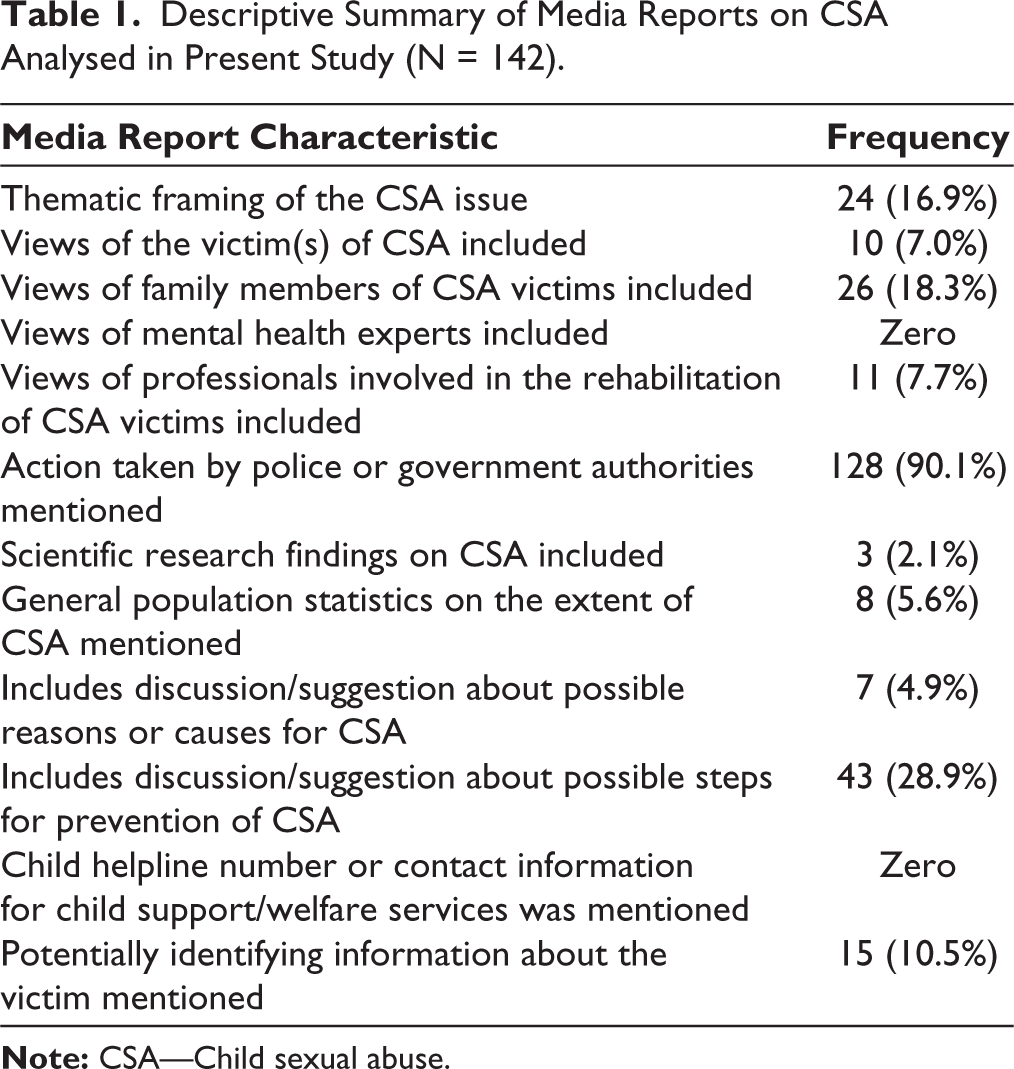
An attempt to counter or dispel the myth of “stranger danger” associated with CSA was explicitly made in only a single news report, and in about 6.3% (n = 9) of news reports the accused was described as a stranger. The relationship between the alleged perpetrator and the victim of CSA was not described in about 28.9% (n = 41) of news reports. However, the accused was reported to be someone known to the victim or the victim’s family in about 57.0% (n = 81) reports. The alleged perpetrator was described as someone who was an authority figure (e.g., priest, public officer) in about 6.3% (n = 9) reports, and a family member or relative of the victim in about 10.6% (n = 15) reports. The information about the victim(s) of a sexual offense that could potentially identify them was revealed in 15 news reports [name ofvictim = 7 (4.9%), information related to identity of victim’s family = 8 (5.6%)]. Lastly, none of the news reports had provided contact information for child support services, child welfare services, or child helpline numbers.
Discussion
The current study aimed to analyse the quality of news reports on CSA in Nepal through a qualitative content analysis of two popular newspapers in Nepal. Most of the news reports focused on describing one particular event of CSA. The framing was episodic in most of the cases and thematic in only a minority of cases. Episodic framing focuses mainly on storytelling. In this framing, the news report focuses on a specific issue or person. Whereas in thematic framing news reports describe an issue in a larger context of a society. The blame for societal problems is placed squarely on individuals in episodic framing and it tries to exclude larger societal factors. 8 This shows that the issue of CSA is still portrayed in the media as more of an individual or local-level issue rather than being presented as a broader societal issue. This is in line with the finding of more frequent episodic framing of CSA than thematic one in media reports on CSA analysed from other countries of the world in the available literature.9,10 The majority (90.1%) of the reports mentioned some form of action taken by the authorities mostly including actions like the arrest of the perpetrator, an ongoing search of the perpetrator, an ongoing investigation, etc. Inferences can thus be made that the criminal-justice point of view for CSA receives greater attention than the sense of social responsibility.
A large number of reports were short and the ones that made it to the front page were the ones with the death of the victim and the involvement of an international perpetrator depicting the lower priority received by the CSA problem in the media. It has been shown that the media has the power to affect public opinion, which can then be translated into public policy change or action. 11 The media’s relatively superficial and narrowly focused attention on these incidents of CSA, may shape the norms and values of society pertaining to this issue in a corresponding manner. A very small fraction of reports (4.9%) discussed the possible causes of CSA, and less than one-third of reports mentioned the possible preventive steps. While many of the current research on the prevention of CSA points toward the need to spread knowledge on problematic sexual interests and behavior and hence facilitate seeking help from professionals, 12 but the views of mental health professionals were conspicuously absent in all the news reports included in this study. This shows that the mental health aspects of neither the victim nor the perpetrator have been given importance while reporting such cases. Similarly, only a small number of reports had mentioned scientific research findings and/or general population statistics on CSA. That way the bigger picture of the CSA problem and the facts remained unheard or unknown to the general population.
In more than half of the reports (57%), the alleged perpetrator was someone known to the victim or the victim’s family. Recent studies have also shown that in most of the cases of CSA, the alleged perpetrator is not a stranger to the victim. 13 But, only one report explicitly attempted to dispel the myth of “stranger danger.” One news report having an international alleged perpetrator was printed on the front page of the newspaper making it seem like a more prevalent and more serious offense than a number of cases in which the alleged perpetrator was a family member and those stories being buried in a small corner of the newspaper concluded within a few lines. There is an important role of media and the ways media frames the story in shaping policy, practice, and public perception of CSA. 9 So, this might be misleading in many ways to the general public. Alarmingly, none of the reports provided any contact information about available child support or welfare organizations (e.g., child helpline number) for providing help or rehabilitation services to the survivors of CSA.
One of the important landmarks in this area has been the promulgation of The Act Relating to Children, 2018 focusing on the rights of children. 14 This document has defined a number of sexual abuses, the punishments for sexual abuses relating to child. It has clearly stated the media should be responsible while publishing and transmitting information, without violating the rights of the child. In the process, adverse effects on the interests of the child cannot be caused. It also mentions about the right to privacy of all children regarding their personal information. However, in the present study, it was seen that the victims are identified by their names or their family names in about one-tenth of news reports violating the law. This could also lead to inadvertent re-traumatization of the CSA survivors and their close family members or friends.
The present study from Nepal is one of very few studies that assess the quality of newspaper reports systematically on CSA. The findings of the present study need to be interpreted along with acknowledgment of some important limitations as in other similar studies. 15 The major limitation is that only the print media reports published in two English newspapers were included. The study didn’t include news reports published in Nepali language which is the vernacular language. Thus the findings cannot be generalized to all media reports published in Nepal. The coverage of CSA news on other social media platforms (Twitter, Facebook), online news, radio, or television was not assessed in this study. Further studies including a wider range of articles are still necessary to establish definite strengths and weaknesses of media reporting of CSA in Nepal. This can be an area of potential research since media’s impact on societal norms and values, public perception and opinion and hence shaping a community cannot be overstated. It is important to note that the cultural context plays an important role in understanding CSA. There are different risk factors as well as protective factors specific to a particular culture. Similarly, culture influences whether abuse is reported and addressed. 16 This also applies in terms of media reporting. Hence, we emphasize on culturally sensitive media reporting and contextualized guidelines for this.
Conclusions
The reporting in the newspaper presented CSA mainly focused on case-specific details and steps taken by the criminal justice system (episodic frame) rather than acknowledging the broader causes and effects on society. There is a gross lack of information about the root causes of CSA and the important steps that need to be taken in order to prevent them. The number of news reports that attempted to educate the public and dispel myths was small. Helpline numbers or contact information to support CSA survivors and their families was not mentioned in a single report. Thus, there is an urgent need to develop national guidelines that could improve media reporting of CSA. Also, there is a need to conduct regular workshops for media professionals to sensitize them about this worldwide prevalent issue and its reporting.
Footnotes
Declaration of Conflicting Interests
The authors declared no potential conflicts of interest with respect to the research, authorship, and/or publication of this article.
Ethical Approval
There was no enrollment of human subjects and anonymized data from news reports available in the public domain was extracted and analysed. Hence, no ethical approval was obtained from IRC/ERB. However, ethical principles were followed during the research.
Funding
The authors received no financial support for the research, authorship, and/or publication of this article.