




Abstract
Background:
During COVID-19 pandemic, education of children was continued in online mode for an extended period of time. Research from India in the beginning of pandemic indicated that teachers faced numerous challenges while adapting to this new mode of teaching. However, no prior study from India evaluated perspective of teachers regarding online classes and their psychosocial well-being during school reopening phase, which started in Feb 2022. During this period both online and offline classes were being conducted and thus presented the opportunity for better comparison of effects of both systems. Schools still revert to online mode of teaching periodically, but it remains to be seen if it benefits the teachers and students.
Methods:
It was a cross-sectional online survey-based study. Self-designed questionnaires assessing perspectives of teachers regarding online classes and psychosocial impact were administered. Depression, Anxiety, and Stress Scale-21 was used to measure psychological distress.
Results:
N = 708 school teachers participated in this survey. A total of 96% of them preferred offline mode of teaching. Several disadvantages of online classes were listed such as connectivity issues, poor interaction with students, poor concentration, and knowledge transfer. Due to online classes, most of them reported increase in working hours, and decrease in leisure time and quality of life. The teachers who conducted online classes (either alone or combined with offline classes), who were employed in private schools and those with lesser family income, had significantly higher psychological distress.
Conclusion:
According to school teachers, online classes carried many disadvantages. Online classes also decreased the psychosocial well-being of teachers.
Introduction
India has one of the most extensive education systems in the world. According to UNICEF, there are more than 8.5 million teachers and 250 million school-going children in the country. 1 Education is crucial for growth and development of children. Teachers play a key role in shaping the lives of children and thereby the future of nation.
During COVID-19 pandemic, the commencement of online classes led to many difficulties for teachers in low- and middle-income countries, including India. Teachers faced various problems which included technical problems, connectivity issues, and lack of expertise in conducting online classes.2–4 However, with the progression of pandemic and consequent prolonged school closure, teachers might have had adapted to these technical challenges. There were studies which hinted at increase in the levels of stress and anxiety due to online classes among teachers in India, but these areas still need further detailed exploration.5–7
Beginning from latter half of 2021, there was rise in media reports of protests by teachers and school managements to stop online education and reopen schools in India.8–11 Other countries too witnessed protests by teachers in various time periods. However, most protests in other countries were against reopening of schools.12,13 In fact, studies from other countries showed that there was increase in the level of psychological distress among teachers on school reopening.12,14–16 The psychosocial well-being of teachers during school reopening phase has not been evaluated in India.
School reopening occurred in Feb 2022 in many parts of India. Students had the option to continue home schooling via online classes from their respective school teachers. The teachers were taking classes in offline, online or combined mode.
11
The present study was thus planned at that time with the following aims and objectives:
To assess the perspectives of teachers regarding online classes during school reopening phase To evaluate the psychological distress and psychosocial impact of online classes on teachers
Materials and Methods
It was a cross-sectional survey-based study conducted by Department of Psychiatry of a medical college of North India.
Sample: Teachers currently working in Government or Private schools of the district. For calculation of sample size, it was assumed that 30% to 40% of teachers would be psychologically distressed after literature review. 6 By using the formula N = 4pq/d2, the sample size was calculated as 700.
Procedure: Permission was sought from the District Education Officer for conducting research in all Government and Private schools of the district. A Google survey form was created for collecting data from teachers. A list of all schools of the district was prepared and over 60 schools were randomly selected and contacted telephonically. The selected schools’ authorities were explained about the purpose of research, permissions for research, and shared the survey form link through WhatsApp or email. Many schools were personally visited by the investigators for circulation of survey forms to teachers. Data collection was done in February and March 2022 till adequate number of participants had filled the survey form.
Assessments:
Ethical considerations: The Institutional Ethics Committee clearance was obtained. Permission from District Education Officer was also taken. The Indian Council of Medical Research guidelines for biomedical research in human subjects were followed as applicable. 19 The survey form included study information, acknowledgment for maintenance of confidentiality and informed consent for participation in the beginning. Those teachers who gave active online consent for participation were directed to fill the rest of the form and submit. Written consents could not be taken from the participants because of the online survey based design of the present study. Principles enunciated in Declaration of Helsinki were complied with.
Statistical analysis: Statistical analysis was done using SPSS (version 25; Chicago, IL). The level of statistical significance was set at P value ≤ .05*. Data were described in terms of range; mean ± SD, median, frequencies, and percentages as appropriate. To assess normality of data distribution, Kolmogorov Smirnov test was used. Comparison of quantitative variables between the study groups was done using Mann-Whitney U test and Kruskal-Wallis test for nonparametric data.
Results
A total of 708 school teachers completed the survey form. Mean age of participants was 40.97±9.03 years. As shown in Table 1, majority were in age group of 31 to 45 years (50.42%), were females (81.35%), married (83.19%), and 84.6% belonged to urban locality. Family income of 56.7% participants was over ₹50,000/month and educational qualification of most of the study participants (74.44%) was post-graduation. 51.5% were employed in government school and majority (46.33%) of the study participants were teaching students of classes 6–10. Almost half of all the teachers were taking both offline and online classes (48.87%).
Sociodemographic Data and Corresponding DASS-21 Subscales Median Scores.
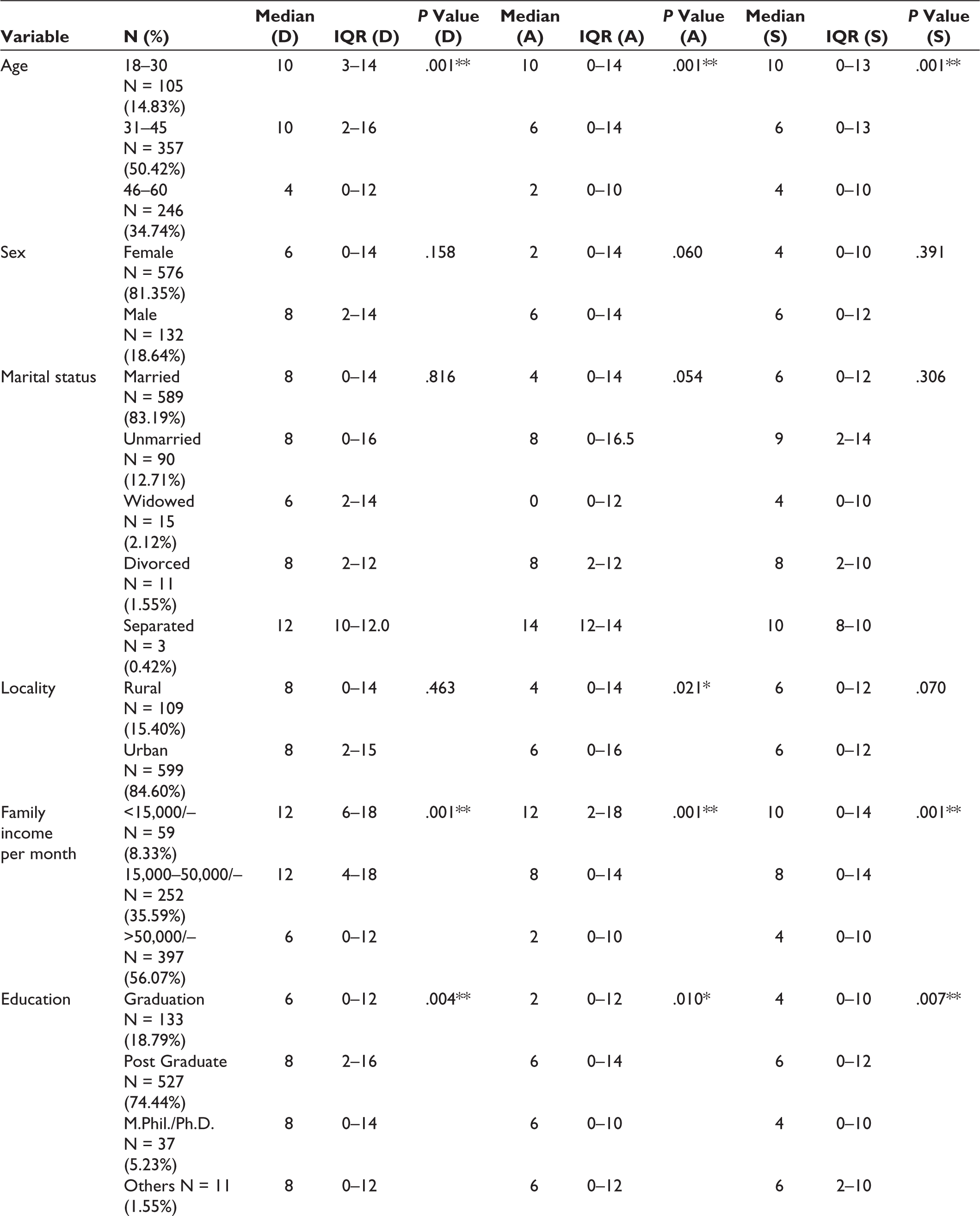
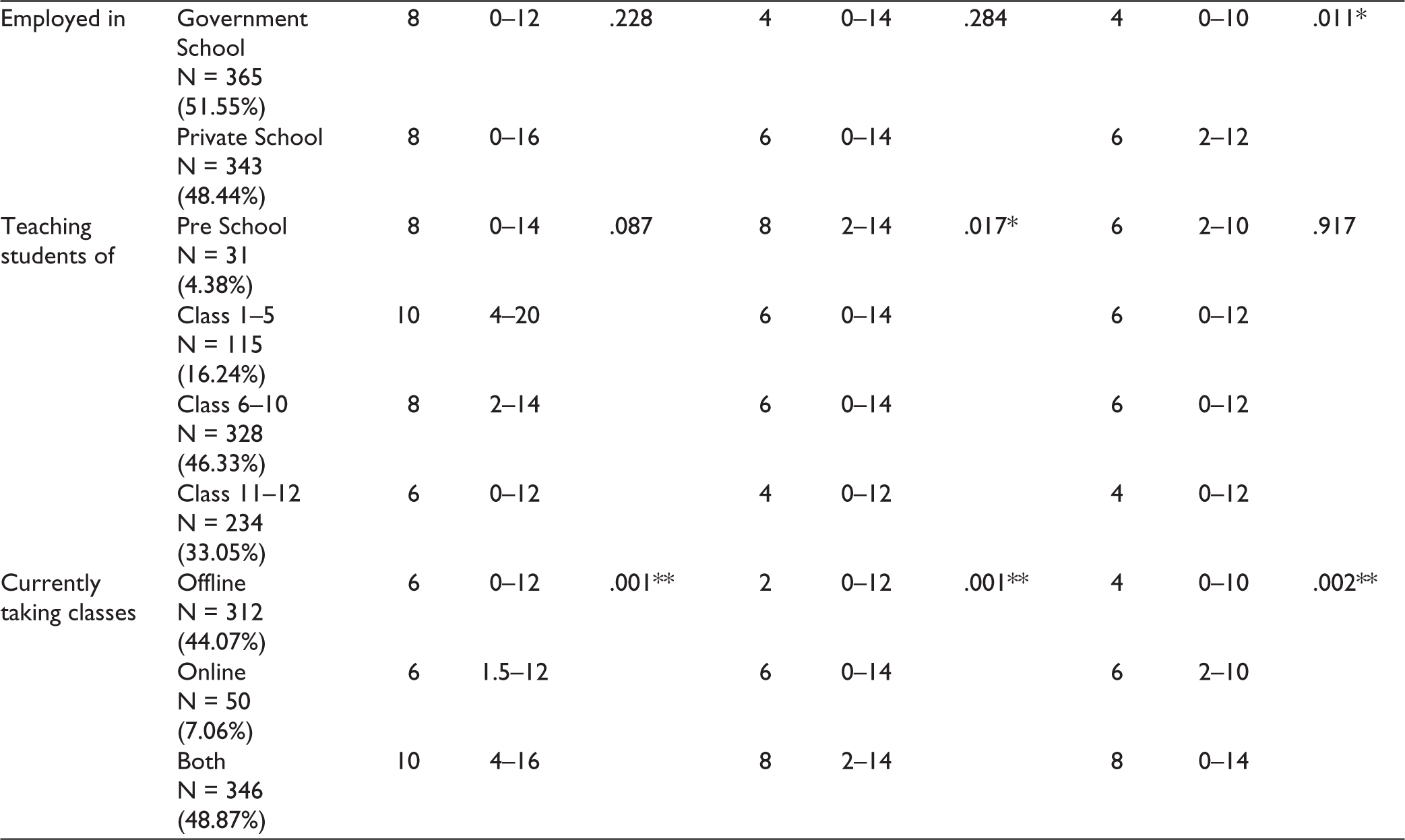
Table 1 also shows the median scores and IQR of depression, anxiety, and stress subscales of DASS-21 within different sociodemographic variables. All the 3 subscale scores were significantly high in younger age groups and those in lower income groups (P = .001**). Similarly, the 3 subscale scores were significantly high in those with higher education levels (P < .05*). There was no significant difference between mean scores of all the 3 subscales in the categories of gender and marital status of teachers. The teachers who were employed in private schools had significantly higher scores on the stress subscale compared to teachers of government schools (P = .011*). Those who were taking classes of preschool children had significantly high anxiety subscale scores (P = .017*) compared to those taking other classes. The scores of all the 3 subscales were significantly high (P = .001**) and were maximum in teachers who were taking both offline and online classes, followed by teachers taking only online classes, and were least in those taking classes only in the offline mode.
A total of 95.9% of the teachers reported that they preferred classroom teaching over online classes. According to most of the participants, offline classes were better as compared to online classes in terms of student teacher interaction (90.11%), students’ attentiveness (92.94%), and making children understand the subject (93.64%) (Table 2).
Perspective of Teachers on Online Classes.

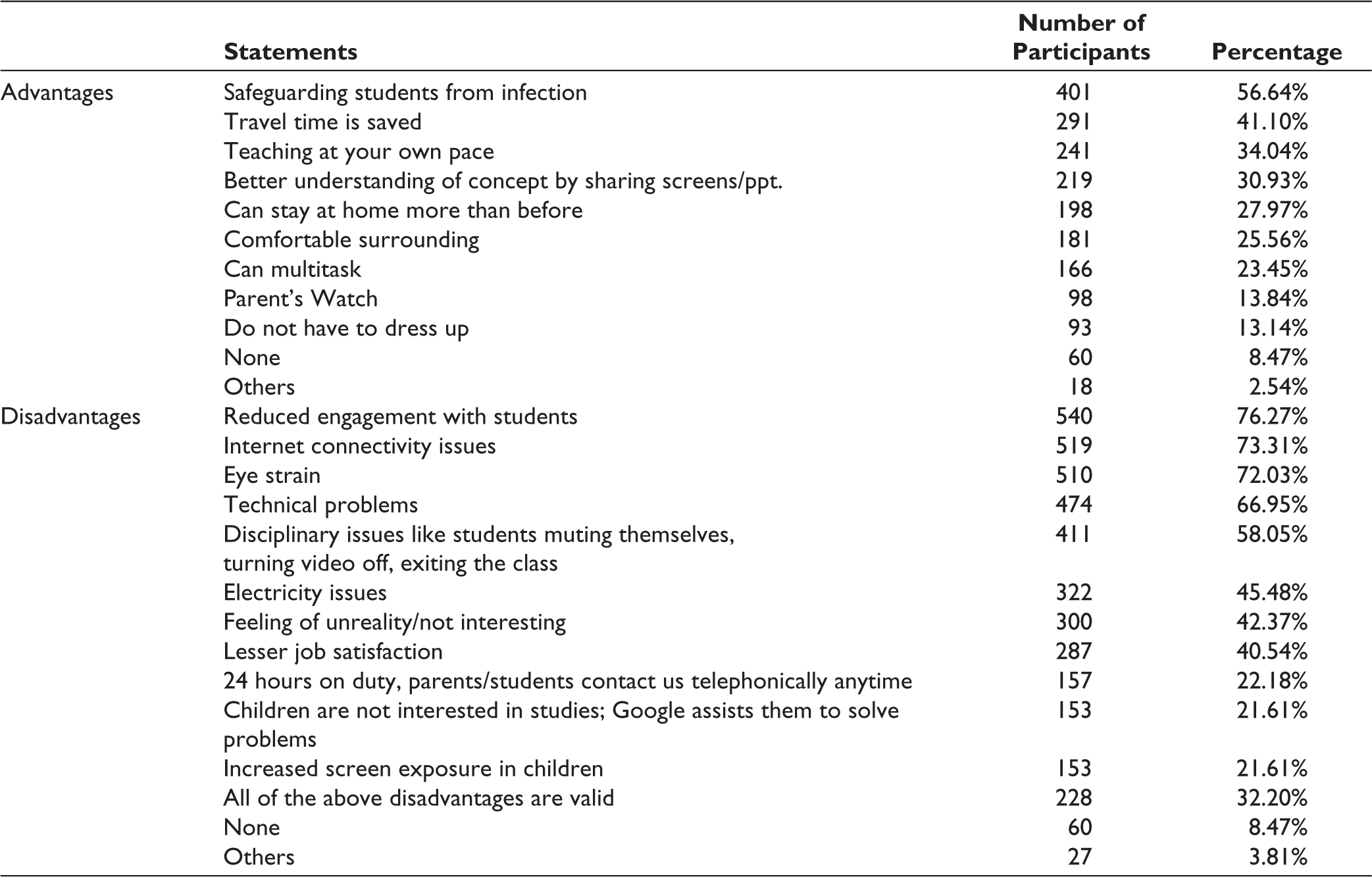
Regarding the advantages of e-learning, the reported reasons were safeguarding the students from infection (56.64%), travel time saved (41.10%), teaching at their own pace (34.04%), can share content through power point presentations (ppt) (30.93%), ability to stay at home (27.97%) amongst others (Table 3).
Disadvantages listed were reduced interaction with students (76%), internet connectivity issues (73.31%), eyes strain (72.03%), technical problems (67%), disciplinary issues (58%), lesser job satisfaction (45%), and others (Table 3).
Advantages and Disadvantages of e-Learning/Online Classes.
N = 490 (69.2%) teachers reported that their overall duty hours increased due to online classes. 34.32% teachers’ duty hours increased by 1 to 5 hours/week and by 5 to 10 hours/week in 21.47%. N = 64 teachers (9%) reported decrease in duty hours and N = 154 (21.75%) reported no change.
Majority of the teachers reported decrease in their interaction with family (67.37%), friends (74.72%), leisure time spent (71.47%), health (53.24%), and quality of life (52.54%). Work-life balance improved for 44.21% (Table 4).
Psychosocial Impact on Teachers.

Discussion
School teachers of a regional area of North India were surveyed to explore their perspectives regarding online classes and their psychosocial well-being. To the best of authors’ knowledge, no prior study from India evaluated these parameters during the school reopening phase.
In this study, 96% teachers reported that they preferred offline mode over online mode for teaching. More than 90% of teachers reported that offline mode of teaching is better in terms of student-teacher interaction, knowledge transfer, and student attentiveness. Most previous studies have reported similar perspective of teachers regarding online classes.3,6,20–23
Further, teachers reported many more disadvantages of online classes compared to advantages. The disadvantages were reduced engagement with students (76%), connectivity issues (73%), eye strain (72%), technical problems (67%), disciplinary issues (58%), electricity issues (45%), feeling of unreality (42%), lesser job satisfaction (41%), parents continuously contact them (22%), and others. These disadvantages were also concordant with previous studies from developing countries.3,4,23–26 This shows that these disadvantages persisted with the progression of pandemic and school closure till Feb 2022.
Among advantages, 56% of teachers felt that it was for safeguarding students from infection, 40% teachers said that their travel time was saved, and 30% felt that sharing class through ppt slides was beneficial for students. Previous studies also reported similar advantages that it was an innovative method of teaching and offered protection from acquiring infection.3,21,23
Regarding psychological distress of school teachers, findings of the present study show that the teachers who were taking online classes either alone (7%) or combined with offline classes (48%) had significantly higher levels of depression, anxiety, and stress than those who were taking classes in offline mode (44%). This finding concurs with the findings of some previous studies from India which suggested that teachers conducting online classes experienced anxiety and stress.5–7 Similarly, studies from developed countries also reported that there was decrease in morale and efficacy of teachers; they were extremely stressed and experiencing burnout due to online classes.27,28
Those teachers who had lesser family income, belonged to Urban locality, had higher educational levels, were employed in private schools had significantly more psychological distress as per the results of this study. This was in accordance with prevailing media reports and a few studies conducted at that time in India. During the COVID-19 pandemic, the private school teachers overworked and despite that many were not paid adequate salaries for months together. Many private schools underpay the teachers, some of them earn even less than unskilled laborers in India.29–32 On the contrary, studies from other countries report that private school teachers experienced lesser stress during pandemic compared to those working in public schools reflecting the cultural and socioeconomic difference of those countries.33,34
The teachers taking classes of preschoolers reported significantly higher psychological distress than those taking other classes. This has been previously reported in literature that the preschool and primary teachers have to give extra inputs and support to students compared to higher classes which leads to higher stress levels for them. 35
Majority of the teachers (70%) reported that their duty hours had increased due to online classes. There was decrease in their time spent with family (67%), friends (74%), leisure time (71%), deterioration of their health (53%), and quality of life (52%) for majority. However, due to online classes, work-life balance improved for 44% and deteriorated for 38% of teachers. Some previous studies reported that the working hours of teachers had increased and they required more time to prepare teaching material3,22,27 and some studies have also found that the teachers had the advantage of flexibility of timings in taking classes.5,23
Teaching is inherently a stressful profession and some studies have found that due to lockdown there was rise in stress levels and deterioration of quality of life of teachers.33,36 The present study was conducted at the time when lockdown was lifted and teachers were taking both online and offline classes, which gave us their perspective regarding both the modes of teaching. With the findings of our study, we can confidently posit that the psychological distress was more in those taking online classes compared to those taking offline classes. Studies from developed countries found that teachers were very stressed on school reopening due to their own safety concerns. Our study was limited by the fact that we did not enquire about this dimension as the underlying cause of psychological distress; however, it was clear that those taking offline classes alone had significantly lesser psychological distress compared to other group of teachers. Other limitations included: due to lack of availability of a standardized questionnaire, we used a self-designed questionnaire; framing the questionnaire in English language instead of local language; detailed explanation of some terms like Quality of Life was not given; additionally the authors had designed the questionnaire after detailed discussion with school teachers but still some teachers might have faced difficulty in comprehending it due to the above reasons.
In conclusion, online mode of education was associated with poor student teacher interaction, poor attentiveness, and decreased understanding of concept by children. Online classes led to several disadvantages and adversely affected teachers’ mental health. Distress among teachers can decrease their efficacy and consequently the quality of education of students. The results of the study highlight that online education system led to more harms than benefit for teachers, students, and education system overall. It cannot replace offline teaching in a developing country like India. Even after decline in COVID-19 pandemic, online classes continue to be conducted for school children for short spans of time in different parts of India. For example, there were school closures and commencement of online classes during hand, foot, and mouth disease outbreaks.37,38 In January 2023, due to chilly weather, winter break was extended in Punjab and online classes were announced for school children. 39 But do these classes actually help the students? According to teachers: Not so much!
Footnotes
Declaration of Conflicting Interests
The authors declared no potential conflicts of interest with respect to the research, authorship, and/or publication of this article.
Ethical Approval
The ethical clearance was obtained from Institutional Ethics Committee, Government Medical College, Patiala. No. Trg 9 (310) 2022/24886. Permission was taken from the District Education Officer, Patiala on 9.2.2022.
Funding
The authors received no financial support for the research, authorship, and/or publication of this article.
Informed Consent
Informed consent was obtained from the participants prior to data collection in a Google Survey Form.