




Abstract
Background:
This study was conducted to understand the impact of comprehensive intervention on HIV positive adolescents.
Methods:
Among the 97 adolescents who were screened, 48 HIV positive adolescents in the experimental group underwent intervention for 6 months focusing on physical, cognitive, affective, and social domains to create flourishing adolescence. The sample consisted of 2 who showed remarkable improvement and 2 who showed negligible improvement post-intervention. Multiple case study design was adopted, and the data was analyzed using thematic analysis.
Results:
The themes identified among the outliers at the higher end were increased self-awareness, self-esteem, coping skill, optimistic attitude, sense of gratitude, and availability of support. The themes gathered from the outliers at the lower end were low self-esteem, lack of support, lack of purpose, pessimistic attitude, and emotional vulnerability.
Conclusions:
Optimistic/pessimistic attitude, self-esteem and perception of support were the intersecting factors which were enhanced among the participants who showed improvement, and lack of these factors were seen among the ones who showed negligible improvement.
Keywords
Introduction
HIV is a virus, which attacks the T-cells (CD-4 cells) in the immune system. AIDS is a syndrome, which appears in the advanced stage of HIV infection. HIV infection can develop into AIDS. However, it is possible to be infected with HIV without developing AIDS. 1 Research has identified that HIV infection affects the person in more ways than one—physical, emotional, and social. Perinatally infected HIV positive adolescents tend to have shorter stature, lower body weight, delayed puberty, and micronutrient deficiency. 2 The advent of Highly Active Anti-Retroviral Therapy has advanced HIV care and management, resulting in a positive medical outcome. Specifically, ART has helped HIV-positive children to preserve, rebuild, and enhance their immune system, thus reducing the risk of opportunistic infection and suppressing HIV replication. 3
Advances in medical facilities are increasing the life span of HIV-positive individuals, yet they are unprepared to face the world. Adolescents with HIV experience multiple challenges besides physical and hormonal changes of adolescence. These challenges are further complicated by the emotional response related to their illness, like denial, stress, anxiety, grief, and bereavement related to the loss of parents and near ones. 4 HIV positive adolescents also suffer from discrimination and stigma perceived or actual in the family, school, and society at large. 4 Additionally, these adolescents are frequently hospitalized and experience difficulties in coming to terms with their HIV positive status. These process can affect them psychologically. 4 The HIV positive adolescents are prone to depression. Higher rates of mental and behavioural disorders have been reported, indicating poor psychological well-being among them.5,6
Researches by Funck-Brentano et al 7 , Senyonyi 8 , and Yang, Liu, Zhang, and Liu 9 have identified that individual interventions like cognitive behavior therapy, extracurricular activities, peer support programs, and mindfulness-based therapies are implemented among people living with HIV. These interventions tend to meet psychosocial needs, mental health challenges and increase medication adherence among people living with HIV. Atwine et al. 10 acknowledged in their study on people living with HIV that implementing comprehensive intervention programs can enhance well-being among HIV-positive adolescents. 10 The literature review points out that the interventions focusing on multiple domains are unexplored, hence creating a scope for comprehensive interventions among HIV positive adolescents. The impact of it needs to be measured quantitatively and qualitatively too. Therefore, the present study focuses on the impact of a comprehensive intervention program on the overall well-being of HIV positive adolescents.
Method
Aim
To understand by comparison the impact of the comprehensive intervention program on 4 HIV positive adolescents, 2 who showed remarkable improvement and 2 who showed negligible improvement post intervention.
Participants
The participants were perinatally infected HIV positive adolescents. One male and female, who showed negligible improvement, and one male and female, who showed remarkable improvement after the interventions, were selected for the interview.
Research Design
The current study adopts a multiple case study design.
Procedure
Ninty seven HIV positive adolescents were assessed on self-esteem (Rosenberg’s Self Esteem Scale, 1965), self-efficacy (General Self-Efficacy Scale, 1995), hope (Children’s Hope Scale—CHS, 1997), optimism (Optimistic-Pessimistic Attitude Scales by 1998), and resilience (Child and Youth Resilience Measure CYRM-12, 2009). HIV positive adolescents who scored low, minimum in any one variable were selected. Nine seven participants were divided into 2 groups—experimental (48) and control group (49).
The comprehensive intervention program was administered separately for 23 boys and 25 girls of the experimental group. The module was delivered weekly for 6 months covering a duration of 44 hr for both boys and girls. The interventions focused on physical, cognitive, affective, and social domains to decrease psychosocial distress and create flourishing adolescence and adulthood. These domains were broken down into 24 topics like identifying the core negative belief, exploring the strengths, mindfulness practice, coping skills, goal setting, etc. Objectives of each topic were addressed through activity-based group counselling sessions.
Post-intervention participants were again assessed on the same variables, and the outliers were identified. One male and female who showed negligible improvement and one male and female who showed significant improvement in the level of self-esteem, self-efficacy, hope, optimism, and resilience were selected for the interview. The interview was unstructured and each participant was interviewed individually by the researcher. The lead questions for the interview were: the activities and techniques which benefited the most, the techniques the participant practiced regularly, and the changes observed during and after the intervention. The data was recorded using field notes.
Ethical Consideration
The Doctoral Committee of Mangalore University approved the present study. The purpose of the research, benefits, and possible challenges were explained to the institution heads while seeking permission to conduct the research. The study was approved by the ethics committee of the institution from where research participants were taken. The study was conducted in accordance with Principles of the Declaration of Helsinki. As the participants were minors, consent was obtained from the Director of the Institute to recruit the participants for research, and informed assent was also obtained from the participants. The participants were made aware of their right to decline or withdraw participation at any phase of the study. The researcher ensured high levels of sensitivity and was cautious to prevent intentional harm and avoid potential harm. Confidentiality was maintained. The data collected using the field notes was stored in a password-protected file, and only the researcher had access to it.
Data Analysis
Thematic analysis was used to analyze the data from the multiple case studies. Initially, the author read and re-read the transcript. This process helped authors to familiarize with the data and to identify the potential themes. In the second stage, the initial codes identifying the feature of the data was given. The codes were compared and sorted into themes in the third stage. The irrelevant themes were discarded, and identified themes were collated. Further, the themes were reviewed, and comparisons were made between the similar and dissimilar themes among the outliers who showed remarkable and negligible improvement. In the final phase, the developed themes were organized with the corresponding data extract.
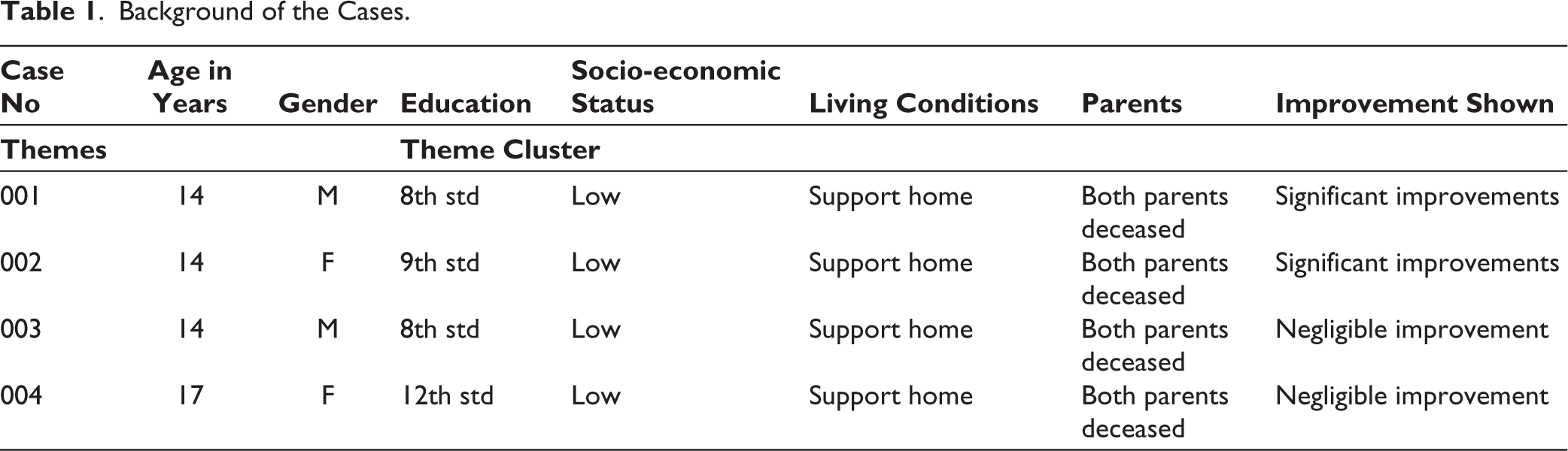
Background of the Cases.
Results and Discussions
Case 1
001 is a 14 year old male studying in class 8 in a government school. He is residing in the HIV care and support home for 5 years. Earlier, he stayed with his relatives for some time; later he moved into the organization. 001 lost both his parents to AIDS. He has a younger sister who resides in the female section of the same HIV care and support home. 001 is also aware of his HIV positive status and has been under ART since birth. He reports skin rashes and hair loss. He was hesitant to talk initially, but later he voluntarily participated and practiced the techniques imparted in the intervention program. 001 showed significant improvement post intervention.
Case 2
002 is a 14-year-old female, studying in class 9 in a government school. She is residing in the HIV care and support home for 4 years. 002 lost her parents to AIDS after she joined the center. She has her grandparents at her native place, which she visits twice a year during vacations. 002 is aware of her HIV positive status. She considers herself responsible, caring, and has immense faith in God. She keeps mentioning her favorite deity very often. 002 is regular with her medication. Initially, she tended to communicate aggressively with elders and other members in her institution, including the researcher, which slowly reduced during the intervention. She also had a negative attitude towards her complexion and physique; later she seemed to be accepting the same. Case 002 showed significant improvement.
Case 3
003 is a 14 year old male, studying in class 8. He is residing in the HIV care and support home for 8 years. 003 lost his parents in his early childhood. He has no siblings. He mentioned that he just has one uncle who visits him or he makes a visit to their house once or twice a year. 003 mentions that he is unhealthy and sick most of the time. He was regular for the sessions but remained silent in the latter half. He reports that he gets easily hurt and is tearful often. He participates in all the activities yet mentions that it will not make any difference. Case 003 showed negligible improvement.
Case 4
004 is a 17 years old female pursuing II PUC. She is residing in the HIV care and support home for 11 years. 004 have a younger brother who stays in the same center. They have their relatives whom they visit twice a year. She is like a mother to the rest of the younger kids in the center and stays with younger kids when they are sick or hospitalized. 004 has issues with hair loss. She blames God for her situation and also feels that studying is wasting money. 004 was active in all the sessions. Case 004 showed negligible improvement.
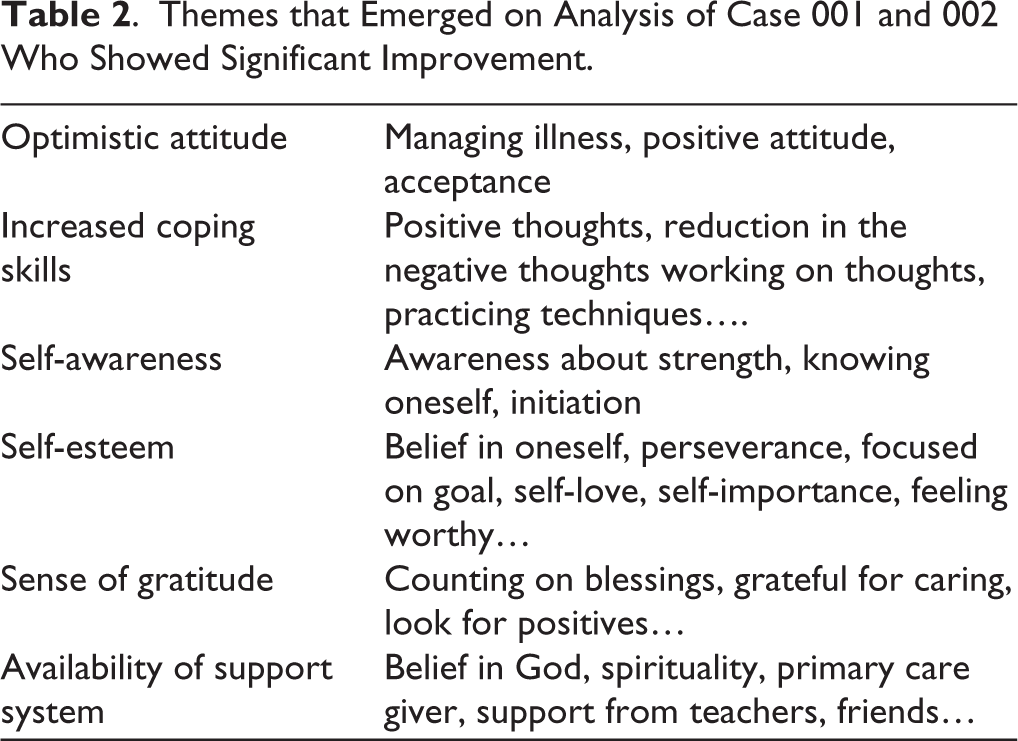
Themes that Emerged on Analysis of Case 001 and 002 Who Showed Significant Improvement.
Optimistic Attitude
Optimism is defined as having hopefulness and confidence about the future or successful outcome of something. It is a tendency to take a favorable or hopeful view. 11 An optimistic attitude is a kind of attitude and a form of positive thinking that includes the belief that more good things will continue to happen irrespective of the current situations. Comprehensive intervention brought in a greater optimistic attitude concerning their illness among the participant by building hope: “Now I know my illness cannot be cured but people are managing. …I too can,” accepting the death of dear ones “I learned that they will not come back, even If I punish myself…only I will be suffering.” “Now I have stopped waiting for relatives to take me,” “I learned to accept myself even if they don’t come” creating positive attitude within them “this is another motivation to study well” and also to acknowledge help from caregivers and other well-wishers. “Now I feel they like us and they want to help us so they come here.”
Increased Coping Skills
Coping skills here refer to independence and self-management among HIV positive adolescents. As they move to adulthood, they need to take responsibility for themselves like, medical care, set goals, find ways to support themselves, handle stigma, and make decisions. The development of positive coping mechanisms and skills can improve mental health among adolescents living with HIV.12,13 Post-intervention, participants 001 and 002 experienced increased positive thoughts and reduction in the negative thoughts, “Now thoughts about death have stopped” “when ‘R’ was in ICU, I got a dream about the hospital, but I am trying to give a positive message as I can manage myself, I have strength in me.” Participants are practicing techniques taught during the session which is helping them move towards self-management, “I am practicing few techniques that you taught in the session. Breathing techniques, mirror exercises.” Participants experienced increased emotional regulation—“As I told earlier, I was short-tempered… (Smile)…. I used to hit people, or if it were seniors, I would give back answers or bang my head…. Now 60%, it has reduced, sometimes when I go uncontrollable, I tell myself ‘I can be calm’…. I go away from fights, come back, and talk later when I am cool. I am less in trouble now.” 001 and 002 also reported better initiation and participation in the extracurricular activities at school: “I participate in games and fun now, dancing, singing. I have started writing poems; I participate in many activities in school.”
Self-awareness and Self-esteem
The development of self-esteem is critical at this period of adolescence due to physical and psychological changes. Knowledge about who they are and what they are is significant, irrespective of their disease conditions. Participants post-intervention felt that their awareness about self, increased, “I am aware of these two strengths that I am a leader and I have helping nature. Now I consider it as my strength; earlier I was upset when my coordinator gave me responsibility. Now I feel good about it because it makes me happy. I initiate bhajans in the night and yoga sessions in the morning along with ‘S’. I am more active and responsible now.”
Extracts from the participants from the interview reveal that belief in oneself has also increased—“I do my work well now; I feel like I am also like other children in the class. I feel good, but I can still be better. I have talents and abilities. I too, like them, want to study and take care of myself. I feel I too can achieve something like others. I have the capacity like others. Earlier I used to think that I was useless, now I don’t have that thought.” The participants experienced greater focus on the goal, increased perseverance, looking forward toward life and feeling worthy. “generally I try once or twice to achieve the goal if I am not able to achieve, then I change the goal and go for an easy one. Now I don’t do that; I give few more chances for myself and put effort to reach the goal.” “Through Intervention, I understood the importance of goals and the need to achieve them. I have a goal sheet for every week and big plans after 10th like, work, money, dressing up well… helping others, etc…. When I see seniors (those who are HIV positive) who are working, I feel I too can achieve my goal.”
Sense of Gratitude and Source of Support
Sense of gratitude here is a positive emotional response to accept and acknowledge the help and favors by others. It also includes appreciating the blessings in one’s life. The participants here felt an increased sense of gratitude post-intervention. “Now I think about my blessings. Think about other options during a crisis. Earlier I considered this caring as irritation; now, I am grateful for it; now I look into good things in my life.”
The source of support here represents the ability of the participants to identify the support around and within them. 001 and 002 were able to identify various sources of support like: belief in God—“God—I believe is Lord Ganesha, so I pray to him and also to other gods”; to recognize the support from the primary caregiver, the center, where the individual resides—“I appreciate the support, I get from Aunty and friend”; support from teachers, friends—“I take help from friends and other classmates…”; to take correction from caregivers, accept care during ill-health, and feeling good being connected—“My friends correct me when I am wrong, take care of me…. I feel good that I have someone to care for me, Aunty and Akka are caring.”
Low Self-esteem
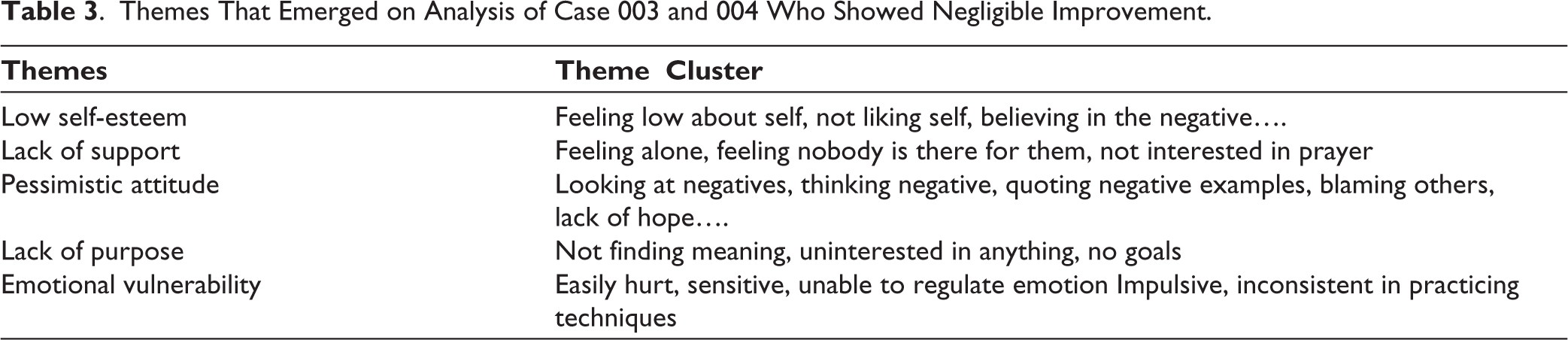
Low self-esteem in people living with HIV is due to rejection, loss of social identity, and the physical consequences of HIV disease. 14 Similarly, participants 003 and 004 experienced feeling low about self, low confidence, not liking one, believing in the negative. “I have hair loss. I feel uncomfortable going to school because I am worried about what other children might think about me. I am weak and sensitive; I am unhealthy and sick all the time. I know I can’t handle… so I avoid going to school.”
Themes That Emerged on Analysis of Case 003 and 004 Who Showed Negligible Improvement.
Pessimistic Attitude
Being pessimistic here is a state of mind in which one anticipates undesirable outcomes in life outweigh the blessings. It describes a general belief that things/situations are bad and tend to become worse.11,15 Participants 003 and 004 tend to look at the negative perspective—“I always think about what wrong did I do, for God to punish Me. I can see that all the time people are falling sick here.” Thinking negative, quoting negative examples and lack of hope—“One Akka was in the hospital for four months and then she just leaves us…. Till then I was having hope; later I felt that one day I too will suffer and die like her.
Lack of Purpose and Lack of Support
Lack of purpose here is not finding meaning in one’s existence but lack of goal and hope. Participants 003 and 004 shared experiencing thoughts related to “Why me?” “I always think what wrong did I do for God to punish me.” Consistently referring back to their illness and emphasizing on awaiting death, “I know I am sick,” “death and suffering will soon embrace me.”
The extract from the interview of 003 and 004 indicates, feeling alone and perceived lack of support around them. “I don’t have anyone; no one comes to meet me…. I am here all the time feeling alone” The participants also felt that the support offered seemed pretentious and hollow, “they help for namesake, people come here to celebrate their birthday and take the photo for themselves”; they consistently mentioned about feeling unwanted, “nobody wants to be with sick people.” The initiated effort to improve one seems to be thwarted by the frequent illness and hospitalization of other inmates, “I could see improvement in how I felt and behaved for some time but the SA being sick and hospitalized brought back meaninglessness in my life.”
Emotional Vulnerability
Emotional vulnerability here is emotional sensitivity, emotional reactivity, or tendency to experience very strong emotional responses and slow return to emotional baseline. 003 and 004 experienced difficulties in regulating their emotions and being impulsive, “I get angry, then I scold others, use bad words and then sometimes hit people; I feel sad easily; I feel it will not change.” Participants also mentioned being inconsistent in practicing techniques, “I feel it will not change. I tried to control by doing some techniques but sometimes it works, sometimes it doesn’t work.”
The cross-analysis of the cases identifies three intersecting factors—optimistic/pessimistic attitude, self-esteem, and perception of support among the outliers who showed remarkable improvement and who showed negligible improvement. On the theme self-esteem, participants who showed remarkable improvement experienced the feeling of self-worth resulting in increased belief in oneself, feeling significant, resourceful, and confident. On the other hand, the participants at the lower end reported low self-esteem and self-worth subsequently feeling unsure and lack of belief in themselves, and lack confidence. Studies have identified that low self-esteem in people living with HIV is due to rejection, loss of social identity, and the physical consequences of HIV disease; however, increased self-esteem can make the individual living with HIV positively perceive him/her. 16
The second theme, perception of support, is an inevitable factor that can enhance as well as negatively influence the adolescent’s development. The present study identifies that participants who showed remarkable improvement perceived increased support both concerning identifying sources for help as well as receiving care and support from other stakeholders, whereas the participants who showed negligible improvement were unable to identify the availability of support and also perceived the support received as hollow. Aligning to these findings, WHO identifies that if adolescents are supported to live interdependently, find ways of supporting themselves, interact with health providers, they are more able to adhere to treatment, remain engaged in HIV care, and face the other challenges of adolescence, demands of everyday life, and lead a productive life. 17
Cross Analysis of Cases Across Outliers Who Showed Significant Improvement (001&002) and Who Showed Negligible Improvement (003 & 004).

Optimistic/Pessimistic attitude, the third intersecting factor, points out 2 perspectives or outlooks an individual can take. This includes the tendency to take a favorable or hopeful view or to anticipate negative outcomes. 11 The participants who showed significant improvement were more optimistic, presented a greater sense of gratitude, were open to experience, and showed a positive attitude. On the other hand, participants who showed negligible improvement displayed a tendency to blame others for their situation and were pessimistic towards self, others, and the world around them. In a similar line, earlier studies have identified that optimism is associated with the slower progression of AIDS, positively associated with psychological wellbeing, and psychological wellbeing is negatively associated with HIV-related stigma.18,19 In contrast higher pessimism is associated with higher viral load among HIV-positive individuals. 20
Conclusion
Among the participants who showed remarkable improvement, enhancement of self-esteem and perception of support was noticed, and they had also showed an increase in optimistic attitude over pessimistic attitude. On the other hand, lack of purpose in life, emotional vulnerability, perceiving the support received as shallow were noticed among the ones who showed negligible improvement post-intervention. One of the factors which might have contributed to the above could be that these 2 participants who had shown negligible improvement were the caregivers for one of the inmate of their hostel who was terminally ill and who eventually died during the post-test assessment.
Footnotes
Declaration of Conflicting Interests
The authors declared no potential conflicts of interest with respect to the research, authorship, and/or publication of this article.
Ethical Approval
This study was approved by institutional ethics committee 001 and 002 (anonymized) dated June 22, 2018; September 18, 2018. Informed assent from all participants was taken prior to their enrolment in the study.
Funding
The authors received no financial support for the research, authorship, and/or publication of this article.