




Abstract
Introduction:
Child sexual abuse (CSA) is defined as all kinds of actions that an adult uses a child for sexual purposes. The studies concluded that parents have incomplete or incorrect information and the protection of children against abuse is the fundamental duty of parents. This study analyses the CSA awareness levels of parents.
Methods:
Descriptive survey model is performed. The research sample covers 455 parents. The Child Sexual Abuse Awareness Scale for Parents and a demographical information form was used for research data collection and analyzed on SPSS 21.0 software.
Results:
A statistically significant difference was found between parents’ CSA awareness levels and age, gender, marital status, duration of marriage, education level, and number of children. The results showed that parents who were married for up to 10 years had a university degree, had only 1 child, and had higher awareness of sexual abuse myths. Contrary to expectations, no significant results were obtained regarding the signs of sexual abuse scores of groups with high awareness of myths of sexual abuse.
Implications for Research and Practice:
Contrary to the literature, the awareness levels of fathers about CSA are lower than the awareness levels of mothers, and the awareness levels of parents decrease as they get older. There is a need for further comprehensive and more scientific studies to identify the CSA problem in North Cyprus and propose solutions, and consequently prevention programs should be developed for professional groups that are related with child and parents.
Introduction
In its most general sense, child sexual abuse (CSA) is defined as all kinds of actions that an adult uses a child for sexual provocation/stimulation or satisfaction purposes 1–3. World Health Organization (WHO) explains this type of abuse where a child is not able to fully comprehend what the nature of action is, and being forced to the sexual actions while physical, emotional, and social development continue and particularly does not have the ability and power to judge whether to experience such actions. 4 Studies show that the most vulnerable age for abuse is between the ages of 7 and 13. 5
Among the other types of abuses, CSA is considered as challenging since it may continue for years. The child thinks that no one will believe him/her because the perpetrator is a relative or acquaintance. Furthermore, in many cases perpetrator threatens the child or child would not know how to tackle such situation.6–8 With all these elements, CSA is kept a secret or continue for many years. Another reason why CSA is not detected early is that sexual abuse actions range from no-contact types such as talking dirty, showing pornographic images, peeping, or exhibitionism to actions with contact such as sexual touching or rape. 9 Hence, the reveal of abuse mostly occurs in a coincidental way.
As the recent studies conducted around the world would suggest, the CSA figures are alarming. The annual report by the WHO reflected that 26% of children are sexually abused and 1 in 5 women and 1 in 13 men were sexually abused during their childhood. 10 In 2022, 120 million girls under the age of 20 were added to these statistics. 11 Pursuant to the report by UNICEF published on the CSA around the world, around 17 million adult women from 38 low- and middle- income countries were forced for sexual intercourse during their childhood. Moreover, a meta-analysis study conducted through 65 researched on the CSA in 22 countries from America, Africa, Europe, and Asia continents revealed that Africa has the highest rate of incidence from the geographical perspective, while the rate of incidence in America and Asia varies between 10.1% and 23.9% while Europe has the lowest rate with 9.2%. 12 This rate can be expressed as 1 in 10 young girls under the age of 20 has a history of CSA globally. 13 The mentioned data are calculated on the reported cases and it can be said that the actual numbers are much higher.
In North Cyprus, there is a lack of official statistical data on child abuse published by government institutions. While the number of studies conducted on the subject matter is not sufficient, there are a number of studies to screen the prevalence of the problem. 14 In a study conducted with 338 parents in North Cyprus, no significant difference was found in terms of their potential to abuse their children. 15 This study on the CSA was undertaken based on the information from police registry. The study showed that there are 267 sex offence victims in all sexual assault cases between 2008 and 2014, and 79 (67 female, 12 male) of the victims are children between the ages of 0 and 18. 16 Another study regarding the views of parents on the CSA reflected that parents have limited knowledge about the issue. 17 Although the studies conducted in the country give a rough idea, more detailed data are needed for prevention studies.
Although CSA exists since the existence of mankind, it has grabbed attention in the last century. As the interest toward this issue was elevated, solutions to eliminate this problem were pursued, and the related studies have become a priority health matter around the world. 18 UNICEF child protection policies indicate that the prevention of child abuse is related with raising awareness of children and all adults that have direct or indirect contact with children.19–21 Therefore, it is possible to say that parents are the foremost and primary people in protecting children against abuse. 22 Although family members are known as the main perpetrators in CSA, 23 the protection of children against abuse is the fundamental duty of the parents. 24
For the prevention of CSA, the problem factors should be established. The studies conducted on CSA with parents regarding the solution of problem concluded that parents have incomplete or incorrect information.25–27 In terms of the rationale behind such lack of information among parents, there are a number of scales developed for parents, yet such scales measure either the parents’ potential in abusing their children 28 or their own sexual abuse experiences from their childhood 29 or parents’ stereotype behaviors following such experiences. 30 While such studies provide information about parents on the level of their abusing their children or of them being abused, there is not any specific information regarding their knowledge and awareness levels.
Another important aspect with regard to the insufficient knowledge and awareness of parents is that false facts, namely myths, about CSA are a crucial part in having incorrect information about sexual abuse.31–33 Myths about CSA may hinder the real prevalence figures and particularly mislead about victims and abusers, which would impede the solution or increase the problem itself.33–35 The most typical example in studies of myths affecting the level of awareness is that the majority of parents think that only strangers will abuse their children.32, 36 Other than the myths, parents do not have the common understanding on how they would behave to protect their children against abuse. In fact, parents have difficulties to talk to their children about these issues or even consider that sexual education would negatively affect their children’s sexual development. 37 According to a study conducted in 2021 on sexual abuse prevention, parents talk more about child abduction, drug use, and death than abuse, and more than half of parents think that educating their children against abuse is harmful. 38 Besides the various sexual taboos that parents who consider CSA prevention education to be harmful, their lack of knowledge about what to teach about abuse may also be a factor. 39 According to the research conducted in this context, nearly 40% of the parents had no conversation with their children about CSA and 20% believed that their children were not at risk. 40
Knowing the awareness levels of parents about CSA, it would allow more concrete steps toward the solution of problem since a high level of knowledge and awareness among parents would help them to educate and protect their children as they would know the risk factors accordingly. This study aims to analyze the CSA awareness levels of parents on CSA who have children at the age of 8 to 10 based on certain variables.
The following sub-problems would be assessed based on this main problem:
Do the awareness levels of parents vary with age? Do the awareness levels of parents vary with gender? Do the awareness levels of parents vary with marital status? Do the awareness levels of parents vary with the duration of marriage? Do the awareness levels of parents vary with education level? Do the awareness levels of parents vary with their number of children? Do the awareness levels of parents vary with employment status?
Methods
Research Model
This is a descriptive survey research performed to analyze the effect of some socio-demographic characteristics on the CSA awareness levels of parents on CSA who have children at the age of 8 to 10. Survey model allows the identification of existing status in a group and analysis based on their specific characteristics.41, 42
Research Sample
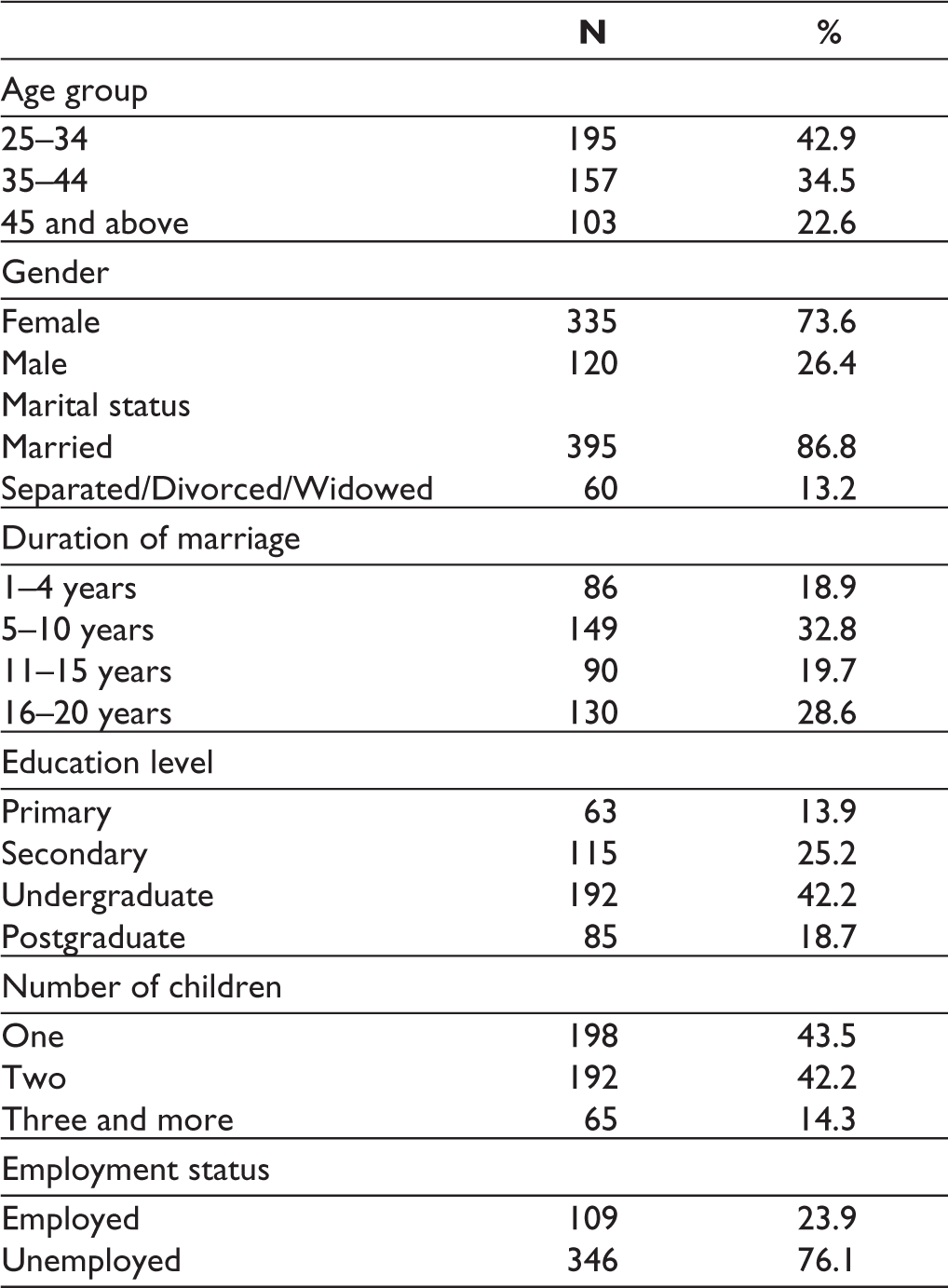
The research population is comprised of parents that have children at the age of 8 to 10 studying in a public school, Nicosia. The convenience sampling method was chosen because of the sensitivity of the subject and the reluctance of many schools to participate in the study. The number of children in this age group is 493 (996 mothers and fathers), and the calculated sample size 43 is 278. The research sample covers a total number of 455 parents as 335 mothers and 120 fathers (Table 1).
Sociodemographic Characteristics of Participants.
Research Instruments
The Child Sexual Abuse Awareness Scale for Parents (CSAASP) was used for research data collection, and a demographical information form developed by the researchers was utilized to gather demographical information.
Child Sexual Abuse Awareness Scale for Parents
The scale was developed by Berkmen and Seçim 44 in North Cyprus to identify the CSA awareness levels of parents on CSA who have children at the age of 8 to 10. The reliability coefficient of scale was found as 0.91 and Cronbach’s Alpha internal consistency coefficient as 0.90. The 5-Point Likert scale with 23 items is comprised of 3 sub-dimensions as Myths of Sexual Abuse, Teachings/Actions against Abuse, and Signs of Sexual Abuse. As the score of scale goes above the average value, the awareness levels of parents on the CSA increases, and the awareness level decreases as the score goes below the average value. 44
Demographic Information Form
Demographic information form was developed by the researchers in order to obtain information about parents. This form covers questions regarding the age, gender, marital status, duration of marriage, education level, employment status, and number of children.
Procedure
First, the information on the scope of study was submitted to the Cyprus International University Ethics Committee for approval. Following the approval from the Committee, 4 public primary schools with the largest number of students in Nicosia were contacted and informed about the aim of the study. Only 1 of the primary school administrations allowed the study to be conducted. In the next step, an official letter of permission was taken for the primary school agreeing to give the contact details of parents from Turkish Republic of Northern Campus Ministry of National Education and Culture.
The data collection phase of study was performed by the voluntary parents who came to the school on the dates decided by the researchers and approved by the school administration. Parents were informed on the aim of parents and that they can leave the study whenever they want. Parents participated in groups with around 55 to 60 people at the school’s conference hall. The activity took around 25 min. On the other hand, 103 parents asked to fill the questionnaire at home indicating that they could not come due to their working hours, and delivered their questionnaires next day. The whole data were collected in 8 days.
Data Analysis
All data generated from parents were analyzed on SPSS 23.0 software, and the correlation between the mean values of CSAASP and socio-demographic characteristics of study group were tested with Mann-Whitney U (M-W) and Kruskal-Wallis (K-W).
Results
This part covers the socio-demographic details of parents participating in the study, and statistical analysis results. The identifying characteristics of parents were determined via frequency analysis, while descriptive statistics were used for the determination of CSAASP scores.
First, Kolmogorov-Smirnov (0.04, P > .05) tests was performed to determine whether scores had a normal distribution, which would allow comparing CSAASP scores of parents with their identifying characteristics. The results showed that the data was not normally distributed. 45 Since the scores do not fit with normal distribution, the use of nonparametric hypothesis tests was preferred respectively. K-W test was performed considering that the independent variable in comparing the CSAASP scores of parents by their age groups, duration of marriage, education level, and number of children has 3 and more categories. 42 In the variables that include more than 2 groups, such as age, number of children, duration of marriage, and education level, the division of the groups is planned according to categorical or equal intervals. The independent variable in comparing the CSAASP scores of parents by their gender, marital status, and employment status has 2 categories, 42 thus M-W test was applied accordingly. The correlation between the scores from CSAASP sub-dimensions was identified with Spearman test and detailed tables are placed in the Appendix.
Table 2 presents the results from M-W test regarding the comparison of CSAASP scores of participants by their gender. Therefore, the scores of participants from CSAASP in general and sub-dimensions—teachings and actions against abuse, myths of sexual abuse, signs of sexual abuse—have statistically significant difference (P < .01). The scores of female parents from CSAASP in general and sub-dimensions— teachings and actions against abuse, myths of sexual abuse, signs of sexual abuse—are higher than the male parents.
Comparison of CSAASP Scores of Participants by Socio-Demographic Characteristics.
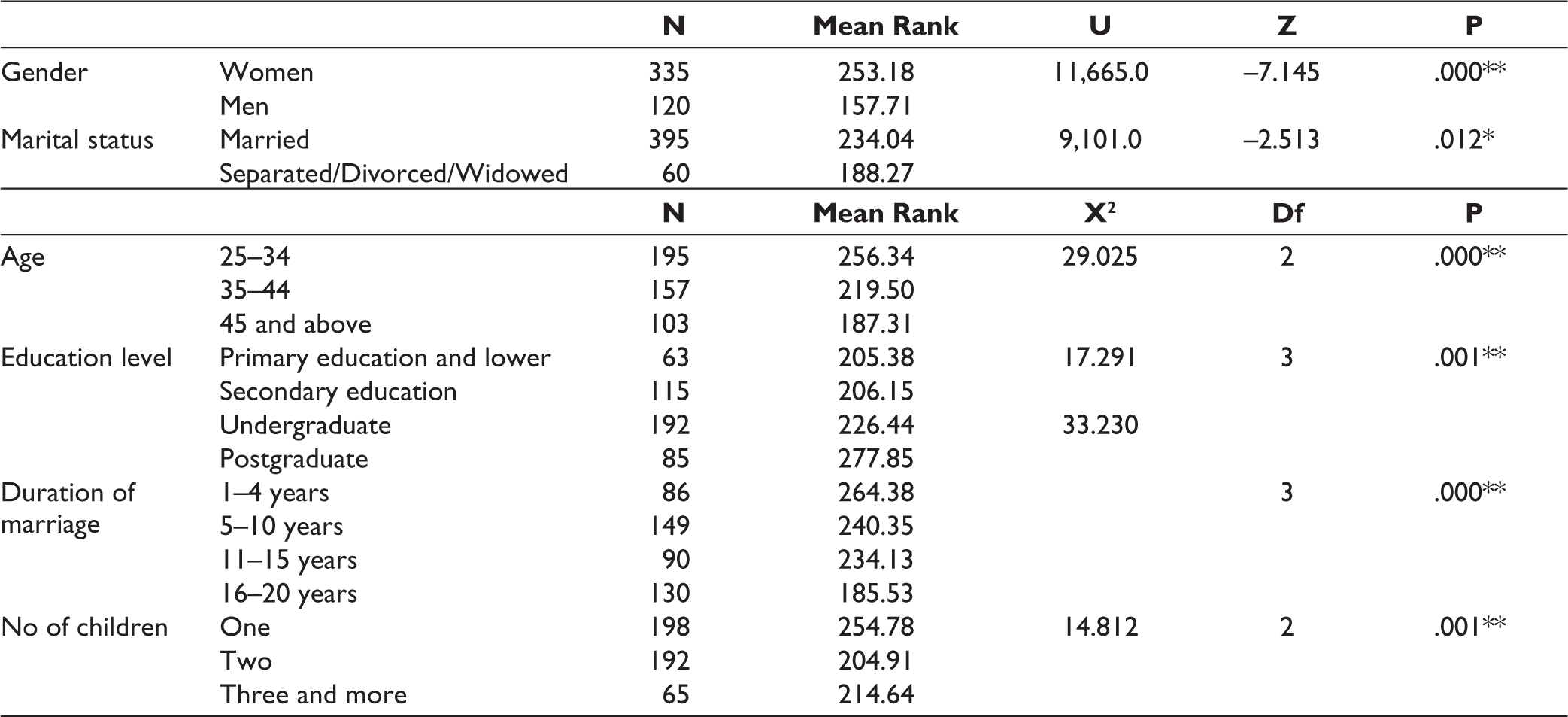
The M-W test results applied on the comparison of CSAASP scores of parents based on their marital status. With regard to the marital status of parents, the scores from the sub- dimensions of CSAASP as teachings and actions against abuse and signs of sexual abuse do not have statistically significant difference (P < .05). Although the scores of married parents from the sub-dimensions as teachings and actions against abuse and signs of sexual abuse are higher, this difference is not considered as statistically significant. Based on the marital status of parents, the scores from the CSAASP in general and sub-dimension as the myths of sexual abuse have statistically significant difference (P < .05). The scores of married parents are higher than the separated/divorced/widowed parents.
The K-W test results applied for comparing the CSAASP scores of parents based on their age groups. Pursuant to the comparison of scores, the CSAASP scores of parents by their age groups have statistically significant difference (P < .01). The scores of parents that participated in the research in the age group of 25 to 34 are higher than the parents in the age group of 35 to 44 and 45 and above. Moreover, the scores of parents aged 35 to 44 are higher than the parents aged 45 and above. The scores of parents from the sub-dimensions of teachings and actions against abuse and myths of sexual abuse under CSAASP are statistically significant in terms of their age (P < .01). Consequently, the scores of parents aged 25 to 34 from the sub-dimension of teachings and actions against abuse were found as higher than the parents aged 45 and above. On the other hand, the parents aged 25 to 34 obtained higher scores from the sub-dimension of myths of sexual abuse than the parents aged 35 to 44 and older than 45. Also for the same sub-dimension, the parents aged 35 to 44 had higher scores than the parents aged 45 and above. Post hoc results can be seen in the Appendix.
The K-W test applied to compare the CSAASP scores of parents by their education levels. The scores of participants from the sub-dimension of teachings and actions against abuse under CSAASP have statistically significant difference by their education levels (P < .05). The scores of parents with undergraduate education have higher scores from the sub- dimension of teachings and actions against abuse than the parents with primary and lower level education. With regard to the education level of parents, the scores from the sub- dimension of myths of sexual abuse have statistically significant difference (P < .01). The myths of sexual abuse scores of parents with undergraduate education are significantly higher than other parents. Based on the education level of participants, the scores of parents from the signs of sexual abuse sub-dimension under CSAASP do not have any statistically significant difference (P > .05). In terms of the education level of participants, the scores of parents from CSAASP in general have statistically significant difference (P < .05). The scores of parents with undergraduate education are significantly higher than other parents and the results can be seen in the Appendix.
The K-W test applied to compare the CSAASP scores of parents by their duration of marriage. The difference in the scores of parents from the CSAASP sub-dimension as the teachings and actions against abuse is statistically significant (P < .05) and can be seen in the Appendix. Parents with the duration of marriage for 16 to 20 years have lower scores from the sub-dimension of teachings and actions against abuse than other participants. Pursuant to the duration of marriage, the scores of parents from the sub-dimension of myths of sexual abuse have statistically significant difference (P < .05). Parents with the duration marriage between 1 and 4 years have higher scores from the myths of sexual abuse than other parents. Additionally, the scores of participants with 5- to 10-year marriage from the myths of sexual abuse are higher than the participants with 16- to 20-year marriage. Based on the duration of marriage, the scores of parents from CSAASP signs of sexual abuse sub-dimension do not have statistically significant difference (P > .05). In terms of the duration of marriage, the scores of parents from CSAASP in general have statistically significant difference (P < .05). Parents with 1- to 4-year and 5- to 10-year marriages have higher scores from the scale in general than the parents with 16- to 20-year marriages.
The results of K-W test applied for comparing the CSAASP scores of parents by their number of children are given in Table 2. In terms of number of children, there is not any statistically significant difference between participants’ scores from the sub-dimensions of teachings and actions against abuse and signs of sexual abuse (P < .05). The scores of participants from CSAASP in general and sub- dimension of myths of sexual abuse are statistically significant by their number of children (P < .01). The scores of parents with 1 child have higher scores from CSAASP in general and sub-dimension of myths of sexual abuse than other parents. Post hoc results can be seen in the Appendix.
M-W test on the comparison of CSAASP scores with employment status of parents was analyzed respectively. As a result of analysis, there is not any statistically significant difference between the scores of parents from CSAASP in general and sub-dimensions of teachings and actions against abuse, myths of sexual abuse, and signs of sexual abuse (P < .05). The scores of employed and unemployed parents have similar scores from CSAASP in general and from its sub-dimensions.
Discussion, Conclusion, and Recommendations
This study analyzed the CSA awareness levels of parents that have children aged 8 to 10 and their average scale scores by comparing the mean scores with regard to the socio-demographic characteristics such as age, gender, marital status, duration of marriage, education level, employment status, and number of children. A total number of 455 parents participated in the study. Consequently, the scores of parents from the scale in general and the sub-dimensions as Teachings and Actions Against Abuse, Myths of Sexual Abuse, and Signs of Sexual Abuse differ by the gender variable, and the CSA awareness levels of fathers are lower than the awareness levels of mothers. Considering the research results from literature, there are different results. A study from Jordan showed that mothers with high education are more aware about CSA. 46 Contrary to this result, another study from Nigeria identified that the awareness levels of fathers are higher than the awareness levels of mothers. 47 Pursuant to a study from Turkey, the CSA awareness levels of parents do not vary by gender; yet, mothers are more worried than fathers, which lead them to take more appropriate measures toward protecting their children from abuse. 48 Another study concluded that the attitudes of 1,043 parents with low socio-economic level against neglect and abuse, and their level of knowledge on child abuse and neglect, do not differ by their gender. 49 A study conducted in North Cyprus reflected that the knowledge and awareness levels of parents on child abuse and neglect do not differ by gender. 50 According to these results, it can be thought that CSA awareness is shaped not only by the gender of individuals but also by gender roles and other variables in the culture they live in.
Parents’ ages are important factor on CSA awareness. Therefore, the awareness levels of parents decrease as they get older. The scores of parents aged 25 to 34 from the sub- dimension of teachings and actions against abuse were found as higher than the parents aged 45 and above. Moreover, the parents aged 25 to 34 obtained higher scores from the sub- dimension of myths of sexual abuse than the parents from other age groups. In consideration with other literature studies, there are similar but also different results. While the study by Gurung and Bahattarai 51 conducted in Kathmandu identified a relation between the child abuse awareness levels of parents and age group, another study identified that middle-aged and older individuals have much lower awareness than young adults. Pursuant to another study, there is not any relation between the child abuse awareness levels of parents and their ages. 52 Considering these results, being young can enable parents to follow the current developments in protecting their children from abuse and be more aware of the signs of abuse in their child.
Another important issue is the effect of parents’ education levels on CSA awareness. The study reflected that the average scale scores of parents differ with the education levels. Hence, the parents, who declared their education level as secondary education, have much higher CSA awareness levels than the parents with primary and lower education. A study conducted in China strongly correlated with the education levels of parents with the CSA awareness levels. 25 Another study concluded that education levels have an influence on the sexual abuse awareness levels of mothers without any influence on fathers. 53 A study conducted in Turkey with 455 parents analyzed the CSA knowledge levels of parents and concluded that illiterate and primary school graduate parents are less conscious about the various aspects of child abuse and neglect than the adults with higher education levels. 54 Pursuant to a study conducted in Tanzania, there is not any significant difference between the education levels of parents and abuse. 24 Bearing in mind that CSA is usually planned by the child’s relatives, 55 it is understandable that parents with higher levels of education have higher CSA awareness. The parents’ high level education enables them to gain information about CSA and risk factors. Consequently, the level of education provides an opportunity for the parents to learn how to protect their child from CSA.
As expected, the CSA awareness levels of parents decrease where the number of children that parents has increases. Considering the literature, there are results that the increase in the number of children decreases the awareness, in other words increase the abuse risk.56, 57 Another study identified that one-third of abused children are the only child. The reason behind the correlation between the number of children and decrease in awareness might be less affection, tolerance, and care given by parents to their children, and with the increase in the number of household, parents experience more stress with more responsibilities and life duties at home. 58
The study showed that the employment status of parents and their CSA awareness levels do not exhibit significant difference. Since the perpetrators of CSA are generally a relative or acquaintance,1, 3, 9 it is thought that the identification of abuse may not be related with employment status. In consideration with the study results, the awareness levels of parents under the sub-dimension of signs of sexual abuse do not significantly differ in any socio-demographic characteristics other than the gender variable.
From the overall perspective, this study is considered to be the first study in North Cyprus analyzing the child sexual awareness levels of parents. Moreover, there is a need for further comprehensive and more scientific studies to identify the CSA problem in North Cyprus and propose solutions, and consequently prevention programs should be developed for professional groups that are related with child and parents.14, 49 As a result of the results of the study, it may be suggested to develop a CSA prevention program for the study group to increase the knowledge and awareness of the parents.
As in every study, this study has 2 limitations. First of these, the study group consists of parents with children aged 8 to 10 who are studying in a primary school in Nicosia. Due to the sensitive nature of the subject, many school administrations decided not to be a part of the study. Therefore, the study shows us the result about a partial region. The second limitation is that due to the scale used, the parents participating in the study only had children between the ages of 8 and 10. In this sense, conducting the study with parents who have children in different age groups will provide us with more comprehensive information.
Footnotes
Declaration of Conflicting Interests
The author declared no potential conflicts of interest with respect to the research, authorship, and/or publication of this article.
Ethical Approval
The information on the scope of study was submitted to the Cyprus International University Ethics Committee for approval. After the study received approval from the Committee, 4 schools in Nicosia were contacted and informed about the aim of the study. Only 1 of the primary school administrations allowed the study to be conducted. In the next step, an official letter of permission was taken for the primary school agreeing to give the contact details of parents from TRNC Ministry of National Education and Culture. Necessary ethical clearances were received and obtained respectively before initiating the study.
Funding
The author received no financial support for the research, authorship, and/or publication of this article.
Informed Consent
Informed consent was received and obtained respectively before initiating the study from all participants.