




Abstract
Background:
Unhealthy sleep patterns have been linked to a variety of adverse effects in children, and temperament could be an influencing factor in poor sleep quality.
Aim:
This study examined the association between temperament and sleep quality among preschoolers.
Methods:
The participants of the study were 35 children aged 3 years to 6 years in Northern Peninsular Malaysia. Observational sleep was recorded across 14 days. Further, a self-administered questionnaire was used to capture the children’s sleep-related issues. The Children’s Behavior Questionnaire-Very-Short-Form was used to measure the temperament of the children. The relationship between sleep patterns and sleep-related issues and temperament was assessed.
Results:
No significant differences were found between the 3 subscales of temperament sleep duration, and sleep and wake times, for both night sleep and naps. Concerning the association between temperament and children’s sleep issues, a negative weak correlation was found between negative affect and children’s difficulty falling asleep, as well as frequent night-time waking. Effortful control was found to have a weak positive correlation with “sufficient sleep” and “earliness of the sleep,” with a negative correlation for the topic “a child’s bad mood and crying through the day.”
Conclusions:
The results of this study did not show positive correlations between temperament and quality of sleep among preschool children in Malaysia, though some children’s sleep issue was correlated with temperament. Similar to other studies, these results might be an indication that a child’s difficult temperament could be a factor affecting sleep quality though further large-scale studies will be needed.
Introduction
Sufficient sleep is important for the mental, emotional, and physical health of children because sleep plays a major role in child development.1, 2 The sleep duration, quality, and pattern tend to change over a lifespan, particularly in the first 5 years of life, making preschool an important phase for developing a healthy sleep schedule. 3 Previous studies have found that preschool children aged 3 years to 6 years slept for approximately 10 h to 13 h in 24 h, 4 and the length of sleep gradually declined as they grew during the 3 years.4, 5 The quality of sleep is assessed not only by the sleeping hours but also by considering its qualitative aspects. Research has revealed that unhealthy sleep patterns are linked to a variety of adverse effects in preschoolers.6–9 Studies have also highlighted the negative impacts of poor sleep on social and educational development, such as concerns with educational outcomes, learning and memory, academic achievement, and adjustment.8–13 Sleep-related issues among preschoolers are reported to be very common and a quarter of parents with children under 5 reported sleep issues among their children, which has been associated with poor behavior, reduced school performance, and obesity.3, 14 Therefore, assessing the quality of sleep of preschoolers is important because of an increased risk associated with irregular sleep rhythms and patterns in later years due to inadequate or poor sleep in the early stages of life. 13
Some studies have indicated associations between sleep issues and a difficult temperament.15–17 Research on temperament has been principally based on 4 prominent temperament theories, namely those of Rothbart, Thomas and Chess, Buss and Plomin, and Goldsmith.18–22 Rothbart defines temperament as the initial state from which a personality develops, and links individual differences in behavior to underlying neural networks. 18 Rothbart developed a tool to measure temperament, namely, the Child Behavior Questionnaire (CBQ). Regarding the study of temperament in Malaysia, an international comparative study on temperament was conducted in 1989 by employing the model of Thomas and Chess. 23 In recent years, a study conducted in 2013 used the CBQ to assess behavioral adjustment among preschoolers. 24 In 2016, another study using the CBQ was conducted among Malaysian preschoolers. 25
However, research focusing on temperament and sleep quality in early childhood in Malaysia could not be found. Therefore, the present study sought to assess the relationship between temperament and sleeping hours, sleep and waking time, and parents’ perception of their children’s life or sleeping issues, among children in Malaysia using the Malay language. The study hypothesized that children with parent-reported sleeping issues, those showing higher scores on surgency, and those with negative affectivity, would demonstrate a lower quality of sleep. Concerning effortful control, the assumption was that children with higher effortful control scores would demonstrate a higher sleep quality. In this study, the children’s temperament was examined using the CBQ (Bahasa Malay version), which is an internationally used assessment scale for measuring the temperament of children aged 3 years to 7 years.
Methods
Sample Selection
The sample comprised 35 children and their guardians. The children attended kindergartens during the weekdays. Due to geographical constraints, 2 states in northern Peninsular Malaysia were selected for the survey. Further, the researchers requested other kindergartens to participate in the survey through informal teacher’s forums. Four childcare facilities—1 daycare and 3 kindergartens—in northern Peninsular Malaysia agreed to cooperate if the children’s guardians agreed to engage in the survey. To obtain the children’s sleep records, briefing sessions were conducted, and written informed consent was obtained from all participants. As the children were minors, their guardians gave consent on their behalf. The survey period was between December 2019 and February 2020.
Measures
Sleep Patterns
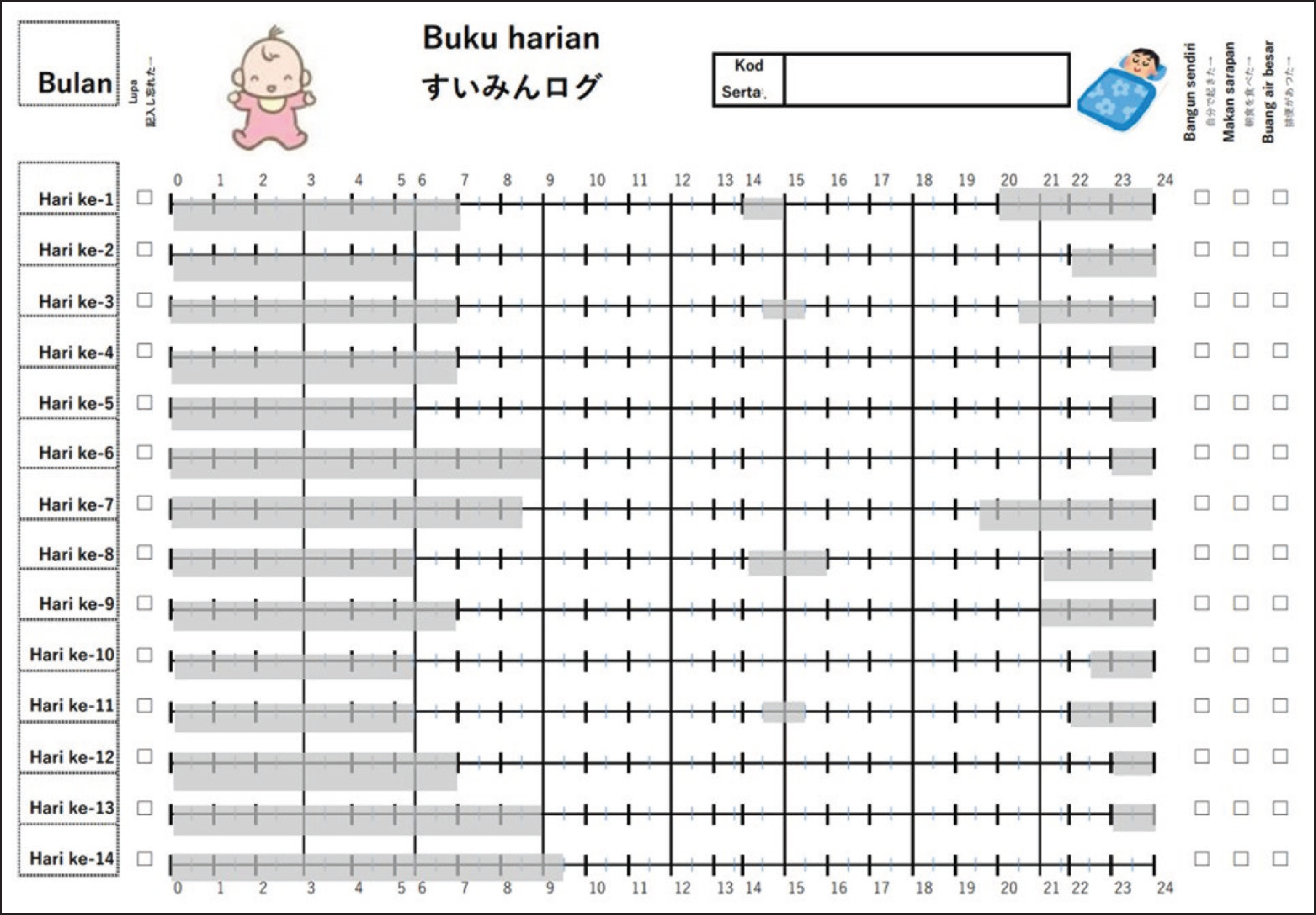
To obtain information on the children’s sleep patterns, the caregivers at home and staff at the childcare facilities kept observational records of either night-time sleep or naps over 24-h periods for 14 consecutive days. Figure 1 shows a sample of the sleep log used in this survey. This form is called the Miike’s log and has been used in several studies in Japan.26, 27 The caregivers or staff described the children’s sleep patterns by drawing lines on a timetable. If the children woke up in the middle of their sleep, for example, due to nighttime crying, the line would be discontinued upon their waking.
Examples of a Sleep Log
Guardians’ Perceptions About Children’s Sleep Issues
Concerning guardians’ perceptions of their children’s sleep issues, a questionnaire composed of 13 topics regarding children’s sleep-related issues was used. This questionnaire was initially developed by referring to the Japanese Sleep Questionnaire for Preschoolers, 28 which was translated to Malay for this study. A semi-structured questionnaire was distributed to the guardians, in which questions were asked about their children’s sleep habits and issues. The questionnaire sought details including the children’s demographic characteristics, parents’ age, occupation, the highest level of education, and perception of their children’s sleep quality, along with any other issue regarding their children’s sleeping habits. Concerning the children’s sleep issues, 13 topics were selected relating to the frequency of sleep issues: my child’s “quality of sleep is high,” “my child always sleeps long enough,” “stays up late,” “goes to sleep early,” “goes to bed and wakes up at a regular time,” “grinds his/her teeth during his/her sleep,” “snores,” “sleeps quietly,” “has trouble falling asleep and it takes more than one hour for him/her to do so,” “is in a bad mood before sleeping,” “wakes up more than three times per night due to crying,” “is awake for more than one hour per night due to crying,” and “is always in a bad mood and keeps crying.” The children’s guardians selected answers from the 13 topics related to possible concerns about their children’s sleeping habits.
Temperament
Based on previous research, the scales of the CBQ were standardized to yield 3 subscales of child temperament: 12 items each for surgency, negative affect, and effortful control to form the Children’s Behavior Questionnaire-Very-Short-Form (CBQ-VSF), a 36-item caretaker report. For the responses, a 7-point Likert-type scale (1 = extremely untrue of your child to 7 = extremely true of your child) was utilized.29–31 Surgency is an “approach” dimension of temperament characterized by impulsivity, intense pleasure-seeking, high activity levels, and low levels of shyness. 19 Negative affect was loaded from 4 scales of impulsivity anchoring surgency: frustration, sadness, fear, and discomfort. 29 Effortful control is a dimension indicated by the capacity to refrain from a desired or dominant behavior, while also maintaining attention on a task and resisting distraction. 19 The effortful control scale was based on 4 subscales: attentional shifting (focusing), inhibitory control, cuddliness (perceptual sensitivity), and low-intensity pleasure.29, 32 These forms were available in multiple languages at the secretariat of the Rothbart questionnaire, and the CBQ-VSF Malaysian version was used in this study.
Ethics Approval Statement
This study was approved by the Doshisha University Research Ethics Committee (human subject research; approval number: 19074) and was positioned as a pilot study.
Statistical Analysis
For analyzing the 14-day sleep records of the children, the average sleep duration and sleep/wake time per day were calculated for each child. The average temperament score for the 3 subscales, namely surgency, negative affect, and effortful control of the CBQ-VSF, were assessed using a t test, the Mann-Whitney U test, and Spearman’s rank correlation. The variables were sex and age of the children. The 3 subscales of the CBQ-VSF were used to measure the sleeping hours, sleep and waking time for nighttime sleep and naps, and guardians’ perceptions about their children’s sleep-related issues. All statistical analyses were performed using the IBM SPSS Statistical Software (version 26.0).
Results
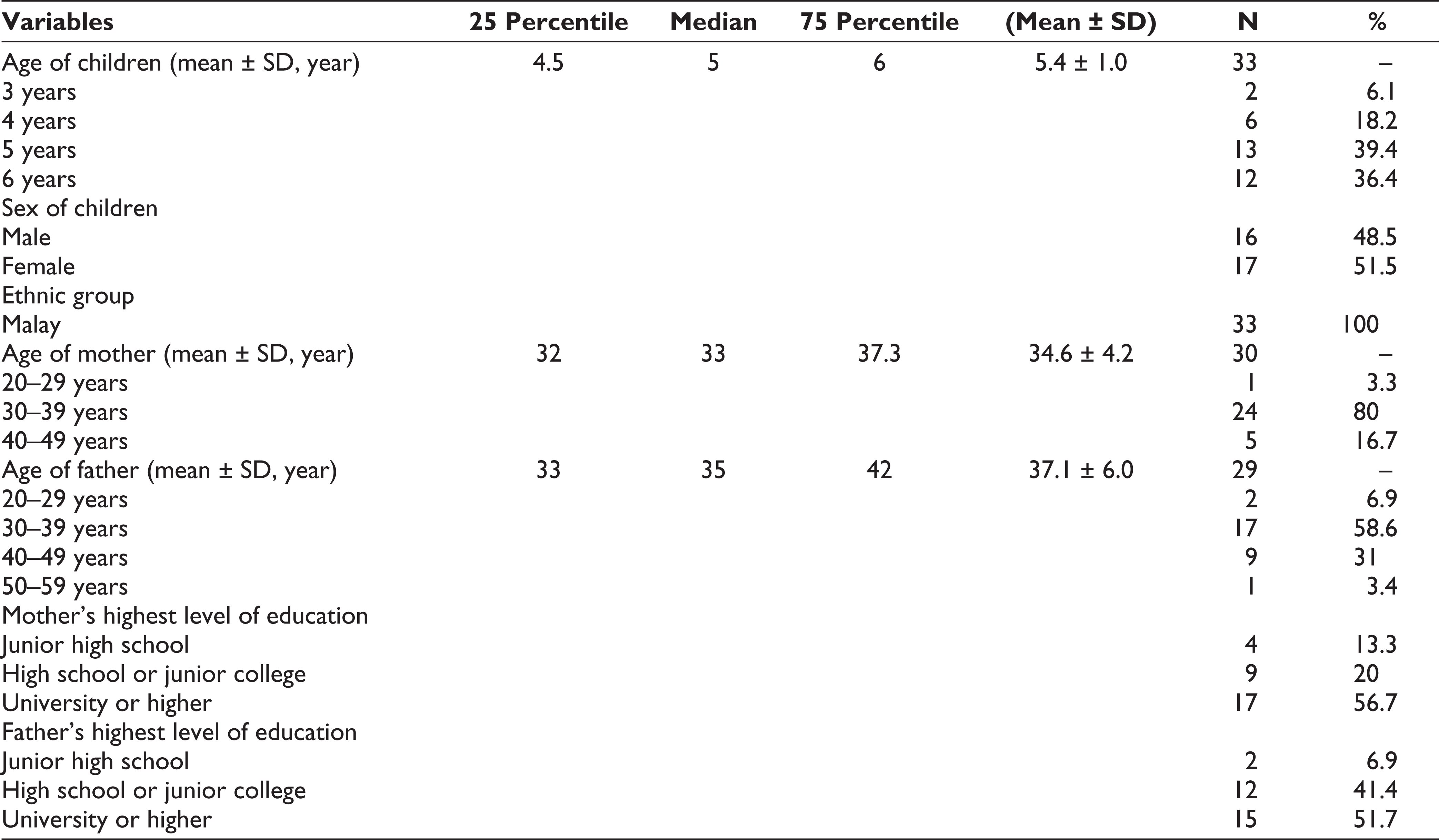
Table 1 shows the participants’ sociodemographic charac-teristics. We obtained 33 sets of completed responses from the children’s guardians. As for the sleep records, each child held a 14-day record, which makes 14 person-days per child. The mean ages were 5.4 ± 1.0 (standard deviation [SD]) for the children, 34.6 ± 4.2 for their mothers, and 37.1 ± 6.0 (SD) for their fathers. All participants were Malay, with 16 male (48.5%) and 17 female children (51.5%).
Sociodemographic Characteristics of the Participants
The results of the sleep records are shown in Table 2. The total average duration of sleep per day was 11 h 26 min ± 1 h 35 min (SD). Over 14 days, all the children slept at night and the average sleep time was 9 h 39 min ± 1 h 27 min (SD). The average bedtime was 21:47 ± 0.49, and the average waking time was 7:35 ± 1.11 for night-time sleep. Naps were calculated only for the days on which the children took them. Six children did not take any naps during the 14 days, and for the remaining 27, naps were not taken daily. The average nap commencing time was 13:57 ± 0.31, and the average end time was 16:52 ± 0.50. The average duration of each nap was 1 h 42 min ± 0 h 58 min (SD).
Results of Sleeping Records

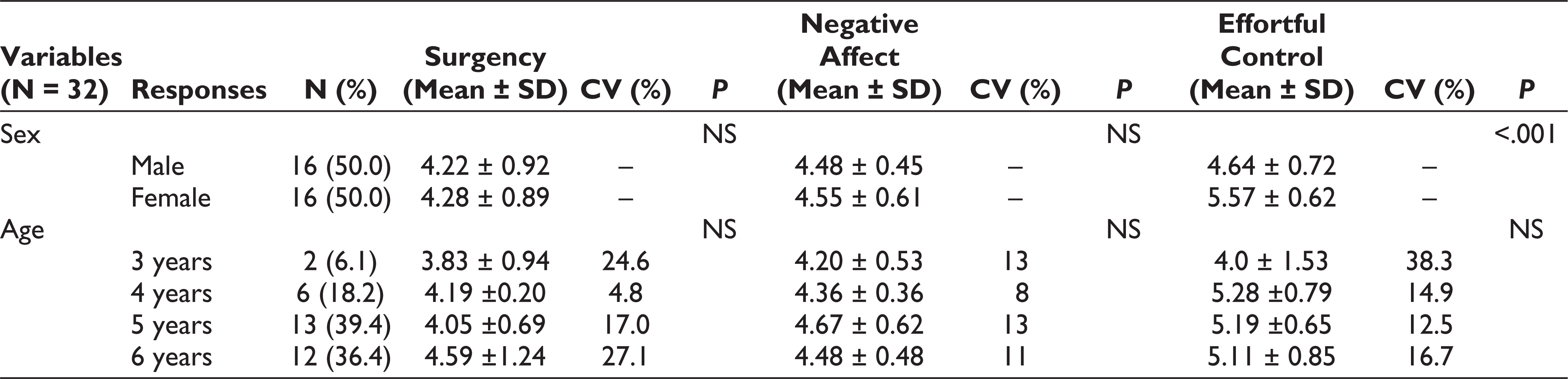
Table 3 shows the average score for temperament using the CBQ-VSF for all children by sex and age. Age did not show a significant association in any of the 3 subscales of temperament. For measuring temperament, 32 responses (16 males [50%] and 16 females [50%]) were analyzable, as 1 participant was withdrawn from the temperament survey. With regard to the 3 subscales based on the children’s sex, the mean scores were 4.2 ± 0.9 (SD) in males and 4.3 ± 0.9 (SD) in females for surgency; 4.5 ± 0.5 (SD) in males and 4.6 ± 0.6 (SD) in females for negative affect; and 4.6 ± 0.7 (SD) in males and 5.6 ± 0.6 (SD) in females for effortful control. The differences in children’s sex and effortful control were significant; the girls scored higher than the boys.
Mean Score of Temperament Subscales by Sex and Age
Further, the relationship between temperament and the 14-day observational sleep records was assessed. There were no significant differences between the 3 subscales of temperament (surgency, negative affect, and effortful control), sleeping hours, bedtime, and waking time for both nighttime and daytime sleep (napping).
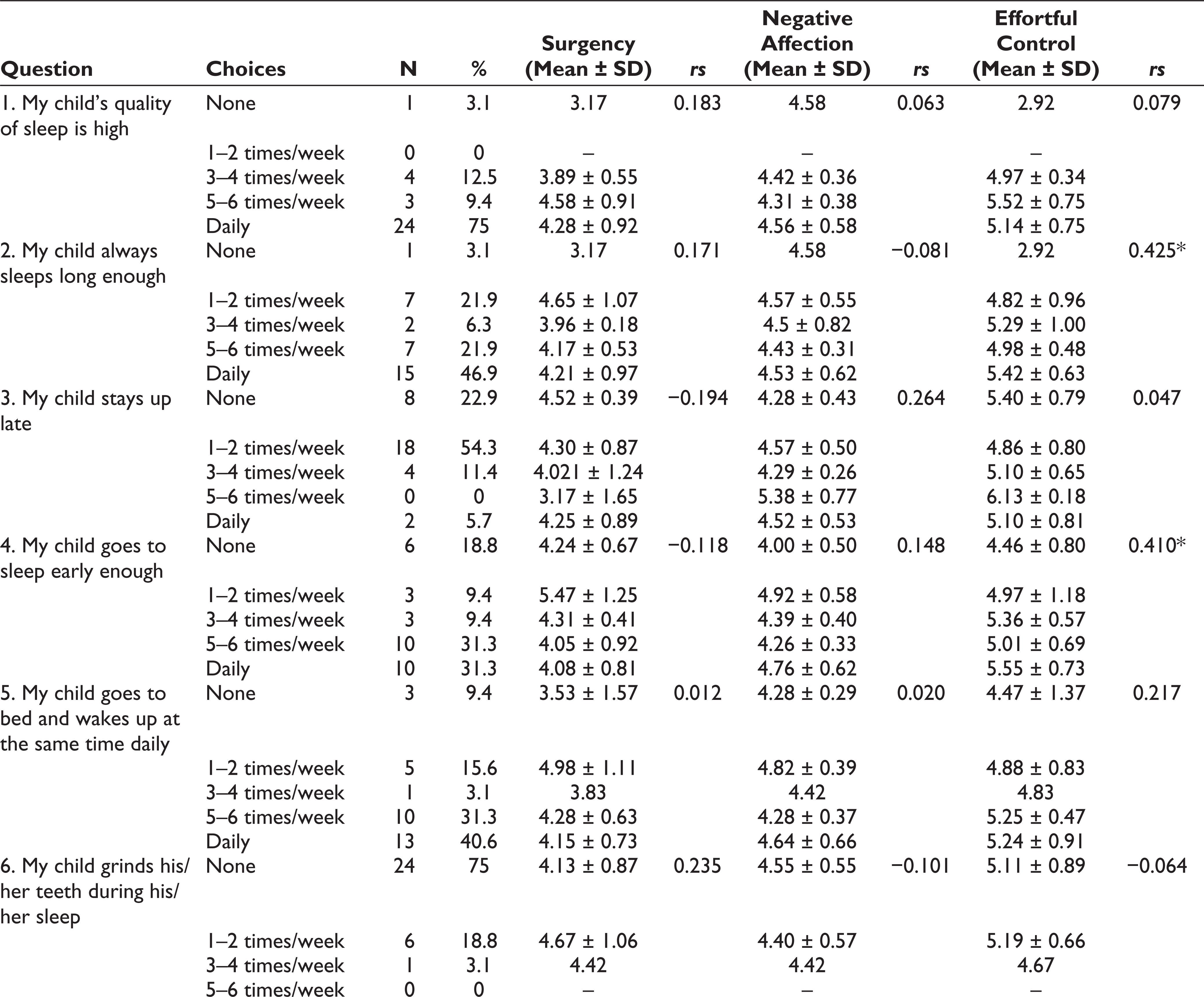
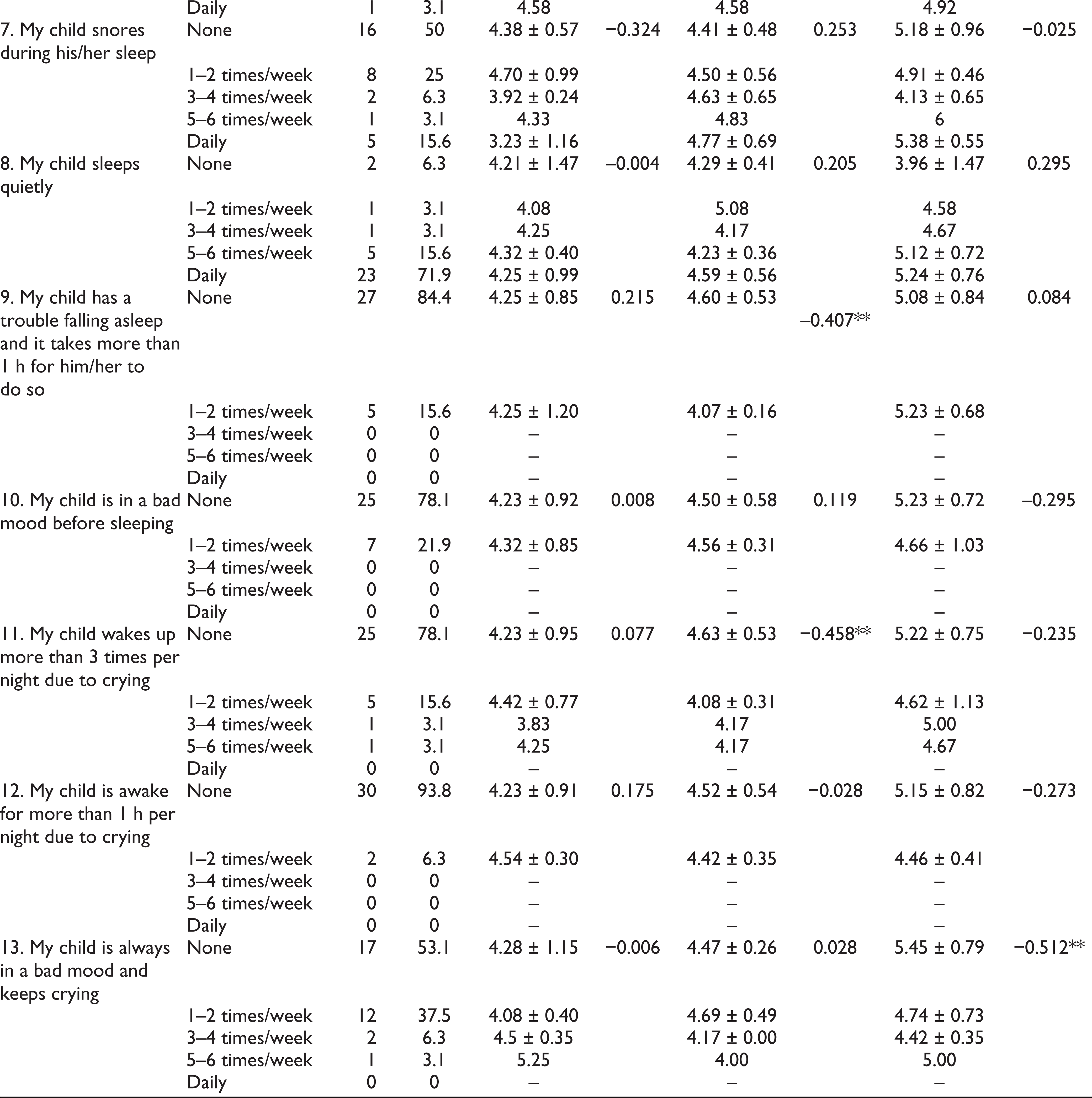
Table 4 shows the results of the guardians’ perceptions of their children’s sleep-related issues. To assess the correlations, Spearman’s rank correlation between the scores of the children’s sleep-related issues and the 3 subscales of temperament (surgency, negative affect, and effortful control) was conducted. For surgency, there was no significant correlation with any of the 13 topics. The score of negative affect in the temperament scale and the answer “my child has trouble falling asleep and it takes more than one hour until he/she does so” showed a negative weak correlation. A total of 27 guardians responded “none,” and 5 responded “one-two times per week.” The average scores of these 2 groups were 4.60 ± 0.53 (SD) and 4.07 ± 0.16 (SD), with a correlation coefficient (rs) of −0.407 at a 0.05 significant level. The score of negative affect and “my child wakes up more than three times per night due to crying” was also negatively correlated (rs = −0.458) at a 0.01 level. A total of 25 guardians responded “none” with the average score of 4.63 ± 0.53 (SD), 5 responded “one-two times per week” with 4.08 ± 0.31 (SD), along with 1 response for “three-four” and 1 for “five-six times per week,” with an average score of 4.17 for both answers. Regarding the score of effortful control, a weak positive correlation was found in the responses to “my child always sleeps long enough” (rs = 0.425) and “my child goes to sleep early enough” (rs = 0.410). A total of 15 guardians responded that their children slept for an adequately long time daily, with the highest temperament average score of 5.42 ± 0.63 (SD); 10 guardians responded that their children went to sleep early enough daily and their children’s score in effortful control was 5.55 ± 0.73 (SD), which was the highest average score among all questions. The correlation between effortful control and the response “my child is always in a bad mood and keeps crying during the daytime” was also significant (rs = −0.512). Children who were not in a bad mood and did not cry tended to have a high temperament score.
Spearman’s Rank Correlation
Discussion
This study analyzed the association between temperament and sleep patterns/sleep-related issues among preschool children in Malaysia. The study results did not show any association between sleep patterns and the 3 subscales of temperament measurement (surgency, negative affect, and effortful control). Regarding the association between sleep quality issues and temperament, a weak positive relation was found between sufficient sleep and effortful control. For sleep timing, a prolonged time for falling asleep showed a negative weak correlation between negative affect, though, with early sleep, effortful control showed a weak positive relationship. Regarding the mood before sleeping or throughout the day, effortful control showed a weak positive relationship in between and the frequency of mid-time waking during nighttime sleep, and a weak negative association was detected for negative affect.
Regarding the association between temperament and sleep patterns (duration of sleep and waking time for night-time sleep and naps), a study using ActiGraph for infants between 4 and 10 weeks reported a negative correlation between temperament dimensions and sleep measures. 33 Regarding sleep and waking time, a recent study that used the same temperament scale as the present research, reported that higher temperamental negative affect was positively correlated with later sleep onset time. 34 However, this study did not support the result.
Regarding the association between sleep quality issues and temperament, a weak positive relation was found between sufficient sleep and effortful control. A longitudinal study that explored toddlers’ sleep and temperament also reported that shorter night-time sleep duration at 2 years predicted more temperamental proneness to anger at 3 years. 35 Another study identified a relationship between difficult temperament and short sleep duration. 36
Regarding the issue of “staying up late” among children, although the findings did not show any relationship with temperament dimensions, a previous study that used the same temperament measurement reported that higher temperamental negative affect was positively correlated with later sleep onset time. 34
Concerning the question “my child has trouble falling asleep and it takes more than one hour until he/she does so,” the responses showed a negative weak correlation with negative affect, which indicates that children with stronger negative affect temperament characteristics take longer time to fall asleep. For the question of whether the children went to sleep early enough, effortful control showed a weak positive relationship with early sleep. A study using the Rothbart temperament scale among infants also reported that temperament was related to sleep problems, sleep latency, and night wakefulness. 37
Concerning the question asked about children’s mood not only at nighttime but throughout the day, effortful control showed a weak positive relationship. Mid-time waking during night-time sleep also showed a weak negative association between negative affect and wake-up frequency. While this issue was focused on “waking up” and “crying,” studies have indicated that difficult temperament increased the odds of frequent night-waking.38, 39 Moore et al 40 used the same temperament subscales and reported higher sleep problem scores related to higher scores on negative affect. 40 The study also provided evidence for associations between temperament (negative affect) and sleep problems identified in infants, toddlers, and school-age children, and adolescents.
No association was found between the frequency of good sleep and average temperament score. However, a study of 1-year-olds indicated that the relation between temperament and sleep efficiency had positive relations. 41
Limitations
This study employed a cross-sectional design and a convenience sample of preschool children and their caregivers. Data relating to lifestyles, including temperament, were obtained through a questionnaire, and sleep logs were filled based on guardians’ observations. Hence, the self-reported information may be subject to rater or common method bias. The guardians’ perceptions of their children’s sleep-related issues recorded in the questionnaires were translated from the existing Japanese questionnaire at the stage before assessing the validity of the factor analysis because the sample size was small and therefore the study was preliminary. This study was conducted as a pilot study for a larger survey. However, due to the COVID-19 pandemic, the subsequent survey has been postponed until circumstances allow the implementation of a large-scale survey.
Conclusions
The results of this study did not show positive correlations between temperament and quality of sleep among preschool children in Malaysia, though some children’s sleep issue were correlated with 2 subscales of temperament; negative affect, and effortful control. Interestingly, the issue-based questions, such as “stay up late,” did not show any association, but the reverse type of questions, such as “early sleep,” showed a positive relationship with effortful control. Also, similar to other studies, sufficient sleep showed a positive relation with effortful control. These results might be an indication that a child’s difficult temperament could be a factor affecting sleep quality. However, further large-scale studies will be needed to verify the findings. However, objective measurement methodologies might enable the detection of more specific aspects of sleep, such as rhythms and patterns.
Footnotes
Declaration of Conflicting Interests
The authors declared no potential conflicts of interest with respect to the research, authorship, and/or publication of this article.
Funding
The authors disclosed receipt of the following financial support for the research, authorship, and/or publication of this article: This study was funded by the Doshisha University research fund.
Statement of Informed Consent and Ethical Approval
Necessary ethical clearances and informed consent was received and obtained respectively before initiating the study from all participants.