




Abstract
Background
Prostate cancer is one of the most common malignancies in men, and immune escape is one of the major challenges in development and treatment. In a hypoxic environment, tumor cells may reduce or stop expressing antigens, thereby avoiding recognition by the immune system and increasing the risk of immune escape.
Purpose
The purpose of this study is to explore the inhibitory effect of the calcitonin gene-related peptide (CGRP)-carrying liposome nano-delivery system on the immune escape of prostate cancer cells under hypoxic conditions and further to study its related mechanism with the nitric oxide (NO)-cyclic guanosine monophosphate (cGMP) signaling pathway.
Materials and Methods
A hypoxic PC-3 culture model was constructed and divided into four groups: Control group (no treatment of prostate cancer cells), Low_Oxygen_1 group (5% hypoxic environment + prostate cancer cells), Low_Oxygen_2 group (3% hypoxic environment + prostate cancer cells), Low_Oxygen_3 group (1% hypoxic environment + prostate cancer cells). For the co-cultivation of the obtained CGRP-low-density lipoprotein (LDL) delivery system with PC-3 cells, they were divided into Low_Oxygen + CGRP-LDL + hypoxia group, CGRP-LDL group, CGRP group, and Low_Oxygen + CGRP group. The apoptosis rate was detected, and the key protein of immune escape of PC-3 cells was analyzed to determine whether the immunosuppressive effect of CGRP-LDL on PC-3 under hypoxic conditions was realized through the NO-cGMP pathway.
Results
GRP-liposome carrying liposome (LCL) was successfully constructed, and the immune escape of prostate cancer cells was found in a hypoxic environment; the lower the oxygen concentration, the higher the degree of escape. The Low_Oxygen_2 group (3% hypoxic environment + CGRP-LCL group) had the most significant anti-cancer effect in the hypoxic environment, with the lowest proliferation and highest apoptosis (vs. other groups, p < .05). Liposome nano-delivery system carrying CGRP has a good anti-cancer effect. Further endothelial nitric oxide synthase (eNOS) messenger ribonucleic acid (mRNA) silencing and comparative verification using the nitric oxide synthase (NOS) inhibitor NG-nitro-
Conclusion
A hypoxic environment can increase the phenomenon of immune escape of tumor cells, but the application of the CGRP-LCL nano-delivery system can intervene in this process. CGRP-LCL nano-delivery system can inhibit the immune escape of prostate cancer cells in a hypoxic environment. The expression of key proteins is inhibited, and this inhibitory effect is mainly exerted through the activation of the NO-cGMP signaling pathway.
Introduction
The incidence of prostate cancer is increasing year by year (Bauer et al., 2023). Although some progress has been made in early diagnosis and treatment, the treatment of prostate cancer still faces many challenges. Hypoxic environment (Chen et al., 2018) is a common feature of tumor growth and metastasis, especially in solid tumors such as prostate cancer. Due to rapid tumor growth and irregular blood supply resulting in insufficient oxygen supply, tissue hypoxia levels generally increase (Gong et al., 2019). Hypoxic environment plays an important role in immune escape, which can lead to a series of changes in the biological behavior of tumor cells, such as invasion, metastasis, and anti-apoptosis (Gutierrez et al., 2021). These changes are collectively referred to as the immune escape of tumor cells. Tumor cells will express some abnormal proteins or mutant proteins, which are recognized by the immune system as “foreign bodies” (Handali et al., 2019), thus triggering an immune response. Therefore, from a therapeutic point of view, it is extremely urgent and necessary to block the immune escape in the hypoxic environment of prostate cancer tumors.
Some studies have shown that under hypoxic conditions, tumor cells can enhance their immune escape ability by inhibiting the nitric oxide (NO)-cyclic guanosine monophosphate (cGMP) signaling pathway (Hu et al., 2020). NO is an important cell-signaling molecule that can regulate various cellular biological processes, such as the activation of immune cells and the apoptosis of tumor cells (Igarashi et al., 2020). As an intracellular signaling molecule of NO, cGMP is involved in the regulation of cell proliferation, differentiation and apoptosis. Studies have found (Kallingal et al., 2023) that the NO-cGMP signaling pathway can bind to the GUCY1A3 receptor on the surface of tumor cells, thereby activating soluble guanylate cyclase (sGC) to convert guanosine triphosphate (GTP), which is converted into cGMP (Kocic et al., 2022), triggering the activation of the intracellular enzyme protein kinase G (PKG). The activated PKG further phosphorylates multiple protein substrates, regulates apoptosis-related proteins, and participates in the regulation of apoptosis.
These findings provide a new direction for anti-tumor therapeutic strategies related to the NO-cGMP signaling pathway, and also provide a theoretical basis for the treatment of prostate cancer.
As a novel drug delivery platform, nano-delivery systems have become a research hotspot in the field of tumor therapy. Liposome is a common nano-delivery system (Devi et al., 2023), which are composed of a phospholipid bilayer and can effectively encapsulate and deliver water-soluble and fat-soluble drugs. In recent years, researchers have begun to apply liposome nano-delivery systems to the treatment of tumors and have made some progress. Studies have shown that targeted liposome nano-delivery systems can target specific receptors, surface antigens or other biomarkers on tumor cells (Li et al., 2019) to achieve precise tumor cell recognition and localization, thereby improving the accuracy and efficacy of treatment. On the other hand, multi-drug combination therapy can target multiple biological targets of tumor cells, exert a synergistic effect (Huebner et al., 2022), enhance the therapeutic effect, and reduce the resistance of tumor cells to a single drug. However, there are still relatively few studies on the mechanism of immune escape of prostate cancer by a liposome nano-delivery system carrying calcitonin gene-related peptide (CGRP).
CGRP is a neuropeptide that widely exists in the central nervous system and peripheral nervous system and plays an important role in regulating various physiological processes. Recent studies have shown (Meng & Wu, 2022) that CGRP also plays an important role in immune regulation. Some studies have shown that CGRP may induce apoptosis by binding to G protein-coupled receptors (GPCRs) and activating the cyclic adenosine monophosphate-protein kinase A (cAMP-PKA) signaling pathway (Muniyan et al., 2020) in tumor cells. And it can also bind to the CGRP receptor on the surface of tumor cells, thereby activating the G protein in tumor cells, and then promoting adenylyl cyclase to catalyze the synthesis of cAMP, which thus further activates protein kinase A (PKA) (Wang et al., 2014), thereby triggering downstream signaling events and mediating apoptosis of cancer cells. This suggests the research potential of CGRP in prostate cancer. Therefore, the use of a liposome nano-delivery system to carry CGRP may be a new strategy for the treatment of prostate cancer.
This study aims to explore the mechanism of the liposome nano-delivery system carrying CGRP on the immune escape of prostate cancer cells through the NO-cGMP signaling pathway in a hypoxic environment. We will establish a prostate cancer cell model in a hypoxic environment, apply the CGRP-carrying liposome nano-delivery system for intervention therapy, and explore its regulatory effect on the NO-cGMP signaling pathway. At the same time, we will study the regulatory role of CGRP-carrying liposome nano-delivery system in the immune escape of prostate cancer cells, as well as its effect on the expression of immune-related factors. Through these experiments, we hope to gain insight into the mechanism of action of the CGRP-carrying liposome nano-delivery system in the treatment of prostate cancer.
Materials and Methods
Panax notoginseng saponins (Yangzijiang Pharmaceutical), enzyme-linked immunosorbent assay (ELISA) kit (Kaibo Bio), 4% paraformaldehyde (G-Clone), TBGREEN (TaKaRa), Cezanne silent lentivirus (shCezanne, Jikai Bio), androgen receptor (AR) antibody (Abcam), 037A reverse transcription kit (TaKaRa).
Experimental Cells and Grouping
Construction of Hypoxic PC-3 Culture Model
The cell culture medium was heated to 37°C, and the fetal bovine serum (FBS) was pre-incubated under hypoxic conditions to remove oxygen from it. Adjust the CO2 concentration to 5% and the oxygen concentration to 5%, 3%, 1% hypoxic levels (usually 1%–5%) in the hypoxic incubator. PC-3 cells were passaged and transferred to medium under hypoxic conditions. Among them, Low_Oxygen_1 group (5% oxygen concentration environment + prostate cancer cells), Low_Oxygen_2 group (3% oxygen concentration environment + prostate cancer cells), Low_Oxygen_3 group (1% oxygen concentration environment + prostate cancer cells). At the same time, a control group was set up, and the cells continued to be cultured under conventional 21% oxygen conditions for 24 h for subsequent experiments.
Preparation of Liposome Nano-Low-density Lipoprotein (LDL) Delivery System Carrying CGRP
The required liposome components (phospholipids, cholesterol, and polyethylene glycol-distearoylphosphatidylethanolamine [PEG-DSPE] modified phospholipids) were mixed at a molar ratio of 7:2:1 and fully dissolved in organic solvent chloroform, and the organic solvent was purified by nitrogen (5% CO₂, 1%–5% O2, equilibrium N2), so that the liposome components formed a film.
Mix the synthesized liposomes with the aqueous solution loaded with CGRP, and make CGRP and liposomes self-assemble under appropriate temperature and pH conditions. Scanning electron microscopy was used to observe the morphology and particle size distribution of the delivery system, and to measure the Zeta potential of the delivery system.
Grouping
The constructed hypoxic PC-3 culture model cells were divided into four groups: Control group (no treatment of prostate cancer cells), Low_Oxygen_1 group (5% hypoxic environment + prostate cancer cells), Low_Oxygen_2 group (3% hypoxic environment + prostate cancer cells), Low_Oxygen_3 group (1% hypoxic environment + prostate cancer cells).
For the co-cultivation of the obtained CGRP-LDL delivery system with PC-3 cells, they were divided into Low_Oxygen + CGRP-LDL + hypoxia group, CGRP-LDL group, CGRP group, and Low_Oxygen + CGRP group.
3-(4,5-Dimethylthiazol-2-yl)-2,5-Diphenyltetrazolium Bromide (MTT) Detection of Cell Viability
The cells were inoculated in an incubator at 37°C and 5% CO2 until the cells adhered to the growth. After reaching a certain density, the cell medium was pumped, the corresponding volume of 0.5 mg/mL MTT working liquid was added (20 µL per well), and the cells were incubated at 37°C for 4 h to make full contact with the MTT reagent. After 2 h of culture, the medium and MTT reagent that were not absorbed by the cells were extracted. Use a shaker to mix the solvent and crystal so that the purple crystal is completely dissolved. The dissolved liquid is transferred to a 96-well plate, and the absorbance value is measured with an absorbometer.
Reverse Transcription Polymerase Chain Reaction (RT-PCR) Detection
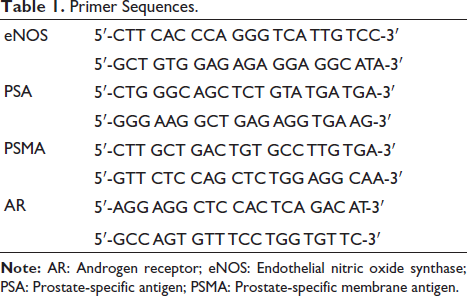
Follow the instructions of the kit, transcribe the extracted RNA into complementary deoxyribonucleic acid (cDNA), use the polymerase chain reaction (PCR) amplification kit to amplify according to the program, and glyceraldehyde-3-phosphate dehydrogenase (GAPDH) was selected as the internal reference to analyze gene expression using the 2−∇∇CT method. The primers and primer sequences are listed in Table 1.
Primer Sequences.
Nitrate Reductase Method to Detect Nitric Oxide Synthase (NOS) Activity Enzyme Concentration
The PC-3 cell culture solution was collected into a centrifuge tube, centrifuged to remove cell debris and precipitates, and then mixed with nitrate reductase reagent to reduce nitrate to NO, and a reaction stopper to stop the nitric acid reduction reaction. Add dye, measure, and calculate the concentration of active NO enzyme by the colorimetric method.
ELISA Detection of PSA Expression
Add different concentrations of standard substances into the standard wells; in the sample wells, mix the samples and enzyme-labeled reagents and incubate at 37°C for 1 h; discard the waste solution and add 1× washing solution to wash five times, and pat dry the liquid in the wells; avoid light and add color development mix reagents (A, B) and incubate at 37°C for 15 min; add stop solution to each well and test on the machine.
Detection of AR Protein Expression by Western Blot
After adding protein loading buffer in proportion, carry out electrophoresis and electro transfer at 99°C for 6 min; after the program is completed, block at room temperature for 1.5 h, wash with phosphate buffered saline (PBS), incubate with primary antibody (1:1,000), and incubate overnight at low temperature; take it out the next day, and incubate with secondary antibody at 25°C (1:1:5,000) for 2 h; in the dark, add luminescent liquid, and perform imaging analysis on the computer; use β-actin as an internal reference, use Image Lab to analyze the gray value of the band and calculate the expression level of the target protein.
Statistical Processing
The experimental results are all measurement data, statistical analysis using Prism8.0.2, the F-test is used when comparing multiple groups, and p < .05 refers to a statistical difference.
Results
Preparation of CGRP-carrying Liposome Nano-delivery System and Its Inhibitory Effect on Prostate Cancer Cells
In order to detect whether CGRP-liposome carrying liposome (LCL) was successfully constructed, its morphology was observed by transmission electron microscopy. The results showed that the nanoparticles formed a regular round shape without aggregation and had good dispersion (Figure 1A). Zeta potential map analysis found that during the preparation process of Ming nanoparticles, loaded SA was evenly distributed outside the nanoparticles (Figure 1B). It suggested that CGRP-LCL NPs were prepared successfully.
Morphology and Potential Distribution of Calcitonin Gene-related Peptide (CGRP)-Liposome Carrying Liposome (LCL) Nanoparticles. (A) SEM Images Showed the Morphology of Nanoparticles; (B) Zeta Potential Distribution Diagram.

NO-c Role of GMP Signaling Pathway in Hypoxia-induced Immune Escape of Prostate Cancer Cells
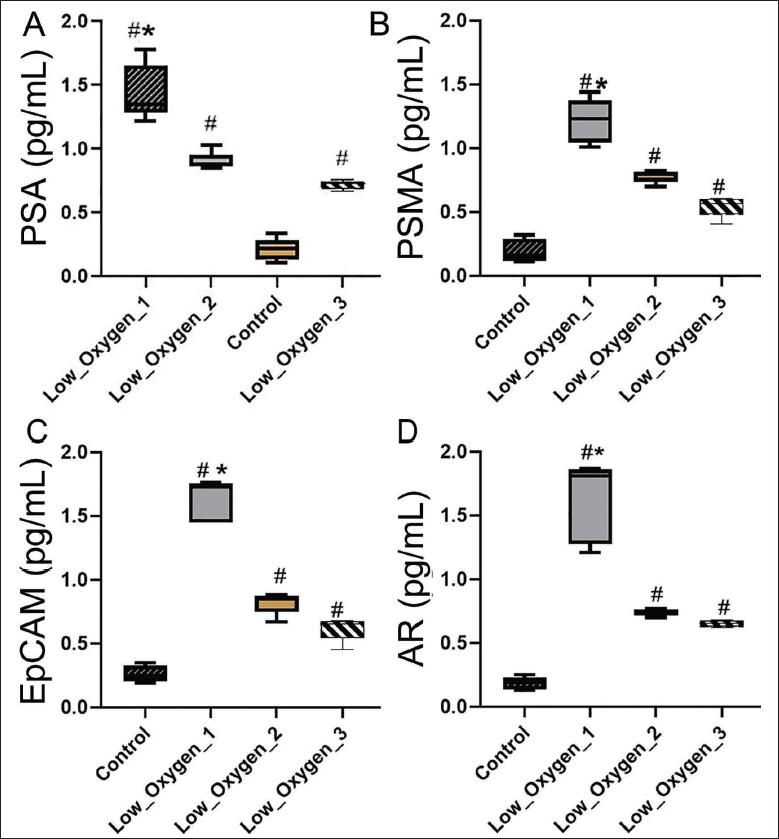
In order to explore the immune escape of prostate cancer cells in a hypoxic environment, we used Western Blot (WB) to detect the surface prostate-specific antigen (PSA), prostate-specific membrane antigen (PSMA), AR, epithelial cell adhesion molecule (EpCAM), and normal human prostate cells. All the above indicators were significantly increased (vs. control group, p < .05, Figure 2), among which the low-oxygen-1 group increased most significantly (vs. other groups, p < .05, Figure 2). Immunological escape of prostate cancer cells was found in a hypoxic environment, and the lower the oxygen concentration, the higher the degree of escape.
The Role of Nitric Oxide (NO)-Cyclic Guanosine Monophosphate (cGMP) Signaling Pathway in Hypoxia-induced Immune Escape of Prostate Cancer Cells (n = 3). (A) Prostate-specific Antigen (PSA) Condition; (B) Prostate-specific Membrane Antigen (PSMA); (C) Epithelial Cell Adhesion Molecule (EpCAM); (D) Androgen Receptor (AR); Compared with Control Group, #p < .05, Compared with Other Hypoxic Groups, *p < .05.
CGRP-carrying Liposome Nano-delivery System Promotes the Expression of NO-cGMP Signaling Pathway and Mediates the Inhibition of Immune Escape in Hypoxic Prostate Cancer Cells
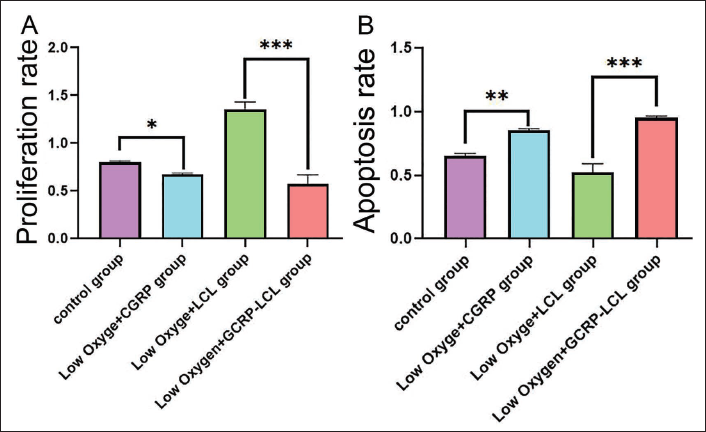
To explore the role of the NO-cGMP signaling pathway in a hypoxic environment, the level of the NO-cGMP signaling pathway in each group was detected. It was found that under hypoxic conditions, the apoptosis rate of prostate cancer cells was the lowest, and in the GCRP intervention group ((3% hypoxic environment + no delivery system + CGRP prostate cancer cells), there was a significant increase in the apoptosis rate (p < .05, Figure 3A,B), but the Low_Oxygen_2 group (3% hypoxic environment + CGRP-LCL group) had the most significant anti-cancer effect in the hypoxic environment, with the lowest proliferation rate and the highest apoptosis rate (vs. other groups, p < .05), indicating that the liposome nano-delivery system carrying CGRP has a good anti-cancer effect.
Apoptosis and Proliferation of Prostate Cancer Cells in Hypoxic Environment (n = 3). (A) Proliferation Rate; (B) Apoptosis Rate; *p < 05, **p < .01,***p < .001.
Liposome Nano-delivery System Carrying CGRP Promotes the Expression of NO-cGMP Signaling Pathway
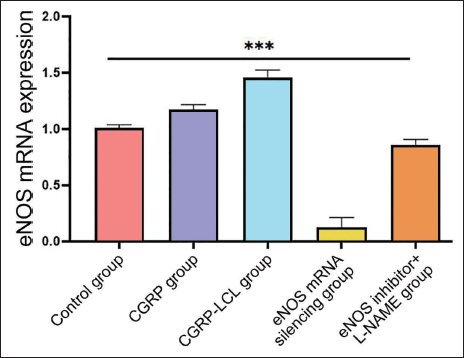
By comparing the control group and the CGRP group, we observed that CGRP-LCL may promote the expression of endothelial nitric oxide synthase (eNOS) MNA in prostate cancer cells in a hypoxic environment (Figure 4). Further eNOS mRNA silencing and comparative verification using the NOS inhibitor NG-nitro-
Endothelial Nitric Oxide Synthase (eNOS) Messenger Ribonucleic Acid (mRNA) Expression of Nitric Oxide (NO)-Cyclic Guanosine Monophosphate (cGMP) Signaling Pathway (n = 3). ***p < .001.
CGRP-LCL Nano-delivery System Activates Prostate Cancer Under Hypoxic Environment Through NO-cGMP Signaling Pathway
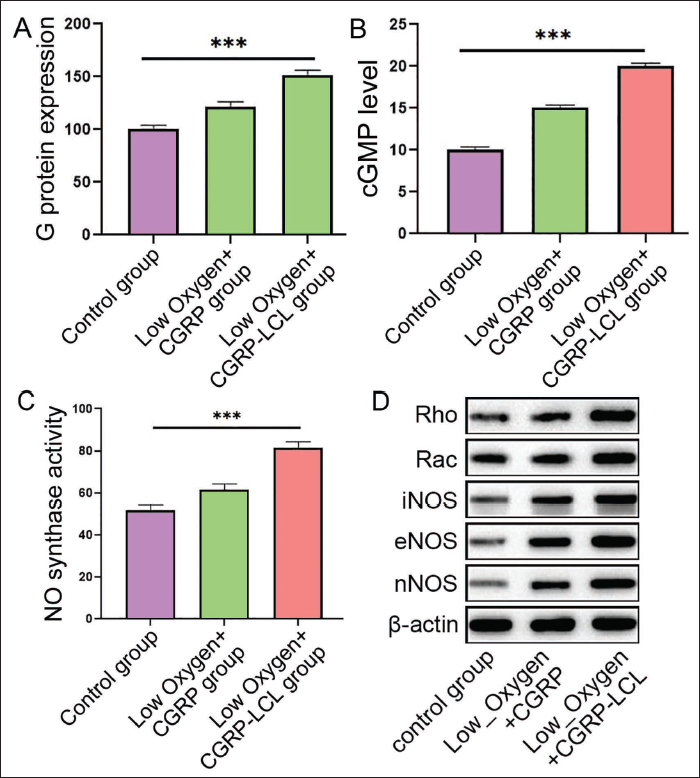
In order to further confirm whether this effect is related to the NO-cGMP signaling pathway, we further detected the NO-cGMP pathway-related proteins and found that the intervention effect of the 3% hypoxic environment + GCRP-LCL group system group was the best, G protein, cGMP concentration and NO synthase activity were the highest (vs. other groups, p < .001, Figure 5).
Calcitonin Gene-related Peptide (CGRP)-Liposome Carrying Liposome (LCL) Activates Nitric Oxide (NO)-Cyclic Guanosine Monophosphate (cGMP) Signaling Pathway in Prostate Cancer Under Hypoxic Environment (n = 3). (A) G Protein Expression; (B) cGMP Expression; (C) NO Synthase Activity; (D) Western Blot (WB) Detection, ***p < .001.
CGRP-LCL Nano-delivery System Activates Prostate Cancer Under Hypoxic Environment Through NO-cGMP Signaling Pathway, Further Inhibiting the Immune Escape of Prostate Cancer Cells
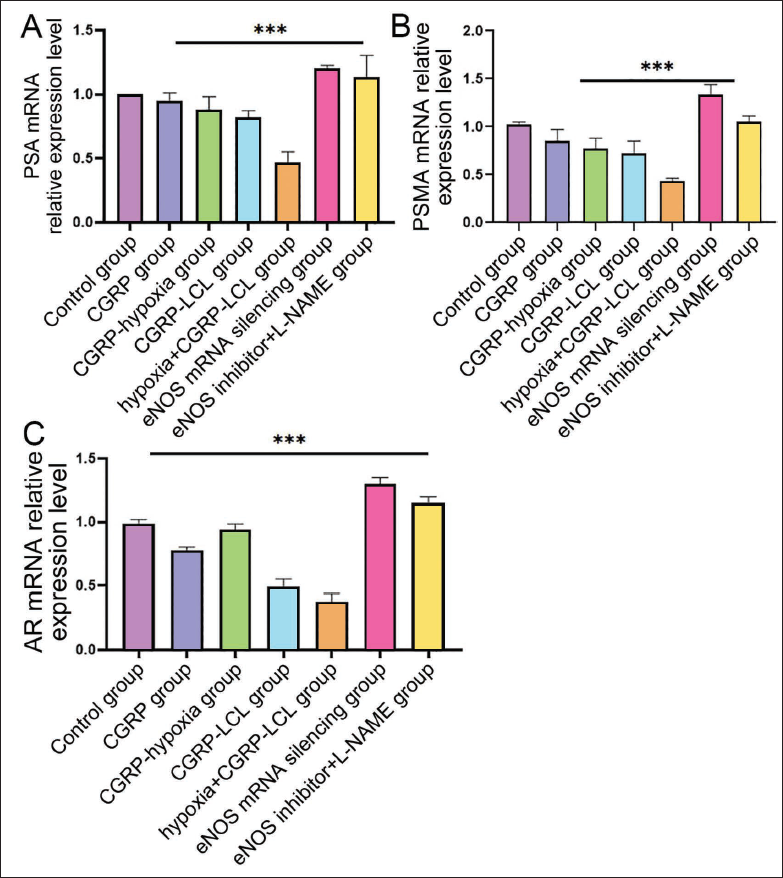
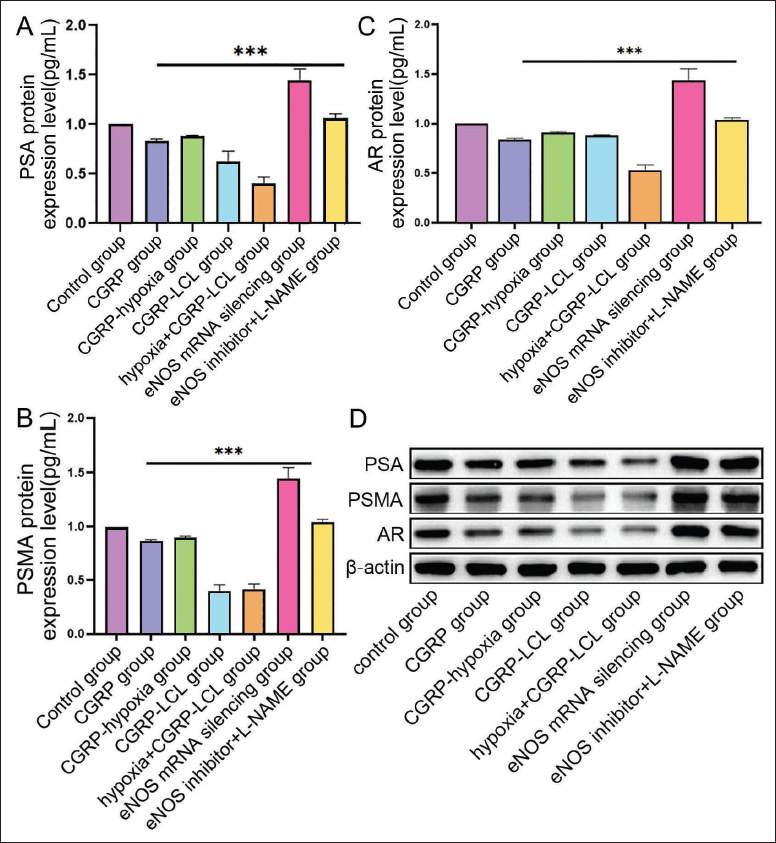
On the basis of the previous experiments, we further detected the expression of key proteins and mRNAs of immune escape in prostate cancer cells, and the results indicated that the expression of proteins such as PSA in PC-3 cells was significantly inhibited by the CGRP-LCL nano-delivery system (vs. control group, CGRP group, etc., p < .05, Figures 6 and 7), after using eNOS gene silencing, the expression of PSA, AR and other genes and their protein products in PC-3 cells were abnormally high (vs. control group, p < .05), the CGRP-LCL group was significantly lower than the eNOS gene silencing group (p < .05), in order to confirm the role of CGRP-LCL in inhibiting the immune escape of PC-3 cells, we added the NOS inhibitor L-NAME group, and detected the correlation protein, it was found that the CGRP-LCL group was significantly lower than the NOS inhibitor L-NAME group, which indicated that CGRP-LCL inhibited the immune escape of PC-3 cells.
Key Proteins of Prostate Cancer Immune Escape (n = 3). (A) Prostate-specific Antigen (PSA) Messenger Ribonucleic Acid (mRNA) Expression; (B) Prostate-specific Membrane Antigen (PSMA) mRNA Expression; (C) Androgen Receptor (AR) mRNA; ***p < .001.
Calcitonin Gene-related Peptide (CGRP)-Liposome Carrying Liposome (LCL) Activates the Nitric Acid (NO)-Cyclic Guanosine Monophosphate (cGMP) Signaling Pathway in Prostate Cancer Under Hypoxic Environment to Inhibit Immune Escape (n = 3). (A) Prostate-specific Antigen (PSA) Protein Expression; (B) Prostate-specific Membrane Antigen (PSMA) Expression; (C) Androgen Receptor (AR) Activity; (D) Western Blot (WB) Detection, ***p < .001.
Discussion
Immune escape has long been a hot topic in the field of cancer. In a hypoxic environment, tumor cells may reduce or stop the expression of antigens, making it difficult for the immune system to recognize (Piazza et al., 2020), thereby avoiding being attacked. A hypoxic environment will reduce the expression of major histocompatibility complex (MHC) molecules (Qiu et al., 2023) on tumor cells, and the antigen presentation ability of tumor cells will be weakened, thereby reducing the immune response of T cells (Reva et al., 2020). At the same time, it can also promote the accumulation of suppressive immune cells such as regulatory T cells (Treg) cells and myeloid-derived suppressor cells (MDSCs) in the body (Kamazani et al., 2021), thereby suppressing the immune response, and the tumor cells transition to produce transforming growth factor-beta (TGF-β), interleukin-10 (IL-10) and prostaglandin E2 (PGE2) and other immunosuppression factors that interfere with the immune response in the normal body and increase the apoptosis of immune cells, thereby assisting tumor cells to evade the host’s immune surveillance. These provide positive directions for tumor treatment strategies.
Although it has been confirmed in the study of CGRP (Sun et al., 2023) that it can regulate osteoprotegerin/receptor activator of nuclear factor kappa-b ligand (OPG/RANKL), play a role in the growth and metabolism of bone tissue, and can promote the osteogenic differentiation of rat bone marrow stromal cells (rBMSCs); however, its impact on prostate cancer cells remains to be explored. In this study, we successfully prepared a CGRP-carrying liposome nano-delivery system and used it in PC-3 cells, and found that the CGRP-LCL delivery system has an anti-cancer effect. And by analyzing the specific antigen detection of PC-3 cells under the condition of 1%–5% low oxygen concentration, it was found that the immune escape phenomenon of PC-3 cells is inversely proportional to the low oxygen concentration, that is, the lower the oxygen concentration, the more PC-3 cells. The expression of key proteins of immune escape is higher. At 3% oxygen concentration, the CGRP-LCL delivery system was set up for research, and it was found that the expression of key proteins of immune escape in PC-3 cells in the CGRP-LCL delivery system group was significantly inhibited. And progress one uses 3% low oxygen concentration to detect the level of NO-cGMP signaling pathway in each group. The hypoxic environment with the CGRP-LCL nano-delivery system has the most significant anti-cancer effect, the lowest proliferation rate and the highest apoptosis rate. In order to further explore whether this effect is related to the NO-cGMP signaling pathway, we further detected related proteins and found that the intervention effect of the 3% hypoxic environment + GCRP-LCL group was the best. It is worth noting that this group, the G protein, cGMP concentration and NO synthase activity were the highest, which seems to suggest that the CGRP-LCL delivery system group significantly inhibited the expression of key proteins of immune escape of PC-3 cells under hypoxic conditions. However, elucidating the mechanism still needs further study.
CGRP binds to the CGRP receptor on the cell surface, and the CGRP receptor undergoes a conformational change to activate the G protein, prompting the activation of guanylate cyclase (Tam et al., 2020), leading to the production of cGMP (the main intermediate of the NO-cGMP signaling pathway). At the same time, the activated G protein can also activate NO synthase, leading to the production of NO (Wu et al., 2019). In this way, CGRP regulates intracellular cGMP and NO levels through this signaling pathway, thereby participating in the regulation of physiological functions of cells (Xu et al., 2018). Further detection of key proteins of immune escape in prostate cancer hypoxic environment confirmed that the CGRP-LCL nano-delivery system had a significant activation effect on the NO-cGMP signaling pathway (vs. other groups, p < .05).
Immune antigens activate the immune system and direct immune cells to attack them to protect the body from infection and disease. Yang et al. (2023) considered that PSA, a common protein secreted by prostate cancer cells, plays an important role in the early diagnosis and monitoring of the treatment of prostate cancer patients. Since healthy tissues also contain PSA, the immune system cannot effectively distinguish and attack tumor cells. In addition, TGF-β and IL-10 are overexpressed due to tumor release, which inhibits the activity of immune cells in the body, thereby reducing the activity of immune system cells. Even if it can recognize tumor cells expressing PSA, it cannot effectively attack cancer cells, so PC-3 cells have the ability to evade recognition and elimination. Studies have reported that prostate cancer cells expressing prostate-specific membrane antigen PSMA can interact with T cell immunosuppressive receptors such as programmed death-1 (PD-1) and cytotoxic T-lymphocyte antigen 4 (CTLA-4) (Zhang et al., 2023), activate or produce immunosuppressive cytokines. Inhibition and exhaustion of T cell function. AR, as a nuclear receptor, plays a key role in prostate cancer cells. Prostate cancer is usually sensitive to androgen in the early stage, and clinically inhibits androgen synthesis or inhibits the function of AR to fight cancer. As the disease progresses, prostate cancer cells may develop an escape mechanism, leading to drug resistance to androgen therapy (Zhang et al., 2022). AR regulates the expression and function of Forkhead Box P3 (FOXP3), increases the number and activity of Treg, thereby inhibiting the anti-tumor immune response, the expression of indoleamine 2,3-dioxygenase (IDO) enzyme is also regulated by it, and the programmed death-ligand 1 (PD-L1) and IDO on the surface of tumor cells increase, Abnormal tryptophan metabolism in the tumor microenvironment increases the number of immunosuppressive cells. In this study, in the hypoxic environment, the mRNAs of PSA and AR in the 3% hypoxic environment + GCRP-LCL group were inhibited, and further protein detection also showed a consistent trend, indicating that GCRP-LCL can perform better in the hypoxic environment. After blocking the NO-cGMP signaling pathway by using the NOS inhibitor L-NAME, the expression of immune escape marker proteins such as PSA and AR abnormally increased, and the high expression of eNOS silencing conditions was the most prominent, indicating that the silencing of eNOS also showed a consistent effect of blocking the NO-cGMP signaling pathway, but GCRP-LCL showed a better pathway activation effect. This suggests that the hypoxic immune escape inhibition of GCRP-LCL is achieved by activating the NO-cGMP signaling pathway.
Our study found that the CGRP-LCL nano-delivery system can inhibit the expression of key proteins of immune escape in prostate cancer cells under a hypoxic environment, and this inhibitory effect is related to the activation of the NO-cGMP signaling pathway. The hypoxic environment may lead to increased immune escape of tumor cells, but the application of the CGRP-LCL nano-delivery system can intervene in this process. In addition, the study also found that after blocking the NO-cGMP signaling pathway, the anti-cancer effect of the CGRP-LCL delivery system was inhibited, further demonstrating the important role of the NO-cGMP signaling pathway in this process. However, although this study guides our understanding of the mechanism of prostate cancer immune escape and the potential therapeutic role of the CGRP-LCL nano-delivery system, there may be some shortcomings in the study. For example, the study sample size may be small, and further validation of these findings in a larger sample of prostate cancer patients is needed. Although we have explored the mechanism in vitro, whether we can show the same results in vivo needs more verification. Next, we will elaborate on the model mice. In addition, the immune escape mechanism is very complex and may involve the regulation of multiple factors and signaling pathways, so more careful research and exploration are needed when understanding the complete mechanism of this process.
Conclusion
In summary, this study provides a positive direction for the treatment strategy of prostate cancer, especially for the inhibition of immune escape in a hypoxic environment. The application of the CGRP-LCL nano-delivery system may be expected to be a new potential strategy for prostate cancer treatment in the future. However, further in-depth research and clinical trials are needed to verify its effectiveness and safety and provide more effective treatments for prostate cancer patients.
Footnotes
Abbreviations
AR: Androgen receptor; cAMP: Cyclic adenosine monophosphate; cDNA: Complementary deoxyribonucleic acid; cGMP: Cyclic guanosine monophosphate; CGRP: Calcitonin gene-related peptide; CTLA-4: Cytotoxic T-lymphocyte antigen 4; ELISA: Enzyme-linked immunosorbent assay; EpCAM: Epithelial cell adhesion molecule; eNOS: Endothelial nitric oxide synthase; FBS: Fetal bovine serum; FOXP3: Forkhead Box P3; GAPDH: Glyceraldehyde-3-phosphate dehydrogenase; GPCRs: G protein-coupled receptors; GTP: Guanosine triphosphate; IDO: Indoleamine 2,3-dioxygenase; IL-10: Interleukin-10; LCL: Liposome carrying liposome; LDL: Low-density lipoprotein; L-NAME: NG-nitro-
Acknowledgments
The authors gratefully acknowledge the Tianjin Medical University Chu Hsien-I Memorial Hospital for providing the necessary equipment for this study.
Declaration of Conflicting Interests
The authors declared no potential conflicts of interest with respect to the research, authorship, and/or publication of this article.
Ethical Approval and Informed Consent
This study was approved by the ethics committee of the Tianjin Medical University Chu Hsien-I Memorial Hospital.
Funding
The authors received no financial support for the research, authorship, and/or publication of this article.
