




Abstract
Background
High efficiency, low toxicity, and environmentally safe pesticides are increasingly being sought and developed to ensure sustainable development and high-yield agricultural production. Chelerythrine has strong inhibitory effects against the mycelial growth of crop pathogens such as Fusarium oxysporum, Anthrax, and grey mold. Our previous studies have shown that chelerythrine inhibits fungus spore germination by up to 86.7% and induces the apoptosis of Ustilaginoidea virens cells. The application of chelerythrine as a green biological pesticide would not only enhance agricultural production but also enhance ecological protection.
Materials and Methods
The formulation of a chelerythrine suspension concentrate was selected. According to the ratio of experimental design requirements to preparation sample, six groups were set up in the field assay; the first spraying was performed approximately 7 days before the rice rupture period, and the second spraying was performed after 10 days. The control effect was investigated at the milk-ripe stage. The present study preliminarily investigates the safety of chelerythrine as a pesticide using the oral acute toxicity test for mice.
Results
In the present study, the effect of chelerythrine as the main ingredient in suspension concentrate formulations and its field effect on rice false smut (RFS) was investigated. The pesticide in the suspending agent was sprayed twice and had superior effects with regard to the prevention and control of RFS in the field. The control effect was 95.88% at an application rate of 192 mL/ha, with low residue, environmentally safe, and low resistance characteristics. An acute toxicity test following intragastric administration in mice showed that the LD50 of chelerythrine suspension was 1580 mg·kg−1, which was much lower than those of other low-toxicity commercial pesticides.
Conclusion
Chelerythrine suspension was a low-toxicity agent and exhibited the characteristics of an environmentally friendly plant pesticide. The application of chelerythrine suspension could facilitate the achievement of the goal of pesticide reduction efficiency.
Introduction
Pesticide application is a critical tool and greatly facilitates agricultural development. However, diseases and insect pests develop resistance gradually following the long-term repeated application of chemical pesticides, which threatens the health of humans and livestock (Arienzo et al., 2013). Therefore, plant-based and herbal pesticides have increasingly attracted the attention of researchers for the control of diseases and insect pests.
Chelerythrine is one of the most abundant alkaloids in the traditional herbal medicine Chelidonium majus L. According to Fan et al. (2009), chelerythrine has strong inhibitory effects against the mycelial growth of crop pathogens such as Fusarium oxysporum, Anthrax, and grey mold. Its pharmacological effects are well documented, including selective protein kinase C inhibition, in addition to anti-inflammatory and anti-tumor activities (Hu et al., 2017; Saavedra et al., 2017; Zhu et al., 2018). Our previous studies have demonstrated that chelerythrine inhibits fungus spore germination by up to 86.7% and induces apoptosis of Ustilaginoidea virens cells (Wei et al., 2020). The adoption of chelerythrine as a green biological pesticide would not only facilitate agricultural production but also facilitate ecological protection.
Biological pesticides, such as chelerythrine, are highly selective, which makes them rather safe for humans (Ai & Gao, 2014). The safety of the main ingredients used for the development and application of biological pesticides must be evaluated. There is pesticide management regulations and measures for the implementation of the pesticide in our country. No previous studies have investigated the acute toxicity of chelerythrine. Consequently, the present study preliminarily investigates the safety of chelerythrine as a pesticide using the oral acute toxicity test for mice, according to Toxicological Test Methods for Pesticide Registration (GB-15670-1995). The results of the present study could provide toxicological information on chelerythrine and provide a basis for the development and registration of novel chelerythrine-based pesticides.
The environmental and human safety of pesticides are influenced by the dosages and formulations adopted. Some developed countries have since transitioned from crude formulations, such as emulsions, to water-based environmentally safe formulations. After China’s accession to the World Trade Organisation, pesticide residues in export agricultural products have become a source of concern, and environmentally safe pesticide preparations have increasingly attracted the attention of stakeholders (Liu et al., 2017). The proportion of crude preparations has dropped from more than 70% before 2000 to about 55% today (Chen et al., 2010). Water-based formulations and suspension agents have fine particle sizes, high suspension rates, and no dust, among other characteristics (Huang, 2006). In addition, after dilution in water, water-based pesticides are relatively easily adsorbed and spread on the surfaces of target crops, which enhance efficiency and environmental safety (Xu et al., 2003). In the present study, chelerythrine was the active drug used to develop a suspension agent, which has low residue, environmental safety, and no drug resistance characteristics. Such a pesticide would not only enhance pest control in rice and other food crops but also minimize the adverse effects of chemical pesticides on the environment.
Materials and Methods
Reagents and Animals
Chelerythrine was extracted as described previously (16% concentration) (Wei et al., 2020). The dispersive wetting agent had the following components: Atlox 4913 (UK), Genapol X080 (Clariant Chemicals Ltd.), Dispersogen 1494 LIQ (Clariant Chemicals Ltd.), Ultrazine NA (Boraig Industries Ltd.), Soprophylaxis or SC (Solvi Group), Ethylan NS-500LQ (Akzo Nobel), Lutensol XL-80 (BASF (China) Co., Ltd.), defoamer: Sag1522 (Maitu High-tech Materials Group), thickener: Magnesium aluminum silicate SK-05 (Suzhou Zhongmaterial Mineral Materials Co., Ltd.), xanthan gum (market sale), Cassone (market sale), antifreeze: urea (commercially available), glycerol (commercially available), and deionized water. The rice used in the field control test was 5 Youdao No. 4 (Wuchang rice of China).
A total of 160 SPF-grade ICR mice, male and female, with a body weight of 18 to 22 g, were used for the acute toxicity preliminary test and formal test of chelerythrine pesticide following intragastric administration. The mice were provided by the Heilongjiang University of Chinese Medicine. The quality testing unit was Heilongjiang Experimental Animal Quality Monitoring Station and its license number is SCXK (Hei) 2018-003, and the license number of the experimental unit is SCXK (Hei) 2018-007. The mice were provided ad libitum access to water but no food for 8–12 h before experimentation.
Formulation of a Chelerythrine Suspension Concentrate
Selection of Wetting Dispersant
The flow point method was used to determine the flow point of the wetting dispersant and to select the effective additives. Aqueous solution with 5% various dispersants, sufficient oscillation dissolved, standby in the volumetric flask, put the small beaker on a weighing electronic balance, add a 10.0 g of chelerythrine power, then add gradually the prepared 5% dispersant aqueous solution, and while with a glass rod grinding stir carefully, until the slurry of the mixture is free to drop from the glass rod, the mass of the solution added to the water was recorded, and the procedure was repeated four times, and the flow point of the dispersant was calculated using the following formula (Frei & Schmid, 2018):

Thickener Selection
Thickener is used with water suspensions, mainly to increase the viscosity of preparations and prevent rapid delamination. Generally, thickening agents with strong effects with less amounts applied are often selected and do not affect the dilution stability of the material. Xanthan gum, magnesium aluminum silicate, and their different combinations were screened successively, observing the fluidity of the sample and thermal storage and water separation characteristics.
Selection of Antifreeze
Antifreeze is used in a water suspension agent to increase the low-temperature storage stability of the preparation, prevent stratified solidification of the water suspension agent, improve the freeze-melting ability of the suspension agent, and prevent drying and crusting. A common antifreeze agent, propylene glycol propylene triol urea, was selected for preparing samples for cold storage, and the stability at low temperature was observed.
Processing Technology
According to the ratio of experimental design requirements, weigh and deionized water quantitative, dispersant, wetting agent, magnesium aluminum silicate, antifreeze mixture shearing, effective component chelerythrine added and reversed-phased until uniform shear, the sand mill grinding at 2000 rpm for 1 h, met the requirement of the particle size, after putting the material into a beaker shear for 10 min, a suitable amount of thickening agent was added.
Field Assay
Suspension concentrate was prepared with chelerythrine as the active component. Six groups were set up; a water control group CK (without drug), active ingredient concentration drug group 1 (1500 mL/ha) (the concentration of the active component in the chelerythrine extract was 16%, and suspension agent dosage was 10%; based on the active ingredient, the dosage is equivalent to 24 mL/ha). The other groups were set up similarly as follows: drug group 2: 3000 mL/ha (48 mL/ha); drug group 3: 6000 mL/ha (96 mL/ha); and drug group 4: 12000 mL/ha (192 mL/ha). Validamycin (13%; 532.5 mL/ha) was set as the positive control (69 mL/ha). The experiment was repeated three times. Each plot covered an area of 60 m2, and each block was enclosed, with a ridge between each block.
The first spraying was performed approximately 7 days before the rice rupture period, and the second spraying was performed after 10 days. The control effect was investigated at the milk-ripe stage. Each experimental group was investigated using the five-point sampling method, with five clumps investigated at each point and 25 clumps of rice investigated for each treatment. The disease index of rice false smut (RFS) was calculated, and the prevention and treatment effects were determined. The disease index was calculated using the new classification standard (Zhang et al., 2012): Grade 0, no disease; Grade 1, 1 false smut ball; Grade 2, 2 false smut balls; Grade 3, 3 to 5 false smut balls; Grade 4, 6 to 9 false smut balls; Grade 5, >10 false smut balls. The formulas for the calculation of the disease index and control effect were as follows:


Acute Toxicity Test in Mice
Preliminary Test
Healthy SPF-grade ICR mice with a body weight of 20 ± 2 g were divided into 80 males and 80 females.
In the first batch, 20 mice were divided into two groups, with 10 mice in each group, male and female, which were administered with the original concentration and 0.002 times the concentration of the test drug. In the second group, 30 mice were divided into three groups, with 10 mice in each group, which were administered with 0.1, 0.2, and 0.04 times the concentration of the test drug. In the third group, 30 mice were divided into three groups, with 10 mice in each group, a half male and a half female, which were administered with 0.3, 0.05, and 0.08 times the concentration of the test drug. All the mice were intragastrically administered with the maximum administration volume of 0.4 mL/10 g body weight, once a day, and the toxicity and death of the animals after administration were observed for 7 days.
Formal Test
Eighty mice were divided into eight groups, 10 mice in each group, a half male and a half female. According to the preliminary experimental results, the concentrations of the test drug in the eight groups were 0.05, 0.067, 0.091, 0.122, 0.165, 0.223, and 0.3 times the original formulation, and one group was the blank control group. The maximum administration volume for mice was 0.4 mL/10 g body weight, administered once a day, and the toxicity and death of animals after administration were observed for 7 days.
Statistical Analysis
All assays were carried out using biological triplicates. Results are expressed as means ± standard error of the mean (SEM). All statistical analyses were performed with DPS v5.5.6 software. Statistically significant differences were tested using the t-test and the Duncan test (p < 0.05).
Results
Determination of Auxiliaries of Chelerythrine Agent
Wetting Dispersant Selection
The flow point method is usually adopted in the preliminary screening of pesticide suspension agents (Xie & Wang, 2003); for the same active agent, the lower the flow point of the dispersant, the more conducive it is for the improvement of the suspension rate (Hao et al., 2013). The determination results are presented in Table 1.
Flow Point of Wet Dispersant.
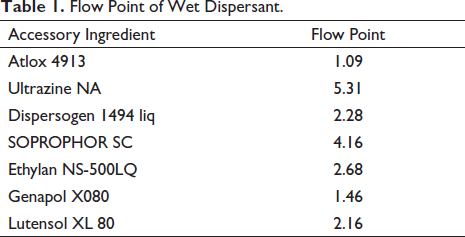
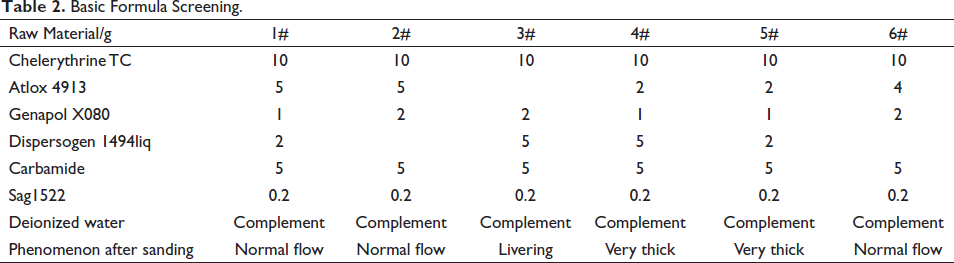
Atlox 4913, Dispersogen 1494, and Liq Genapol X080 were selected for the next step. Six matching schemes were designed (Table 2), and 6# was selected as the basic formula after comparison.
Basic Formula Screening.
Thickener Selection
The determination results for different thickeners are shown in Table 3. After the comparison, the thickener was xanthan gum + magnesium aluminum silicate (0.1% + 0.5%).
Thickener Selection.

Antifreeze Selection
Propanediol glycerol urea was prepared for cold storage, and the low-temperature stability was qualified without freezing.
Formulation Determination
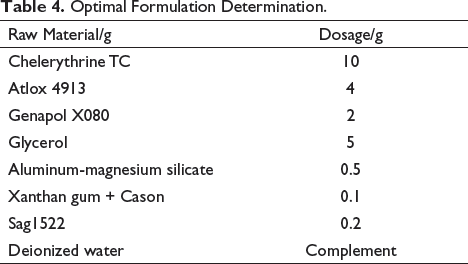
After comparison, the optimal formulation was determined and is shown in Table 4.
Optimal Formulation Determination.
Characterization and Analysis of Chelerythrine Suspension Agent
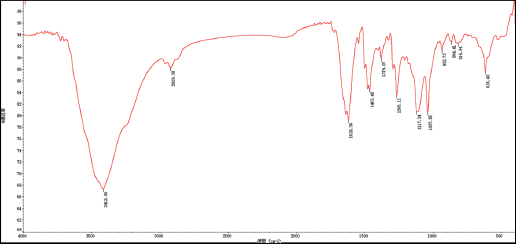
As shown in Figure 1, 1379.07 cm−1 is the stretching vibration peak of symmetrical angle change of CH3, 1463.48 cm−1 is the stretching vibration peak of angle change of CH2 in alkanes, 1618.36 cm−1 is the vibration peak of antisymmetric stretching of the COO of carboxylic acid, 2919.38 cm−1 is the antisymmetric stretching vibration peak of CH2 in alkanes, and 3413.90 cm−1 is the vibration peak of aromatic secondary amine (NH) stretching. By comparing the chemical structure of the chelerythrine standard with that of chelerythrine extract, the main component of the synthetic suspension agent was chelerythrine.
Fourier Transform-Infra-Red Analysis 1379.07 cm−1 is the Stretching Vibration Peak of Symmetrical Angle Change of CH3, 1463.48 cm−1 is the Stretching Vibration Peak of Angle Change of CH2 in Alkanes, 1618.36 cm−1 is the vibration Peak of Antisymmetric Stretching of the COO of Carboxylic Acid, 2919.38 cm−1 is the Antisymmetric Stretching Vibration Peak of CH2 in Alkanes, and 3413.90 cm−1 is the Vibration Peak of Aromatic Secondary Amine (NH) Stretching.
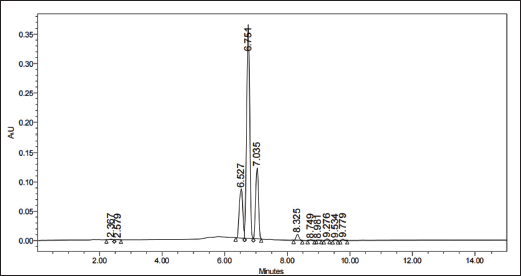
As shown in Figure 2, the characteristic absorption peak of the suspension agent was 6.751 min. By comparing the retention time of the characteristic absorption peak with that of the standard product, the main component of chelerythrine was determined to be chelerythrine.
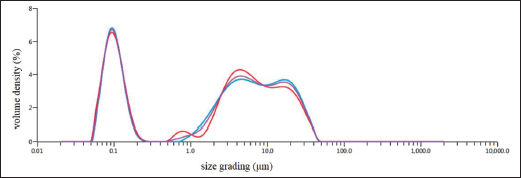
As shown in Figure 3, the suspension concentrate was an orange-red liquid suspension with easy flow and a measurable volume, with no caking. Quality control indices were pH 6.11, and the suspension rate was ≥80%. The result of the wet-sieve test was ≥99%. In particle size distribution, D50 = 3.59 µm and D90 = 19.50 µm. Less than 25 mL after one minute of continuous foaming. The residue after pouring was ≤5%. The residue after rinsing was ≤0.5%. The particle size distribution of the dispersed phase in the suspension agent was relatively concentrated, and the proportion of large particle sizes in the suspension was relatively small. The dispersion in water was relatively uniform.
Particle Size Analysis. The Suspension Concentrate was Orange-Red Liquid Suspension with Easy Flow and a Measurable Volume, with no Caking. Quality Control Indices were pH 6.11, and Suspension Rate was ≥80%. The Result of the Wet-Sieve Test was ≥99%. In Particle Size Distribution, D50 = 3.59 µm and D90 = 19.50 µm. Less Than 25 mL After One Minute of Continuous Foaming. The Residue After Pouring was ≤5%. The Residue After Rinsing was ≤0.5%.
Biological Control Effect of U. virens in the Field
After spraying twice in the rice field, the disease index of the control group (CK) was 1.78. The disease index for group 4 was 0.07, and the prevention and treatment effect was 95.88%, which was the highest. The disease index for group 2 was 0.52, and the prevention and treatment effect was 70.97%. The disease index for the positive control (validamycin) was 0.78, and the prevention and treatment effect was 56.18% (Table 5). Based on the indices mentioned above, all insecticides exerted a control effect on RFS in the field, a complex and fluctuating environment, and the control effect of group 2 (48 mL/ha active ingredient) was superior to that for the commercial pesticide validamycin (13%, 69 mL/ha active ingredient concentration). Therefore, the CHE suspension concentrate has excellent control effects.
Field Control of U. virens with Plant Fungicide.
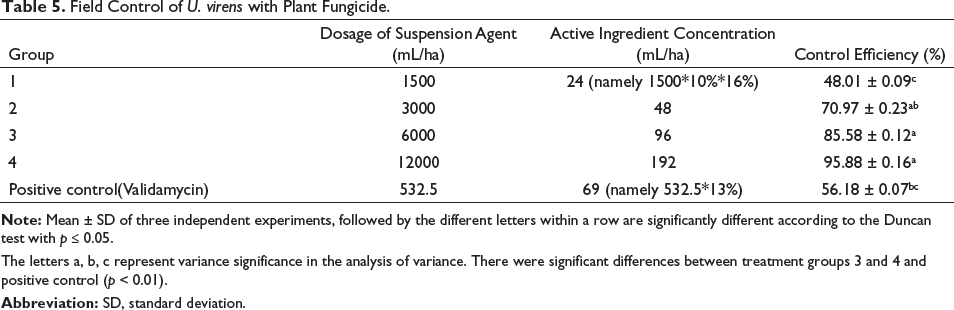
The letters a, b, c represent variance significance in the analysis of variance. There were significant differences between treatment groups 3 and 4 and positive control (p < 0.01).
Safety Evaluation of Chelerythrine Suspension Agent
According to the results of the preliminary test, seven dosage groups were set up for the formal test. After calculation of the data, the regression equation was obtained as follows:

The LD50 was 0.079 times the concentration of the agent, namely 1580 mg·kg−1 (the original concentration of the agent was 10%, and the active ingredient was 16%). The 95% confidence interval was 0.069 to 0.09. According to the classification standard of acute oral toxicity in China, when LD50 > 500 mg/kg−1, it was low toxicity. Therefore, the oral toxicity of chelerythrine suspension was low. No brain, heart, liver, spleen, lung, and kidney abnormality was observed in the dead mice.
Discussion
Screening of Auxiliaries
Pesticide dosage is a complex frontier subject. The theoretical basis of pesticide dosage research is colloid chemistry and interface chemistry. A pesticide water suspension is a very complex multi-component heterogeneous coarse dispersion suspension system. The continuous phase is a polymer aqueous solution containing different dispersants. As a basic component of the suspension agent, the dispersant plays an important role. It adsorbs on the surface of the premixed particles of the original drug, wets the surface of the particles in the mixture of dry active ingredients and water, and discharges the air between the particles. During the grinding process, the surfactant helps to rewet and disperse the re-formed particles, acting as an abrasive aid. Dispersants also contribute to the stability of the preparation. The adsorption of surfactants on the particles can reduce the interfacial energy of the particles, thus reducing particle coalescence. Surfactants can form a diffusion double layer around particles, in turn generating electric potential, which hinders aggregation and bonding between particles. Surfactants can also form a dense protective layer by adsorbing on the particle interface, forcing particles apart through “steric hindrance” to prevent precipitation, thus increasing suspension agent stability.
Evaluation of Field Control Effectiveness
Zhao et al. (2021) compared the control effects of several fungicides on rice smut and found that 75% oxime·tebutazool WG (300 g/ha, active ingredient 225 g/ha) and 32.5% benzoyl·pyrimethanil SC (600 mL/ha, active ingredient 195 mL/ha) had high control effects, at 100% and 76.4%, respectively. In addition, Lin et al. (2021) reported that the control effect of 40% propithiol·tebutazol (750 mL/ha, active ingredient 300 mL/ha) was 89.6% after spraying two times. Xia et al. (2021) studied the control effect of a compound pesticide, 60% fluocyclozole and tricyclazole wettable powder (mass ratio 1:3), applied at a rate of 288 to 360 g/ha (the active ingredient), on rice smut, and found that the control effect of “Chuanluyou 188” was 76.2%−83.6%. The control effect against lvyou 4923 was 62.6%−79.5%, which was significantly higher than that of a single agent. In the present study, when the active ingredients were 192 mL/ha, the control effect for RFS was 95.88%, which was higher than those in the previous findings above. Therefore, chelerythrine pesticide could be applied for the control of various diseases and pests.
Acute Toxicity Evaluation in Mice
The results of acute toxicity testing in mice following intragastric administration showed that the LD50 of chelerythrine suspension was 1580 mg·kg−1, which was much lower than that of other commercial low-toxicity pesticides. The LD50s of natural pyrethrin and rotenone were 900 and 34.1 mg·kg−1, respectively (Ding & Hu, 1981; Jiang et al., 2016), indicating that the drylourine suspension had higher oral safety. Acute oral toxicity testing is the initial step in pesticide safety evaluation, and the test results cannot be directly extended to humans (Yang et al., 2016). Further verification and comprehensive evaluation based on other toxicological tests are required for the determination of the precise safety thresholds of pesticides with regard to humans and livestock.
Conclusion
RFS, caused by Ustilaginoidea virens, is widely distributed in major rice-producing regions. The disease not only affects the yield and quality of rice but also produces toxins that are harmful to humans and livestock. Chemical pesticides are the most effective method for controlling crop diseases. However, their repeated use over long periods may result in pesticide resistance and accumulation of harmful residues in the environment. Therefore, there is an urgent need to develop environmentally friendly methods of controlling crop diseases, and botanical pesticides are attractive in that regard. In the present study, chelerythrine was evaluated as the main ingredient of suspending agent pesticide formulations, and its field effects on rice false smut, a fungal disease, were examined. When the suspending agent was sprayed twice, better prevention and control effects on rice smut were observed in the field. When the effective component was 192 mL/ha, the control effect was 95.88%, indicating that its application could facilitate the achievement of the goal of pesticide reduction efficiency. According to the results of the acute toxicity test in mice, chelerythrine suspension was a low-toxicity agent and exhibited the characteristics of an environmentally friendly plant pesticide. Further studies should be carried out in order to provide a theoretical basis for the prevention and control of plant diseases and the processing and production of plant-derived pesticides.
Footnotes
Acknowledgments
This project was financially supported by the Science and Technology Key Project of 2021 Heilongjiang Academy of Agricultural Sciences (China, 2021YYYF026).
Authors’ Contribution
Qinghui Wei proposed the conceptualization, methodology, writing-review and editing, resources, and writing-original draft preparation and gained acquisition of financial support for the project leading to this publication. Investigation, formal analysis, and data curation were performed by Qinghui Wei, Weifeng Song, Xinmin Li, and Min Zhao. All authors have read and agreed to the published version of the manuscript.
Declaration of Conflicting Interests
The authors declared no potential conflicts of interest with respect to the research, authorship, and/or publication of this article.
Ethical Approval
Not applicable.
Funding
Supported by Science and Technology Key Project of 2021 Heilongjiang Academy of Agricultural Sciences (China, 2021YYYF026).
