




Abstract
Background
There are many active substances in the composition of the Hypericum perforatum L. plant that have different and complex structures and show different pharmacological effects. It was accepted as a medicinal plant by the World Health Organization in 2002, and it is given a detailed place in the monographs under the name Hyperici herba. In these monographs, the anti-bacterial, anti-viral, anti-depressant, protein kinase-C inhibitor, and wound-healing effects of the plant were described.
Objectives
The aim of this study is to determine the essential oil components in the samples of the H. perforatum L. plant, which is widely grown in the Thrace region in Türkiye.
Materials and Methods
H. perforatum L. plant growing naturally in the provinces of the Thrace region was collected, and the essential oils of the plant were obtained by using the hydro distillation method after the collected herbs were dried. Chemical content analyses were performed on a gas chromatography-flame ionization detection (GC-FID).
Results
The main components of the essential oil of the plant are sesquiterpenes (ß-caryophyllene, caryophyllene oxide, β-selinene, α-selinene, β-farnesene, α-amorphene, spathulenol), alcohols (1-tetradecanol, 1-tridecanol, phytol, and alpha cadinol), and fatty acids (pentadecanoic acid, palmitic acid, and 9, 12 octadecadienoic acid).
Conclusion
This is the first study to determine the chemical composition of essential oil in H. perforatum L. samples collected from the Thrace region in Türkiye. The essential oil content of the plant can be affected by factors such as the developmental stages of the plant (preblooming, flowering stage, and fruiting time), use of fresh or dry plant material, extraction method, genetic parameters, and climate.
Introduction
Hypericum perforatum L. is accepted as a valuable medicinal plant in Turkey as well as all over the world and is widely used as an alternative in the treatment of wounds and burns (Özkan & Mat 2013). There are many active substances in the composition of the H. perforatum L. plant that have different and complex structures and show different pharmacological effects. It was accepted as a medicinal plant by the World Health Organization in 2002, and it is given a detailed place in the monographs under the name Herba hyperici. In these monographs, the antibacterial, antiviral, antidepressant, protein kinase-C inhibitor, and wound-healing effects of the plant are described (WHO, 2002). H. perforatum L. also has many anti-inflammatory, antioxidant, antitumor, hepatoprotective, and analgesic effects (Patočka, 2003).
Hypericum species, to which the genus H. perforatum L. belongs, is more than 500 in the world; there are 107 species in Turkey. It grows in many geographical regions, such as the Marmara, Aegean, Mediterranean, Black Sea, and Eastern and Southeastern Anatolia in Turkey (Özbek et al., 2019). H. perforatum L. usually grows on roadsides, forest edges, uncultivated fields, meadows, and rocky and stony places. Flowering time is from June to September (Kaçar & Azkan, 2005).
Hypericum species are generally classified as plants that are poor in essential oils (usually oil yield <1%), and the amount of essential oil has been observed to vary between 0.1 and 0.35% (Morshedloo et al., 2015). The essential oil content of the plant can be affected by factors such as the developmental stages of the plant (preblooming, flowering stage, fruiting time), use of fresh or dry plant material, extraction method, genetic parameters, and climate (Crockett et al., 2011; Morshedloo et al., 2014).
The groups that make up the chemical structure of the plant are naphtodiantrone (hypericin, pseudohypericin, etc.), phloroglucinols (hyperforin, adhyperforin, etc.), flavonoids (hyperoside, rutin, quercetin, etc.), biflavones (biapigenin, amentoflavone, etc.), phenylpropanes, and procyanidins. In addition to these, tannins, xanthones, essential oils, and amino acids are also present in lesser amounts (Ion et al., 2022). The amount and composition of an essential oil vary according to the part of the plant from which it is obtained, the type of plant, the geographical conditions of the region where the plant is located, the climate, the developmental stages of the plant, and the extraction methods (Saffariha et al., 2021).
This study was carried out to determine the chemical composition of essential oil in H. perforatum L. samples collected from Tekirdağ, Kırklareli, Edirne, Çanakkale (Gelibolu peninsula), and Istanbul’s European side between June and August 2021, representing the Thrace region. In addition, it is the first study to determine the chemical components of essential oil in H. perforatum L. samples collected from the Thrace region in Türkiye.
Materials and Methods
Plant Materials
In this study, between June and August 2021, representing the Thrace region in Türkiye, a total of 75 samples were collected from the above-ground parts of the plant during the flowering period of the self-growing H. perforatum L. in different locations of Tekirdağ, Kırklareli, Edirne, Çanakkale (Gallipoli peninsula), and the European side of Istanbul. The collected specimens were dried in a shaded environment. The voucher specimens were preserved in Tekirdağ Namık Kemal University, Faculty of Veterinary Medicine, Pharmacology and Toxicology laboratory (Number 21/1-75).
Hydrodistillation Process
The dried plant samples were ground in a Lavion grinding device until they turned into powder. From the ground samples, 100 g were weighed and transferred to a glass balloon (1 L). Five hundred milliliters of distilled water was added. The samples were boiled for 4–5 h using the Clevenger. Approximately, 0.3–1 mL of essential oil was taken into Eppendorf tubes.
Gas chromatography-flame ionization detection (GC-FID) analyses were performed using a Varian CP-3800 gas chromatograph equipped with a Shimadzu QP2010 ultra model, a DB-5 capillary column, and a Varian Saturn 2000 ion trap mass detector. The essential oil was diluted in 10% n-hexane and injected into a GC-FID, Technochroma 5-MS column, and helium as a carrier gas. The column temperature is 60°C, and the flow rate is 1 mL/min. Column temperature increased from 60°C to 240°C at 3°C increments per minute. The injection and ion source temperature was 240°C. The characterization of the components in essential oils was performed using electronic libraries (NIST 98, ADAMS).
Results
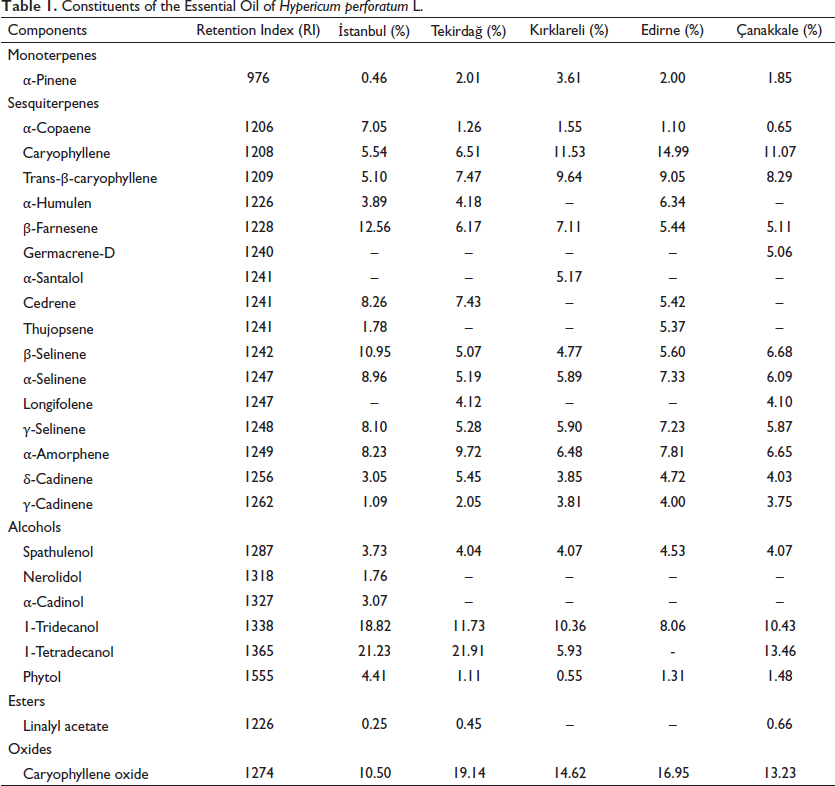
According to the results of gas chromatography-mass spectrometry (GC-MS) analysis, the main components of the essential oils of the plant samples collected from the Thrace region are generally sesquiterpenes (β-caryophyllene, caryophyllene oxide, β-selinene, α-selinene, β-farnesene, α-amorphene, etc.). There are also alcohols (spathulenol, alpha cadinol, and phytol) and fatty acids (pentadecanoic acid and palmitic acid) (Table 1).
Constituents of the Essential Oil of Hypericum perforatum L.
Discussion
The main components of essential oils obtained by hydrodistillation from H. perforatum L. in Bulgaria are 2-methyloctane (10.33%), α-pinene (10.61%), 3-methylnonane (2.98%), β-pinene (5.95%), trans-β-caryophyllene (16.02%), germacrene D (5.44%), and caryophyllene oxide (15.90%). The main components we detected in our study were α-pinene, trans-β-caryophyllene, germacrene D, and caryophyllene oxide, which are generally similar to the main components of this study (Semerdjieva et al., 2023).
In a study by Çakir et al. (1997) in Gaziantep, it was determined that the main components of the essential oil of the naturally grown H. perforatum L. species were β-pinene (61.7%), β-caryophyllene (5.5%), myrcene (3.6%), α-pinene (3%), cadalene (3.2%), sabirene (2.4%), and terpinene (2.2%). The main components of our study, β-caryophyllene and α-pinene, are similar to the main components of this study (Çakir et al., 1997).
The main components of the essential oil analyzed as a result of a study conducted in Samsun were γ-muurolene (5.00%–9.56%), β-caryophyllene (4.08%–5.93%), α-selinene (4.12%–10.42%), β-selinene (5.08%–19.63%), delta-cadinene (3.02%–4.94%), caryophyllene oxide (6.01%–12.18%), and spathulenol (2.34%–5.14%). It also contains traces of myrcene, α-terpineol, α- and β-pinene, linalool, and trans-linalool oxide. Caryophyllene oxide, α-selinene, delta-cadinene, and spathulenol, which are the main components in our study, are similar to the study by Çırak et al. (2010).
The main components of the essential oil of H. perforatum L. collected from Kazdağları (Balıkesir-Edremit) in 2011–2012 are as follows: 1-tetradecanol (19.5%), α-pinene (13.1%), caryophyllene oxide (6.3%), cubenol (6.2%), gurjunene gamma (5.3%), β-caryophyllene (4.8%), and τ-muurolene (4.1%). The findings obtained in the study conducted with the samples collected from Kazdağları; 1-tetradecanol, α-pinene, caryophyllene oxide, and caryophyllene are similar components to our study (Paşa, 2013).
In Deveci’s study, the essential oil content of H. perforatum L. collected from Malatya province is as follows: α-pinene (35.0%), Odesma-4 [14],11-diene (14.5%), α-selinene (10.0%), α-amorphene (4.5%), caryophyllene (3.5%), β-selinene (3.0%), 1-deken (3%), octane 2-methyl (3.0%), caryophyllene oxide (2.0%), and spathulenol (2.0%). The main components in the samples from Tunceli province are caryophyllene (6.8%), caryophyllene oxide (3.0%), α-pinene (60%), thujopsene (3.3%), Odesma-4 [14],11-diene (1.8%), and α-selinene (1.5%). In Bitlis province; Odesma-4 [14],11-diene (14.5%), germacrene D (8.5%), α-selinene (7.1%), 1-deken (4.6%), α-pinene (4.5%), caryophyllene (3.5%), spathulenol (3.5%), and caryophyllene oxide (2.5%) were found. Although the provinces of Gaziantep, Tunceli, and Malatya (whose distance to Tekirdag is approximately 1300 km) are in different regions with different climatic conditions, it has been observed that the main components have similar chemical contents (Deveci, 2014).
Mockutė et al. determined that the essential oil rate was 0.1%–0.4% in H. perforatum L. samples collected from nine different locations in the west of Lithuania. The main components of the essential oil are caryophyllene oxide (13.3%–35.8%), β-caryophyllene (10.5%–19.1%), germacrene D (16.1%–31.5%), spathulenol (3.9%–8.0%), α-cadinol (2.2%–6.2%), α-pinene (1.1%–6.9%), β-farnesene (0.6%–8.2%), δ-cadinene (1.7%–6.7%), and α-muurolene-14-hydroxy (1.9%–9.1%). The common main components of our study and the study in Lithuania were caryophyllene oxide, β-farnesene, spathulenol, germacrene D, and β-caryophyllene (Mockutė et al., 2003).
In a study by Akhbari and Batooli, 24 essential oil components were identified in the flowers and seeds of H. perforatum L., while 55 essential oil components were detected in its leaves. The main components of the flower and seed are α-amorphene (15.86%), α-pinene (11.34%), thymol (7.27%), and δ-cadinene (5.72%). The main essential oil components in the leaves are α-pinene (29.33%), β-pinene (3.89%), α-amorphene (6.27%), and α-cadinene (3.15%). We carried out our study by grinding the above-ground parts at the same time without separating the flowers and leaves. The main components (α-amorphene and α-pinene) in our study are similar to the components obtained from the leaves (Akhbari & Batooli, 2009).
Schwob et al. (2004) found that the main components were caryophyllene oxide (18.5%), β-caryophyllene (18.3%), spathulenol (12.7%), 1-tetradecanol (7%), β-funebrene (3.2%), 1-dodecanol (4.1%), and γ-muurolene (4.1%); 64 of the identified compounds were common to all these oils.
In Serbia, Smelcerovic et al. (2004) identified the main components in the study as β-caryophyllene (0.64%–19.23%), 1-tetradecanol (5.08%–23.75%), 10-methyl-1-undecene(0%–14.66%), palmitic acid (0%–10.27%), and n-eicosane (0%–30.86%). In another study by Smelcerovic et al., the essential oil components in the leaves were α-bergamotene (11.5%), germacrene D (10.0%), caryophyllene oxide (6.1%), β-caryophyllene (5.5%), 2-methyl-octene (1.8%), α-pinene (1.2%), and n-hexadecanoic acid (0.5%). In flowers, 2-methyloctane (27.3%), α-pinene (15.2%), β-pinene (3.4%), β-caryophyllene (5.0%), caryophyllene oxide (1.6%), n-tetradecanol (2.1%), germacrene D (1.7%), and n-hexadecanoic acid (1.7%). We carried out our study by grinding the above-ground parts at the same time without separating the flowers and leaves. The main components obtained from the leaves and flowers are similar to the compounds obtained from our study (Smelcerovic et al., 2007).
In another study conducted by Tognolini et al. in France, the essential oil components of H. perforatum L. were 2-methyloctane (36.0%), α-pinene (26.0%), 2-methlynonane (7.0%), 2-methyldecane (4.8%), and caryophyllene oxide (4.2%). The only component in common with our study is caryophyllene oxide (Tognolini et al., 2006).
In Uzbekistan, a study conducted by Baser et al. (2002) identified the main components obtained from the essential oil as β-caryophyllene (11.7%), caryophyllene oxide (6.3%), spathulenol (6%), and α-pinene (5%). The compounds of our study, β-caryophyllene, spathulenol, and α-pinene, are similar to the main components of this study (Baser et al., 2002).
In Italy, a study conducted by Pintore et al. identified the main components of essential oil as germacrene D (17.6%), 2-methyloctane (21.1%), and α-pinene (15.8%). Germacrene D and α-pinene are the main components of our study (Pintore et al., 2005).
According to the study conducted in North India, the main components in essential oils are as follows: α-pinene (67.3%), caryophyllene (5.2%), geranyl acetate (4.8%), nonane (4.6%), and α-cuprenene (3.2%). α-Pinene and caryophyllene are similar to the main components of our study (Weyerstahlet al., 1995). In another study conducted in India, the main components of essential oil were germacrene D (22.1%), while other important components were α-pinene (8.6%), β-pinene (3.8%), β-caryophyllene (11.3%), α-cadinol (4.4%), 2-methyl-octane, (3%), caryophyllene oxide (3.3%), terpinen-4-ol (3.3%), spathulenol (2.8%), and α-muurolol (2.9%). The main essential oil components of this study, only caryophyllene oxide, spathulenol, and β-caryophyllene matched our components (Morshedloo et al., 2015).
According to the study conducted in Tunisia, the main components obtained from the essential oil of H. perforatum L. are β-selinene (5.5%), α-selinene (6.5%), n-octane (7.3%), germacrene D (10.6%), alloaromadendrene (11.4%), and α-pinene (13.1%). In this study, β-selinene, α-selinene, and α-pinene components were also found in our samples (Hosni et al., 2008).
In Tajikistan, Sharopov et al. have identified the main components of the essential oil of H. perforatum as germacrene D (13.7%), α-pinene (5.1%), (E)-caryophyllene (4.7%), n-dodecanol (4.5%), caryophyllene oxide (4.2%), bicyclogermacrene (3.8%), and spathulenol (3.4%). In this study, germacrene D, α-pinene, caryophyllene, and caryophyllene oxide components were also found in our samples (Sharopov et al., 2010).
Conclusion
It is the first study to determine the chemical composition of essential oil in H. perforatum L. samples collected from the Thrace region in Türkiye. The chemical composition of essential oils obtained from St. John’s Wort collected from the Thrace region includes sesquiterpenes (β-caryophyllene, caryophyllene oxide, β-selinene, α-selinene, β-farnesene, and α-amorphene) alcohols (alpha-canenol, spathulenol, and phytol), and fatty acids (pentadecanoic acid and palmitic acid). The essential oil content of the plant can be affected by factors such as the developmental stages of the plant (preblooming, flowering stage, and fruiting time), use of fresh or dry plant material, extraction method, genetic parameters, and climate.
Footnotes
Acknowledgments
This study is a summary of the master’s thesis of the first author. Tekirdağ Namık Kemal University, Health Science Institute. This work was supported by the Scientific Research Project Coordination Unit of Tekirdag Namik Kemal University, Tekirdag (The project number: NKUBAP.10.YL.20.276).
Declaration of Conflicting Interests
The authors declared no potential conflicts of interest with respect to the research, authorship, and/or publication of this article.
Statement of Informed Consent and Ethical Approval
The approval of research ethics committees was not required to achieve the objectives of this study because experimentally any human or animal were not used in the study.
Funding
This work was supported by the Scientific Research Project Coordination Unit of Tekirdag Namik Kemal University, Tekirdag (the project number: NKUBAP.10.YL.20.276).
Supplemental Material

References
Supplementary Material
Please find the following supplemental material available below.
For Open Access articles published under a Creative Commons License, all supplemental material carries the same license as the article it is associated with.
For non-Open Access articles published, all supplemental material carries a non-exclusive license, and permission requests for re-use of supplemental material or any part of supplemental material shall be sent directly to the copyright owner as specified in the copyright notice associated with the article.
