




Abstract
Background
Alzheimer’s disease (AD) is a type of dementia that leads to loss of memory and learning ability. Aloe arborescens is a traditional medicinal plant in Europe and Africa. It has been reported that A. arborescens showed anti-inflammatory, anti-cancer, antioxidant, and anti-obesity effects. Previously, we reported that fermented A. arborescens extract had neuroprotective activity in glutamate-insulted HT22 cells.
Materials and Methods
In this study, we evaluated its cognitive enhancing activity by using scopolamine-induced memory impairment in mice as a model system. Morris water maze test was carried out to evaluate spatial memory enhancing activity and a passive avoidance test was performed to evaluate an effect on learning memory. A. arborescens was extracted with methanol in an ultrasonic extraction device and fermented with Lactobacillus brevis. Fermented A. arborescens extract was treated to scopolamine-insulted Institute of Cancer Research (ICR) mice at a concentration of 100, 200, and 300 mg/kg, respectively.
Results
The fermented A. arborescens extract significantly improved the scopolamine-insulted memory impairment. Fermented A. arborescens extract inhibited acetylcholine esterase activity and boosted brain-derived neurotrophic factor and phosphorylated cAMP-response element-binding protein (p-CREB) expression. These results showed that fermented AA extract improved memory impairment through the increase of the BDNF and p-CREB signal pathway.
Conclusion
According to these results, we considered that the fermented A. arborescens extract can be a useful candidate for new nutraceuticals for improving memory impairment.
Introduction
Dementia is caused by various reasons and is one of the disorders of various cognitive functions such as learning ability, computing ability, language ability, and the like due to general cerebral dysfunction.
1
It is known that 50 to 60% of dementia is caused by Alzheimer’s disease (AD), including the amyloid-b plaque caused by hyperphosphorylation of tau protein, neurofibrillary tangles, and neuronal cell death due to hostile stress.2–4 However, since a clear etiology has not yet been established, fundamental treatment is difficult. In the early stage, the symptoms are mild and difficult to detect, but as the disease progresses, neurons in various areas will be damaged and lead to disability in daily living. Drugs currently used for dementia treatment have included donepezil, livastagmine, and galatamine. However, these AChE inhibitors or N-methyl-
Aloe arborescens is a succulent plant with large green leaves with many spikes. It has long been widely used as a traditional medicine to treat various diseases. A. aborescens is well cultivated in warm and humid places and is mainly distributed in the western Mediterranean Sea, Australia, California, Japan, Korea, and the Marshall Islands. In Korea, the gel of succulent leaves of A. arborescens is extracted and used as a raw material for functional foods or cosmetics.13, 14
According to various recent research, A. arborescens has been reported that it showed various pharmacological activities such as anti-fungal, antibacterial, antiviral, anti-tumor, antioxidant, anti-inflammatory, hepatoprotective, anti-obesity, wound healing, and burn to heal.15–19 Furthermore, it has also been reported A. arborescens contains many bioactive components such as polysaccharides, flavonoids, anthraquinone, and pyrones.20–22
The fermentation process is a kind of metabolic process that causes chemical changes through enzyme reactions and can be used as a useful way to increase the pharmacological activity of natural products through changes in the metabolites of natural products. The fermentation process using lactic acid bacteria performed under low temperatures or non-harsh conditions is mainly used to increase the activity of natural products without impairing their stability of natural products. Especially, Lactobacillus family is a widely used strain to increase the activity of natural products because Lactobacillus strain confirms the criteria set by the General Authorized As Safe (GRAS) of the Food and Drug Administration (FDA) guideline.23, 24
In the previous study, A. arborescens-fermented extracts had significant results on neuronal cell protective activity against glutamate. Treatment of fermented A. arborescens extract not only effectively reduced ROS and Ca2+ ions, but also maintained mitochondrial membrane potential at normal levels. Glutathione content and activities of related enzymes such as glutathione reductase and glutathione peroxidase also significantly increased.
In this study, we tried to evaluate the cognitive enhancing activity of the fermented A. arborescens extract showing neuroprotective activity against scopolamine-induced memory impairment in mice through in vivo behavior tests such as MWM and passive avoidance tests. Furthermore, we attempted to elucidate mechanisms of action using by measurement of acetylcholine esterase activity and BDNF expression in the hippocampus of mice.
Materials and Methods
Plant Materials and Preparation
To obtain the fermented aloe extract, 100 g of dried A. arboresecens was extracted with 900 mL of distilled water at 100°C for 24 h with a reflux condensed extractor (GLHMR B1000, Global Lab, Siheung, Korea). Then, the whole extracts were mixed with the following basal medium: 0.5% yeast extract, 1% peptone, 2% glucose, 0.01% magnesium sulfate, 0.005% manganese sulfate, 0.2% potassium phosphate, and 0.1% polysorbate 80. After that, 3% (v/v) of Lactobacillus brevis was inoculated into a medium that was already autoclaved at 121°C for 30 min. The incubator was operated at 100 rpm and 37°C for 3 days. Then, the culture broth was lyophilized to make a powder with a freeze dryer (RV8, Edwards, Sweden). The powders were stored at −20°C before use.
Reagents
Scopolamine, phosphate buffered saline (PBS), and carboxymethyl cellulose (CMC) were purchased from Sigma (St Luis, MO, USA). Scopolamine was used to induce Alzheimer’s type dementia by an increase of activity of acetylcholine esterase. 27 Donepezil was manufactured by Samjin Pharmaceutical Co., Ltd. (Seoul, Korea). Donepezil prevents acetylcholine esterase from the degradation of acetylcholine and to be maintained a high concentration of acetylcholine in neuronal cells. As a result, donepezil usually helps to improve memory and cognitive function. 33 Actin, BDNF, CREB, and phosphorylated cAMP-response element-binding protein (p-CREB) were purchased from Santa Cruz Biotechnology (Santa Cruz, CA, USA).
Experimental Animals
Institute of Cancer Research (ICR) mice were used for the evaluation of cognitive-enhancing activity in this study. Four-week-old ICR male mice were purchased from Kangwon Life Science Co. (Gangwon Province, Korea). These mice were adapted for 1 week at Kangwon National University Animal Care Center. The temperature (23 ± 1°C), humidity (60%), and darkness (12 h) of the animal room remained constant during the adaptation period. Experimental animals received unlimited feed and water during the adaptation period. All animal experiments and care were carried out in accordance with Kangwon national university animal care and use guidelines IACUC (KIACUC). Also, the experiment was performed according to the ARRIVE guidelines.
Drug Administration
The mice were split into six groups (n = 7): control group, scopolamine group, positive control group (donepezil (1 m/kg) treatment), and three fermented A. arborescens extract groups (100, 200, and 300 mg/kg of fermented A. arborescens treatment). Fermented A. arborescens extract and donepezil were treated 90 min before scopolamine treatment by oral administration. The control group was treated with only 0.5% CMC solution. Scopolamine (1 mg/kg) was dissolved in normal saline (0.9% NaCl) and treated in all groups except the controls by subcutaneous injection 30 min before the behavior test. The mice were treated over four consecutive days before undergoing daily trials in the MWM test and were treated for only 1 day (training trial) before the passive avoidance test.
MWM Test
The MWM test was performed as described by Morris. The MWM test was carried out in a large circular pool (90 cm diameter and 40 cm height) filled with water (20 ± 1°C) and 500 ml of white milk. The water maze test area was divided into four quadrants, and the escape platform (10 cm diameter and 26 cm height) was placed 1 cm below the surface of the water in the center of one quadrant. All swimming activities of mice, including swim time, distance, and speed were monitored and recorded by a smart video-tracking system (ver. 2.5.21) linked video camera. After the mouse found and reached the platform, the time was recorded as escape latency. Mice were allowed 60 s in the absence of the platform as a test trial on the first day. The mice were given four trial sessions per day for four consecutive days and the interval between each trial session was 1 day. If the mouse did not find the platform within 120 s, the trial session was quit and the escape latency was recorded as 120 s. After the experiment, the mice were euthanized by cervical dislocation.
Passive Avoidance Test
The passive avoidance was carried out using two equally sized compartments (17 cm × 12 cm × 10 cm) with an electrifiable grid floor and two compartments were separated by a guillotine door. An acquisition trial was performed on the first day. The mouse was initially placed and explored in the light compartment. The door between the two compartments was opened after 40 s. When the mouse moved into the dark compartment, the door automatically closed. About 24 h after the acquisition trial, the mouse was placed in a light compartment and the guillotine door was opened 30 s after. When the mice moved into the dark compartment, the door closed automatically and an electric foot shock (0.1 mA/10 g body weight) for 2-sec durations was delivered through the grid floor. 24 h after the training trial, the mice were again placed into the light compartment and the latency that was taken to enter the dark compartment after opening the door within 180 s, was measured. After the experiment, the mice were euthanized by cervical dislocation.
Acetylcholinesterase (AChE) Inhibition Assay
An AChE inhibition assay was performed according to the method described by Ellman with slight modification. 25 The brain tissue was immediately removed from the mouse within 30 min after the behavior test. The hippocampi were isolated from the brain tissues of the mice and rapidly homogenized with sodium phosphate buffer. The reaction mixture contained 33 mL of supernatant, 470 mL of phosphate buffer (pH 8.0), 167 mL of 5,5’-dithio-bis(2-nitrobenzoic acid) (DTNB) (3 mM), and 280 mL of acetylcholine iodide (ACh) (1 mM). Inhibition of the AChE enzyme of fermented A. arborescens extract was measured by AChE enzyme activity. The reaction mixture was consisting of AChE, DTNB, and ACh. AChE activity was measured at 412 nm using a spectrophotometer.
Western Blot Analysis
The hippocampus was prepared from the mouse within 30 min of the behavioral test. Then, the hippocampus was washed with PBS, dissolved in 1 ml of RIPA buffer to dissolve the protein, and the precipitate and supernatant were separated by centrifugation and homogenized. The supernatant was subjected to 15% SDS-PAGE gel and transferred to the PVDF membrane. The membrane was blocked in 5% skim milk for 1 h and was incubated with primary antibodies, with mouse anti-actin (1:2000), rabbit anti-BDNF (1:1000), mouse anti-CREB (1:1000), and goat anti-p-CREB (1:500) for overnight at 4°C. After incubation, the membrane was washed three times for 10 min and secondary antibodies (goat-anti-rabbit IgG HRP 1:2000 for BDNF and horse-anti-goat IgG HRP for p-CREB and goat-anti-mouse IgG HRP 1:2000 for actin and CREB) were incubated for 1 h at room temperature and the membrane washed five times. Detection was performed using enhanced chemiluminescence (ECL) solution and exposed to X-ray film in a dark room.
Statistics
The results from the MWM, passive avoidance test, and western blot experiment were mean ± SEM, respectively. All experimental results were statistically analyzed using ANOVA and the difference between the experimental groups was significant at p < 0.05, 0.01, and 0.001 levels.
Results and Discussion
Fermented A. arborescens Extract Improved Spatial Memory Against Scopolamine Insulted Memory Impairment in Mice
MWM test was applied to evaluate the cognitive enhancing activity of fermented A. arborescens extract against scopolamine-induced memory loss (Figure 1A). The escape latency (s) of the control group mice has been significantly and continuously decreasing day by day for four trial days. The escape latency time of the control group on the fourth day was 12 s. However, the escape latency of scopolamine treated group mice was longer than that of the control group and remained constant without decreasing after the first day. The escape latency time of the scopolamine-treated group on the fourth day was 96.2 s. This means that scopolamine appropriately induced memory impairment in mice in this experiment. We conducted the test for the evaluation of the memory-enhancing activity of fermented A. arborescens extract for a total of four days and observed a significant difference in each concentration group after the third day of the experiment. The latency time of the donepezil-treated group was observed at 52.4 s on the third day and significantly reduced to about 33.0 s on the fourth day. The fermented A. arborescens extract-treated group showed a decrease in escape latency in a dose-dependent manner compared to the scopolamine-treated group. At the concentration of 200 mg/kg of fermented A. arborescens, the latency time was 12.2 s. The latency time of 100 mg/kg and 300 mg/kg of fermented A. arborescens extract-treated groups were 83.1 s and 37.4 s, respectively (Figure 1A).
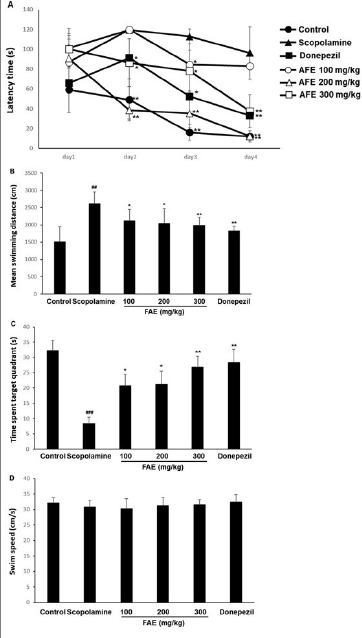
As shown in Figure 1B, the swimming distance of the control group was much shorter than that of the scopolamine-treated group. The swimming distance of the control group was 1503 cm and that of the scopolamine-treated group was 2613 cm. The fermented A. arborescens extract significantly decreased swimming distance that increased by scopolamine-induced memory impairment for 4 days in a dose-dependent manner. The swimming distances of 100 mg/kg, 200 mg/kg, and 300 mg/kg of fermented A. arborescens extract treated groups were 2118, 2043, and 1986 cm, respectively (Figure 1B).
To take the probe test, the time mice stayed in the target quadrant with the platform was measured. The control group stayed in the target quadrant longer than the scopolamine-treated group. The time spent in the target quadrant of the control group was 32.3 s and that of the scopolamine-treated group was 8.3 s. The fermented A. arborescens extract-treated group increased time consumption in the target quadrant in a dose-dependent manner. The time spent in the target quadrant of 100 mg/kg, 200 mg/kg, and 300 mg/kg of fermented A. arborescens extract treated groups were 20.8 s, 21.2 s, and 26.8 s, respectively (Figure 1C).
The swimming speed of the mouse was measured to confirm that the decrease in the time to find the target platform in the fermented A. arborescens-treated group was not due to an increase in the mouse’s motor ability. A significant difference in the mean swimming speed of the mice was not observed among control, scopolamine-treated, fermented A. arborescens-treated, and donepezil-treated groups (Figure 1D). These data indicated that the effect of scopolamine, donepezil, and A. arborescens extract was not due to the improvement of the mouse’s locomotor activity, but to the enhancement of spatial memory.
MWM test was used to measure the protective effect of fermented A. arborescens extract against scopolamine-induced cognitive impairment. MWM was designed to evaluate spatial memory and learning skills. 26 Scopolamine was well known to block cholinergic signaling and caused impairment in learning and memory. 27 And, it has been reported that scopolamine increased the AChE activity in the hippocampus of the mouse. Fermented A. arborescens extract decreased escape latency that increased by scopolamine treatment in a dose-dependent manner in MWM test. And fermented A. arborescens extract-treated group found a shorter way to reach the platform than the scopolamine-treated group. However, the average swimming speed of mice was not significantly different during the 4 days for all groups. These results confirmed that the decrease in escape latency of the fermented A. arborescens-treated group was not due to strengthening muscular motility but due to the recovery of memory impairment. Moreover, we established that fermented A. arborescens extract-treated mice remembered and recognized the location of the platform because the fermented A. arborescens extract-treated group stayed longer in the target quadrant including the platform compared to scopolamine-treated group. In conclusion, the fermented A. arborescens extract was shown to improve spatial memory and learning ability in the MWM test.
Fermented A. arborescens Extract Improved Learning Memory Against Scopolamine Attenuated Memory Ability in the Passive Avoidance Test
Passive avoidance tests were generally applied to evaluate LTP. 28 To confirm the long-term memory improvement effect of the fermented A. arborescens extract treatment, the passive avoidance experiment was carried out on the scopolamine-induced memory impairment in the mouse model. There was no significant difference in latency time among all groups in the acquisition trial (Figure 2). The control group, scopolamine-treated group and donepezil-treated group had average latency times of 2.26 s, 2.26 s, and 2.1 s, respectively. And the fermented A. arborescens extract-treated group showed average latency times of 2.5 s, 2.42 s, and 2.36 s at a concentration of 100 mg/kg, 200 mg/kg, and 300 mg/kg, respectively. These data showed that the test began at an equal point among all groups.
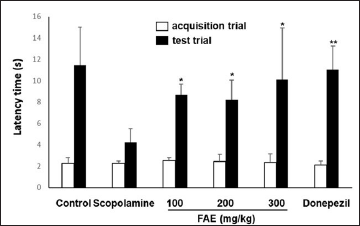
However, the latency time of the scopolamine-treated group was significantly decreased compared with the control group in the test trial. Therefore, it was confirmed that the induction of memory impairment by scopolamine in mice was effectively accomplished. In the test trial, the latency time of the control group was 11.44s and the scopolamine-treated group measured a latency time of about 4.26 s. And the fermented A. arborescens extract-treated group increased average latency times of 8.68 s, 8.22 s, and 10.08 s at the concentration of 100 mg/kg, 200 mg/kg, and 300 mg/kg, respectively.
The passive avoidance test is carried out using animal learning to avoid aversive stimulation such as an electron foot shock. The fermented A. arborescens extract was administered orally and the passive avoidance test was carried out to evaluate to improve scopolamine-induced memory deficiency and LTP. In the acquisition trial, no significant difference was measured in all groups. These results suggested that all experimental mice used in the experiments were in a similar condition. However, the fermented A. arborescens extract increased the mean latency time in a dose-dependent manner compared to the scopolamine-treated group. These data suggested that fermented A. arborescens extract effectively increased learning ability and recovered the memory impairment and deficiency induced by scopolamine treatment.
Fermented A. Aroborescens Extract Inhibited Ache Activity In The Hippocampus
The effect of fermented A. arbroescens extract on AChE activity in the hippocampus was evaluated. AChE activity increased in the scopolamine-treated group compared to the control group, whereas fermented A. arbroescens extract significantly inhibited AChE activity in a dose-dependent manner (p < 0.05) (Figure 3). AChE activity of the scopolamine-treated group was increased to 142.2% compared to the control group. And the fermented A. arborescens extract-treated group decreased AChE activity by 125.6, 122.1, and 108.5% at the concentration of 100 mg/kg, 200 mg/kg and 300 mg/kg, respectively.
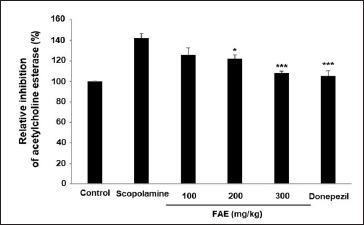
The expressions and activities of some enzymes were measured to evaluate the mechanism of action on the memory improvement activity of the fermented A. arborescens extract. Acetycholine has an important role in learning and memory and shows an influence on working memory and spatial memory function. In the central nerve system of the patients with neurodegenerative diseases, the amount of acetylcholine was lower than in healthy people and a low level of acetylcholine was responsible for memory impairment. It has been reported that activation and expression of acetylcholine esterase decreased acetylcholine levels in the synapse of AD patients.29, 30 For this reason, acetylcholine esterase has been the pharmacological target of treatment for AD. Many acetylcholine esterase inhibitors including donepezil, galantamine, and tacrine were developed and taken for the AD patients. They can attenuate memory impairment by inhibiting the degradation of acetylcholine.31–33 In the acetylcholine esterase assay, fermented A. arborescens extract inhibited acetylcholine esterase activity in a dose-dependent manner. These results suggested that fermented A. arborescens extract attenuated the scopolamine-induced memory deficiency by inhibiting the activity of acetylcholine esterase followed by the increase of acetylcholine.
Fermented A. aroborescens Extract Increased the BDNF and p-CREB Levels in the Hippocampus
BDNF was related to the canonical nerve growth factor and played an important role in the long-term memory of certain neurons in the hippocampus. We evaluated the expression of BDNF protein using western blot analysis. BDNF expression was significantly decreased due to scopolamine treatment but significantly increased in the fermented A. arborescens extract-treated group in a dose-dependent manner (Figure 4). CREB was well known to be one of the transcription factors that regulate the expression of neurological important proteins such as BDNF through the phosphorylation process as a phosphorylated form of CREB (p-CREB). We also evaluated the expression of CREB and p-CREB protein using western blot analysis. The expression of phosphorylation of CREB (p-CREB) was decreased after scopolamine treatment compared to the control group. However, the fermented A. arborescens extract-treated group showed significantly increased p-CREB/CREB ratios in the hippocampus compared with the scopolamine-treated group (Figure 5).
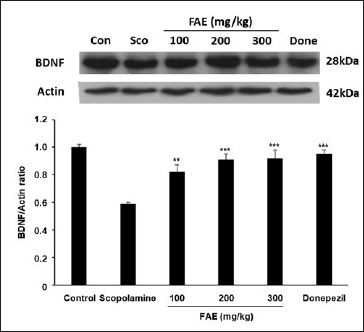
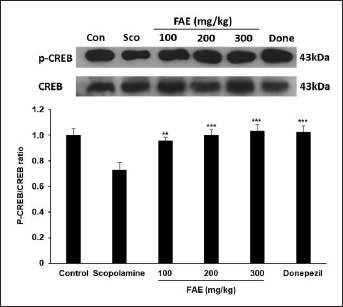
BDNF is one of the neural growth factor families and is known to play an important role in regulating neurotransmitters and neuroplasticity in the hippocampus. And CREB is one of the memory processes and long-term formation-related transcription factors and plays an essential role in BDNF gene expression after the phosphorylation process. Phosphorylation of CREB leads to the upregulation of BDNF (phosphorylated at Ser-133).34–38 We investigated the effect of fermented A. arborescens extract on BDNF expression and CREB phosphorylation in the scopolamine-treated mice by western blot analysis. We confirmed that fermented A. arborescens extract increased the expression of BDNF protein and phosphorylation of CREB in the hippocampus. These results indicated that the cognitive-enhancing activity of fermented A. arborescens extract was influenced by the activation of BDNF and phosphorylation of CREB.
Conclusion
In conclusion, we have shown that fermented A. arborescens extract could attenuate scopolamine-induced memory impairments in mice, and this may be attributed to the acetylcholine esterase inhibition and activated BDNF and p-CREB signaling caused by fermented A. arborescens extract. The present study suggests that fermented A. arborescens extract may be a new botanical drug candidate for the treatment of neurodegenerative diseases such as AD. However, compounds that play an important role in the enhancement of the cognitive function of fermented A. arborescens extract have not yet been identified. It is thought that further research on active compounds is necessary.
Footnotes
Abbreviations
AD: Alzheimer’s disease; BDNF: Brain-derived neurotrophic factor; CREB: cAMP-response element binding protein.
Authors’ Contributions
GJ and SHL performed the experiments and analyzed the data. HL, SHL, JHB, YSK, and CJM designed the experiments and discussed the data. CJM wrote and corrected the manuscript. All authors read and approved the final manuscript.
Declaration of Conflicting Interests
The authors declared no potential conflicts of interest with respect to the research, authorship, and/or publication of this article.
Ethics Approval and Consent to Participate
All animals used in this study were reviewed and approved by the Ethics Committee on Animal Use of the Kangwon National University (Chunchon, Korea).
Funding
This research was financially supported by the Ministry of Small and Medium-sized Enterprises (SMEs) and Startups (MSS), Korea, under the “Regional Specialized Industry Development Plus Program (R&D, S3087870)” supervised by the Korea Institute for Advancement of Technology (KIAT).
Summary
Fermented A. arborescens significantly improved memory function against scopolamine-induced memory impairment in mice through the BDNF signaling. It has the potential for the prevention and treatment of degenerative brain diseases by cognitively enhancing activity against memory impairment.