




Abstract
In 2018, a multisite case study investigated the agricultural challenges faced by Maldivian farmers and farming stakeholders. The study interviewed a total of 373 farmers and stakeholders from 51 islands across 15 atolls. In their own words, farmers and stakeholders identified factors in macro and micro levels agricultural systems that are related to poor connectivity between farmers and the markets. This research article conducts a deeper investigation into these factors using the Ecological Systems Theory. In this investigation, the data clearly reveal that any efforts towards market connectivity resolution must address the individual within the context of the greater, extrinsic challenges present in the interrelated systems of farming in the Maldives. While the individual is placed at the smallest level of a greater system, and the interconnections of the larger systems are great in impact, the individual is ultimately the decision maker on what and how things work, and how effective they will be. In this article, five recommendations are identified to enhance farmers’ connectivity to markets. This first-person perspective of smallholder farmers is an essential contribution to understanding what measures are needed to address connectivity challenges between Maldivian farmers and the markets they would like to supply.
Keywords
Introduction
In 2018, a multisite case study—Agriculture and Capacity Building towards Sustainable Development in the Maldives, investigated the agricultural challenges farmers and farming stakeholders faced in the Maldives. The study interviewed a total of 373 farmers and farming stakeholders who, in their own words, identified macro and micro levels of agricultural systems, and factors bound within these systems, that were barriers to market connectivity. This research article provides a deeper investigation into the connective nature of these agricultural systems and factors, and significantly, their intersection with farming stakeholders. This first-person perspective of smallholder farmers in the Maldives is an essential contribution to understanding the systems and their nested factors that must be addressed in building market connectivity within Maldivian atolls. The outcomes illustrate that any strategic intervention to improve market connectivity should be realistically grounded and align with the socio-cultural, economic and environmental context of the individual farmers’ beliefs and attitudes.
Review of Literature
The International Fund for Agricultural Development (IFAD) Rural Poverty Report 2011 noted that many smallholders in the developing world regard connection to agricultural markets as the vehicle through which their farming effort is translated into financial gain (IFAD 2010). In addition, the International Assessment of Agricultural Science & Technology for Development (IAASTD 2009) and Conway (2012) observed that dislocation from these agricultural markets can result in a financial loss for farmers. Feelings of exclusion and insularity often follow as farmers become so disillusioned with agriculture, they exit the sector altogether. This is a momentous concern as The Food and Agricultural Organisation (FAO), IFAD and World Food Programme (WFP) report that market dislocation can affect up to two billion people in developing countries who derive livelihoods from agriculture (FAO, IFAD, and WFP 2013).
The issue of market dysconnectivity was discussed by Jomo and Fine (2005) who posited that the 20th-century laissez-faire approach, espousing unfettered market access to connect with global trade, can marginalise many small farmers. They noted that this was particularly the case in sub-Saharan Africa where farmers were dislocated from markets that had become dominated by larger producers (IFAD 2010; Jomo and Fine 2005). IFAD (2010) added that the larger producers often had the technological capacity to capture the growth benefits of connecting with global markets, whereas small farmers who did not possess such capacity were often excluded. The Post-Washington Consensus and the new development economics of the 21st century attempted to address these imperfections by building enabling environments to connect small farmer supply to domestic and regional markets (World Bank 2007). More recent thinking has supported the establishment of agribusinesses designed to scale production to commercial levels that can supply larger business orientated customers (IFAD 2020). However, farmers are not always willing or able to source the requisite technology and funding to make agribusinesses work.
Markets in many Small Island Developing States (SIDS) are constrained in their activity by the key determinants of the states’ smallness and isolation. This often results in high unit costs for goods as cargoes are small, mixed and subject to expensive freight costs (Briguglio 1995). Becker (2012, 1) added that the ‘tyranny of distance’ in Pacific SIDS inflated production costs thus hindering access to markets for producers. Diseconomies of scale and inefficiencies in production contributed to many SIDS becoming net importers of food (Poonyth and Ford 2005) resulting in food security being more predicated on purchasing power for food imports rather than local production capacity. Acknowledging the Maldives’ continuing status as a net food importer, IFAD (2020, 3) noted: ‘that about 95% of the country’s food consumption is met by imports’. This has led to periodic food insecurity in the outer islands where infrequent and expensive food distribution can result food shortages (IFAD 2020). In addressing Maldivian food import dependency, successive National Development Plans and accompanying programmatic interventions, have sought to rectify capacity deficits in agricultural supply chains that lead to low agricultural output. This was most recently iterated in the Strategic Action Plan 2019–2023 where capacity deficits in areas such as technical expertise and transportation connectivity were noted (GoM 2019).
The agricultural landscape of the Maldives is succinctly described by IFAD (2020) as follows:
Cultivable land is limited, as is the availability of technology to enhance production and productivity. Logistics and market access are also significant challenges. Farming is mostly practiced in an unorganized manner and on a limited scale. Small farmers in the outer atolls suffer the most in terms of periodic food insecurity and poverty. The absence of organized agriculture data also hinders the orientation of public and private investments in the sector; as a result, the country relies heavily on imported agricultural products. (IFAD 2020, 3)
Following on from this description, it is noted that most agriculture in the Maldives is subsistence and semi-subsistence in nature, and is confined by a dearth of natural resources such as land, fertile soils and freshwater (FAO 2012a; Liebregts 2007). Adding to these physiographical limitations are the negative impacts of climate change on crops such as flooding, wind flattening, water/soil salinisation and drought (FAO 2012a; Liebregts 2007; Ministry of Fisheries and Agriculture (MoFA) 2010; Mörner 2004; Van Driessche 2018).
Agriculture is typically undertaken in household gardens and in field plots on the edge of settlements where the average field plot size is 700 m2 (IFAD 2020). Cultivation methods include low-tech bush fallow and greenhouses utilising hydroponic cultivation systems (IFAD 2020; Ministry of Fisheries, Marine Resources and Agriculture (MoFMRA) 2019). This produces a variety of fruits, legumes, starch tubas, salad leaves, herbs and spices (Department of National Planning (DNP) 2011). In addition, there are small pockets of livestock production including backyard poultry for eggs and meat and a few larger egg-producing units (Van Driessche 2020). Small-scale goat and duck farming constitutes the remainder of the fledgling livestock sector.
The commercial agricultural sector in the Maldives mainly comprises established private sector interests such as food retailers and resort operators who typically cross subsidise agricultural operations with their non-agriculture businesses. In this setting, resources attached to these businesses such as technology and transportation are shared with the agricultural ventures. Commercial production mainly includes the hydroponic cultivation of fruit and vegetables in greenhouses. Despite the presence of commercial agriculture, it is unclear whether this has lessened the country’s reliance on food imports (IFAD 2020; Van Driessche 2018).
The Maldivian National Bureau of Statistics noted that the agricultural sectors’ contribution to Gross Domestic Product declined from a high of 7% in 1984 to 1.6% in 2020 (National Bureau of Statistics 2021). The number of registered farmers in the Maldives has also fallen from a 2013 high of 9,973 to 7,611 in 2019 (National Bureau of Statistics 2020). Despite these declines, subsistence and semi-subsistence agriculture continues to be widely undertaken providing food for home consumption, farmgate and market sales and as a hobby and pastime activity.
In his 1980 book, People of the Maldive Islands, Maloney commented on the scarcity of producer markets in the Maldives: ‘Of great significance is the absence of any marketing system for produce’ (Maloney 1980, 289). He added that the Maldives does not even have a bartering system for the exchange of food and suggested that the development of a national marketing system could address this situation. More recent reflection on the paucity of markets was referenced by IFAD (2017, 18) commenting on the 2005 Post Tsunami Fisheries and Agricultural Rehabilitation Programme: ‘The programme would have benefitted from greater attention being paid to marketing and transport issues and the need to tailor production to the demands of the market, especially in the resort islands’. The relatively new Maldives Agribusiness Programme (MAP) further noted that: ‘Logistics and market access are also significant challenges’ (IFAD 2020, 3).
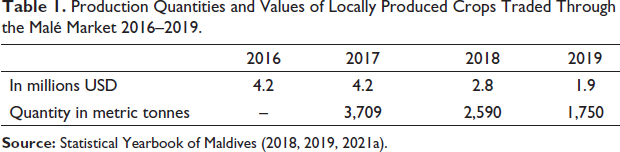
Despite the challenges with producer markets, Bell (1883) and Butany (1974) commented positively on the importance of the Malé fruit and vegetable market as the main food trading hub supplying the country. Smaller markets in regional centres such as Kulhudhufushi Island (Haa Dhaalu Atoll) in the north, and Hithadhoo Island (Seenu Atoll) in the south also act as food marketing hubs trading local and imported produce (DNP 2011; MoFA 2010). The figures in Table 1 show the decline in production quantities and value of locally produced goods traded through the Malé market from 2016 to 2019. These annual values and quantities are dwarfed in comparison by the values of imported food seen in Table 2.
Production Quantities and Values of Locally Produced Crops Traded Through the Malé Market 2016–2019.
Value of Food Imports to Maldives 2017–2021.
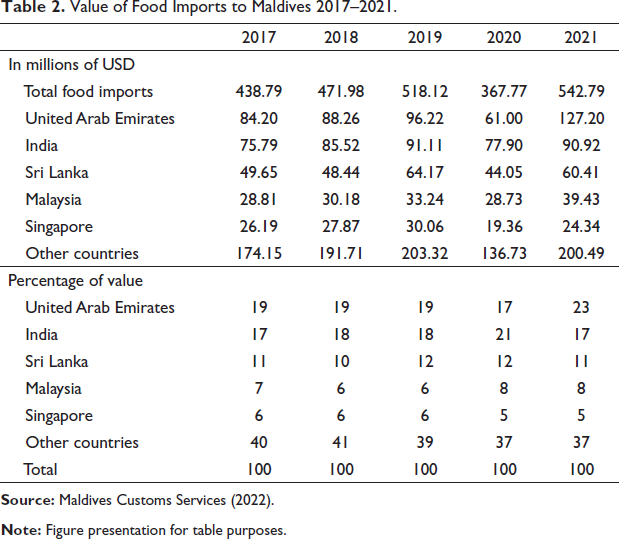
The United Arab Emirates, India and Sri Lanka are the main suppliers of food to the Maldives as seen in Table 2—Value of food imports to the Maldives 2017–2021 (Maldives Customs Services 2022). Imports include the categories of price-administered staples (wheat flour, rice, sugar), vegetables, root crops, spices, fruit, nuts and seeds, meat, fish and seafood, dairy and eggs, beverages and confectionaries and other food items. 1 Most food items do not attract import duty; however, a 15% tariff is applied to imports that are also produced in the Maldives including watermelons, bananas, mangoes, papaya, tuna and areca nut (Maldives Customs Services 2017). External food supply chains are generally characterised by frequent and reliable delivery schedules, competitive pricing, uniform quality, product variety and food safety. Once the produce arrives in the Maldives, local food distributors continue the efficiency of this supply chain through to customer delivery (ADB 2005).
Assisting agriculture in the Maldives are the admirable efforts of the MoFMRA 2 who have long sought to enhance market connectivity for producers through interventions targeting subsistence and semi-subsistence farmers. The interventions typically include technological innovation, knowledge transfer, natural resource management, environmental conservation, institutional strengthening and gender empowerment. These intervention components are bound within a sustainability mantra (IFAD 2017). Most recently, the 2020 MoFMRA/IFAD MAP seeks to build small farmers’ market connectivity through an agribusiness approach where value chains, farming inputs, contract farming and technical assistance are all contemplated (IFAD 2020). It is envisaged that the MAP will work with the complementary interventions of the United Nations Development Programme (UNDP)—Sustainable Economic Empowerment and Development of SMEs (SEEDS) programme, and the Agro National Corporation (AgroNat). MAP, SEEDS and AgroNat have a synthesised view in striving to connect agricultural production gains to increased market coverage (AgroNat 2021; IFAD 2020; Zalif 2021).
Although factor markets in the Maldives supplying farming inputs such as seed, fertiliser and equipment are not the focus of this article, the connectivity of these markets to farmers is worth noting. Kelly, Adesina, and Gordon (2003) and Alpert (2011) discussed the merits of a trusted rural agro dealer supplying competitively priced inputs, training and advice on product usage in sub-Saharan Africa. However, many farmers in the 2018 Maldivian study commented on the often-sporadic supply of farming inputs provided by island agro dealers, and how this sometimes led to high pricing. Suspicion of agro dealers’ product knowledge was also raised in terms of product efficacy, application methods and dosage. Commenting on the agro dealer’s interaction with farmers, MoFA (2010, 16) noted that this is often: ‘inadequate given the limited technical expertise of their staff and their business orientation’.
In considering the literature relating to this research question, ‘How can poor market connectivity between farmers and the markets be enhanced?’ Perhaps one of the central challenges is that some of the crops grown are not always based on market considerations. Simply put, the market is not getting the products it requires from local farmers and, therefore, must source from external sources. The logical correction to this anomaly is for farmers to produce more of what the market requires. This would build national productive capacity and lessen the reliance on food imports. While this observation addresses the macro considerations of the market, does it align with farmers’ and farming stakeholders’ perspectives on the challenges they face? Is there a gap in where the research has been focusing?
Context of the Case Study and Method
This research article examines the research question: How can poor market connectivity between farmers and the markets be enhanced? The methodology for the study is phenomenological; Patton’s (2002, 9) observation of phenomenology is that it is ‘The study of how people describe things and experience them through their senses’. This study examines the ‘lived experiences’ (Van Manen 1990, 9) of Maldivian farmers and farming stakeholders; it explores how Maldivian farmers and stakeholders, in their own words, interpret their experiences and frame their existence within their experiences.
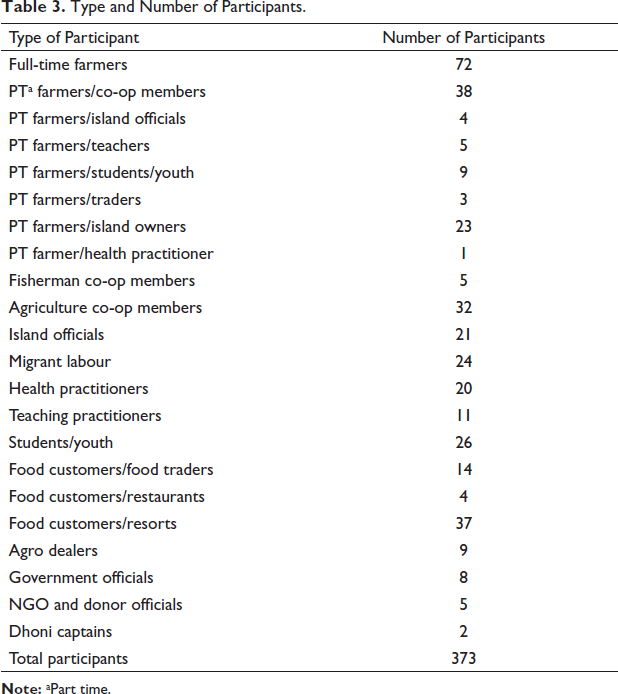
The method of the study is a multisite case study where data from 51 islands in 15 atolls were collected and analysed. The wide geographical disbursement of small levels of agricultural activity, covering nearly 200 small islands, lends itself to a multisite method where multiple agricultural experiences can be collected, compared and then form a robust generalised view of the unit of study, or case—Maldivian farmers bound within their island communities. Data collection involved 373 participants comprising farmers, commercial food distributors and resort operators, government and donor officials and associated agricultural stakeholders (see Table 3). In eliciting the data, 147 semi-structured interviews and 27 focus group discussions were conducted, and 153 field journal observations noted.
Type and Number of Participants.
Merriam (2009) suggested that the best instruments for data collection are humans who can act spontaneously to queries, clarifications and difficult questions. In this study, the author was the main data collector and conducted all interviews, discussions and recorded field journal entries. The author also collated and analysed all data. Data were collected from a variety of sites that were categorically linked to one another through island agriculture. Miles and Huberman (1994) and Stake (2005) suggested that these types of groupings and phenomena can elicit rich and descriptive responses. Lincoln and Guba (1985) and Chein (1981) noted that the purposeful sampling of participants and sites should be based on where the best experiences are likely to reside. In this study, gatekeepers such as Island councillors, teachers and doctors were contacted to gain access to sites and to those participants thought to have rich agricultural experiences. The qualitative data collected in the study showed how socio-cultural, economic and environmental factors related to the participants’ perspectives on market connectivity. It also provided systematic insight into the meanings derived from the experiences of these farming individuals.
Nvivo 11 data analysis software was used to organise, sort and collate the qualitative data (QSR 2015). Data coding consisted of a process of analysing participants’ words with a focus on the identification of keywords, sentences, explicit and implicit meanings, outliers and in some instances, the unsaid. Keywords and meanings were then grouped into themes and categories which organised the phenomena as experienced by participants.The coding process used was both inductive based on what was said by participants and deductive based on the community and scientific experience of the researcher. Data triangulation as discussed by Cohen, Manion, and Morrison (2013) was applied to ensure accuracy and reliability in deriving meanings from data, and to establish where areas of researcher bias may reside.
Results and Discussion
Analysis of the 2018 participant data revealed that according to Maldivian farmer and farming stakeholder participants, poor market connectivity was the most dominant/emergent code in the data set. But what lay within the code of poor market connectivity? Analysis of this code revealed seven nested participant experience sub-themes (see Table 4), that show the facets that comprise poor agricultural market connectivity in the Maldives.
Core Code ‘Poor Market Connectivity’ and Seven Sub-themes of the Code.
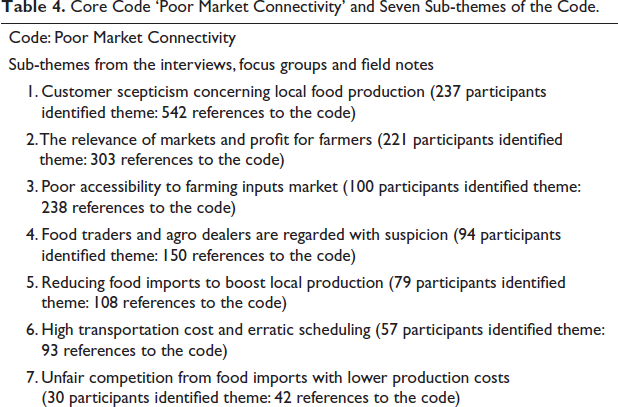
Sub-theme 1: Consumer scepticism concerning local food production. Commercial food distributor and resort operator participants were sceptical over claims by farmers that enhanced local production would lessen the reliance on food imports (30 participants, 42 references). This scepticism is based on three considerations: (1) local producers will not be able to replicate the efficient systems for purchase, payment, delivery and product quality guarantees, (2) limited local resources (technology and funding) will hinder the graduation of semi-subsistence farming to the required commercialisation necessary to compete with food imports and (3) many farmers simply do not wish to compete with food imports due to the perceived production rigours and costs involved. Summing up the ease and reliability of dealing with external food supply chains, a resort chef noted:
We don’t even have to pick up the phone and call the suppliers anymore. All our ordering is now automated online. It’s quick, easy, cost-efficient, and we know what, when, and how we are getting the food items. Even the storage temperatures during transportation are recorded along with details of the packaging. We need this guaranteed food supply for our resorts.
Despite the proficiency of external supply chains, a commercial food trader participant noted that some local produce is of excellent quality and competitively priced. However, he also observed that local supply chain interruptions are commonplace due to a variety of reasons such as poor weather affecting transportation and damaging crops. In summary, he noted: ‘We have tried so hard in the past to deal with farmers. It usually starts OK, but then falls apart because they cannot deliver the quantities we want when we want’.
An outlier comment from the study by two businessmen trading food suggested that Maldivian agriculture should rather be offshored to neighbouring countries such as India and Sri Lanka where ample agricultural resources reside. Indeed, the data revealed that at least one supplier from Sri Lanka produces crops exclusively for the Maldivian market.
Sub-theme 2: The relevance of markets and profit for farmers. Producer markets in the Maldives are expected and required by farmers to translate agricultural effort into financial gain. This requirement is iterated by 177 participants (214 references) when discussing the terms ‘sustainable agriculture’ and ‘building capacity in agriculture’ in the study (Van Driessche 2020). It is further succinctly noted in the study by a participant youth farmer: ‘We do this farm work to make the profit, not to stand still and be the same. We need the profit to go forward’. When markets are perceived as not working, participant farmers’ responses are similarly succinct as noted by the farming president of an Island Council: ‘Our profit is bad because the market is bad’. However, an outlier comment observes that blaming the market for farming losses is a default position adopted by some farmers to mask inherent weaknesses in their farming operations. These include management capacity deficits in areas such as record keeping and poor communication with customers.
Sub-theme 3: Poor accessibility to the farming inputs market. Although the farming inputs market is not the focus of this article, it is bound to food production challenges and is recognised as such by 85 participants (166 references) in the study. MoFMRA acknowledges that poor accessibility to factor markets is a concern (IFAD, 2020) as they seek to facilitate affordable and safe inputs for farmers (IFAD 2020; MoFMRA 2019). MoFMRA further notes that considerable effort has been expended in training farmers to use alternative technologies that would replace some inputs. This is the case with integrated pest management replacing chemical pesticides and composting as an alternative to synthetic fertilisers. However, analysis reveals that many farmers still prefer the quick-fix solutions of imported pesticides and fertilisers (Ministry of Environment and Energy 2015; Van Driessche 2018).
Sub-theme 4: Food traders and agro dealers are treated with suspicion. In the study, participant farmers observed that food traders in the main Malé market appear mercurial in their ability to source low priced imported and local food products and sell them at a high margin. It follows that some participant farmers also believe that the supply of products to the Malé market is manipulated to maintain high retail pricing. A similar strand of suspicion is directed towards food traders visiting islands to purchase products. Here, farmer participants reported that they are not always getting a fair selling price from traders (31 participants, 32 references). They added that traders’ margins on selling prices were too high. Countering farmer suspicion are a group of farmer participants in Baa and Malé atolls who extolled the integrity of a well trusted trader, and who in turn was equally complimentary of the farmers who supply him: ‘We have a few farmers who have been supplying us for years. They know we have agreements to supply resorts, so they do not let us down, and always give us good quality pumpkin and watermelon’.
Agro dealers. In the study, participant farmers held a twofold criticism of agro dealers: (1) agro dealers manipulate the supply of inputs to maintain high prices and (2) the technical advice agro dealers provide to farmers regarding product usage is sometimes inaccurate. The study suggests little evidence to support the first criticism particularly as there is a proliferation of agro dealers in Malé and other urban centres suggesting an increasingly competitive sector. Many participant agro dealers interviewed in the study were weary of references to their alleged rapacious activity. One agro dealer stated: ‘We have to buy the inputs in US dollars and sell them here in Rufiyaa. So, it is difficult to get dollars from the bank or other places to buy imports. The farmers can bring inputs themselves, and then they will see how expensive it is’. Of the second criticism, this article has already mentioned reference to a lack of technical knowledge accompanying the sale of chemical pesticides and fertilisers. Despite this, the study found that increasing attempts are made by agro dealers to translate foreign language instructions into Dhivehi and guide farmers in the correct dosage, storage and application of pesticides and fertilisers.
Sub-theme 5: Reducing food imports to boost local production. The study found that there was a common perception amongst farmers that a controlled reduction in food imports through regulation would stimulate local food production (143 participants, 196 references). This was predicated on the assumption that farmers have the will and resources to fill the ensuing food gaps caused by reduced food imports. However, some farmers acknowledged that this could not be achieved overnight and accepted that increasing production capacity would be a gradual process. They further acknowledged the unlikelihood of producing the staples of flour, sugar and rice, and most meat and dairy items.
In discussing regulatory measures to control food imports, participant farmers in the study alluded to the imposition of tariffs and quotas (18 participants, 25 references). As noted by one of three cooperative committee members:
There should be a limit on what food is imported especially if it can be grown here. I know they have import duties on some fruits that are grown here, but we must also have the quota to stop too much coming in, then our production will run smoothly in this country.
MoFMRA countered this proposition believing that protectionist measures will not stimulate local production but instead will result in product shortages and inflated prices. As noted by Worrell (1992) and Briguglio (1995) in their reference to import substitution policies in small island nations, expectations of filling supply gaps with locally produced goods from a limited resource base are unrealistic due to inherent inefficiencies in production and diseconomies of scale. The study notes the possibility that those benefitting from controlling food import flows would likely be food traders who could act quickly in exploiting price differential for profit. As if to reinforce this view, one of five Bangladeshi participant food traders noted: ‘We are here to make money not grow food. We set the prices for most food in and out of the Malé market and make good money’.
Sub-theme 6: High transportation cost and erratic scheduling. International transportation connectivity is supported by frequent tourist air traffic and busy Gulf/Indian/SE Asian cargo shipping routes. This serves both factor and food markets with imports. The study reveals that domestic transportation networks are not as competitive in coverage and pricing as the international networks. This can impede the supply of farm inputs to outer islands and the delivery of produce to marketing hubs. During an interview in the study, a participant teacher/farmer noted: ‘Everything is down to transportation in the Maldives. Everybody’s issue is transportation. If it doesn’t work properly, nor do we’. Whilst connectivity between atoll hubs and Malé is evident, atolls closer to Malé typically enjoy a higher frequency of ferry service and more competitive freight rates (41 participants, 72 references).
A particular transport challenge identified in the study is inter-island connection within atolls. Here, 27 participants (48 references) reported that ferry routing often bypasses production islands resulting in the need for expensive private hires to connect with atoll transportation hubs to send goods to the main markets in Malé. A participant trader noted: ‘It makes a huge difference if islanders cannot trade with each other when their islands are so close by. All the time you must go through another island which costs more money’. However, a participant boat captain in the study operating an inter-island ferry noted: ‘We used to let islanders transport their vegetables and fruit free of charge if there was space. But now everybody is sending cargo between the islands, so there is no free space, and we charge everyone the same rate’.
Sub-theme 7: Unfair competition from food imports with lower production costs. Poonyth and Ford (2005) observed that the narrow economic range in many SIDS inflates agricultural production costs and hinders competitiveness with food imports. This appears the case in the Maldives with India, the largest supplier of food, utilising its considerable agricultural resource base and proximity to provide regular and competitively priced food products to the Maldives. The second largest supplier is the UAE, a regional food distribution hub, supplying mainly traded foods from other countries. Participant farmers in the study note that they are neither able to compete with the economies of scale and efficiencies in production achieved by Indian agriculture nor with the seamless technology driven food distribution networks of Dubai and Singapore. Iterating this sentiment, a participant cooperative member stated:
We cannot compete with this imported food as we have to pay duty and boat charges for our fertilisers and chemicals to get it to our island. We have to spend more money to grow this food than these outside farmers do. It is easier just to import the food than trying to grow it here.
Reinforcing the primacy of food importation into the Maldives, many resort operators in the study believed it easier to source imported produce from domestic food distributors and from external supply points than from local farmers. They contended that food import markets are easy to work with and reliable in offering competitively priced quality products on a regular basis. A participant resort chef noted:
If you order 50 kg’s of mango from Thailand, you will get it. Even if the Thai supplier does not have mangoes in stock, he will find them for you. He will never say we cannot supply them. You cannot get this level of service with local farmers. It is not their fault; they are just not ready for this type of supplying yet.
Throughout this code, Maldivian farmers and agricultural stakeholders have articulated the umbrella issue of Poor Market Connectivity. A deeper analysis of participant perspectives revealed that nested within the code of Poor Market Connectivity, lay seven sub-themes: consumer scepticism about local production; the relevance of profitability and markets for farmers; poor access to farming inputs markets; farmers’ suspicion of food traders and agro dealers; efforts to boost local production by regulating the reduction of food imports; transportation limitations; and, unfair foreign competition.
Analysis of the data also revealed other barriers farmers face in connecting with markets. Poor communication between farmers and customers is one such barrier where a lack of advance notice in late deliveries or product shortages is not communicated in a timely way to customers. Conversely, food import agents do generally communicate such potential supply chain interruptions and are often able to source replacement produce quickly. Despite the barriers, a narrative lighting the pathway market connectivity emerged from the study. The narrative identifies a successful transactional model involving small-scale—direct to consumer—truncated communication. On the island of Thoddhoo, Alifu Alfiu atoll, participants reported the story of a boat captain whose vessel transports produce to the Malé’ market from Thoddhoo. The boat captain acts as an intermediary in the sale between the farmers and customers using mobile telephony as he speaks to both parties in auctioning farmers’ produce from the deck of the boat (Van Driessche 2018). Sale payments are either remitted electronically to the farmers or cash is physically transported back to Thoddhoo by the boat captain—a truly stellar example of a small-scale transactional trust model.
As the key provider of institutional assistance to the agricultural sector, MoFMRA is keenly aware that its interventions need to target barriers such as poor communication and farmer dissatisfaction but realise that addressing such issues is complex and related as much to the sociocultural context of island communities as it is to the economic strands of food supply chains. In addressing this complexity, we see that the poor market connectivity phenomenon comprises a networking interaction of interrelated systems where individual farmers and farming stakeholders intersect with historical context, geography, government, regulation and policy, economic systems, infrastructure and logistics, technology, community systems, and the attitudes and behaviours of the individual farmer and farming stakeholder.
In looking to a theoretical framework to provide a lens through which this multifaceted, multi-layered data, can make sense, we find that Bronfenbrenner’s Ecological Systems Theory (Brofenbrenner 1977; Guy-Evans 2020) has been used in agricultural paradigms (Vande Velde, Charlier, and Claerebout 2018). This has mapped the phenomenon of individual farmers within complex systems (see Figure 1) (Klerkx, Aarts, & Leeuwis, 2010), and has effectively identified solutions that realistically consider all levels of the phenomenon.
Ecological Systems Theory: Participant Identified Interrelated Nests of Systems/Issues that Are Barriers to improving Market Connectivity.
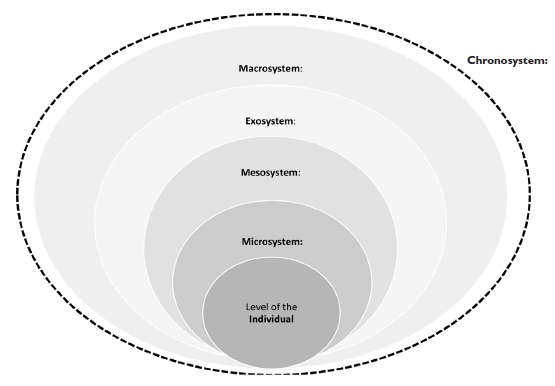
Using Ecological Systems Theory, the participant data from the farmers and farming stakeholders have been mapped directly onto the nested circles of the interrelated systems. This provides a means to understand the interrelated nature of market connectivity and what resolution towards market connectivity must be considered. The nested circles of the interrelated systems are now examined.
Level of the Individual: Data reveal: Participants are enthusiastic, intelligent, pragmatic, resourceful, trusting, risk taking and mainly short-term planners. Participants comprise individual farmers (men and women), family farming units, informal groups of friends sharing farming functions and migrant labour often with residual agricultural knowledge and skills. Subsistence and semi subsistence farmers are commonplace. Farmers are generally under resourced in funding, technical knowledge, agricultural innovation and transportation. Farmers often have limited access to factor and producer markets. Microsystem (interactions between individuals): Data reveal: Participants have an aversion to formal bodies such as cooperatives acting as financial intermediaries between farmers and markets. Migrant labour is prevalent in the agricultural supply chain (labouring/boat crews/market traders). Women farm household gardens and small plots mainly undertaking cultivation and harvesting. Men do heavy lifting and interact with factor and producer markets. Commercial agriculture is seen as out of reach for many. Poor youth participation rates in farming are due to its ‘low-class’ stigmatisation and lack of technology. Mesosystem (interrelations between individual systems): Participants report: Customer scepticism concerning local food production compared to the ease, pricing and reliability of food imports. Food traders are regarded with suspicion over large selling margins on traded food. Agro dealers are regarded with suspicion over the provision of inaccurate information concerning the application of pesticides and fertilisers. Poor communication between producers and the market interrupts the supply chain. Gaps in the transportation network, particularly serving the outer islands, result in a limited service and high cargo cost. Participation fatigue is sometimes experienced by the intended beneficiaries of institutional interventions. Exosystem (industry, regulations, community): Participants report: Limited accessibility (affordability and availability) to farming inputs. The belief that regulations to reduce food imports will boost local production; conversely, regulators believe this would result is shortages and price volatility. Infrequent and expensive cargo transportation especially relating to outer islands. Unfair competition from countries with lower food production costs. Migrant labour is gradually taking over the agricultural supply chain, possibly to the detriment of Maldivian farmers. Alternatively, migrant labour is an enabler of the agricultural supply chain. Profitability in farming is not always an explicitly stated intended benefit of institutional interventions but is rather implied as part of agricultural sustainability. Macrosystem (norms and ideology of the systems): Participants report: Subsistence farming can graduate to semi subsistence farming but does not usually scale to commercial production. Semi-subsistence farming is manageable whereas commercial farming can be costly and difficult to operate. There is food import dependency with regional neighbours supplying food staples and other food items particularly to the tourist sector. The Maldives is primarily a fishing nation not a farming nation due to an abundance of ocean territory and limited land and freshwater. Farming is regarded as a low-class activity associated with south Asian migrant labour. It is also seen as a retirement activity and hobby. Youth would be interested in farming if technology inputs generated ‘cleaner’ working conditions and profitability. Fresh food is not always seen as being healthy as it is more perishable than processed food that contains chemical additives and preservatives. Chronosystem (impact of time, history): Literature reveals: 14th century commentary alludes to sustainable food production with an abundance of coconuts providing milk, oil and confectionary. The presence of fresh and fried fish delicacies is also noted. Late 1880s Maldivian agriculture produced a variety of fruits, vegetables, millets and fish but this diet was noted as being deficient in nutritional content. There is evidence of food trading with neighbouring countries with most rice being sourced from southern India. Further evidence suggests that Maldivian agriculture had the capacity to sustain its small population in the provision of certain food types; however, the development of tourism in early 1980s saw increased demand for food variety, quality and quantity which could not all be sourced locally. Food imports then proliferated. Today, Maldivian food security is predicated on the capacity to purchase food imports rather than the capacity to grow food locally; 95% of the national food requirement is imported. Institutional support for subsistence and semi subsistence agriculture remains strong with increasing interest from the private sector in developing commercial agriculture. The ongoing challenge of enhancing local production to supply more of the national food requirement continues. Maldivians remain enthusiastic agriculturalists. Source: Vande Velde, Charlier, and Claerebout (2018), Van Driessche (2018, 2020).
Using the Ecological Systems Theory, the data plainly reveal that any efforts towards market connectivity resolution must consider and address the individual within the context of the greater, extrinsic challenges present in the interrelated systems of farming in the Maldives. While the individual is placed at the smallest level of a greater system, and the interconnections of the larger systems are great in impact, the individual is ultimately the decision maker on what and how things work. Therefore, all measures aimed at achieving a connectivity resolution must take the individual into account if they are to be effective.
Conclusions and Recommendations
This article proposes that the best chance of enhancing market connectivity for farmers resides in a realistic interpretation of how local producers and the market interact. Following the evidence, this study posits that five factors could be further considered in coupling institutional assistance with the farmer’s enthusiasm to enhance market connectivity.
Confluence of reasoning: A confluence of reasoning involves four points. First, there is a residual base of agricultural knowledge amongst farmers in the Maldives combined with enthusiasm to improve productivity and link this to supplying tourist sector markets. Second, there is committed institutional support from MoFMRA that already intersects with farmers at a policy and programmatic level. Third, there is a willingness amongst commercial food distributors and resort operators to trial locally sourced produce providing it can compete with food imports on pricing, quality, quantity and continuity of supply. And finally, there is an acceptance by farmers, food traders and food customers that the local production of food variety is constrained. In view of these points, many agricultural stakeholders believe that the production of high-value niche crops that are expensive to import could be the way forward for local supply. For example, lettuce varieties incur expensive airfreight packaging which could be minimised through local production and delivery. While this idea is not new and has formed the basis of past agricultural interventions, a confluence of reasoning needs to more effectively integrate with the following four factors to enhance market connectivity. Sustainable intensification and commercialisation of agriculture. Championed by many including Hazell (1995), Pretty and Bharucha (2015) and Tilman et al. (2011), sustainable intensification pursues higher yields without negative environmental impacts. It does this by employing regenerative technology in farming practices such as no-till cultivation and cover cropping. Further technologies such as drone imaging, soil and water sensors and weather tracking can assist the production process in controlling pest intrusion, improving soil nutrient composition and better safeguarding marine and terrestrial biodiversity. Pretty (1997, 248) added that sustainable intensification builds human capacity to a point where it can act on new technical knowledge, and where ‘human capacity and ingenuity’ can shape contextually aligned agricultural policy. This individual level input is at the heart of Ecological Systems Theory and is the lynchpin in sustainably intensifying the production of a more precise product requirement, particularly for the tourist sector.
In recent years, the private sector in the Maldives has increased investment in commercial food production mainly in fruits and salad varieties typically utilising hydroponic cultivation systems in greenhouses (Van Driessche 2018). To date, there are in excess of fifty islands with dedicated agricultural leases with some producing fruit, vegetable and spice varieties which are supplied to local markets. On a larger scale, a conglomeration of technology and agricultural companies in the Netherlands is promoting the Island Resilient Maldives Matter project. This project focuses on local food production utilising sustainable energy sources within controlled environment greenhouses (Resilient Island 2018). The promoters of this project envisage a superior product to that which is currently imported, mainly in tomato and lettuce varieties (Resilient Island 2018). In addition, they plan to transfer skills and learning through the employment of community members (Resilient Island 2018). While this type of project is driven by commercial rationale, it is appreciative of the interrelated systems as defined in Figure 1 and how these will contextually shape this project and its outcomes.
The MAP complements sustainable intensification and commercialisation strategies through its promotion of agribusinesses. MAP aims to connect productivity gains to the markets through the strengthening of agricultural supply chains. The Agro National Corporation Ltd (AgroNat) (Corporate Maldives, 2021a, b) and the UNDP SEEDS project (UNDP Maldives 2021) have a synthesised view in building areas of production that can be linked to domestic markets, particularly in the tourist sector (IFAD 2020; Zalif 2021). The success of these of these initiatives will be dependent upon their interrelation with farmers and the farming systems the farmers occupy.
Building commercial characteristics into local supply chains: If local supply chains wish to compete with those chains supplying food imports, they need to replicate, where possible, similar production and marketing traits that are rooted in commercial rationale, namely, reliability and competitiveness. As a starting point, accurate production data need to be collated through the establishment of atoll data collection hubs, and communication between farmers and customers should be enhanced to reduce supply chain interruptions. This will more effectively inform farmers and the systems in which they operate where production and marketing gaps reside, and so provide a sound basis for improving and scaling operations. Individualistic farming: Individualistic farming activity rather than agricultural collectives is the preferred farming unit in the Maldives (Van Driessche 2020). This includes sole farmers, family farming units and informal groupings of friends sharing jobs such as land clearing and weeding. The study notes that this individualistic preference mirrors community preferences in other small island states. Lowenthal (1987) observed that in many small states individualistic activity is favoured over group action to avoid confrontation with others and maintain social harmony. In the Maldives, this is particularly evident in transacting goods and services where farmers prefer to represent their own financial interests rather than have cooperatives acting as their intermediaries (IFAD 2017). The study further notes that individual farmers are generally quicker to respond to farming disruptions such as price volatility and supply shortages and surpluses than larger agricultural organisations. The individualistic preference expressed by Maldivian farmers fits perfectly within the Ecological Systems Theory where the individual is at the heart of the interrelated systems. Communication connectivity between farmers and customers: Van Driessche (2018) recommended the introduction of Farmer Framework Forums to facilitate discussion amongst farmers and associated stakeholders on agricultural challenges and potential solutions. Forums would take place at an island and atoll level and would inform national agricultural programming and policy. Forum issues could include (1) drivers and barriers in agricultural supply chains, (2) mapping of output from production hubs and the subsequent impacts on national food demand, (3) identification of high-value niche crops for production and (4) resort partnering with neighbouring farming communities for resource sharing in areas of transportation and technical skill transfer (accounting/administration).The enhancement of communication connectivity facilitates the interrelationship between the systems detailed in the Ecological Systems Theory.
The conflation of the five factors that sit within the Ecological Systems Theory of Maldivian agriculture have the potential to improve market connectivity for farmers. Individualistic farming units can benefit from knowledge exchange Farmers Framework Forums in overcoming production and marketing barriers as measures such as sustainable intensification and commercialisation are considered. This would result in the production of high-value niche crops satisfying a more precise market requirement, particularly in the tourist sector. The greater interrelatedness of the attitudes and behaviours of the Maldivian farmer and farming stakeholders with agricultural systems will light the pathway to enhance market connectivity between farmers and the markets.
Footnotes
Acknowledgements
The author wishes to extend his heartfelt thanks to all those farming stakeholders in the Maldives who willingly gave of their time in contributing to the data in the 2018 study.
Declaration of Conflicting Interests
The author declared no potential conflicts of interest with respect to the research, authorship and/or publication of this article.
Funding
Bloomberg Philanthropies contributed to the funding of the 2018 PhD study.
