




Abstract
This case delves into the entrepreneurial journey of a dairy business owner, shedding light on the intricacies of the dairy industry within the Pakistani market. It provides a comprehensive overview of the dairy business’s value chain and delves into the life cycle of cattle used for milking. The case also offers insights into the operational aspects of managing a cattle farm and the requisite business systems. Emphasizing the vital components of cattle farm management and the evolving business landscape, it elucidates the crucial roles played by farm workers and the necessary systems for efficient management.
Furthermore, the case furnishes valuable information regarding the economics of running a cattle farm, highlighting key cost factors such as food and overhead expenses. The revenue side of the business is intricately linked with the farm management practices, specifically focusing on the yield. The case concludes with the entrepreneur’s desire to reevaluate their business model, shifting from buffalo milk to the exploration of the dynamics involved in the cow milk business.
Keywords
Discussion Questions
Is the current scenario conducive to profitability for Capital Dairy operations?
Is it possible to succeed in the buffalo model, and what are the ramifications of operating a hybrid model?
What measures can be taken to enhance yield levels?
What strategies should be employed to effectively manage farm workers?
In September 2014, Adnan Khan, the proprietor of Capital Dairy, found himself deep in contemplation while driving through the outskirts of Islamabad. He grappled with a pivotal question concerning the future trajectory of his company. In 2011, driven by a passion to entice consumers away from low-fat cow milk and towards high-fat buffalo milk, Adnan embarked on a buffalo farming venture to establish a premium market. Nevertheless, the financial viability of his farming business remained elusive, causing Adnan considerable concern about the bottom line.
He pondered what additional efforts might be required to turn the business into a profitable venture. Moreover, he contemplated whether the business model’s profitability was linked to the choice of livestock, namely buffalo or cow.
Dairy Business in Pakistan
The unorganized sector had traditionally dominated the supply side of the dairy business in Pakistan. This unorganized sector primarily consisted of small-scale cattle owners residing in villages or suburban areas who delivered milk using bicycles or carts. Their customers included urban and suburban households and businesses like milk shops, sweet shops and confectioneries. In the 1980s, competition to the unorganized sector emerged in the form of ultra-high-temperature (UHT) processed milk, marketed in Tetra Pak packages with a shelf life of over a month. Despite nearly three decades of market development, the unorganized sector remained the primary supplier. However, fast-moving consumer goods (FMCG) companies like Nestle significantly fostered the dairy sector.
With large-scale intermediaries bridging the gap between consumers and producers, and with Nestle’s support, cattle farming began to evolve into a viable option for medium- to large-scale farms, attracting investments into the sector.
In the late 1990s, pasteurized milk entered the upscale segments of society. Local companies ventured into pasteurized milk, following an end-to-end model, often supported by medium- to large-scale self-owned farms upstream of the supply chain. They made substantial investments in brand building on the downstream side. In addition to these more prominent players, several medium-sized cattle farm owners entered the business with home delivery models focused on specific localities.
By 2014, a litre of UHT processed milk was retailing for PKR 110, while a litre of pasteurized milk was selling for PKR 120. Small to medium-sized businesses (with 10–150 cattle) offered milk at PKR 100 per L. At the same time, they faced competition from rapidly growing confectionery chains that had ventured into private label businesses, retailing fresh poly-packed milk at PKR 80. Small cattle owners (with fewer than ten cattle, often managed under the informal economy) were delivering milk to households at prices ranging from PKR 65 to PKR 75 per L. However, consumers faced concerns regarding the quality of milk these small cattle owners delivered, primarily due to water mixing and unhygienic conditions. A section of society also expressed doubts about the nutritional value of UHT milk.
In 2014, some companies in the pasteurized milk sector began offering derivative products with varying fat contents, including 0% fat, 2% fat or whole milk with 5% fat. Additionally, some local brands introduced buffalo milk, giving consumers more choices.
Pure Milk
Adnan, a civil engineer by profession, had previously managed the construction division of a multinational corporation before embarking on his own construction business. His construction enterprise specialized in bidding for turnkey projects, and over four years, his firm completed ten distinct projects, earning a stellar reputation for delivering quality work. His achievements even led to the acquisition of several prestigious quality awards. However, Adnan grew disillusioned with the prevalent industry practices, which involved currying favour with project owners by offering commissions in exchange for project contracts. Adnan said these commissions typically ranged from 8% to 12% of the project’s value, leading bidders to recoup their investments by employing subpar materials. Despite completing ten projects without compromising quality, Adnan closed down the business after incurring losses totalling nearly PKR 35 million over four years.
Adnan explored various agricultural ventures in search of a business that aligned with his values of ethical conduct and self-respect, one free from bribery or entanglements with tax authorities. He considered options in agriculture, poultry or cattle farming. However, due to the high cost of land in the Islamabad region, pursuing agriculture would necessitate relocating to the interior or southern parts of Punjab, which he was not inclined to do. The poultry business appeared oversaturated, and a market slump around 2010–2011 further discouraged him. Consequently, through a process of elimination, he decided to venture into cattle farming despite having little prior knowledge of the field.
Adnan believed that while the dairy industry was mature, the farming aspect was still evolving, presenting an opportunity for innovation. He was aware of the crowded cow milk market and its saturation, prompting him to choose buffalo milk as his focus. Adnan perceived a gap in the buffalo farming sector, with the high-fat content of buffalo milk offering a unique selling proposition that would allow him to stand out and create a niche for his business.
In 2011, Adnan embarked on his buffalo farming journey, commencing with just six buffaloes at a rented location in the suburbs of Islamabad. However, he swiftly recognized a severe lack of knowledge in buffalo farming, particularly within the Pothohar region. 1 In his pursuit of expertise, Adnan reached out to numerous industry experts, visited farms in Okara 2 and scoured the internet and various other resources for literature. He tried to gather literature from the internet and various other resources. During this experimental phase, Adnan initiated the practice of delivering buffalo milk to friends and acquaintances free of charge, seeking valuable feedback. This marked the beginning of long-term commitment to the business for Adnan. In contrast, others who entered the market around the same time with medium-scale plans (less than 200–300 cattle) eventually exited due to substantial losses.
Within the first month and a half of commencing his farm operations, Adnan undertook several essential steps. He renovated the shed, expanded the number of animals to thirty and acquired a packing machine. He planned to deliver milk door to door directly, bypassing the traditional intermediaries or ‘gawalas’, 3 to ensure quality and prevent any adulteration during transit.
Simultaneously, Adnan collaborated with a partner to develop the downstream aspect of the business, focusing on establishing a brand for his milk. Marketed under the name ‘Pure’, their milk was made available through four retail outlets in Rawalpindi, complemented by a home delivery service. Capital Dairy supplied cow milk to ‘Pure’ at PKR 75 per L and buffalo milk at PKR 80 per L. These products were retailed or home delivered at PKR 95 per L for cow milk and PKR 105 per L for buffalo milk. Adnan firmly opposed utilizing traditional ‘gawalas’ for milk delivery, as it compromised quality due to a lack of control. The alternative of selling milk to ‘gawalas’ in bulk presented challenges in credit recovery, making it an unviable option.
Cattle Lifecycle
The first lactation cycle, signifying the commencement of milk production, typically began shortly after the birth of the cattle, whether it was a cow or a buffalo. From that point onward, cattle typically continued lactating for an average duration of approximately ten to twelve months before their milk production gradually waned. Exhibit 1 illustrates a conventional lactation cycle for a cow, while Exhibit 2 depicts the lactation cycle for selected cows and buffalos. Some cattle deviated from the average in terms of the duration of lactation, with some producing milk for a longer period and others drying up earlier. Similarly, there were variations in the milk yields, with some cattle surpassing the average while others falling below it.
It proved beneficial for the farm when cattle conceived shortly after giving birth to a calf. This ensured that the next lactation cycle and calf birth almost coincided with the conclusion of the previous lactation cycle. Otherwise, there would be an extended dry period during which the cattle would not generate revenue.
Generally, it was believed that cows reached child-bearing age earlier than buffalos and had a higher reproductive rate. According to Adnan, approximately two-thirds of the cows conceived within the first few months of lactation, whereas this percentage could be as low as 10% for buffalos. Depending on the breed type and the farm’s conditions, cattle could undergo up to ten lactation cycles. However, the yield typically started to decline from the fourth lactation cycle onwards.
The Decision to Keep Offspring
When he started the farm, Adnan initially based his decisions on the moral principle of not separating a newly born calf from its mother cattle. As a policy, he chose to raise all calves born on the farm, finding moral satisfaction in this approach and believing that such an organic growth model would naturally increase the number of cattle without the need to purchase from the market. When the farm’s milk-yielding cattle reached a count of 100, 70 calves were also present. Even when acquiring new milk-yielding cattle from the market, it would come with a newly delivered calf. Adnan expressed, ‘I couldn’t grasp the economics of raising offspring on our farm, but I was content that the herd size had increased’. He added, ‘Soon enough, I realized it was a mistake and a significant drain on our resources. We learned that a baby calf, on average, consumed 2–2.5 L of milk daily, and one can calculate how much that would amount to over a month’.
Adnan continued,
In addition, in the Pothohar region, all resources had a price tag, whether managing cattle or providing their food, resulting in a cost of keeping the offspring. This model could be viable in a rural setting where the entire household took care of the cattle stock, and family members (such as the wife or kids) of the milkman would handle the cattle for grazing. However, there was no industrial model for raising a calf on a farm run for commercial purposes. It was generally believed to be feasible only for cattle yielding more than 30–35 L, as that made economic sense.
Farm Operations
In the dairy farm, each farm worker was assigned a specific group of cattle and entrusted with various responsibilities. These tasks included caring for the cattle, milking them twice daily, managing their feed, maintaining cleanliness in their designated area, attending to their needs, and promptly identifying and reporting any abnormalities. Adnan emphasized the critical role of these farm workers, stating, ‘The farm owners are dependent upon these workers; they have the farm’s fate in their hands’.
The farm workers, predominantly hailing from rural areas, typically had limited literacy and were recruited based on referrals from existing staff. New entrants to the farm workforce were often family members, relatives or acquaintances of current workers, migrating from villages to cities with minimal formal education. Their families either resided in the villages they migrated from or were in suburban areas around the city dwellings.
Typically, each worker was responsible for around ten animals. They carried out the essential task of milking the animals twice a day – once in the morning and once in the evening. The collected milk was measured and then transferred to the industrial chiller’s drum. Within 1.5 hours of collection, the milk was chilled to 4 degrees Celsius, and within the next two hours, it was meticulously packed for delivery.
Yield
Milk yield in the dairy farm was subject to numerous variables; as Adnan explained, ‘The yields quoted in the market are generally for animals kept under the best conditions or the top yields ever achieved. Relying on those figures from day one for feasibility can be a big surprise’. With no available operating manuals, experimentation was the only way to learn. Various external and internal factors, such as weather, temperature, environment, treatment of animals and their food, among others, could impact milk yield. Adnan emphasized the challenge that if the yield dropped for any reason, it did not necessarily rebound to the maximum the next day. Mishandling sick animals could even result in a permanent reduction in yield. In the initial stages of the buffalo project, achieving 10 L per day was considered an accomplishment based on regional market norms. Through experimentation, the team became confident in achieving an average yield of 13 L per day, with some buffalos reaching as high as 16–17 L.
After exclusively working with buffalos for nearly three years (from 2011 to 2014), Adnan decided to venture into cow farming, gradually increasing the number of cows to around forty. Adnan noted, ‘Cows were easier to keep, had higher yields, and had better chances of conceiving’. By maintaining buffalos properly from the start, the team confidently maintained an average yield of 17 L per day, with some buffalos reaching up to 25 L in a day. Learning from the initial phase, where understanding the cattle and reaching peak yield took three to four months, the focus shifted to achieving peak yield earlier in the lactation cycle, considered crucial for the farm’s survival. Exhibit 3 compares two buffalos of the same breed regarding the time taken to reach maximum yield. Buffalo #51, brought in October 2013, took almost three months, while Buffalo #82, brought in July 2014, reached maximum yield within almost a month. Adnan believed that maintaining a minimum of 60% of cattle in the ‘wet’ or milking state was essential for profitability, and a milking percentage of seventy to eighty was considered healthy for the business.
Expenses
Running a cattle farm incurred major expenses in the form of food and farm overheads. Food served as the primary source of energy and other dietary necessities crucial for maintaining the health of the cattle. The energy requirement varied based on factors such as the cattle’s body size, milk production and the stage of lactation. Clinically, the dry mass intake (DMI) requirement for lactating cows could range from 3% to 5% of the cattle’s body weight, potentially higher for high-yielding animals. The requirement for non-lactating mature cows in dry periods dropped below 2% of body weight, subject to variations in the diet’s moisture content, composition and nutritional value. The essential dietary components included carbohydrates, fats, proteins and calcium.
Carbohydrates, derived mainly from fibre in the fodder, met the energy needs of lactating animals and played a crucial role in maintaining rumen health and facilitating food fermentation. Fats were introduced to increase energy concentration and could be supplemented with vegetable sources like oil seeds. Proteins were vital for lactating animals as the amino acids in proteins were necessary for milk synthesis. Calcium, especially crucial for lactating cows, faced extraction from the animal’s body, particularly the bones, which could shift the balance towards calcium deficiency. Maintaining this balance was imperative, with inorganic sources providing 70–75% calcium absorption, while organic diets like fodder yielded 30% calcium uptake.
The quality of the diet significantly influenced milk yield, with around 80% of the diet consumed by milk-producing cattle. While some multinationals offered prepared feeds based on standardized formulas, most cattle farms in Pakistan opted to create their own dietary plans due to the expense of these products. The nutritional value of inputs varied by region and season, leading to the absence of a universal diet plan. Though no standard diet existed in the market, certain staple items were considered essential based on protein and carbohydrate requirements, their quantities adjusted by farms based on cattle type, farm environment and experience. Additionally, ample drinking water was crucial for maintaining cattle health.
The diet employed at Capital Dairy comprised khal (cotton seed cake after extracting oil), porridge (wheat and corn), choker, khal JAMA and roti (wheat bread leftovers). These ingredients and their respective prices are detailed in Exhibit 4. The amalgamation of these components was referred to as ‘wanda’ and was administered alongside varying quantities and compositions of wheat straw and fodder. Over the years, Adnan determined that 27 kg of fodder per day per animal was the most suitable, while the ‘wanda’ portion ranged from 2 to 9 kg for high-yield cows.
Feeding Management
The allocation of feed to the cattle at Capital Dairy was determined by their milk yields. Cattle were categorized based on their yields and expected yields, with the diet adjusted accordingly. Dry animals, such as those in the ninth month of pregnancy, received a minimal diet compared to milking cattle. At Capital, cows were divided into four categories based on their daily milk yields: less than 5 L, 5 to 10 L, 10 to 15 L and greater than 15 L. Buffalos had two categories, with averages of around 13 and 9 L per day.
Supervisors mixed the ‘wanda’ for each category in the morning, which was then provided to the worker responsible for a particular set of animals. It was ensured that the cattle assigned to a worker fell within the same yield category. Category assignments were revised every fortnight, although frequent reassignment was avoided to prevent disruption to the cattle.
Capital had experimented with a pre-mixed food option from a multinational. The suggested alternative to ‘wanda’ was a mixture of ingredients weighing 15 kg. Adnan noted that they were able to achieve the same yields with 8 kg of their own ‘wanda’ recipe. Ingredient prices varied with the seasons; for example, khal price was typically lowest at the end of summer when new crops arrived and peaked around the start of summer. In 2013, khal prices ranged from PKR 1,255 to PKR 2,200 per 40 kg. Conversely, ingredients derived from crops, like porridge, exhibited a different pattern, with prices peaking around the start of winter and decreasing around the beginning of summer. Porridge prices ranged from PKR 1,425 to PKR 1,700 per 40 kg.
Fodder prices were higher due to additional logistics costs incurred when obtaining it from the central Punjab region. Given the increased consumption, a price difference of PKR 70–80 per 40 kg from the central Punjab region represented a significant operating expense for a cattle farm outside the fodder-growing area.
Injections
In addition to the aforementioned diet, a regular practice at Capital Dairy included the administration of a hormonal injection, Bovine Somatotropin (BST), to maintain lactation cells. In Pakistan, the use of such injections was generally discouraged and considered a negative practice, especially by consumers. There was a prevailing perception that milk produced with the use of injections might be injurious to human health, and the process itself could be detrimental to the health of the animals. Adnan acknowledged, ‘I had also heard of such views, so initially, we did not use these supplements. However, later, I found that these were FDA-approved. 4 That further raised my curiosity, so I decided to learn myself’.
BST was a hormonal, dietary supplement that redirected more proteins to the udder. Adnan explained, ‘As long as the protein requirements are fulfilled, there is no harm. In addition, the recommended quantity of fodder is 15 kg, whereas I have found the optimum quantity to be 25 kg. As long as extra proteins are given, it is beneficial; otherwise, it could be detrimental to health’. He emphasized the distinction between natural and artificial hormones and noted, ‘Generally, people working in this business can’t afford extra food costs’.
Masala
In addition to the above diet, animals were also given supplements. Adnan said,
Initially, I had no idea what the role of these supplements was, which are known as ‘masala’ in the farm language. These are organic supplements which are believed to impact animals’ health and yield, plus they act as basic remedies and cures for some health-related issues. These include turmeric, mustard oil, etc. We have over the years tinkered with many things and their constituents based on local practices, recommendations from veterinarians, and my observations.
The ‘masala’ cost per animal at Capital was around PKR 650.
Overheads
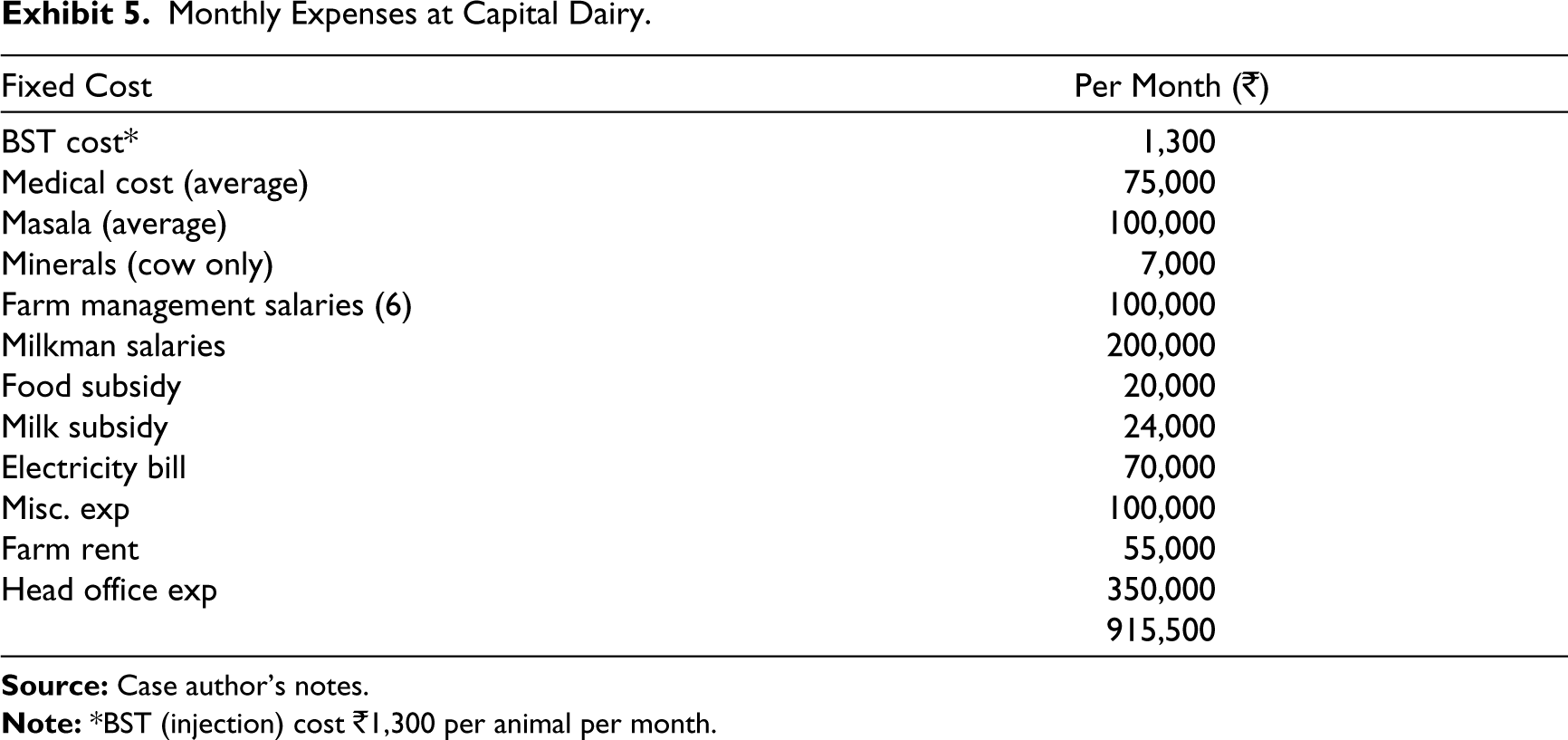
The overheads at Capital Dairy encompassed various components such as salaries, farm rent, miscellaneous expenses, subsidies on food provided to workers, utility costs and more. The salary structure comprised three categories: salaries for supervisory staff (including six individuals covering supervisors of farm workers and two security guards), wages for the milkmen and salaries for the management. In the existing system, each worker was responsible for managing ten cattle. Exhibit 5 provides a breakdown of the overheads at Capital for an average month.
Miscellaneous expenses primarily included unforeseen costs related to maintenance and medical expenses. Subsidies were provided to workers in the form of subsidized food at the canteen, as well as milk for tea and other related benefits.
Farm Management System
Adnan strongly believed in maintaining comprehensive data records from his farm. This not only encompassed tracking expenses but also involved gathering data on the milk yields of cattle. Although it took some time to develop the formats and convince the ‘illiterate’ workforce to gather and report data, the workers eventually perceived this as a form of supervision. Adnan was convinced that without such data, he would never be able to keep track of the impact of different variables on milk yields. This data also played a crucial role in monitoring the performance of the workers and allowed him to develop hypotheses based on his experiments with diet and the environment. Additionally, the data was essential for categorizing the cattle based on their yields, which, in turn, influenced diet planning. A screenshot of Adnan’s farm management sheet is displayed in Exhibit 6, illustrating the average yields per cow or buffalo over the year.
Depreciation
Adnan said,
The trickiest part of the business was comprehending the ‘asset’ depreciation. When a cow or a buffalo is purchased, it generally marks the start of its lactation cycle. If the cattle conceive during the first half of the lactation period, it is retained at the farm. During the dry period, the diet is minimized as the dietary requirements significantly decrease. If the cattle do not conceive within that time, they are typically sold to slaughterhouses, and new ones are acquired. This helps in maintaining the overall output of the business. The ‘salvage’ value starts at around PKR 50,000 for cows and goes up to PKR 75,000 for buffalos, whereas new cattle could cost anywhere from PKR 150,000 to PKR 175,000. Without depreciation, it is straightforward to book the revenues and expenses’.
Adnan further explained,
We did not realize this at the start; the model seemed fine until we went into the market to ‘refresh’ our animals and had to book a huge loss. For example, if we bought a buffalo for PKR 150,000, kept it for 9 months, and had an average yield of 13 L, it brought a lot more imaginary profit if the ‘stock refreshing’ cost was not accounted for. And that’s what we did; however, when we went to sell them off, our profits got wiped off, and in fact, we realized that for the majority, we had incurred a loss.
Way Forward
By September 2014, four years into its operations, Capital Dairy, housing 120 buffalos and 40 cows, was barely breaking even. On average, they would be required to refresh 33% of the cows and almost 80–90% of the buffalos after every lactation cycle to maintain a steady output level. Some friends advised Adnan to consolidate before expanding further. Adnan contemplated liquidating some personal investments in stocks and real estate to acquire a larger piece of land in the suburbs of Islamabad. According to him, this was essential for continuing the buffalo model, providing space for the cattle to move around. Pure buffalo milk commanded a market premium of PKR 10 per L. Adnan believed that with 200 cattle, he could achieve economies of scale and better manage them from the start, increasing average yields. He also felt he had acquired enough knowledge to understand the psyche of the workers. However, the decision to continue with the buffalo model or switch to a cow-based model was still uncertain.
Adnan believed that the domestic model worked best at a lower scale (fifteen to twenty cows), with the milkman managing the cattle, delivering milk to a selected group of houses and having minimal overheads. On the other extreme, a large herd with a minimum of 200 cattle offered economies of scale and critical mass to counterbalance unforeseen events. Adnan considered a centrally controlled model with CCTVs but was sceptical about trusting the workforce in his absence. He emphasized the importance of in-person supervision and occasional ‘abuses’ to keep the workers motivated.
While Adnan grappled with these decisions, he remembered his friend, a business school professor, advising him to manage the workforce by adjusting incentive systems. Adnan questioned this advice, citing the stubbornness of workers who had never seen a school in their lives. Managing workers like Nasir, who caused a drop in milk yield, and dealing with instances of workers compromising credibility with water in containers or other dishonest practices made Adnan uncertain about implementing incentive systems. He considered experimenting with reducing workload by assigning fewer animals to a worker to better manage the cattle.
Adnan believed success in the dairy business hinged on minimizing the dry period for cattle, achieving a calving cycle of approximately 12 months and increasing the ratio of pregnant cattle to avoid asset ‘refreshment’ costs. He experimented with buying bulls for natural reproduction, tried artificial insemination and contemplated managing lactation and calving cycles scientifically with hormonal injections. Adnan needed more data to validate his assumptions about the relationship between yields and lactation cycles. The industry norm of assigning ten animals to a worker did not convince him, and he pondered whether reducing the workload by assigning seven animals to a worker might increase yields.
Footnotes
Declaration of Conflicting Interests
The authors declared no potential conflicts of interest with respect to the research, authorship and/or publication of this article.
Funding
The authors received no financial support for the research, authorship and/or publication of this article.
Appendix
Monthly Expenses at Capital Dairy.
| Fixed Cost | Per Month (₹) |
| BST cost* | 1,300 |
| Medical cost (average) | 75,000 |
| Masala (average) | 100,000 |
| Minerals (cow only) | 7,000 |
| Farm management salaries (6) | 100,000 |
| Milkman salaries | 200,000 |
| Food subsidy | 20,000 |
| Milk subsidy | 24,000 |
| Electricity bill | 70,000 |
| Misc. exp | 100,000 |
| Farm rent | 55,000 |
| Head office exp | 350,000 |
| 915,500 |