




Abstract
Background
Sludge content, also called ‘overstimulation videos’, is a novel social media content format that combines multiple, unrelated clips/videos/text posts that play simultaneously on a single, split screen. This kind of content has been shown to drive up user engagement on media sites due to its unpredictability and very short duration, which suits the cycle of ‘doomscrolling’, that is, persistent, aimless scrolling through media content that requires low cognitive effort and provides a variety of intermittent and fast stimulation.
Purposes
The present study experimentally investigated the impact of sludge media content viewing on individuals’ performance on tasks of sustained attention and working memory.
Method
Participants with high media usage (n = 45) were randomly assigned to one of three experimental groups: those viewing (a) sludge media content, (b) regular short-video media content, and (c) no media content, while participants with low media usage (n = 3) were assigned to view sludge media content. All participants completed the continuous performance task for sustained attention assessment and the 2-Back task for working memory assessment before and after viewing. The performance of the groups before and after viewing the respective contents was then compared across the pre- and post-test conditions.
Results
The results showed that while the three groups differed with respect to their performance on the sustained attention task following different forms of media content viewing, they did not differ with respect to the working memory task. Furthermore, sludge content viewing led to the greatest decline in scores from pre-test to post-test on the sustained attention task.
Conclusion
The findings thus indicated that sludge content viewing had a significant impact on sustained attention capacity but not working memory capacity.
Keywords
Introduction
‘Sludge’/‘Overstimulation’ Media
The newest addition to the list of social media content formats has been ‘sludge content’. Sludge content, also called ‘overstimulation videos’, is a format that combines multiple clips/videos that play simultaneously on a single screen. The screen is typically split into three to four sections, each section containing a separate, wholly unrelated video, which is usually (a) clippings of games (such as Minecraft and Subway Surfer), (ii) visually ‘satisfying’ videos of people making/playing with slimes, play-doughs and others, (iii) clippings from popular TV shows (such as The Simpsons), and (iv) some form of written comments/posts from different social media platforms (such as Instagram, Reddit and X).
The ever-increasing popularity of such content on major media platforms owes to the fact that this particular content format caters to certain novel, and undeniably problematic, needs of instant, low-effort gratification and quick, dynamic entertainment that provides a myriad of stimulation simultaneously. This kind of content has also been shown to drive up user engagement on these media sites due to the unpredictability, and thus novelty of each of the constituent stimuli, as well as the very short duration of such content, which suits the cycle of ‘doomscrolling’, that is, persistent, aimless scrolling through media content that requires low cognitive effort and provides a variety of intermittent and fast stimulation, which maintains the cycle.
Sustained Attention
Sustained attention is the ability to maintain focus or remain engaged with a particular task over time. 1 In the fields of psychology and cognitive neuroscience, the term has been used to refer to vigilance, or the state of being alert and watchful, or a general state of persevering cognitive or behavioural responsiveness.2, 3 It is imperative for daily functioning and adaptability, and plays an essential role in academics, personal safety, socialisation and overall mental health. 4 Thus, any impairment in sustained attention has deleterious consequences for important cognitive functions such as learning and memory. 5
While sustained attention is usually defined simply as focusing on performance on one task over a period of time, different models and theories of sustained attention have attempted to explain individual variations in attentional fluctuations over time, as well as people’s differing capacities for maintaining persevering task performance. For example, the attentional allocation model6, 7 posits that during any sustained attention task, attention is invariably divided or differentially directed towards task-related and task-unrelated thoughts, while the resource control model holds that ‘mind-wandering’ (task-unrelated thoughts) is the default state of mind and must be actively competed against in order to sustain attention towards a particular task.8, 9 Alternatively, the opportunity-cost model proposes a relative, subjective value/reward-based distribution of attentional resources,10–13 while the information processing perspective 14 was based on the observation that when performing tasks with a high degree of motivation, individuals not only sustained attention better in terms of greater representation of task-related information but also improved communication of this information among the attentional network and default mode network (associated with mind-wandering). Additionally, sustained attention has also been found to be influenced by task parameters (instructions, stimulus modality, stimulus distinctiveness and so on), extraneous environmental/situational variables (noise, temperature, crowding and so on) and individual subject characteristics (age, mental illness, personality and so on), thus factors both internal and external to the individual.15, 16
Working Memory
Working memory refers to the limited amount of information that can be held in one’s mind and used for the active execution of various cognitive tasks. Thus, it may be loosely thought of as a system that provides access to information that is required for particular ongoing cognitive tasks. Engle stated that working memory is best understood not in terms of storage but as the ‘capacity for controlled, sustained attention in the face of interference or distraction’. 17 From this perspective, working memory becomes a manner of using attention to either maintain or suppress information, that is, ‘executive attention’.18, 19 Working memory load refers to the complexity of the task being performed, with tasks requiring the concurrent performance of multiple cognitive activities or maintenance of numerous bits of information amounting to a greater working memory load. 20 One aspect of tasks that increases the working memory load they would amount to is the presence of distractors. The more the number of distractors, the greater the load on working memory capacity.20, 21
The two major models of working memory include the multi-component model and the embedded processes model. While the former conceptualises working memory as a three-component process, comprising the central executive, that is, the attentional control system, and two short-term storage systems, that is, the visuo-spatial sketchpad, for visual information, and the phonological loop, for auditory/verbal information22, 23; the latter described working memory as a confluence of information and memories in conscious awareness/focus of attention, memories not in focus but still activated, and memories not activated but still having the potential for retrieval due to the presence of pertinent cues.24, 25 Factors pertaining to individual differences, such as intelligence, age and mental illness, as well as those pertaining to the environment, such as stress/anxiety, stereotype threat, sleep and drug use, influence an individual’s performance on tasks assessing working memory.26–28
Review of Literature
Sludge/overstimulation videos have been viewed by many as a response to people’s ever-growing need for constant stimulation and ever-reducing attentional capacities. While the effects of such content on the brain and its functions are yet understudied, some researchers have compared it to ‘media multitasking’, or the practice of consuming different media simultaneously on different devices (the TV, laptop and cell phone). Media multitasking has been linked to deficits in cognitive control, 29 such as task switching,30, 31 filtering of information, 32 working memory 31 and sustained attention.33, 34 The primary explanation offered for these findings is that frequently switching between different forms of media or different activities undermines the ability to focus on a single task and therefore leads to a deterioration in top-down cognitive control processes.29, 35 Cognitive control refers to the processes involved in the ability of selecting and maintaining actions and progress towards a particular goal achievement or task completion. 36 These include, but are not limited to, functions such as sustaining attention on goal-relevant information, filtering out or inhibiting irrelevant information, and retaining and manipulating information to complete a task, that is, efficient working memory functioning.36, 37
A cursory overview of the studies investigating the relationship between cognitive functions such as sustained attention and working memory and different levels of media and media multitasking shows that such studies typically fall under one of two categories: self-report-based studies and behavioural performance-based studies. Studies including self-report-based measures of attention, memory and related difficulties show nearly consistent results that high levels of media use and media multitasking lead to greater instances of attentional and memory failures, as well as greater mind wandering and impulsivity.31, 38 However, studies involving behavioural performance measures of these functions yield less consistent results. While some of these studies report that light- and heavy-media multitaskers show no difference with respect to their performance on tasks of sustained attention and working memory,31, 38, 39 others report small or significant effects of high media usage/multitasking on attentional and memory measures.34, 40
The impact that media usage/multitasking may have on attention and memory capacity has been explained in terms of three processes: habituation to high levels of arousal, enhanced sensitivity to irrelevant information and gradual decline in attentional control mechanisms. 31 Habituation to high levels of arousal refers to the fact that engaging in persistent media usage/multitasking essentially heightens arousal by constantly exposing the individual to new stimuli or allowing them to switch between them. 41 Consistently engaging in such behaviours would thus lead to a gradual habituation to such high levels of arousal, which would in turn maintain or even increase such media usage. When offline or real-world activities/tasks do not match this heightened threshold for arousal/stimulation, the individual may unintentionally disengage from the task or may find it simply impossible to maintain attention towards it. Moreover, persistent exposure to such media exacerbates the individual’s sensitivity to irrelevant information, since high media usage/multitasking has been associated with a decline in cognitive processes like inhibition. 35 Thus, not only does the individual experience constant exposure to multiple stimuli and streams of information simultaneously, but they also experience a progressive deterioration in their ability to inhibit or block out irrelevant stimuli/streams, and both these factors compound to result in a general heightened sensitivity to irrelevant and unwanted stimulation. Third, the ‘deficit-producing hypothesis’ holds that high media usage/multitasking leads to a deterioration of attentional control processes. 39 The hypothesis holds that such patterns of media consumption essentially shift the locus of attentional control outside the individual, that is, the individual’s focus of attention shifts each time one or the other media source throws a new form of stimulation at them, for example, while watching television, a text pops up on their phone and draws their attention away from the television, till the time the scene changes and their attention is drawn back to the television again. Thus, high media usage/multitasking essentially degrades the individual’s ability to exert conscious, internal control over their attention, rather making it dependent on external stimulation. 42
Two other hypotheses, though opposing, have also been presented to explain the impact of media multitasking, in particular, on cognitive control mechanisms like sustained attention and working memory. The first of the two, termed the ‘scattered attention hypothesis’, posits that persistent and simultaneous exposure to different forms of media leads to ‘breadth-biased’ cognitive control, that is, ill-focused, fragmented attention that is scattered across various channels of information/stimulation. 35 When attention is scattered in such a manner, the individual comes to face greater difficulties in filtering out irrelevant information and stimulation and consequently becomes highly distractible and may also struggle to hold important bits of information for further processing in memory and subsequent completion of a task. The second hypothesis, on the other hand, posits that media multitasking may actually result in an improvement in cognitive control. Termed the ‘trained attention hypothesis’, it holds that because media multitaskers are routinely exposed to multiple channels of information/stimulation coming in simultaneously, they develop the ability to efficiently deal with numerous streams of information being presented at the same time.30, 43 The process of constantly switching between various forms of media is believed to help the individual train their cognitive processes and improve functions like task switching and filtering out irrelevant information.
The findings of some studies, such as those conducted by Cain and Mitroff 34 and Baumgartner et al., 31 have lent support to the idea that media multitasking and short-form video media content viewing lead to lowered performance on sustained attention measures, whereas findings of other studies were contradictory. 38 Similarly, certain studies assessing the impact of media multitasking and level of social media usage on working memory report significant reductions in working memory task scores of those engaging in higher levels of media usage/multitasking,35, 44 whereas others refute these findings by reporting either mixed results or simply no such significant differences in working memory task performance among individuals engaging in differing levels of media usage/multitasking.31, 45, 46
Rationale
Sludge/overstimulation video content is gaining increasing popularity on the most frequently used media platforms such as Instagram, X, YouTube, TikTok and Facebook. Its appeal has been attributed to how well it caters to young users’ need for instant gratification with low cognitive effort. The steep rise in user engagement that media platforms owe to such content is reflective of the very high degree to which individuals are now engaging with such content. Little is known, however, about the impact that sludge/overstimulation videos may be having on the different cognitive capacities of individuals. A review of studies based on high media multitasking, that is, the simultaneous consumption/use of more than one piece of media/technology (e.g., texting on the cell phone while working on the laptop), and general high media usage shows a trend of negative influences of such levels and forms of media consumption on a variety of cognitive functions such as attention, 31 memory,35, 45 learning,47, 48 inhibition31, 35 and task switching.45, 46
Studies34, 35, 49 investigating the impact of high levels of social media use and media multitasking on individuals’ capacity for sustained attention and working memory have yielded mixed results, with certain studies reporting significantly lower sustained attention and working memory performance outcomes for high media users/multitaskers, while others31, 45 either report no or marginal differences between low- and high-media users/multitaskers. The aim of the present study is to explore the impact that sludge/overstimulation media content has on individuals’ sustained attention and working memory. Bearing in mind the sudden boom of these content formats on all popular media platforms, an attempt is made to ascertain whether engaging with this new format has any influence on the aforementioned cognitive capacities, as compared to viewing general short video content, as well as not viewing any media content.
Method
Hypotheses
H1: There is a difference in the post-test performance on the sustained attention task between the group watching sludge media content, the one watching regular short-video content and the one not watching any media content.
H2: There is a difference in the post-test performance on the working memory task between the group watching sludge media content, the one watching regular short-video content and the one not watching any media content.
Design
A multi-group, pre-test–post-test, experimental research design was used for the study. The study included four independent experimental groups. Group 1 comprised medium-high social media users who were administered a sustained attention and working memory task at baseline, followed by 10 min of sludge content viewing, followed by another set of sustained attention and working memory tasks, and performance on baseline and final tasks was compared. Group 2 comprised medium-high media users who were administered the sustained attention and working memory tasks at baseline, followed by 10 minutes of viewing regular short videos (those longer than at least 2 min), followed by another set of sustained attention and working memory tasks, and the performance on both occasions was compared. Group 3 comprised medium-high social media users who were administered the sustained attention and working memory tasks at baseline, followed by no viewing of any media content for 10 min, followed by another set of sustained attention and working memory tasks, and performance on both occasions was compared. Group 4 comprised low social media users who were administered the sustained attention and working memory task at baseline, followed by 10 min of sludge content viewing, followed by another set of sustained attention and working memory tasks, and performance on baseline and final tasks was compared. The findings of all groups were then compared.
While the participants for the study were initially gathered through the method of convenience sampling, each participant (with medium-high media usage) was further randomly assigned to any one of the three (sludge media, regular media, no media) experimental conditions of the study. To control for potential order effects caused by the multiple-test conditions, counterbalancing was employed, that is, half of the individuals in each experimental group were administered the sustained attention task before the working memory task, and the other half of the individuals were administered the working memory task before the sustained attention task. To control for individual variations in the participants’ everyday social media usage, separate groups for individuals with moderate-high daily social media usage and those with low social media usage were included in the study. Thus, prior to random allocation to any one of the study conditions, data were collected from participants regarding the average number of hours they spend on social media. The average time spent by Indian youth on social media was estimated to be approximately 2.35 h daily in 2023. 50 Thus, individuals with usage less than 1.5 h daily were categorised as low social media users, and those with more than 1.5 hours daily were categorised as medium-high social media users.
Sample and Sampling Technique
The inclusion criteria for the study included individuals (a) between the ages of 20 and 25 years, (b) users of media platforms such as Instagram, YouTube and X, and (c) physically available for the study, as it was carried out offline at the Department of Applied Psychology, University of Delhi, South Delhi Campus. Individuals from all socio-economic strata, genders and educational backgrounds were eligible to participate in the study. Forty-eight individuals between the ages of 22 and 25 years who use social media websites such as Instagram, YouTube and X participated in the study. 45 participants were medium-high media users, while 3 were low media users. 25 female and 23 male participants were included in the study, with 5 belonging to the lower-middle-class SES, 8 belonging to the upper-middle-class SES and 35 belonging to the middle-class SES. The convenience sampling technique was used to recruit participants for the study and was followed by randomisation, that is, the enrolled participants with high social media usage were randomly assigned to any of the three study conditions (sludge media, regular media or no media). All participants were screened for their average daily social media usage and were segregated based on whether they have low- or medium/high-daily media usage levels.
Tools
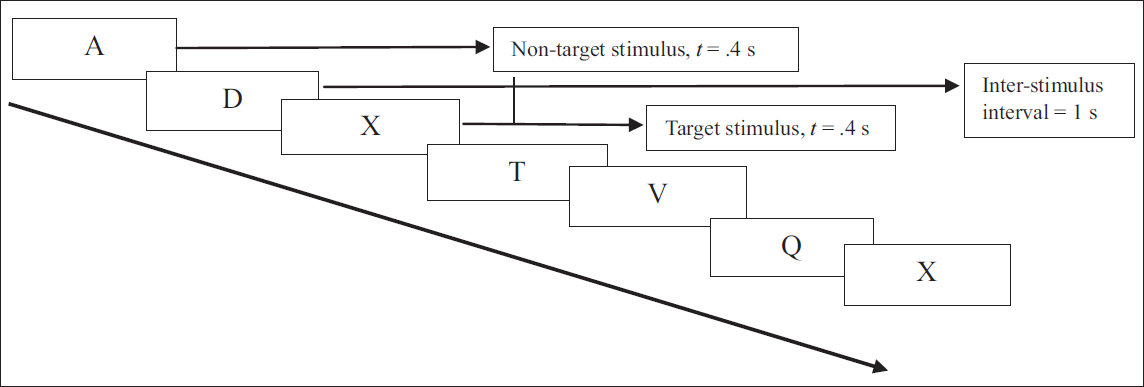
The attention task used for the study was the continuous performance test (CPT). 51 CPT is an attention paradigm that has evolved into a class of neuropsychological tests used to assess sustained attention. There is no single ‘continuous performance test’, as a number of commercially available and research CPT tasks exist and have been published. The common characteristic of all these tests is that they involve sequential presentation of stimuli, usually letters or numbers, each for a few seconds, over an extended period of time. The participant is to attend and respond to particular target stimuli, while ignoring other stimuli that serve as non-target distractors. For example, the participant may be required to respond every time they see an X on the screen.
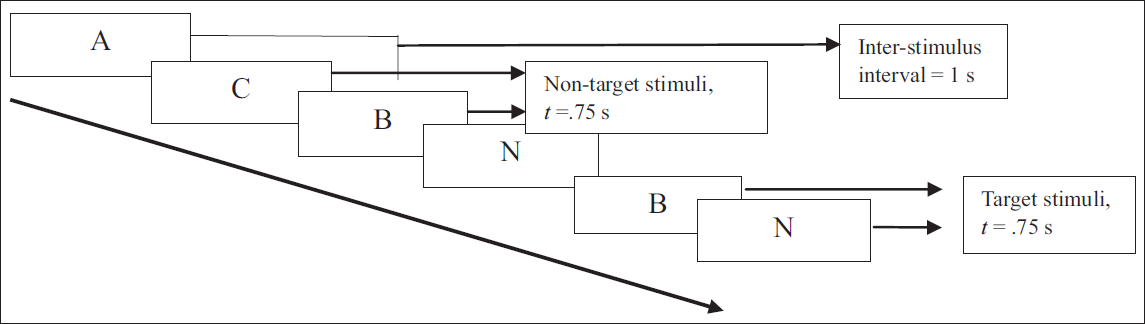
The working memory task used for the study was the 2-Back task. A particular version of the general paradigm of n-Back tasks, 52 the 2-Back task requires the participant to monitor a series of stimuli and to respond whenever they see a stimulus that is the same as the stimulus presented two trials back. Alternative versions of the task are the 3-Back and 4-Back, which require responses to stimuli that are the same as the stimuli 3- and 4-trials back, respectively. In most cases, the respondents are required to respond by pressing a button when they see a target stimulus, and to withhold responses when viewing distractor stimuli. However, some studies have also required the participant to respond differentially by pressing one of two buttons to each stimulus presented based on whether they believe it to be a target stimulus or not. 53 The target stimuli may range from numbers/digits and letters to pictures, words or even faces. 54
Both tasks were constructed and administered using the software PsychoPy-2024.2.4, an open-source package that allows the construction of online experiments, both through a non-programming builder view as well as Python programming language (see Figures 1 and 2 for samples). Two sets of pre-test–post-test experiments were built, one set with the CPT task before the 2-Back task and the other set with the 2-Back task before the CPT task. The CPT task consisted of 200 stimuli, out of which 45 were target stimuli and 155 were non-target stimuli. The division was made according to the 22.5% target and 77.5% non-target proportion suggested for average-load CPT tasks. 55 Each stimulus was shown for a period of 0.4 s, with a 1-s inter-stimulus interval. 56 The 2-Back task consisted of 20+2 (initial) stimuli, out of which 8 were target and 14 were non-target stimuli. 57 Each stimulus was shown for a period of 0.75 s, with a 1-s inter-stimulus interval. 54 Different sets of stimuli were used for the pre-test and post-test; however, the same set of stimuli was used for each experimental group’s pre-tests, and similarly, the same set was used for each experimental group’s post-tests to maintain uniformity across testing groups and occasions. Each stimulus was sized 0.9 cm, and was coloured white, and presented atop a dark-grey-black background.
Procedure
Rapport Formation
Rapport was formed with each individual participant at the outset of each testing session. The participant was invited into the laboratory setting and asked to sit comfortably. Casual conversation about how their day was going and what they had been up to before coming in for the study was initiated. Once the participant appeared at ease, they were informed about the purpose of the study and were assured that they could leave the study if they pleased and that all information about them, including their demographic data and test scores, would be kept strictly confidential and their names omitted from the record. They were requested to ask any questions they might have pertaining to the study, and once their consent was obtained, the instructions for the study were given.
Instructions
The following instructions were given to each participant:
The study is divided into three phases. In the first phase, you will be required to complete two tasks; in the second phase you will be required to watch certain/no media content for 10 min; and in the third phase, you will again be required to perform two tasks. The instructions for each of the tasks will be presented before the beginning of each task. You may take as much time to read and understand them as required, and you are also encouraged to clarify any doubts that you may have. We will conduct a short practice session for the two tasks before starting the first phase of the study, just to help you understand the tasks and what you would be required to do in each. If you are ready, we may begin with the practice session.
Once the participant’s assent to move ahead was obtained, the practice session began.
The instructions for the CPT task were as follows, ‘You will now see a series of letters appear on your screen one at a time. Please press the “X” key each time you see an “X”, and an “X” only. Please press the SpaceBar to begin!’. Clarifications were offered as required. The instructions for the 2-Back task were as follows:
You will now see a series of letters on your screen. For each letter, you must decide and press the SpaceBar if you saw the same letter two trials ago. For example, if the series goes B, V, B, then you respond to the second B by pressing the SpaceBar, since it is indeed the same as the letter two trials ago. Please press the SpaceBar to begin the task.
Clarifications were offered as required.
Conduction
Once the rapport formation process was complete, the participants were informed, roughly, about the structure of the session: the pre-test phase, the media or no-media viewing phase, and the post-test phase; however, no specific details about what type of media they would be viewing were provided. The conduction began with the participant completing a short practice session to ensure that they understood the instructions for both tasks and knew how and when to respond. Once confident that they had adequately understood what the tasks required of them, the first/pre-test phase was begun. When the participant completed the first phase, they were informed that the second phase would now begin immediately, and the media was placed in front of them to watch for 10 min. The participants in the group watching no media content were instead engaged in casual conversation for 10 min. Once this second phase of the study had also been completed, the third/post-test phase was commenced. The participant completed the same tasks as the pre-test, but with a different set of stimuli. Half of the participants in each group were presented the CPT task before the 2-Back task, while the other half were presented the 2-Back task first in order to effectively counterbalance and control for any order effects.
Scoring
The CPT paradigm is based on signal detection theory and method, and thus there are certain indices common to all versions of the test: correct responses, errors of omission (misses), errors of commission (false positives) and response time (RT). The present study follows the example of earlier studies55, 56 and conducts analyses using the hit rates/correct response rate and the response times. The correct responses were recorded based on the sum of the number of times the participant correctly responded to the target and correctly avoided responding to distractors. Higher rates of correct detections indicate better attention performance. Additionally, the response times for all the participants’ responses were recorded and averaged before analysis.
The scoring of n-Back tasks is also typically based on the response latency, that is, the response time, along with the accuracy, that is, the correct response rate, for a participant. Typically, as n increases, so does the response time, but not the accuracy rate, that is, the response time is lower and the number of accurate responses is higher for a 2-Back task as compared to a 3- or 4-Back task, which exerts a greater load on the working memory.58–60 The present study also follows the example of earlier studies and conducts analyses with the accurate response rate and the response times.
Data Analysis
Statistical analyses were carried out for the data using IBM SPSS Statistics 27 software. The Kruskal–Wallis (independent-samples) test was used to compare the performance of participants in the three experimental conditions (viewing sludge media, regular short videos and no media content), separately for the sustained attention and working memory tasks, and pre-test and post-test scores and response times. This was followed by a post hoc analysis to ascertain the specific pairwise comparisons between the groups. The pre-test scores and response times were compared with the post-test scores and response times for each experimental group using the Wilcoxon signed-rank test (dependent samples). These non-parametric measures were used due to the small sample size included in each of the study groups. The descriptives for each experimental group for both tasks were also calculated. The correlations between the CPT and 2-Back pre-test scores and response times, and post-test scores and response times, were also calculated.
Ethical Guidelines
Informed consent was obtained from all participants, and they were assured of their right to withdraw from the study as and when, and if, they pleased. All personal/identification information gathered about the participants, along with their scores in the study, was kept strictly confidential, and their names were omitted from the record to maintain absolute anonymity. The study was conducted according to the convenience of the participants, and no class or personal time of theirs was encroached upon. All the data collected were used purely for academic purposes, and were not, and will not be, disclosed to third parties in the present or future.
Results
This section encompasses the results of all data analyses conducted. Tables 1 and 2 contain the descriptives for the sustained attention and working memory tasks, respectively, in the context of the four experimental groups. Tables 3 and 4 show the correlations between the scores and response times for the sustained attention and working memory tasks, respectively. Tables 5 and 6 consist of the results of the Kruskal–Wallis (H) test conducted to compare the scores and response times on each of the tasks across groups. Table 5a comprises the post hoc, pairwise comparisons of group post-test scores for the sustained attention task. Tables 7 and 8 enlist the results of the Wilcoxon signed-rank (Z) test conducted to compare the pre- and post-test scores and response times for each of the groups for both tasks, respectively.
Sustained Attention Task Score and Response Time Descriptive (All Groups).

Working Memory Task Score and Response Time Descriptive (All Groups).

Correlations Between Scores and Response Times for Sustained Attention Task.

Correlations Between Scores and Response Times for Working Memory Task.

Kruskal–Wallis (H) Test Comparing Sustained Attention Pre-test and Post-test Scores and Response Times Across All Groups.

Pairwise Comparison of Groups for Sustained Attention Post-test Scores.

Kruskal–Wallis (H) Test Comparing Working Memory Pre-test and Post-test Scores and Response Times Across All Groups.

Wilcoxon Signed-Rank (Z) Test (Related Samples) Comparing Sustained Attention Pre-test and Post-test Scores and Response Times for Each Group.

Wilcoxon Signed-Rank (Z) Test (Related Samples) Comparing Working Memory Pre-test and Post-test Scores and Response Times for Each Group.

Discussion
A correlational analysis was carried out between the pre-test scores and response times and post-test scores and response times for both tasks and for all the experimental groups, the results of which are enlisted in Tables 3 and 4. A review of the findings shows that there are no significant correlations between accurate responding and response times for any of the experimental groups on either of the tasks. Previous research has yielded mixed results regarding the association between scores and response times in the context of both CPT and 2-Back tasks, with some research reporting significant correlations between them while others do not.54, 61 There is, however, a significant correlation between CPT post-test scores and response time for the group with low media users watching sludge media content (p ≤ .01). This significant association may have arisen due to the rather uncomplicated impact that sludge media viewing would have had on individuals who do not engage in high levels of media use, that is, such individuals do not regularly use social media very much, and thus being exposed to multi-frame overstimulation videos may undoubtedly have a more consistent negative influence on their performance, both in terms of accuracy and response time. This explanation may also somewhat be in line with the trained attention hypothesis, which posits that high levels of media usage and multitasking may inoculate the individual to high levels of stimulation and thereby improve their ability to deal with it.30, 35, 43
Influence on Sustained Attention
With respect to sustained attention, a Kruskal–Wallis test indicated that there was no significant difference in CPT pre-test scores (Table 5) across the sludge media (Group 1), regular media (Group 2) and no media content groups (Group 3), H (df = 2, N = 45) = 0.855, p = .652. Two other Kruskal–Wallis tests revealed that (a) there was no significant difference in CPT pre-test response times (Table 5) across the sludge media, regular media and no media content groups, H (df = 2, N = 45) = 0.961, p = .172; and (b) there was no significant difference in CPT post-test response times (Table 5) across the sludge media, regular media and no media content groups, H (df = 2, N = 45) = 3.526, p = .172. However, a Kruskal–Wallis test also revealed that there was a significant difference in the CPT post-test scores (Table 5) across the sludge media, regular media and no media content groups, H (df = 2, N = 45) = 17.164, p < .001. Post hoc comparisons using the Dunn–Bonferroni method indicated that CPT post-test scores of the no media content group were significantly higher than those of the sludge media content group, p < .001 (Table 5a). However, there was no significant difference between the CPT post-test scores of the sludge media and regular media (p = .104), and regular media and no media (p = .127).
Thus, H1 is retained, since it states that there is a significant difference in the post-test performance on the sustained attention task between the three experimental groups, as the aforementioned findings indicate that viewing sludge media content and viewing no media content led to significantly different performance on the CPT post-test among the participants. However, these findings must be interpreted in the context of the comparison of pre- and post- test scores for each of the three groups, as detailed in Tables 8a, 8c and 8e. A series of Wilcoxon signed-rank tests (Table 7) showed that (a) there was a significant difference between the CPT pre-test and post-test scores of the group watching sludge media content, z = –3.413, p < .001; (b) there was a significant difference between the CPT pre-test and post-test scores of the group watching regular short-video content, z = –2.513, p = .012; and (c) there was a significant difference between the CPT pre-test and post-test scores of the group watching no media content, z = –2.127, p = .033.
Thus, all three groups show statistically significant differences between the CPT performance of participants from pre-test to post-test. Nevertheless, the difference is most significant for individuals viewing sludge media content (p < .001), followed by individuals viewing regular short-media content (p = .012), and lastly for those viewing no media content (p = .033). When examined holistically, the findings appear to suggest that while participants in all groups showed a decline in CPT performance between the pre- and post-tests (see Table 1 for descriptive data), the decline is most significant for those watching sludge video content and the least for those watching no media content. Furthermore, the difference in the CPT post-test scores was significant only between the sludge video and no media content groups. The group watching sludge media content was also the only group for which the CPT response times differed significantly (p = .004) between the pre- and post-testing phases (see Table 7). It is, therefore, clear that not only did the participants watching sludge media content show the most drastic decline in performance on the sustained attention task, but it is also the only group out of the two watching different forms of media content that differed significantly with respect to the acting control, that is, the group watching no media content at all.
These findings largely corroborate earlier research conducted on phenomena such as high degree of social media usage and media multitasking that report statistically significant lower sustained attention scores and higher response times among high social media users/multitaskers.31, 33 There are numerous theories and hypotheses that have been proposed to explain this link between greater media usage/multitasking and lowered sustained attention capacity. For one, a group of researchers has argued that media multitasking is, in itself, essentially a failure of, or a conscious attempt to avoid, sustaining attention towards one particular target. 42 This position argues that by virtue of engaging in media multitasking, the individual makes a trade-off right at the outset: they either attend fully to one source of media for a transient period before switching their attention to the other media and so forth; or they constantly maintain some degree of divided attention towards each of the various forms of media being used simultaneously. Sludge/overstimulation video content is a random combination of multiple unrelated stimuli, which necessarily requires the viewer’s attention to either be drawn to each of the constituent stimuli for brief periods while it switches back and forth between each of the stimuli, or it involves the viewer passively taking in all the different stimuli all at once. Either way, the individual is most certainly not sustaining their attention towards the perception and processing of any one stimulus, which may explain the decline in the CPT scores after the present study’s participants viewed sludge media content.
The findings can also be interpreted as lending support to the scattered attention hypothesis, since it can be observed that the difference between post-test scores among the three groups is significant only between the sludge video and no media content groups. Compared to the regular short-video content group, the group watching sludge videos did have to divide their attention more between the multiple constituent videos within each larger frame. Consequently, the significant difference between sludge video and no media content groups may be understood as arising out of the fragmenting of attentional resources amongst numerous, unrelated stimuli, which would subsequently lead to a reduced capacity to focus along with increased distractibility. 35 Researchers posit that high levels of media multitasking, or in this case, viewing multi-frame sludge videos, broaden the attentional scope of the individual and effectively widen the amount of relevant and irrelevant information being taken in.32, 34, 35 Due to this broadening, the individual’s ability to filter out irrelevant stimuli and maintain a unitary channel of focus becomes impaired and may translate into lowered performance on tasks of sustained attention.33, 43, 44
Additionally, the findings may be attributed to the three-pronged influence that simultaneous engagement in multiple sources of media is believed to have on attentional capacity.31, 35, 41, 42 First, the participants viewing sludge media content may have become habituated to the large influx of novel, rapid and unrelated stimuli to which they were being continuously exposed for 10 min and thus performed poorly on the second sustained attention task, since it did not match the heightened level of arousal that had been induced by the sludge media content viewing. Second, the constant exposure to sludge content may also have reduced the individual’s ability to block out irrelevant channels of stimulation and may have led to worse sustained attention performance due to greater distractibility during the performance of the post-test. And third, sludge media content viewing may have effectively shifted the individual’s locus of attentional control outside them, since each unrelated video playing simultaneously on the screen may have kept drawing the individual’s attention towards itself at different points in time; so much so that the individual’s ability to select and maintain focus only on a single channel of stimulation may have been impacted and led to a decline in sustained attention scores.
Influence on Working Memory
With respect to working memory, Kruskal–Wallis tests indicated that there was no significant difference in (a) 2-Back pre-test scores (Table 6) across the sludge media (Group 1), regular media (Group 2) and no media content groups (Group 3), H (df = 2, N = 45) = 5.205, p = .074; and (b) 2-Back post-test scores (Table 6) across the sludge media, regular media and no media content groups, H (df = 2, N = 45) = 0.815, p = .665. Two other Kruskal-Wallis tests revealed that; (a) there was no significant difference in 2-Back pre-test response times (Table 6) across the sludge media, regular media and no media content groups, H (df = 2, N = 45) = 1.793, p = .408; and (b) there was no significant difference in 2-Back post-test response times (Table 6) across the sludge media, regular media and no media content groups, H (df = 2, N = 45) = 1.679, p = .432.
Thus, H2 is rejected, since it states that there is a significant difference between the post-test performance on the working memory task between the groups watching sludge media content, regular media content and no media content. Contrary to the significant difference in performance found in the sustained task, none of the three experimental groups differed significantly with respect to the 2-Back pre- and post-test scores or response times. Additionally, a series of Wilcoxon signed-rank tests revealed that (a) there was no significant difference between the 2-Back pre- and post-test scores (z = 1.912, p = .56) and the response times (z = 1.084, p = .278) of the group watching sludge media content (Table 8); (b) there was no significant difference between the 2-Back pre- and post-test scores (z = 0, p = 1) and the response times (z = –1.854, p = .064) of the group watching regular media content (Table 8); and (c) there was no significant difference between the 2-Back pre- and post-test response times (z = –1.037, p = .3) of the group watching no media content (Table 8). A Wilcoxon signed-rank test did, however, reveal a significant difference between the 2-Back pre-test and post-test scores of the group watching no media content, z = 2.021, p = .043 (Table 8).
Therefore, the only significant difference found with respect to the 2-Back task is between the pre- and post-test scores for the group watching no media content, with the 2-Back scores showing an increase, though marginal, from pre-test to post-test. This finding may indicate how watching no form of media content, be it regular short-video or sludge/overstimulation videos, leads to an improvement in working memory capacity. While the findings do not lend support to propositions like the scattered attention hypothesis, since they do not show any significant reduction in 2-Back scores from pre- to post-test among those viewing sludge media content, they may instead be reflective of the observation that periods of idle and quiet in between tasks improve working memory functions. 62 Indeed, research has suggested that taking short breaks of wakeful rest in between tasks demanding the utilisation of working memory or other memory systems improves performance on measures of such memory functions. 63 Thus, the 10-min period of not watching any media content at all may have provided such a short break of wakeful rest to the participants in the groups, thereby improving their performance on the post-test.
The insignificant difference between the sludge content group’s 2-Back pre- and post-test scores and response times may be explained by the trained attention hypothesis. According to this hypothesis, media multitasking, or sludge-media viewing in the context of the present study, has a positive influence on cognitive functions like working memory because it enhances the ability to maintain multiple bits of information in memory simultaneously, further improving the individual’s ability to manipulate and process larger amounts of information more efficiently and accurately.30, 35, 43 The findings of the present study also corroborate those of earlier research that has found no difference between high- and low-media multitaskers with respect to their working memory capacities.31, 35, 45, 64 Researchers posit that this enhancement in working memory performance arises out of an improved ability to resist and filter out irrelevant stimulation and maintain a more focused as well as more flexible focus on the primary stimulation. As can be seen in Table 4, there is a (marginal) increase in the mean 2-Back score from pre- to post-test among the sludge media content viewers, which may be indicative of a somewhat improved capacity of working memory among the group members and may be interpreted as supporting the trained attention hypothesis.
When coupled with the observation that the mean pre- and post-test scores for the regular media content group were wholly unchanged (Table 2), the significant yet marginal increase in the mean post-test score of the no media content group, and the insignificant yet marginal increase in the mean post-test score of the sludge media content group, may indicate that periods of idle rest lead to a statistically significant improvement in working memory capacity, while periods of engaging in an alternative form of media multitasking, that is, sludge media viewing, may also lead to some degree of improvement in working memory capacity due to an enhancement of the individual’s ability to maintain and process multiple bits of information in memory simultaneously, which is in line with the trained attention hypothesis.
Conclusion
Sludge content, also called ‘overstimulation videos’, is a format that combines multiple clips/videos that play simultaneously on a single screen and has now become one of the most pervasive content formats on popular social media platforms such as YouTube, Instagram and X. It owes its popularity to catering directly to the needs of instant, low-effort gratification and quick, dynamic entertainment that provides a barrage of stimulation simultaneously without requiring a great deal of cognitive effort. In the context of this ever-growing need for constant stimulation and ever-reducing attentional capacities, the present study is an attempt to gauge the impact that consumption of sludge media may have on cognitive processes like sustained attention and working memory.
The significant decline in performance following sludge media content viewing may be explained using the scattered attention hypothesis, which posits that attending to varying forms of media simultaneously may lead to fragmentation of attentional capacity and thereby make it more and more difficult for the individual to sustain their attention towards a single stimulus/task.32–35 It may also be explained using the three-pronged approach to understanding the impact of consuming forms of media simultaneously, 31 that is, exposure to sludge media content habituates individuals to heightened levels of arousal and thereby reduces their capacity to maintain attention on relatively less arousing tasks, along with increasing the individual’s sensitivity to irrelevant stimuli and shifting the locus of attentional control outside the individual.35, 41, 42 The lack of a significant difference with respect to working memory may, on the other hand, be explained by two complementary ideas: first, that taking short breaks of wakeful rest between tasks may improve working memory performance; and second, that consuming sludge media content may, in fact, enhance an individual’s capacity to attend to and process multiple bits of information simultaneously, as predicted by the trained attention hypothesis.30, 35, 43
Footnotes
Declaration of Conflicting Interests
The authors declared no potential conflicts of interest with respect to the research, authorship and/or publication of this article.
Funding
The authors received no financial support for the research, authorship and/or publication of this article.
Statement of Ethics
The Authors Declare that, in Preparing of the piece of Research Article, we have fully taken care of the Ethical Guidelines mentioned by APA, 2017 such as taking consent from the participants and assuring them their data will be kept confidential. We are not also using the data for any financial and other interest.
