




Abstract
Background
Anxiety is highly prevalent among college students due to academic pressures and developmental transitions. Positive psychological constructs such as self-compassion, gratitude, and PERMA-based well-being may function as protective factors that promote resilience and psychological adjustment.
Purpose
The present study aimed to examine the relationships between self-compassion, gratitude, PERMA-based well-being, and anxiety among college students and to determine whether these positive psychological variables significantly predict anxiety levels.
Method
A quantitative correlational research design was employed. The sample comprised 89 college students aged 18–25 years from universities in the Delhi-NCR region, selected using purposive and convenience sampling. Participants completed standardised measures including the Self-compassion Scale (SCS; Neff, 2003, Self Identity, 2, 3, 223–250), the Gratitude Questionnaire-6 (GQ-6; McCullough et al., 2002, Journal of Personality and Social Psychology, 82, 1, 112–127), the PERMA Profiler (Butler & Kern, 2016, International Journal of Wellbeing, 6, 3, 1–48) and the Beck Anxiety Inventory (BAI; Beck et al., 1988, Journal of Consulting and Clinical Psychology, 56, 6, 893–897). Data were analysed using Pearson’s correlation and multiple linear regression analyses.
Results
Pearson’s correlation analyses revealed significant negative associations between anxiety and self-compassion (r = −0.79, p < .01), gratitude (r = −0.78, p < .01), and PERMA-based well-being (r = −0.89, p < .01). In the multiple linear regression model, PERMA-based well-being emerged as the only significant independent predictor of anxiety (β = −0.81, p < .001).
Conclusion
The results highlight the vital role of self-compassion, gratitude and well-being in reducing anxiety and promoting psychological resilience among young adults. Incorporating these strengths into college-based mental health programmes may enhance emotional regulation and holistic well-being in this population.
Introduction
The transition into college life represents a formative yet demanding stage of development, marked by profound academic, emotional and social adjustments. Young adulthood, typically spanning the ages of 18–25, is characterised by growing independence, evolving identity and exposure to multiple stressors related to academics, finances and interpersonal relationships. These developmental pressures often heighten vulnerability to anxiety and emotional distress. 1 In recent years, the prevalence of anxiety among college students has become a major mental health concern globally and in India, where increased academic competition and societal expectations have intensified psychological strain. 2 This scenario necessitates a deeper exploration of internal psychological resources that promote resilience and well-being.
Among such internal resources, self-compassion has gained considerable attention in contemporary psychological research. Rooted in the humanistic and Buddhist traditions, self-compassion refers to extending kindness, understanding and non-judgement towards oneself during times of failure or distress. 3 The construct is grounded in Neff’s tripartite model, which encompasses self-kindness versus self-judgement, common humanity versus isolation and mindfulness versus over-identification. Theoretically, self-compassion enhances emotion regulation and mitigates maladaptive self-criticism, thereby fostering psychological flexibility. 4 Empirical studies consistently show that higher self-compassion is associated with lower levels of anxiety and depression and greater psychological well-being.5, 6
Another vital construct, gratitude, represents a positive emotional response to recognising and appreciating the beneficial actions of others or the presence of good in one’s life. The concept originates from moral and affective theories that position gratitude as a prosocial emotion promoting psychological growth and relational harmony. 7 The broaden-and-build theory of positive emotions 8 suggests that gratitude expands cognitive and emotional capacities, facilitating adaptive coping and resilience. Contemporary studies have established that gratitude enhances optimism, life satisfaction and mental well-being, while reducing symptoms of anxiety and depression.9, 10
Well-being, in the context of positive psychology, extends beyond the mere absence of distress to encompass optimal functioning and flourishing. Seligman’s PERMA model 11 conceptualises well-being as a multidimensional construct consisting of five elements: Positive Emotion, Engagement, Relationships, Meaning and Accomplishment. Each component contributes uniquely to psychological health and life satisfaction. The PERMA framework has been empirically supported across diverse populations and is widely used to assess holistic well-being.12, 13 Within the framework of higher education, well-being not only reflects emotional balance but also predicts academic performance, resilience and social connectedness.
In the present context, anxiety has emerged as one of the most prevalent mental health issues among university students, exacerbated by lifestyle shifts, technological overuse and post-pandemic academic restructuring. 14 The theoretical basis for examining anxiety in relation to self-compassion, gratitude and PERMA well-being is anchored in the idea that these positive psychological constructs serve as protective factors against stress. The self-regulation and emotion-focused coping mechanisms inherent in self-compassion, 15 the cognitive reframing and prosocial orientation of gratitude, 16 and the multidimensional flourishing outlined in the PERMA model collectively counteract anxiety’s affective and cognitive components.
College students are particularly vulnerable to anxiety due to academic demands, developmental transitions and social pressures, making anxiety a salient mental health outcome in this population. 2 Guided by positive psychology and strength-based models of mental health, the present study focuses on psychological resources that may buffer anxiety rather than solely emphasising psychopathology. Self-compassion, gratitude and PERMA-based well-being were selected based on established theoretical frameworks and consistent empirical evidence linking these constructs to emotional regulation and reduced psychological distress.
Self-compassion is grounded in Neff’s self-compassion theory, which conceptualises self-kindness, mindfulness and common humanity as adaptive responses to personal suffering. 3 Empirical studies and meta-analytic findings have demonstrated robust inverse associations between self-compassion and anxiety, particularly among young adults.5, 17 Gratitude draws on the broaden-and-build theory of positive emotions, which posits that positive emotions broaden cognitive and behavioural repertoires and build enduring psychological resources. 8 Research has consistently shown that gratitude is associated with greater well-being, adaptive coping and lower anxiety and stress.10, 16 PERMA-based well-being, derived from Seligman’s theory of flourishing, offers a multidimensional framework encompassing positive emotions, engagement, relationships, meaning and accomplishment. 11 Prior research indicates that higher PERMA domains are associated with better mental health outcomes and lower levels of anxiety.13, 18 Examining these constructs together allows for an integrative understanding of how positive psychological resources relate to anxiety among college students and can inform preventive and health-promotion efforts. Despite growing research on these constructs individually, limited studies in the Indian context have explored their interconnected roles in predicting anxiety among young adults. Given the unique sociocultural fabric of Indian academia, where high parental expectations, societal comparison and performance-based validation are prevalent, understanding how these internal strengths interact offers both theoretical and applied value. Investigating these relationships can enrich existing models of mental health and guide evidence-based interventions aimed at building emotional resilience in educational settings.
The current study, therefore, aims to bridge this gap by examining the relationships between self-compassion, gratitude, PERMA-based well-being and anxiety among college students. It further seeks to identify which of these constructs serves as the most significant predictor of anxiety. By emphasising internal strengths over psychopathology, this study aligns with the positive psychology paradigm, underscoring the importance of cultivating compassion, appreciation and flourishing to enhance mental health among emerging adults in the present era.
Methods
Aim and Objectives
The present study aimed to examine the relationships among self-compassion, gratitude, PERMA-based well-being and anxiety in college students, and to determine the predictive influence of these positive psychological variables on anxiety.
Objectives
To explore the relationship between self-compassion and gratitude among college students.
To explore the relationship between self-compassion and PERMA-based well-being among college students.
To explore the relationship between self-compassion and anxiety among college students.
To explore the relationship between gratitude and PERMA-based well-being among college students.
To explore the relationship between gratitude and anxiety among college students.
To explore the relationship between PERMA-based well-being and anxiety among college students.
To explore whether self-compassion significantly predicts anxiety among college students.
To explore whether gratitude significantly predicts anxiety among college students.
To explore whether PERMA-based well-being significantly predicts anxiety among college students.
Source of Population and Selection Criteria
The target population comprised undergraduate and postgraduate students aged 18–25 years, enrolled in universities and colleges across the Delhi-NCR region. This age group represents the developmental period of emerging adulthood, often associated with elevated psychological distress and identity-related challenges. Participants were selected using purposive and convenience sampling based on accessibility and inclusion criteria.
Inclusion Criteria
College students aged between 18 and 25 years.
Enrolled full-time in undergraduate or postgraduate programmes.
Proficient in English to comprehend the questionnaires.
Exclusion Criteria
Individuals with a current clinical diagnosis of anxiety or depression are undergoing psychotherapy or pharmacological treatment.
Participants
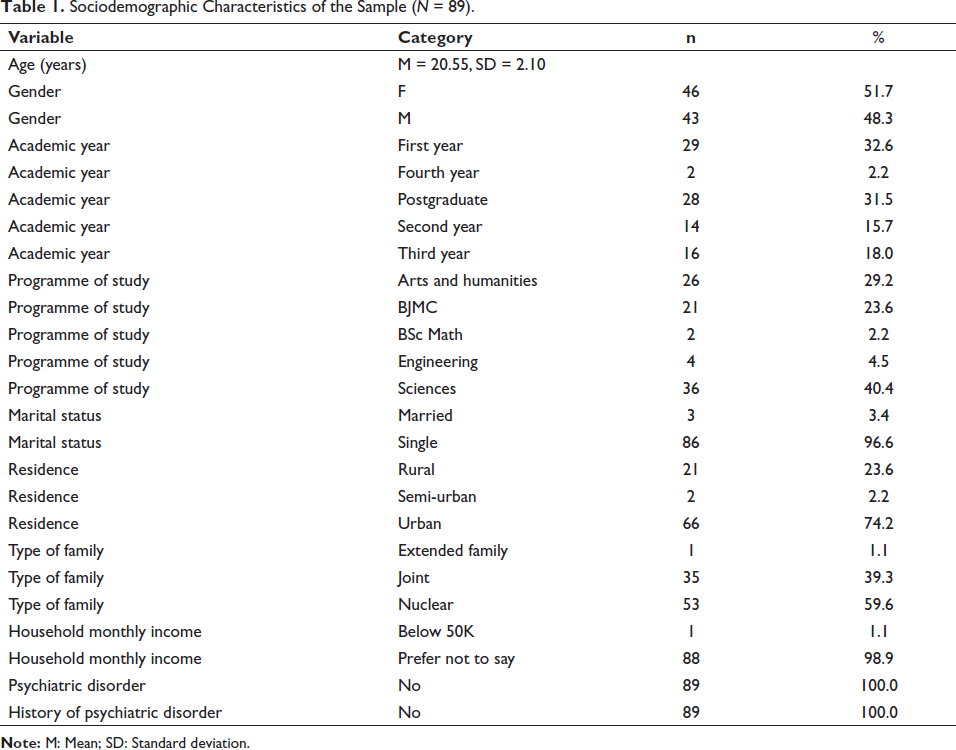
The final sample comprised 89 college students (aged 18–25 years) from various universities in the Delhi-NCR region. The sample size was calculated by G-Power test. Out of this, 46 were females, and 43 were males. Gender distribution was approximately balanced. Participants provided informed consent prior to data collection, and confidentiality was maintained throughout the process.
Tools and Techniques
Self-compassion Scale (SCS) 3 : This 26-item scale assesses the degree to which individuals extend kindness and understanding towards themselves during times of failure or distress. It comprises six subscales: self-kindness, self-judgement, common humanity, isolation, mindfulness and over-identification. Items are rated on a five-point Likert scale (1 = almost never to 5 = almost always). Higher scores reflect greater self-compassion. The SCS has demonstrated excellent internal consistency (α = 0.92) and cross-cultural validity.
Gratitude Questionnaire–6 (GQ-6) 7 : The GQ-6 is a six-item self-report measure assessing the tendency to experience gratitude in daily life. Items are rated on a seven-point Likert scale, ranging from 1 (strongly disagree) to 7 (strongly agree). Higher scores denote greater dispositional gratitude. The scale has shown robust internal reliability (α = 0.82–0.87) and good convergent validity across Indian samples.
PERMA Profiler 18 : This 23-item scale measures multidimensional well-being across five domains: Positive Emotion, Engagement, Relationships, Meaning and Accomplishment. Responses are recorded on an 11-point scale (0 = never, 10 = always). Higher scores indicate greater perceived well-being. The instrument has demonstrated good psychometric properties and cross-cultural applicability.
Beck Anxiety Inventory (BAI) 19 : The BAI is a 21-item inventory used to assess the severity of anxiety symptoms over the past week. Each item is rated on a four-point scale (0 = not at all to 3 = severely). Higher scores indicate greater anxiety. The BAI has high internal consistency (α = 0.92) and strong discriminant validity.
Statistical Procedure
Data were coded and analysed using IBM Statistical Package for the Social Sciences (SPSS) Statistics (Version 25.0). Descriptive statistics (mean, standard deviation) were computed for all continuous variables to summarise central tendencies and variability. Prior to analysis, the distribution of all study variables was examined to assess normality. As the variables were found to be approximately normally distributed, Pearson’s product–moment correlation coefficients were computed to examine associations among the study variables. Assumptions relevant to Pearson correlation, including linearity and absence of significant outliers, were evaluated through visual inspection of scatterplots. Prior to conducting regression analyses, key statistical assumptions were examined. Linearity and homoscedasticity were assessed through visual inspection of scatterplots of standardised residuals plotted against predicted values. The plots demonstrated random dispersion without evidence of curvature or funnel-shaped patterns, indicating that the assumptions of linearity and homoscedasticity were met. Residual normality was evaluated using a histogram of standardised residuals, which approximated a normal distribution with a mean close to zero and a standard deviation near one, supporting the assumption of normality. Independence of errors was assessed using the Durbin–Watson statistic, which yielded a value of 2.153, indicating that the residuals were independent. Therefore, findings were interpreted in view of the underlying data distribution. To examine the relative contribution of self-compassion, gratitude and PERMA-based well-being to anxiety, a multiple regression analysis was conducted, with anxiety as the outcome variable and self-compassion, gratitude and PERMA-based well-being entered simultaneously as predictors. Statistical significance was set at p < .05. Effect sizes (β coefficients) were calculated to determine the strength and clinical significance of each predictor. Effect sizes were interpreted in accordance with Cohen’s guidelines to facilitate a meaningful interpretation of the magnitude of the observed associations.
Results
Sociodemographic Characteristics of the Sample (N = 89).
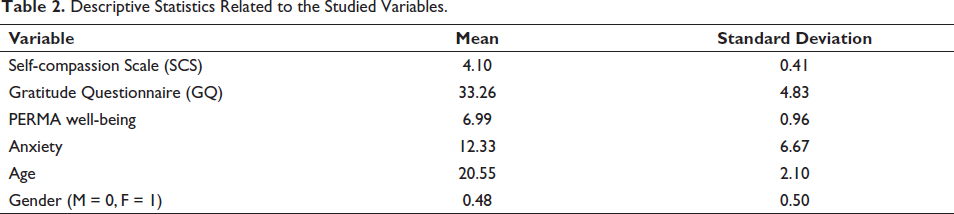
Descriptive Statistics Related to the Studied Variables.
Pearson’s Correlations Between Study Variables (N = 89).
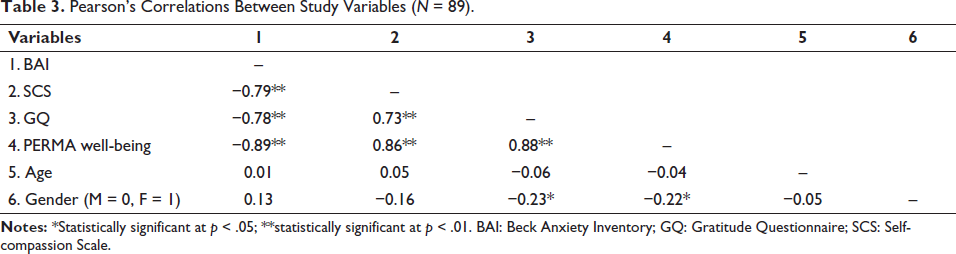
The results indicate that higher levels of self-compassion, gratitude and well-being were associated with lower levels of anxiety among college students. Consistent with positive psychology frameworks, these results suggest that greater psychological resources are linked to reduced psychological distress in this population.
Self-compassion and gratitude have a significant positive correlation (r = 0.73, p < .01), which, according to Cohen’s guidelines, 20 represents a large effect size. This means that as self-compassion increases, gratitude also increases and vice versa. It also suggests that individuals who respond to themselves with kindness and understanding are also more likely to experience and express gratitude.
Similarly, self-compassion showed a strong positive association with PERMA-based well-being (r = 0.86, p < .01), indicating that higher self-compassion is closely related to greater overall psychological flourishing. This association is a large and strong one, as per Cohen. 20 This means that as self-compassion increases, the PERMA well-being also increases, and vice versa.
Gratitude and PERMA-based well-being were also strongly and positively correlated (r = 0.88, p < .01), reflecting a substantial overlap between gratitude and multiple dimensions of well-being, including positive emotions, meaning and engagement. This association is a large and strong one, as per Cohen. 20 This means that as gratitude increases, the PERMA well-being also increases, and vice versa.
Importantly, all three positive psychological constructs demonstrated strong and significant negative associations with anxiety. Self-compassion exhibited a large negative correlation with anxiety (r = −0.79, p < .01), suggesting that individuals with higher self-compassion report markedly lower anxiety levels. This association is large and strong, as per Cohen. 20 This means that as self-compassion increases, anxiety decreases and vice versa. This has clinical implications for working with clients with significantly high clinical anxiety. Gratitude was also significantly and negatively associated with anxiety (r = −0.78, p < .01), indicating that greater appreciation of positive life experiences may serve as a protective factor against anxiety. This association is large and strong, as per Cohen. 20 This means that as gratitude feelings increase in people, anxiety decreases. This finding also carries clinical and well-being implications.
PERMA-based well-being showed the strongest negative association with anxiety (r = −0.89, p < .01), highlighting the potential role of overall psychological flourishing in mitigating anxiety symptoms among college students. This association is large and strong, as per Cohen. 20 This means that as PERMA well-being increases, anxiety decreases.
Multiple Linear Regression: Predicting Anxiety from Self-compassion, Gratitude, PERMA-based Well-being, Age and Gender (N = 89).
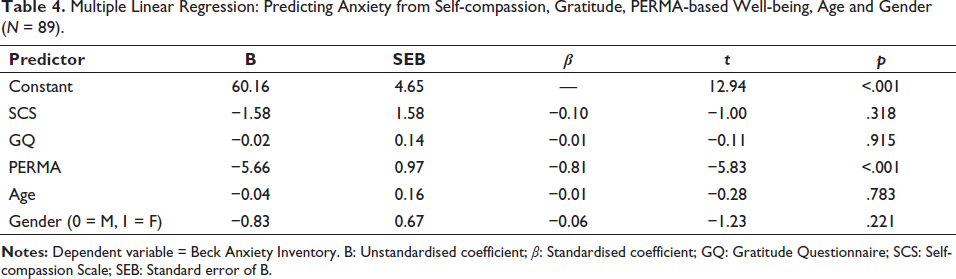
Model statistics:
R = 0.89, R2 = 0.80, Adjusted R2 = 0.79, F(5, 83) = 65.88, p < .001.
Durbin–Watson = 2.15.
Collectively, the results suggest that while self-compassion and gratitude are closely associated with anxiety at the correlational level, PERMA-based well-being demonstrates the strongest and most robust predictive relationship with anxiety when all variables are considered together.
Discussion
The present study examined the relationships between self-compassion, gratitude, PERMA-based well-being and anxiety among college students, and further assessed the predictive role of these positive psychological constructs on anxiety while accounting for age and gender. The findings revealed significant negative correlations between anxiety and each of the three positive constructs: self-compassion, gratitude and well-being, indicating that higher levels of these positive psychological resources were associated with lower anxiety among college students. When examined simultaneously through multiple linear regression analysis, PERMA-based well-being emerged as the strongest and only significant predictor of anxiety after controlling for self-compassion, gratitude, age and gender. This finding suggests that although self-compassion and gratitude are meaningfully associated with anxiety at the bivariate level, their predictive influence may be subsumed within broader dimensions of psychological flourishing captured by the PERMA model. The results highlight the importance of considering multidimensional well-being when examining protective factors against anxiety. These results highlight the importance of internal psychological strengths in mitigating anxiety among young adults navigating academic and social transitions.
The finding that self-compassion is negatively associated with anxiety supports existing literature emphasising its protective role against psychological distress. Neff 3 conceptualised self-compassion as an adaptive emotional stance towards one’s imperfections, which promotes self-acceptance and emotional resilience. Previous research has similarly reported that self-compassion fosters effective emotion regulation, reducing rumination and anxiety.5, 21 Studies on Indian college samples have also demonstrated that individuals high in self-compassion show lower levels of test anxiety and social evaluation fear. 6 The present results extend this evidence, confirming that cultivating self-compassion may buffer students against the anxiety associated with performance pressure and self-criticism prevalent in competitive academic settings.
The significant negative correlation between gratitude and anxiety is consistent with prior findings, suggesting that gratitude enhances positive affect and adaptive coping while diminishing negative affectivity.10, 16 Gratitude is theorised to broaden cognitive appraisals and promote emotional balance, aligning with Fredrickson’s broaden-and-build theory. 8 Recent studies in Indian populations have also linked gratitude practices with reduced anxiety and improved well-being. 9 The present results therefore reinforce the idea that gratitude interventions such as reflective journaling or daily appreciation exercises can effectively reduce stress and foster emotional regulation among college students.
Similarly, PERMA-based well-being showed a strong inverse association with anxiety, emerging as the most robust predictor. This finding aligns with Seligman’s 11 multidimensional framework of flourishing, wherein positive emotions, engagement, relationships, meaning and accomplishment collectively support mental health. Empirical work across cultures indicates that individuals with higher PERMA scores experience lower anxiety and greater life satisfaction.12, 18 Within the Indian academic context, higher well-being is associated with enhanced self-efficacy, social connectedness and optimism. 22 The present study corroborates these findings and highlights the role of holistic well-being in fostering resilience against anxiety symptoms.
Taken together, the results of this study affirm that self-compassion, gratitude and well-being act as psychological buffers that mitigate anxiety in emerging adults. The findings align with the principles of positive psychology, emphasising the enhancement of strengths rather than merely reducing pathology. Integrating practices that foster compassion, appreciation and purposeful living into university mental health initiatives could significantly enhance students’ coping capacities and overall well-being.
While the results largely support existing literature, some variations in effect magnitude may be attributed to cultural factors, sample size and methodological differences. For instance, previous Western studies have found gratitude to be a stronger predictor of well-being than self-compassion, 16 whereas the current findings indicate that well-being and self-compassion were more powerful predictors of reduced anxiety. This variation underscores the potential influence of collectivistic values in the Indian context, where relational harmony and self-acceptance are central to psychological health.
Scope of Improvement
The study’s limitations should be acknowledged. The use of a cross-sectional design restricts causal interpretations of the observed relationships. The reliance on self-report measures may have introduced social desirability bias and shared method variance, potentially contributing to inflated associations and higher R2 values in the regression analyses. Furthermore, the sample size (N = 89), though adequate for preliminary analysis, limits generalisability. The study also focused on college students from a specific geographical area, and thus, the findings may not represent broader youth populations across different educational or socio-economic backgrounds.
Implications
Despite these limitations, the study carries important implications for both clinical and academic settings. In clinical contexts, interventions integrating self-compassion training, 23 gratitude-based cognitive reframing and PERMA-informed well-being modules may effectively reduce anxiety symptoms in young adults. In academic institutions, incorporating psychoeducational workshops that emphasise emotional awareness, self-kindness and gratitude practices can help foster a culture of psychological resilience. Faculty and counselling units could adopt these frameworks to support students’ mental health proactively rather than reactively.
Future Directions
Future research should employ longitudinal or experimental designs to determine causality and examine whether structured interventions targeting these constructs lead to sustained reductions in anxiety. Expanding the research to diverse populations and incorporating qualitative approaches may provide deeper insights into how cultural and contextual factors influence self-compassion, gratitude and well-being in young adults. Further, integrating neuropsychological or physiological measures could help elucidate the underlying mechanisms linking these positive constructs with emotional regulation and anxiety reduction.
Conclusion
The present study highlights the importance of positive psychological resources in understanding anxiety among college students. While self-compassion, gratitude and PERMA-based well-being were all significantly associated with lower anxiety, PERMA-based well-being emerged as the strongest and only unique predictor when examined within a multiple regression framework, controlling for age and gender. These findings underscore the value of fostering holistic well-being to enhance emotional resilience and mental health in young adults. Integrating interventions that promote well-being, alongside self-compassion and gratitude practices, within college counselling and wellness programmes may be particularly effective in reducing anxiety and supporting overall psychological functioning.
Footnotes
Acknowledgement
The researchers are grateful to the participants who gave their valuable time to the researchers.
Authors’ Contribution
PS conceptualized the study, contributed to the study design, collected the data, conducted the statistical analysis, and prepared the initial draft of the manuscript.
MNK provided research supervision, reviewed the manuscript, and approved the final version for publication. All authors approved the final manuscript.
Declaration of Conflicting Interests
The authors declared no potential conflicts of interest with respect to the research, authorship and/or publication of this article.
Funding
The authors received no financial support for the research, authorship and/or publication of this article.
Patient Consent
The author confirms that informed consent was obtained from all participants prior to data collection. Participants were informed about the purpose of the study, confidentiality of their responses, and their right to withdraw at any time. No identifying information has been reported in the manuscript.
Statement of Ethics
Ethical approval was obtained from the institutional review committee prior to the commencement of data collection.
