




Abstract
Background
Convulsions (seizures) are common neurological conditions characterised by abnormal electrical activity in the brain. Various modern treatments are available for managing convulsions; however, due to the side effects of available treatments, alternative medicine is gaining attention. One of the most popular homoeopathic remedies is Belladonna, used for treating neurological symptoms such as seizures, but scientific evidence is not available.
Purpose
The present study was designed to evaluate its anticonvulsive effect in the zebrafish animal model.
Methodology
The effect of homoeopathic Belladonna on pentylenetetrazole (PTZ)-induced seizures in zebrafish (Danio rerio) was assessed in this study. The safe dose was identified through acute toxicity studies, which revealed that 0.25% and 0.5% were non-toxic to zebrafish larvae and adults, respectively. In seizure studies, zebrafish larvae and adults were pre-treated with Belladonna mother tincture (Bell-MT), Bell-6C and Bell-30C potencies, followed by PTZ exposure to induce epileptic responses. An in silico molecular docking study was performed with the help of the Glide tool of Schrödinger Suite 2022–4.
Results
The total phenolic content (TPC) in Belladonna-MT was 292.61 µg of gallic acid/100% MT. In zebrafish larvae, Bell-6C and Bell-30C significantly increased the latency to reach seizure score 2 and score 3, compared to the PTZ group. In adult zebrafish, Bell-6C and Bell-30C pre-treatment resulted in significant delays in reaching seizure scores 1–5. Additionally, the number of rotations and total distance travelled were also improved after the Belladonna pre-treatment in larvae and adult zebrafish and suggest a marked protective effect against pentylenetetrazole (PTZ)-induced seizures in zebrafish. The possible mechanisms involved in the anti-convulsant activity of Belladonna were elucidated using molecular docking studies.
Conclusion
Collectively, these findings support the potential of Belladonna as an anticonvulsant and could be a potential candidate for the management of epilepsy. However, further exploration for epilepsy management through the underlying mechanisms of action is needed in the future.
Introduction
Convulsions, characterised by sudden, abnormal electrical activity in the brain and are a hallmark of epilepsy and other neurological disorders, affecting millions worldwide. Epilepsy affects more than 65 million people worldwide. Recurrent and unpredictable seizures are the hallmark of this disorder and occur due to abnormal neuronal cell activity.1, 2 Modern anticonvulsant drugs such as valproate and phenytoin are widely prescribed but often come with side effects and varying efficacy across individuals.3, 4 It has been reported that nearly one-third of patients continue to experience seizures despite available antiepileptic drugs.3, 5 This treatment gap has prompted exploration of plant-based and traditional medicines as alternative therapeutic strategies. For the no side effects and cost-effective treatment, alternative treatments, including homoeopathic remedies, have been gaining attention to offer holistic options for managing these conditions. Belladonna (Atropa belladonna), a classical homoeopathic and ethnobotanical remedy, has historically been used for neurological conditions, including seizures.6–8 The poisonous perennial herbaceous plant Atropa belladonna, commonly referred to as Belladonna or deadly nightshade, belongs to the Solanaceae family of nightshades. The main chemical constituents of this plant are tropane alkaloids, including hyoscyamine, atropine and scopolamine, which have well-documented pharmacological effects on the central nervous system. 9 These alkaloids are known to have anticholinergic activity, which inhibits acetylcholine receptors to affect neurotransmission. 10 A few very old clinical studies also reported the potential effect of the homoeopathic medicine of Belladonna in the treatment of epilepsy in patients.6, 11–13 In addition to this, a study reported in 2007 that Belladonna at high dilution used for the clinical management of idiopathic epilepsy in dogs showed positive results. 12 It has been reported that Belladonna in doses ranging from 1st to 30th potency is advised for the treatment of symptoms such as twitching and convulsive movements. 7 In 2009, a preclinical study reported that Belladonna in a homoeopathic preparation was found effective in stressful conditions induced in rodents. 13 Despite the widespread use of Belladonna, there is a lack of scientific data regarding the effect of the homoeopathic preparation of Belladonna in the management of convulsions.
In recent times, zebrafish (Danio rerio) is gaining attention for studies in behavioural neuroscience and neuro-psychopharmacology, due to a high level of physiological and genetic similarity with humans.14, 15 It is a small freshwater teleost that has many advantages over other animal models. As per several reports, zebrafish is widely used as an experimental animal model for convulsions16, 17 induced with pentylenetetrazole (PTZ; a widely recognised convulsant agent) in both life stages, larvae and adults and showed behavioural and electrographical changes in the form of seizures and is used in drug screening for neurological conditions.18, 19 Zebrafish have emerged as a reliable and translational model for screening novel anticonvulsant compounds due to their conserved neurophysiology and reproducible seizure phenotypes.20–23 Considering the established effectiveness of zebrafish as a model for epilepsy research, coupled with preliminary evidence suggesting that Belladonna may exert anticonvulsant effects, investigating Belladonna’s impact on seizure activity in zebrafish presents an opportunity to enhance our understanding of its potential role in epilepsy treatment. Therefore, the present study aims to evaluate the anticonvulsant potential of Belladonna in a zebrafish model by assessing its effects on seizure episodes induced by PTZ in zebrafish with the aim of providing preclinical evidence for its potential therapeutic application in epilepsy.
Materials and Methods
Chemicals, Reagents and Medicines
PTZ, sodium valproate, Folin–Ciocalteu reagent and gallic acid were purchased from Sigma-Aldrich (St. Louis, MO, USA). All the other reagents and chemicals of analytical grade were used in the experiment. The homoeopathic medicines, namely Belladonna mother tincture (Bell-MT), hydro-alcoholic extract, medium dilution (Bell-6C; dilution factor-1012) and high dilution (Bell-30C, dilution factor-1060) potencies, were procured from the homoeopathic pharmacy industry (Good manufacturing practices certified pharma industry). Briefly, the crude sample was macerated with ethanol by a process of maceration. The filtered liquid was known as MT. The 6C and 30C were prepared by serial dilution and succussion processes on a centesimal scale, as described in the Homoeopathic Pharmacopoeia of India.
Phytochemical Analysis of Bell
Estimation of Total Phenolic Content
The total phenolic content (TPC) present in Bell was estimated using the Folin–Ciocalteu reagent as per a previous report with minor modifications (Kumar et al., 2022). 24 Briefly, 20 µL of sample (serial dilution with respective alcohol (Alc): 100, 50, 25, 12.5, 6.25, 3.13, 1.56, 0.78, 0.39, 1.95, 0.09 and 0.045%) of MT was added to 80 µL of Folin–Ciocalteu reagent (10% in distilled water) in a 96-well microplate. Following mixing, each well received 160 µL of a saturated sodium carbonate solution (7.5% w/v in water), which was then incubated for 30 min with shaking at 37 °C in a dark environment. After the incubation, all sample from each well was scanned using a microplate spectrophotometer reader (Biotek, India) to determine the optical density (OD) of the blue colour absorbance at a wavelength of 765 nm. The OD of each sample was calculated to determine the TPC in various percentages of Bell-MT as equivalent to µg/mL of gallic acid.
In Vitro Antioxidant Activity of Bell (2,2-Diphenyl-1-picrylhydrazyl (DPPH) Radical Scavenging Activity)
At a minimum of 24 h before the experiment, DPPH radical (60 mM) was prepared in methanol and allowed to generate stable radicals under dry and room temperature conditions and followed the protocol. 25 During use, 280 µL of DPPH solution was added to each well of the 96-well microplate and the concentration of DPPH was set to attain the absorbance (OD) of 0.7 at 515 nm. Further, 20 µL of each drug sample was added to the respective well. The plate was scanned for 30 min reaction kinetics to record the OD of each sample at a one-minute interval using a microplate reader (Biotek, India). As a positive standard control, ascorbic acid was tested with the DPPH radical solution. The ODs of DPPH radical solution after 20 min of reaction initiation were used to calculate the percentage of radical scavenging of each group as follows:
% of DPPH radical scavenging = (OD of DPPH alone – OD of DPPH with sample) 100/OD of DPPH alone.
Animal Model
Wild-type, both male and female zebrafish (Danio rerio) of 3–6 months old used in this study were purchased from a local commercial supplier. Embryos were raised in our laboratory and maintained under standard laboratory conditions, with temperature control at 26 ± 2 °C and a 14:10 light-dark cycle. Throughout the experiment, the pH of water was kept between 7.0 ± 0.2 with continuous filtering and aeration. All the standard laboratory conditions were kept up in accordance with The Zebrafish Book. 26 Zebrafish were fed the meal (dried brine shrimp) thrice a day. The research related to animal use has complied with all the relevant national regulations and institutional policies for the care and use of animals. All the experiment protocols were approved by the Institutional Animal Ethical Committee (IAEC) with certificate number: (DDPR-CRIH/Pharmacology/CPCSEA/IAEC/2018/002).
Selection of the Dose of Bell in Zebrafish Larvae
Before the main experiment, the maximum tolerance concentrations (MTC) of Bell-MT, Bell-6C and Bell-30C were selected after the toxicity test using zebrafish larvae.21–27 MTC was established by subjecting 12 larvae to doses of 0.25%, 0.5% and 1.0% in a 100 µl volume during 96 h, 7 days post-fertilisation (dpf). The observations were made every 15 min for the first 2 h of exposure and then three times a day for the remaining 96 h of exposure. The larvae were examined for mortality, hatching, heartbeat, oedema, feed intake, somite cell development, morphology, behaviour and response to mechanical stimulation.
Selection of the Dose of Bell in Adult Zebrafish
To select the MTC, 12 adult zebrafish were treated to Bell-MT, Bell-6C and Bell-30C in 1 L volumes at doses of 0.5%, 1.0%, 2.0% and 4.0% for 18 h at 28 °C. 28 The following were noted: Mortality, feed intake, heartbeat, oedema, morphology, behaviour and response to mechanical and auditory stimuli. For the aforementioned observations, the zebrafish were first examined after 1 h and 18 h of exposure.
Experimental Design
The entire protocol was divided into two sets of experiments and the standard protocol was followed and depicted in Figure 1.29, 30 In the first set of experiments, zebrafish larvae at 7 dpf were randomly divided into six groups having 10 larvae in each group, namely, disease control (PTZ), vehicle control Alc, Bell-MT, Bell-6C, Bell-30C and standard control (valproic acid [VP]). The pre-treatment of 0.25% of Alc, Bell-MT, 6C and 30C was given to larvae via exposure for 1 hr to group II, III, IV and group V, respectively. Group VI was treated through exposure to 1 mM of VP in larvae. The larvae were incubated at 28 °C for 1 h in the dark. After 1 hr of exposure, each larva of all groups was submerged in 7.5 mM of PTZ solution in a 24-well plate for 15 min to induce seizures. The seizure-like activity of larvae was then observed.
A Flowchart of Study Design.
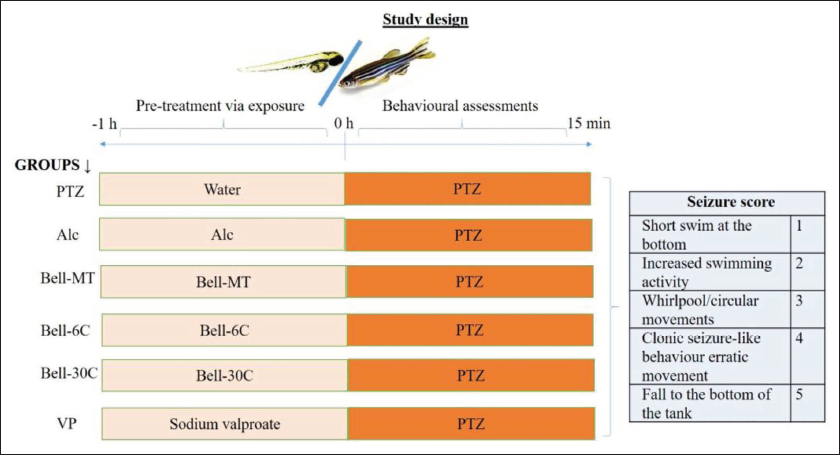
In the second set of experiments, the effect of Bell was evaluated using adult zebrafish. All the zebrafish were randomly assigned to six groups of 10 fish each: The groups that received PTZ, Alc, Bell-MT, Bell-6C, Bell-30C and VP to groups I to VI, respectively. All the fish, except group I, were pre-treated with 0.5% of Bell-MT, Bell-6C, Bell-30C and 3 mM of VP to groups from II to VI, respectively, for 1 h before PTZ exposure. Following 1 h of exposure, each fish was submerged in a 10 mM PTZ solution and for 15 min, their seizure-like behaviour was observed and recorded.
All behavioural assessments were conducted from 11 am to 4 pm by a blinded observer to minimise behavioural variance and consistency. All the seizures were divided into five stages as Stage I: Short swim at the bottom; Stage II: Increased swimming activity; Stage III: Whirlpool/circular movements; Stage IV: Clonic seizure-like behaviour, erratic movement; Stage V: Fall to the bottom of the tank.18, 25 The total distance travelled, the number of rotations and the duration of the seizures during the tracking time were used to measure the locomotor activity. The ANY maze video tracking programme was used to capture the behaviour.
In Silico Molecular Docking Study
In the current molecular docking investigation, Schrödinger software version 2024–1 was employed. The three-dimensional crystalline structures such as calcium channel v3.2 (protein data bank [PDB] ID: 9ayl), sodium channel v1.2 (PDB ID: 6j8e), glutamate receptor (PDB ID: 3rn8), human carbonic anhydrase isoenzyme (hCA-II) (PDB ID: 5fdc) and γ-amino butyric acid-amino transferase (GABA-AT) (PDB ID: 4y0d) were procured from protein data bank and after removal of all the solvent and other unwanted materials targets were ready for docking purpose. After refinement, ligands were prepared using LigPrep (optimized potentials for liquid simulations (OPLS) 2005), in which conformers having the lowest energies were considered for computational studies. However, before that, three-dimensional structures of ligands were obtained using ChemSketch software and with the help of OpenBabel, these structures were converted into simplified molecular input (SMI) format. Further, different grids were generated for respective targets. Furthermore, the Glide utility was employed for docking purposes. The entire process was carried out using Maestro v13.9.
Statistical Analysis
The mean ± standard error of the mean (SEM) was used to express all values. Tukey’s post hoc test was used after a one-way analysis of variance (ANOVA) for all statistical analyses of the data. It was deemed significant when p < .05.
Results
Total Phenolic Content in Bell
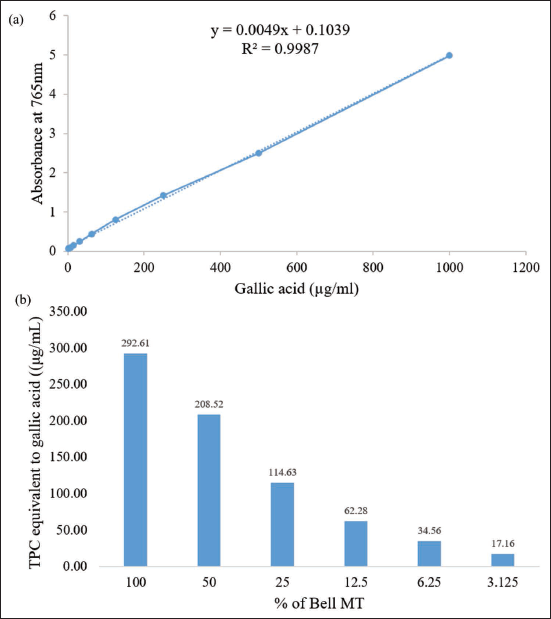
The Folin–Ciocalteau method was used to determine the TPC in Bell-MT. Gallic acid was used as a standard and the standard calibration curve was obtained at 765 nm (y = 0.0049x + 0.1039 R² = 0.9987) was displayed in Figure 2(a). As shown in Figure 2(b), the TPC was 17.16 µg of gallic acid/3.12% of Bell-MT and it was increased with increasing the percentage of Bell-MT and the maximum was 292.61 µg of gallic acid/100% of Bell-MT.
Total Phenol Content of Bell-MT (a) Calibration Curve of the Standard Compound Gallic Acid (µg/mL); (b) Total Phenolic Content (TPC), Expressed as Gallic Acid Equivalents, Measured in Different Concentrations (100%–3.125%) of Bell-MT.
Antioxidant Activity of Bell (DPPH Free Radicals Scavenge)
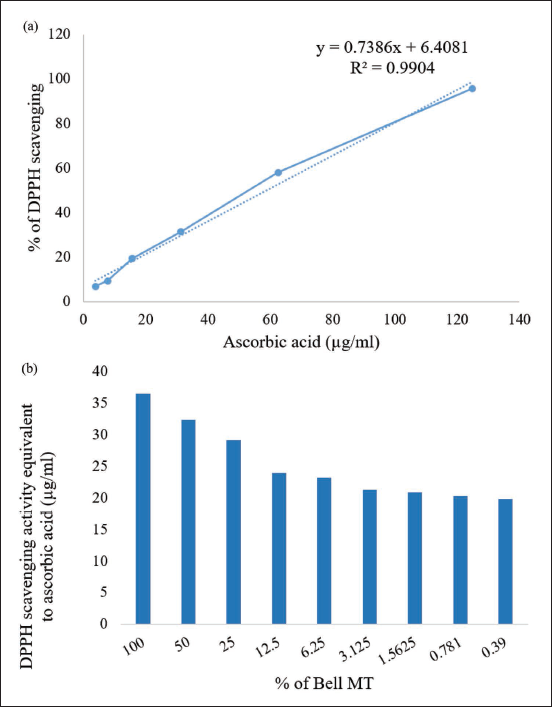
Figure 3 demonstrated the ability of Bell to scavenge free radicals on DPPH. Figure (a) shows the standard calibration curve for ascorbic acid at 517 nm (y = 0.7386x + 6.4081; R² = 0.9904), whereas Figure (b) shows the DPPH scavenging activity equivalent to ascorbic acid (µg/ml). In results, different dilutions of Bell-MT showed an amount of DPPH radical scavenging activity at 20 min of reaction kinetics with methanolic DPPH solution. The findings showed that as time rose, Bell’s DPPH scavenging activity increased as well. As the concentration of Bell rose, Figure 3(b) demonstrated a higher percentage inhibition of DPPH scavenging activity.
Free Radical Scavenging Activity of Bell-MT Assessed by DPPH Assay. (a) Calibration Curve of Standard Compound Ascorbic Acid (µg/mL); (b) Percentage (%) DPPH Scavenging Activity in Different Concentrations (100%–0.39%) of Bell-MT.
Acute Toxicity Study
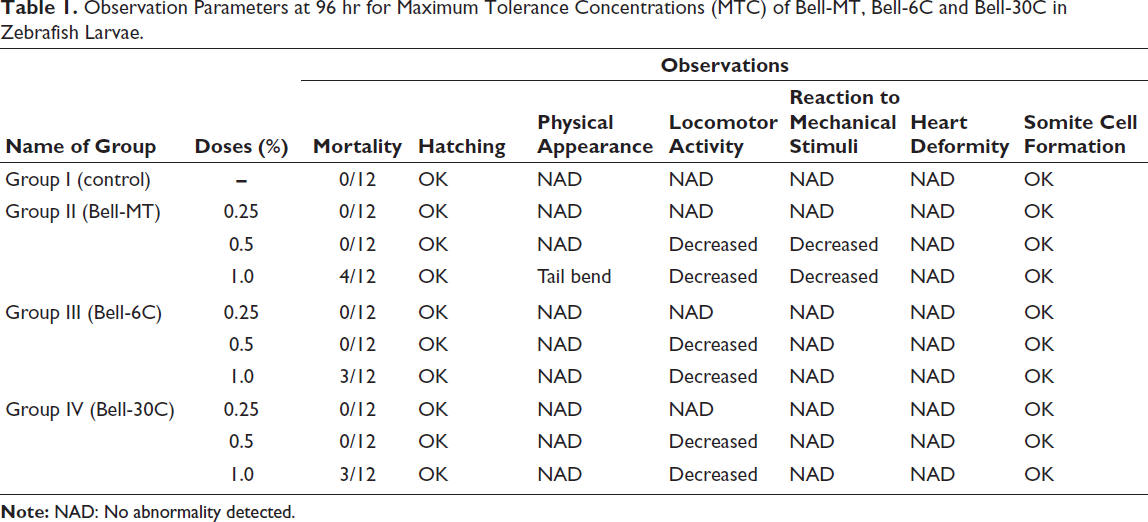
The acute toxicity study revealed that at a 1.0% dose of Bell, mortality occurred and at 0.5%, behaviour changes were found in larvae. Since there were no symptoms of toxicity or locomotor impairment at a dosage of 0.25% Bell-MT, Bell-6C and Bell-30C, it was chosen as the MTC for further zebrafish larval experiment (Table 1). On the other hand, in the case of adult toxicity test, exposure at and above 1.0% of Bell showed toxicity and mortality in zebrafish. Based on the observations, 0.5% of Bell-MT, Bell-6C and Bell-30C were found to be toxicity-free; therefore, 0.5% was selected for further testing (Table 2).
Observation Parameters at 96 hr for Maximum Tolerance Concentrations (MTC) of Bell-MT, Bell-6C and Bell-30C in Zebrafish Larvae.
Observation Parameters at 18 hr for Maximum Tolerance Concentrations (MTC) of Bell-MT, Bell-6C and Bell-30C in Adult Zebrafish.
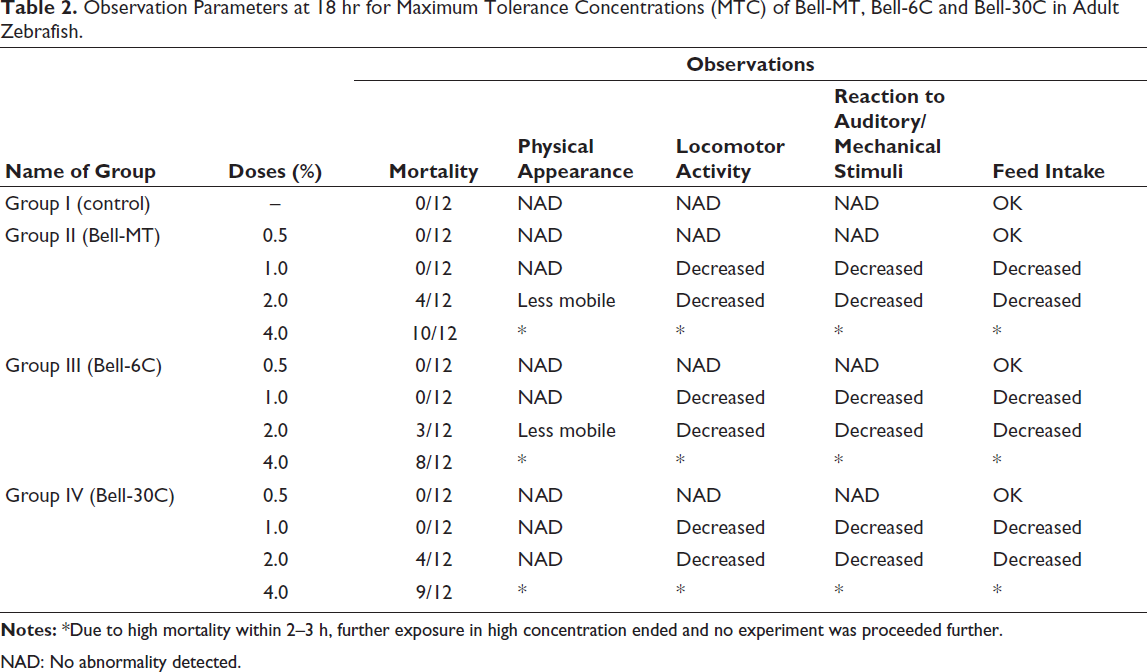
NAD: No abnormality detected.
Anticonvulsive Effect of Bell on Zebrafish Larvae
Effect of Bell on Seizure Score Latency (Score 1–5) in Zebrafish Larvae
The effect of Bell-MT, Bell-6CH and Bell-30CH and VP on seizure scores, latency 1–5 (Figure 4) in PTZ-induced epilepsy in zebrafish larvae. Statistical analysis revealed that there were significant differences in the seizure score among the groups. Post hoc analysis showed that Bell-6C and 30C significantly increased the latency up to scores 3 in zebrafish larvae as compared to the PTZ group larvae. Statistical analysis revealed that there were significant (p < .05) differences in the latency to reach score 2 and score 3. Post hoc analysis showed that in the case of scores 4 and 5, there were no significant changes that occurred in latency after the pre-treatment of Bell as compared to the PTZ group in zebrafish larvae.
Effects of Bell-MT, 6C and 30C Dilutions on PTZ induced Seizure Latency to Score (1–5) in Zebrafish Larvae. Data are Represented as Mean ± SEM and Analysed by Two-way ANOVA Followed by Bonferroni Post-hoc Test. *p < .05, **p < .01, ***p < .001 Indicates Significant Differences Compared to the PTZ Group of the Corresponding Score.
Effect of Bell on Seizure Duration in Zebrafish Larvae
The duration of the seizure score in zebrafish larvae is depicted in Figure 5. Significant variations in seizure duration were found across the groups using a one-way ANOVA. In comparison to the PTZ group, the seizure duration at scores 1 and 5 was considerably (p < .05) reduced in the Bell-30C treatment group. The duration of seizure in score 4 was significantly (p < .05) decreased after the treatment with Bell-6C in larvae. Although the duration of seizure score 2 and 3 was decreased in the treatment groups of Bell-6C and 30C, this difference was not statistically significant (p > .05). The VP treatment group also showed the same outcome in zebrafish larvae.
Effects of Bell-MT, 6C and 30C Dilutions on Seizure Duration (Score 1–5) in PTZ-Induced Zebrafish Larvae. Data are Represented as Mean ± SEM and Analysed by Two-way ANOVA Followed by Bonferroni Post-hoc Test. ap < .05 Indicates Significant Differences Compared to the PTZ Group.
Effect of Bell on Locomotor Activity in Zebrafish Larvae
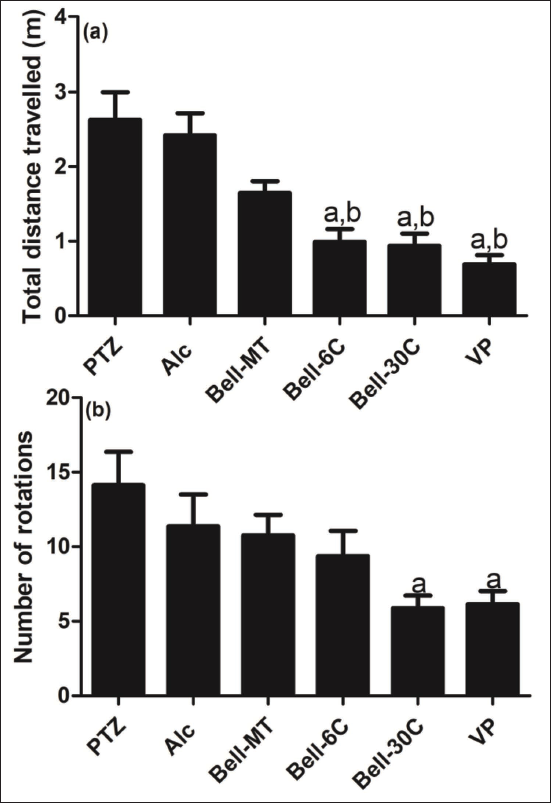
Figures 6(a) and 6(b) illustrate the effect of Bell-MT, Bell-6C and Bell-30C on locomotor activity in terms of total distance travelled and number of rotations, respectively, in zebrafish larvae. According to statistical analysis, the treatment with Bell-6C and 30C significantly (p < .05) ameliorated the PTZ-induced increase in distance travelled by larvae; however, this decrease was not statistically compared to the PTZ group. In the case of the number of rotations, Bell-30C significantly decreased as compared to the PTZ group in zebrafish larvae. Although Bell 6C decreased the no of rotations however the change was not significant (p > .05). In contrast, VP significantly (p < .05) reduced the increased distance travelled as well as the number of rotations by zebrafish larvae when compared to the diseased (PTZ) group.
Effects of Bell-MT, 6C and 30C Dilutions on Total Distance Travelled (a) and on Number of Rotations (b) in PTZ-induced Zebrafish Larvae. Data are Represented as Mean ± SEM and Analysed by One-way ANOVA Followed by Dunn’s Multiple Comparison Post-hoc Test. ap < .05 Indicates Significant Differences Compared to the PTZ Group and bp < .05 Compared to the Alc Group.
Anticonvulsive Effect of Bell on Adult Zebrafish
Effect of Bell on Seizure Score Latency (Scores 1–5) in Adult Zebrafish
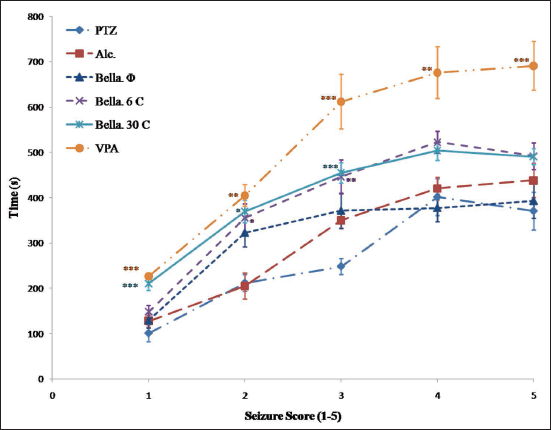
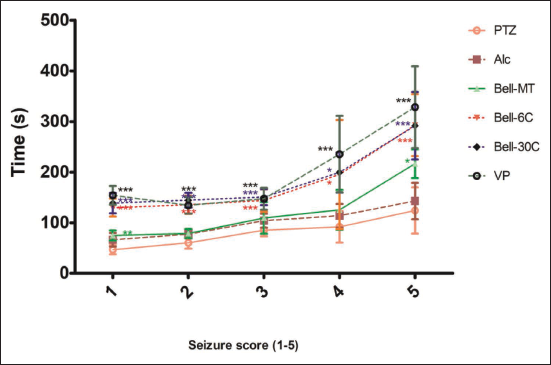
The effect of Bell-MT, Bell-6C, Bell-30C and VP on seizure scores 1–5 is illustrated in Figure 7 in PTZ-induced epilepsy in adult zebrafish. Statistical analysis revealed that there were significant differences between the seizure scores among the groups. Post hoc analysis showed that Bell-6C and Bell-30C significantly increased the time taken for all seizure scores (1–5) in adult zebrafish as compared to the PTZ group fish. Statistical analysis revealed that fish took more time to reach all scores from 1 to 5 than the PTZ group. The result showed that Bell-6C and 30C significantly increased the latency to reach stages 1–5 after pre-treatment with Bell against PTZ-induced seizures in adult zebrafish.
Effects of Bell-MT, Bell-6C, and Bell-30C on PTZ-induced changes in latency to score (1-5) in adult zebrafish. Data are represented as mean ± SEM and analyzed by two-way ANOVA followed by Bonferroni post-hoc test, *P < 0.05, **P < 0.01, ***P < 0.001 indicates significant differences of score compared to the PTZ group of individual score.
Effect of Bell on Seizure Duration in Adult Zebrafish
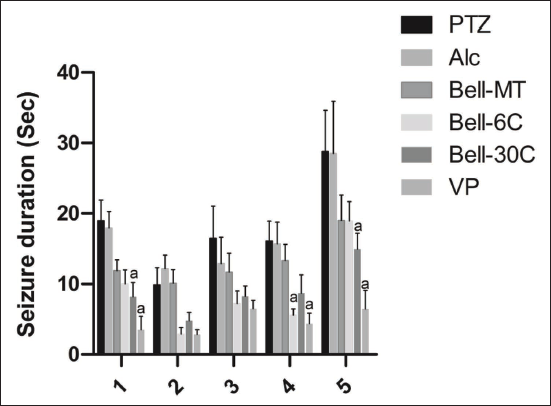
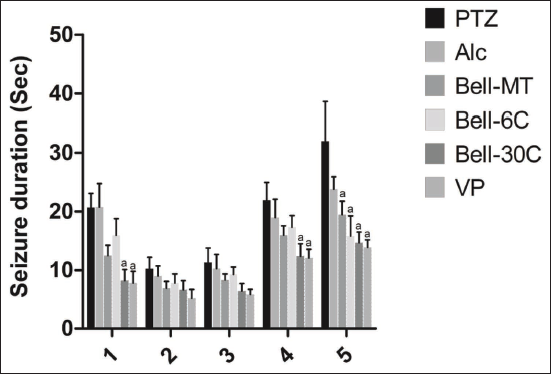
Figure 8 shows the duration of the seizure score in adult zebrafish. A one-way ANOVA revealed significant differences in seizure duration between the groups. In adult zebrafish, the VP treatment group showed a significant (p < .05) decrease in scores 1, 4 and 5 as compared to the diseased group. The seizure durations in scores 1 and 4 significantly (p < .05) reduced in the treatment of the Bell-30C group as compared to the PTZ group. The duration of score 5 was significantly decreased after the treatment of all test groups (Bell-MT, 6C and 30C) as compared to the PTZ group. Following treatment with Bell-6C, the seizure score duration was decreased in adult zebrafish; however, this difference was not statistically significant (p > .05).
Effects of Bell-MT, 6C and 30C Dilutions on Seizure Duration (Score 1–5) in PTZ-Induced Adult Zebrafish. Data are Represented as Mean ± SEM and Analysed by Two-way ANOVA Followed by Bonferroni Post-hoc Test. ap < .05 Indicates Significant Differences Compared to the PTZ Group.
Effect of Bell on Locomotor Activity in Adult Zebrafish
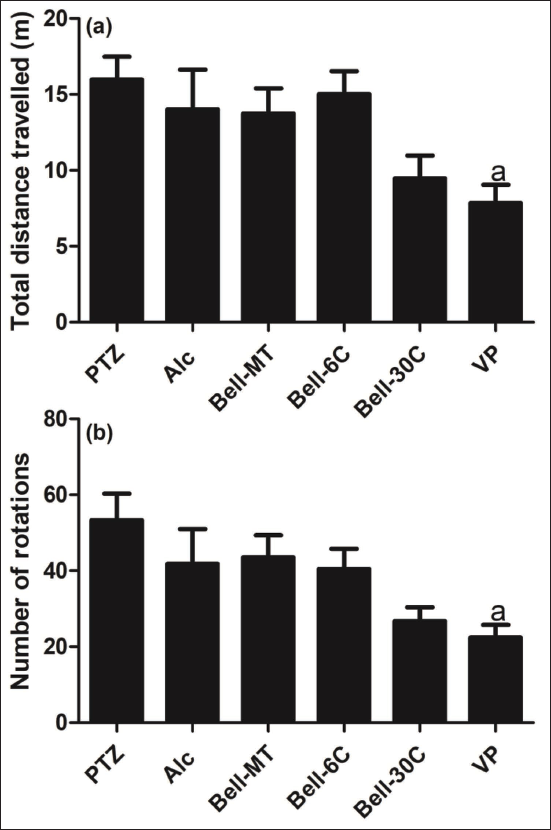
The effects of Bell-MT, Bell-6C and Bell-30C on locomotor activity in adult zebrafish are shown in Figures 9(a) and 9(b), respectively, in terms of total distance travelled and number of rotations. Statistical analysis revealed that the PTZ-induced increase in distance travelled was considerably (p < .05) mitigated by the treatment with VP. Bell-30C treatment decreased both parameters, such as distance travelled and number of rotations, in adult zebrafish; however, this decrease was not statistically compared to the PTZ group.
Effects of Bell-MT, 6C and 30C Dilutions on Total Distance Travelled (a) and Number of Rotations (b) in PTZ-induced Adult Zebrafish. Data are Represented as Mean ± SEM and Analysed by One-way ANOVA Followed by Dunn’s Multiple Comparison Post-hoc Test. ap < .05 Indicates Significant Differences Compared to the PTZ Group.
Molecular Docking Analysis
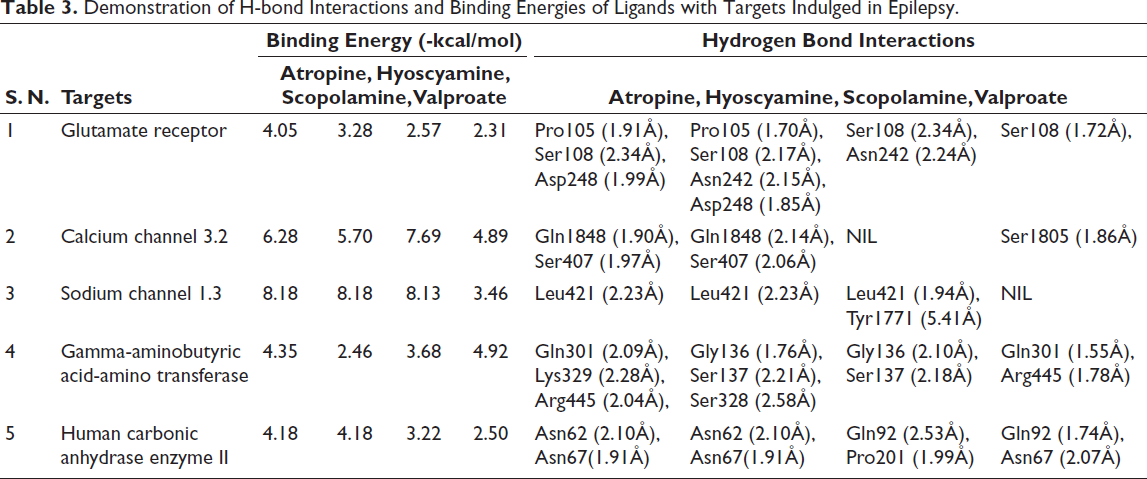
For in silico evaluation of antiepileptic activity of some phytochemicals, most of the common targets, such as calcium channel v3.2, sodium channel v1.2, the glutamate receptor, hCA-II and GABA-AT, were included in the molecular docking studies to decipher the binding energy and interactions. The active sites of the molecular targets were selected for the molecular docking studies to decipher the binding energy and interactions and found that at the calcium channel v3.2, all compounds involved in the study inserted themselves through IV–I fenestration of the channel and were surrounded by hydrophobic interactions such as Leu377, Ile403, Ser407/Phe408 from repeat 1. Moreover, residues Phe1756, Phe2802, Ser1805 and Thr1806 from repeat IV were also found in interactions with hydrophobic compounds. Huang et al. (2024) described in a docking study that compound ACT-709478 stabilised itself via accommodating a hydrogen bond with the hydroxyl group of Ser1805, as well as formation of hydrogen bonds with Asn 412 and Gln 1848, contributing to the stability of the complexes. In our study, atropine and hyoscyamine exhibited entirely similar hydrophobic and hydrogen bond formation; however, there were differences in the binding energies, whereas valproate made a hydrogen bond with Ser 1805, hence followed the explanation provided by Huang and his team. 31 While scopolamine did not afford any hydrogen bond formation but demonstrated the maximum binding energy among other compounds. At sodium channel v1.2, the compounds of the present study were found to interact with those amino acid residues as previously discussed. 32 However, the standard drug valproate could not form any hydrogen bond with an amino acid, as it does not possess any hydroxyl or amide group in its structure such unlike atropine, hyoscyamine, both possess a hydroxyl group and made a hydrogen bond with Leu421, whereas the amide group present in scopolamine formed a hydrogen bond with Tyr 1771. Atropine and hyoscyamine, in the absence of an amide group, formed a ύ-cation salt bridge with Tyr1771. Besides, atropine and hyoscyamine could manage to form ύ–ύ stacking with Phe1779. These interactions possibly contributed to the stability of the docked complexes. Intriguingly, atropine and hyoscyamine exhibited the same and the maximum binding energies comparable to other compounds. Although at hCA-II, all compounds were found to be docked, atropine and hyoscyamine formed a prerequisite water-mediated hydrogen bond with Asn67. Moreover, they were capable of establishing a hydrogen bond with Asn62. Considerably, valproate also formed a hydrogen bond with Asn67 via the oxygen atom. Besides, valproate managed to form a hydrogen bond with Gln92 via the ketone group. Scopolamine formed two hydrogen bonds with Pro201 via the hydroxyl group and Gln92 via the ketone group. In case of glutamate receptor, Glu13, Asp58, Thr91, Arg172 and Thr174 participated in hydrogen bond formation while Leu12, Gly59, Tyr61, Gly141, Thr173, Leu188, Tyr190, Leu192, Glu193 and Met196 made different hydrophobic interactions with glutamate receptor. 33 In our study, no ligand could follow the discussed pattern of interactions and bind to the target elsewhere. However, all compounds formed a hydrogen bond with the Ser108 residue and occupied quite a similar binding pattern, indicating that hydrogen bond formation might be a mandatory interaction for the stability of the docked complex and inhibition of the glutamate receptor. The docking at GABA-AT indicating that binding pocket is composed of Ile100, Ser102, Ala162, Cys162, Cys163, Gly164, Ser165, Phe217, His218, Gly219, Arg220, Glu293, Asp326, Val328, Gln329, Gln33, Ser356, Lys357 and Met360. 34 They revealed that some molecules formed hydrogen bonds and slat bridges with amino acids present in the active pocket of GABA-AT. However, in our research, we found that our molecules interacted with two amino acids, namely Val328 and Gln329, either through hydrogen bond formation or via other hydrophobic connections, deciphering the importance of these two amino acids in inhibiting GABA-AT. Moreover, standard drug valproate bound with GABA-AT with the highest binding energy compared to other ligands, while hyoscyamine demonstrated the least binding energy.
Out of the selected phytochemicals, atropine emerged as the most effective compound; however, at the two targets, atropine and hyoscyamine exhibited quite similar binding energies and interactions. (Table 3) and Figures (S1–S5) comprise the comprehensive description of binding modes and energies of all compounds.
Demonstration of H-bond Interactions and Binding Energies of Ligands with Targets Indulged in Epilepsy.
Discussion
The present study demonstrates the anticonvulsive effect of the homoeopathic remedy, Belladonna (Atropa belladonna; Bell), against PTZ-induced seizure models in both zebrafish larvae as well as adults. The results support the traditional use of Belladonna in treating neurological symptoms such as convulsions and offer experimental evidence of its role in mitigating seizures.
From the acute toxicity study, it has been found that Bell is safe for zebrafish at concentrations of 0.5% in adults and 0.25% in larvae; accordingly, doses were selected for the main study. PTZ is a well-known chemoconvulsant that acts on an allosteric site and is documented to act through the GABA-A receptor. 35 Previous literature reported that the zebrafish treated with PTZ exhibited seizure-like symptoms in both larvae and adults, including increased involuntary movement activity, erratic movements and increased travelled distance, which is also evident in the results of the present study.35–37 The pre-treatment with Bell at higher dilutions (6C and 30C) markedly delayed the onset and progression of seizures in PTZ-induced seizure models. In the case of larvae of zebrafish, Bell modulates early seizure activity, as seen by the increased latency to intermediate seizure stages (scores 2–3). On the other hand, Bell-6C and Bell-30C also showed greater effectiveness in adult zebrafish by delaying progression across all seizure stages (scores 1–5). The higher effectiveness seen in adults may be due to differences in neurodevelopment, metabolic capacity or drug distribution in larger organisms. These results are consistent with previous studies that suggested the effect against PTZ-induced epileptic seizures in zebrafish. 29
Additionally, the effect on locomotor activity, behavioural endpoints which are validated markers of seizure severity in larvae and adult zebrafish, was assessed in terms of the rotation of the body and the total distance travelled. These parameters are commonly used in previous reports to assess locomotor impairments and hyperactivity caused by seizures and the effect of an antiepileptic candidate against the PTZ effect on locomotor activity38, 39 is suggested as an important behavioural parameter to assess the anti-epileptic activity in the zebrafish animal model. Belladonna treatment improved behavioural outcomes, such as reduced rotations and total distance travelled, which was also shown by other compounds for their anti-epileptic activity in zebrafish exposed to PTZ.36, 37 Similar to this, in the present study, pre-treatment with Bell-6C and 30C decreased the total distance travelled of PTZ-induced zebrafish larvae, whereas in adult zebrafish, Bell-30C reduced that distance. Similarly, the number of rotations was also reduced after the pre-treatment with Bell-30C in both larvae and adult zebrafish. According to the present study, pre-treatment with Bell at high dilution, particularly at 30C, delayed the course of seizures, improved behavioural changes and confirmed its protective role in a PTZ-induced seizure model of zebrafish.
From previous reports, it was suggested that excessive formation of reactive oxygen species during epileptogenesis could lead to the development of oxidative stress 40 and related tissue damage and apoptotic processes.41, 42 The Present study showed the antioxidant activity of Bell and this is supported by research showing that therapies high in antioxidants may enhance neuroprotection in neurodegenerative diseases.39–43 Given the role of oxidative stress in epileptogenesis and neuronal injury,40, 41 the antioxidant properties of Belladonna are also consistent with earlier research9, 44 may contribute to its anticonvulsant effects.
The present study used molecular docking techniques, which helped to predict the anti-convulsive mechanism insights based on the structural docking calculation of target protein compounds, as the same as recent scientific community now a days using this tool to investigate receptor-ligand binding mechanisms and binding sites. The present study provided complementary mechanistic evidence by identifying interactions of Belladonna constituents (e.g., atropine, hyoscyamine, scopolamine) with ion channels and neurotransmitter-related targets. Strong binding interactions were observed with calcium channel v3.2, sodium channel v1.2, GABA-AT and hCA-II, suggesting potential multimodal mechanisms. For instance, atropine and hyoscyamine exhibited hydrogen bonding with calcium channel v3.2 and sodium channel v1.2 residues, interactions comparable to those reported for clinically used antiseizure drugs.31, 32 Similarly, ligands formed stable complexes with GABA-AT at critical residues (Val328, Gln329), implicating modulation of GABA metabolism as another potential mechanism. 34
The combined in vivo and in silico data suggest that Belladonna at higher dilution exerts protective effects in the management of convulsions through antioxidant activity, modulation of GABAergic/glutamatergic neurotransmission and stabilisation of ion channel function. However, this study was limited to pre-treatment paradigms, which may not fully mimic clinical scenarios where patients receive therapy after seizure onset. This design was selected to assess its potential neuroprotective and prophylactic effects, as has been done in several zebrafish and rodent seizure models, where natural compounds were administered before seizure induction to evaluate anticonvulsant potential.21, 45, 46 Although the present findings highlight the prophylactic potential of Belladonna, future work should include post-treatment models, chronic exposure studies in higher-order animals to strengthen translational relevance. Additionally, mechanistic studies combining electrophysiology with molecular assays will be essential to validate docking predictions.
Conclusion
The present study confirms the potential of Belladonna at higher dilution as a natural anticonvulsant by demonstrating its effectiveness in reducing PTZ-induced seizures in zebrafish at both stages, that is, the larval and adult phases. Its therapeutic potential is highlighted by the noted improvements in behavioural outcomes and delays in seizure progression. Furthermore, the underlying mechanisms and targets with higher animal models in epilepsy management are the need of future study.
Footnotes
Acknowledgements
The authors are thankful to Officer-in-Charge, DDPR-CRIH, Noida, for providing administrative support.
Authors’ Contribution
The authors confirm their contribution to the article as follows:
M. Sharma: Investigation, analysis and interpretation of data, data curation, formal analysis, statistical analysis, visualisation, writing—original manuscript draft and execution of animal experiments.
P. Gupta: Conceptualisation, funding acquisition, administration, supervision and review and editing of manuscript.
S. Behera: Methodology and investigation.
S. Jabbar: Investigation.
R. K. Regar: Investigation.
G. V. Kumar: Review and editing manuscript draft.
A. Agarwal: In silico study.
S. Prajapati and A. Kumar: Execution of experiments.
D. Verma: Review and editing manuscript draft.
S. Kaushik: Review manuscript draft.
Data Availability
The authors declare that all the raw data used in the study is available in the manuscript.
Declaration of Conflicting Interests
The authors declared no potential conflicts of interest with respect to the research, authorship and/or publication of this article.
Declaration of Generative AI in Scientific Writing
During the preparation of this work, the authors used ChatGPT in the writing process to improve the readability and language of the manuscript. After using this tool/service, the authors reviewed and edited the content as needed and take full responsibility for the content of the published article.
Funding
The authors received no financial support for the research, authorship and/or publication of this article.
Human and Animal Rights
In the present study, no humans were used. All the animal-related procedures were performed according to the standard (ARRIVE) guidelines.
Informed Consent
Not applicable.
Statement of Ethics
All applicable institutional rules and national regulations for the care and use of animals have been followed in the conduct of the animal study as per the National Institutes of Health guide for the Care and Use of Laboratory Animals (NIH Publications No. 8023, revised 1978) and approved by the IAEC study protocol, with certificate number: DDPR-CRIH/Pharmacology/CPCSEA/IAEC/2018/002.
Supplemental Material

References
Supplementary Material
Please find the following supplemental material available below.
For Open Access articles published under a Creative Commons License, all supplemental material carries the same license as the article it is associated with.
For non-Open Access articles published, all supplemental material carries a non-exclusive license, and permission requests for re-use of supplemental material or any part of supplemental material shall be sent directly to the copyright owner as specified in the copyright notice associated with the article.
