




Abstract
Background
As John Dewey said—‘School is a miniature form of society’. As India is a diverse country, our schools and colleges have students from culturally diverse backgrounds, and they have different kinds of habitual ways of learning, thinking and remembering information, that is, cognitive style. So, it is very important for teachers to know and understand the cognitive style and have cultural intelligence (CQ) to foster learning, diversity and inclusiveness in classrooms.
Purpose
The aim of this study is to explore the cognitive styles of pupil teachers in relation to their CQ with reference to gender, stream and family type.
Methods
In this study Descriptive Survey method is used to collect and analyse the data accurately. A standard tool on cognitive style and a self-made Likert-scale on CQ were used to collect research data from 100 pupil teachers belonging to different colleges of Kanpur city by using the Random Sampling technique.
Results
The results indicated that both male and female pupil teachers, as well as the pupil teachers living in joint and nuclear families, were found to have cognitive styles to the same extent in relation to their CQ. The cognitive style of arts stream pupil teachers was found to be significantly more from the cognitive style of science stream pupil teachers in relation to their CQ.
Conclusion
The findings urge a major concern towards pupil teachers to focus on Cognitive Style and CQ as it develops reasoning, understanding, patterns of adjustment to foster multicultural interaction that promotes unity in diversity.
Introduction
Cognitive Style vary across cultures. —Allport and Pettigrew
1
Cognitive style is a concept in cognitive psychology that refers to the way an individual thinks, perceives and remembers information. 2 As every individual has a style of learning but the person’s habitual way of learning or teaching is termed as cognitive style. It is very important for the teaching-learning process as it is directly related to the habitual way of learning and the habitual way of teaching, and the teacher. 3
As India is a country of ‘Unity in Diversity’ that has so many cultures, and each culture has its own traditions, values and customs, nowadays students from abroad also come to India for studies. As John Dewey said—‘School is a miniature form of society’. Our schools and colleges have students from culturally diverse groups. So, to take care of every student and also to maximise the potential of each and every student. A teacher must know, understand cognitive style and have cultural intelligence (CQ). So that she/he is able to solve conflicts, does not bias towards one culture, respects everyone’s culture and their way of learning, to foster peace and integrity in the class, it is much needed for the effectiveness of the teaching-learning process.
Students belong to different cultures and have different kinds of habitual ways of learning, and they think, process and remember information differently. So, we can say that Cognitive Style and CQ play a key role in the teaching-learning process. But the question is ‘Do the pupil teachers know about the concept of Cognitive Style and Cultural Intelligence, and are they well equipped with the knowledge of it?’. Therefore, in this context, there emerges a need to study the Cognitive Style and CQ of Pupil Teachers so that the existing system of education focuses on the importance of cognitive style and CQ in the Educational process.
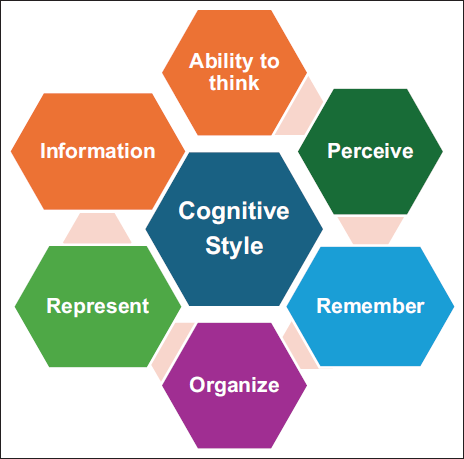
The concept of cognitive style was first introduced by psychologist Gordon Allport in 1937. In 1951, Klein and Herbert J. Schlesinger coined the term cognitive style to describe how various cognitive controls are integrated within an individual. In cognitive psychology, this term refers to the unique manner in which a person thinks, perceives and remembers information. 2 As every individual processes information but the preference or the preferred way in which an individual processes information is called cognitive style. The term ‘Cognitive Style as how an individual preferred and habitually approached, to organise and represent information’ (see Figure 1). 3
Cognitive Style.
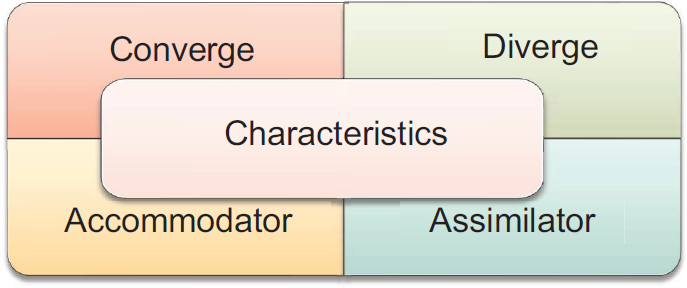
Kolb had discussed the characteristics of cognitive style are (see Figure 2)
4
: Converge: It is related to the dominant learning capacities of active experimentation and abstract conceptualisation. Diverge: It is related to organising concrete situations from different perspectives and constructing their relationships into a meaningful whole observation. Assimilator: It has abstract thinking about concepts and reflective observation. Accommodator: It depends on active experimentation and concrete experience.
5
Characteristics of Cognitive Style.
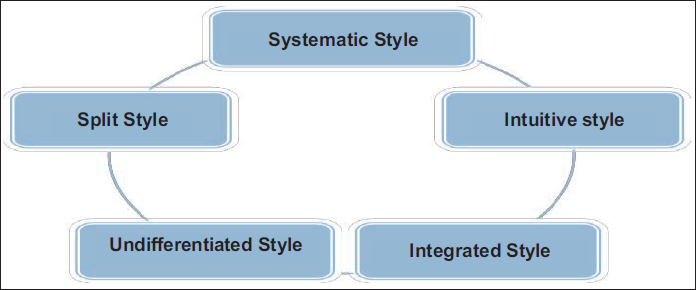
The dimensions of the cognitive style are systematic, Intuitive, Integrated and Undifferentiated Style (see Figure 3): Systematic style: It involves logical and rational thinking, characterised by a clear step-by-step method for learning, planning and solving problems. Intuitive style: It is marked as a less predictable sequence of analytical steps, relying on experience, recognising patterns, and quickly exploring different alternatives during problem solving. Integrated style: It takes place in a matter of seconds, and integrated people are able to modify the style easily and quickly. Undifferentiated style: It is the style in which a person is not able to differentiate between the two style extremes, that is, systematic and intuitive.
2
Dimensions of Cognitive Style.
The concept of CQ was introduced by Earley and Ang in their 2003 book published by Stanford University Press. 6 It refers to the ability to function successfully and adapt effectively in culturally diverse settings across a variety of cultural contexts, such as ethnic generations and organisation-wise cultures. It not only focuses on understanding cultures but also on problem solving, adjustment and effective cultural settings. 7 This gives us a better understanding of culture, even if we experience any culture for the first time. We may use CQ while interacting with families, classrooms colleagues who belong to similar or different cultures than ours. With the knowledge and understanding of CQ, we are able to adapt beautifully in cross-cultural settings and able to understand different cultures, which helps us to solve conflicts, foster peace and bring many cultures together. Then, in the true sense, we celebrate unity in diversity. CQ as an ‘individual’s capabilities to function and manage effectively in cultural diverse settings’. 8 The characteristics of CQ are: Cultural Awareness helps to identify biases and assumptions in cross-cultural settings, Effective Communication empowers us to communicate, interact across cultural boundaries, Respecting Cultural Norms helps us to build trust and rapport during cross-cultural interactions, and Conflict Resolution helps to develop insight, understanding and empathy for all cultures that resolve conflicts and promote peace and cooperation. 9
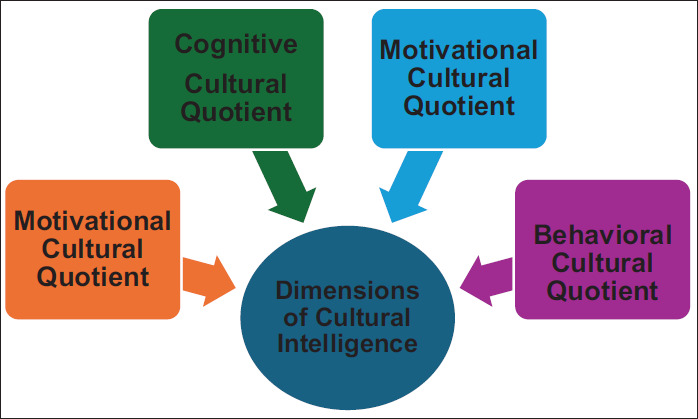
CQ consists of four dimensions (see Figure 4):
8
Motivational cultural quotient: It motivates us to interact with others and also to understand other cultural settings.
10
Cognitive cultural quotient: It involves understanding the principles, customs and norms of various cultures gained through both educational and personal experience.
6
Metacognitive cultural quotient: It signifies an ability to plan, monitor, revise and adjust mental encroaching models.
11
Behavioural cultural quotient: It is an individual’s capacity to adapt appropriate behaviour for different cultures.
12
Dimensions of Cultural Intelligence.
Hence, Cognitive Style and CQ play an important role in understanding behaviour, logic, thinking, problem solving, collaboration and decision making of people. These are also 21st-century skills, so with the understanding of cognitive style and CQ, teachers promote peace, collaboration, integrity and inclusiveness in classrooms that help in the holistic development of students and foster creativity and innovation.
Review of Related Literature
The researcher reviewed various research about cognitive style and CQ.
Alalouch studied cognitive styles, Gender and Student Academic Performance in Engineering Education. 13 The result showed that the female students showed stronger performance and had a clearer understanding of their preferred cognitive style, while male students demonstrated greater flexibility in adjusting to various learning tasks. Krishna Mohan, P., carried out an investigation to explore the relationship between cognitive styles of student teachers and their level of Social & Emotional Intelligence. 14 The findings highlighted that there exist a positive and moderate association between cognitive style, Social and Emotional Intelligence. Nufus & Ariawan explored the relationship between Cognitive Style and Habits of Mind. The result of the study showed that there was a significant weak correlation between Cognitive Style and Habit of Mind. 15 Ravichandran (2018) studied Emotional Intelligence, cultural intelligence and academic achievement of student teachers. 16 The findings highlighted that there was a significant difference among Emotional Intelligence, CQ and academic achievement. Sternberg conducted a study on CQ: What is it and how can it effectively be measured. 12 The result signifies that CQ can be assessed using both maximum–Performance and typical-Performance tests of CQ. A thorough and systematic review of the various research revealed that separate studies were conducted in the field of cognitive style and CQ. As India is a diverse country so we have culturally diverse classrooms, and teachers must have the CQ to relate and teach effectively by using cognitive styles in culturally diverse situations. There are very few studies regarding the cognitive styles of pupil teachers in relation to their CQ. Keeping in view the importance of cognitive styles of pupil teachers in relation to their CQ made me do the research on this topic.
Objectives of the Study
To study the cognitive style of pupil teachers in relation to their CQ.
To study the cognitive style of Science and Art Stream pupil teachers in relation to their CQ.
To study the cognitive style of pupil teachers living in a Joint and Nuclear Family in relation to their CQ.
Hypotheses of the Study
There is no significant difference in the cognitive style of male and female pupil teachers in relation to their CQ.
There is no significant difference in the cognitive style of Science and Art Stream pupil teachers in relation to their CQ.
There is no significant difference in the cognitive style of pupil teachers living in Joint and Nuclear Family in relation to their CQ.
Research Methodology
Research Design
The Descriptive Survey method is used to collect and analyse data accurately.
Population and Sampling
The target population of the present study includes all the pupil teachers studying in the BEd programme of the campus and the aided colleges of Kanpur. Hence, 100 pupil teachers from six colleges (campus and aided) of Kanpur city were chosen to conduct the research study.
Tools Used
In this study, two tools were used: are Cognitive Style Inventory and the Self-made CQ Scale. Cognitive Style Inventory by Praveen Kumar Jha, which is a self-report measure of the ways of thinking, judging, remembering, storing information, decision making and believing in interpersonal relationships. This scale consists of two dimensions, namely systematic and Intuitive Style, and the reliability of these dimensions is 0.83 and 0.78, respectively, and validity is 0.262 (p < .01, df = 98) at the 0.01 level of significance and Self-Made Scale on CQ has four dimensions, namely Metacognitive-CQ, Cognitive-CQ, Motivational-CQ and Behavioural-CQ. The reliability of the tool is 0.86, close to 1.0, which is good, and the validity was established by the experts in Education and Psychology.
Statistical Technique
The data were analysed by using mean, Standard Deviation, Percentage, t-test and One-way ANCOVA.
Data Collection
For the collection of data, the researcher seeks permission from the Department of Education, C.S.J.M. University and then contacts the Head of the Department of Education of selected institutions for the collection of data. Then the researcher gives proper instructions regarding the tool and distributes the tool among pupil teachers.
Data Analysis
Objective 1: To study the Cognitive Styles of Male and Female Pupil Teachers of Kanpur city in relation to their CQ.
The objective was to compare the mean scores of Cognitive Styles of Male and Female Pupil Teachers in relation to their CQ. Here, Gender was one variable having two levels, namely Males and Females. CQ was one covariate, and Cognitive Style was the Criterion Variable. Thus, the data were analysed with the help of One-way ANCOVA using Statistical Package for the Social Sciences (SPSS). The results are given in Table 1.
Summary of One-way ANCOVA of Cognitive Styles of Pupil Teachers by Taking Their Cultural Intelligence as Covariate.
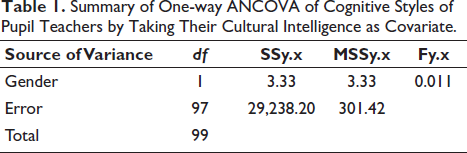
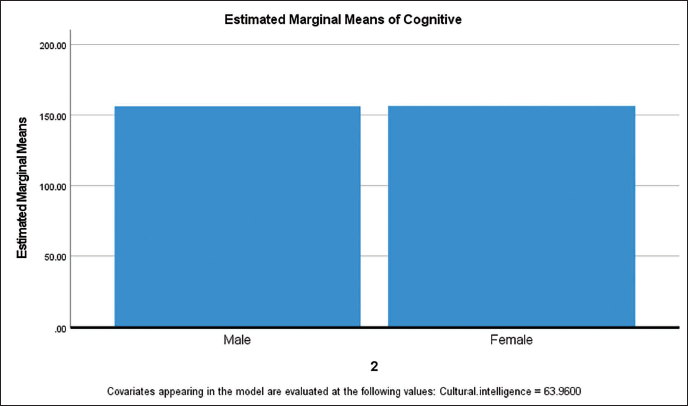
From Table 1, it can be seen that the adjusted F-value is 0.011, which is not significant. It indicates that there is no significant difference in the mean scores of Cognitive Styles of Male and Female Pupil Teachers in relation to their CQ. Thus, the null hypothesis that there is no significant difference between the Cognitive Styles of Male and Female Pupil Teachers in relation to their CQ is retained. It may therefore be said that both male and female pupil teachers were found to have cognitive styles to the same extent in relation to their CQ.
Objective 2: To study the Cognitive Styles of Science and Arts Stream Pupil Teachers of Kanpur City in relation to their CQ.
The objective was to compare the mean scores of Cognitive Styles of Science and Arts Stream Pupil Teachers in relation to their CQ. Here, Stream was one variable having two levels, namely, Science and Arts. CQ was one covariate, and Cognitive Style was the Criterion Variable. Thus, the data were analysed with the help of One-way ANCOVA using SPSS. The summary of results is given in Table 2.
Summary of One-way ANCOVA of Cognitive Styles of Science and Arts Stream Pupil Teachers in Relation to Their Cultural Intelligence.
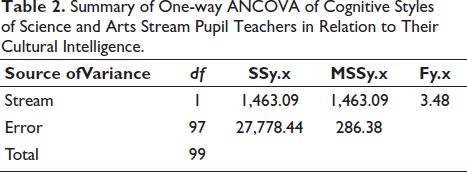
From Table 2, it can be seen that the adjusted F-value is 3.48, which is significant at the 0.005 level with df = 1/97. It indicates that the mean scores of Cognitive Styles of Science and Arts Stream Pupil Teachers differ significantly by considering their CQ as a covariate. Thus, the null hypothesis that there is no significant difference between Cognitive Styles of Science and Arts Stream Pupil Teachers in relation to their CQ is rejected.
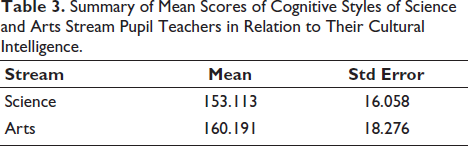
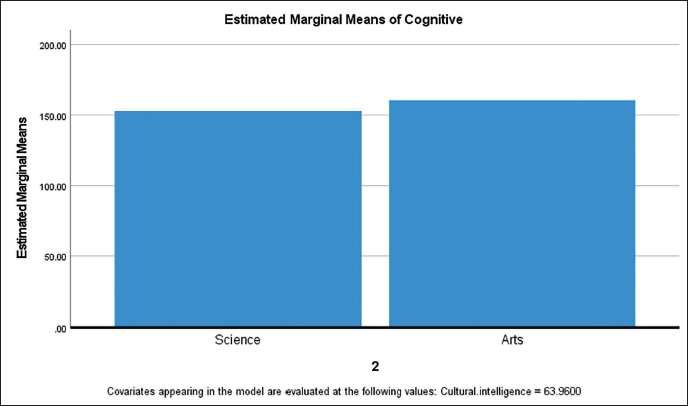
From Table 3, it can be seen that the mean scores of cognitive style of science stream pupil teachers are 153.113, which is significantly lower than that of cognitive style of arts stream pupil teachers, whose mean scores are 160.191. It may therefore be said that the cognitive style of arts stream pupil teachers was found to be significantly more than the cognitive style of science stream pupil teachers when CQ was taken as a covariate.
Summary of Mean Scores of Cognitive Styles of Science and Arts Stream Pupil Teachers in Relation to Their Cultural Intelligence.
Objective 3: To study the cognitive styles of pupil teachers living in Joint and Nuclear Family of Kanpur city in relation to their CQ.
The objective was to compare the mean scores of cognitive styles of pupil teachers living in joint and nuclear families in relation to their CQ. Here, Family Type was one variable having two levels, namely joint and nuclear. CQ was one covariate, and Cognitive Style was the Criterion Variable. Thus, the data were analysed with the help of One-way ANCOVA using SPSS. The summary of results is given in Table 4.
Summary of One-way ANCOVA of Cognitive Styles of Pupil Teachers Living in Joint and Nuclear Family in Relation to Their Cultural Intelligence.
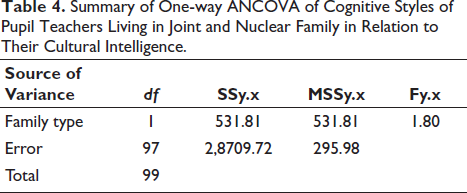
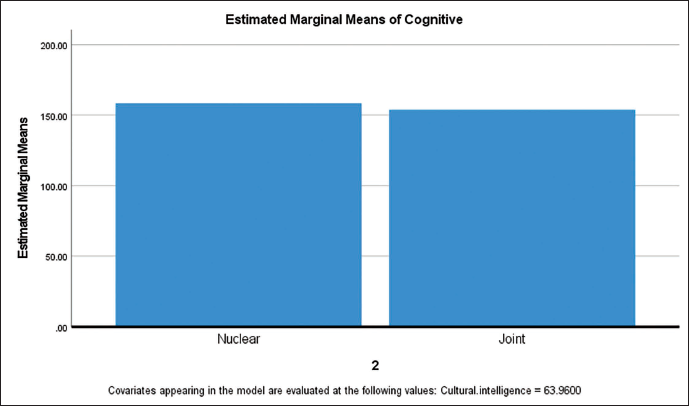
From Table 4, it can be seen that the adjusted F-value is 1.80, which is not significant. It indicates that there is no significant difference in mean scores of cognitive styles of pupil teachers living in Joint and Nuclear Family in relation to their CQ. Thus, the null hypothesis that there is no significant difference between cognitive styles of pupil teachers living in joint and nuclear families in relation to their CQ is retained. It may therefore be said that both pupil teachers living in Joint and Nuclear Family were found to have cognitive styles to the same extent in relation to their CQ.
Results
The mean scores for male and female pupil teachers are presented in Figure 5. The comparison of mean scores for Science and Arts pupil teachers is shown in Figure 6. The mean score differences between joint and nuclear families are illustrated in Figure 7.
Mean Scores of Cognitive Styles of Male and Female Pupil Teachers in Relation to Their Cultural Intelligence.
Mean Scores of Cognitive Styles of Science and Arts Stream Pupil Teachers in Relation to Their Cultural Intelligence.
Mean Scores of Cognitive Styles of Pupil Teachers Belonging to Nuclear and Joint Families in Relation to Their Cultural Intelligence.
The results indicated that both Male & Female Pupil Teachers and pupil teachers living in Joint & Nuclear families were found to have cognitive styles to the same extent in relation to their CQ. Cognitive Style of Arts Stream Pupil Teachers was found to be significantly more than cognitive style of science stream pupil teachers in relation to their CQ.
Several additional studies relevant to cognitive style and cultural intelligence are reviewed in the reference section.17–48
Conclusion
The results of the study conclude that the male and female pupil teachers exhibit similar cognitive styles in relation to their CQ, suggesting that gender may not significantly influence how individuals perceive, process, and respond to culturally diverse situations. In today’s educational environment, both male and female pupil teachers are exposed to similar academic content, teaching methodologies, and multicultural interactions. This shared exposure likely fosters a comparable development of both cognitive flexibility and cultural awareness. Cognitive Styles of arts stream pupil teachers were found to be significantly higher than cognitive styles of science stream pupil teachers in relation to their CQ due to the nature of the arts curriculum, which emphasises interpretation, critical thinking, emotional awareness, and social understanding. These subjects—such as literature, sociology, history, and psychology—require students to engage deeply with diverse cultures, human behaviour, and global perspectives. This exposure naturally enhances their ability to think flexibly, adapt to new ideas, and respond sensitively to cultural differences. The pupil teachers belonging to Joint and Nuclear Family were found to have similar cognitive styles in relation to their CQ because of several interrelated factors as the standardised curriculum, pedagogical approaches, CQ dimensions- metacognitive, cognitive, motivational and behavioural play an important role in shaping individuals’ adaptability and problem-solving skills in diverse cultural contexts. The influence of family type on cognitive development diminishes as individuals engage more deeply with formal education and diverse social interactions, leading to the homogenisation of cognitive styles in relation to their CQ.
Educational Implications
The following are some measures that every Teacher Educator must follow to develop cognitive style and CQ in pupil teachers. The findings of the present study have the following educational implications: pupil teachers should be provided enough opportunities to think, perceive and remember information, that is, to learn according to their cognitive style and CQ. Teacher Educators should provide a proper environment in the premises of the college and university that enhances diversity in classrooms and develops CQ. Multisensory teaching should be provided in the classroom, which enhances the cognitive style of pupil teachers. Teacher Educators can develop sensitivity towards other cultures for the development of CQ among pupil teachers. Several global and intercultural seminars, conferences should be organised by training institutions and other agencies in teachers’ training programmes related to the development of cognitive styles and CQ.
Footnotes
Acknowledgement
The authors would like to express their sincere gratitude to all individuals and institutions who contributed to this research. Special thanks to Chhatrapati Shahu Ji Maharaj University, Kanpur for their support and cooperation throughout the study.
Authors’ Contribution
All authors have made substantial contributions to the conception, design, data acquisition, analysis, and interpretation of this study. Shubhi Mishra and Gopal Singh were responsible for the study design and manuscript drafting. Shubhangi Mishra, Neelesh Kumar and Avinash Kumar contributed to data collection, literature review, and critical revisions. Pradeep Kumar Tiwari and Anil Kumar handled data analysis and interpretation. All authors reviewed and approved the final version of the manuscript and agree to be accountable for all aspects of the work.
Declaration of Conflicting Interests
The authors declared no potential conflicts of interest with respect to the research, authorship and/or publication of this article.
Funding
The authors received no financial support for the research, authorship and/or publication of this article.
Patient Consent
Patient consent is not required.
Statement of Ethics
Ethical approval was not required for this study as per the guidelines of the Chhatrapati Shahu Ji Maharaj University, Kanpur, because it was a theoretical/methodological article.
