




Abstract
Background
The societal norms of emotional expression among males have been evolving for the past few decades. However, males prefer to keep their emotions hidden and avoid their genuine expression, as they want to conform to traditional masculine gender roles. The suppression or inhibition adversely affects the mental health of men in our society.
Purpose
The current article aims to develop and standardise a tool for assessing Masculine Emotional Expressivity (MEE).
Methods
The study included males (N = 715, M = 22.76, SD = 4.31) from various educational institutes and corporations. The author created an initial pool of 26 items to assess the males’ emotional expressivity. This initial pool of items was sent to a group of experts for review. After the review, items were modified and 16 items were selected. These 16 items were subjected to a complete psychometric evaluation.
Results
The findings resulted in a scale containing 10 items (a five-point Likert scale) and two subscales: Masculine Emotional Inhibition (MEI) and Masculine Emotional Openness (MEO), as determined by post-factor analysis. The MEE scale showed satisfactory reliability and validity.
Conclusion
This scale can contribute to further research in social psychology, clinical psychology, gender and culture-related studies.
Introduction
As humans, we constantly experience a range of emotions and actively manage them, either by expressing emotions or suppressing them, in our daily lives. Emotional expression is crucial for survival, encompassing both verbal and nonverbal cues such as body language and facial expressions. 1 Some theorists argue that emotional expression is instinctual and involuntary, while others suggest it is an intentional process that reflects an individual’s reasons for actions or behaviours. 2 Emotional expression varies according to factors such as age, gender, culture and ethnicity. This study focuses on understanding emotional expression among males by developing and standardising tools to measure it.
Variation of Emotional Expressivity Among Males and Females
Gender differences exist in the ways that people communicate their emotions. It is a common misconception that men are less adept than women at expressing their feelings. 3 Men and women might behave differently when expressing their emotions for several reasons. Gender-based emotional socialisation is one explanation wherein boys and girls are expected to express their feelings differently as they grow. For instance, girls are trained to show their loving and vulnerable emotions, but boys are pushed to hide their vulnerability.4, 5 Due to variances in gender development, men and women are expected to behave differently in different societies. 6 Based on the division of labour, parents believe that their sons and daughters will take up different roles in the future. For example, men are expected to take care of the instrumental needs of the family and work outside their homes. Such gender-based roles require males to be tough and hence, males must limit their emotional responses. On the contrary, Females usually follow caregiving roles that require emotional expression. 7 The emphasis on gender roles and norms for emotional expression varies across cultures. 8 These gender roles are culturally adapted and can influence how men and women relate to their social conceptions of masculinity and femininity. 6 It was observed in a study that male and female students experienced physiological arousal when shown a video of a tragic death scene. 9 However, while reporting their emotional experience, males showed less negative affect than females. The author interpreted the results using social learning theory, positing that distinct socialisation processes contribute to differential emotional expression between males and females. For male emotional inexpressiveness, a more recent study suggests that men often find it challenging to recognise and articulate their emotions. This condition has been termed normative male alexithymia. 10 However, research pointed out that men’s willingness to express emotions is rooted in how they internalise the concept of masculinity and not in their inability to recognise emotions. 11
Masculine Norms and Emotional Expression
Masculinity can be understood as socially or culturally related opinions, actions, gender roles, customs, feelings, institutions, establishments and all other ways expected of males. However, it is a descriptive definition that explains masculinity in terms of different societal norms, culture and practices, not prescriptive, which defines how a man ought to be or an ideal state of being a man. 12 A theory, ‘traditional masculine ideology (TMI)’ explains how men tend to practice the cultural norms and expectations which associate most associated with the masculine traits. This theory suggests four factors of TMI: First, men should not express feminine traits; a man’s worth has to be decided by their professional accomplishments or success, men are expected to suppress their vulnerabilities and men must engage in risk-taking behaviours even if it includes violence. TMI clearly states how men are expected to suppress their genuine emotions or expressions to resonate with cultural standards of masculinity.13, 14
A study found that men converse socially from a very young age to control their ‘experience of affect’. 15 Because of active and passive learning, men prefer or adhere to the social norms of masculinity (such as ‘men are supposed to be stronger’ or ‘men do not experience pain’), resulting in the formation of schemas and philosophical, mental sets of ‘being a man’. 16 They believe expressing emotions is a sign of weakness and femininity. Thus, they prefer behaviours associated with the social concept of masculinity and show adherence to the social role of being a man, going the opposite, which may lead to anxiety or stress.
Specific gender-associated emotional expression also depends on the context of the emotional situation. In a recent study, it was found that male participants had a strong belief in the perceived traditional concept of masculinity because it was valued by other women and even men. 17 Further, in the same study, another finding suggested that women in particular valued masculine emotional toughness. Thus, it can be assumed that the influence on men’s view of masculinity depends on societal expectations, including the perception of the opposite gender.
Impact of Inhibition or Suppression of Emotional Expressions
Inhibiting or suppressing emotions has several consequences for males. Research suggests that due to limited emotional expressivity, denial or suppression of intrinsic emotional needs, men tend to experience imbalances in life, stressors and burnout-like situations, specifically in challenging contexts. 18 Conditions such as depression and other mental health disorders are positively associated with various domains of masculinity, such as restricting emotionality, gender role dilemma, emotional control and machismo. 19
Emotional expression is an essential part of maintaining a healthy mental state. Purposeful suppression or limited expression of emotions can harm mental health. A person may also experience frequent anger, frustration, depressive symptoms and interpersonal discord. In much research, it has been evident that due to the social paradigm of perceived masculinity, men often limit their emotional expressivity to a large extent. This persistent inexpressiveness and emotional invulnerability lead to inconsistency between their ideal and real self and interfere with their emotional values. Men’s emotional concerns often result from not adhering to their ideal masculine self and the construction scale attempts to understand masculine emotional expression concerning gender role social norms.
Existing Scales on Male’s Emotional Expression
Literature suggests that researchers have mainly used the subscale of emotional restrictivity from the Gender Conflict Scale to study male inexpressiveness. This subscale explains that not expressing emotions leads to adverse outcomes. However, there is no clear-cut explanation of how this is due to men’s conformity to gender role norms. 20 Thus, the current study focuses on the development and standardisation of the Masculine Emotional Expressivity (MEE) scale that links the concept of masculinity and emotional expression. This scale would provide a wide-ranging scope of research in the field, such as emotional expression among men in different contexts, gender stereotypes studies and emotional validation-related studies. This scale would work great with primary prevention mental health programmes.
Methods
Participants
Purposive and snowball sampling methods were used to approach 1,000 healthy males (no known physical and mental ailments) between 18 and 35 years of age (M = 22.6, SD = 4.32). The sample was recruited from various educational institutes and the corporate sector. Those who agreed to participate were included in the study. The final sample included 715 participants. Literature suggests that a sample of 500 or above is considered ‘very good’ by experts to conduct exploratory factor analysis (EFA).21, 22
Procedure
The following steps were followed for tool construction and validation.
Item Development Phases
Creating Initial Item Pool
The initial item pool was created by reviewing the existing literature on masculinity and emotional expression. The author developed a total of 26 items to measure male emotional inexpressiveness. The language of the items was kept simple and did not add any jargon so that it could be comprehensible to the general population. For the initial pool items, please refer to the supplementary materials (Appendix 1)
Scaling of Responses and Instructions for Responding
The items were scaled on a five-point Likert scale ranging from strongly agree to strongly disagree. Research suggests that using a Likert scale with five to seven points results in better reliability than a two-to-three-point Likert scale. 22 Instructions for the respondents were clearly crafted to avoid any ambiguity. Participants were provided with both written and video instructions.
Review from the Experts and Revision of Items
The initial items were then sent to experts in the field for review. These experts were academicians and practising psychologists with a wide range of experience between 15 and 20 years. Based on their suggestions, items were modified and 10 items were dropped from the final version of the scale. Thus, a total of 16 items were included in the final version (Appendix 2).
Measures for Validation of the Tool
The Emotion Regulation Questionnaire (ERQ), developed by Gross and John (2003), was used to validate the scale. 23 This questionnaire consists of 10 items designed to assess respondents’ tendencies to control their emotions through either expressive suppression or cognitive reappraisal. Both subscales of the ERQ are theoretically supported, demonstrating how individuals may modify their emotional responses due to social norms or prefer not to express their emotions. Participants responded on a seven-point Likert scale, ranging from strongly agree to strongly disagree. The Cronbach’s alpha values for reappraisal and suppression were 0.79 and 0.73, respectively, with a test-retest reliability of 0.69 over three months for both measures. The ERQ was chosen for validation because of its similar theoretical foundation related to emotional expression and suppression influenced by social norms, as well as its demonstrated reliability and validity.
Administration
After creating the final pool of items, the scale was created using Google Forms. The online forms were circulated to participants at various educational institutions and organisations. Participants were asked to go through the consent form. They were assured about the privacy and confidentiality of the data. To provide clear instructions, a video instruction was uploaded within the Google Form explaining the instructions to complete the questionnaires. Once the participants read/heard the instructions and agreed to participate, they were instructed to fill in the two questionnaires. In the end, the participants were debriefed and acknowledged for participating in the study. After the collection of data, it was subjected to statistical analysis using Jeffreys’s Amazing Statistics Program (JASP).
Results
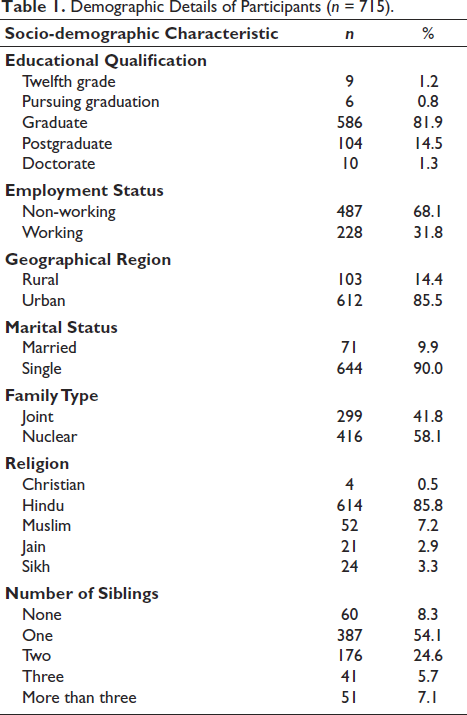
The purpose of achieving the aims and objectives of the current study was fulfilled through a rigorous attempt at collecting data from a socio-demographically rich, varied male population. Demographic details of the participants is reported in Table 1.
Demographic Details of Participants (n = 715).
Exploratory Factor Analysis
The data was quantitatively analysed for adequacy to administer EFA through Kaiser-Meyer-Olkin (KMO) and Barlett’s Test. The KMO result value of 0.797 was significant (p < .001), confirming that the sample was adequate for factor analysis. KMO values ≥0.70 are desirable for conducting EFA.24, 25 The Barlett test of sphericity was calculated to check whether the items are intercorrelated. The result revealed a significant result (X 2 = 2,100.12, df = 45, p < .001), indicating the suitability of EFA. Both these indicators increased confidence in conducting EFA. Hence, EFA was carried out to meet the aim of the study, which was to develop and standardise a tool to measure emotional expressivity among men.
The 16 items were analysed using EFA to identify the underlying factors that best represent the questionnaire’s items. EFA was conducted with principal axis factoring and oblique rotation (Promax). Research suggests that oblique rotation, such as Promax, is more appropriate than orthogonal rotation because it allows for factor intercorrelation, providing a more realistic representation of the data.26–29 Consequently, the current study employed the Promax rotation method for the EFA.
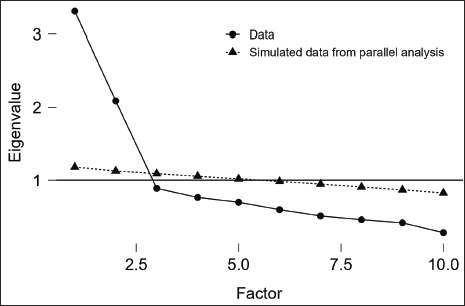
The factor extraction process followed established guidelines.25, 26, 29, 30 First, a factor loading threshold of 0.40 was set, as loadings below 0.30 are considered insufficient, contributing less than 10% to the variation in the latent construct being measured. Second, factors were retained based on eigenvalues greater than one. Third, each factor was required to include at least three items. Fourth, items were expected to load on only one factor with no cross-loadings. Fifth, each factor had to demonstrate a reliability coefficient of ≥0.70. Following these criteria, 10 items were retained, resulting in two factors: Factor 1 (items 2, 1, 3, 15, 5 and 7) and Factor 2 (items 10, 13, 9 and 11) (Refer Table 2 and Figure 1).
EFA Output Comprising Factor Loading, Sum of Squared Loadings, Proportion of Variance and Cumulative Variance.
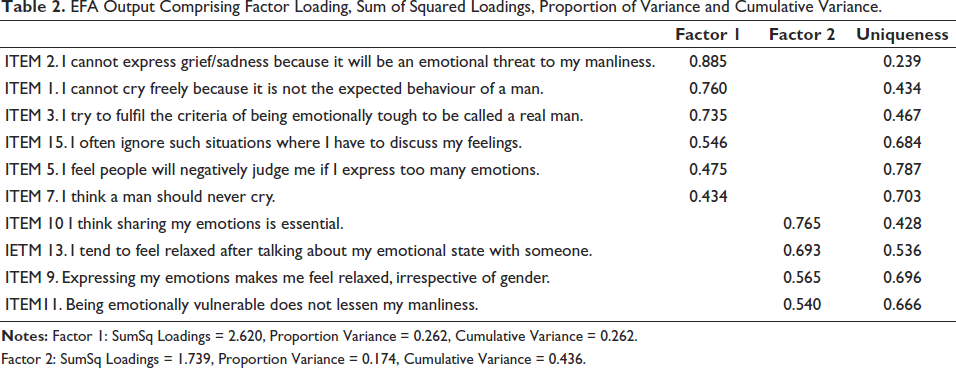
Factor 2: SumSq Loadings = 1.739, Proportion Variance = 0.174, Cumulative Variance = 0.436.
The first factor of the MEES scale, consisting of six items, was labelled as Masculine Emotional Inhibition (MEI). The second factor, comprising four items, was named Masculine Emotional Openness (MEO). To confirm the suitability of the retained factors, model fit statistics were calculated, focusing on the Comparative Fit Index (CFI) and Tucker-Lewis Index (TLI). The values of 0.9 and above are indicative of a good model fit. 31 In this study, the CFI value was 0.952 and the TLI value was 0.917, both exceeding the 0.9 threshold. Therefore, the two factors demonstrated a good model fit and were retained in the final MEES scale.
Analysis for Reliability
The reliability of the items in the scale was assessed using Guttman’s lambda (λ2). The λ2 value for the entire test was 0.712, making the scale reliable. The λ2 values of the two factors identified were 0.814 (MEI) and 0.732 (MEO), respectively. Overall, the scale was found to be reliable for use to assess MEE.
Correlation Between Factors and Total Score of the Current Scale (Mees)
Pearson’s correlation was carried out to assess the correlation, if any, between all factors and the total of the current scale. The results showed a significant positive (<.001) correlation between all factors, namely MEI (0.852) and MEO (0.355). The correlation was carried out to support the reliability of two factors of the current scale as the factors correlate significantly with the total scores of the scale. The correlation is suggestive of all the factors importantly contributing to measuring what the scale intends to measure, that is, MEE. Through their research, it was emphasised that the correlation between the total score of a tool and the reliability of all items of the test is an efficient way of optimising tool construction (Refer Table 3). 32
Correlation Between Factors of the Current Scale and Factors of the Emotional Expression Scale.

Analysis for Validity
To validate the scale, the authors opted for concurrent validity, which means carrying out a correlation between the new scale (MEES) and the already established and reliable scale, ERQ, administered in the last section of the scale. The two factors, namely MEI and MEO, were correlated with the two factors, namely Cognitive Reappraisal Facet and Expressive Suppressive Facet, to determine whether the items of the scale are valid enough to judge emotional expressivity among men.
Thus, the correlations found between the factors of the two scales were significant enough to determine the convergent and discriminant validity of the current scale.
Norms for the Administration of the Scale
Percentile rank was used to establish the norms of the scale. The scale norms suggest that a total score of 32 would be conclusive of low emotional expressivity among men, 33–38 would be conclusive of moderate emotional expressivity and scores above 39 would be conclusive of high emotional expressivity among men. (Please see supplementary materials, Appendix 4).
Discussion
The prime contribution of this study is the development and standardisation of a tool to assess emotional expressivity among men. The development of this tool represents a significant step toward understanding emotional expressivity among men through a detailed understanding of their beliefs and attitudes toward expressing themselves emotionally. The study aimed to develop a standardised MEE scale, for which data were collected between February and May 2023 from males aged 18–35 years.
The results of the current study demonstrate that the MEES measures emotional expressivity in men yielded a two-factor structure with factors, namely, MEI is a state of perceived emotional toughness arising from societal norms of manliness, resulting in deliberate restriction of emotional disclosure, specifically negative emotions, along with fear of being judged. MEO is the extent to which a man values sharing his emotions, is comfortable and experiences freedom of emotional expression irrespective of social norms of manliness.
λ2 values were acceptable for the entire scale and established the scale’s internal consistency. The validity was tested against the two-factor structure of the ERQ. 23 Emotion regulation determines which, when and how the emotions will be expressed and experienced by the individuals. 33 The factors of MEES correlated in expected ways with both the factors of ERQ, namely Cognitive Reappraisal and Expressive Suppression. Cognitive reappraisal encompasses an attempt to change how one thinks about a situation to change its emotional impact. 34 It is negatively correlated with Factor 1 MEI. This means that men who inhibit their emotional experiences in any particular context or life are less likely to change their thoughts associated with the stressful event. 35 Expressive suppression encompasses a person’s attempts to inhibit the behavioural expression of his or her emotions. It showed a significant positive correlation with MEI. It means the more men try to inhibit or hide their emotions or opinions about masculinity, the higher the chances are that they will try to suppress their emotions. Expressive suppression negatively correlated with MEO, suggesting that the more men are open and comfortable sharing their emotions, the less likely they are to engage in expressive suppression. Studies pointed out that males tend to suppress their emotions compared to females. 36 These patterns align with those commonly found in previous work using the ERQ, which states that emotion regulation aims to express adequate responses to environmental demands. 37 The concurrent validity, ascertained using the ERQ, indicates that the MEES is a valid tool for assessing emotional expressivity.
Conclusion
The study resulted in a multi-factorial structure and showed adequate reliability and convergent validity indices. Therefore, the MEES is a promising tool for measuring men’s emotional expression. The tool can help explore the beliefs and attitudes of males towards emotional expression. The current study focused on developing a short scale to measure MEES. This short scale would help clinicians and researchers tap male emotional inexpressiveness time-efficiently. However, future research could aim to increase the items and subscales.
Footnotes
Acknowledgement
The authors are grateful to the participants and colleagues who provided their extended support in the completion of this work.
Abbreviations
SS (Swati Saxena)
RK (Dr. Rati Khurana)
NK (Dr. Navkiran Kalsi)
KV (Dr. Kriti Vyas)
Authors’ Contribution
Data Availability Statement
The raw data supporting the conclusions of this article will be made available by the corresponding author on reasonable request.
Declaration of Conflicting Interests
The authors declared no potential conflicts of interest with respect to the research, authorship and/or publication of this article.
Funding
The authors received no financial support for the research, authorship and/or publication of this article.
IJMJE Statement
The present manuscript aligns with the IJMJE guidelines.
Informed Consent
The participants were given a consent form and all the ethical standards of research were followed.
Statement of Ethics
All the ethical standards were followed for this research work.
