




Abstract
Background
Any risk behaviour may result in a negative outcome. This highly depends on the complex interplay of emotions and an individual’s perception of risk. AI and ML can study the biological signature and speech of individuals, which can help clinicians intervene with individualised structured interventions.
Summary
This review investigates how AI and ML-based algorithms are used for detecting risk behaviours such as along with their diagnostic characteristics and treatment results. The review serves to collect all modern research about risk detection using existing ML techniques, along with their positive impact on clinical practice. The research explores how applying various DL models enhances the diagnostic accuracy and reliability of the findings.
Key Message
Though many ML models show a strong potential in detecting the risk behaviours, they do face limitations like a sub-optimal level of precision and sensitivity, Limited clinical value, external validity, high false positive rates, and less interpretability. Hence, HMM is recommended as a good alternative because of its excellence in uncovering the hidden states from overt behaviours, especially using language or speech analysis. The research currently in the field of risk prediction works on text or speech analysis and uses neuroimaging data. The implementation of DL practice is needed through validation, and at the same time, ethical considerations, data privacy issues should also be considered. There is strong evidence to suggest that DL and ML models and their adaptations show promising ways to predict and prevent risky behaviours.
Keywords
Introduction
The book, The psychology of risk-taking behaviour (vol. 107), defines risk behaviour as, ‘Risk taking is any consciously, or non-consciously controlled behaviour with a perceived uncertainty about its outcome, and/or about its possible benefits or costs for the physical, economic or psycho-social well-being of oneself or others’. 1
Individuals’ ability to carry out risky behaviour varies based on many factors. Influences include genetics, personality, gender, protective factors like family patterns, peer group, social influences, situational, and demographic factors, cognitive factors like low working memory and high anxiety sensitivity, and personal factors like self-efficacy, emotional regulation and emotional intelligence.2–9
Risky behaviour is any behaviour that has an uncertain outcome, 10 it can be toward a positive or a negative side. While positive behaviours can be constructive and socially acceptable, like winning an Olympic medal or protesting for a cause, etc. Negative risk-taking behaviours often include illegal, dangerous, and socially unacceptable behaviours like substance use, self-harm, delinquency, or suicidal ideation (SI). 11 A study that tries to determine the influence of personality and gender factors on risk-taking behaviour suggests that males take more risks and are not as sensitive to negative outcomes as female participants. Also, it further states that Adolescents are prone to take more risks even though they can evaluate the consequences of their behaviour similarly to adults because of prevailing factors such as sensitivity to reward, impulsiveness, and social anxiety. 7
Other studies suggest that risk-taking, like substance abuse, driving while intoxicated, behaviours and many more anti-social behaviours, peak during adolescence as neural circuitry goes through major reorganisation during adolescence, especially related to executive functions and social cognition. Many structural and functional MRI studies also show that there is evidence to suggest that the decrease in grey matter may also contribute to the risk-taking and novelty-seeking behaviours in adolescence. 12
Examining the neural activity using FMRI data related to neural and behavioural responses to reward across development suggests that adolescents differ from children and adults in the nucleus accumbent and Orbitofrontal cortex, with accumbent activity in adolescents resembling those of adults and in contrast, the OFC resembling those of children, and the disproportionate maturing of subcortical regions may lead an adolescent to prefer short-term reward over the long term consequences, thus increasing the chances of risk-related behaviour. 13 These findings shift our focus to finding answers for risk-taking behaviours in neuroscience. Different neural processes involved in various brain areas are not limited to reward-punishment pathways; dealing with uncertainty, self-control, and impulsiveness has an impact on risk-taking behaviour. A person who is more drawn to the reward and is ready to overlook the negative consequences of a risky situation may be much more likely to get involved in such a situation. Similarly, the repelling aspect of the punishment may also push one away from a risky situation. Also, self-control one exhibited when one is willing to let go of the immediate rewards for better rewards in the future acts as a barrier to taking a risky decision. The risk-taking also increases when uncertainty is not distressing. Also, based on several functional and structural MRI studies, decision-making, and learning paradigms, the regions involved in uncertainty processing, which is a key component of risk-taking behaviour involved in a variety of brain areas, including the posterior parietal cortex, anterior insula, anterior cingulate cortex, and ventrolateral prefrontal cortex. It was also found that brain lesions on the VMPFC (Ventro-Medial Pre-Frontal Cortex) may lead to impaired decision-making and thus increased risky decisions. 14
A comprehensive narrative review focusing on two decades of neuroimaging studies on suicidal thoughts and behaviours suggests that lateral and medial regions of the VMPFC and their connections can be important in stimulating SI and impairments in the Inferior frontal gyrus (IFG) and Dorsolateral Pre-frontal cortex (DLPFC) can be significant in suicide attempt (SA) behaviours, and a combination of Ventral and Dorsal PFC may lead to high-risk situations, where SI is converted into actions due to inflexible decision making and decreased inhibition of behaviour. 15 Also, this study, which examines the brain correlates of eighteen international cohorts in 18,925 participants, highlights the involvement of the thalamus and pallidum, a region linked to response to positive affect and reward in SA. 16 Impairments in the neurotransmitter serotonin and the stress response system of the hypothalamic-pituitary-adrenal pathway have also been shown to have a link with the risk of suicide. 17 Similar brain structures like DLPFC, posterior cingulate cortex, left ventral anterior cingulate cortex, right thalamus, and left insular under activation are shown to be involved in self-harming behaviours.18, 19 Neurocognitive analysis of substance-induced craving and withdrawal also involves brain areas such as the medial prefrontal cortex, ventral pallidum, ventral striatal and tegmental areas, and limbic regions. Recently cerebellum has also been researched as a part of craving episodes. 20
As we consider the potential solution to address this behaviour to intervene, we may look at the overt indicators of the risk behaviours. Some of the overt behaviours at risk of suicide may include depression and hopelessness, prior SA, insomnia, anxiety-sensitivity, substance abuse, and speech or language pattern changes.21–25 Out of all these characteristics, one of the promising predictors is speech or language analysis.26, 27 For example, suicidal behaviours can be predicted if a person uses more nouns and prepositions, changes in verb usage, and uses multi-functional words with more pronoun usage, etc. 22
Many acoustic properties of speech, such as Amplitude modulations and certain other vocal parameters, have emerged as strong predictors of suicidal risk. 27 In another study done on cocaine-dependent individuals, psychological stress has been proven to increase craving consistently, 28 which can cause a significant change to the pitch, tone, and frequency of their voice. 29 These changes have the potential to help cocaine users recover from addiction. 30
Hidden Markov Model (HMM) has been gaining popularity these days, especially in the field of speech recognition because of its precise statistical property, ease of use of algorithms used for training speech data, and the ease of implementation to suit various needs. 31 Because of its versatility, most large vocabulary continuous speech recognition (LVCSR) systems use HMM models for speech recognition. HMM can provide state-of-the-art performance for any study model if necessary refinements are provided. 32 An extension of the HMM model, type-2 fuzzy HMMs (T2 FHMMs) have proved to handle dialect and noise in speech signals and provide better performance than classical HMMs. 33 In addition to speech, the HMM model has applications in many fields, particularly in the field of neuroscience and psychology. 34 For example, this study uses HMM in a heterogeneous neurological disorder like Epilepsy to identify brain activity, taking the highly variable neural activity into account to provide personalised care, using magnetoencephalography (MEG) data in paediatric patients. HMM was able to localise and provide associations between the epileptogenic areas as well as provide customised output for each individual, while also providing a flexible result for manual review of each state, offering multiple advantages. 34 In another study, the finding path model of HMM in the Alzheimer’s patient group and the control group, HMM achieved 80.3% accuracy. 35 HMM models have also proved to be more accurate than other techniques in using simulated brain images as well as real images of the brain based on 3D models of MRI brain segmentation. 36 HMM has also been found to be very suitable for analysing EEG signals. 37
This discussion explores a predictive model based on HMM that uses speech patterns, neuroimaging, and electroencephalogram data to predict and diagnose risky behaviours. This will help us proceed with a customised intervention right at the time. The ever-growing field of AI can enable us to use state-of-the-art technologies and enable objective outcomes and efficient methods to manage tricky situations and challenges.
Purpose of the Study
In recent days, with the advent of AI and ML models, mental health predictions, diagnoses, and treatments have reached new milestones. Language has always been considered a window to the mind, which can access the metaphorical aspects of thoughts.38–40 Thanks to modern AI and ML algorithms, it can now be quantified, deciphered, checked for underlying mental health conditions and can be used for therapeutic interventions. 41
ML demonstrates a substantial potential for detecting risky behaviours from various brain imaging data and using speech/language analysis. 42 The development of risky behaviour is a multifaceted study, which takes place through the combination of various social, environmental, psychological, and genetic factors, thus requiring an examination of every aspect of research about its causes and symptoms. 43 In animal models,Using the combination of layered,hybrid datasets, HMM can distinctively classify dynamic behavioral pattern providing insights into how animals respond to risky situations. 44 Clinicians can use the data to tailor structured interventions to everyone. Such timely interventions, in many cases, can save lives, as in the case of suicides, or prevent further manifestation or complication of mental health symptoms. 45 Clinicians can use the data to tailor structured interventions according to the individual. Such timely interventions, in many cases, can save lives, as in the case of suicides, or prevent further manifestation or complication of mental health symptoms. 45
Thus, the HMM model-based algorithm can be a useful tool for handling heterogeneous data while building a unique profile for each user. This tool can very well be used by psychologists to structure an intervention. 46 It is also to be noted that HMM has proved to be a successful tool to determine the spiking of membrane potential of the neural activity and brain-computer interface of a data processing approach using EEG signals.47, 48
This research examines all the literature dealing with AI and DL techniques in risky behaviour prediction. Risk behaviour refers to a collection of behaviours which have uncertain outcomes, this research focuses particularly on the negative risky behaviours, SI/behaviour, substance craving/addiction, online gambling, risky driving, violation of social norms and self-harm. Traditional assessment measures depend on clinical interviews and diagnosis using various psychometric scales. This may lead to accidental misdiagnosis, because of the lack of recording symptoms, which may be fatal in many cases, especially if suicidal risk is involved.
The review investigates AI and ML model applications involved in detecting the risk behaviours of SI/risk, substance craving/abuse and other prominent risk behaviours like gambling addiction, NSSI (Non-Suicidal Self Injury), Criminal behaviours, Social Norms violation and Reckless driving behaviours. Alongside, this article also talks about the most effective approaches regarding accuracy improvement and their outcome. Traditional approaches to detecting risk behaviour may lack accuracy and may not be able to handle large data. ML approaches excel over traditional methods here as they are scalable, with large data handling capacity and can provide insights into how these risks shift over time. 49
This review assesses published research to find potential existing solutions that have been successfully implemented to prevent SI, thoughts and behaviour. It also extends the same to another risk behaviour, substance craving, abuse ideation and other risky behaviours along with their challenges and recommendations. The review also evaluates a suitable model that could be implemented in clinical settings, for customising and providing individualised treatment.
‘Risk Assessment using ML models’, ‘AI in suicidal risk detection’, ‘Substance craving prediction using ML models’, ‘self-harm prediction using ML models’, ‘Risky driving prediction using AI and ML’, ‘Online Gambling risk prediction through AI and ML’, these keywords resulted in a wide range of search results. Researchers limited the results from studies ranging from 2015 to 2025 to discover the recent developments and new innovations in the areas of risk assessment. The review approved 6 articles in SI/behaviour and 5 articles in substance abuse/craving, and 5 articles related to other risk behaviours out of the total 250 articles showing both methodological excellence and practical research value for detailed designs regarding suicidal, substance and other risks. The article evaluation procedure included two steps to ensure the findings are dependable, through its assessment of high quality journal selection that studied the fundamental ML and DL frameworks applied in risk analysis. Also, to highlight the efficiency and potential applicability of the HMM model in the field of risk prediction. Ultimately, our goal is to encourage clinicians to adopt AI-based diagnostic tools, as they could enhance accuracy and reliability in the prediction of risk assessment. This becomes especially important in crisis counselling situations. 50
Methods
This review investigates the key elements of how AI and ML-based algorithms are used for detecting risk behaviours. The review serves to collect all modern research about risk detection using existing ML techniques, along with their positive impact on clinical practice. The research explores how applying various DL models enhances the diagnostic accuracy and reliability of the findings. The results generated from this review will benefit both researchers and clinicians in diagnosing and providing timely interventions with customised results. With enhanced and novel innovations and the capacity to screen large datasets, ML models have shown promising results, especially in high-risk areas such as crisis settings. 51
Studies published after 2015 were identified from different electronic sources like PubMed, DOAJ, and PsycINFO. After the screening to incorporate only intervention-based studies, 16 articles (6 articles on the effectiveness of ML for SI/behaviour, 5 articles on the effectiveness of ML for detecting substance use and 5 articles related to other risk behaviours) were scrutinised and discussed. The quality of all the articles was measured using the Quality Assessment Tool developed by NHLBI.
Results
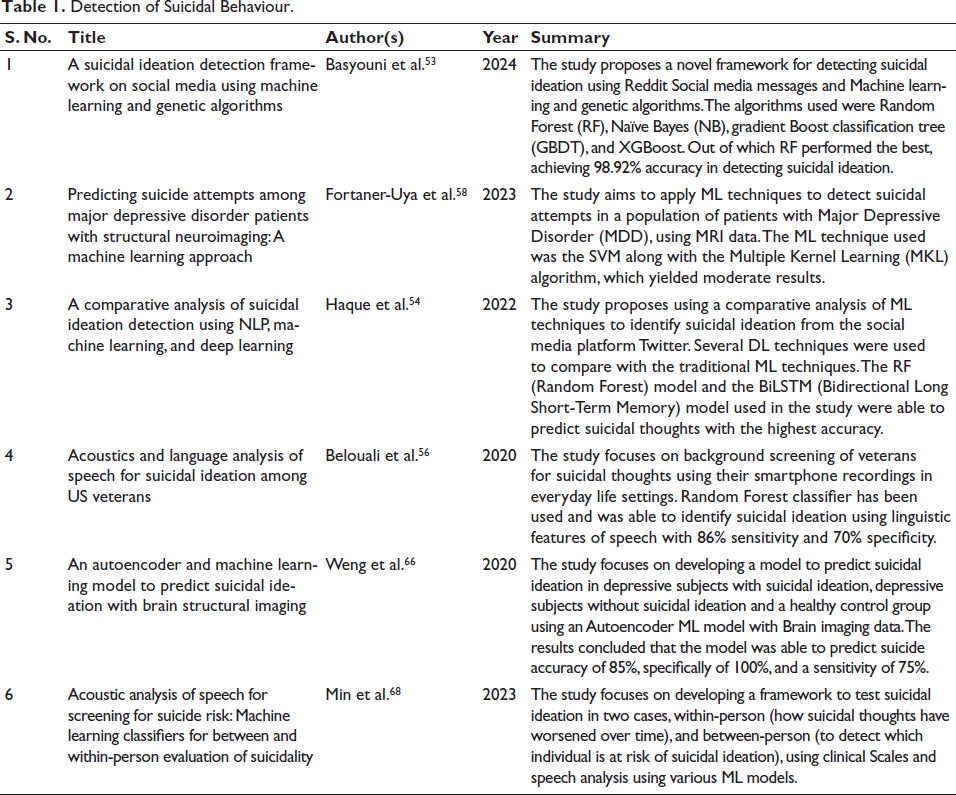
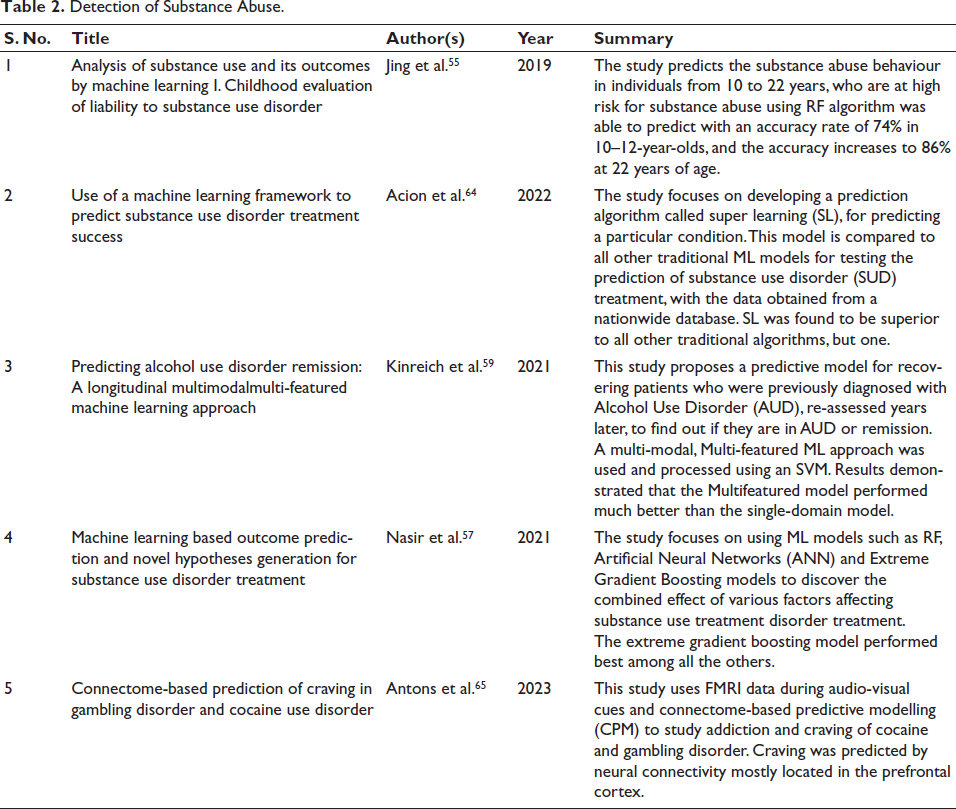
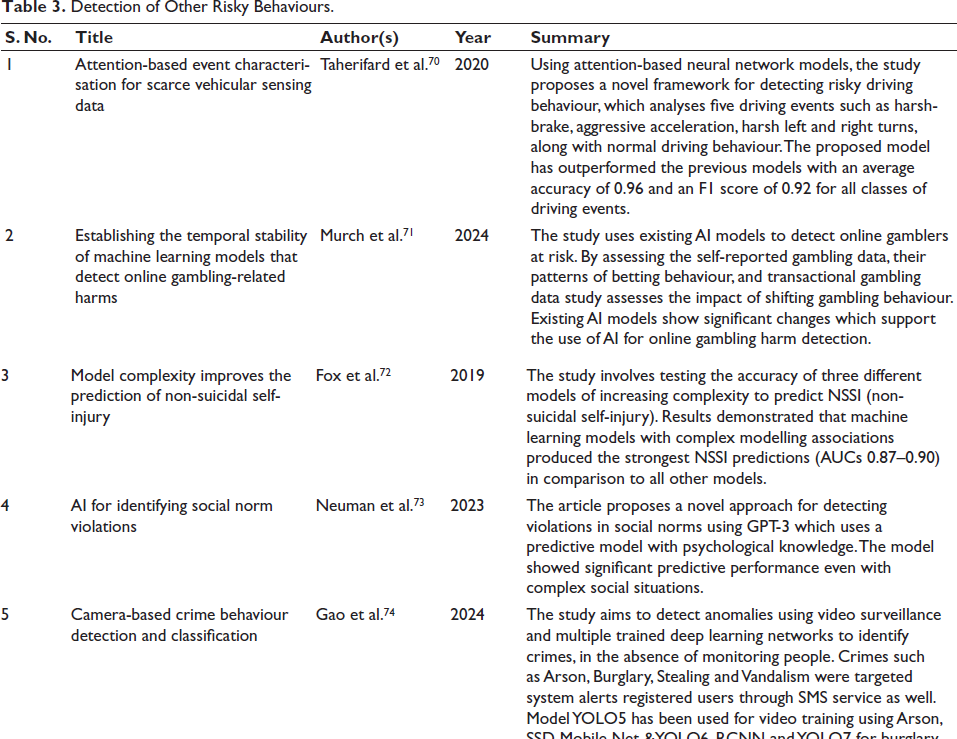
Table 1 shows the study that used ML algorithms for identifying risk behaviours like suicidal thoughts. Table 2 shows the studies which demonstrated the effective use of ML for detecting substance use. Table 3 shows the studies which demonstrated the effective use of ML for detecting other risky behaviours.
Detection of Suicidal Behaviour.
Detection of Substance Abuse.
Detection of Other Risky Behaviours.
Discussion
The main aim of this research is to collect the literature that supports the AI and Machine Learning approaches to identify and predict risk behaviours, to help with timely interventions. Risk behaviours are not limited to what is mentioned in this article. Still, the capability of these models to handle these conditions will also give us a snapshot of how other similar types of risk behaviours can be handled. The results gathered through this research give clinicians and researchers motivation to use Machine Learning algorithms for the researcher’s involvement in predicting risk behaviours. Mental health innovations powered by AI can improve diagnostic accuracy, quality of care, and reduce stigma if provided in a holistic way, which will seamlessly integrate into the existing framework and can bridge the gap in access and elevate the quality of mental health care. 52
Several studies have explored different algorithms for predicting risk behaviours like suicide and substance use, including the Random Forest (RF) model, Support Vector Machine (SVM), BiLSTM (Bidirectional Long Short-term memory), Convolutional Neural Network (CNN), Super Learning (SL) model, and Artificial Neural Networks (ANN). These models were effective in predicting risk behaviours like SI and substance abuse.
To overcome the limitations of previous studies that use ML models, such as feature redundancy and limited relevance to the target class, a framework that captures meaningful words from the post, the semantic aspects from the Reddit text messages, and Generic algorithms is also used to capture features relevant to the target class. 53 Many ML classifiers were used to check the post for SI, and the framework demonstrated superior efficiency to previous research. The research also proposed that the best performance was obtained from the RF classifier. These findings are also supported by comparative analysis, 54 the comparison of several ML and DL algorithms to identify suicidal risk from text messages in Twitter. RF has achieved the highest classification score among all. Similarly, in the study that analyses the Substance risk behaviour. 55 RF performed best among all other algorithms and was able to predict Substance use with an accuracy of 74% in 10–12 years, and the accuracy increases at 22 years of age. RF and speech analysis to detect SI, 56 where RF was able to identify SI using linguistic features with 86% sensitivity and 70% specificity. The RF model has also been used in the study of substance disorder treatment, 57 where it is used along with an ANN and extreme gradient boosting model, which has performed best. The objective biomarker of suicidality was studied to enhance the suicide risk and prevention of patients with Major Depressive Disorder (MDD). 58 The study was carried out using ML algorithms like SVM and Multiple Kernel Learning (MKL), studying grey matter and white matter using structural MRI. Performances of all the studies were reported as moderate, with SVM reaching the highest accuracy. Similarly, SVM was also used to predict Alcohol use disorder remission, 59 which is a multi-modal and multi-featured approach. The multi-featured prediction models achieved higher scores than single-domain models. The other ML models like BiLsTM, Naive Bayes (NB), gradient Boost classification tree (GBDT), and XGBoost, BiLSTM (Bidirectional Long Short-Term Memory) and Artificial Neural Net- works (ANN) were used in combination with RF models in studies.53, 54, 57Apart from this other ML models used were CNN based Deep learning (DL) model 60 detected suicide risk with an accuracy of 93.7%. The systematic review on suicidality training 61 done with ML models using MRI findings predicted that DL models exhibited higher predictive power than other models. The Explainable AI text classifier, called Shapley Additive Explanations for suicidality prediction using text line users was able to predict suicidal risk using predictive language associated with Suicidal ideation 62 was able to predict suicidal risk with an accuracy of 79%. Suicide Artificial Intelligence Prediction Heuristic (SAIPH) model 63 to predict suicidality from publicly available data was able to predict suicidal thoughts with an accuracy of AUC of 0.88. The Super Learning (SL) algorithm, 64 was found to be superior to all the traditional algorithms but one. The connectome-based predictive modelling (CPM), 65 using FMRI data and audio-visual cues to study addiction and craving of cocaine and gambling disorder. In addition to this, the methods employed by the study also varied; some studies were based on predicting SI through text data, either through social media posts53, 54 or through crisis helplines. 62 Brain imaging data like FMRI/MRI scans or EEG60,61,65–67 were used as data in these studies.
Many studies were also based on speech data, either from smartphone recordings, 56 or clinical speech data. 68 There are many advantages to all these models their accuracy, precision, objectivity, identifying key features of speech, and prediction of the likelihood of remission in case of suicidality and substance abuse.59, 68 The advent of AI and ML models has brought about tremendous changes in the field of mental health and across multiple areas like risk prediction, diagnosis, treatment, support, and clinical accuracy. 69 ML models have a significant advantage in terms of prediction accuracy, using varying data sources, and giving personalised interventions.49, 63 ML algorithms have their applications not just in suicide and substance abuse detection, but we can see their applications in other risky behaviours as well, as we see in Table 3. For example, ML algorithms have been implemented in detecting various other risky behaviours. 70 In their study, they have used attention-based neural network models to study the risky driving behaviours, which include harsh-brake, aggressive acceleration, harsh left and right turns, along with normal driving behaviour. Here, the proposed model has outperformed the previous models. AI models have also been used in detecting online gambling behaviour 71 by analysing the patterns of betting behaviour and transactional gambling data. Here, the proposed model has shown significant changes, which makes the study support the use of AI in gambling harm detection. Significance of using complex ML models has been proven with complex modelling associations in detecting NSSI (Non-Suicidal Self Injury). 72
The automatic identification of social norms and their violation using GPT-3 has been made possible thanks to. 73 Predictive models with psychological knowledge have enabled even complex social situations to be detected with greater accuracy. Criminal activities such as Arson, Vandalism, Burglary and theft are now detectable using video surveillance and without human interference. This has been made possible with the study of where different objects 74 detection YOLO models are used along with RCNN and SSD Mobile Net. The system is designed to send SMS alerts to registered users in case any anomaly is detected.
Existing Management Strategies for Detecting Risk Behaviours
When we look at the existing traditional strategies for risk behaviours, key management strategies contain comprehensive risk assessment, which may include clinical training of providing the clinicians with the right support, knowledge, and skill in supporting high-risk patients, continued education in the related area, Post SA care, holistic assessment, individualised care, community support groups and programs etc. 75 Screening for suicidal risk in the emergency department has increased the suicidal risk identification to two-fold. 76 Studies also suggest simple clinical strategies like informed consent discussions of the risks of opting out of care, self-management skills, proactively engaging in identifying the barriers to ask for help, proactively and specifically plan for future management of risk episodes, etc., can be helpful for those at risk. 77 More recently, smartphones and Wearable devices have contributed to the field of predicting risk behaviours by enabling real-time monitoring and predictive algorithms. These devices are capable of measuring sleep disturbances, stress, emotional distress, and interpersonal behaviour. These technologies may facilitate both early detection and intervention implementation for risky behaviours. 78 In extending this, Ecological Momentary Assessment (EMA) is another method of collecting symptoms and experiences of appetite changes, stress, sleep, and suicide or self-harm ideations through smartphones and wearable devices. The AI systems use this information to build a personalised profile of a risk management strategy. 79
Multiple AI and ML-based applications have demonstrated their effectiveness in predicting risk behaviours. Studies prove that the choice of taking a risk and a non-risk task may be a result of brain activity. Many studies use brain imaging as primary data in analysing risk behaviours. 80 Particularly those involving cognitive control, which involves the cortical regions which is the seat of decision making. 81 With the increase in the prevalence of risky behaviours, early detection and prevention have become very important. 53
With the advent of AI, ML models have been used widely in all fields. ML models have been shown to have higher performance in predicting risk than other models, like logistic regression. 82 Most ML models are data-driven and can handle many predictors. ML models can automatically learn from data and, with sophisticated calculations, can also handle non-linear relationships, interactions, and associations between the variables. Though they can be more flexible compared to regression models, they do have limitations, like lacking face validity, if there are many predictors that can be especially suitable for black-box algorithms and can lack transparency. 83 Results are varied while using ML models for MRI data, while DL models are found to outperform ML in predicting suicidal risk. 61
Similarly, structured data, the data that can be interpreted by humans, like psychometric assessments and tests, and unstructured data, the data that can be interpreted by psychometric instruments, have shown similar accuracy when using ML models for suicidal risk prediction. 84 RF is a predictive model, which has been used widely in detecting risk behaviours like suicide and substance craving. In many studies, the RF model has been shown to predict SI and behaviours as well as other risk behaviours with an accuracy of AUC of 0.8. 85 Many variants of the RF model, like the temporally enhanced RF model and Omni-temporal Balanced Random Forests (OTBRFs), which include the temporal information in predicting suicidal behaviour, have found the temporal variables to be associated. It was also found to be more effective in predicting than the Naive Bayesian classifier model. 86 Similarly, the RF algorithm has been successful in predicting substance abuse behaviour compared to other ML algorithms. 55 SVM, another ML model, has been shown to have a high accuracy of predicting suicide when used with whole-brain functional connectivity analysis, among MDD patients. 87 In a study based on a population of adolescents, the SVM model has been proven to identify suicide attempters and patients with SI, using MRI data, with a positive predictive value of 88.24%. 88
NB is a probabilistic machine learning model, which is simple and effective. It has been used alongside the RF model in a study involving a Brazilian community sample, where it has recorded an AUC of 0.798. 89 It was also found that NB, along with RF, performs much better with structured Electronic Health Record (EHR) data than unstructured EHR when predicting suicidal risk. 86
The ML technique using extreme gradient boosting (XGBoost) classifier is an algorithm based on decision trees on large data sets. XGBoost was employed with Python to detect suicidal risk among patients with Depressive disorder and healthy individuals. This study aimed to establish a predictive model that combines cognitive, genetic, environmental, and psychometric properties. The algorithm was able to successfully able to predict individuals with suicidal characteristics at the end of the trial. 90 XGBoost has also been shown to demonstrate a greater accuracy of 96.33% in determining suicidal risk in a study involving social media data. 91
CNN-based deep learning and dense net models have also been successfully implemented in predicting risk behaviours like SI, SA, depressive patients without suicidal thoughts (DP), and healthy cohorts (HCs). Overall results show that the Dense net model performs better than CNN in detecting SAs. 60
ANN models are designed to simulate how the human brain functions. They gather complex information and learn, or are rather trained to understand the relationships between different parameters and patterns. In other words, they learn not by programming but by experience. 92 ANNs have been used to detect risky behaviours as well. For example, in this study, an ANN was able to detect the risk of suicide successfully using everyday social media posts. 93
Challenges Faced by Existing Frameworks in Risk Management
Looking at the key challenges faced by existing frameworks, we can see that some frameworks have a sub-optimal level of precision and sensitivity and are often criticised for having no clinical value. In some cases, the result of these tools might be more towards the negative side than the positive. This begs the need for developers to work with more comprehensive predictor sets and advanced statistical designs. There is also a need for developers to look more at clinical needs and overall reduce the risk, rather than looking just at the predictive value. 94 Limited clinical value of these tools is another major limitation. 83 Tools are more structured and not comparable to the unstructured clinical process; moreover, the process of including these tools to enhance the clinical value is not being considered, and tools do not consider a range of clinical measures. For these reasons, the review concludes by saying the suicidal or self-harm predicting accuracy of the tools remains unclear. Some tools overemphasise classifying patients to be high-risk and low-risk, which could be misleading. Instead, the clinical context, nuances, and statistical expertise are missing. 95 Suicidal, or any risk behaviour, has dynamic predictors which are difficult to capture in a predictive model. 96
Though various ML algorithms predict risk behaviours through speech with high to moderate accuracy, various challenges exist in implementation, training and prediction. The prediction of risk factors like suicide or self-harm appears to be of varied accuracy between various ML models, mainly because of the implementation and the varied data quality and model types. The predictive utility and clinical accuracy of the models were also found to be questionable. 83 Also, some studies suggest that when implemented in isolation, these models may have high false positive rates, and several critical issues remain unaddressed. 97 Also, external validity may not be efficient particularly in models involving MRI data or in those models of whole-brain connectivity based on single-centre cohorts.61, 87Apart from these, although some models may be good at predicting the risk factors, because of the black box approach of these models, they may lack interpretability, making clinicians have a hard time understanding the reason behind the predictions.96, 98 Data scarcity is another prominent issue in most ML algorithms, where limited data makes it less robust and generalisable. 99 In addition to that, interpreting the varying characteristics of speech like pitch and rhythms along with emotional overtones makes it difficult for ML algorithms to predict the intention of the risk behaviour. 100
Though ML models seem promising with their predictive powers, these challenges need to be considered. At present, only a small number of ML-based systems are validated using clinical trials; also, regulatory agencies and ethical boards have not adapted to the new reality of ML in clinical practices. Which is not quite surprising, considering this is a new emerging field. Hence, an ethical review of ML models becomes a necessity, considering the growth of the field. 101
Recommendations
Considering the limitations faced by the ML models when using speech analysis for risk prediction, the HMM is recommended as a good alternative, as it has been proven to be an efficient tool for handling temporal variability in speech recognition. 31 Various algorithms of HMM, like Hidden Semi-Markov models, Temporally Varying Weight Regression (TVWR), and Type 2 fuzzy HMMs using fuzzy logic, improve the capabilities of HMM to handle much more sophisticated features than traditional HMMs, like feature projection, noise reduction, and improved covariance modelling. 102
HMMs have been proven to effectively manage sequential data; hence, often in risk situations, it becomes necessary to follow the progression of speech to understand the nature and degree of risk factors involved, with the advanced algorithm that can detect anomaly detection factors, HMMs can improve the prediction accuracy.103, 104
While there have been claims that many models used to have low interpretability, clinicians may have a hard time interpreting the results from the models. Since risk prediction is a time-sensitive decision, 49 the interpretability of the results becomes an important factor. HMMs can classify the progression states from low risk to high risk, thus providing insight into the background of the risk factors and increasing the trustworthiness of the model’s prediction. 105
Moreover, studies have proved the excellence of HMMs in uncovering the hidden states from overt behaviours, especially using language or speech analysis. For example, in this study, HMMs have been used to study emotional classification using speech analysis. The proposed method makes use of short-time log frequency power coefficients (LFPC) as a representation of the speech signal and discrete HMM as a classifier. The six categories of emotions were studied: Anger, Disgust, Fear, Joy, Sadness and Surprise. Results show that the system excelled with an average accuracy of 78% and a best accuracy of 96% in classifying all six emotions. 106
An adaptation of HMM called a deep time-delay Markov network (DTMN), which essentially consists of HMMs, and a time delay neural network (TDNN) was used to predict stress and emotional state using speech. 107 Experimental results of this study show that the proposed system was able to accurately predict the stress and emotional states of performing the baseline. Many studies have proved the correlation between emotional states and risky behaviours.108–110 gives us enough evidence to extend the study of HMMs to predict risky behaviours using speech.
Conclusion
The future diagnosis and management of risky behaviours benefits from various ML and DL algorithms and their adaptations, which can enhance the diagnostic accuracy along with personalised approaches. The research currently in the field of risk prediction works on text or speech analysis and uses neuroimaging data. Future research should focus on practical applications and on incorporating ML/DL models of risk prediction seamlessly into everyday clinical and crisis applications. This will provide more personalised predictions and thus provide early opportunities for interventions. The implementation of DL practice is needed through validation, and at the same time, ethical considerations. Data privacy issues should also be considered. Scientists should also look at the various predictors that could lead an individual to a risky situation instead of just categorising them as high and low risk. This could help with intervention, and especially the crisis intervention, which could be crucial, and could save lives in case of suicidal risk. There is strong evidence to suggest that DL and ML models and their adaptations show promising ways to predict and prevent risky behaviours, which will be very helpful many times in saving lives or could prevent risky behaviours and provide time for therapeutic intervention to improve the patient’s condition.
Footnotes
Acknowledgement
The authors acknowledge the support received by the Central Library of Amity University in completing the article, including technical assistance and valuable insights provided by the faculty members.
Authors’ Contribution
Author S.T.S. conceptualised the study, supervised and validated the findings, and author H.N. extracted data, synthesised and developed the manuscript.
Declaration of Conflicting Interests
The authors declared no potential conflicts of interest with respect to the research, authorship and/or publication of this article.
Funding
The authors received no financial support for the research, authorship and/or publication of this article
Patient Consent
Not applicable.
Statement of Ethics
Not required as it is a review article.
