




Abstract
Social inclusion is a process through which the marginalised sections of society are included in the mainstream of society. It is ironic that even in the 21st century, many sections of Indian society remain outside the mainstream. Factors such as poverty, ill health, homelessness and abuse are ubiquitous among marginalised children, who are also considered ‘at risk’ across both developed and developing nations. There is a crucial need for every child to be given the opportunity to be educated. Holistic education is influenced by the progressive educational movement (Dewey 2024, Democracy and education, pp. 1–400). It harmoniously develops and empowers all the given human potential (Ushuluddin et al., 2019, Int J Lang Res Educ Stud, 3, pp. 54–70). This social exclusion greatly affects the physical and mental health of these marginalised children. The present research article analyses a caselet and reviews literature to explain the problems encountered by marginalised children, with an emphasis on their social inclusion. The article discusses the concepts of social inclusion and exclusion in the context of mental health. It scrutinises various educational policies of the Indian government and accentuates the importance of holistic education as a key factor in improving the mental health and social well-being of marginalised children.
Keywords
Journey from Social Exclusion to Inclusion: Story of a Dalit Boy
Chandrashekhar, 21, was born into a Scheduled Caste family living in a Delhi slum area. His father used to drive a rickshaw, and his mother worked as a labourer. Chandrashekhar was the eldest of the five siblings in the family. Because of this, he also sometimes contributed to earning a living for the household. Despite all the difficulties, Chandrashekhar’s parents instilled values in all their children and motivated them to complete their education at the nearby government school. Coming from a marginalised section, Chandrashekhar had to face social neglect many times in his social and educational life. He used to feel dejected and depressed when people ill-treated him due to his caste and socio-economic status. In spite of all the physical, mental and social challenges, Chandrashekhar completed his university education by taking tuitions. He worked very hard and qualified for the most prestigious Civil Services Examination. The people who did not allow him to sit near them and ill-treated him started to hover around him. Today, Chandrashekhar has social status, respect, identity and prestige, which is the result of his hard work in education. Today, this boy from the marginalised section of the society is living with feelings of high self-worth and has forgotten the childhood trauma of physical, mental and social abuse. The parents from his slum area are now giving his example to the children in their families, and he has become a role model for youth in his neighbourhood. He gives the credit for his journey from social exclusion to social inclusion to his teachers and education. He has great regard for his parents, who instilled in him the importance of education despite being uneducated themselves.
Social Exclusion and Inclusion: Conceptual Understanding
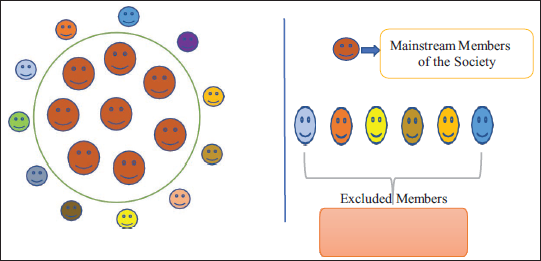
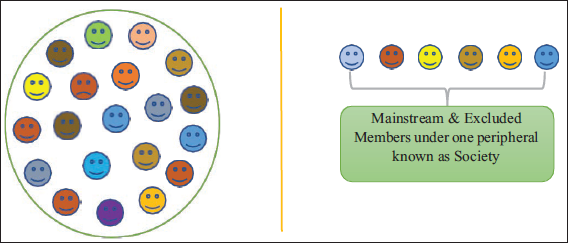
The above caselet can explain the concept of social exclusion by the life led by Chandrashekhar before he qualified for the Civil Services Examination and social inclusion after the Civil Services Examination.
Social exclusion and marginalisation are frequently used terms in Social Sciences; Education, Sociology, Psychology, Political Science, Economics, etc. In general interpretation, socially excluded individuals or groups cannot contribute to or participate in the social, political and economic activities of the society in which they live. The feeling of discrimination and alienation ensues for children at risk; disabled, minority groups, substance abused, LGBT Group (lesbian, gay, bisexual, transgender), etc. In the UNICEF Report, a multidimensional definition includes deprivations of economic, social, gender, cultural and political rights, making exclusion a broader concept than material poverty. In another interpretation, it is the process of relegation of individuals and social groups to the margins of society.1–3 These individuals or groups are systematically denied full access to various rights, facilities, resources and opportunities that are generally available to the other mainstream members of society. There is a great need for social inclusion to provide their rights, opportunities and resources to the socially excluded groups and to integrate them into the mainstream of society, in which education has a very important role. Dr B. R. Ambedkar once said, ‘Education is what makes a person fearless, teaches him the lesson of unity, makes him aware of his rights, and inspires him to struggle for his rights’. Therefore, true education is that which helps individuals to make their identity in society by making them aware of their rights and opportunities. According to John Dewey, there are three major pillars of education: Teacher, Student and Society. 1
‘Social Exclusion’
‘Social Inclusion’
Exploring the Relationship Between Education and Social Inclusion
John Dewey said that school is a miniature of society. If you want to see the process, culture, ethics, thoughts, values, beliefs and behaviour of a society flourishing and developing, then you should look at its schools, because it is a formal agency of education where students are educated according to their capacities and abilities. 1 Each student has different abilities; identifying them and providing them proper guidance is the main responsibility of a teacher. This task becomes more difficult for a teacher when they have diverse learners in their classes. In line with the implementation of the concept and plan of inclusive education today, diverse learners (socially, culturally, economically and politically) read, write, learn and play under one roof, which is the reflection of our Indian society, and all are given ample opportunity ‘to play, learn and grow together’, which is the motto of inclusive education. A teacher plans and implements their teaching-learning practices and processes according to the diversity of their class and accordingly creates learning materials to maximise the development of all students and transform them into productive citizens. For the establishment of social justice and social inclusion, it is very necessary that discrimination and inequality prevailing in society should be removed, and it should start from the classes of Indian schools. A teacher plays the role of an agent of education to achieve the above-mentioned purpose. A socialised person who can harmonise with different levels moves towards a better lifestyle, and their status in society also changes. A well-educated individual becomes socially dynamic and leads a life of quality. Both education and teachers play a very important role in the selection and inclusion of the marginalised individual, leading to their social empowerment.
Social identity ensures social empowerment. Providing opportunities for social identity in a country like India, which is full of diversity, is a very difficult task. Governments (Central and State) formulate various plans, programmes and policies from time to time for each section of the society, especially for the marginalised sections, so that they can be added to the mainstream of society by social empowerment. Social empowerment and social mobility are the signs of social change. According to MacIver and Page, ‘Social change is the change in social relations’. Change in social relations is the main cause of changes in social processes, patterns and social structures, and affects social development. The desired change in the right direction in social relations, structures, patterns and processes is a sign of progress in society. 4
In a country like India, where there is a lot of diversity, social change in the right direction is extremely challenging. However, no country can progress until every section, even at the grassroots level of that society, is developed. Mainly, social inclusion should be achieved by connecting the marginalised section of society to the mainstream so that Indian constitutional values like equality and justice can be established.
Social Exclusion and Mental Health
The Dalit boy in the above caselet had suffered from anxiety and depression due to the behaviour of society. He experienced low self-esteem and feelings of low self-worth due to his caste and socio-economic status. Mental health greatly influences the behaviour of students and their overall educational journey. Conditions like anxiety, depression and disruptive behaviours may influence learning and social interactions negatively. Issues related to mental health struggles often result in behavioural issues, influencing concentration, motivation and interactions in a negative manner. Students may show signs of resentment, withdrawal, aggression and diminished academic involvement. Addressing mental health concerns of marginalised children is necessary for cultivating an optimal learning environment. The psychological issues of the marginalised sections are to be addressed for the education to make its impact.
Social Inclusion and Increased Self-worth
Social inclusion leads to improved self-esteem and feelings of high self-worth among the marginalised sections. Social recognition and acceptance play a very crucial role in developing self-efficacy and self-confidence. When individuals feel included and supported by their social environment, they are more likely to experience a positive sense of self and mental well-being.
Examining Various Government Policies and Programmes
A review of government policies, programmes and initiatives supporting the education of children at risk is presented here, highlighting a variety of efforts to guarantee fair access to high-quality education. To overcome the obstacles that children who are at-risk encounter, such as poverty, disability and social marginalisation, these measures are crucial.
Sarva Shiksha Abhiyan (SSA), India:
A flagship initiative of the Indian government, the SSA was introduced in 2001 to achieve universal basic education. 5 The programme’s main goal is to include underrepresented populations, such as girls, children from low-income families and children with impairments. In India, SSA has greatly increased enrolment rates, reduced gender gaps and enhanced educational facilities. Special provisions, including inclusive education initiatives and the provision of appliances and aids, are also included in the programme for children with disabilities. 6 According to the Ministry of Education, ‘Sarva Shiksha Abhiyan (SSA) has been instrumental in increasing the net enrolment ratio and reducing gender disparities in primary education’. 7
Right to Education (RTE) Act, 2009, India:
All Indian children aged 6–14 are required to receive free and compulsory education under the terms of the RTE Act. 8 The Act guarantees that no child is turned away for lack of documents or education, as it includes measures for the admission of children from underprivileged groups. 9 Enrolment in schools has significantly increased because of the RTE Act, especially for children from underprivileged neighbourhoods. It also encourages social inclusion by requiring private schools to set aside 25% of their enrolment for students from economically disadvantaged areas. The RTE Act has been a game-changer in promoting the educational rights of children from marginalised communities. 10
Integrated Child Development Services (ICDS), India:
One of the largest early childhood care and education programmes in the world was introduced in 1975 with the launch of the ICDS programme. 11 It offers children under 6 years of age health, nutrition and educational support, with an emphasis on children from low-income families. Improved maternal health, early childhood education and child nutrition have all benefited from ICDS. Anganwadi facilities, which provide a secure environment for early learning and nutritional support, are an essential resource for children who are considered to be at risk. ICDS plays a vital role in providing early childhood care and education to children from marginalised communities. 11
National Policy for the Education of Girls and Women (NPEGW), India:
This policy focuses on improving access to education for girls and women, particularly those from marginalised communities. It includes initiatives like the Kasturba Gandhi Balika Vidyalaya scheme, which provides residential schooling for girls from disadvantaged groups. 12 The NPEGW and related schemes have significantly improved enrolment rates for girls, particularly in rural areas, and have provided essential support services such as scholarships and free textbooks. The NPEGW has been pivotal in addressing gender disparities in education in India. 13
National Plan of Action for Children (NPAC), India:
The NPAC 2016 emphasises the need for special protection and educational support for children at risk, including those in conflict with the law, street children and children with disabilities. The NPAC is aligned with the United Nations Convention on the Rights of the Child. NPAC provides a framework for coordinating various government programmes aimed at the holistic development of children at risk, ensuring that their right to education is protected. NPAC serves as a comprehensive strategy to safeguard the educational rights of children at risk, in line with international standards. 14
These government policies and programmes demonstrate a commitment to ensuring that at-risk children receive the education they need to overcome their circumstances. While the outcomes have been mixed, these initiatives have laid the groundwork for more inclusive and equitable education systems.
Conclusion
Physical and mental health conditions, socio-economic status, gender and territorial differences within society hinder the education of many children in India. Children from the marginalised sections face the greatest challenges and threats if they express the desire to be included in the mainstream. The above caselet highlights that social inclusion of any individual can be accelerated through the provision of quality education. If these children are self-motivated, they demonstrate great resilience and achieve their goals despite all limitations. The intricate relationship between mental health and behaviour underscores the need for a holistic educational approach, which includes life skills training. Mental health awareness, early interventions and collaborative endeavours empower educators to foster an environment where students can flourish academically and emotionally, laying the foundation for lifelong well-being. The education policies in India, if practiced in their true essence, can help in social inclusion of the marginalised children. The social inclusion of these children has a very positive impact on their psychological and social well-being. Society at large which initially ill-treated the Dalit boy in the caselet, later begins to acknowledge his worth. This change in the attitude of others leads to improved psychological and social well-being for the individual. Such examples in society also serve as motivational factors for other children and youth in their surroundings.
Implications of the Study
The study points towards the need for inclusive teaching practices that can cater to the diverse learning needs of marginalised students. The mental health considerations of this section of the society are to be deliberated upon by the policymakers of the nation. The focus needs to shift from the traditional approach to education towards the importance of holistic education. Flexible assignments and emotional support for the marginalised students must be prioritised. The study indicates the need for different strategies to include the marginalised children and youth in the mainstream society for the development of the nation.
Footnotes
Acknowledgements
We express our heartfelt gratitude to the person on whose case study this article is based. We also express gratitude to the parents and neighbours of the person for addressing our queries.
Authors’ Contribution
All authors contributed to the conception and design of the study. All authors read and approved the final manuscript.
Declaration of Conflicting Interests
The authors declared no potential conflicts of interest with respect to the research, authorship and/or publication of this article.
Funding
The authors received no financial support for the research, authorship and/or publication of this article.
ICMJE Statement
The manuscript complies with ICMJE guidelines.
Statement of Ethics
Approval was granted by the Ethics Committee of Amity University Uttar Pradesh, Lucknow, India.
