




Abstract
Background
The development of prosocial behaviour is a crucial facet of adolescent growth, encompassing acts of kindness, empathy and cooperation. It is widely recognised that multiple factors influence the formation of prosocial tendencies during adolescence.
Purpose
Among these factors, parental attachment and parental autonomy support are pivotal. Attachment theory states that secure parent–child bonds form the bedrock of prosocial behaviour. Adolescents with emotionally close, trusting parental relationships exhibit greater prosocial behaviour. Furthermore, parental autonomy support, which balances guidance with decision-making freedom, further nurtures responsibility and empathy. Together, these factors play a crucial role in shaping adolescents’ prosocial behaviour.
Methodology
In this study, the relationship between parental attachment and autonomy with prosocial behaviour is studied by using correlation and regression analyses.
Results and conclusion
All attachment and autonomy support variables demonstrated positive correlations with overall prosocial behaviour except for alienation from mother and father, which showed a negative association. This indicates that a stronger connection with the parents is linked to higher prosocial behaviour. Additionally, mother communication along with mother and father offering choice within certain limits as predictors of prosocial behaviours in adolescents is a major finding of the study.
Introduction
Prosocial behaviour, defined as voluntary actions intended to benefit others or society, has been a central topic of psychological inquiry since the early 20th century. Early researchers, such as McDougall and Wispé,1, 2 distinguished prosocial behaviour from antisocial behaviour, establishing the groundwork for modern interpretations. 3 A major event that propelled further investigation into prosocial behaviour was the tragic 1964 murder of Kitty Genovese in New York City, which led researchers to examine why individuals sometimes fail to help in emergencies. Latané and Darley’s 4 seminal work introduced a decision-tree model, explaining that helping behaviour is a multistep process influenced by various contextual factors. 3
The motivation behind prosocial actions is complex, encompassing both intrinsic and extrinsic factors. 5 Research suggests that prosocial behaviour can express personal values, fulfil social obligations or meet psychological needs. 3 It also varies by context, as individuals are more or less likely to help depending on the situation. Definitions of prosocial behaviour range from selfless acts to those motivated by self-interest. 6 Prosocial actions, such as helping, sharing and cooperating, are typically driven by empathy and concern for others, but they can also align with altruistic or egoistic motives. The progression of prosocial behaviours during adolescence is associated with an array of benefits, including stronger social ties, greater emotional control and improved academic performance. 7 These behaviours assist adolescents in developing critical social functioning abilities such as collaboration, conflict resolution and social cohesiveness, all of which are necessary for navigating this transitional phase. 8 As adolescents navigate this complex transition, the development of prosocial behaviour becomes increasingly important, as it lays the foundation for essential skills and traits that have the potential to benefit both the individual and society. 9 Furthermore, engagement in prosocial actions can contribute to a sense of purpose and life satisfaction, reinforcing positive social adjustment and reducing the likelihood of engaging in problematic behaviours.8, 10
Keeping in mind that adolescence is characterised by a heightened demand for social belonging, with teenagers often seeking social approval and recognition and spending more time with peers, 11 this increased social sensitivity can promote prosocial behaviours when adolescents feel supported and valued within their peer groups. At the same time, it can also lead to negative behaviours if their social environment encourages maladaptive coping strategies. 12
Numerous factors, such as social contexts, cultural norms and personal traits, affect how prosocial behaviour develops. 13 One such key factor is parenting practices, which are instrumental in shaping adolescents’ prosocial behaviours. Within the parenting domain, two primary factors, attachment and autonomy support, play a critical role in the development of prosocial behaviour among teenagers. 14 Research has consistently shown that patterns of parenting are integral in shaping adolescent development and behaviour. 15 Both the degree of emotional attachment adolescents share with their parents and the extent to which parents support their autonomy have been identified as key factors that influence adolescents’ prosocial tendencies.
Attachment theory, initially developed by Bowlby 16 provides foundational insight into how early caregiver relationships influence individuals’ social and emotional development. 17 Attachment is defined as affective bonding between the child and the primary caregiver. 16 The quality of these early attachments, particularly those characterised by warmth, trust and emotional security, has been shown to foster effective emotional regulation strategies and a sense of reciprocity in children and adolescents. 18 Furthermore, healthy attachment patterns promote a range of prosocial behaviours, from empathy and compassion to sustained engagement in caring actions. 19 Adolescents whose parents are emotionally available, responsive and accepting are more likely to acquire an elevated sense of self-worth, become involved in healthy interpersonal connections and effectively navigate the challenges of adolescence. 20 Conversely, insecure attachments are linked to relational and psychological difficulties, suggesting that a secure attachment style in childhood and adolescence acts as a protective factor for long-term social and psychological well-being.18, 21 Adolescents who develop insecure attachment patterns are more likely to experience behavioural difficulties, anxiety, depression and other internalising and externalising disorders. 22 Empirical evidence has consistently linked prosocial behaviour with positive parental attachment.23, 24
Complementing attachment theory, self-determination theory 25 posits that fulfilling three fundamental psychological needs, autonomy, competence and relatedness, is essential for optimal human development and well-being. Among these, autonomy stands out as a particularly important factor in shaping prosocial behaviours during adolescence. Autonomy-supportive parenting, which includes behaviours such as providing choices, encouraging self-initiative and acknowledging the child’s perspective, has been linked to enhanced self-regulation, well-being and social competence in adolescents. 26 Adolescents who are granted a sense of independence and self-direction in their decision-making tend to exhibit higher levels of empathy, cooperation and concern for others. 27 This autonomy support from parents allows adolescents to develop a stronger sense of agency and self-regulation, which in turn facilitates the internalisation of prosocial values and behaviours. 28 In contrast, adolescents who experience excessive parental control or authoritarian parenting styles are more likely to develop external motivations for prosocial actions, reducing the likelihood of genuine, intrinsically motivated helping behaviours. 29
Adolescents who perceive their parents as autonomy-supportive, while also maintaining a secure attachment bond, tend to exhibit higher levels of prosocial tendencies, such as volunteering, sharing and helping others. 30 This suggests that the combination of parental support for adolescents’ independence and self-endorsed functioning, coupled with an emotionally supportive and responsive parent–child relationship, creates a nurturing environment that fosters the development of prosocial inclinations among adolescents. Hence, the present study aimed to analyse both parental attachment and parental autonomy support together as correlates of prosocial behaviour among adolescents.
Objectives of the Present Study
To study the relationship between parental attachment and prosocial behaviour among adolescents.
To study the relationship between parental autonomy support and prosocial behaviour among adolescents.
To study the role of parental attachment and parental autonomy support as predictors of prosocial behaviour among adolescents.
Hypotheses
There will be a significant positive relationship between parental attachment and prosocial behaviour among adolescents.
There will be a significant positive relationship between parental autonomy support and prosocial behaviour among adolescents.
Parental attachment and parental autonomy support will significantly and positively predict prosocial behaviour among adolescents.
Methodology
Sample
The original sample for the present study consisted of 250 adolescents (125 females and 125 males). The incomplete questionnaires were omitted, which reduced the sample size to 200 adolescents (116 females and 84 males). The age range of the adolescents was 15–18 years, with a mean age of 15.37 years. Data were collected from various schools in Jammu (Union Territory of Jammu and Kashmir). A convenient sampling technique was employed for data collection. All the questionnaires were used in their original form, as they have been consistently used with Indian samples in the past31–33 and have demonstrated strong psychometric properties as reported by the original developers.34–36
Psychological Tests
The Prosociality Scale 34 (PS): PS, developed by Caprara et al. in 2005, is a widely utilised self-report instrument for assessing prosocial behaviours, which encompass actions aimed at benefiting others, such as helping, sharing and cooperating. The PS comprises 16 items that evaluate various aspects of prosocial behaviour. Participants rated the frequency of their engagement in these behaviours using a five-point Likert scale, ranging from 1 (‘Never’) to 5 (‘Always’). A total score was obtained by summing all the items.
Inventory of Parent and Peer Attachment 35 (IPPA): IPPA is a 75-item self-report measure, developed by Armsden and Greenberg in 1987, to examine the degree of attachment relationships between adolescents and their parents. The IPPA consists of three sections, mother attachment, father attachment and peer attachment, with 25 items each. All three sections assess the dimensions of trust (10 items), communication (9 items) and alienation (6 items). The respondents marked their responses on a five-point scale ranging from ‘almost never or never true = 1’ to ‘almost always or always true = 5’. Indicators of stronger attachment relationships include lower scores for alienation and higher scores for communication and trust. In the current study, the mother attachment and father attachment sections were employed.
Perceived Parental Autonomy Support Scale 36 (P-PASS): P-PASS, created by Mageau et al. in 2014, measures two characteristics of parenting: autonomy support and controlling behaviour. It consists of 24 items that assess the degree to which parents offer autonomy support versus display controlling behaviours. Items are assessed using a seven-point Likert scale. Higher scores on autonomy support and lower scores on controlling behaviour suggest greater perceptions of autonomy support. The respondents chose from one of the following seven options: ‘do not agree at all = 1’, ‘hardly agree = 2’, ‘slightly agree = 3’, ‘somewhat agree = 4’, ‘agree = 5’, ‘strongly agree = 6’ and ‘very strongly agree = 7’. The current study employed the autonomy support subscale.
Procedure
The Institutional Ethics Committee granted ethical permission for the study (Reg. No: 1414/HG; dated: 27/03/23). Permission was obtained from the participants and the school authorities before the administration of the psychological tests. Participants were made aware of the objectives of the study and assured that the information collected was purely for research purposes and would be kept confidential. Focus was laid on building a good rapport with the participants prior to data collection. The questionnaires were administered during the free period. Any doubts or difficulties in understanding the items were addressed with complete cooperation. Separate instructions were provided for each test based on the manual. The tests were conducted in groups of 20–25 participants.
Statistical Analysis
The data collected were subjected to descriptive statistics (mean, standard deviation, skewness, and kurtosis) and inferential statistics, including Pearson’s product moment correlation and multiple linear regression, using SPSS 20. The 0.01 and 0.05 levels of significance were used for testing the framed hypotheses.
Results
Table 1 is an APA 7th edition-styled table presenting descriptive statistics summarising the mean, standard deviation, skewness and kurtosis of the variables:
Descriptive Statistics for Study Variables (N = 200).
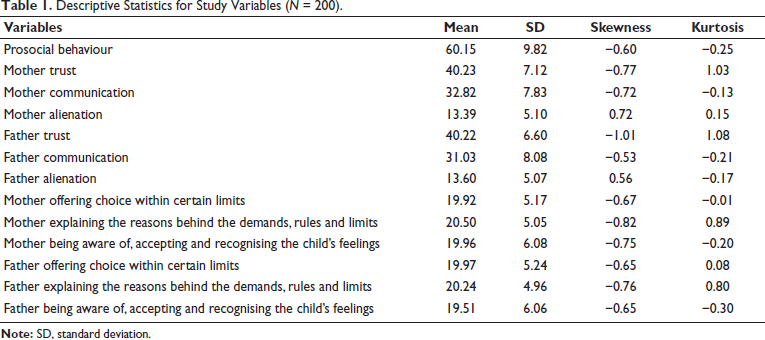
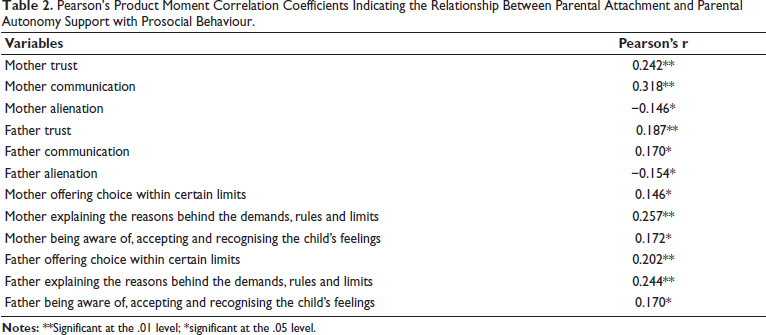
Before the application of inferential statistics to meet the objectives of the current investigation, descriptive statistics were calculated to check for the normality of the data. The values of skewness and kurtosis in Table 1 highlight that the data were normally distributed. To achieve the first and second objectives of this study, Pearson’s product moment correlation was employed. The correlation coefficients between the variables examined are presented in Table 2. From Table 2, the results of Pearson’s product moment correlation between the variables under study clearly show that both parental attachment and parental autonomy support are significantly correlated with prosocial behaviour among adolescents. In the case of parental attachment, mother trust, mother communication, father trust and father communication are significantly and positively correlated with prosocial behaviour (r = .242, r = .318, r = .187 and r = .170, respectively), whereas mother alienation and father alienation are significantly and negatively correlated with prosocial behaviour among adolescents (r = −.146 and r = −.154, respectively). In case of parental autonomy support, mother offering choice within certain limits; mother explaining the reasons behind the demands, rules and limits; mother being aware of, accepting and recognising the child’s feelings; father offering choice within certain limits; father explaining the reasons behind the demands, rules and limits; and father being aware of, accepting and recognising the child’s feelings are significantly and positively correlated with prosocial behaviour among adolescents (r = .146, r = .257, r = .172, r = .202, r = .244, and r = .170, respectively). Based on the findings of the correlation coefficients, Hypotheses 1 and 2 are accepted.
Pearson’s Product Moment Correlation Coefficients Indicating the Relationship Between Parental Attachment and Parental Autonomy Support with Prosocial Behaviour.
Further, to study the role of parental attachment and parental autonomy support as predictors of prosocial behaviour among adolescents, multiple linear regression analysis was conducted. The results show that the value of the multiple correlation coefficient is .431, which is moderate. It is evident that approximately 18.6% of the variance in prosocial behaviour among adolescents can be accounted for by the linear combination of the variables under study. The probability value for the F-statistic (3.551) for the overall regression relationship is P < .01, indicating that there is a significant relationship between the set of predictor variables that are mother communication, father offering choice within certain limits and mother offering choice within certain limits.
Summary Table Showing Results of Multiple Regression Analysis.
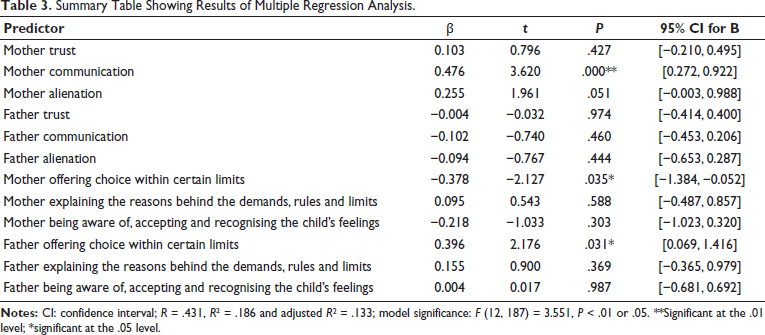
Table 3 shows that for mother communication, the β coefficient of .476 (P < .01) suggests that it emerged as a significant positive predictor of prosocial behaviour among adolescents. Father offering choice within certain limits, with a β coefficient of .396 (P < .05), also significantly and positively predicted prosocial behaviour. Interestingly, mothers offering choice within certain limits, with a β coefficient value of −.396 (P < .05), significantly and negatively predicted prosocial behaviour. Thus, the third hypothesis is partially accepted.
Discussion
The current study highlights that mother communication is significantly linked with prosocial behaviour. Adolescents who reported being more involved in prosocial behaviour were more likely to have positive interactions with their mothers. Mothers are a key figure of attachment for adolescents and a healthy mother communication indicates that adolescents share a secure bond with their mothers. Research indicates that secure and supportive parent–child relationships foster social competencies and empathy. 37 It provides a sense of closeness, support and affiliation that is crucial for the development of prosocial behaviours. 38 The findings of this study support past empirical evidence suggesting that secure parental bonds promote positive social behaviours. 37 Research also suggests that mothers who engage in empathetic communication help adolescents develop the ability to recognise and respond to others’ emotions, which encourages prosocial actions like helping and sharing. This encourages adolescents to engage in prosocial actions like helping and sharing. Furthermore, maternal involvement in conflict resolution and setting expectations for respectful behaviour enhances adolescents’ social competence, which in turn promotes prosocial behaviour.8, 39 This supportive communication creates an environment where adolescents are more inclined to act in ways that benefit others. Moreover, mothers who reinforce moral values such as fairness and kindness, and provide positive reinforcement for helping behaviours, increase the likelihood that adolescents will act prosocially. This supportive communication creates an environment where adolescents are more inclined to engage in behaviours that benefit others. Emotion socialisation during adolescence is a crucial aspect of parental influence on prosocial development. Mothers who validate and respond appropriately to their adolescent’s positive emotional expressions help them develop better emotion regulation skills, which are linked to increased prosocial behaviour. 40
Further, while previous research has generally supported the positive impact of parental autonomy support on adolescent development, 41 the current study uncovered a surprising finding, that is a negative predictive relationship between mothers offering choices within limits and adolescent prosocial behaviour. Interestingly, this counterintuitive result suggests that when mothers provide a highly structured form of autonomy support, where the choices available to adolescents are constrained, adolescents may perceive this approach as controlling or restrictive, which could potentially undermine the typically positive effects associated with autonomy-supportive parenting. 42 In contrast, when fathers offered choices within certain limits, it positively predicted prosocial behaviour, reinforcing the beneficial impact of providing a balanced approach to parental autonomy support.
These nuanced findings underscore the importance of considering the complex interplay between parental gender, cultural influences and adolescents’ interpretations of autonomy-relevant parenting practices. Specifically, the negative association between mothers offering choices within certain limits and prosocial behaviour suggests that the appropriate balance between granting autonomy and maintaining clear expectations and structure may vary based on factors such as cultural context and adolescents’ perceptions. 43 In the Indian cultural milieu, overly permissive autonomy support from mothers could be seen as neglecting the importance of family obligations and social harmony. Mothers in traditional Indian families are often expected to take on a more directive and controlling role in child-rearing, and adolescents may perceive such structured autonomy support as overly restrictive, potentially undermining the development of prosocial tendencies. 44 Moreover, adolescents usually see mothers as the primary caregivers, and any kind of restrictions imposed by mothers might be perceived as incongruent. This can explain the low levels of prosocial behaviour reported by adolescents when mothers offer choice within certain limits.
Consistent with previous research in Western contexts, 45 the positive association between fathers offering choices within certain limits and adolescent prosocial behaviour can be understood through the lens of cultural norms in many Indian families. In traditional Indian society, fathers are often seen as the primary authority figures, and by providing a balanced approach to autonomy support, where clear expectations are coupled with a sense of agency, fathers may be better able to facilitate the internalisation of prosocial norms and empathy among their adolescent children. 46 This aligns with research suggesting that in collectivist cultures like India, adolescents may be more responsive to parenting practices that emphasise structure, guidance and the maintenance of family harmony.
Conclusion and Implications
This study highlights the crucial role of parental attachment and autonomy support in fostering prosocial behaviour during adolescence. Secure attachment, particularly trust and open communication with the mother, was found to positively influence prosocial tendencies, while feelings of alienation from the mother had a negative impact. Also, the parenting practices that involve offering choices, providing clear explanations, and acknowledging adolescents’ emotions were associated with higher levels of prosocial behaviour.
These findings suggest that parents should focus on building trust and maintaining open lines of communication with their children while supporting their autonomy in a balanced manner. Schools and community programs can also play an essential role by equipping parents with practical strategies to nurture prosocial behaviour. By fostering secure, supportive relationships, parents can help their adolescents develop empathy, kindness and cooperation, contributing to their overall emotional and social well-being.
Limitations and Future Recommendations
During the course of this study, certain limitations were observed. First, a larger sample size would have increased the ability to generalise the findings. Second, information from other sources, such as parents or official records (e.g., school trips), would have allowed for cross-confirmation of the study’s findings. Third, while this study examined the predictability and association between variables, studying causality would have added to the existing knowledge.
In addition, studying these variables in different cultural contexts could offer broader insights and phenomenological implications. In the Indian context, many other psychosocial factors influence the parental role in adolescents’ well-being and prosocial tendencies, which should be studied to broaden the existing knowledge.
Footnotes
Authors’ Contribution
Both authors contributed to the conception and design of the study. Vidhushi Mahajan was responsible for material preparation, methodology development, data collection and analysis. The initial draft of the manuscript was written by Vidhushi Mahajan, while Dr Rupan Dhillon provided supervision, resources and manuscript review and editing. All authors have read and approved the final manuscript.
Data Availability
The data supporting this study will be made available upon reasonable request.
Declaration of Conflicting Interests
The authors declared no potential conflicts of interest with respect to the research, authorship and/or publication of this article.
Funding
The authors received no financial support for the research, authorship and/or publication of this article.
Patient Consent
Informed consent was obtained from all participants and their legal guardians.
Statement of Ethics
This study was approved by the Institutional Ethics Committee of Guru Nanak Dev University, Amritsar (Reg. No. 1414/HG; dated: 27/03/23).
